Request Free Sample ×

Kindly complete the form below to receive a free sample of this Report

* Please use a valid business email

Leading companies partner with us for data-driven Insights

clients tt-cursor
Hero Background
English
Chinese
French
Japanese
Korean
German
Spanish

Fortified Foods Market Share

ID: MRFR/FnB/11057-HCR
128 Pages
Snehal Singh
March 2026

Global Fortified Foods Market Size, Share, Industry Trend & Analysis Research Report By Product Type (Fortified Dairy Products, Fortified Cereals, Fortified Beverages, Fortified Snacks), By Nutritional Benefit (Vitamins, Minerals, Protein, Fiber), By End User (Infants, Children, Adults, Elderly), By Distribution Channel (Supermarkets, Online Retail, Convenience Stores, Health Food Stores) and By Regional (North America, Europe, South America, Asia Pacific, Middle East and Africa)-Forecast to 2035

Share:
Download PDF ×

We do not share your information with anyone. However, we may send you emails based on your report interest from time to time. You may contact us at any time to opt-out.

Fortified Foods Market Infographic
Purchase Options

Market Share

Fortified Foods Market Share Analysis

In the competitive realm of fortified foods, companies employ diverse market share positioning strategies to establish themselves in a market driven by health-conscious consumers and evolving nutritional trends. Another very important strategy is product creation. Always greeted with skepticism, companies constantly develop new fortified foods of various formulations to meet specific health needs. This entails arguing from the principle point of best fit, whereby he works to provide products with nutritional value and produce health outcomes, and projecting this trend forward into the future. Through continued innovation, such as fortified foods with some fortified foods providing solutions to various health and health care concerns, companies strive to become leaders in this area. In the fortified foods industry, branding/marketing strategies are a key component in where you claim market share. Better Time Companies grope in the dark, trying to form well-established brand images along the lines of reliability, transparency, and health-conscious choices. Among all these, effective marketing campaigns such as clear-cut labeling and educational efforts are necessary to promote a sense of trust among consumers. Secondly, underlining the actual health benefits of fortified ingredients, and stressing the pure and natural nature of products, can help the brand to stand out in a market which sees consumers more and more selectively raising questions about the contents and the information printed on the label, and often births suspicion with a highly critical attitude. Not surprisingly companies are now picking up on this trend--given consumer's various, particular health needs. Another considered strategy is one that offers customized solutions where users are able to choose which components to fortify their food with, as per their personal preferences or nutritional needs. In the fortified foods market, because consumers do not blindly focus on one parameter, pricing strategies are a key. These models vary greatly in pricing. One may price quite expensively for products which have special or high quality ingredients. In a highly competitive land- scape, companies must find just the right sweet spot, where perceived value on the one hand and price on the other combine to give them the critical edge. R & D investments are crucial to the companies seeking to dominate in the fortified foods market. Products must maintain competitive advantages in terms of either nutritional efficacy, taste, or consumer appeal. In addition to research and scientific development, R&D is an important way for companies to pioneer fortified food technology and formulation. This strategic drive toward innovation draws the consumers looking for the most advanced solutions, and lies as a foundation for the development and maturing of the market. Being transparent about numbers and sources--this is a market share positioning strategy, but one that confirms consumer trust.
Author
Snehal Singh
Assistant Manager - Research

High acumen in analyzing complex macro & micro markets with more than 6 years of work experience in the field of market research. By implementing her analytical skills in forecasting and estimation into market research reports, she has expertise in Packaging, Construction, and Equipment domains. She handles a team size of 20-25 resources and ensures smooth running of the projects, associated marketing activities, and client servicing.

Leave a Comment

FAQs

What is the current valuation of The Global Fortified Foods?

<p>The market valuation reached 149.3 USD Billion in 2024.</p>

What is the projected market size for The Global Fortified Foods by 2035?

The market is expected to grow to 298.54 USD Billion by 2035.

What is the expected CAGR for The Global Fortified Foods during the forecast period 2025 - 2035?

The anticipated CAGR for this period is 6.5%.

Which segments are leading in The Global Fortified Foods?

Fortified Cereals and Fortified Snacks are among the leading segments, with valuations of 40.0 and 44.3 USD Billion respectively in 2024.

What are the key nutritional benefits driving The Global Fortified Foods?

Protein and Fiber are significant drivers, with valuations of 44.65 and 52.24 USD Billion respectively in 2024.

Who are the major players in The Global Fortified Foods?

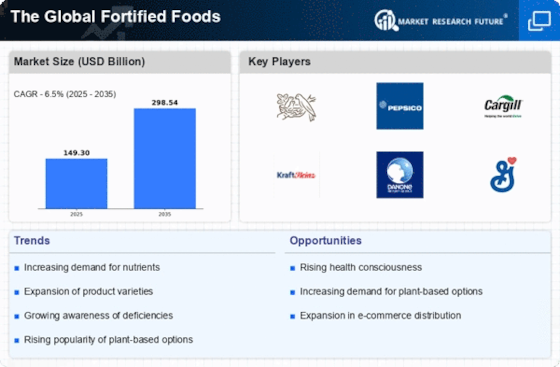
Key players include Nestle, PepsiCo, Cargill, and Kraft Heinz, among others.

What is the distribution channel that generated the highest revenue in 2024?

Supermarkets generated the highest revenue, amounting to 59.72 USD Billion in 2024.

Which end-user segment is projected to grow the most by 2035?

The Adult segment, valued at 60.0 USD Billion in 2024, is projected to grow significantly by 2035.

How do fortified dairy products perform in the market?

Fortified Dairy Products had a valuation of 30.0 USD Billion in 2024, indicating a solid market presence.

What trends are expected to shape The Global Fortified Foods in the coming years?

Trends suggest a growing focus on health and wellness, likely driving demand for fortified foods through 2035.

Market Summary

As per Market Research Future analysis, The Global Fortified Foods Market was estimated at 149.3 USD Billion in 2024. The fortified foods industry is projected to grow from 159.01 USD Billion in 2025 to 298.54 USD Billion by 2035, exhibiting a compound annual growth rate (CAGR) of 6.5% during the forecast period 2025 - 2035

Key Market Trends & Highlights

The Global Fortified Foods Market is experiencing robust growth driven by health consciousness and technological advancements.

  • North America remains the largest market for fortified foods, reflecting a strong consumer preference for health-oriented products.
  • The Asia-Pacific region is emerging as the fastest-growing market, fueled by increasing urbanization and changing dietary habits.
  • Fortified dairy products dominate the market, while fortified cereals are witnessing the fastest growth due to rising demand for convenient nutrition.
  • Key market drivers include rising nutritional awareness and government initiatives promoting functional foods.

Market Size & Forecast

2024 Market Size 149.3 (USD Billion)
2035 Market Size 298.54 (USD Billion)
CAGR (2025 - 2035) 6.5%
Largest Regional Market Share in 2024 North America

Major Players

Nestle (CH), PepsiCo (US), Cargill (US), Kraft Heinz (US), Danone (FR), General Mills (US), BASF (DE), Archer Daniels Midland (US), Unilever (GB)

Market Trends

The Global Fortified Foods Market is currently experiencing a notable transformation, driven by increasing consumer awareness regarding nutrition and health. This market encompasses a diverse range of products, including cereals, dairy, beverages, and snacks, all enhanced with essential vitamins and minerals. As individuals become more health-conscious, the demand for fortified foods appears to be on the rise, suggesting a shift towards preventive health measures. Furthermore, the growing prevalence of lifestyle-related diseases has prompted consumers to seek out products that can contribute to their overall well-being. In addition, The Global Fortified Foods Market is likely to benefit from advancements in food technology and innovation. Manufacturers are exploring new methods to enhance the nutritional profile of their offerings, which may lead to the development of more appealing and effective fortified products. This trend indicates a potential for growth as companies strive to meet the evolving preferences of health-oriented consumers. Moreover, regulatory support for fortified foods could further bolster market expansion, as governments recognize the importance of addressing nutritional deficiencies within populations. Overall, the landscape of The Global Fortified Foods Market appears dynamic, with various factors influencing its trajectory.

Health Consciousness

The increasing awareness of health and nutrition among consumers is driving the demand for fortified foods. Individuals are actively seeking products that can enhance their dietary intake of essential nutrients, leading to a rise in the popularity of fortified options.

Technological Advancements

Innovations in food technology are enabling manufacturers to create more effective fortified products. These advancements may enhance the nutritional value and appeal of fortified foods, catering to the preferences of health-focused consumers.

Regulatory Support

Government initiatives aimed at improving public health through nutrition are likely to support the growth of The Global Fortified Foods Market. Regulatory frameworks that promote fortified products can help address nutritional deficiencies in various populations.

Fortified Foods Market Market Drivers

Increased Urbanization

Urbanization is transforming dietary patterns and lifestyles, which in turn influences The Global Fortified Foods Industry. As populations migrate to urban areas, there is a noticeable shift towards convenience foods, which often lack essential nutrients. This urban shift has led to a heightened demand for fortified foods that can easily integrate into busy lifestyles. Data suggests that urban populations are more likely to purchase fortified products, as they seek quick and nutritious meal options. The market for fortified foods is expected to benefit from this trend, with urban consumers driving innovation and variety in product offerings. This dynamic indicates a potential for sustained growth in the fortified foods sector.

Rising Nutritional Awareness

The increasing awareness regarding nutrition and health among consumers appears to be a pivotal driver for The Global Fortified Foods Industry. As individuals become more informed about the benefits of essential vitamins and minerals, the demand for fortified foods is likely to surge. Reports indicate that the fortified foods segment is projected to grow at a compound annual growth rate of approximately 7.5% over the next five years. This trend suggests that consumers are actively seeking products that can enhance their dietary intake, particularly in regions where nutrient deficiencies are prevalent. Consequently, manufacturers are responding by innovating and expanding their product lines to cater to this growing demand, thereby reinforcing the market's expansion.

Innovations in Food Technology

Innovations in food technology are reshaping the landscape of The Global Fortified Foods Industry. Advances in food processing and preservation techniques enable manufacturers to enhance the nutritional profile of their products while maintaining taste and quality. For example, new methods of fortification allow for the incorporation of a wider range of vitamins and minerals without compromising the sensory attributes of food. This technological progress is expected to attract a broader consumer base, as taste and convenience remain paramount. Furthermore, the integration of smart packaging solutions is likely to enhance consumer engagement and education regarding fortified foods, thereby driving market growth.

Growing Demand for Functional Foods

The trend towards functional foods, which offer health benefits beyond basic nutrition, is emerging as a significant driver for The Global Fortified Foods Industry. Consumers are increasingly seeking foods that can support specific health goals, such as immunity, digestive health, and overall wellness. This shift is prompting manufacturers to develop fortified products that cater to these health-conscious consumers. Market analysis indicates that the functional food segment is anticipated to grow substantially, with fortified foods playing a crucial role in this expansion. As consumers prioritize health and wellness, the demand for fortified foods that deliver added benefits is likely to increase, further propelling market growth.

Government Initiatives and Regulations

Government initiatives aimed at combating malnutrition and promoting public health are likely to bolster The Global Fortified Foods Industry. Various countries have implemented policies that encourage the fortification of staple foods with essential nutrients. For instance, regulations mandating the fortification of flour and salt with iron and iodine have been adopted in numerous regions. These initiatives not only aim to reduce nutrient deficiencies but also create a favorable environment for fortified food manufacturers. The market is expected to expand as governments continue to support and promote fortified products, thereby enhancing public health outcomes and driving consumer acceptance.

Market Segment Insights

By Type: Fortified Dairy Products (Largest) vs. Fortified Cereals (Fastest-Growing)

In The Global Fortified Foods Market, Fortified <a href="https://www.marketresearchfuture.com/reports/dairy-market-11483" target="_blank">dairy</a> Products command the largest share due to their widespread acceptance and incorporation into daily diets. These products include fortified milk, yogurt, and <a href="https://www.marketresearchfuture.com/reports/cheese-market-2213" target="_blank">cheese</a>, which have become staples in many households. Their popularity is driven by consumers' increasing awareness of nutritional deficiencies and the added health benefits of essential vitamins and minerals, making them a preferred choice among health-conscious individuals. On the other hand, Fortified Cereals are emerging rapidly as a significant segment, appealing particularly to families with children and health-focused consumers seeking convenient yet nutritious breakfast options. The growth of this segment is fueled by innovative product formulations that cater to specific dietary needs, the rise of clean-label products, and marketing strategies that emphasize health benefits, contributing to their rising popularity in various consumer demographics.

Fortified Dairy Products (Dominant) vs. Fortified Beverages (Emerging)

Fortified Dairy Products represent the dominant force within The Global Fortified Foods Market, favored for their nutritional value and versatility. These products often undergo fortification with vitamins A, D, and calcium, making them key players in combating dietary deficiencies. In contrast, Fortified Beverages, including fortified juices and plant-based drinks, are rapidly emerging as consumer interest pivots towards convenient and health-enhancing options. This trend is driven by a growing demand for ready-to-drink products that deliver nutritional benefits without sacrificing taste. As consumers seek functional beverages that support their health goals, the fortified beverages segment is positioned for innovative growth, with manufacturers exploring new ingredients and formulations to attract health-conscious buyers.

By Nutritional Benefit: Protein (Largest) vs. Vitamins (Fastest-Growing)

In The Global Fortified Foods Market, the nutritional benefits are primarily distributed among four key segments: Vitamins, Minerals, Protein, and Fiber. Currently, Protein leads the market, holding the largest share due to its essential role in muscle building and overall health. Vitamins are also significant, contributing to diverse physiological functions, while Minerals and Fiber play supportive roles in the fortified foods landscape. Each segment caters to different consumer needs, reflecting varying health priorities. Growth trends indicate that the Vitamins segment is the fastest-growing due to increased awareness of their importance in boosting immunity and overall well-being. Meanwhile, Protein continues to thrive, driven by demand for high-protein diets among health-conscious consumers. Factors such as rising health awareness, changing dietary patterns, and the growing prevalence of lifestyle diseases support this positive growth trajectory for these nutritional benefits in the fortified foods market.

Vitamins (Dominant) vs. Minerals (Emerging)

Within The Global Fortified Foods Market, Vitamins occupy a dominant position due to their widespread recognition as essential nutrients vital for numerous bodily functions including immune response and metabolic health. Consumers are increasingly prioritizing Vitamins in their dietary choices, which has driven innovations in fortified foods designed to enhance vitamin content without altering taste or texture. In contrast, while Minerals are emerging as a critical segment, they tend to be overshadowed by Vitamins. Minerals play essential roles in various physiological processes, but consumer awareness of their specific benefits remains relatively lower. However, the shift towards holistic health is gradually increasing interest in mineral fortification, positioning this segment for potential growth as more consumers seek comprehensive nutritional solutions.

By End User: Children (Largest) vs. Elderly (Fastest-Growing)

In The Global Fortified Foods Market, the 'By End User' segment is prominently characterized by a diverse demographic distribution. Children hold the largest market share, driven by the increasing awareness among parents regarding nutritional needs and the emphasis on health and wellness at an early age. Meanwhile, products tailored for the elderly are witnessing a growing interest, as this age group places a premium on health management and disease prevention. The rise in fortified food options catering to these distinct groups highlights the varied consumer needs within the segment.

Children (Dominant) vs. Elderly (Emerging)

The Children segment is dominant in The Global Fortified Foods Market, primarily due to the aggressive marketing of nutrient-rich products aimed at this demographic. Parents are increasingly investing in fortified foods to ensure their children's developmental needs are met. On the other hand, the Elderly segment is emerging rapidly, spurred by aging populations globally and a growing focus on health benefits associated with fortified foods. This segment seeks products that enhance immunity and cognitive function, driving innovation in flavors and formulations. Both segments illustrate the market's capacity to cater to distinct nutritional needs, although they operate on different drivers and trends.

By Distribution Channel: Supermarkets (Largest) vs. Online Retail (Fastest-Growing)

In The Global Fortified Foods Market, supermarkets are the dominant distribution channel, capturing a significant share due to their convenience and wide product assortment. They serve as a one-stop shopping solution for consumers looking to purchase fortified foods, making them the preferred choice for many shoppers. Conversely, online retail is emerging as a fast-growing distribution channel. The shift toward online shopping has been accelerated by changing consumer habits, especially in the wake of the pandemic, which has driven sales through digital platforms.

Supermarkets (Dominant) vs. Online Retail (Emerging)

Supermarkets continue to maintain their position as a dominant channel for fortified foods, offering consumers access to a broad range of products in a single location. They benefit from established customer loyalty and in-store promotions, enhancing the shopping experience. On the other hand, online retail has quickly become an emerging channel, capturing the interest of younger demographics and tech-savvy consumers. The convenience of home delivery and the ability to compare products easily online have made fortified foods more accessible, fostering a new wave of consumer interest in health-oriented products. Both channels play a crucial role in shaping market dynamics, appealing to different consumer preferences.

Get more detailed insights about Fortified Foods Market Research Report-Forecast to 2035

Regional Insights

The Global Fortified Foods Market experienced notable growth across various regions, with a total valuation reaching 105.99 USD Billion in 2024 and projected to climb to 150.0 USD Billion by 2035. North America held a majority share in this market, valued at 37.5 USD Billion in 2024 and expected to grow significantly to 55.0 USD Billion by 2035, influenced by rising health awareness and demand for fortified products. Europe followed closely, contributing 30.0 USD Billion in 2024, and is anticipated to reach 42.0 USD Billion by 2035, driven by stringent regulations and consumer preferences for nutritional enrichment.

The Asia-Pacific (APAC) region, valued at 25.0 USD Billion in 2024 and projected to increase to 38.0 USD Billion by 2035, showcases substantial growth potential due to a large population base and increasing urbanization, leading to higher demand for fortified foods. South America held a market value of 8.0 USD Billion in 2024, and moving to 12.0 USD Billion by 2035 reflects a growing awareness of dietary deficiencies.

Conversely, the Middle East and Africa (MEA) segment was valued at 5.49 USD Billion in 2024 and is expected to see a slight decline to 3.0 USD Billion by 2035, facing challenges like economic instability and changing consumer behaviors.This regional segmentation highlights the varying dynamics and significant opportunities within the Global Fortified Foods Market, making it crucial for stakeholders to understand local market trends and drivers.

Key Players and Competitive Insights

The Global Fortified Foods Market has been experiencing notable growth, driven by increasing health awareness, dietary needs, and rising consumer demand for nutritional products. This market landscape is characterized by a diverse range of players, each vying for market share through various strategies, including innovation, product differentiation, and strategic partnerships. The competitive dynamics are influenced by factors such as regional regulations, consumer preferences, and the ongoing trend toward health and wellness. Companies are focusing on fortifying foods with vitamins and minerals to cater to an increasingly health-conscious consumer base, which in turn is intensifying competition.
Additionally, the market features an array of players that range from large multinational corporations to smaller niche brands, all of which bring unique strengths and challenges.Kraft Heinz has established a significant presence in the Global Fortified Foods Market with a portfolio that reflects its commitment to providing nutritional value. The company's strengths in the market are highlighted by robust brand recognition and a diverse range of fortified products that appeal to various consumer segments. Kraft Heinz is known for its strategic acquisitions that have expanded its reach and capabilities, allowing it to enhance its product offerings.
The company leverages a strong distribution network, ensuring its fortified foods are widely available across various channels, including grocery stores and online platforms. Furthermore, Kraft Heinz invests in marketing initiatives aimed at educating consumers about the benefits of fortified foods, thereby reinforcing its competitive edge in an overcrowded marketplace.Abbott Laboratories stands as one of the leading players in the Global Fortified Foods Market, with a reputation built on innovation and quality. The company's key offerings include a range of nutritional products for infants, children, and adults, which are fortified to meet varying dietary requirements.
Abbott's strengths include its strong research and development capabilities, which enable the introduction of cutting-edge fortified products in response to consumer health trends. The company's global presence is further supported by strategic mergers and acquisitions that have bolstered its product line and market access. Abbott maintains a comprehensive distribution strategy to ensure that its fortified foods reach consumers across different regions effectively. The company's commitment to quality and innovation not only enhances its brand loyalty but also positions it as a key player in addressing the global demand for fortified foods, thereby capturing a substantial share of the market.

Key Companies in the Fortified Foods Market include

Industry Developments

Recent developments in the Global Fortified Foods Market have seen major players like Kraft Heinz, Abbott Laboratories, and Nestle expanding their product lines to address growing consumer health consciousness. In October 2023, Unilever announced the launch of a new range of fortified snacks aimed at children, tapping into the increasing demand for healthy and nutritious food options. The market is currently witnessing a surge in investment, with Cargill acquiring a nutritional ingredient supply company to enhance its fortified food offerings. In September 2023, Reckitt Benckiser launched an innovative fortified drink focusing on immunity support amidst rising public health awareness.

Additionally, merger activity has been notable, with General Mills acquiring a small health food brand in July 2023 to diversify its portfolio. The valuation of the fortified foods market has increased significantly, largely propelled by the growing trend toward preventative health and nutrition. This surge in growth is reflected in the rising stock prices of companies such as Kellogg's and Herbalife, who have both reported increased sales driven by fortified product lines. The Global Fortified Foods Market continues to evolve, driven by both consumer demand and strategic corporate decisions.

Future Outlook

Fortified Foods Market Future Outlook

The Global Fortified Foods Market is projected to grow at a 6.5% CAGR from 2025 to 2035, driven by rising health awareness, regulatory support, and innovation in product formulations.

New opportunities lie in:

  • Expansion into plant-based fortified products
  • Development of personalized nutrition solutions
  • Strategic partnerships with health-focused retailers

By 2035, the market is expected to achieve substantial growth, reflecting evolving consumer preferences and increased health consciousness.

Market Segmentation

Fortified Foods Market Type Outlook

  • Fortified Dairy Products
  • Fortified Cereals
  • Fortified Beverages
  • Fortified Snacks

Fortified Foods Market End User Outlook

  • Infants
  • Children
  • Adults
  • Elderly

Fortified Foods Market Nutritional Benefit Outlook

  • Vitamins
  • Minerals
  • Protein
  • Fiber

Fortified Foods Market Distribution Channel Outlook

  • Supermarkets
  • Online Retail
  • Convenience Stores
  • Health Food Stores

Report Scope

MARKET SIZE 2024 149.3(USD Billion)
MARKET SIZE 2025 159.01(USD Billion)
MARKET SIZE 2035 298.54(USD Billion)
COMPOUND ANNUAL GROWTH RATE (CAGR) 6.5% (2025 - 2035)
REPORT COVERAGE Revenue Forecast, Competitive Landscape, Growth Factors, and Trends
BASE YEAR 2024
Market Forecast Period 2025 - 2035
Historical Data 2019 - 2024
Market Forecast Units USD Billion
Key Companies Profiled Nestle (CH), PepsiCo (US), Cargill (US), Kraft Heinz (US), Danone (FR), General Mills (US), BASF (DE), Archer Daniels Midland (US), Unilever (GB)
Segments Covered Product Type, Nutritional Benefit, End User, Distribution Channel, Regional
Key Market Opportunities Rising consumer demand for health-oriented products drives innovation in The Global Fortified Foods.
Key Market Dynamics Rising consumer awareness drives demand for fortified foods, influencing market dynamics and competitive strategies.
Countries Covered North America, Europe, APAC, South America, MEA

FAQs

What is the current valuation of The Global Fortified Foods?

<p>The market valuation reached 149.3 USD Billion in 2024.</p>

What is the projected market size for The Global Fortified Foods by 2035?

The market is expected to grow to 298.54 USD Billion by 2035.

What is the expected CAGR for The Global Fortified Foods during the forecast period 2025 - 2035?

The anticipated CAGR for this period is 6.5%.

Which segments are leading in The Global Fortified Foods?

Fortified Cereals and Fortified Snacks are among the leading segments, with valuations of 40.0 and 44.3 USD Billion respectively in 2024.

What are the key nutritional benefits driving The Global Fortified Foods?

Protein and Fiber are significant drivers, with valuations of 44.65 and 52.24 USD Billion respectively in 2024.

Who are the major players in The Global Fortified Foods?

Key players include Nestle, PepsiCo, Cargill, and Kraft Heinz, among others.

What is the distribution channel that generated the highest revenue in 2024?

Supermarkets generated the highest revenue, amounting to 59.72 USD Billion in 2024.

Which end-user segment is projected to grow the most by 2035?

The Adult segment, valued at 60.0 USD Billion in 2024, is projected to grow significantly by 2035.

How do fortified dairy products perform in the market?

Fortified Dairy Products had a valuation of 30.0 USD Billion in 2024, indicating a solid market presence.

What trends are expected to shape The Global Fortified Foods in the coming years?

Trends suggest a growing focus on health and wellness, likely driving demand for fortified foods through 2035.

  1. SECTION I: EXECUTIVE SUMMARY AND KEY HIGHLIGHTS
    1. | 1.1 EXECUTIVE SUMMARY
    2. | | 1.1.1 Market Overview
    3. | | 1.1.2 Key Findings
    4. | | 1.1.3 Market Segmentation
    5. | | 1.1.4 Competitive Landscape
    6. | | 1.1.5 Challenges and Opportunities
    7. | | 1.1.6 Future Outlook
  2. SECTION II: SCOPING, METHODOLOGY AND MARKET STRUCTURE
    1. | 2.1 MARKET INTRODUCTION
    2. | | 2.1.1 Definition
    3. | | 2.1.2 Scope of the study
    4. | | | 2.1.2.1 Research Objective
    5. | | | 2.1.2.2 Assumption
    6. | | | 2.1.2.3 Limitations
    7. | 2.2 RESEARCH METHODOLOGY
    8. | | 2.2.1 Overview
    9. | | 2.2.2 Data Mining
    10. | | 2.2.3 Secondary Research
    11. | | 2.2.4 Primary Research
    12. | | | 2.2.4.1 Primary Interviews and Information Gathering Process
    13. | | | 2.2.4.2 Breakdown of Primary Respondents
    14. | | 2.2.5 Forecasting Model
    15. | | 2.2.6 Market Size Estimation
    16. | | | 2.2.6.1 Bottom-Up Approach
    17. | | | 2.2.6.2 Top-Down Approach
    18. | | 2.2.7 Data Triangulation
    19. | | 2.2.8 Validation
  3. SECTION III: QUALITATIVE ANALYSIS
    1. | 3.1 MARKET DYNAMICS
    2. | | 3.1.1 Overview
    3. | | 3.1.2 Drivers
    4. | | 3.1.3 Restraints
    5. | | 3.1.4 Opportunities
    6. | 3.2 MARKET FACTOR ANALYSIS
    7. | | 3.2.1 Value chain Analysis
    8. | | 3.2.2 Porter's Five Forces Analysis
    9. | | | 3.2.2.1 Bargaining Power of Suppliers
    10. | | | 3.2.2.2 Bargaining Power of Buyers
    11. | | | 3.2.2.3 Threat of New Entrants
    12. | | | 3.2.2.4 Threat of Substitutes
    13. | | | 3.2.2.5 Intensity of Rivalry
    14. | | 3.2.3 COVID-19 Impact Analysis
    15. | | | 3.2.3.1 Market Impact Analysis
    16. | | | 3.2.3.2 Regional Impact
    17. | | | 3.2.3.3 Opportunity and Threat Analysis
  4. SECTION IV: QUANTITATIVE ANALYSIS
    1. | 4.1 Food, Beverages & Nutrition, BY Type (USD Billion)
    2. | | 4.1.1 Fortified Dairy Products
    3. | | 4.1.2 Fortified Cereals
    4. | | 4.1.3 Fortified Beverages
    5. | | 4.1.4 Fortified Snacks
    6. | 4.2 Food, Beverages & Nutrition, BY Nutritional Benefit (USD Billion)
    7. | | 4.2.1 Vitamins
    8. | | 4.2.2 Minerals
    9. | | 4.2.3 Protein
    10. | | 4.2.4 Fiber
    11. | 4.3 Food, Beverages & Nutrition, BY End User (USD Billion)
    12. | | 4.3.1 Infants
    13. | | 4.3.2 Children
    14. | | 4.3.3 Adults
    15. | | 4.3.4 Elderly
    16. | 4.4 Food, Beverages & Nutrition, BY Distribution Channel (USD Billion)
    17. | | 4.4.1 Supermarkets
    18. | | 4.4.2 Online Retail
    19. | | 4.4.3 Convenience Stores
    20. | | 4.4.4 Health Food Stores
    21. | 4.5 Food, Beverages & Nutrition, BY Region (USD Billion)
    22. | | 4.5.1 North America
    23. | | | 4.5.1.1 US
    24. | | | 4.5.1.2 Canada
    25. | | 4.5.2 Europe
    26. | | | 4.5.2.1 Germany
    27. | | | 4.5.2.2 UK
    28. | | | 4.5.2.3 France
    29. | | | 4.5.2.4 Russia
    30. | | | 4.5.2.5 Italy
    31. | | | 4.5.2.6 Spain
    32. | | | 4.5.2.7 Rest of Europe
    33. | | 4.5.3 APAC
    34. | | | 4.5.3.1 China
    35. | | | 4.5.3.2 India
    36. | | | 4.5.3.3 Japan
    37. | | | 4.5.3.4 South Korea
    38. | | | 4.5.3.5 Malaysia
    39. | | | 4.5.3.6 Thailand
    40. | | | 4.5.3.7 Indonesia
    41. | | | 4.5.3.8 Rest of APAC
    42. | | 4.5.4 South America
    43. | | | 4.5.4.1 Brazil
    44. | | | 4.5.4.2 Mexico
    45. | | | 4.5.4.3 Argentina
    46. | | | 4.5.4.4 Rest of South America
    47. | | 4.5.5 MEA
    48. | | | 4.5.5.1 GCC Countries
    49. | | | 4.5.5.2 South Africa
    50. | | | 4.5.5.3 Rest of MEA
  5. SECTION V: COMPETITIVE ANALYSIS
    1. | 5.1 Competitive Landscape
    2. | | 5.1.1 Overview
    3. | | 5.1.2 Competitive Analysis
    4. | | 5.1.3 Market share Analysis
    5. | | 5.1.4 Major Growth Strategy in the Food, Beverages & Nutrition
    6. | | 5.1.5 Competitive Benchmarking
    7. | | 5.1.6 Leading Players in Terms of Number of Developments in the Food, Beverages & Nutrition
    8. | | 5.1.7 Key developments and growth strategies
    9. | | | 5.1.7.1 New Product Launch/Service Deployment
    10. | | | 5.1.7.2 Merger & Acquisitions
    11. | | | 5.1.7.3 Joint Ventures
    12. | | 5.1.8 Major Players Financial Matrix
    13. | | | 5.1.8.1 Sales and Operating Income
    14. | | | 5.1.8.2 Major Players R&D Expenditure. 2023
    15. | 5.2 Company Profiles
    16. | | 5.2.1 Nestle (CH)
    17. | | | 5.2.1.1 Financial Overview
    18. | | | 5.2.1.2 Products Offered
    19. | | | 5.2.1.3 Key Developments
    20. | | | 5.2.1.4 SWOT Analysis
    21. | | | 5.2.1.5 Key Strategies
    22. | | 5.2.2 PepsiCo (US)
    23. | | | 5.2.2.1 Financial Overview
    24. | | | 5.2.2.2 Products Offered
    25. | | | 5.2.2.3 Key Developments
    26. | | | 5.2.2.4 SWOT Analysis
    27. | | | 5.2.2.5 Key Strategies
    28. | | 5.2.3 Cargill (US)
    29. | | | 5.2.3.1 Financial Overview
    30. | | | 5.2.3.2 Products Offered
    31. | | | 5.2.3.3 Key Developments
    32. | | | 5.2.3.4 SWOT Analysis
    33. | | | 5.2.3.5 Key Strategies
    34. | | 5.2.4 Kraft Heinz (US)
    35. | | | 5.2.4.1 Financial Overview
    36. | | | 5.2.4.2 Products Offered
    37. | | | 5.2.4.3 Key Developments
    38. | | | 5.2.4.4 SWOT Analysis
    39. | | | 5.2.4.5 Key Strategies
    40. | | 5.2.5 Danone (FR)
    41. | | | 5.2.5.1 Financial Overview
    42. | | | 5.2.5.2 Products Offered
    43. | | | 5.2.5.3 Key Developments
    44. | | | 5.2.5.4 SWOT Analysis
    45. | | | 5.2.5.5 Key Strategies
    46. | | 5.2.6 General Mills (US)
    47. | | | 5.2.6.1 Financial Overview
    48. | | | 5.2.6.2 Products Offered
    49. | | | 5.2.6.3 Key Developments
    50. | | | 5.2.6.4 SWOT Analysis
    51. | | | 5.2.6.5 Key Strategies
    52. | | 5.2.7 BASF (DE)
    53. | | | 5.2.7.1 Financial Overview
    54. | | | 5.2.7.2 Products Offered
    55. | | | 5.2.7.3 Key Developments
    56. | | | 5.2.7.4 SWOT Analysis
    57. | | | 5.2.7.5 Key Strategies
    58. | | 5.2.8 Archer Daniels Midland (US)
    59. | | | 5.2.8.1 Financial Overview
    60. | | | 5.2.8.2 Products Offered
    61. | | | 5.2.8.3 Key Developments
    62. | | | 5.2.8.4 SWOT Analysis
    63. | | | 5.2.8.5 Key Strategies
    64. | | 5.2.9 Unilever (GB)
    65. | | | 5.2.9.1 Financial Overview
    66. | | | 5.2.9.2 Products Offered
    67. | | | 5.2.9.3 Key Developments
    68. | | | 5.2.9.4 SWOT Analysis
    69. | | | 5.2.9.5 Key Strategies
    70. | 5.3 Appendix
    71. | | 5.3.1 References
    72. | | 5.3.2 Related Reports
  6. LIST OF FIGURES
    1. | 6.1 MARKET SYNOPSIS
    2. | 6.2 NORTH AMERICA MARKET ANALYSIS
    3. | 6.3 US MARKET ANALYSIS BY TYPE
    4. | 6.4 US MARKET ANALYSIS BY NUTRITIONAL BENEFIT
    5. | 6.5 US MARKET ANALYSIS BY END USER
    6. | 6.6 US MARKET ANALYSIS BY DISTRIBUTION CHANNEL
    7. | 6.7 CANADA MARKET ANALYSIS BY TYPE
    8. | 6.8 CANADA MARKET ANALYSIS BY NUTRITIONAL BENEFIT
    9. | 6.9 CANADA MARKET ANALYSIS BY END USER
    10. | 6.10 CANADA MARKET ANALYSIS BY DISTRIBUTION CHANNEL
    11. | 6.11 EUROPE MARKET ANALYSIS
    12. | 6.12 GERMANY MARKET ANALYSIS BY TYPE
    13. | 6.13 GERMANY MARKET ANALYSIS BY NUTRITIONAL BENEFIT
    14. | 6.14 GERMANY MARKET ANALYSIS BY END USER
    15. | 6.15 GERMANY MARKET ANALYSIS BY DISTRIBUTION CHANNEL
    16. | 6.16 UK MARKET ANALYSIS BY TYPE
    17. | 6.17 UK MARKET ANALYSIS BY NUTRITIONAL BENEFIT
    18. | 6.18 UK MARKET ANALYSIS BY END USER
    19. | 6.19 UK MARKET ANALYSIS BY DISTRIBUTION CHANNEL
    20. | 6.20 FRANCE MARKET ANALYSIS BY TYPE
    21. | 6.21 FRANCE MARKET ANALYSIS BY NUTRITIONAL BENEFIT
    22. | 6.22 FRANCE MARKET ANALYSIS BY END USER
    23. | 6.23 FRANCE MARKET ANALYSIS BY DISTRIBUTION CHANNEL
    24. | 6.24 RUSSIA MARKET ANALYSIS BY TYPE
    25. | 6.25 RUSSIA MARKET ANALYSIS BY NUTRITIONAL BENEFIT
    26. | 6.26 RUSSIA MARKET ANALYSIS BY END USER
    27. | 6.27 RUSSIA MARKET ANALYSIS BY DISTRIBUTION CHANNEL
    28. | 6.28 ITALY MARKET ANALYSIS BY TYPE
    29. | 6.29 ITALY MARKET ANALYSIS BY NUTRITIONAL BENEFIT
    30. | 6.30 ITALY MARKET ANALYSIS BY END USER
    31. | 6.31 ITALY MARKET ANALYSIS BY DISTRIBUTION CHANNEL
    32. | 6.32 SPAIN MARKET ANALYSIS BY TYPE
    33. | 6.33 SPAIN MARKET ANALYSIS BY NUTRITIONAL BENEFIT
    34. | 6.34 SPAIN MARKET ANALYSIS BY END USER
    35. | 6.35 SPAIN MARKET ANALYSIS BY DISTRIBUTION CHANNEL
    36. | 6.36 REST OF EUROPE MARKET ANALYSIS BY TYPE
    37. | 6.37 REST OF EUROPE MARKET ANALYSIS BY NUTRITIONAL BENEFIT
    38. | 6.38 REST OF EUROPE MARKET ANALYSIS BY END USER
    39. | 6.39 REST OF EUROPE MARKET ANALYSIS BY DISTRIBUTION CHANNEL
    40. | 6.40 APAC MARKET ANALYSIS
    41. | 6.41 CHINA MARKET ANALYSIS BY TYPE
    42. | 6.42 CHINA MARKET ANALYSIS BY NUTRITIONAL BENEFIT
    43. | 6.43 CHINA MARKET ANALYSIS BY END USER
    44. | 6.44 CHINA MARKET ANALYSIS BY DISTRIBUTION CHANNEL
    45. | 6.45 INDIA MARKET ANALYSIS BY TYPE
    46. | 6.46 INDIA MARKET ANALYSIS BY NUTRITIONAL BENEFIT
    47. | 6.47 INDIA MARKET ANALYSIS BY END USER
    48. | 6.48 INDIA MARKET ANALYSIS BY DISTRIBUTION CHANNEL
    49. | 6.49 JAPAN MARKET ANALYSIS BY TYPE
    50. | 6.50 JAPAN MARKET ANALYSIS BY NUTRITIONAL BENEFIT
    51. | 6.51 JAPAN MARKET ANALYSIS BY END USER
    52. | 6.52 JAPAN MARKET ANALYSIS BY DISTRIBUTION CHANNEL
    53. | 6.53 SOUTH KOREA MARKET ANALYSIS BY TYPE
    54. | 6.54 SOUTH KOREA MARKET ANALYSIS BY NUTRITIONAL BENEFIT
    55. | 6.55 SOUTH KOREA MARKET ANALYSIS BY END USER
    56. | 6.56 SOUTH KOREA MARKET ANALYSIS BY DISTRIBUTION CHANNEL
    57. | 6.57 MALAYSIA MARKET ANALYSIS BY TYPE
    58. | 6.58 MALAYSIA MARKET ANALYSIS BY NUTRITIONAL BENEFIT
    59. | 6.59 MALAYSIA MARKET ANALYSIS BY END USER
    60. | 6.60 MALAYSIA MARKET ANALYSIS BY DISTRIBUTION CHANNEL
    61. | 6.61 THAILAND MARKET ANALYSIS BY TYPE
    62. | 6.62 THAILAND MARKET ANALYSIS BY NUTRITIONAL BENEFIT
    63. | 6.63 THAILAND MARKET ANALYSIS BY END USER
    64. | 6.64 THAILAND MARKET ANALYSIS BY DISTRIBUTION CHANNEL
    65. | 6.65 INDONESIA MARKET ANALYSIS BY TYPE
    66. | 6.66 INDONESIA MARKET ANALYSIS BY NUTRITIONAL BENEFIT
    67. | 6.67 INDONESIA MARKET ANALYSIS BY END USER
    68. | 6.68 INDONESIA MARKET ANALYSIS BY DISTRIBUTION CHANNEL
    69. | 6.69 REST OF APAC MARKET ANALYSIS BY TYPE
    70. | 6.70 REST OF APAC MARKET ANALYSIS BY NUTRITIONAL BENEFIT
    71. | 6.71 REST OF APAC MARKET ANALYSIS BY END USER
    72. | 6.72 REST OF APAC MARKET ANALYSIS BY DISTRIBUTION CHANNEL
    73. | 6.73 SOUTH AMERICA MARKET ANALYSIS
    74. | 6.74 BRAZIL MARKET ANALYSIS BY TYPE
    75. | 6.75 BRAZIL MARKET ANALYSIS BY NUTRITIONAL BENEFIT
    76. | 6.76 BRAZIL MARKET ANALYSIS BY END USER
    77. | 6.77 BRAZIL MARKET ANALYSIS BY DISTRIBUTION CHANNEL
    78. | 6.78 MEXICO MARKET ANALYSIS BY TYPE
    79. | 6.79 MEXICO MARKET ANALYSIS BY NUTRITIONAL BENEFIT
    80. | 6.80 MEXICO MARKET ANALYSIS BY END USER
    81. | 6.81 MEXICO MARKET ANALYSIS BY DISTRIBUTION CHANNEL
    82. | 6.82 ARGENTINA MARKET ANALYSIS BY TYPE
    83. | 6.83 ARGENTINA MARKET ANALYSIS BY NUTRITIONAL BENEFIT
    84. | 6.84 ARGENTINA MARKET ANALYSIS BY END USER
    85. | 6.85 ARGENTINA MARKET ANALYSIS BY DISTRIBUTION CHANNEL
    86. | 6.86 REST OF SOUTH AMERICA MARKET ANALYSIS BY TYPE
    87. | 6.87 REST OF SOUTH AMERICA MARKET ANALYSIS BY NUTRITIONAL BENEFIT
    88. | 6.88 REST OF SOUTH AMERICA MARKET ANALYSIS BY END USER
    89. | 6.89 REST OF SOUTH AMERICA MARKET ANALYSIS BY DISTRIBUTION CHANNEL
    90. | 6.90 MEA MARKET ANALYSIS
    91. | 6.91 GCC COUNTRIES MARKET ANALYSIS BY TYPE
    92. | 6.92 GCC COUNTRIES MARKET ANALYSIS BY NUTRITIONAL BENEFIT
    93. | 6.93 GCC COUNTRIES MARKET ANALYSIS BY END USER
    94. | 6.94 GCC COUNTRIES MARKET ANALYSIS BY DISTRIBUTION CHANNEL
    95. | 6.95 SOUTH AFRICA MARKET ANALYSIS BY TYPE
    96. | 6.96 SOUTH AFRICA MARKET ANALYSIS BY NUTRITIONAL BENEFIT
    97. | 6.97 SOUTH AFRICA MARKET ANALYSIS BY END USER
    98. | 6.98 SOUTH AFRICA MARKET ANALYSIS BY DISTRIBUTION CHANNEL
    99. | 6.99 REST OF MEA MARKET ANALYSIS BY TYPE
    100. | 6.100 REST OF MEA MARKET ANALYSIS BY NUTRITIONAL BENEFIT
    101. | 6.101 REST OF MEA MARKET ANALYSIS BY END USER
    102. | 6.102 REST OF MEA MARKET ANALYSIS BY DISTRIBUTION CHANNEL
    103. | 6.103 KEY BUYING CRITERIA OF FOOD, BEVERAGES & NUTRITION
    104. | 6.104 RESEARCH PROCESS OF MRFR
    105. | 6.105 DRO ANALYSIS OF FOOD, BEVERAGES & NUTRITION
    106. | 6.106 DRIVERS IMPACT ANALYSIS: FOOD, BEVERAGES & NUTRITION
    107. | 6.107 RESTRAINTS IMPACT ANALYSIS: FOOD, BEVERAGES & NUTRITION
    108. | 6.108 SUPPLY / VALUE CHAIN: FOOD, BEVERAGES & NUTRITION
    109. | 6.109 FOOD, BEVERAGES & NUTRITION, BY TYPE, 2024 (% SHARE)
    110. | 6.110 FOOD, BEVERAGES & NUTRITION, BY TYPE, 2024 TO 2035 (USD Billion)
    111. | 6.111 FOOD, BEVERAGES & NUTRITION, BY NUTRITIONAL BENEFIT, 2024 (% SHARE)
    112. | 6.112 FOOD, BEVERAGES & NUTRITION, BY NUTRITIONAL BENEFIT, 2024 TO 2035 (USD Billion)
    113. | 6.113 FOOD, BEVERAGES & NUTRITION, BY END USER, 2024 (% SHARE)
    114. | 6.114 FOOD, BEVERAGES & NUTRITION, BY END USER, 2024 TO 2035 (USD Billion)
    115. | 6.115 FOOD, BEVERAGES & NUTRITION, BY DISTRIBUTION CHANNEL, 2024 (% SHARE)
    116. | 6.116 FOOD, BEVERAGES & NUTRITION, BY DISTRIBUTION CHANNEL, 2024 TO 2035 (USD Billion)
    117. | 6.117 BENCHMARKING OF MAJOR COMPETITORS
  7. LIST OF TABLES
    1. | 7.1 LIST OF ASSUMPTIONS
    2. | | 7.1.1
    3. | 7.2 North America MARKET SIZE ESTIMATES; FORECAST
    4. | | 7.2.1 BY TYPE, 2025-2035 (USD Billion)
    5. | | 7.2.2 BY NUTRITIONAL BENEFIT, 2025-2035 (USD Billion)
    6. | | 7.2.3 BY END USER, 2025-2035 (USD Billion)
    7. | | 7.2.4 BY DISTRIBUTION CHANNEL, 2025-2035 (USD Billion)
    8. | 7.3 US MARKET SIZE ESTIMATES; FORECAST
    9. | | 7.3.1 BY TYPE, 2025-2035 (USD Billion)
    10. | | 7.3.2 BY NUTRITIONAL BENEFIT, 2025-2035 (USD Billion)
    11. | | 7.3.3 BY END USER, 2025-2035 (USD Billion)
    12. | | 7.3.4 BY DISTRIBUTION CHANNEL, 2025-2035 (USD Billion)
    13. | 7.4 Canada MARKET SIZE ESTIMATES; FORECAST
    14. | | 7.4.1 BY TYPE, 2025-2035 (USD Billion)
    15. | | 7.4.2 BY NUTRITIONAL BENEFIT, 2025-2035 (USD Billion)
    16. | | 7.4.3 BY END USER, 2025-2035 (USD Billion)
    17. | | 7.4.4 BY DISTRIBUTION CHANNEL, 2025-2035 (USD Billion)
    18. | 7.5 Europe MARKET SIZE ESTIMATES; FORECAST
    19. | | 7.5.1 BY TYPE, 2025-2035 (USD Billion)
    20. | | 7.5.2 BY NUTRITIONAL BENEFIT, 2025-2035 (USD Billion)
    21. | | 7.5.3 BY END USER, 2025-2035 (USD Billion)
    22. | | 7.5.4 BY DISTRIBUTION CHANNEL, 2025-2035 (USD Billion)
    23. | 7.6 Germany MARKET SIZE ESTIMATES; FORECAST
    24. | | 7.6.1 BY TYPE, 2025-2035 (USD Billion)
    25. | | 7.6.2 BY NUTRITIONAL BENEFIT, 2025-2035 (USD Billion)
    26. | | 7.6.3 BY END USER, 2025-2035 (USD Billion)
    27. | | 7.6.4 BY DISTRIBUTION CHANNEL, 2025-2035 (USD Billion)
    28. | 7.7 UK MARKET SIZE ESTIMATES; FORECAST
    29. | | 7.7.1 BY TYPE, 2025-2035 (USD Billion)
    30. | | 7.7.2 BY NUTRITIONAL BENEFIT, 2025-2035 (USD Billion)
    31. | | 7.7.3 BY END USER, 2025-2035 (USD Billion)
    32. | | 7.7.4 BY DISTRIBUTION CHANNEL, 2025-2035 (USD Billion)
    33. | 7.8 France MARKET SIZE ESTIMATES; FORECAST
    34. | | 7.8.1 BY TYPE, 2025-2035 (USD Billion)
    35. | | 7.8.2 BY NUTRITIONAL BENEFIT, 2025-2035 (USD Billion)
    36. | | 7.8.3 BY END USER, 2025-2035 (USD Billion)
    37. | | 7.8.4 BY DISTRIBUTION CHANNEL, 2025-2035 (USD Billion)
    38. | 7.9 Russia MARKET SIZE ESTIMATES; FORECAST
    39. | | 7.9.1 BY TYPE, 2025-2035 (USD Billion)
    40. | | 7.9.2 BY NUTRITIONAL BENEFIT, 2025-2035 (USD Billion)
    41. | | 7.9.3 BY END USER, 2025-2035 (USD Billion)
    42. | | 7.9.4 BY DISTRIBUTION CHANNEL, 2025-2035 (USD Billion)
    43. | 7.10 Italy MARKET SIZE ESTIMATES; FORECAST
    44. | | 7.10.1 BY TYPE, 2025-2035 (USD Billion)
    45. | | 7.10.2 BY NUTRITIONAL BENEFIT, 2025-2035 (USD Billion)
    46. | | 7.10.3 BY END USER, 2025-2035 (USD Billion)
    47. | | 7.10.4 BY DISTRIBUTION CHANNEL, 2025-2035 (USD Billion)
    48. | 7.11 Spain MARKET SIZE ESTIMATES; FORECAST
    49. | | 7.11.1 BY TYPE, 2025-2035 (USD Billion)
    50. | | 7.11.2 BY NUTRITIONAL BENEFIT, 2025-2035 (USD Billion)
    51. | | 7.11.3 BY END USER, 2025-2035 (USD Billion)
    52. | | 7.11.4 BY DISTRIBUTION CHANNEL, 2025-2035 (USD Billion)
    53. | 7.12 Rest of Europe MARKET SIZE ESTIMATES; FORECAST
    54. | | 7.12.1 BY TYPE, 2025-2035 (USD Billion)
    55. | | 7.12.2 BY NUTRITIONAL BENEFIT, 2025-2035 (USD Billion)
    56. | | 7.12.3 BY END USER, 2025-2035 (USD Billion)
    57. | | 7.12.4 BY DISTRIBUTION CHANNEL, 2025-2035 (USD Billion)
    58. | 7.13 APAC MARKET SIZE ESTIMATES; FORECAST
    59. | | 7.13.1 BY TYPE, 2025-2035 (USD Billion)
    60. | | 7.13.2 BY NUTRITIONAL BENEFIT, 2025-2035 (USD Billion)
    61. | | 7.13.3 BY END USER, 2025-2035 (USD Billion)
    62. | | 7.13.4 BY DISTRIBUTION CHANNEL, 2025-2035 (USD Billion)
    63. | 7.14 China MARKET SIZE ESTIMATES; FORECAST
    64. | | 7.14.1 BY TYPE, 2025-2035 (USD Billion)
    65. | | 7.14.2 BY NUTRITIONAL BENEFIT, 2025-2035 (USD Billion)
    66. | | 7.14.3 BY END USER, 2025-2035 (USD Billion)
    67. | | 7.14.4 BY DISTRIBUTION CHANNEL, 2025-2035 (USD Billion)
    68. | 7.15 India MARKET SIZE ESTIMATES; FORECAST
    69. | | 7.15.1 BY TYPE, 2025-2035 (USD Billion)
    70. | | 7.15.2 BY NUTRITIONAL BENEFIT, 2025-2035 (USD Billion)
    71. | | 7.15.3 BY END USER, 2025-2035 (USD Billion)
    72. | | 7.15.4 BY DISTRIBUTION CHANNEL, 2025-2035 (USD Billion)
    73. | 7.16 Japan MARKET SIZE ESTIMATES; FORECAST
    74. | | 7.16.1 BY TYPE, 2025-2035 (USD Billion)
    75. | | 7.16.2 BY NUTRITIONAL BENEFIT, 2025-2035 (USD Billion)
    76. | | 7.16.3 BY END USER, 2025-2035 (USD Billion)
    77. | | 7.16.4 BY DISTRIBUTION CHANNEL, 2025-2035 (USD Billion)
    78. | 7.17 South Korea MARKET SIZE ESTIMATES; FORECAST
    79. | | 7.17.1 BY TYPE, 2025-2035 (USD Billion)
    80. | | 7.17.2 BY NUTRITIONAL BENEFIT, 2025-2035 (USD Billion)
    81. | | 7.17.3 BY END USER, 2025-2035 (USD Billion)
    82. | | 7.17.4 BY DISTRIBUTION CHANNEL, 2025-2035 (USD Billion)
    83. | 7.18 Malaysia MARKET SIZE ESTIMATES; FORECAST
    84. | | 7.18.1 BY TYPE, 2025-2035 (USD Billion)
    85. | | 7.18.2 BY NUTRITIONAL BENEFIT, 2025-2035 (USD Billion)
    86. | | 7.18.3 BY END USER, 2025-2035 (USD Billion)
    87. | | 7.18.4 BY DISTRIBUTION CHANNEL, 2025-2035 (USD Billion)
    88. | 7.19 Thailand MARKET SIZE ESTIMATES; FORECAST
    89. | | 7.19.1 BY TYPE, 2025-2035 (USD Billion)
    90. | | 7.19.2 BY NUTRITIONAL BENEFIT, 2025-2035 (USD Billion)
    91. | | 7.19.3 BY END USER, 2025-2035 (USD Billion)
    92. | | 7.19.4 BY DISTRIBUTION CHANNEL, 2025-2035 (USD Billion)
    93. | 7.20 Indonesia MARKET SIZE ESTIMATES; FORECAST
    94. | | 7.20.1 BY TYPE, 2025-2035 (USD Billion)
    95. | | 7.20.2 BY NUTRITIONAL BENEFIT, 2025-2035 (USD Billion)
    96. | | 7.20.3 BY END USER, 2025-2035 (USD Billion)
    97. | | 7.20.4 BY DISTRIBUTION CHANNEL, 2025-2035 (USD Billion)
    98. | 7.21 Rest of APAC MARKET SIZE ESTIMATES; FORECAST
    99. | | 7.21.1 BY TYPE, 2025-2035 (USD Billion)
    100. | | 7.21.2 BY NUTRITIONAL BENEFIT, 2025-2035 (USD Billion)
    101. | | 7.21.3 BY END USER, 2025-2035 (USD Billion)
    102. | | 7.21.4 BY DISTRIBUTION CHANNEL, 2025-2035 (USD Billion)
    103. | 7.22 South America MARKET SIZE ESTIMATES; FORECAST
    104. | | 7.22.1 BY TYPE, 2025-2035 (USD Billion)
    105. | | 7.22.2 BY NUTRITIONAL BENEFIT, 2025-2035 (USD Billion)
    106. | | 7.22.3 BY END USER, 2025-2035 (USD Billion)
    107. | | 7.22.4 BY DISTRIBUTION CHANNEL, 2025-2035 (USD Billion)
    108. | 7.23 Brazil MARKET SIZE ESTIMATES; FORECAST
    109. | | 7.23.1 BY TYPE, 2025-2035 (USD Billion)
    110. | | 7.23.2 BY NUTRITIONAL BENEFIT, 2025-2035 (USD Billion)
    111. | | 7.23.3 BY END USER, 2025-2035 (USD Billion)
    112. | | 7.23.4 BY DISTRIBUTION CHANNEL, 2025-2035 (USD Billion)
    113. | 7.24 Mexico MARKET SIZE ESTIMATES; FORECAST
    114. | | 7.24.1 BY TYPE, 2025-2035 (USD Billion)
    115. | | 7.24.2 BY NUTRITIONAL BENEFIT, 2025-2035 (USD Billion)
    116. | | 7.24.3 BY END USER, 2025-2035 (USD Billion)
    117. | | 7.24.4 BY DISTRIBUTION CHANNEL, 2025-2035 (USD Billion)
    118. | 7.25 Argentina MARKET SIZE ESTIMATES; FORECAST
    119. | | 7.25.1 BY TYPE, 2025-2035 (USD Billion)
    120. | | 7.25.2 BY NUTRITIONAL BENEFIT, 2025-2035 (USD Billion)
    121. | | 7.25.3 BY END USER, 2025-2035 (USD Billion)
    122. | | 7.25.4 BY DISTRIBUTION CHANNEL, 2025-2035 (USD Billion)
    123. | 7.26 Rest of South America MARKET SIZE ESTIMATES; FORECAST
    124. | | 7.26.1 BY TYPE, 2025-2035 (USD Billion)
    125. | | 7.26.2 BY NUTRITIONAL BENEFIT, 2025-2035 (USD Billion)
    126. | | 7.26.3 BY END USER, 2025-2035 (USD Billion)
    127. | | 7.26.4 BY DISTRIBUTION CHANNEL, 2025-2035 (USD Billion)
    128. | 7.27 MEA MARKET SIZE ESTIMATES; FORECAST
    129. | | 7.27.1 BY TYPE, 2025-2035 (USD Billion)
    130. | | 7.27.2 BY NUTRITIONAL BENEFIT, 2025-2035 (USD Billion)
    131. | | 7.27.3 BY END USER, 2025-2035 (USD Billion)
    132. | | 7.27.4 BY DISTRIBUTION CHANNEL, 2025-2035 (USD Billion)
    133. | 7.28 GCC Countries MARKET SIZE ESTIMATES; FORECAST
    134. | | 7.28.1 BY TYPE, 2025-2035 (USD Billion)
    135. | | 7.28.2 BY NUTRITIONAL BENEFIT, 2025-2035 (USD Billion)
    136. | | 7.28.3 BY END USER, 2025-2035 (USD Billion)
    137. | | 7.28.4 BY DISTRIBUTION CHANNEL, 2025-2035 (USD Billion)
    138. | 7.29 South Africa MARKET SIZE ESTIMATES; FORECAST
    139. | | 7.29.1 BY TYPE, 2025-2035 (USD Billion)
    140. | | 7.29.2 BY NUTRITIONAL BENEFIT, 2025-2035 (USD Billion)
    141. | | 7.29.3 BY END USER, 2025-2035 (USD Billion)
    142. | | 7.29.4 BY DISTRIBUTION CHANNEL, 2025-2035 (USD Billion)
    143. | 7.30 Rest of MEA MARKET SIZE ESTIMATES; FORECAST
    144. | | 7.30.1 BY TYPE, 2025-2035 (USD Billion)
    145. | | 7.30.2 BY NUTRITIONAL BENEFIT, 2025-2035 (USD Billion)
    146. | | 7.30.3 BY END USER, 2025-2035 (USD Billion)
    147. | | 7.30.4 BY DISTRIBUTION CHANNEL, 2025-2035 (USD Billion)
    148. | 7.31 PRODUCT LAUNCH/PRODUCT DEVELOPMENT/APPROVAL
    149. | | 7.31.1
    150. | 7.32 ACQUISITION/PARTNERSHIP
    151. | | 7.32.1

Food, Beverages & Nutrition Market Segmentation

Food, Beverages & Nutrition By Type (USD Billion, 2025-2035)

  • Fortified Dairy Products
  • Fortified Cereals
  • Fortified Beverages
  • Fortified Snacks

Food, Beverages & Nutrition By Nutritional Benefit (USD Billion, 2025-2035)

  • Vitamins
  • Minerals
  • Protein
  • Fiber

Food, Beverages & Nutrition By End User (USD Billion, 2025-2035)

  • Infants
  • Children
  • Adults
  • Elderly

Food, Beverages & Nutrition By Distribution Channel (USD Billion, 2025-2035)

  • Supermarkets
  • Online Retail
  • Convenience Stores
  • Health Food Stores
Infographic

Free Sample Request

Kindly complete the form below to receive a free sample of this Report

Get Free Sample

Customer Strories

Compare Licence

×
Features License Type
Single User Multiuser License Enterprise User
Price $4,950 $5,950 $7,250
Maximum User Access Limit 1 User Upto 10 Users Unrestricted Access Throughout the Organization
Free Customization
Direct Access to Analyst
Deliverable Format
Platform Access
Discount on Next Purchase 10% 15% 15%
Printable Versions