Request Free Sample ×

Kindly complete the form below to receive a free sample of this Report

* Please use a valid business email

Leading companies partner with us for data-driven Insights

clients tt-cursor
Hero Background
English
Chinese
French
Japanese
Korean
German
Spanish

Fluoropolymer Films Market Analysis

ID: MRFR/CnM/4611-HCR
200 Pages
Chitranshi Jaiswal
December 2024

Fluoropolymer Films Market Research Report:By Application (Electrical Insulation, Protective Coatings, Gaskets and Seals, Films for Medical Devices), By Type (Polytetrafluoroethylene, Polyvinylidene Fluoride, Fluorinated Ethylene Propylene), By End Use Industry (Automotive, Aerospace, Medical, Electronics, Construction) and By Regional (North America, Europe, South America, Asia Pacific, Middle East and Africa) - Forecast to 2035

Share:
Download PDF ×

We do not share your information with anyone. However, we may send you emails based on your report interest from time to time. You may contact us at any time to opt-out.

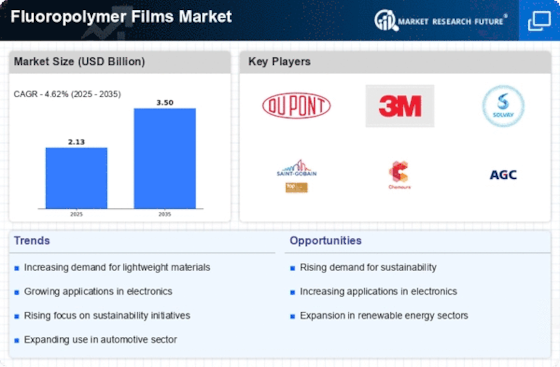
Fluoropolymer Films Market Infographic
Purchase Options

Market Analysis

In-depth Analysis of Fluoropolymer Films Market Industry Landscape

The market dynamics of the Fluoropolymer Films industry are shaped by a combination of various factors that influence supply, demand, and overall market trends. Fluoropolymer films are highly sought after due to their exceptional properties such as high chemical resistance, thermal stability, and non-stick characteristics. These films find extensive applications in industries like electronics, automotive, aerospace, and packaging. One key driver of the market is the increasing demand for high-performance materials in these sectors. The growing awareness of environmental concerns and the need for sustainable solutions have also led to the rising adoption of fluoropolymer films, which are known for their durability and longevity.

On the supply side, the market dynamics are influenced by the availability of raw materials, primarily fluoropolymers like polytetrafluoroethylene (PTFE), polyvinylidene fluoride (PVDF), and others. The production processes and technologies employed by manufacturers also play a crucial role in determining the supply chain efficiency and overall market competitiveness. Companies investing in research and development to enhance manufacturing processes and reduce production costs gain a competitive edge, affecting the overall market dynamics.

Global economic conditions and geopolitical factors also impact the fluoropolymer films market dynamics. Fluctuations in currency exchange rates, trade policies, and geopolitical tensions can affect the cost of raw materials, production, and transportation, ultimately influencing the market prices of fluoropolymer films. Additionally, the industry is responsive to regulatory changes related to environmental standards and product safety. Compliance with these regulations not only shapes the competitive landscape but also affects consumer preferences, driving the demand for eco-friendly and compliant fluoropolymer films.

Market dynamics are further influenced by technological advancements. Ongoing research and development efforts lead to the introduction of innovative fluoropolymer film products with enhanced properties. These advancements can disrupt the market by offering superior performance or cost-effectiveness, thereby influencing consumer choices and industry trends. As industries evolve, the demand for specific characteristics in fluoropolymer films may change, necessitating constant adaptation and innovation by market players.

Competitive forces within the fluoropolymer films market also contribute significantly to its dynamics. The presence of established manufacturers, emerging players, and the threat of new entrants shape the level of competition. Strategic collaborations, mergers, and acquisitions are common strategies adopted by companies to strengthen their market position and expand their product portfolios. Price competition, quality differentiation, and customer service become crucial elements in gaining a competitive advantage.

Moreover, the influence of end-user industries on the fluoropolymer films market cannot be understated. The growth of sectors like electronics and automotive directly impacts the demand for high-performance materials, driving the market forward. Similarly, evolving consumer preferences, environmental consciousness, and regulatory standards in packaging industries contribute to the changing landscape of the fluoropolymer films market.

The increasing growth of the potential end-users and the growing economic condition of the countries which are considered as the manufacturing hubs are expected to boost the overall growth of the fluoropolymer films industry. For instance, China is considered as the leading manufacturer of electronics, automotive and is also considered as the leading producer of fluoropolymer films. Moreover, China has been adopting fluoropolymer films for the production of solar panels and semiconductors as well. The favorable economic condition and the utilization of advanced technologies by the region are expected to boost the overall growth of the fluoropolymer films industry.


Author
Author Profile
Chitranshi Jaiswal
Team Lead - Research

Chitranshi is a Team Leader in the Chemicals & Materials (CnM) and Energy & Power (EnP) domains, with 6+ years of experience in market research. She leads and mentors teams to deliver cross-domain projects that equip clients with actionable insights and growth strategies. She is skilled in market estimation, forecasting, competitive benchmarking, and both primary & secondary research, enabling her to turn complex data into decision-ready insights. An engineer and MBA professional, she combines technical expertise with strategic acumen to solve dynamic market challenges. Chitranshi has successfully managed projects that support market entry, investment planning, and competitive positioning, while building strong client relationships. Certified in Advanced Excel & Power BI she leverages data-driven approaches to ensure accuracy, clarity, and impactful outcomes.

Leave a Comment

FAQs

What is the projected market valuation of the Fluoropolymer Films Market by 2035?

<p>The Fluoropolymer Films Market is projected to reach a valuation of 3.501 USD Billion by 2035.</p>

What was the market valuation of the Fluoropolymer Films Market in 2024?

<p>In 2024, the Fluoropolymer Films Market was valued at 2.13 USD Billion.</p>

What is the expected CAGR for the Fluoropolymer Films Market during the forecast period 2025 - 2035?

<p>The expected CAGR for the Fluoropolymer Films Market during the forecast period 2025 - 2035 is 4.62%.</p>

Which application segment is projected to have the highest growth in the Fluoropolymer Films Market?

<p>The Electrical Insulation application segment is projected to grow from 0.85 USD Billion in 2024 to 1.25 USD Billion by 2035.</p>

What are the key players in the Fluoropolymer Films Market?

<p>Key players in the Fluoropolymer Films Market include DuPont, 3M, Solvay, Saint-Gobain, Chemours, AGC Inc., Daikin Industries, Kuraray Co. Ltd., and Mitsubishi Chemical Corporation.</p>

How does the market for Polytetrafluoroethylene compare to other types in 2025?

<p>Polytetrafluoroethylene is expected to grow from 0.85 USD Billion in 2024 to 1.4 USD Billion by 2035, indicating strong performance compared to other types.</p>

What end-use industry is anticipated to drive demand for Fluoropolymer Films?

<p>The Electronics end-use industry is anticipated to drive demand, with growth from 0.6 USD Billion in 2024 to 1.0 USD Billion by 2035.</p>

What is the projected growth for the Protective Coatings application segment?

<p>The Protective Coatings application segment is projected to grow from 0.65 USD Billion in 2024 to 1.0 USD Billion by 2035.</p>

Which type of fluoropolymer film is expected to see the least growth by 2035?

<p>Fluorinated Ethylene Propylene is expected to see the least growth, increasing from 0.63 USD Billion in 2024 to 1.0 USD Billion by 2035.</p>

What is the growth outlook for the Medical end-use industry in the Fluoropolymer Films Market?

<p>The Medical end-use industry is projected to grow from 0.3 USD Billion in 2024 to 0.5 USD Billion by 2035, indicating a steady increase.</p>

Market Summary

As per Market Research Future analysis, the Fluoropolymer Films Market Size was estimated at 2.13 USD Billion in 2024. The Fluoropolymer Films industry is projected to grow from 2.228 USD Billion in 2025 to 3.501 USD Billion by 2035, exhibiting a compound annual growth rate (CAGR) of 4.62% during the forecast period 2025 - 2035

Key Market Trends & Highlights

The Fluoropolymer Films Market is poised for substantial growth driven by technological advancements and increasing demand across various sectors.

  • The market experiences rising demand in electronics, particularly in North America, which remains the largest market. Sustainability initiatives are gaining traction, influencing production processes and material choices in the Asia-Pacific region. Technological advancements are propelling the growth of protective coatings, which is the fastest-growing segment in the market. Key drivers include the rising demand in automotive applications and the growth in the renewable energy sector, particularly impacting polytetrafluoroethylene products.

Market Size & Forecast

2024 Market Size 2.13 (USD Billion)
2035 Market Size 3.501 (USD Billion)
CAGR (2025 - 2035) 4.62%
Largest Regional Market Share in 2024 North America

Major Players

DuPont (US), 3M (US), Solvay (BE), Saint-Gobain (FR), Chemours (US), AGC Inc. (JP), Daikin Industries (JP), Kuraray Co. Ltd. (JP), Mitsubishi Chemical Corporation (JP)

Market Trends

The fluoropolymer films market is currently experiencing a notable evolution, driven by multiple factors that are influencing its growth across diverse industries. Increasing demand for high-performance materials in sectors such as electronics, automotive, and packaging is acting as a major catalyst for expansion. Fluoropolymer films are widely valued for their exceptional chemical resistance, high thermal stability, and low friction characteristics, making them ideal for applications requiring durability and reliability. According to recent fluoropolymer films market analysis, advancements in production technologies are also improving manufacturing efficiency and product quality, which is supporting the steady expansion of the fluoropolymer films market size globally.

Beyond industrial applications, sustainability considerations are increasingly shaping the fluoropolymer films market. Manufacturers are exploring eco-friendly production processes and recycling solutions to reduce environmental impact. These developments are expected to influence fluoropolymer films market share among key manufacturers, as companies invest in greener technologies and innovative material solutions. The shift toward sustainable materials and improved processing techniques is further highlighted in ongoing fluoropolymer films market analysis, which indicates that environmental responsibility and performance improvements will remain key drivers of future growth.

Rising Demand in Electronics

The electronics sector is increasingly adopting fluoropolymer films due to their excellent insulating properties and resistance to harsh chemicals. This trend suggests a shift towards more reliable and efficient electronic components, which could drive further innovation in the industry.

Sustainability Initiatives

There is a growing emphasis on sustainability within the Fluoropolymer Films Market. Manufacturers are exploring eco-friendly alternatives and recycling options, indicating a potential transformation in production practices that align with environmental goals.

Technological Advancements

Ongoing advancements in manufacturing technologies are likely to enhance the production processes of fluoropolymer films. This evolution may lead to improved material properties and expanded applications, fostering greater market penetration across various sectors.

Fluoropolymer Films Market Market Drivers

Growth in Renewable Energy Sector

The Fluoropolymer Films Market is poised to benefit from the expansion of the renewable energy sector. As the world increasingly focuses on sustainable energy solutions, fluoropolymer films are becoming essential in applications such as solar panels and wind turbine components. These films offer excellent chemical resistance and thermal stability, making them ideal for protecting sensitive electronic components in renewable energy systems. The market for solar energy, in particular, has seen substantial growth, with forecasts indicating a potential increase in demand for fluoropolymer films by approximately 6% annually. This growth is driven by the need for efficient energy solutions and the durability that fluoropolymer films provide, thereby enhancing the overall performance and reliability of renewable energy technologies.

Advancements in Medical Technology

The Fluoropolymer Films Market is significantly influenced by advancements in medical technology. Fluoropolymer films are increasingly utilized in medical devices and equipment due to their biocompatibility and resistance to chemicals. These films are essential in applications such as drug delivery systems, surgical instruments, and protective barriers. The medical device market has been expanding rapidly, with estimates suggesting a growth rate of around 7% per year. This trend indicates a rising demand for high-performance materials that can meet stringent regulatory standards. As healthcare continues to evolve, the role of fluoropolymer films in enhancing the safety and efficacy of medical technologies is likely to become more pronounced, further driving market growth.

Emerging Applications in Electronics

The Fluoropolymer Films Market is experiencing growth due to emerging applications in the electronics sector. With the proliferation of electronic devices, there is an increasing need for materials that can provide insulation and protection against environmental factors. Fluoropolymer films are utilized in various electronic components, including circuit boards and connectors, due to their excellent dielectric properties and thermal stability. The electronics market is projected to grow at a rate of around 5% annually, which is likely to bolster the demand for fluoropolymer films. As technology continues to advance, the versatility and performance of fluoropolymer films will be crucial in meeting the evolving needs of the electronics industry.

Increased Focus on Chemical Resistance

The Fluoropolymer Films Market is witnessing a heightened focus on chemical resistance across various sectors. Industries such as chemicals, pharmaceuticals, and food processing require materials that can withstand aggressive substances without degrading. Fluoropolymer films are renowned for their exceptional chemical resistance, making them a preferred choice for protective linings and packaging solutions. The demand for these films is expected to rise as industries prioritize safety and compliance with regulatory standards. Market analysis suggests that the chemical processing sector alone could contribute to a growth rate of approximately 4% in the fluoropolymer films market. This trend highlights the critical role that chemical resistance plays in driving the adoption of fluoropolymer films in diverse applications.

Rising Demand in Automotive Applications

The Fluoropolymer Films Market is experiencing a notable surge in demand from the automotive sector. This is primarily due to the increasing need for lightweight and durable materials that can withstand extreme temperatures and harsh environments. Fluoropolymer films are utilized in various automotive components, including insulation and protective coatings, which enhance performance and longevity. As the automotive industry shifts towards electric vehicles, the demand for advanced materials is expected to grow. Reports indicate that the automotive sector accounts for a significant share of the fluoropolymer films market, with projections suggesting a compound annual growth rate of around 5% over the next few years. This trend underscores the importance of fluoropolymer films in meeting the evolving requirements of modern automotive design and manufacturing.

Market Segment Insights

By Application: Electrical Insulation (Largest) vs. Protective Coatings (Fastest-Growing)

In the Fluoropolymer Films Market, the application segment exhibits significant diversity, with Electrical Insulation commanding the largest share. This application benefits from its superior dielectric properties, making it essential in various electrical and electronic components. <a href="https://www.marketresearchfuture.com/reports/protective-coatings-market-8432">Protective Coatings</a>, while currently smaller in share, is rapidly gaining traction as industries increasingly seek materials that offer exceptional resistance to chemicals and temperature fluctuations, highlighting a shift towards high-performance solutions. The growth trends within these segments are driven by rising demand across industries such as automotive, aerospace, and healthcare. The need for reliable insulation in electrical applications is pivotal, while the surge in protective coatings can be attributed to stricter regulations on safety and environment. The innovation in material science continues to propel these segments forward, catering to an evolving market landscape.

Electrical Insulation (Dominant) vs. Protective Coatings (Emerging)

Electrical <a href="https://www.marketresearchfuture.com/reports/insulation-market-1654">Insulation</a> serves as the dominant application in the Fluoropolymer Films Market due to its critical role in the safety and performance of electrical devices. This segment leverages the unique properties of fluoropolymers, such as high thermal stability and excellent dielectric characteristics, making it indispensable in various applications including cables and insulators. On the other hand, Protective Coatings represent an emerging market segment characterized by their growing utilization across diverse industries. The need for effective corrosion and chemical resistance solutions in sectors like healthcare and automotive is fueling this growth, positioning protective coatings as a vital area of focus. Both segments are essential to the overall dynamics of the Fluoropolymer Films Market, each contributing significantly to innovation and market evolution.

By Type: Polytetrafluoroethylene (Largest) vs. Polyvinylidene Fluoride (Fastest-Growing)

In the Fluoropolymer Films Market, <a href="https://www.marketresearchfuture.com/reports/polytetrafluoroethylene-market-1740" target="_blank" title="polytetrafluoroethylene">Polytetrafluoroethylene</a> (PTFE) holds a significant share due to its well-established applications across various industries, including electrical, chemical, and food processing. Its superior properties such as high-temperature resistance and excellent chemical inertness make it a preferred choice among manufacturers. <a href="https://www.marketresearchfuture.com/reports/polyvinylidene-fluoride-market-4472">Polyvinylidene Fluoride (PVDF)</a>, while smaller in overall market share, is quickly gaining traction due to its exceptional properties, which include high strength and flexibility, making it suitable for a wide range of applications including membranes and coatings.

Polytetrafluoroethylene (Dominant) vs. Polyvinylidene Fluoride (Emerging)

Polytetrafluoroethylene (PTFE) is regarded as the dominant player in the Fluoropolymer Films Market due to its unparalleled chemical resistance and thermal stability, which allow it to outperform other polymers in demanding environments. It is commonly used in applications requiring non-stick surfaces and insulation in electrical components. In contrast, Polyvinylidene Fluoride (PVDF) is presenting itself as an emerging contender, with its growing use in the renewable energy sector, particularly in photovoltaic and battery technologies. PVDF's adaptability for specialty coatings and lightweight films paves the way for new opportunities, making it a vital polymer for future innovations.

By End Use Industry: Automotive (Largest) vs. Electronics (Fastest-Growing)

In the Fluoropolymer Films Market, the automotive sector holds a significant share, driven by the increasing demand for lightweight and fuel-efficient vehicles. Fluoropolymer films are widely used in automotive applications, including insulation and protective components due to their excellent chemical resistance and durability. Meanwhile, the electronics industry emerges as the fastest-growing segment, fueled by advancements in technology and the rising need for high-performance materials in electronic devices.

Automotive (Dominant) vs. Electronics (Emerging)

The automotive segment is dominant within the Fluoropolymer Films Market, leveraging advancements in materials designed for demanding automotive applications such as wiring insulation and surface protection. These films ensure robustness in performance and reliability, essential for automotive components subjected to harsh environments. Conversely, the electronics segment has emerged as a key player, experiencing rapid growth due to the proliferation of smart technology and consumer electronics. As devices demand higher thermal stability and chemical resistance, fluoropolymer films are becoming the go-to material, thus positioning the electronics sector as a vital force in shaping market trends.

Get more detailed insights about Fluoropolymer Films Market Research Report – Forecast to 2035

Regional Insights

The Fluoropolymer Films Market exhibits significant regional variations, revealing diverse growth prospects and trends. In 2024, the market is projected to be valued at approximately 2.13 USD Billion, with North America holding the largest portion at 0.85 USD Billion, representing a majority holding that underscores its established industrial base and R&D advancements. Europe follows, expected to reach 0.63 USD Billion, driven by increasing applications in automotive and electronics.

The Asia Pacific region, valued at 0.45 USD Billion in 2024, shows remarkable growth potential, further boosted by rising industrialization and the demand for high-performance materials.South America and the Middle East and Africa, valued at 0.15 USD Billion and 0.05 USD Billion, respectively, present emerging opportunities, albeit on a smaller scale. As these regions advance, challenges such as market accessibility and regional regulations will be pivotal in influencing their growth.

Emerging trends like sustainability and technological innovation in the Fluoropolymer Films Market position these regions uniquely in the industry landscape, contributing to the ongoing expansion and evolution of the Fluoropolymer Films Market revenue.

Key Players and Competitive Insights

The Fluoropolymer Films Market is characterized by a rapidly evolving landscape of competition, driven by increasing demand across various applications such as electrical insulation, flexible electronics, and packaging solutions. Key players in this market are focusing on product innovation and technological advancements to meet the specific requirements of a diverse clientele. The competitive dynamics are influenced by factors such as market entry barriers, pricing strategies, distribution channels, and the geographical presence of companies. Companies are leveraging their research and development capabilities to create tailored solutions and enhance their operational efficiencies. Furthermore, collaborations and strategic partnerships are dominant themes within the sector as firms strive to broaden their market outreach and solidify their positions against emerging challengers. SaintGobain is a notable player within the Fluoropolymer Films Market, recognized for its extensive expertise and commitment to quality. The company has established a significant footprint in this market, leveraging its broad portfolio of innovative products that cater to various industrial needs. SaintGobain's strengths lie in its advanced materials science, enabling the development of superior fluoropolymer films with remarkable chemical resistance, thermal stability, and low friction properties. These characteristics position the company favorably against other competitors. With a strong emphasis on sustainability and eco-friendly practices, SaintGobain is also aligning its product offerings to meet the growing demand for environmentally friendly solutions. Its established presence and robust supply chain facilitate effective distribution, allowing the company to meet market demand efficiently. Continental Industries also plays a vital role in the Fluoropolymer Films Market, offering a range of products renowned for their versatility and performance. The company is known for its innovations in fluoropolymer technology, providing specialized films that cater to various sectors, including automotive, electronics, and industrial applications. Continental Industries has strengthened its market position through strategic mergers and acquisitions, enabling it to enhance its product offerings and expand its presence in key regions. The company's commitment to research and development has resulted in a diverse array of key products and services, including custom solutions tailored to meet specific customer requirements. With a focus on quality and service excellence, Continental Industries has built a solid reputation, which is further reinforced by its efforts to maintain strong customer relationships and agile operational capabilities in the market.

Key Companies in the Fluoropolymer Films Market include

Industry Developments

  • Q2 2024: AGC to Expand Fluon+ ETFE Film Production Capacity in Japan AGC Inc. announced plans to expand its production capacity for Fluon+ ETFE fluoropolymer films at its Chiba Plant in Japan, aiming to meet growing demand from the solar and electronics sectors. The expansion is scheduled to be operational by late 2024.
  • Q2 2024: Daikin Industries Launches New High-Performance Fluoropolymer Film for EV Batteries Daikin Industries introduced a new grade of fluoropolymer film designed for use in electric vehicle battery insulation, targeting improved thermal and chemical resistance for next-generation battery packs.
  • Q3 2024: Chemours Announces $200 Million Investment in Fluoropolymer Film Manufacturing Facility in Texas Chemours revealed a $200 million investment to build a new fluoropolymer film manufacturing facility in Texas, expected to create 150 jobs and increase supply for the North American electronics and automotive markets.
  • Q3 2024: Saint-Gobain Acquires Specialty Fluoropolymer Film Producer in Germany Saint-Gobain completed the acquisition of a German-based specialty fluoropolymer film manufacturer, strengthening its position in the European high-performance films market.
  • Q4 2024: 3M Announces Strategic Partnership with SolarEdge for Advanced PV Backsheet Films 3M entered a strategic partnership with SolarEdge to supply advanced fluoropolymer backsheet films for next-generation photovoltaic modules, aiming to enhance durability and efficiency in solar installations.
  • Q4 2024: Arkema Unveils New Kynar PVDF Film Line at Calvert City Plant Arkema inaugurated a new production line for Kynar PVDF fluoropolymer films at its Calvert City, Kentucky facility, expanding capacity to serve the lithium-ion battery and electronics sectors.
  • Q1 2025: DuPont Appoints New Head of Advanced Materials Division DuPont named Dr. Lisa Chen as the new head of its Advanced Materials Division, which includes the company’s fluoropolymer films business, signaling a renewed focus on innovation and sustainability.
  • Q1 2025: Toray Industries Secures Major Contract to Supply Fluoropolymer Films Market for Semiconductor Manufacturing Toray Industries announced it has secured a multi-year contract to supply high-purity fluoropolymer films to a leading global semiconductor manufacturer, supporting advanced chip fabrication processes.
  • Q2 2025: Solvay Receives Regulatory Approval for New Fluoropolymer Film Plant in Belgium Solvay obtained regulatory approval to construct a new fluoropolymer film production facility in Belgium, with operations expected to commence in 2026 to meet rising European demand.
  • Q2 2025: Asahi Glass Co. Launches Ultra-Thin Fluoropolymer Film for Flexible Electronics Asahi Glass Co. introduced an ultra-thin fluoropolymer film designed for flexible electronic devices, targeting applications in foldable smartphones and wearable technology.
  • Q3 2025: Honeywell Wins Contract to Supply Fluoropolymer Films Market for Aerospace Applications Honeywell secured a contract to provide specialized fluoropolymer films for use in next-generation aerospace components, supporting lightweight and high-durability requirements.
  • Q3 2025: Dongyue Group Announces Expansion of Fluoropolymer Film Production in China Dongyue Group announced a significant expansion of its fluoropolymer film production capacity at its Shandong facility, aiming to serve growing demand in the Asia-Pacific electronics and solar sectors.

Future Outlook

Fluoropolymer Films Market Future Outlook

The Fluoropolymer Films Market is projected to grow at a 4.62% CAGR from 2025 to 2035, driven by increasing demand in electronics, automotive, and packaging sectors.

New opportunities lie in:

  • <p>Development of high-performance fluoropolymer films for renewable energy applications. Expansion into emerging markets with tailored product offerings. Investment in R&amp;D for innovative fluoropolymer film technologies.</p>

By 2035, the market is expected to achieve robust growth, solidifying its position in various industries.

Market Segmentation

Fluoropolymer Films Market Type Outlook

  • Polytetrafluoroethylene
  • Polyvinylidene Fluoride
  • Fluorinated Ethylene Propylene

Fluoropolymer Films Market Application Outlook

  • Electrical Insulation
  • Protective Coatings
  • Gaskets and Seals
  • Films for Medical Devices

Fluoropolymer Films Market End Use Industry Outlook

  • Automotive
  • Aerospace
  • Medical
  • Electronics
  • Construction

Report Scope

MARKET SIZE 2024 2.13(USD Billion)
MARKET SIZE 2025 2.228(USD Billion)
MARKET SIZE 2035 3.501(USD Billion)
COMPOUND ANNUAL GROWTH RATE (CAGR) 4.62% (2025 - 2035)
REPORT COVERAGE Revenue Forecast, Competitive Landscape, Growth Factors, and Trends
BASE YEAR 2024
Market Forecast Period 2025 - 2035
Historical Data 2019 - 2024
Market Forecast Units USD Billion
Key Companies Profiled DuPont (US), 3M (US), Solvay (BE), Saint-Gobain (FR), Chemours (US), AGC Inc. (JP), Daikin Industries (JP), Kuraray Co. Ltd. (JP), Mitsubishi Chemical Corporation (JP)
Segments Covered Application, Type, End Use Industry, Regional
Key Market Opportunities Growing demand for lightweight, high-performance materials in automotive and aerospace applications drives Fluoropolymer Films Market expansion.
Key Market Dynamics Rising demand for high-performance materials drives innovation and competition in the fluoropolymer films market.
Countries Covered North America, Europe, APAC, South America, MEA

FAQs

What is the projected market valuation of the Fluoropolymer Films Market by 2035?

<p>The Fluoropolymer Films Market is projected to reach a valuation of 3.501 USD Billion by 2035.</p>

What was the market valuation of the Fluoropolymer Films Market in 2024?

<p>In 2024, the Fluoropolymer Films Market was valued at 2.13 USD Billion.</p>

What is the expected CAGR for the Fluoropolymer Films Market during the forecast period 2025 - 2035?

<p>The expected CAGR for the Fluoropolymer Films Market during the forecast period 2025 - 2035 is 4.62%.</p>

Which application segment is projected to have the highest growth in the Fluoropolymer Films Market?

<p>The Electrical Insulation application segment is projected to grow from 0.85 USD Billion in 2024 to 1.25 USD Billion by 2035.</p>

What are the key players in the Fluoropolymer Films Market?

<p>Key players in the Fluoropolymer Films Market include DuPont, 3M, Solvay, Saint-Gobain, Chemours, AGC Inc., Daikin Industries, Kuraray Co. Ltd., and Mitsubishi Chemical Corporation.</p>

How does the market for Polytetrafluoroethylene compare to other types in 2025?

<p>Polytetrafluoroethylene is expected to grow from 0.85 USD Billion in 2024 to 1.4 USD Billion by 2035, indicating strong performance compared to other types.</p>

What end-use industry is anticipated to drive demand for Fluoropolymer Films?

<p>The Electronics end-use industry is anticipated to drive demand, with growth from 0.6 USD Billion in 2024 to 1.0 USD Billion by 2035.</p>

What is the projected growth for the Protective Coatings application segment?

<p>The Protective Coatings application segment is projected to grow from 0.65 USD Billion in 2024 to 1.0 USD Billion by 2035.</p>

Which type of fluoropolymer film is expected to see the least growth by 2035?

<p>Fluorinated Ethylene Propylene is expected to see the least growth, increasing from 0.63 USD Billion in 2024 to 1.0 USD Billion by 2035.</p>

What is the growth outlook for the Medical end-use industry in the Fluoropolymer Films Market?

<p>The Medical end-use industry is projected to grow from 0.3 USD Billion in 2024 to 0.5 USD Billion by 2035, indicating a steady increase.</p>

  1. SECTION I: EXECUTIVE SUMMARY AND KEY HIGHLIGHTS
    1. | 1.1 EXECUTIVE SUMMARY
    2. | | 1.1.1 Market Overview
    3. | | 1.1.2 Key Findings
    4. | | 1.1.3 Market Segmentation
    5. | | 1.1.4 Competitive Landscape
    6. | | 1.1.5 Challenges and Opportunities
    7. | | 1.1.6 Future Outlook
  2. SECTION II: SCOPING, METHODOLOGY AND MARKET STRUCTURE
    1. | 2.1 MARKET INTRODUCTION
    2. | | 2.1.1 Definition
    3. | | 2.1.2 Scope of the study
    4. | | | 2.1.2.1 Research Objective
    5. | | | 2.1.2.2 Assumption
    6. | | | 2.1.2.3 Limitations
    7. | 2.2 RESEARCH METHODOLOGY
    8. | | 2.2.1 Overview
    9. | | 2.2.2 Data Mining
    10. | | 2.2.3 Secondary Research
    11. | | 2.2.4 Primary Research
    12. | | | 2.2.4.1 Primary Interviews and Information Gathering Process
    13. | | | 2.2.4.2 Breakdown of Primary Respondents
    14. | | 2.2.5 Forecasting Model
    15. | | 2.2.6 Market Size Estimation
    16. | | | 2.2.6.1 Bottom-Up Approach
    17. | | | 2.2.6.2 Top-Down Approach
    18. | | 2.2.7 Data Triangulation
    19. | | 2.2.8 Validation
  3. SECTION III: QUALITATIVE ANALYSIS
    1. | 3.1 MARKET DYNAMICS
    2. | | 3.1.1 Overview
    3. | | 3.1.2 Drivers
    4. | | 3.1.3 Restraints
    5. | | 3.1.4 Opportunities
    6. | 3.2 MARKET FACTOR ANALYSIS
    7. | | 3.2.1 Value chain Analysis
    8. | | 3.2.2 Porter's Five Forces Analysis
    9. | | | 3.2.2.1 Bargaining Power of Suppliers
    10. | | | 3.2.2.2 Bargaining Power of Buyers
    11. | | | 3.2.2.3 Threat of New Entrants
    12. | | | 3.2.2.4 Threat of Substitutes
    13. | | | 3.2.2.5 Intensity of Rivalry
    14. | | 3.2.3 COVID-19 Impact Analysis
    15. | | | 3.2.3.1 Market Impact Analysis
    16. | | | 3.2.3.2 Regional Impact
    17. | | | 3.2.3.3 Opportunity and Threat Analysis
  4. SECTION IV: QUANTITATIVE ANALYSIS
    1. | 4.1 Chemicals and Materials, BY Application (USD Billion)
    2. | | 4.1.1 Electrical Insulation
    3. | | 4.1.2 Protective Coatings
    4. | | 4.1.3 Gaskets and Seals
    5. | | 4.1.4 Films for Medical Devices
    6. | 4.2 Chemicals and Materials, BY Type (USD Billion)
    7. | | 4.2.1 Polytetrafluoroethylene
    8. | | 4.2.2 Polyvinylidene Fluoride
    9. | | 4.2.3 Fluorinated Ethylene Propylene
    10. | 4.3 Chemicals and Materials, BY End Use Industry (USD Billion)
    11. | | 4.3.1 Automotive
    12. | | 4.3.2 Aerospace
    13. | | 4.3.3 Medical
    14. | | 4.3.4 Electronics
    15. | | 4.3.5 Construction
    16. | 4.4 Chemicals and Materials, BY Region (USD Billion)
    17. | | 4.4.1 North America
    18. | | | 4.4.1.1 US
    19. | | | 4.4.1.2 Canada
    20. | | 4.4.2 Europe
    21. | | | 4.4.2.1 Germany
    22. | | | 4.4.2.2 UK
    23. | | | 4.4.2.3 France
    24. | | | 4.4.2.4 Russia
    25. | | | 4.4.2.5 Italy
    26. | | | 4.4.2.6 Spain
    27. | | | 4.4.2.7 Rest of Europe
    28. | | 4.4.3 APAC
    29. | | | 4.4.3.1 China
    30. | | | 4.4.3.2 India
    31. | | | 4.4.3.3 Japan
    32. | | | 4.4.3.4 South Korea
    33. | | | 4.4.3.5 Malaysia
    34. | | | 4.4.3.6 Thailand
    35. | | | 4.4.3.7 Indonesia
    36. | | | 4.4.3.8 Rest of APAC
    37. | | 4.4.4 South America
    38. | | | 4.4.4.1 Brazil
    39. | | | 4.4.4.2 Mexico
    40. | | | 4.4.4.3 Argentina
    41. | | | 4.4.4.4 Rest of South America
    42. | | 4.4.5 MEA
    43. | | | 4.4.5.1 GCC Countries
    44. | | | 4.4.5.2 South Africa
    45. | | | 4.4.5.3 Rest of MEA
  5. SECTION V: COMPETITIVE ANALYSIS
    1. | 5.1 Competitive Landscape
    2. | | 5.1.1 Overview
    3. | | 5.1.2 Competitive Analysis
    4. | | 5.1.3 Market share Analysis
    5. | | 5.1.4 Major Growth Strategy in the Chemicals and Materials
    6. | | 5.1.5 Competitive Benchmarking
    7. | | 5.1.6 Leading Players in Terms of Number of Developments in the Chemicals and Materials
    8. | | 5.1.7 Key developments and growth strategies
    9. | | | 5.1.7.1 New Product Launch/Service Deployment
    10. | | | 5.1.7.2 Merger & Acquisitions
    11. | | | 5.1.7.3 Joint Ventures
    12. | | 5.1.8 Major Players Financial Matrix
    13. | | | 5.1.8.1 Sales and Operating Income
    14. | | | 5.1.8.2 Major Players R&D Expenditure. 2023
    15. | 5.2 Company Profiles
    16. | | 5.2.1 DuPont (US)
    17. | | | 5.2.1.1 Financial Overview
    18. | | | 5.2.1.2 Products Offered
    19. | | | 5.2.1.3 Key Developments
    20. | | | 5.2.1.4 SWOT Analysis
    21. | | | 5.2.1.5 Key Strategies
    22. | | 5.2.2 3M (US)
    23. | | | 5.2.2.1 Financial Overview
    24. | | | 5.2.2.2 Products Offered
    25. | | | 5.2.2.3 Key Developments
    26. | | | 5.2.2.4 SWOT Analysis
    27. | | | 5.2.2.5 Key Strategies
    28. | | 5.2.3 Solvay (BE)
    29. | | | 5.2.3.1 Financial Overview
    30. | | | 5.2.3.2 Products Offered
    31. | | | 5.2.3.3 Key Developments
    32. | | | 5.2.3.4 SWOT Analysis
    33. | | | 5.2.3.5 Key Strategies
    34. | | 5.2.4 Saint-Gobain (FR)
    35. | | | 5.2.4.1 Financial Overview
    36. | | | 5.2.4.2 Products Offered
    37. | | | 5.2.4.3 Key Developments
    38. | | | 5.2.4.4 SWOT Analysis
    39. | | | 5.2.4.5 Key Strategies
    40. | | 5.2.5 Chemours (US)
    41. | | | 5.2.5.1 Financial Overview
    42. | | | 5.2.5.2 Products Offered
    43. | | | 5.2.5.3 Key Developments
    44. | | | 5.2.5.4 SWOT Analysis
    45. | | | 5.2.5.5 Key Strategies
    46. | | 5.2.6 AGC Inc. (JP)
    47. | | | 5.2.6.1 Financial Overview
    48. | | | 5.2.6.2 Products Offered
    49. | | | 5.2.6.3 Key Developments
    50. | | | 5.2.6.4 SWOT Analysis
    51. | | | 5.2.6.5 Key Strategies
    52. | | 5.2.7 Daikin Industries (JP)
    53. | | | 5.2.7.1 Financial Overview
    54. | | | 5.2.7.2 Products Offered
    55. | | | 5.2.7.3 Key Developments
    56. | | | 5.2.7.4 SWOT Analysis
    57. | | | 5.2.7.5 Key Strategies
    58. | | 5.2.8 Kuraray Co. Ltd. (JP)
    59. | | | 5.2.8.1 Financial Overview
    60. | | | 5.2.8.2 Products Offered
    61. | | | 5.2.8.3 Key Developments
    62. | | | 5.2.8.4 SWOT Analysis
    63. | | | 5.2.8.5 Key Strategies
    64. | | 5.2.9 Mitsubishi Chemical Corporation (JP)
    65. | | | 5.2.9.1 Financial Overview
    66. | | | 5.2.9.2 Products Offered
    67. | | | 5.2.9.3 Key Developments
    68. | | | 5.2.9.4 SWOT Analysis
    69. | | | 5.2.9.5 Key Strategies
    70. | 5.3 Appendix
    71. | | 5.3.1 References
    72. | | 5.3.2 Related Reports
  6. LIST OF FIGURES
    1. | 6.1 MARKET SYNOPSIS
    2. | 6.2 NORTH AMERICA MARKET ANALYSIS
    3. | 6.3 US MARKET ANALYSIS BY APPLICATION
    4. | 6.4 US MARKET ANALYSIS BY TYPE
    5. | 6.5 US MARKET ANALYSIS BY END USE INDUSTRY
    6. | 6.6 CANADA MARKET ANALYSIS BY APPLICATION
    7. | 6.7 CANADA MARKET ANALYSIS BY TYPE
    8. | 6.8 CANADA MARKET ANALYSIS BY END USE INDUSTRY
    9. | 6.9 EUROPE MARKET ANALYSIS
    10. | 6.10 GERMANY MARKET ANALYSIS BY APPLICATION
    11. | 6.11 GERMANY MARKET ANALYSIS BY TYPE
    12. | 6.12 GERMANY MARKET ANALYSIS BY END USE INDUSTRY
    13. | 6.13 UK MARKET ANALYSIS BY APPLICATION
    14. | 6.14 UK MARKET ANALYSIS BY TYPE
    15. | 6.15 UK MARKET ANALYSIS BY END USE INDUSTRY
    16. | 6.16 FRANCE MARKET ANALYSIS BY APPLICATION
    17. | 6.17 FRANCE MARKET ANALYSIS BY TYPE
    18. | 6.18 FRANCE MARKET ANALYSIS BY END USE INDUSTRY
    19. | 6.19 RUSSIA MARKET ANALYSIS BY APPLICATION
    20. | 6.20 RUSSIA MARKET ANALYSIS BY TYPE
    21. | 6.21 RUSSIA MARKET ANALYSIS BY END USE INDUSTRY
    22. | 6.22 ITALY MARKET ANALYSIS BY APPLICATION
    23. | 6.23 ITALY MARKET ANALYSIS BY TYPE
    24. | 6.24 ITALY MARKET ANALYSIS BY END USE INDUSTRY
    25. | 6.25 SPAIN MARKET ANALYSIS BY APPLICATION
    26. | 6.26 SPAIN MARKET ANALYSIS BY TYPE
    27. | 6.27 SPAIN MARKET ANALYSIS BY END USE INDUSTRY
    28. | 6.28 REST OF EUROPE MARKET ANALYSIS BY APPLICATION
    29. | 6.29 REST OF EUROPE MARKET ANALYSIS BY TYPE
    30. | 6.30 REST OF EUROPE MARKET ANALYSIS BY END USE INDUSTRY
    31. | 6.31 APAC MARKET ANALYSIS
    32. | 6.32 CHINA MARKET ANALYSIS BY APPLICATION
    33. | 6.33 CHINA MARKET ANALYSIS BY TYPE
    34. | 6.34 CHINA MARKET ANALYSIS BY END USE INDUSTRY
    35. | 6.35 INDIA MARKET ANALYSIS BY APPLICATION
    36. | 6.36 INDIA MARKET ANALYSIS BY TYPE
    37. | 6.37 INDIA MARKET ANALYSIS BY END USE INDUSTRY
    38. | 6.38 JAPAN MARKET ANALYSIS BY APPLICATION
    39. | 6.39 JAPAN MARKET ANALYSIS BY TYPE
    40. | 6.40 JAPAN MARKET ANALYSIS BY END USE INDUSTRY
    41. | 6.41 SOUTH KOREA MARKET ANALYSIS BY APPLICATION
    42. | 6.42 SOUTH KOREA MARKET ANALYSIS BY TYPE
    43. | 6.43 SOUTH KOREA MARKET ANALYSIS BY END USE INDUSTRY
    44. | 6.44 MALAYSIA MARKET ANALYSIS BY APPLICATION
    45. | 6.45 MALAYSIA MARKET ANALYSIS BY TYPE
    46. | 6.46 MALAYSIA MARKET ANALYSIS BY END USE INDUSTRY
    47. | 6.47 THAILAND MARKET ANALYSIS BY APPLICATION
    48. | 6.48 THAILAND MARKET ANALYSIS BY TYPE
    49. | 6.49 THAILAND MARKET ANALYSIS BY END USE INDUSTRY
    50. | 6.50 INDONESIA MARKET ANALYSIS BY APPLICATION
    51. | 6.51 INDONESIA MARKET ANALYSIS BY TYPE
    52. | 6.52 INDONESIA MARKET ANALYSIS BY END USE INDUSTRY
    53. | 6.53 REST OF APAC MARKET ANALYSIS BY APPLICATION
    54. | 6.54 REST OF APAC MARKET ANALYSIS BY TYPE
    55. | 6.55 REST OF APAC MARKET ANALYSIS BY END USE INDUSTRY
    56. | 6.56 SOUTH AMERICA MARKET ANALYSIS
    57. | 6.57 BRAZIL MARKET ANALYSIS BY APPLICATION
    58. | 6.58 BRAZIL MARKET ANALYSIS BY TYPE
    59. | 6.59 BRAZIL MARKET ANALYSIS BY END USE INDUSTRY
    60. | 6.60 MEXICO MARKET ANALYSIS BY APPLICATION
    61. | 6.61 MEXICO MARKET ANALYSIS BY TYPE
    62. | 6.62 MEXICO MARKET ANALYSIS BY END USE INDUSTRY
    63. | 6.63 ARGENTINA MARKET ANALYSIS BY APPLICATION
    64. | 6.64 ARGENTINA MARKET ANALYSIS BY TYPE
    65. | 6.65 ARGENTINA MARKET ANALYSIS BY END USE INDUSTRY
    66. | 6.66 REST OF SOUTH AMERICA MARKET ANALYSIS BY APPLICATION
    67. | 6.67 REST OF SOUTH AMERICA MARKET ANALYSIS BY TYPE
    68. | 6.68 REST OF SOUTH AMERICA MARKET ANALYSIS BY END USE INDUSTRY
    69. | 6.69 MEA MARKET ANALYSIS
    70. | 6.70 GCC COUNTRIES MARKET ANALYSIS BY APPLICATION
    71. | 6.71 GCC COUNTRIES MARKET ANALYSIS BY TYPE
    72. | 6.72 GCC COUNTRIES MARKET ANALYSIS BY END USE INDUSTRY
    73. | 6.73 SOUTH AFRICA MARKET ANALYSIS BY APPLICATION
    74. | 6.74 SOUTH AFRICA MARKET ANALYSIS BY TYPE
    75. | 6.75 SOUTH AFRICA MARKET ANALYSIS BY END USE INDUSTRY
    76. | 6.76 REST OF MEA MARKET ANALYSIS BY APPLICATION
    77. | 6.77 REST OF MEA MARKET ANALYSIS BY TYPE
    78. | 6.78 REST OF MEA MARKET ANALYSIS BY END USE INDUSTRY
    79. | 6.79 KEY BUYING CRITERIA OF CHEMICALS AND MATERIALS
    80. | 6.80 RESEARCH PROCESS OF MRFR
    81. | 6.81 DRO ANALYSIS OF CHEMICALS AND MATERIALS
    82. | 6.82 DRIVERS IMPACT ANALYSIS: CHEMICALS AND MATERIALS
    83. | 6.83 RESTRAINTS IMPACT ANALYSIS: CHEMICALS AND MATERIALS
    84. | 6.84 SUPPLY / VALUE CHAIN: CHEMICALS AND MATERIALS
    85. | 6.85 CHEMICALS AND MATERIALS, BY APPLICATION, 2024 (% SHARE)
    86. | 6.86 CHEMICALS AND MATERIALS, BY APPLICATION, 2024 TO 2035 (USD Billion)
    87. | 6.87 CHEMICALS AND MATERIALS, BY TYPE, 2024 (% SHARE)
    88. | 6.88 CHEMICALS AND MATERIALS, BY TYPE, 2024 TO 2035 (USD Billion)
    89. | 6.89 CHEMICALS AND MATERIALS, BY END USE INDUSTRY, 2024 (% SHARE)
    90. | 6.90 CHEMICALS AND MATERIALS, BY END USE INDUSTRY, 2024 TO 2035 (USD Billion)
    91. | 6.91 BENCHMARKING OF MAJOR COMPETITORS
  7. LIST OF TABLES
    1. | 7.1 LIST OF ASSUMPTIONS
    2. | | 7.1.1
    3. | 7.2 North America MARKET SIZE ESTIMATES; FORECAST
    4. | | 7.2.1 BY APPLICATION, 2025-2035 (USD Billion)
    5. | | 7.2.2 BY TYPE, 2025-2035 (USD Billion)
    6. | | 7.2.3 BY END USE INDUSTRY, 2025-2035 (USD Billion)
    7. | 7.3 US MARKET SIZE ESTIMATES; FORECAST
    8. | | 7.3.1 BY APPLICATION, 2025-2035 (USD Billion)
    9. | | 7.3.2 BY TYPE, 2025-2035 (USD Billion)
    10. | | 7.3.3 BY END USE INDUSTRY, 2025-2035 (USD Billion)
    11. | 7.4 Canada MARKET SIZE ESTIMATES; FORECAST
    12. | | 7.4.1 BY APPLICATION, 2025-2035 (USD Billion)
    13. | | 7.4.2 BY TYPE, 2025-2035 (USD Billion)
    14. | | 7.4.3 BY END USE INDUSTRY, 2025-2035 (USD Billion)
    15. | 7.5 Europe MARKET SIZE ESTIMATES; FORECAST
    16. | | 7.5.1 BY APPLICATION, 2025-2035 (USD Billion)
    17. | | 7.5.2 BY TYPE, 2025-2035 (USD Billion)
    18. | | 7.5.3 BY END USE INDUSTRY, 2025-2035 (USD Billion)
    19. | 7.6 Germany MARKET SIZE ESTIMATES; FORECAST
    20. | | 7.6.1 BY APPLICATION, 2025-2035 (USD Billion)
    21. | | 7.6.2 BY TYPE, 2025-2035 (USD Billion)
    22. | | 7.6.3 BY END USE INDUSTRY, 2025-2035 (USD Billion)
    23. | 7.7 UK MARKET SIZE ESTIMATES; FORECAST
    24. | | 7.7.1 BY APPLICATION, 2025-2035 (USD Billion)
    25. | | 7.7.2 BY TYPE, 2025-2035 (USD Billion)
    26. | | 7.7.3 BY END USE INDUSTRY, 2025-2035 (USD Billion)
    27. | 7.8 France MARKET SIZE ESTIMATES; FORECAST
    28. | | 7.8.1 BY APPLICATION, 2025-2035 (USD Billion)
    29. | | 7.8.2 BY TYPE, 2025-2035 (USD Billion)
    30. | | 7.8.3 BY END USE INDUSTRY, 2025-2035 (USD Billion)
    31. | 7.9 Russia MARKET SIZE ESTIMATES; FORECAST
    32. | | 7.9.1 BY APPLICATION, 2025-2035 (USD Billion)
    33. | | 7.9.2 BY TYPE, 2025-2035 (USD Billion)
    34. | | 7.9.3 BY END USE INDUSTRY, 2025-2035 (USD Billion)
    35. | 7.10 Italy MARKET SIZE ESTIMATES; FORECAST
    36. | | 7.10.1 BY APPLICATION, 2025-2035 (USD Billion)
    37. | | 7.10.2 BY TYPE, 2025-2035 (USD Billion)
    38. | | 7.10.3 BY END USE INDUSTRY, 2025-2035 (USD Billion)
    39. | 7.11 Spain MARKET SIZE ESTIMATES; FORECAST
    40. | | 7.11.1 BY APPLICATION, 2025-2035 (USD Billion)
    41. | | 7.11.2 BY TYPE, 2025-2035 (USD Billion)
    42. | | 7.11.3 BY END USE INDUSTRY, 2025-2035 (USD Billion)
    43. | 7.12 Rest of Europe MARKET SIZE ESTIMATES; FORECAST
    44. | | 7.12.1 BY APPLICATION, 2025-2035 (USD Billion)
    45. | | 7.12.2 BY TYPE, 2025-2035 (USD Billion)
    46. | | 7.12.3 BY END USE INDUSTRY, 2025-2035 (USD Billion)
    47. | 7.13 APAC MARKET SIZE ESTIMATES; FORECAST
    48. | | 7.13.1 BY APPLICATION, 2025-2035 (USD Billion)
    49. | | 7.13.2 BY TYPE, 2025-2035 (USD Billion)
    50. | | 7.13.3 BY END USE INDUSTRY, 2025-2035 (USD Billion)
    51. | 7.14 China MARKET SIZE ESTIMATES; FORECAST
    52. | | 7.14.1 BY APPLICATION, 2025-2035 (USD Billion)
    53. | | 7.14.2 BY TYPE, 2025-2035 (USD Billion)
    54. | | 7.14.3 BY END USE INDUSTRY, 2025-2035 (USD Billion)
    55. | 7.15 India MARKET SIZE ESTIMATES; FORECAST
    56. | | 7.15.1 BY APPLICATION, 2025-2035 (USD Billion)
    57. | | 7.15.2 BY TYPE, 2025-2035 (USD Billion)
    58. | | 7.15.3 BY END USE INDUSTRY, 2025-2035 (USD Billion)
    59. | 7.16 Japan MARKET SIZE ESTIMATES; FORECAST
    60. | | 7.16.1 BY APPLICATION, 2025-2035 (USD Billion)
    61. | | 7.16.2 BY TYPE, 2025-2035 (USD Billion)
    62. | | 7.16.3 BY END USE INDUSTRY, 2025-2035 (USD Billion)
    63. | 7.17 South Korea MARKET SIZE ESTIMATES; FORECAST
    64. | | 7.17.1 BY APPLICATION, 2025-2035 (USD Billion)
    65. | | 7.17.2 BY TYPE, 2025-2035 (USD Billion)
    66. | | 7.17.3 BY END USE INDUSTRY, 2025-2035 (USD Billion)
    67. | 7.18 Malaysia MARKET SIZE ESTIMATES; FORECAST
    68. | | 7.18.1 BY APPLICATION, 2025-2035 (USD Billion)
    69. | | 7.18.2 BY TYPE, 2025-2035 (USD Billion)
    70. | | 7.18.3 BY END USE INDUSTRY, 2025-2035 (USD Billion)
    71. | 7.19 Thailand MARKET SIZE ESTIMATES; FORECAST
    72. | | 7.19.1 BY APPLICATION, 2025-2035 (USD Billion)
    73. | | 7.19.2 BY TYPE, 2025-2035 (USD Billion)
    74. | | 7.19.3 BY END USE INDUSTRY, 2025-2035 (USD Billion)
    75. | 7.20 Indonesia MARKET SIZE ESTIMATES; FORECAST
    76. | | 7.20.1 BY APPLICATION, 2025-2035 (USD Billion)
    77. | | 7.20.2 BY TYPE, 2025-2035 (USD Billion)
    78. | | 7.20.3 BY END USE INDUSTRY, 2025-2035 (USD Billion)
    79. | 7.21 Rest of APAC MARKET SIZE ESTIMATES; FORECAST
    80. | | 7.21.1 BY APPLICATION, 2025-2035 (USD Billion)
    81. | | 7.21.2 BY TYPE, 2025-2035 (USD Billion)
    82. | | 7.21.3 BY END USE INDUSTRY, 2025-2035 (USD Billion)
    83. | 7.22 South America MARKET SIZE ESTIMATES; FORECAST
    84. | | 7.22.1 BY APPLICATION, 2025-2035 (USD Billion)
    85. | | 7.22.2 BY TYPE, 2025-2035 (USD Billion)
    86. | | 7.22.3 BY END USE INDUSTRY, 2025-2035 (USD Billion)
    87. | 7.23 Brazil MARKET SIZE ESTIMATES; FORECAST
    88. | | 7.23.1 BY APPLICATION, 2025-2035 (USD Billion)
    89. | | 7.23.2 BY TYPE, 2025-2035 (USD Billion)
    90. | | 7.23.3 BY END USE INDUSTRY, 2025-2035 (USD Billion)
    91. | 7.24 Mexico MARKET SIZE ESTIMATES; FORECAST
    92. | | 7.24.1 BY APPLICATION, 2025-2035 (USD Billion)
    93. | | 7.24.2 BY TYPE, 2025-2035 (USD Billion)
    94. | | 7.24.3 BY END USE INDUSTRY, 2025-2035 (USD Billion)
    95. | 7.25 Argentina MARKET SIZE ESTIMATES; FORECAST
    96. | | 7.25.1 BY APPLICATION, 2025-2035 (USD Billion)
    97. | | 7.25.2 BY TYPE, 2025-2035 (USD Billion)
    98. | | 7.25.3 BY END USE INDUSTRY, 2025-2035 (USD Billion)
    99. | 7.26 Rest of South America MARKET SIZE ESTIMATES; FORECAST
    100. | | 7.26.1 BY APPLICATION, 2025-2035 (USD Billion)
    101. | | 7.26.2 BY TYPE, 2025-2035 (USD Billion)
    102. | | 7.26.3 BY END USE INDUSTRY, 2025-2035 (USD Billion)
    103. | 7.27 MEA MARKET SIZE ESTIMATES; FORECAST
    104. | | 7.27.1 BY APPLICATION, 2025-2035 (USD Billion)
    105. | | 7.27.2 BY TYPE, 2025-2035 (USD Billion)
    106. | | 7.27.3 BY END USE INDUSTRY, 2025-2035 (USD Billion)
    107. | 7.28 GCC Countries MARKET SIZE ESTIMATES; FORECAST
    108. | | 7.28.1 BY APPLICATION, 2025-2035 (USD Billion)
    109. | | 7.28.2 BY TYPE, 2025-2035 (USD Billion)
    110. | | 7.28.3 BY END USE INDUSTRY, 2025-2035 (USD Billion)
    111. | 7.29 South Africa MARKET SIZE ESTIMATES; FORECAST
    112. | | 7.29.1 BY APPLICATION, 2025-2035 (USD Billion)
    113. | | 7.29.2 BY TYPE, 2025-2035 (USD Billion)
    114. | | 7.29.3 BY END USE INDUSTRY, 2025-2035 (USD Billion)
    115. | 7.30 Rest of MEA MARKET SIZE ESTIMATES; FORECAST
    116. | | 7.30.1 BY APPLICATION, 2025-2035 (USD Billion)
    117. | | 7.30.2 BY TYPE, 2025-2035 (USD Billion)
    118. | | 7.30.3 BY END USE INDUSTRY, 2025-2035 (USD Billion)
    119. | 7.31 PRODUCT LAUNCH/PRODUCT DEVELOPMENT/APPROVAL
    120. | | 7.31.1
    121. | 7.32 ACQUISITION/PARTNERSHIP
    122. | | 7.32.1

Chemicals and Materials Market Segmentation

Chemicals and Materials By Application (USD Billion, 2025-2035)

  • Electrical Insulation
  • Protective Coatings
  • Gaskets and Seals
  • Films for Medical Devices

Chemicals and Materials By Type (USD Billion, 2025-2035)

  • Polytetrafluoroethylene
  • Polyvinylidene Fluoride
  • Fluorinated Ethylene Propylene

Chemicals and Materials By End Use Industry (USD Billion, 2025-2035)

  • Automotive
  • Aerospace
  • Medical
  • Electronics
  • Construction
Infographic

Free Sample Request

Kindly complete the form below to receive a free sample of this Report

Get Free Sample

Customer Strories

Compare Licence

×
Features License Type
Single User Multiuser License Enterprise User
Price $4,950 $5,950 $7,250
Maximum User Access Limit 1 User Upto 10 Users Unrestricted Access Throughout the Organization
Free Customization
Direct Access to Analyst
Deliverable Format
Platform Access
Discount on Next Purchase 10% 15% 15%
Printable Versions