×
Request Free Sample ×

Kindly complete the form below to receive a free sample of this Report

* Please use a valid business email

Leading companies partner with us for data-driven Insights

clients tt-cursor
Hero Background
English
Chinese
French
Japanese
Korean
German
Spanish

Fire Protection Systems Market Share

ID: MRFR/SEM/3255-CR
296 Pages
Shubham Munde
March 2021

Fire Protection Systems Market Size, Share and Research Report By Type (Passive Fire Protection Systems and Active Fire Protection Systems), Product (Fire Suppression, Fir Sprinklers, Fire Detection, Fire Response, and Fire Analysis), Services (Managed Services, Installation & Design Services, and Maintenance Services), Vertical (Commercial, Residential, Manufacturing, Transportation & Logistics, Government, Oil & Gas, Energy & Power, Others), and By Region (North America, Europe, Asia-Pacific and Rest Of The World)- Industry... read more

Share:
Download PDF ×

We do not share your information with anyone. However, we may send you emails based on your report interest from time to time. You may contact us at any time to opt-out.

Fire Protection Systems Market Infographic
Purchase Options

Market Share

Fire Protection Systems Market Share Analysis

Inside the consistently changing space of the Fire Security Frameworks Market, associations execute different strategies to reinforce their portion of the overall industry situating and accomplish an upper hand. A broadly embraced system is to underline item separation. Associations try to make unmistakable and historic fire security arrangements that separate them from rival firms. This might include the fuse of eco-accommodating elements, the coordination of state-of-the-art advancements, and the arrangement of customization choices. Organizations attempt to extend their customer base and position themselves as market pioneers specifically areas through the arrangement of remarkable and esteem added items.

Market entrance is an extra basic strategy carried out by organizations to expand their market predominance. This involves expanding the business volume of current items in laid out business sectors. This can be achieved through the extension of circulation channels, passage into undiscovered purchaser fragments, or section into new geographic areas. The execution of fruitful showcasing and special drives is crucial for expanding customer mindfulness and cultivating the take-up of fire assurance frameworks. Businesses aim to increase their market share and establish themselves as consumers' preferred options by implementing strategic pricing and promotional initiatives.

The foundation of vital coalitions and joint efforts assumes a crucial part in laying out a prevailing business sector position for fire security frameworks. Associations every now and again lay out essential associations with different firms in their industry, innovation merchants, or administrative offices to profit by their joined capacities. By teaming up, organizations can get to integral assets, trade information, and address industry challenges collectively. Businesses can strengthen their market share by strengthening their competitive rank, expanding market penetration, and improving the quality of their products via strategic alliances.

To boost market share, businesses use M&A as strategic manoeuvres. Associations can wander into undiscovered market fragments, procure state of the art advancements, and widen their scope of items through consolidations and acquisitions. Also, M&A exchanges empower organizations to accomplish economies of scale, lessen rivalry, and reinforce their general market standing. Then again, for M&A methodologies in the Fire Assurance Frameworks Market to find success, hierarchical societies should be really coordinated and adjusted.

The execution of client driven systems is urgent with regards to laying out portion of the overall industry. It is basic to understand and take care of the remarkable prerequisites of buyers to cultivate brand devotion and flood market presence. Associations assign assets towards client assistance, backing, and input instruments fully intent on enlarging the general customer experience. By giving comprehensive arrangements that address the particular requirements of different areas and utilizations, organizations can fortify their market standing. Consumer loyalty emphatically impacts the probability of client maintenance and item references, the two of which are urgent for supporting portion of the overall industry development.

For organizations trying to keep up with and increment their piece of the pie in the fire assurance frameworks industry, advancement and it are urgent to progressing item improvement. By staying side by side of mechanical turns of events, organizations can acquaint further developed items that adjust with moving security guidelines and customer requests. Steady updates and upgrades to current item contributions ensure that associations support their upper hand and are viewed as leaders in the area, in this manner interesting to customers that puts a superior on imaginative and reliable fire security arrangements.

Organizations habitually carry out worldwide extension as an essential move determined to expand their portion of the overall industry. Organizations might consider wandering into global business sectors as the interest in fire insurance frameworks increments across various areas, determined to profit by arising open doors. Guaranteeing consistence with neighbourhood guidelines and norms is a basic part of really entering worldwide business sectors. As well as extending the client base, laying out a worldwide presence for a business reinforces its flexibility through the broadening of income streams across different locales.


Author
Shubham Munde
Research Analyst Level II

With a technical background in information technology & semiconductors, Shubham has 4.5+ years of experience in market research and analytics with the tasks of data mining, analysis, and project execution. He is the POC for our clients, for their consulting projects running under the ICT/Semiconductor domain. Shubham holds a Bachelor’s in Information and Technology and a Master of Business Administration (MBA). Shubham has executed over 150 research projects for our clients under the brand name Market Research Future in the last 2 years. His core skill is building the research respondent relation for gathering the primary information from industry and market estimation for niche markets. He is having expertise in conducting secondary & primary research, market estimations, market projections, competitive analysis, analysing current market trends and market dynamics, deep-dive analysis on market scenarios, consumer behaviour, technological impact analysis, consulting, analytics, etc. He has worked on fortune 500 companies' syndicate and consulting projects along with several government projects. He has worked on the projects of top tech brands such as IBM, Google, Microsoft, AWS, Meta, Oracle, Cisco Systems, Samsung, Accenture, VMware, Schneider Electric, Dell, HP, Ericsson, and so many others. He has worked on Metaverse, Web 3.0, Zero-Trust security, cyber-security, blockchain, quantum computing, robotics, 5G technology, High-Performance computing, data centers, AI, automation, IT equipment, sensors, semiconductors, consumer electronics and so many tech domain projects.

Leave a Comment

FAQs

How much is the Fire Protection Systems market?

Fire Protection Systems market was valued at USD 95326.70 billion in 2024

What is the market size for 2035, for the Fire Protection Systems market?

Fire Protection Systems market is projected to reach USD 342178.64 billion by 2035

What is the growth rate of the Fire Protection Systems market?

The Fire Protection Systems market size is predicted to hit a CAGR of 12.32% by 2035

Which region held the largest market share in the Fire Protection Systems market?

North America is expected to hold the highest market share in the global Fire Protection Systems market

Who are the prominent players in the Fire Protection Systems market?

Honeywell International Inc. (US), Siemens AG (Germany), Johnson Controls International PLC (Ireland), United Technologies Corporation (US), Robert Bosch GmbH (Germany), Hochiki Corporation (Japan), Halma PLC (UK), Minimax Viking GmbH (Germany), Gentex Corporation (US), Securiton AG (Switzerland), Encore Fire Protection (US), Sterling Safety Systems, Fire Suppression Ltd (UK), Napco Security Technologies, Inc. (US), and Others.

Fire protection systems are being widely adopted across commercial, energy & power

Fire protection systems are being widely adopted across commercial, energy & power, transportation & logistics, manufacturing, oil & gas, and government sectors. It is due to the growing concern towards workers in the commercial sector to prevent occupational hazards, the commercial sector is experiencing a high rate of fire protection systems adoption. By 2025, the commercial sector segment of the market can cross USD 12,636.4 million of valuation.

Market Summary

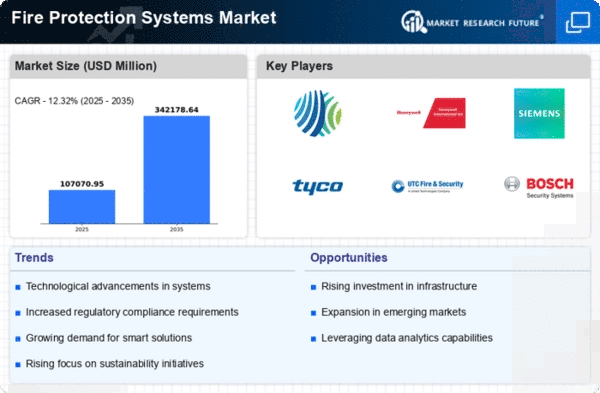
As per MRFR analysis, the Fire Protection Systems Market Size was estimated at 95326.7 USD Million in 2024. The Fire Protection Systems industry is projected to grow from 107071.18 USD Million in 2025 to 342178.64 USD Million by 2035, exhibiting a compound annual growth rate (CAGR) of 12.32 during the forecast period 2025 - 2035.

Key Market Trends & Highlights

The Fire Protection Systems Market is experiencing robust growth driven by technological advancements and increasing regulatory compliance.

  • The integration of smart technologies is transforming fire protection systems, enhancing their efficiency and effectiveness.
  • Regulatory compliance and standards are becoming increasingly stringent, driving demand for advanced fire protection solutions in North America.
  • Sustainability in fire protection solutions is gaining traction, particularly in the Asia-Pacific region, as eco-friendly practices become a priority.
  • The rising incidence of fire accidents and growing awareness of fire safety regulations are key drivers propelling the market forward, especially in the residential and commercial segments.

Market Size & Forecast

2024 Market Size 95326.7 (USD Million)
2035 Market Size 342178.64 (USD Million)
CAGR (2025 - 2035) 12.32%
Largest Regional Market Share in 2024 North America

Major Players

Johnson Controls (US), Honeywell International (US), Siemens (DE), Tyco International (IE), UTC Fire & Security (US), Bosch Security Systems (DE), Minimax Viking (DE), Schneider Electric (FR), Eaton Corporation (IE)

Market Trends

The Fire Protection Systems Market is currently experiencing a dynamic evolution, driven by increasing awareness of safety regulations and the necessity for advanced fire prevention technologies. As urbanization accelerates, the demand for comprehensive fire protection solutions is likely to rise, particularly in densely populated areas. This market encompasses a wide array of products, including fire alarms, sprinklers, and extinguishing systems, which are essential for safeguarding lives and property. Furthermore, the integration of smart technologies into fire protection systems appears to enhance their effectiveness, providing real-time monitoring and rapid response capabilities. In addition, the regulatory landscape surrounding fire safety is becoming more stringent, compelling organizations to invest in robust fire protection measures. This trend is particularly evident in sectors such as construction, manufacturing, and healthcare, where compliance with safety standards is paramount. The Fire Protection Systems Market is poised for growth as stakeholders increasingly recognize the importance of proactive fire safety measures. As innovations continue to emerge, the market is likely to adapt, ensuring that fire protection solutions remain effective and relevant in an ever-changing environment.

Integration of Smart Technologies

The incorporation of smart technologies into fire protection systems is gaining traction. These advancements enable real-time monitoring, automated alerts, and enhanced data analytics, which collectively improve response times and overall safety.

Regulatory Compliance and Standards

The evolving regulatory framework surrounding fire safety is prompting organizations to prioritize compliance. Stricter regulations necessitate the adoption of advanced fire protection solutions, particularly in high-risk industries.

Sustainability in Fire Protection Solutions

There is a growing emphasis on sustainability within the Fire Protection Systems Market. Manufacturers are increasingly focusing on eco-friendly materials and energy-efficient technologies, aligning with global sustainability goals.

Fire Protection Systems Market Market Drivers

Market Growth Projections

The Global Fire Protection Systems Market Industry is poised for substantial growth, with projections indicating a market value of 95.3 USD Billion in 2024 and an anticipated increase to 286.1 USD Billion by 2035. This growth trajectory reflects a compound annual growth rate (CAGR) of 10.51% from 2025 to 2035. The increasing demand for advanced fire protection solutions, driven by regulatory compliance, technological advancements, and heightened awareness of fire safety, underscores the market's potential. As industries continue to prioritize safety and risk mitigation, the Global Fire Protection Systems Market is expected to expand significantly in the coming years.

Technological Advancements

Technological advancements play a pivotal role in shaping the Global Fire Protection Systems Market Industry. Innovations such as smart fire detection systems, integrated fire alarm systems, and automated suppression systems enhance the efficiency and effectiveness of fire protection measures. For example, the integration of Internet of Things (IoT) technology allows for real-time monitoring and alerts, significantly improving response times during emergencies. This trend is likely to attract investments, as organizations seek to modernize their fire safety protocols. The market is projected to grow at a CAGR of 10.51% from 2025 to 2035, indicating a robust demand for cutting-edge fire protection solutions.

Growing Awareness of Fire Safety

Growing awareness of fire safety among businesses and consumers significantly influences the Global Fire Protection Systems Market Industry. Educational campaigns and training programs emphasize the importance of fire prevention and safety measures, leading to increased adoption of fire protection systems. Organizations are recognizing the potential financial and reputational risks associated with fire incidents, prompting them to invest in reliable fire safety solutions. This heightened awareness is likely to drive market growth, as more entities prioritize fire safety in their operational strategies. As a result, the market is anticipated to witness substantial growth in the coming years.

Increasing Regulatory Compliance

The Global Fire Protection Systems Market Industry experiences a notable driver in the form of increasing regulatory compliance. Governments worldwide are implementing stringent fire safety regulations to protect lives and property. For instance, the National Fire Protection Association (NFPA) establishes codes that mandate the installation of fire protection systems in commercial and residential buildings. This regulatory landscape compels organizations to invest in advanced fire protection technologies, thereby driving market growth. As of 2024, the market is valued at approximately 95.3 USD Billion, reflecting the urgency for compliance and safety in various sectors.

Expansion of the Insurance Sector

The expansion of the insurance sector acts as a catalyst for the Global Fire Protection Systems Market Industry. Insurance companies increasingly require businesses to implement robust fire protection measures as a condition for coverage. This trend is particularly evident in sectors such as manufacturing, hospitality, and healthcare, where the risk of fire incidents is elevated. By investing in fire protection systems, organizations not only enhance safety but also potentially lower their insurance premiums. This symbiotic relationship between fire protection investments and insurance requirements is likely to drive market growth, as more businesses seek to comply with insurance mandates.

Rising Urbanization and Infrastructure Development

The rapid pace of urbanization and infrastructure development serves as a significant driver for the Global Fire Protection Systems Market Industry. As cities expand and new constructions arise, the demand for comprehensive fire protection systems escalates. Urban areas, characterized by high population density and complex building structures, necessitate advanced fire safety measures to mitigate risks. For instance, in developing regions, the construction of high-rise buildings and commercial complexes has surged, leading to increased investments in fire protection systems. This trend is expected to contribute to the market's growth, with projections indicating a market value of 286.1 USD Billion by 2035.

Market Segment Insights

By Application: Fire Detection (Largest) vs. Fire Suppression (Fastest-Growing)

In the Fire Protection Systems Market, the application segments are diverse, with Fire Detection holding a prominent share due to its critical role in early hazard identification. This segment encompasses various technologies such as smoke detectors and heat sensors, making it an essential component of any fire safety strategy. Following closely, Fire Suppression is witnessing growth due to the increasing demand for effective fire control measures in infrastructure and industrial applications. These segments demonstrate varying degrees of market penetration and consumer reliance based on safety regulations and technological advancements.

Fire Detection (Dominant) vs. Fire Suppression (Emerging)

Fire Detection systems are considered dominant in the market, primarily due to their foundational role in ensuring safety and compliance in both commercial and residential settings. The segment includes a broad range of technologies, including smoke detectors and thermal imaging devices, which are crucial for timely hazard alerts. Conversely, Fire Suppression systems are emerging as a critical component for businesses seeking to mitigate fire risks effectively. With advancements in suppression technologies and an increasing emphasis on fire safety regulations, this segment is experiencing rapid product innovation and deployment, ensuring its swift ascent in the market.

By End Use: Residential (Largest) vs. Commercial (Fastest-Growing)

In the Fire Protection Systems Market, the end-use segment is dominated by the Residential sector, which holds the largest share. This dominance is primarily driven by the increasing demand for safety solutions in residential buildings, where regulations are becoming stricter. As homeowners prioritize safety, the adoption of fire protection systems like smoke alarms and sprinkler systems has surged, contributing significantly to market share distribution. On the other hand, the Commercial sector is rapidly expanding, fueled by the growth of business infrastructures and the rising need for comprehensive fire safety protocols in commercial establishments. Companies are increasingly investing in advanced fire protection technologies to mitigate risks and comply with regulations.

Residential (Dominant) vs. Industrial (Emerging)

The Residential segment stands out as the dominant force in the Fire Protection Systems Market, characterized by a substantial demand for innovative safety solutions such as advanced smoke detectors, fire alarms, and sprinkler systems. This dominance is bolstered by stringent building codes and heightened public awareness regarding fire safety among homeowners. In contrast, the Industrial sector is emerging as a critical player, propelled by the expansion of manufacturing facilities and the growing emphasis on safeguarding industrial assets. While traditionally focusing on standard fire protection systems, industrial applications are now seeing an influx of advanced technologies, including automated response systems and IoT-enabled devices, which are enhancing overall safety measures. The contrasting characteristics of these segments showcase the diverse needs and growth trajectories within the fire protection ecosystem.

By System Type: Fire Alarm Systems (Largest) vs. Fire Suppression Systems (Fastest-Growing)

The Fire Protection Systems Market is characterized by a diverse range of system types, with Fire Alarm Systems currently holding the largest market share among them. This system is widely adopted across various industries due to the increasing emphasis on safety regulations and technological advancements. Following closely are Fire Suppression Systems, which are gaining traction as organizations focus on mitigating risks associated with fire outbreaks and protecting valuable assets. Market trends indicate a robust growth trajectory for Fire Suppression Systems, driven largely by innovations in suppression technologies and an upsurge in safety awareness. Additionally, the rising instances of fire hazards and tightening regulations around fire safety are propelling demand for both active and passive systems, enhancing the overall growth of the market.

Fire Alarm Systems (Dominant) vs. Fire Detection Systems (Emerging)

Fire Alarm Systems play a crucial role in ensuring the safety of buildings and their occupants, making them the dominant segment within the Fire Protection Systems Market. Their advanced technology, including integration with smart building systems and rapid response capabilities, ensures timely alerts during fire incidents. Conversely, Fire Detection Systems, while emerging, are rapidly evolving due to advancements in sensor technology and analytics. These systems specialize in identifying smoke and heat, providing critical early warnings before the situation escalates. As industries increasingly prioritize preventative measures, Fire Detection Systems are expected to gain significant market share as part of a comprehensive fire safety strategy.

By Technology: Integrated Technology (Largest) vs. Smart Technology (Fastest-Growing)

Within the Fire Protection Systems Market, the distribution of market share among various technology segments is noteworthy. Integrated Technology currently leads the market, driven by its comprehensive systems that combine multiple functions into one solution. In contrast, Smart Technology is rapidly gaining traction, appealing particularly to tech-savvy consumers who prioritize real-time data and automated systems. This evolution highlights a shift in the market towards more interconnected and proactive solutions.

Technology: Integrated Technology (Dominant) vs. Smart Technology (Emerging)

Integrated Technology stands out in the Fire Protection Systems Market due to its ability to unify various fire protection components, optimizing efficiency and response times. It integrates fire detection, suppression, and alarm systems, providing a holistic approach to fire safety. On the other hand, Smart Technology is emerging as a key player, leveraging IoT connectivity to offer real-time monitoring and alert features. As businesses and consumers increasingly seek advanced solutions that enhance safety and compliance, Smart Technology's innovative features are expected to bridge the gap between traditional systems and next-generation safety protocols.

By Component: Fire Sprinklers (Largest) vs. Fire Alarms (Fastest-Growing)

In the Fire Protection Systems Market, the component segment is characterized by a variety of essential safety devices, including fire sprinklers, fire extinguishers, fire alarms, smoke detectors, and fire hoses. Among these, fire sprinklers hold the largest market share, recognized for their widespread utilization in both commercial and residential spaces due to their effectiveness in suppressing flames. Fire alarms, on the other hand, have recently gained notable traction, contributing substantially to the segment's growth and reflecting a shift in focus towards proactive fire detection systems.

Fire Sprinklers (Dominant) vs. Fire Extinguishers (Emerging)

Fire sprinklers are the cornerstone of fire suppression solutions, known for their reliability and extensive application in various buildings. They operate automatically, providing immediate response in the event of a fire, thus proving essential in minimizing damage and ensuring safety. Conversely, fire extinguishers are gaining recognition as an emerging component, particularly portable options designed for ease of use in residential and commercial settings. The evolving landscape of fire safety emphasizes the accessibility and versatility of extinguishers, making them a critical part of comprehensive fire protection strategies.

Get more detailed insights about Fire Protection System Market Research Report - Global Forecast 2035

Regional Insights

North America : Market Leader in Fire Safety

North America continues to lead the Fire Protection Systems market, holding a significant share of 47,600.0. The growth is driven by stringent safety regulations, increasing construction activities, and heightened awareness of fire safety. The region's robust infrastructure and technological advancements further fuel demand, making it a key player in the global market. Regulatory bodies are enforcing stricter compliance measures, enhancing the market's growth trajectory. The United States is the primary contributor, with major players like Johnson Controls, Honeywell International, and UTC Fire & Security dominating the landscape. The competitive environment is characterized by innovation and strategic partnerships, ensuring a steady supply of advanced fire protection solutions. The presence of established companies fosters a healthy competitive atmosphere, driving further advancements in technology and service delivery.

Europe : Emerging Market with Growth Potential

Europe's Fire Protection Systems market is valued at 29,000.0, reflecting a growing demand driven by regulatory support and increasing safety standards. The European Union has implemented various directives aimed at enhancing fire safety in buildings, which has catalyzed market growth. The rising number of construction projects and retrofitting initiatives in existing structures are also contributing to the demand for advanced fire protection systems. Germany, France, and the UK are leading countries in this market, with key players like Siemens and Bosch Security Systems making significant contributions. The competitive landscape is marked by innovation and a focus on sustainability, with companies investing in eco-friendly technologies. The presence of established firms ensures a competitive market, fostering advancements in fire safety solutions. "The European Commission emphasizes the importance of fire safety regulations in protecting lives and property," stated a recent report.

Asia-Pacific : Rapidly Growing Market Segment

The Asia-Pacific region, with a market size of 15,000.0, is witnessing rapid growth in the Fire Protection Systems sector. This surge is attributed to urbanization, industrialization, and increasing investments in infrastructure development. Governments are implementing stricter fire safety regulations, which are driving demand for advanced fire protection solutions. The growing awareness of fire safety among businesses and consumers is also a significant factor contributing to market expansion. China, India, and Japan are the leading countries in this market, with a mix of local and international players competing for market share. Companies like Tyco International and Schneider Electric are actively involved in this region, focusing on innovative solutions tailored to local needs. The competitive landscape is evolving, with new entrants and established firms striving to capture the growing demand for fire safety systems. The region is poised for significant growth as safety standards continue to rise.

Middle East and Africa : Emerging Market with Challenges

The Middle East and Africa region, with a market size of 726.7, is gradually emerging in the Fire Protection Systems market. The growth is driven by increasing urbanization, infrastructure development, and a rising focus on safety regulations. Governments are beginning to implement more stringent fire safety standards, which is expected to enhance market growth. However, challenges such as economic fluctuations and varying regulatory frameworks across countries may hinder rapid progress. Countries like the UAE and South Africa are leading the market, with a growing number of projects requiring advanced fire protection systems. The competitive landscape is characterized by a mix of local and international players, with companies like Eaton Corporation and Minimax Viking making significant inroads. As the region continues to develop, the demand for effective fire safety solutions is anticipated to rise, driven by both regulatory and market needs.

Key Players and Competitive Insights

The Fire Protection Systems Market is currently characterized by a dynamic competitive landscape, driven by increasing regulatory requirements and a heightened focus on safety across various sectors. Major players such as Johnson Controls (US), Honeywell International (US), and Siemens (DE) are strategically positioned to leverage innovation and technological advancements. Johnson Controls (US) emphasizes smart building technologies, integrating fire protection systems with IoT capabilities to enhance safety and operational efficiency. Meanwhile, Honeywell International (US) focuses on digital transformation, offering cloud-based solutions that streamline fire safety management. Siemens (DE) is also investing in advanced analytics and AI to optimize fire protection systems, indicating a collective shift towards more integrated and intelligent solutions in the market.In terms of business tactics, companies are increasingly localizing manufacturing and optimizing supply chains to enhance responsiveness and reduce costs. The market appears moderately fragmented, with a mix of established players and emerging companies vying for market share. This competitive structure allows for diverse offerings, yet the influence of key players remains substantial, as they set benchmarks for innovation and service quality.

In November Johnson Controls (US) announced a partnership with a leading technology firm to develop next-generation fire detection systems utilizing AI algorithms. This strategic move is likely to enhance their product offerings, positioning them as a leader in smart fire protection solutions. The integration of AI could significantly improve response times and accuracy in fire detection, thereby reducing potential damages and enhancing safety.

In October Honeywell International (US) launched a new cloud-based fire safety management platform aimed at simplifying compliance and reporting for businesses. This initiative reflects a growing trend towards digital solutions in fire protection, suggesting that Honeywell is keen on addressing the complexities of regulatory compliance through technology. Such advancements may not only streamline operations but also provide a competitive edge in a market increasingly driven by digital capabilities.

In September Siemens (DE) unveiled a new line of fire protection systems that incorporate advanced analytics for predictive maintenance. This development indicates a strategic focus on enhancing system reliability and reducing downtime, which is crucial for maintaining safety standards. By leveraging data analytics, Siemens is likely to improve customer satisfaction and operational efficiency, further solidifying its market position.

As of December current trends in the Fire Protection Systems Market are heavily influenced by digitalization, sustainability, and the integration of AI technologies. Strategic alliances among key players are shaping the competitive landscape, fostering innovation and enhancing product offerings. The shift from price-based competition to a focus on technological advancement and supply chain reliability is evident. Companies that prioritize innovation and adaptability are likely to thrive, as the market continues to evolve towards more sophisticated and integrated fire protection solutions.

Key Companies in the Fire Protection Systems Market include

Industry Developments

June 2024: Edwards, a branch of Carrier, made a launch of a new product, the Optica Smoke Duct Detector, which is to be used in industrial and commercial areas. It is meant for use in Commercial and Industrial settings to look out for smoke from HVAC systems.

April 2024: Fire Lite, a system brand of Honeywell International Inc, was launched in the market for residential buildings, offices, and industrial warehouses. It is ideal for used in small- and medium-sized enterprises. To the system, cloud technology, remote monitoring, and better regulation were added.

March 2024: ANSUL® N-101 Clean Agent Vehicle Fire Suppression System, created by Johnson Controls, was launched in March 2024 as a means of safeguarding live electrical equipment located in unoccupied electrical cabinets in heavy industrial vehicles. The use of nitrogen gas, which has no global warming potential (GWP), is natural, and it enables ANSUL N-101 to offer sustainable fire suppression for vehicle hazards classified as Class C and E within mining, forestry, and other industries where combustion occurs.

According to the company, ANSUL N-101 suppressants have been designed so that none of them remain inside a cabinet or cause any side reactions. This way, it does not lead to loss or damage of protected electrical assets or the necessity to clean them after discharge, therefore making them environment-friendly for people and their belongings.

July 2023: Version 1 of the SparxTM Smart Sprinkler System prototype has been finished by the fire protection technology business Sparx Holdings Group, Inc. This is a proof-of-concept development prototype which will be utilized for testing, component development, and part refining. The prototype aims to revolutionize the fire suppression industry by significantly improving the response time of conventional sprinkler systems as well as their efficiency in putting out complex fires, such as those in structures with high ceilings, crowded storage arrangements, intricate architectural designs, and the storage of hazardous materials.

The prototype interacts with traditional sprinkler heads to improve their reactivity and to allow sprinklers to work together and communicate effectively to maximize fire response.

July 2023: With the addition of QTEC fire suppression solutions, Integrated Fire Technology, has expanded its offering of fire suppression products. This is because IFT has obtained the exclusive distributorship in South Africa and the distribution rights for this premium brand's low pressure foam spray system in Southern Africa. For stationary plant applications like conveyor belts & diesel & oil storage tanks, & also for big, semi-enclosed or open mobile equipment like draglines and huge excavators, QTEC's flexible and adaptable system offers a fire suppression solution.

This qualifies QTEC for a wide range of industrial and commercial applications, including mining, processing facilities, ports & harbors, and general industry.

June 2023: Fike Fire Monitors have been introduced by Fike Corp., a global producer and provider of fire safety equipment with headquarters in Blue Springs, Missouri. According to Fike, these autonomous water cannons can put out flames in hard-to-reach areas quickly—often within 15 seconds of their discovery. A fire suppression system that is water-based may be made using the cannons, Fike flame detectors, high-definition cameras, and thermal imaging cameras. The technology, according to the manufacturer, is perfect for locations where complete flood control is either impractical or not desired.

September 2022: Fire Safety Digital Services were released in September 2022 by Siemens; this is a unique package of digital and managed systems helping to connect fire safety with the cloud through intelligent safety that will ensure total protection instead of the reactive, compliance-based approach taken earlier. Hazard identification and prevention can be improved while digital services are applied towards operations, event handling as well and maintenance, allowing customers to make better choices regarding risk control measures, ensuring continuity of business processes, or even providing a safe environment for employees’ physical integrity together with enterprise’s valuables.

Remote diagnostics and services involving on-site visits accompany this portfolio, thereby reducing troubleshooting efforts among several businesses during their inspections. High levels of knowledge, experience, and capacity above-site and on-site work together to achieve specific customer goals.

March 2022: C-TEC announced the launch of its new set of BS 5839-1 Fire Detection & Fire Alarm System Compliance courses in March 2022. The courses run from C-TEC’s training center situated in North West England and encompass both theory-based tasks plus practical exercises. FireQual is an awarding body for the UK fire protection sector, and one could also gain a regulated qualification in BS 5839-1 after covering the BS 5839-1 modules such as Foundation, Design, Installation & Commissioning, and Maintenance.

Future Outlook

Fire Protection Systems Market Future Outlook

The Fire Protection Systems Market is projected to grow at a 12.32% CAGR from 2025 to 2035, driven by technological advancements, regulatory changes, and increasing safety awareness.

New opportunities lie in:

  • Integration of IoT-enabled fire detection systems
  • Development of advanced fire suppression agents
  • Expansion into emerging markets with tailored solutions

By 2035, the market is expected to be robust, driven by innovation and increased demand for safety solutions.

Market Segmentation

Fire Protection Systems Market End Use Outlook

  • Residential
  • Commercial
  • Industrial
  • Government
  • Transportation

Fire Protection Systems Market Component Outlook

  • Fire Sprinklers
  • Fire Extinguishers
  • Fire Alarms
  • Smoke Detectors
  • Fire Hoses

Fire Protection Systems Market Technology Outlook

  • Conventional Technology
  • Addressable Technology
  • Wireless Technology
  • Smart Technology
  • Integrated Technology

Fire Protection Systems Market Application Outlook

  • Fire Detection
  • Fire Suppression
  • Fire Alarm
  • Fire Extinguishing
  • Fire Safety Management

Fire Protection Systems Market System Type Outlook

  • Active Fire Protection Systems
  • Passive Fire Protection Systems
  • Fire Detection Systems
  • Fire Suppression Systems
  • Fire Alarm Systems

Report Scope

MARKET SIZE 202495326.7(USD Million)
MARKET SIZE 2025107071.18(USD Million)
MARKET SIZE 2035342178.64(USD Million)
COMPOUND ANNUAL GROWTH RATE (CAGR)12.32% (2025 - 2035)
REPORT COVERAGERevenue Forecast, Competitive Landscape, Growth Factors, and Trends
BASE YEAR2024
Market Forecast Period2025 - 2035
Historical Data2019 - 2024
Market Forecast UnitsUSD Million
Key Companies ProfiledJohnson Controls (US), Honeywell International (US), Siemens (DE), Tyco International (IE), UTC Fire & Security (US), Bosch Security Systems (DE), Minimax Viking (DE), Schneider Electric (FR), Eaton Corporation (IE)
Segments CoveredApplication, End Use, System Type, Technology, Component
Key Market OpportunitiesIntegration of smart technologies enhances efficiency in the Fire Protection Systems Market.
Key Market DynamicsRising regulatory standards and technological advancements drive innovation in fire protection systems across various industries.
Countries CoveredNorth America, Europe, APAC, South America, MEA

FAQs

How much is the Fire Protection Systems market?

Fire Protection Systems market was valued at USD 95326.70 billion in 2024

What is the market size for 2035, for the Fire Protection Systems market?

Fire Protection Systems market is projected to reach USD 342178.64 billion by 2035

What is the growth rate of the Fire Protection Systems market?

The Fire Protection Systems market size is predicted to hit a CAGR of 12.32% by 2035

Which region held the largest market share in the Fire Protection Systems market?

North America is expected to hold the highest market share in the global Fire Protection Systems market

Who are the prominent players in the Fire Protection Systems market?

Honeywell International Inc. (US), Siemens AG (Germany), Johnson Controls International PLC (Ireland), United Technologies Corporation (US), Robert Bosch GmbH (Germany), Hochiki Corporation (Japan), Halma PLC (UK), Minimax Viking GmbH (Germany), Gentex Corporation (US), Securiton AG (Switzerland), Encore Fire Protection (US), Sterling Safety Systems, Fire Suppression Ltd (UK), Napco Security Technologies, Inc. (US), and Others.

Fire protection systems are being widely adopted across commercial, energy & power

Fire protection systems are being widely adopted across commercial, energy & power, transportation & logistics, manufacturing, oil & gas, and government sectors. It is due to the growing concern towards workers in the commercial sector to prevent occupational hazards, the commercial sector is experiencing a high rate of fire protection systems adoption. By 2025, the commercial sector segment of the market can cross USD 12,636.4 million of valuation.

  1. SECTION I: EXECUTIVE SUMMARY AND KEY HIGHLIGHTS
    1. | 1.1 EXECUTIVE SUMMARY
    2. | 1.1.1 Market Overview
    3. | 1.1.2 Key Findings
    4. | 1.1.3 Market Segmentation
    5. | 1.1.4 Competitive Landscape
    6. | 1.1.5 Challenges and Opportunities
    7. | 1.1.6 Future Outlook
  2. SECTION II: SCOPING, METHODOLOGY AND MARKET STRUCTURE
    1. | 2.1 MARKET INTRODUCTION
    2. | 2.1.1 Definition
    3. | 2.1.2 Scope of the study
    4. |-- 2.1.2.1 Research Objective
    5. |-- 2.1.2.2 Assumption
    6. |-- 2.1.2.3 Limitations
    7. | 2.2 RESEARCH METHODOLOGY
    8. | 2.2.1 Overview
    9. | 2.2.2 Data Mining
    10. | 2.2.3 Secondary Research
    11. | 2.2.4 Primary Research
    12. |-- 2.2.4.1 Primary Interviews and Information Gathering Process
    13. |-- 2.2.4.2 Breakdown of Primary Respondents
    14. | 2.2.5 Forecasting Model
    15. | 2.2.6 Market Size Estimation
    16. |-- 2.2.6.1 Bottom-Up Approach
    17. |-- 2.2.6.2 Top-Down Approach
    18. | 2.2.7 Data Triangulation
    19. | 2.2.8 Validation
  3. SECTION III: QUALITATIVE ANALYSIS
    1. | 3.1 MARKET DYNAMICS
    2. | 3.1.1 Overview
    3. | 3.1.2 Drivers
    4. | 3.1.3 Restraints
    5. | 3.1.4 Opportunities
    6. | 3.2 MARKET FACTOR ANALYSIS
    7. | 3.2.1 Value chain Analysis
    8. | 3.2.2 Porter's Five Forces Analysis
    9. |-- 3.2.2.1 Bargaining Power of Suppliers
    10. |-- 3.2.2.2 Bargaining Power of Buyers
    11. |-- 3.2.2.3 Threat of New Entrants
    12. |-- 3.2.2.4 Threat of Substitutes
    13. |-- 3.2.2.5 Intensity of Rivalry
    14. | 3.2.3 COVID-19 Impact Analysis
    15. |-- 3.2.3.1 Market Impact Analysis
    16. |-- 3.2.3.2 Regional Impact
    17. |-- 3.2.3.3 Opportunity and Threat Analysis
  4. SECTION IV: QUANTITATIVE ANALYSIS
    1. | 4.1 Semiconductor & Electronics, BY Application (USD Million)
    2. | 4.1.1 Fire Detection
    3. | 4.1.2 Fire Suppression
    4. | 4.1.3 Fire Alarm
    5. | 4.1.4 Fire Extinguishing
    6. | 4.1.5 Fire Safety Management
    7. | 4.2 Semiconductor & Electronics, BY End Use (USD Million)
    8. | 4.2.1 Residential
    9. | 4.2.2 Commercial
    10. | 4.2.3 Industrial
    11. | 4.2.4 Government
    12. | 4.2.5 Transportation
    13. | 4.3 Semiconductor & Electronics, BY System Type (USD Million)
    14. | 4.3.1 Active Fire Protection Systems
    15. | 4.3.2 Passive Fire Protection Systems
    16. | 4.3.3 Fire Detection Systems
    17. | 4.3.4 Fire Suppression Systems
    18. | 4.3.5 Fire Alarm Systems
    19. | 4.4 Semiconductor & Electronics, BY Technology (USD Million)
    20. | 4.4.1 Conventional Technology
    21. | 4.4.2 Addressable Technology
    22. | 4.4.3 Wireless Technology
    23. | 4.4.4 Smart Technology
    24. | 4.4.5 Integrated Technology
    25. | 4.5 Semiconductor & Electronics, BY Component (USD Million)
    26. | 4.5.1 Fire Sprinklers
    27. | 4.5.2 Fire Extinguishers
    28. | 4.5.3 Fire Alarms
    29. | 4.5.4 Smoke Detectors
    30. | 4.5.5 Fire Hoses
    31. | 4.6 Semiconductor & Electronics, BY Region (USD Million)
    32. | 4.6.1 North America
    33. |-- 4.6.1.1 US
    34. |-- 4.6.1.2 Canada
    35. | 4.6.2 Europe
    36. |-- 4.6.2.1 Germany
    37. |-- 4.6.2.2 UK
    38. |-- 4.6.2.3 France
    39. |-- 4.6.2.4 Russia
    40. |-- 4.6.2.5 Italy
    41. |-- 4.6.2.6 Spain
    42. |-- 4.6.2.7 Rest of Europe
    43. | 4.6.3 APAC
    44. |-- 4.6.3.1 China
    45. |-- 4.6.3.2 India
    46. |-- 4.6.3.3 Japan
    47. |-- 4.6.3.4 South Korea
    48. |-- 4.6.3.5 Malaysia
    49. |-- 4.6.3.6 Thailand
    50. |-- 4.6.3.7 Indonesia
    51. |-- 4.6.3.8 Rest of APAC
    52. | 4.6.4 South America
    53. |-- 4.6.4.1 Brazil
    54. |-- 4.6.4.2 Mexico
    55. |-- 4.6.4.3 Argentina
    56. |-- 4.6.4.4 Rest of South America
    57. | 4.6.5 MEA
    58. |-- 4.6.5.1 GCC Countries
    59. |-- 4.6.5.2 South Africa
    60. |-- 4.6.5.3 Rest of MEA
  5. SECTION V: COMPETITIVE ANALYSIS
    1. | 5.1 Competitive Landscape
    2. | 5.1.1 Overview
    3. | 5.1.2 Competitive Analysis
    4. | 5.1.3 Market share Analysis
    5. | 5.1.4 Major Growth Strategy in the Semiconductor & Electronics
    6. | 5.1.5 Competitive Benchmarking
    7. | 5.1.6 Leading Players in Terms of Number of Developments in the Semiconductor & Electronics
    8. | 5.1.7 Key developments and growth strategies
    9. |-- 5.1.7.1 New Product Launch/Service Deployment
    10. |-- 5.1.7.2 Merger & Acquisitions
    11. |-- 5.1.7.3 Joint Ventures
    12. | 5.1.8 Major Players Financial Matrix
    13. |-- 5.1.8.1 Sales and Operating Income
    14. |-- 5.1.8.2 Major Players R&D Expenditure. 2023
    15. | 5.2 Company Profiles
    16. | 5.2.1 Johnson Controls (US)
    17. |-- 5.2.1.1 Financial Overview
    18. |-- 5.2.1.2 Products Offered
    19. |-- 5.2.1.3 Key Developments
    20. |-- 5.2.1.4 SWOT Analysis
    21. |-- 5.2.1.5 Key Strategies
    22. | 5.2.2 Honeywell International (US)
    23. |-- 5.2.2.1 Financial Overview
    24. |-- 5.2.2.2 Products Offered
    25. |-- 5.2.2.3 Key Developments
    26. |-- 5.2.2.4 SWOT Analysis
    27. |-- 5.2.2.5 Key Strategies
    28. | 5.2.3 Siemens (DE)
    29. |-- 5.2.3.1 Financial Overview
    30. |-- 5.2.3.2 Products Offered
    31. |-- 5.2.3.3 Key Developments
    32. |-- 5.2.3.4 SWOT Analysis
    33. |-- 5.2.3.5 Key Strategies
    34. | 5.2.4 Tyco International (IE)
    35. |-- 5.2.4.1 Financial Overview
    36. |-- 5.2.4.2 Products Offered
    37. |-- 5.2.4.3 Key Developments
    38. |-- 5.2.4.4 SWOT Analysis
    39. |-- 5.2.4.5 Key Strategies
    40. | 5.2.5 UTC Fire & Security (US)
    41. |-- 5.2.5.1 Financial Overview
    42. |-- 5.2.5.2 Products Offered
    43. |-- 5.2.5.3 Key Developments
    44. |-- 5.2.5.4 SWOT Analysis
    45. |-- 5.2.5.5 Key Strategies
    46. | 5.2.6 Bosch Security Systems (DE)
    47. |-- 5.2.6.1 Financial Overview
    48. |-- 5.2.6.2 Products Offered
    49. |-- 5.2.6.3 Key Developments
    50. |-- 5.2.6.4 SWOT Analysis
    51. |-- 5.2.6.5 Key Strategies
    52. | 5.2.7 Minimax Viking (DE)
    53. |-- 5.2.7.1 Financial Overview
    54. |-- 5.2.7.2 Products Offered
    55. |-- 5.2.7.3 Key Developments
    56. |-- 5.2.7.4 SWOT Analysis
    57. |-- 5.2.7.5 Key Strategies
    58. | 5.2.8 Schneider Electric (FR)
    59. |-- 5.2.8.1 Financial Overview
    60. |-- 5.2.8.2 Products Offered
    61. |-- 5.2.8.3 Key Developments
    62. |-- 5.2.8.4 SWOT Analysis
    63. |-- 5.2.8.5 Key Strategies
    64. | 5.2.9 Eaton Corporation (IE)
    65. |-- 5.2.9.1 Financial Overview
    66. |-- 5.2.9.2 Products Offered
    67. |-- 5.2.9.3 Key Developments
    68. |-- 5.2.9.4 SWOT Analysis
    69. |-- 5.2.9.5 Key Strategies
    70. | 5.3 Appendix
    71. | 5.3.1 References
    72. | 5.3.2 Related Reports

Semiconductor & Electronics Market Segmentation

Semiconductor & Electronics By Application (USD Million, 2025-2035)

  • Fire Detection
  • Fire Suppression
  • Fire Alarm
  • Fire Extinguishing
  • Fire Safety Management

Semiconductor & Electronics By End Use (USD Million, 2025-2035)

  • Residential
  • Commercial
  • Industrial
  • Government
  • Transportation

Semiconductor & Electronics By System Type (USD Million, 2025-2035)

  • Active Fire Protection Systems
  • Passive Fire Protection Systems
  • Fire Detection Systems
  • Fire Suppression Systems
  • Fire Alarm Systems

Semiconductor & Electronics By Technology (USD Million, 2025-2035)

  • Conventional Technology
  • Addressable Technology
  • Wireless Technology
  • Smart Technology
  • Integrated Technology

Semiconductor & Electronics By Component (USD Million, 2025-2035)

  • Fire Sprinklers
  • Fire Extinguishers
  • Fire Alarms
  • Smoke Detectors
  • Fire Hoses
Infographic

Free Sample Request

Kindly complete the form below to receive a free sample of this Report

Get Free Sample

Customer Strories

Compare Licence

×
Features License Type
Single User Multiuser License Enterprise User
Price $4,950 $5,950 $7,250
Maximum User Access Limit 1 User Upto 10 Users Unrestricted Access Throughout the Organization
Free Customization
Direct Access to Analyst
Deliverable Format
Platform Access
Discount on Next Purchase 10% 15% 15%
Printable Versions