Request Free Sample ×

Kindly complete the form below to receive a free sample of this Report

* Please use a valid business email

Leading companies partner with us for data-driven Insights

clients tt-cursor
Hero Background
English
Chinese
French
Japanese
Korean
German
Spanish

Extreme Ultraviolet EUV Lithography Market Share

ID: MRFR/SEM/10851-HCR
128 Pages
Aarti Dhapte
March 2026

Extreme Ultraviolet (EUV) Lithography Market Size, Share and Research Report By Equipment (Light, Source, Opitcs, Mask And Others), By End User (Integrated Device Manufacturer (IDM) And Foundries) And By Region (North America, Europe, Asia-Pacific, And Rest Of The World) – Industry Forecast Till 2035

Share:
Download PDF ×

We do not share your information with anyone. However, we may send you emails based on your report interest from time to time. You may contact us at any time to opt-out.

Extreme Ultraviolet EUV Lithography Market Infographic
Purchase Options

Market Share

Extreme Ultraviolet EUV Lithography Market Share Analysis

Market share positioning strategies play a pivotal role in shaping the dynamics of the Extreme Ultraviolet (EUV) lithography market. One key strategy employed by companies in this sector is technological differentiation. As the competition intensifies, companies are striving to develop and offer advanced EUV lithography solutions with unique features and capabilities. This differentiation not only attracts customers seeking cutting-edge technology but also helps companies carve out a distinct market share by offering superior performance and efficiency.

Pricing strategies also play a crucial role in market share positioning. Given the high costs associated with EUV lithography technology, companies must carefully consider their pricing models. Some opt for premium pricing, targeting high-end markets and customers willing to pay a premium for the advanced capabilities of EUV lithography. Others may adopt a more competitive pricing strategy to capture a larger market share by appealing to a broader customer base. Striking the right balance between pricing and perceived value is essential for companies looking to optimize their market share positioning.

Strategic partnerships and collaborations are instrumental in enhancing market share in the EUV lithography segment. Companies often form alliances with semiconductor manufacturers, research institutions, or other industry players to pool resources, share expertise, and accelerate innovation. These partnerships not only facilitate the development of more advanced EUV lithography solutions but also provide companies with a broader reach and influence in the market. Collaborative efforts can lead to the creation of comprehensive ecosystems, strengthening the position of companies within the EUV lithography market.

Geographical expansion is another key market share positioning strategy. Companies seek to establish a strong presence in key regions with a significant demand for semiconductor manufacturing technologies. By strategically expanding their footprint, companies can tap into emerging markets and gain access to new customer bases. Understanding the regional nuances and tailoring marketing and distribution strategies accordingly is crucial for successful market penetration and the establishment of a robust market share.

Continuous innovation and product development are imperative strategies for maintaining and expanding market share in the EUV lithography market. Given the rapid pace of technological advancements, companies must stay at the forefront of innovation to meet evolving customer demands. Regular product updates, improvements, and the introduction of new features help companies not only retain existing customers but also attract new ones. The ability to adapt to changing market needs and consistently offer state-of-the-art solutions is a key driver for market share growth.

Customer-focused strategies, such as excellent customer support, training programs, and collaborative problem-solving, contribute significantly to market share positioning. As EUV lithography technology is complex, companies that prioritize customer satisfaction and provide comprehensive support services can build strong, long-lasting relationships with their clients. Satisfied customers are more likely to become repeat buyers and advocates for a particular brand, thereby influencing the market share of companies in the EUV lithography sector.

Author
Author Profile
Aarti Dhapte
AVP - Research

A consulting professional focused on helping businesses navigate complex markets through structured research and strategic insights. I partner with clients to solve high-impact business problems across market entry strategy, competitive intelligence, and opportunity assessment. Over the course of my experience, I have led and contributed to 100+ market research and consulting engagements, delivering insights across multiple industries and geographies, and supporting strategic decisions linked to $500M+ market opportunities. My core expertise lies in building robust market sizing, forecasting, and commercial models (top-down and bottom-up), alongside deep-dive competitive and industry analysis. I have played a key role in shaping go-to-market strategies, investment cases, and growth roadmaps, enabling clients to make confident, data-backed decisions in dynamic markets.

Leave a Comment

FAQs

What is the projected market valuation of the Extreme Ultraviolet (EUV) Lithography Market by 2035?

<p>The projected market valuation for the Extreme Ultraviolet (EUV) Lithography Market is 174.83 USD Billion by 2035.</p>

What was the market valuation of the Extreme Ultraviolet (EUV) Lithography Market in 2024?

<p>The overall market valuation of the Extreme Ultraviolet (EUV) Lithography Market was 18.75 USD Billion in 2024.</p>

What is the expected CAGR for the Extreme Ultraviolet (EUV) Lithography Market during the forecast period 2025 - 2035?

<p>The expected CAGR for the Extreme Ultraviolet (EUV) Lithography Market during the forecast period 2025 - 2035 is 22.5%.</p>

Which companies are considered key players in the Extreme Ultraviolet (EUV) Lithography Market?

<p>Key players in the Extreme Ultraviolet (EUV) Lithography Market include ASML, Nikon, Canon, Samsung Electronics, Intel, Taiwan Semiconductor Manufacturing Company, GlobalFoundries, Micron Technology, and SK Hynix.</p>

What are the main segments of the Extreme Ultraviolet (EUV) Lithography Market?

<p>The main segments of the Extreme Ultraviolet (EUV) Lithography Market include Equipment and End User.</p>

What was the valuation of the Equipment segment in the Extreme Ultraviolet (EUV) Lithography Market in 2024?

<p>In 2024, the Equipment segment of the Extreme Ultraviolet (EUV) Lithography Market had a valuation of 18.75 USD Billion.</p>

What is the projected valuation of the Foundries segment by 2035?

The projected valuation of the Foundries segment in the Extreme Ultraviolet (EUV) Lithography Market is 104.83 USD Billion by 2035.

How does the valuation of the Light Source segment compare to the Mask segment in 2024?

In 2024, the Light Source segment was valued at 5.25 USD Billion, whereas the Mask segment was valued at 3.0 USD Billion.

What is the expected growth trend for the Integrated Device Manufacturer (IDM) segment during the forecast period?

The Integrated Device Manufacturer (IDM) segment is expected to grow from 7.5 USD Billion in 2024 to 70.0 USD Billion by 2035.

What are the projected values for the Others segment in the Equipment category by 2035?

The Others segment in the Equipment category is projected to reach 59.83 USD Billion by 2035.

Market Summary

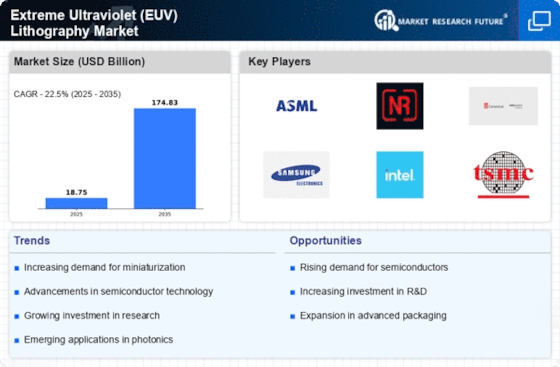
As per Market Research Future analysis, the Extreme Ultraviolet (EUV) Lithography Market Size was estimated at 18.75 USD Billion in 2024. The EUV lithography industry is projected to grow from USD 22.97 Billion in 2025 to USD 174.83 Billion by 2035, exhibiting a compound annual growth rate (CAGR) of 22.5% during the forecast period 2025 - 2035

Key Market Trends & Highlights

The Extreme Ultraviolet (EUV) Lithography Market is poised for substantial growth driven by technological advancements and increasing demand for miniaturization.

  • North America remains the largest market for EUV lithography, driven by its robust semiconductor industry. Asia-Pacific is emerging as the fastest-growing region, fueled by rapid technological adoption and manufacturing expansion. The light source segment dominates the market, while the optics segment is experiencing the fastest growth due to innovations in design. Rising demand for advanced semiconductor devices and increased investment in research and development are key drivers propelling market expansion.

Market Size & Forecast

2024 Market Size 18.75 (USD Billion)
2035 Market Size 174.83 (USD Billion)
CAGR (2025 - 2035) 22.5%
Largest Regional Market Share in 2024 North America

Major Players

ASML (NL), Nikon (JP), Canon (JP), Samsung Electronics (KR), Intel (US), Taiwan Semiconductor Manufacturing Company (TW), GlobalFoundries (US), Micron Technology (US), SK Hynix (KR)

Market Trends

The Extreme Ultraviolet (EUV) Lithography Market is currently experiencing a transformative phase, driven by the increasing demand for advanced semiconductor manufacturing technologies. As the industry progresses towards smaller nodes, the necessity for precise lithography techniques becomes paramount. EUV lithography, with its ability to produce intricate patterns on silicon wafers, appears to be at the forefront of this evolution. Major players in the semiconductor sector are investing heavily in EUV systems, which suggests a robust growth trajectory for this market. Furthermore, the integration of EUV technology into production lines is likely to enhance efficiency and yield, thereby attracting more manufacturers to adopt this innovative approach. In addition to technological advancements, the Extreme Ultraviolet (EUV) Lithography Market is also influenced by geopolitical factors and supply chain dynamics. The ongoing competition among global semiconductor manufacturers has led to strategic partnerships and collaborations aimed at enhancing EUV capabilities. This collaborative spirit may foster innovation and accelerate the development of next-generation lithography solutions. As the market continues to evolve, it is essential to monitor these trends closely, as they could shape the future landscape of semiconductor manufacturing and influence the competitive positioning of key industry players.

Technological Advancements

The Extreme Ultraviolet (EUV) Lithography Market is witnessing rapid technological advancements that enhance the precision and efficiency of semiconductor manufacturing. Innovations in light source technology and optics are likely to improve the performance of EUV systems, making them more accessible to a broader range of manufacturers.

Geopolitical Influences

Geopolitical factors are playing a crucial role in shaping the Extreme Ultraviolet (EUV) Lithography Market. Trade policies and international collaborations among semiconductor firms may impact the availability and distribution of EUV technology, potentially leading to shifts in market dynamics.

Sustainability Initiatives

Sustainability is becoming increasingly relevant in the Extreme Ultraviolet (EUV) Lithography Market. Manufacturers are exploring eco-friendly practices and materials in their production processes, which may not only reduce environmental impact but also appeal to a growing segment of environmentally conscious consumers.

Extreme Ultraviolet EUV Lithography Market Market Drivers

Strategic Collaborations and Partnerships

Strategic collaborations and partnerships among key players in the semiconductor industry are shaping the Extreme Ultraviolet (EUV) Lithography Market. These alliances often focus on sharing expertise, resources, and technology to accelerate the development and deployment of EUV lithography solutions. For example, partnerships between equipment manufacturers and semiconductor fabs have led to the co-development of advanced EUV systems tailored to specific manufacturing needs. Such collaborations are essential for overcoming the technical challenges associated with EUV technology and are likely to enhance its adoption across various sectors. As these partnerships continue to evolve, they may significantly impact the competitive landscape of the EUV lithography market.

Technological Advancements in EUV Equipment

Technological advancements in EUV equipment are propelling the Extreme Ultraviolet (EUV) Lithography Market forward. Innovations in light source technology, optics, and mask design have significantly improved the efficiency and effectiveness of EUV lithography systems. For instance, the introduction of high-power EUV light sources has enhanced throughput, making it feasible for manufacturers to adopt this technology at scale. As of 2025, the market for EUV lithography equipment is expected to surpass 10 billion dollars, driven by these advancements. The continuous evolution of EUV technology not only enhances production capabilities but also enables the fabrication of more complex semiconductor devices, thereby expanding its application scope.

Growing Need for Miniaturization in Electronics

The growing need for miniaturization in electronics is a crucial factor driving the Extreme Ultraviolet (EUV) Lithography Market. As devices become smaller and more powerful, the demand for lithography techniques that can produce finer features is paramount. EUV lithography offers the precision required to create intricate patterns on silicon wafers, facilitating the production of compact and efficient semiconductor components. This trend is particularly evident in the smartphone and wearable technology sectors, where manufacturers are striving to deliver high-performance devices in smaller form factors. The miniaturization trend is expected to continue, further increasing the reliance on EUV technology in semiconductor manufacturing.

Increased Investment in Research and Development

Investment in research and development within the semiconductor sector is significantly influencing the Extreme Ultraviolet (EUV) Lithography Market. Companies are allocating substantial resources to innovate and enhance lithography technologies, aiming to achieve higher yields and lower production costs. This trend is evident as major semiconductor manufacturers have reported R&D expenditures exceeding 20 billion dollars annually. The focus on developing next-generation chips, particularly for applications in artificial intelligence and high-performance computing, underscores the necessity for advanced lithography solutions like EUV. As these investments continue to grow, they are likely to accelerate the adoption of EUV technology, further solidifying its position in the market.

Rising Demand for Advanced Semiconductor Devices

The increasing demand for advanced semiconductor devices is a primary driver of the Extreme Ultraviolet (EUV) Lithography Market. As consumer electronics, automotive applications, and IoT devices proliferate, manufacturers are compelled to produce smaller, more efficient chips. This trend necessitates the adoption of EUV lithography, which enables the fabrication of intricate patterns at nanoscale dimensions. According to recent data, the semiconductor industry is projected to reach a valuation of over 1 trillion dollars by 2030, with EUV technology playing a pivotal role in meeting this demand. The ability of EUV lithography to enhance chip performance while reducing power consumption positions it as a critical technology in the semiconductor manufacturing landscape.

Market Segment Insights

By Equipment: Light Source (Largest) vs. Optics (Fastest-Growing)

<p>In the Extreme Ultraviolet (EUV) Lithography Market, the distribution of market share among the equipment segment values showcases significant dynamics. The Light Source segment holds the largest market share due to its critical role in the lithographic process, providing the necessary wavelength for high-resolution patterning. In contrast, the Optics segment is experiencing rapid growth as technological advancements drive demand for improved imaging capabilities, thus positioning itself as a vital component in EUV systems. Growth trends within this segment suggest that while the Light Source continues to lead, the Optics segment is gaining traction. Innovations in optical components that enhance efficiency and resolution are leading to increased investments in this area, making it a focal point for manufacturers. As the market expands, both segments are expected to evolve, reflecting the ongoing shifts in lithography techniques and the push towards smaller, more integrated semiconductor technologies.</p>

<p>Optics (Dominant) vs. Mask (Emerging)</p>

<p>Within the equipment segment of the EUV Lithography Market, Optics has emerged as a dominant force due to its essential function in focusing and directing the EUV light onto the wafer. The advancements in optical technologies, including the development of specialized materials and coatings, have significantly improved the performance of lithographic systems. Meanwhile, the Mask segment, while currently seen as emerging, plays a pivotal role in defining circuit patterns. Continuous research and development efforts aim to refine mask materials and techniques to enhance their compatibility with EUV wavelengths. Both Optics and Mask must adapt to the evolving demands of the semiconductor industry, balancing innovation with cost-effectiveness to maintain their market positions.</p>

By End User: Integrated Device Manufacturer (IDM) (Largest) vs. Foundries (Fastest-Growing)

<p>The 'Extreme Ultraviolet (EUV) Lithography Market' showcases a competitive landscape between Integrated Device Manufacturers (IDMs) and Foundries. IDMs hold the largest share of the market due to their ability to integrate design and manufacturing processes effectively, allowing them to optimize production costs and enhance their product offerings. Foundries, however, are emerging strong, capturing significant attention as they cater to an increasing demand from fabless companies and those seeking external manufacturing capabilities.</p>

<p>Integrated Device Manufacturer (IDM) (Dominant) vs. Foundries (Emerging)</p>

<p>Integrated Device Manufacturers (IDMs) are characterized by their substantial investment in advanced lithography technology and in-house production capabilities, allowing them to control quality and maintain competitive edges in product innovation. They typically develop a broad spectrum of semiconductors, meeting diverse industry needs. Conversely, Foundries are positioned as emerging players, utilizing EUV lithography to cater to the growing market of fabless semiconductor companies, which rely on external partners for manufacturing. This segment benefits from partnerships, enhancing flexibility and scaling production to meet varying demands. The rapid technological advancements are also boosting their capability to produce chips with smaller geometries, further elevating their role in the EUV ecosystem.</p>

By Technology: Extreme Ultraviolet Lithography (Largest) vs. Maskless Lithography (Fastest-Growing)

<p>The market for extreme ultraviolet lithography technology is primarily dominated by Extreme Ultraviolet Lithography, which holds the largest share among the various technologies. This segment is integral to the manufacturing of advanced semiconductor devices, contributing significantly to the overall growth of the market. Mask-based Lithography and Nanoimprint Lithography follow, each capturing a smaller share of the market but still playing crucial roles in specific applications.</p>

<p>Technology: Extreme Ultraviolet Lithography (Dominant) vs. Maskless Lithography (Emerging)</p>

<p>Extreme Ultraviolet Lithography (EUV) stands as the dominant technology within the extreme ultraviolet lithography market, favored for its precision in fabricating smaller nodes in semiconductors. Its capacity to produce intricate designs is unrivaled, making it essential for cutting-edge microelectronics. Conversely, Maskless Lithography is rapidly emerging due to its flexibility and efficiency, appealing particularly to niche applications in rapid prototyping and low-volume production. This adaptability allows it to fill gaps where traditional methods may be less viable, thus driving a trend towards customization and shorter lead times.</p>

By Component: Light Source (Largest) vs. Optics (Fastest-Growing)

<p>In the extreme ultraviolet lithography market, the component segment is characterized by significant contributions from various technologies, namely Light Source, Optics, Photoresist, and Mask. Among these, the Light Source stands out as the largest segment due to its critical role in driving the lithography process. Optics follows closely as an essential component, with Photoresist and Mask playing crucial support roles in achieving the desired nanoscale precision in semiconductor manufacturing. The distribution of market share highlights the reliance on advanced technologies to enhance production efficiency and yield.</p>

<p>Light Source (Dominant) vs. Photoresist (Emerging)</p>

<p>The Light Source segment in the extreme ultraviolet lithography market is currently dominant due to its foundational role in generating the required wavelengths for effective lithography processes. It involves cutting-edge technologies that facilitate the production of high-resolution patterns on semiconductor wafers. In contrast, Photoresist is emerging as a vital component, gaining traction with ongoing advancements in formulation and application techniques. This shift is propelled by the demand for more precise and efficient materials that can withstand the extreme conditions of EUV lithography, making it a focal point for innovation and investment in the semiconductor industry.</p>

Get more detailed insights about Extreme Ultraviolet (EUV) Lithography Market Research Report—Global Forecast till 2035

Regional Insights

By region, the study provides the market insights into North America, Europe, Asia-Pacific and Rest of the World. The North American Extreme Ultraviolet (EUV) Lithography Market area will dominate this market, owing to increased demand for technologically advanced products including smartphones, laptops, and others. As Washington steps up its efforts to constrain Beijing's ability to produce cutting-edge semiconductors and gain dominance over strategic technologies, China will find it more difficult to catch up to the US and its semiconductor sector partners.

Last week, Washington imposed limitations on the sale to China of specified Nvidia and AMD sophisticated Graphic Processor Units (GPUs) used in supercomputers and artificial intelligence applications. Washington has been encouraging its East Asian allies Taiwan, South Korea, and Japan to join a "Chip 4" industry alliance in order to exclude China from the global digital ecosystem.

Further, the major countries studied in the market report are The US, Canada, German, France, the UK, Italy, Spain, China, Japan, India, Australia, South Korea, and Brazil.

Figure2: EXTREME ULTRAVIOLET (EUV) LITHOGRAPHY MARKET SHARE BY REGION 2022 (USD Billion)

EXTREME ULTRAVIOLET (EUV) LITHOGRAPHY MARKET SHARE BY REGION 2022

Europe Extreme Ultraviolet (EUV) Lithography Market accounts for the second-largest market share because of the region's high demand for tiny technologies and modern cellphones. Further, the German Extreme Ultraviolet (EUV) Lithography Market held the largest market share, and the UK Extreme Ultraviolet (EUV) Lithography Market was the fastest growing market in the European region

The Asia-Pacific Extreme Ultraviolet (EUV) Lithography Market is expected to grow at the fastest CAGR from 2023 to 2032. This is because of the significant demand from Fab-less players at top foundries in the region, as well as the growing number of wafer processing capabilities. The presence of a large number of leading foundries, such as Toshiba. Samsung and SK Hynix are the market leaders in the region. Moreover, China’s Extreme Ultraviolet (EUV) Lithography Market held the largest market share, and the IndianExtreme Ultraviolet (EUV) Lithography Market was the fastest growing market in the Asia-Pacific region.

Key Players and Competitive Insights

Leading market players are investing heavily in research and development in order to expand their product lines, which will help the Extreme Ultraviolet (EUV) Lithography Market, grow even more. Market participants are also undertaking a variety of strategic activities to expand their global footprint, with important market developments including new product launches, contractual agreements, mergers and acquisitions, higher investments, and collaboration with other organizations. To expand and survive in a more competitive and rising market climate, Extreme Ultraviolet (EUV) Lithography industry must offer cost-effective items.Manufacturing locally to minimize operational costs is one of the key business tactics used by manufacturers in the global Extreme Ultraviolet (EUV) Lithography industry to benefit clients and increase the market sector. In recent years, the Extreme Ultraviolet (EUV) Lithography industry has offered some of the most significant advantages to medicine. Major players in the Extreme Ultraviolet (EUV) Lithography Market, including Nikon Corporation, Cannon Inc., ASML and others, are attempting to increase market demand by investing in research and development operations.ASML Holding N.V. is a Dutch international firm that was created in 1984. ASML specializes in the design and manufacture of photolithography devices used in the production of computer chips. As of 2022, it is the world's largest semiconductor provider and the sole supplier of extreme ultraviolet lithography (EUV) photolithography machines, which are necessary to build the most modern chips. ASML had a market capitalization of over US$280 billion as of June 2023, making it the most valuable European technology business.

In December ASML, a hot stock in Europe, is releasing a new version of its extreme ultraviolet lithography equipment, which is used to carve patterns into silicon chips required to construct the world's most powerful CPUs. Using their existing EUV equipment, Samsung, TSMC, and Intel develop chips for the next generation of PCs and smartphones.NTT DATA Corporation is a global Japanese information technology (IT) service and consulting firm headquartered in Tokyo. Nippon Telegraph and Telephone (NTT) owns a portion of the company. NTT's predecessor, Japan Telegraph and Telephone Public Corporation, began its Data Communications business in 1967. Following its privatization in 1985, NTT spun off its Data Communications section as NTT DATA in 1988, becoming the largest of Japan's IT Services companies.

In June lITG and NTT-AT signed a Memorandum of Understanding (MOU) to improve industry-academia collaboration on advanced technologies by sharing information, conducting collaborative research, and exchanging resources. 

Key Companies in the Extreme Ultraviolet EUV Lithography Market include

Industry Developments

March 2021, Samsung is ramping up production of EUV scanners capable of competing with the world's largest foundry, TSMC. EUV scanners, as opposed to traditional machines, optimize the chip fabrication process by decreasing the number of photolithography procedures required to build finer circuits, forcing major chipmakers to compete for the technology.

June 2022, ASML launched a new technology education program alongside Mad Science. The ASL Junior Academy initiative will provide technology teaching to all 271 primary schools in the Brainport-Eindhoven region. This means that Mad Science will teach around 60,000 children about technology each year through the curriculum. The ASML Junior Academy will begin in fifty primary schools in September.

Future Outlook

Extreme Ultraviolet EUV Lithography Market Future Outlook

The Extreme Ultraviolet (EUV) Lithography Market is projected to grow at a 22.5% CAGR from 2025 to 2035, driven by advancements in semiconductor technology and increasing demand for miniaturization.

New opportunities lie in:

  • Development of advanced photomasks for enhanced resolution</p><p>Integration of AI-driven analytics in lithography processes</p><p>Expansion into emerging markets with tailored EUV solutions

By 2035, the EUV Lithography Market is expected to achieve substantial growth and technological advancements.

Market Segmentation

Extreme Ultraviolet EUV Lithography Market End User Outlook

  • Integrated Device Manufacturer (IDM)
  • Foundries

Extreme Ultraviolet EUV Lithography Market Equipment Outlook

  • Light Source
  • Optics
  • Mask
  • Others

Report Scope

MARKET SIZE 2024 18.75(USD Billion)
MARKET SIZE 2025 22.97(USD Billion)
MARKET SIZE 2035 174.83(USD Billion)
COMPOUND ANNUAL GROWTH RATE (CAGR) 22.5% (2025 - 2035)
REPORT COVERAGE Revenue Forecast, Competitive Landscape, Growth Factors, and Trends
BASE YEAR 2024
Market Forecast Period 2025 - 2035
Historical Data 2019 - 2024
Market Forecast Units USD Billion
Key Companies Profiled ASML (NL), Nikon (JP), Canon (JP), Samsung Electronics (KR), Intel (US), Taiwan Semiconductor Manufacturing Company (TW), GlobalFoundries (US), Micron Technology (US), SK Hynix (KR)
Segments Covered Equipment, End User, Region
Key Market Opportunities Advancements in semiconductor miniaturization drive demand for Extreme Ultraviolet (EUV) Lithography Market technologies.
Key Market Dynamics Technological advancements in Extreme Ultraviolet Lithography drive competitive dynamics and influence semiconductor manufacturing processes.
Countries Covered North America, Europe, APAC, South America, MEA

FAQs

What is the projected market valuation of the Extreme Ultraviolet (EUV) Lithography Market by 2035?

<p>The projected market valuation for the Extreme Ultraviolet (EUV) Lithography Market is 174.83 USD Billion by 2035.</p>

What was the market valuation of the Extreme Ultraviolet (EUV) Lithography Market in 2024?

<p>The overall market valuation of the Extreme Ultraviolet (EUV) Lithography Market was 18.75 USD Billion in 2024.</p>

What is the expected CAGR for the Extreme Ultraviolet (EUV) Lithography Market during the forecast period 2025 - 2035?

<p>The expected CAGR for the Extreme Ultraviolet (EUV) Lithography Market during the forecast period 2025 - 2035 is 22.5%.</p>

Which companies are considered key players in the Extreme Ultraviolet (EUV) Lithography Market?

<p>Key players in the Extreme Ultraviolet (EUV) Lithography Market include ASML, Nikon, Canon, Samsung Electronics, Intel, Taiwan Semiconductor Manufacturing Company, GlobalFoundries, Micron Technology, and SK Hynix.</p>

What are the main segments of the Extreme Ultraviolet (EUV) Lithography Market?

<p>The main segments of the Extreme Ultraviolet (EUV) Lithography Market include Equipment and End User.</p>

What was the valuation of the Equipment segment in the Extreme Ultraviolet (EUV) Lithography Market in 2024?

<p>In 2024, the Equipment segment of the Extreme Ultraviolet (EUV) Lithography Market had a valuation of 18.75 USD Billion.</p>

What is the projected valuation of the Foundries segment by 2035?

The projected valuation of the Foundries segment in the Extreme Ultraviolet (EUV) Lithography Market is 104.83 USD Billion by 2035.

How does the valuation of the Light Source segment compare to the Mask segment in 2024?

In 2024, the Light Source segment was valued at 5.25 USD Billion, whereas the Mask segment was valued at 3.0 USD Billion.

What is the expected growth trend for the Integrated Device Manufacturer (IDM) segment during the forecast period?

The Integrated Device Manufacturer (IDM) segment is expected to grow from 7.5 USD Billion in 2024 to 70.0 USD Billion by 2035.

What are the projected values for the Others segment in the Equipment category by 2035?

The Others segment in the Equipment category is projected to reach 59.83 USD Billion by 2035.

  1. SECTION I: EXECUTIVE SUMMARY AND KEY HIGHLIGHTS
    1. | 1.1 EXECUTIVE SUMMARY
    2. | | 1.1.1 Market Overview
    3. | | 1.1.2 Key Findings
    4. | | 1.1.3 Market Segmentation
    5. | | 1.1.4 Competitive Landscape
    6. | | 1.1.5 Challenges and Opportunities
    7. | | 1.1.6 Future Outlook
  2. SECTION II: SCOPING, METHODOLOGY AND MARKET STRUCTURE
    1. | 2.1 MARKET INTRODUCTION
    2. | | 2.1.1 Definition
    3. | | 2.1.2 Scope of the study
    4. | | | 2.1.2.1 Research Objective
    5. | | | 2.1.2.2 Assumption
    6. | | | 2.1.2.3 Limitations
    7. | 2.2 RESEARCH METHODOLOGY
    8. | | 2.2.1 Overview
    9. | | 2.2.2 Data Mining
    10. | | 2.2.3 Secondary Research
    11. | | 2.2.4 Primary Research
    12. | | | 2.2.4.1 Primary Interviews and Information Gathering Process
    13. | | | 2.2.4.2 Breakdown of Primary Respondents
    14. | | 2.2.5 Forecasting Model
    15. | | 2.2.6 Market Size Estimation
    16. | | | 2.2.6.1 Bottom-Up Approach
    17. | | | 2.2.6.2 Top-Down Approach
    18. | | 2.2.7 Data Triangulation
    19. | | 2.2.8 Validation
  3. SECTION III: QUALITATIVE ANALYSIS
    1. | 3.1 MARKET DYNAMICS
    2. | | 3.1.1 Overview
    3. | | 3.1.2 Drivers
    4. | | 3.1.3 Restraints
    5. | | 3.1.4 Opportunities
    6. | 3.2 MARKET FACTOR ANALYSIS
    7. | | 3.2.1 Value chain Analysis
    8. | | 3.2.2 Porter's Five Forces Analysis
    9. | | | 3.2.2.1 Bargaining Power of Suppliers
    10. | | | 3.2.2.2 Bargaining Power of Buyers
    11. | | | 3.2.2.3 Threat of New Entrants
    12. | | | 3.2.2.4 Threat of Substitutes
    13. | | | 3.2.2.5 Intensity of Rivalry
    14. | | 3.2.3 COVID-19 Impact Analysis
    15. | | | 3.2.3.1 Market Impact Analysis
    16. | | | 3.2.3.2 Regional Impact
    17. | | | 3.2.3.3 Opportunity and Threat Analysis
  4. SECTION IV: QUANTITATIVE ANALYSIS
    1. | 4.1 Semiconductor & Electronics, BY Equipment (USD Billion)
    2. | | 4.1.1 Light Source
    3. | | 4.1.2 Optics
    4. | | 4.1.3 Mask
    5. | | 4.1.4 Others
    6. | 4.2 Semiconductor & Electronics, BY End User (USD Billion)
    7. | | 4.2.1 Integrated Device Manufacturer (IDM)
    8. | | 4.2.2 Foundries
    9. | 4.3 Semiconductor & Electronics, BY Region (USD Billion)
    10. | | 4.3.1 North America
    11. | | | 4.3.1.1 US
    12. | | | 4.3.1.2 Canada
    13. | | 4.3.2 Europe
    14. | | | 4.3.2.1 Germany
    15. | | | 4.3.2.2 UK
    16. | | | 4.3.2.3 France
    17. | | | 4.3.2.4 Russia
    18. | | | 4.3.2.5 Italy
    19. | | | 4.3.2.6 Spain
    20. | | | 4.3.2.7 Rest of Europe
    21. | | 4.3.3 APAC
    22. | | | 4.3.3.1 China
    23. | | | 4.3.3.2 India
    24. | | | 4.3.3.3 Japan
    25. | | | 4.3.3.4 South Korea
    26. | | | 4.3.3.5 Malaysia
    27. | | | 4.3.3.6 Thailand
    28. | | | 4.3.3.7 Indonesia
    29. | | | 4.3.3.8 Rest of APAC
    30. | | 4.3.4 South America
    31. | | | 4.3.4.1 Brazil
    32. | | | 4.3.4.2 Mexico
    33. | | | 4.3.4.3 Argentina
    34. | | | 4.3.4.4 Rest of South America
    35. | | 4.3.5 MEA
    36. | | | 4.3.5.1 GCC Countries
    37. | | | 4.3.5.2 South Africa
    38. | | | 4.3.5.3 Rest of MEA
  5. SECTION V: COMPETITIVE ANALYSIS
    1. | 5.1 Competitive Landscape
    2. | | 5.1.1 Overview
    3. | | 5.1.2 Competitive Analysis
    4. | | 5.1.3 Market share Analysis
    5. | | 5.1.4 Major Growth Strategy in the Semiconductor & Electronics
    6. | | 5.1.5 Competitive Benchmarking
    7. | | 5.1.6 Leading Players in Terms of Number of Developments in the Semiconductor & Electronics
    8. | | 5.1.7 Key developments and growth strategies
    9. | | | 5.1.7.1 New Product Launch/Service Deployment
    10. | | | 5.1.7.2 Merger & Acquisitions
    11. | | | 5.1.7.3 Joint Ventures
    12. | | 5.1.8 Major Players Financial Matrix
    13. | | | 5.1.8.1 Sales and Operating Income
    14. | | | 5.1.8.2 Major Players R&D Expenditure. 2023
    15. | 5.2 Company Profiles
    16. | | 5.2.1 ASML (NL)
    17. | | | 5.2.1.1 Financial Overview
    18. | | | 5.2.1.2 Products Offered
    19. | | | 5.2.1.3 Key Developments
    20. | | | 5.2.1.4 SWOT Analysis
    21. | | | 5.2.1.5 Key Strategies
    22. | | 5.2.2 Nikon (JP)
    23. | | | 5.2.2.1 Financial Overview
    24. | | | 5.2.2.2 Products Offered
    25. | | | 5.2.2.3 Key Developments
    26. | | | 5.2.2.4 SWOT Analysis
    27. | | | 5.2.2.5 Key Strategies
    28. | | 5.2.3 Canon (JP)
    29. | | | 5.2.3.1 Financial Overview
    30. | | | 5.2.3.2 Products Offered
    31. | | | 5.2.3.3 Key Developments
    32. | | | 5.2.3.4 SWOT Analysis
    33. | | | 5.2.3.5 Key Strategies
    34. | | 5.2.4 Samsung Electronics (KR)
    35. | | | 5.2.4.1 Financial Overview
    36. | | | 5.2.4.2 Products Offered
    37. | | | 5.2.4.3 Key Developments
    38. | | | 5.2.4.4 SWOT Analysis
    39. | | | 5.2.4.5 Key Strategies
    40. | | 5.2.5 Intel (US)
    41. | | | 5.2.5.1 Financial Overview
    42. | | | 5.2.5.2 Products Offered
    43. | | | 5.2.5.3 Key Developments
    44. | | | 5.2.5.4 SWOT Analysis
    45. | | | 5.2.5.5 Key Strategies
    46. | | 5.2.6 Taiwan Semiconductor Manufacturing Company (TW)
    47. | | | 5.2.6.1 Financial Overview
    48. | | | 5.2.6.2 Products Offered
    49. | | | 5.2.6.3 Key Developments
    50. | | | 5.2.6.4 SWOT Analysis
    51. | | | 5.2.6.5 Key Strategies
    52. | | 5.2.7 GlobalFoundries (US)
    53. | | | 5.2.7.1 Financial Overview
    54. | | | 5.2.7.2 Products Offered
    55. | | | 5.2.7.3 Key Developments
    56. | | | 5.2.7.4 SWOT Analysis
    57. | | | 5.2.7.5 Key Strategies
    58. | | 5.2.8 Micron Technology (US)
    59. | | | 5.2.8.1 Financial Overview
    60. | | | 5.2.8.2 Products Offered
    61. | | | 5.2.8.3 Key Developments
    62. | | | 5.2.8.4 SWOT Analysis
    63. | | | 5.2.8.5 Key Strategies
    64. | | 5.2.9 SK Hynix (KR)
    65. | | | 5.2.9.1 Financial Overview
    66. | | | 5.2.9.2 Products Offered
    67. | | | 5.2.9.3 Key Developments
    68. | | | 5.2.9.4 SWOT Analysis
    69. | | | 5.2.9.5 Key Strategies
    70. | 5.3 Appendix
    71. | | 5.3.1 References
    72. | | 5.3.2 Related Reports
  6. LIST OF FIGURES
    1. | 6.1 MARKET SYNOPSIS
    2. | 6.2 NORTH AMERICA MARKET ANALYSIS
    3. | 6.3 US MARKET ANALYSIS BY EQUIPMENT
    4. | 6.4 US MARKET ANALYSIS BY END USER
    5. | 6.5 CANADA MARKET ANALYSIS BY EQUIPMENT
    6. | 6.6 CANADA MARKET ANALYSIS BY END USER
    7. | 6.7 EUROPE MARKET ANALYSIS
    8. | 6.8 GERMANY MARKET ANALYSIS BY EQUIPMENT
    9. | 6.9 GERMANY MARKET ANALYSIS BY END USER
    10. | 6.10 UK MARKET ANALYSIS BY EQUIPMENT
    11. | 6.11 UK MARKET ANALYSIS BY END USER
    12. | 6.12 FRANCE MARKET ANALYSIS BY EQUIPMENT
    13. | 6.13 FRANCE MARKET ANALYSIS BY END USER
    14. | 6.14 RUSSIA MARKET ANALYSIS BY EQUIPMENT
    15. | 6.15 RUSSIA MARKET ANALYSIS BY END USER
    16. | 6.16 ITALY MARKET ANALYSIS BY EQUIPMENT
    17. | 6.17 ITALY MARKET ANALYSIS BY END USER
    18. | 6.18 SPAIN MARKET ANALYSIS BY EQUIPMENT
    19. | 6.19 SPAIN MARKET ANALYSIS BY END USER
    20. | 6.20 REST OF EUROPE MARKET ANALYSIS BY EQUIPMENT
    21. | 6.21 REST OF EUROPE MARKET ANALYSIS BY END USER
    22. | 6.22 APAC MARKET ANALYSIS
    23. | 6.23 CHINA MARKET ANALYSIS BY EQUIPMENT
    24. | 6.24 CHINA MARKET ANALYSIS BY END USER
    25. | 6.25 INDIA MARKET ANALYSIS BY EQUIPMENT
    26. | 6.26 INDIA MARKET ANALYSIS BY END USER
    27. | 6.27 JAPAN MARKET ANALYSIS BY EQUIPMENT
    28. | 6.28 JAPAN MARKET ANALYSIS BY END USER
    29. | 6.29 SOUTH KOREA MARKET ANALYSIS BY EQUIPMENT
    30. | 6.30 SOUTH KOREA MARKET ANALYSIS BY END USER
    31. | 6.31 MALAYSIA MARKET ANALYSIS BY EQUIPMENT
    32. | 6.32 MALAYSIA MARKET ANALYSIS BY END USER
    33. | 6.33 THAILAND MARKET ANALYSIS BY EQUIPMENT
    34. | 6.34 THAILAND MARKET ANALYSIS BY END USER
    35. | 6.35 INDONESIA MARKET ANALYSIS BY EQUIPMENT
    36. | 6.36 INDONESIA MARKET ANALYSIS BY END USER
    37. | 6.37 REST OF APAC MARKET ANALYSIS BY EQUIPMENT
    38. | 6.38 REST OF APAC MARKET ANALYSIS BY END USER
    39. | 6.39 SOUTH AMERICA MARKET ANALYSIS
    40. | 6.40 BRAZIL MARKET ANALYSIS BY EQUIPMENT
    41. | 6.41 BRAZIL MARKET ANALYSIS BY END USER
    42. | 6.42 MEXICO MARKET ANALYSIS BY EQUIPMENT
    43. | 6.43 MEXICO MARKET ANALYSIS BY END USER
    44. | 6.44 ARGENTINA MARKET ANALYSIS BY EQUIPMENT
    45. | 6.45 ARGENTINA MARKET ANALYSIS BY END USER
    46. | 6.46 REST OF SOUTH AMERICA MARKET ANALYSIS BY EQUIPMENT
    47. | 6.47 REST OF SOUTH AMERICA MARKET ANALYSIS BY END USER
    48. | 6.48 MEA MARKET ANALYSIS
    49. | 6.49 GCC COUNTRIES MARKET ANALYSIS BY EQUIPMENT
    50. | 6.50 GCC COUNTRIES MARKET ANALYSIS BY END USER
    51. | 6.51 SOUTH AFRICA MARKET ANALYSIS BY EQUIPMENT
    52. | 6.52 SOUTH AFRICA MARKET ANALYSIS BY END USER
    53. | 6.53 REST OF MEA MARKET ANALYSIS BY EQUIPMENT
    54. | 6.54 REST OF MEA MARKET ANALYSIS BY END USER
    55. | 6.55 KEY BUYING CRITERIA OF SEMICONDUCTOR & ELECTRONICS
    56. | 6.56 RESEARCH PROCESS OF MRFR
    57. | 6.57 DRO ANALYSIS OF SEMICONDUCTOR & ELECTRONICS
    58. | 6.58 DRIVERS IMPACT ANALYSIS: SEMICONDUCTOR & ELECTRONICS
    59. | 6.59 RESTRAINTS IMPACT ANALYSIS: SEMICONDUCTOR & ELECTRONICS
    60. | 6.60 SUPPLY / VALUE CHAIN: SEMICONDUCTOR & ELECTRONICS
    61. | 6.61 SEMICONDUCTOR & ELECTRONICS, BY EQUIPMENT, 2024 (% SHARE)
    62. | 6.62 SEMICONDUCTOR & ELECTRONICS, BY EQUIPMENT, 2024 TO 2035 (USD Billion)
    63. | 6.63 SEMICONDUCTOR & ELECTRONICS, BY END USER, 2024 (% SHARE)
    64. | 6.64 SEMICONDUCTOR & ELECTRONICS, BY END USER, 2024 TO 2035 (USD Billion)
    65. | 6.65 BENCHMARKING OF MAJOR COMPETITORS
  7. LIST OF TABLES
    1. | 7.1 LIST OF ASSUMPTIONS
    2. | | 7.1.1
    3. | 7.2 North America MARKET SIZE ESTIMATES; FORECAST
    4. | | 7.2.1 BY EQUIPMENT, 2025-2035 (USD Billion)
    5. | | 7.2.2 BY END USER, 2025-2035 (USD Billion)
    6. | 7.3 US MARKET SIZE ESTIMATES; FORECAST
    7. | | 7.3.1 BY EQUIPMENT, 2025-2035 (USD Billion)
    8. | | 7.3.2 BY END USER, 2025-2035 (USD Billion)
    9. | 7.4 Canada MARKET SIZE ESTIMATES; FORECAST
    10. | | 7.4.1 BY EQUIPMENT, 2025-2035 (USD Billion)
    11. | | 7.4.2 BY END USER, 2025-2035 (USD Billion)
    12. | 7.5 Europe MARKET SIZE ESTIMATES; FORECAST
    13. | | 7.5.1 BY EQUIPMENT, 2025-2035 (USD Billion)
    14. | | 7.5.2 BY END USER, 2025-2035 (USD Billion)
    15. | 7.6 Germany MARKET SIZE ESTIMATES; FORECAST
    16. | | 7.6.1 BY EQUIPMENT, 2025-2035 (USD Billion)
    17. | | 7.6.2 BY END USER, 2025-2035 (USD Billion)
    18. | 7.7 UK MARKET SIZE ESTIMATES; FORECAST
    19. | | 7.7.1 BY EQUIPMENT, 2025-2035 (USD Billion)
    20. | | 7.7.2 BY END USER, 2025-2035 (USD Billion)
    21. | 7.8 France MARKET SIZE ESTIMATES; FORECAST
    22. | | 7.8.1 BY EQUIPMENT, 2025-2035 (USD Billion)
    23. | | 7.8.2 BY END USER, 2025-2035 (USD Billion)
    24. | 7.9 Russia MARKET SIZE ESTIMATES; FORECAST
    25. | | 7.9.1 BY EQUIPMENT, 2025-2035 (USD Billion)
    26. | | 7.9.2 BY END USER, 2025-2035 (USD Billion)
    27. | 7.10 Italy MARKET SIZE ESTIMATES; FORECAST
    28. | | 7.10.1 BY EQUIPMENT, 2025-2035 (USD Billion)
    29. | | 7.10.2 BY END USER, 2025-2035 (USD Billion)
    30. | 7.11 Spain MARKET SIZE ESTIMATES; FORECAST
    31. | | 7.11.1 BY EQUIPMENT, 2025-2035 (USD Billion)
    32. | | 7.11.2 BY END USER, 2025-2035 (USD Billion)
    33. | 7.12 Rest of Europe MARKET SIZE ESTIMATES; FORECAST
    34. | | 7.12.1 BY EQUIPMENT, 2025-2035 (USD Billion)
    35. | | 7.12.2 BY END USER, 2025-2035 (USD Billion)
    36. | 7.13 APAC MARKET SIZE ESTIMATES; FORECAST
    37. | | 7.13.1 BY EQUIPMENT, 2025-2035 (USD Billion)
    38. | | 7.13.2 BY END USER, 2025-2035 (USD Billion)
    39. | 7.14 China MARKET SIZE ESTIMATES; FORECAST
    40. | | 7.14.1 BY EQUIPMENT, 2025-2035 (USD Billion)
    41. | | 7.14.2 BY END USER, 2025-2035 (USD Billion)
    42. | 7.15 India MARKET SIZE ESTIMATES; FORECAST
    43. | | 7.15.1 BY EQUIPMENT, 2025-2035 (USD Billion)
    44. | | 7.15.2 BY END USER, 2025-2035 (USD Billion)
    45. | 7.16 Japan MARKET SIZE ESTIMATES; FORECAST
    46. | | 7.16.1 BY EQUIPMENT, 2025-2035 (USD Billion)
    47. | | 7.16.2 BY END USER, 2025-2035 (USD Billion)
    48. | 7.17 South Korea MARKET SIZE ESTIMATES; FORECAST
    49. | | 7.17.1 BY EQUIPMENT, 2025-2035 (USD Billion)
    50. | | 7.17.2 BY END USER, 2025-2035 (USD Billion)
    51. | 7.18 Malaysia MARKET SIZE ESTIMATES; FORECAST
    52. | | 7.18.1 BY EQUIPMENT, 2025-2035 (USD Billion)
    53. | | 7.18.2 BY END USER, 2025-2035 (USD Billion)
    54. | 7.19 Thailand MARKET SIZE ESTIMATES; FORECAST
    55. | | 7.19.1 BY EQUIPMENT, 2025-2035 (USD Billion)
    56. | | 7.19.2 BY END USER, 2025-2035 (USD Billion)
    57. | 7.20 Indonesia MARKET SIZE ESTIMATES; FORECAST
    58. | | 7.20.1 BY EQUIPMENT, 2025-2035 (USD Billion)
    59. | | 7.20.2 BY END USER, 2025-2035 (USD Billion)
    60. | 7.21 Rest of APAC MARKET SIZE ESTIMATES; FORECAST
    61. | | 7.21.1 BY EQUIPMENT, 2025-2035 (USD Billion)
    62. | | 7.21.2 BY END USER, 2025-2035 (USD Billion)
    63. | 7.22 South America MARKET SIZE ESTIMATES; FORECAST
    64. | | 7.22.1 BY EQUIPMENT, 2025-2035 (USD Billion)
    65. | | 7.22.2 BY END USER, 2025-2035 (USD Billion)
    66. | 7.23 Brazil MARKET SIZE ESTIMATES; FORECAST
    67. | | 7.23.1 BY EQUIPMENT, 2025-2035 (USD Billion)
    68. | | 7.23.2 BY END USER, 2025-2035 (USD Billion)
    69. | 7.24 Mexico MARKET SIZE ESTIMATES; FORECAST
    70. | | 7.24.1 BY EQUIPMENT, 2025-2035 (USD Billion)
    71. | | 7.24.2 BY END USER, 2025-2035 (USD Billion)
    72. | 7.25 Argentina MARKET SIZE ESTIMATES; FORECAST
    73. | | 7.25.1 BY EQUIPMENT, 2025-2035 (USD Billion)
    74. | | 7.25.2 BY END USER, 2025-2035 (USD Billion)
    75. | 7.26 Rest of South America MARKET SIZE ESTIMATES; FORECAST
    76. | | 7.26.1 BY EQUIPMENT, 2025-2035 (USD Billion)
    77. | | 7.26.2 BY END USER, 2025-2035 (USD Billion)
    78. | 7.27 MEA MARKET SIZE ESTIMATES; FORECAST
    79. | | 7.27.1 BY EQUIPMENT, 2025-2035 (USD Billion)
    80. | | 7.27.2 BY END USER, 2025-2035 (USD Billion)
    81. | 7.28 GCC Countries MARKET SIZE ESTIMATES; FORECAST
    82. | | 7.28.1 BY EQUIPMENT, 2025-2035 (USD Billion)
    83. | | 7.28.2 BY END USER, 2025-2035 (USD Billion)
    84. | 7.29 South Africa MARKET SIZE ESTIMATES; FORECAST
    85. | | 7.29.1 BY EQUIPMENT, 2025-2035 (USD Billion)
    86. | | 7.29.2 BY END USER, 2025-2035 (USD Billion)
    87. | 7.30 Rest of MEA MARKET SIZE ESTIMATES; FORECAST
    88. | | 7.30.1 BY EQUIPMENT, 2025-2035 (USD Billion)
    89. | | 7.30.2 BY END USER, 2025-2035 (USD Billion)
    90. | 7.31 PRODUCT LAUNCH/PRODUCT DEVELOPMENT/APPROVAL
    91. | | 7.31.1
    92. | 7.32 ACQUISITION/PARTNERSHIP
    93. | | 7.32.1

Semiconductor & Electronics Market Segmentation

Semiconductor & Electronics By Equipment (USD Billion, 2025-2035)

  • Light Source
  • Optics
  • Mask
  • Others

Semiconductor & Electronics By End User (USD Billion, 2025-2035)

  • Integrated Device Manufacturer (IDM)
  • Foundries
Infographic

Free Sample Request

Kindly complete the form below to receive a free sample of this Report

Get Free Sample

Customer Strories

Compare Licence

×
Features License Type
Single User Multiuser License Enterprise User
Price $4,950 $5,950 $7,250
Maximum User Access Limit 1 User Upto 10 Users Unrestricted Access Throughout the Organization
Free Customization
Direct Access to Analyst
Deliverable Format
Platform Access
Discount on Next Purchase 10% 15% 15%
Printable Versions