×
Request Free Sample ×

Kindly complete the form below to receive a free sample of this Report

* Please use a valid business email

Leading companies partner with us for data-driven Insights

clients tt-cursor
Hero Background

Emergency Lighting Market

ID: MRFR/SEM/2579-HCR
200 Pages
Ankit Gupta
February 2026

Emergency Lighting Market Size, Share and Research Report By Components (Hardware, Software, and Services), By Power System (Self-Contained, Central, and Hybrid), By Battery Type (Ni–Cd, Ni–MH, LiFePO4, and Lead–Acid), By Light Source (Fluorescent, LED, Incandescent, and Induction), By Application (Residential, Commercial, and Industrial), And By Region (North America, Europe, Asia-Pacific, And Rest Of The World) – Industry Forecast Till 2035

Share:
Download PDF ×

We do not share your information with anyone. However, we may send you emails based on your report interest from time to time. You may contact us at any time to opt-out.

Emergency Lighting Market Infographic
Purchase Options

Emergency Lighting Market Summary

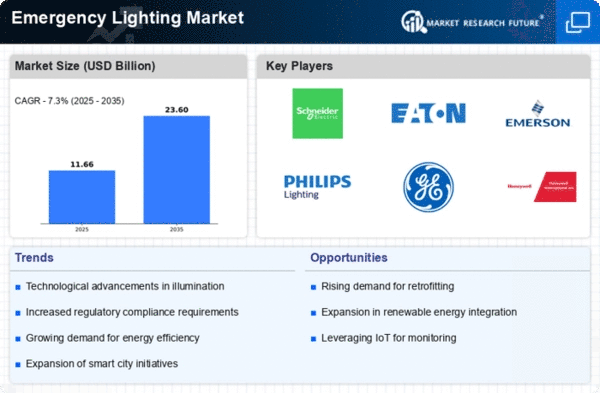
As per MRFR analysis, the Emergency Lighting Market was estimated at 10.87 USD Billion in 2024. The Emergency Lighting industry is projected to grow from 11.67 USD Billion in 2025 to 23.6 USD Billion by 2035, exhibiting a compound annual growth rate (CAGR) of 7.3 during the forecast period 2025 - 2035.

Key Market Trends & Highlights

The Emergency Lighting Market is poised for substantial growth driven by technological advancements and increasing safety regulations.

  • North America remains the largest market for emergency lighting, driven by stringent safety standards and regulations.
  • The Asia-Pacific region is emerging as the fastest-growing market, fueled by rapid urbanization and infrastructure development.
  • The commercial segment dominates the market, while the industrial segment is experiencing the fastest growth due to heightened safety awareness.
  • Technological advancements and increased safety regulations are key drivers propelling the demand for emergency lighting solutions.

Market Size & Forecast

2024 Market Size 10.87 (USD Billion)
2035 Market Size 23.6 (USD Billion)
CAGR (2025 - 2035) 7.3%

Major Players

Schneider Electric (FR), Eaton Corporation (US), Honeywell International (US), Emerson Electric (US), Philips Lighting (NL), General Electric (US), Acuity Brands (US), Osram Licht AG (DE), Cooper Lighting Solutions (US). Several of these players maintain a strong presence across regional markets, including deployments such as east coast emergency lighting projects in commercial and industrial facilities.

Our Impact
Enabled $4.3B Revenue Impact for Fortune 500 and Leading Multinationals
Partnering with 2000+ Global Organizations Each Year
30K+ Citations by Top-Tier Firms in the Industry

Emergency Lighting Market Trends

The Emergency Lighting Market is currently experiencing a notable transformation driven by advancements in technology and increasing safety regulations. As urbanization continues to rise, the demand for reliable emergency lighting solutions is becoming more pronounced. This market encompasses a variety of products designed to provide illumination during power outages or emergencies, ensuring safety in commercial, residential, and industrial settings. The integration of smart technologies, such as IoT and wireless systems, is enhancing the functionality and efficiency of these lighting solutions, including central battery systems for emergency lighting, making them more appealing to consumers and businesses alike.

Moreover, the growing awareness of safety standards and regulations is prompting organizations to invest in high-quality emergency lighting systems. This trend is particularly evident in sectors such as healthcare, education, and hospitality, where the need for effective emergency preparedness is paramount. As a result, manufacturers are focusing on developing innovative products that not only meet regulatory requirements but also offer energy efficiency and sustainability. The Emergency Lighting Market appears poised for continued growth as stakeholders recognize the importance of reliable lighting solutions in safeguarding lives and property during unforeseen events.

Technological Integration

The Emergency Lighting Market is witnessing a surge in the adoption of advanced technologies. Innovations such as LED lighting and smart control systems are enhancing the efficiency and effectiveness of emergency lighting solutions, including central battery systems for emergency lighting. These technologies not only improve energy consumption but also extend the lifespan of lighting products, making them more cost-effective for users.

Sustainability Focus

There is a growing emphasis on sustainability within the Emergency Lighting Market. Consumers and businesses are increasingly seeking eco-friendly lighting solutions that minimize environmental impact, accelerating the adoption of energy-efficient systems and central battery systems for emergency lighting.

Regulatory Compliance

Evolving safety regulations are driving the demand for advanced emergency lighting solutions. Organizations across various sectors are compelled to adopt compliant systems, ensuring the safety of occupants during emergencies and enhancing overall preparedness.

Emergency Lighting Market Drivers

Rising Urbanization

Urbanization is a key driver of the Global Emergency Lighting Market Industry, as more people migrate to urban areas, leading to increased infrastructure development. Cities are expanding, necessitating the installation of emergency lighting systems in high-rise buildings, public transport facilities, and commercial establishments. This trend is particularly evident in developing regions where rapid urban growth is occurring. The demand for reliable emergency lighting solutions is expected to surge, contributing to a compound annual growth rate (CAGR) of 7.3% from 2025 to 2035. This urban expansion underscores the critical need for effective emergency preparedness measures.

Technological Advancements

Technological innovations are significantly influencing the Global Emergency Lighting Market Industry. The introduction of LED technology has revolutionized emergency lighting solutions, offering energy efficiency, longer lifespans, and reduced maintenance costs. Moreover, smart emergency lighting systems, which integrate IoT capabilities, allow for real-time monitoring and control. These advancements not only enhance performance but also align with sustainability goals, appealing to environmentally conscious consumers. As a result, the market is poised for growth, with projections indicating a value of 23.6 USD Billion by 2035, reflecting the increasing adoption of advanced lighting technologies.

Increasing Safety Regulations

The Global Emergency Lighting Market Industry is experiencing growth driven by the implementation of stringent safety regulations across various sectors. Governments worldwide are mandating the installation of emergency lighting systems in commercial and residential buildings to enhance safety during emergencies. For instance, the National Fire Protection Association (NFPA) has established codes that require adequate emergency lighting in public spaces. This regulatory push is expected to contribute to the market's expansion, as organizations invest in compliant systems. The increasing focus on safety is likely to propel the market value, projected to reach 10.9 USD Billion in 2024.

Growing Awareness of Emergency Preparedness

The Global Emergency Lighting Market Industry is benefiting from a heightened awareness of emergency preparedness among businesses and consumers. As natural disasters and unforeseen events become more frequent, organizations are increasingly prioritizing safety measures, including emergency lighting systems. This awareness is driving investments in reliable lighting solutions that ensure visibility during power outages or emergencies. Educational campaigns and training programs are further promoting the importance of emergency preparedness, leading to increased sales of lighting products. Consequently, the market is expected to grow steadily, reflecting the changing attitudes towards safety and preparedness.

Market Segment Insights

By Application: Commercial (Largest) vs. Industrial (Fastest-Growing)

In the Emergency Lighting Market, the application segment is characterized by various sectors, each contributing to the overall market share. The commercial sector holds the largest share, attributed to the increasing demand for safety regulations and compliance in buildings. Following closely is the industrial sector, which has shown significant traction as industries strive to enhance worker safety and operational reliability. Other important applications include residential, healthcare, and transportation, but they lag behind in sheer market share. The growth trends within the application segment reveal that while commercial applications dominate, industrial applications are the fastest-growing. Driven by stricter occupational health and safety regulations, industries are investing heavily in emergency lighting solutions. Healthcare facilities are also upgrading their systems to improve patient safety and comply with updated standards, while the transportation sector focuses on innovative solutions to enhance safety protocols.

Commercial (Dominant) vs. Transportation (Emerging)

The commercial application segment of the Emergency Lighting Market remains dominant due to its extensive use in corporate offices, retail establishments, and public buildings. This sector prioritizes compliance with safety regulations and recognizes the necessity of reliable lighting during emergencies. In comparison, the transportation sector is an emerging area within this market. Here, emergency lighting solutions are increasingly being integrated into public transportation systems, including buses and trains, to ensure passenger safety. The growing emphasis on enhancing safety features in transit systems, as well as the rise in innovative designs for emergency lighting, position this segment as a key area for future development and investment.

By End Use: Retail (Largest) vs. Hospitality (Fastest-Growing)

In the Emergency Lighting Market, the distribution of market share among end-use segments reveals that retail holds the largest share, significantly benefitting from stringent safety regulations and a focus on enhancing customer experience. Following closely are segments like hospitality and manufacturing, where proactive safety measures are increasingly prioritized to ensure compliance and safety standards. The education and public sector segments also contribute but on a smaller scale, reflecting varying levels of investment in emergency preparedness across different regions.

Retail (Dominant) vs. Hospitality (Emerging)

The retail sector stands out as a dominant player within the Emergency Lighting Market due to its extensive customer base and the necessity for safety compliance in public-facing settings. Major retailers are investing in advanced emergency lighting solutions to enhance safety and reassurance for shoppers. In contrast, the hospitality sector is emerging as a fastest-growing segment, driven by the need for improved emergency protocols and guest safety. Hotels and restaurants are increasingly adopting innovative emergency lighting systems to comply with safety regulations, demonstrating a forward-looking approach to guest protection.

By Technology: LED (Largest) vs. Fluorescent (Fastest-Growing)

In the Emergency Lighting Market, the technology segment is led predominantly by LED lights, which have established their dominance due to their energy efficiency, long lifespan, and lower maintenance costs. Fluorescent lamps are also a significant player in the market, but their share is gradually being supplanted by innovations in LED technology. This shift indicates that while fluorescent lighting remains prevalent, it is clearly overshadowed by the rising favor of LEDs among consumers and businesses alike. Growth trends within the technology segment are being driven by an increasing focus on sustainability and energy conservation. Concerns over energy consumption and environmental impact have accelerated the transition to LED technology, which is seeing rapid advancements and cost reductions. Meanwhile, fluorescent technology, though losing ground, continues to evolve with improvements in efficiency and brightness, appealing to specific sectors seeking cost-effective solutions. This dynamic interplay between established and emerging technologies shapes the competitive landscape of the market.

Technology: LED (Dominant) vs. Fluorescent (Emerging)

LED emergency lighting has taken a dominant position in the market, primarily due to its unparalleled energy efficiency and durability. These lights provide superior brightness and a longer operational lifespan, making them ideal for critical emergency situations. On the other hand, fluorescent emergency lighting is positioned as an emerging technology, gaining traction through continuous improvements in performance and cost-effectiveness. Despite facing competition from LEDs, fluorescent lights are favored in certain applications due to their lower initial costs and better performance in temperature-regulated environments. As the market evolves, both technologies are likely to coexist, catering to varied preferences and requirements across industries.

By Power Source: Battery Powered (Largest) vs. Solar Powered (Fastest-Growing)

The Emergency Lighting Market demonstrates a diverse distribution among its power source segments. Battery Powered solutions hold the largest market share, primarily due to their reliability and ease of installation in various settings. Hardwired systems follow closely, favored in permanent installations for their longevity and lower maintenance needs. Solar Powered systems are gaining traction, driven by advancements in technology and increasing awareness of sustainable practices.

Battery Powered (Dominant) vs. Solar Powered (Emerging)

Battery Powered emergency lighting systems continue to dominate the market, prized for their portability and independence from electrical grids. Their performance in emergencies is well-illustrated through their consistent usage in residential, commercial, and industrial sectors. Conversely, Solar Powered systems are emerging as a key player, appealing especially in off-grid locations and environmentally-conscious markets. Their growth is propelled by reductions in solar technology costs and increasing governmental incentives for renewable energy solutions, making them a preferable choice for future installations.

By Installation Type: Fixed (Largest) vs. Portable (Fastest-Growing)

The Emergency Lighting Market showcases a diverse range of installation types, with fixed emergency lighting solutions holding the largest share. This category is favored in commercial buildings and critical infrastructure for its reliability and regulatory compliance. Portable emergency lighting, however, is gaining traction as an essential safety tool in various sectors, including construction and outdoor events. Its ease of use and versatility make it an appealing choice for immediate deployment in emergencies.

Fixed (Dominant) vs. Portable (Emerging)

Fixed emergency lighting solutions are characterized by their permanent installation in structures, providing consistent illumination during power failures. They comply with strict safety regulations, making them a preferred choice in commercial and industrial settings. On the other hand, portable emergency lighting is becoming increasingly popular due to its mobility and ease of setup, catering to the needs of dynamic environments. It appeals particularly to sectors that require temporary lighting solutions, such as construction sites and outdoor events. This segment’s growth is driven by the need for adaptable safety measures, with manufacturers innovating to enhance the features of portable offerings.

Get more detailed insights about Emergency Lighting Market

Regional Insights

North America : Market Leader in Emergency Lighting

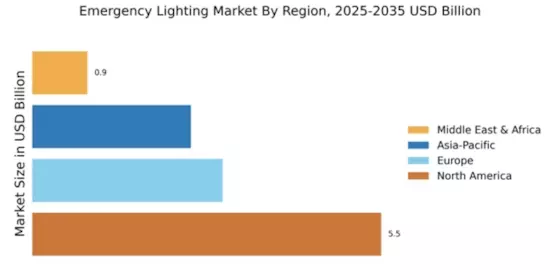
North America is poised to maintain its leadership in the Emergency Lighting Market, holding a significant market share of 5.5 in 2024. The region's growth is driven by stringent safety regulations, increasing urbanization, and a rising focus on energy-efficient solutions. The demand for reliable emergency lighting systems is further fueled by the growing number of commercial and residential buildings requiring compliance with safety standards. The competitive landscape in North America is robust, featuring key players such as Eaton Corporation, General Electric, and Honeywell International. These companies are investing heavily in R&D to innovate and enhance their product offerings. The presence of advanced infrastructure and a strong distribution network also contribute to the region's market dominance, ensuring that emergency lighting solutions are readily available across various sectors.

Europe : Emerging Market with Growth Potential

Europe is witnessing a growing demand for emergency lighting solutions, with a market size of 3.0 in 2024. This growth is driven by increasing regulatory requirements for safety in public spaces and commercial buildings. The European Union's commitment to enhancing safety standards and promoting energy-efficient technologies is a significant catalyst for market expansion. Additionally, the rise in awareness regarding workplace safety is propelling the demand for reliable emergency lighting systems. Leading countries in this region include Germany, France, and the UK, where major players like Philips Lighting and Schneider Electric are actively competing. The competitive landscape is characterized by innovation and strategic partnerships aimed at enhancing product offerings. The presence of established companies and a focus on sustainability are key factors contributing to the region's growth in the emergency lighting market.

Asia-Pacific : Rapidly Growing Market Dynamics

The Asia-Pacific region is emerging as a significant player in the Emergency Lighting Market, with a market size of 2.5 in 2024. The growth is primarily driven by rapid urbanization, increasing investments in infrastructure, and a rising focus on safety regulations. Countries like China and India are witnessing a surge in demand for emergency lighting solutions due to their expanding commercial and residential sectors. Additionally, government initiatives aimed at enhancing public safety are further propelling market growth. The competitive landscape in Asia-Pacific is evolving, with key players such as Acuity Brands and Emerson Electric making significant inroads. The region's market is characterized by a mix of local and international companies, fostering innovation and competitive pricing. As safety standards continue to tighten, the demand for advanced emergency lighting solutions is expected to rise, positioning Asia-Pacific as a vital market for future growth.

Middle East and Africa : Emerging Market with Unique Challenges

The Middle East and Africa region is gradually developing its Emergency Lighting Market, currently valued at 0.87 in 2024. The growth is driven by increasing urbanization, infrastructural development, and a growing awareness of safety regulations. However, challenges such as economic instability and varying regulatory frameworks across countries can hinder market growth. Despite these challenges, the demand for reliable emergency lighting solutions is on the rise, particularly in urban areas. Leading countries in this region include South Africa and the UAE, where key players like Cooper Lighting Solutions are establishing a presence. The competitive landscape is characterized by a mix of local and international companies striving to meet the growing demand. As the region continues to develop, the focus on safety and compliance will likely drive further investments in emergency lighting solutions.

Emergency Lighting Market Regional Image

Key Players and Competitive Insights

The Emergency Lighting Market is currently characterized by a dynamic competitive landscape, driven by increasing safety regulations and the growing demand for reliable lighting solutions in emergencies. Key players such as Schneider Electric (FR), Eaton Corporation (US), and Philips Lighting (NL) are strategically positioned to leverage innovation and technological advancements. Schneider Electric (FR) focuses on integrating smart technologies into their emergency lighting systems, enhancing energy efficiency and user experience. Eaton Corporation (US) emphasizes sustainability in its product offerings, aligning with global trends towards eco-friendly solutions. Philips Lighting (NL) is actively pursuing partnerships to expand its market reach, particularly in emerging economies, thereby shaping a competitive environment that prioritizes innovation and regional adaptability. In terms of business tactics, companies are increasingly localizing manufacturing to reduce lead times and optimize supply chains. The market structure appears moderately fragmented, with several players vying for market share. However, the collective influence of major companies like General Electric (US) and Honeywell International (US) is notable, as they continue to set industry standards and drive technological advancements. This competitive structure fosters an environment where innovation is paramount, compelling companies to continuously enhance their product offerings. In November 2025, Eaton Corporation (US) announced the launch of a new line of energy-efficient emergency lighting solutions designed to meet the latest safety standards. This strategic move not only reinforces Eaton's commitment to sustainability but also positions the company to capture a larger share of the growing market for eco-friendly lighting solutions. The introduction of these products is likely to enhance Eaton's competitive edge, particularly among environmentally conscious consumers and businesses. In October 2025, Philips Lighting (NL) entered into a strategic partnership with a leading technology firm to develop AI-driven emergency lighting systems. This collaboration aims to integrate advanced analytics and machine learning into lighting solutions, thereby improving response times during emergencies. The significance of this partnership lies in its potential to revolutionize how emergency lighting systems operate, making them more responsive and efficient, which could set a new benchmark in the industry. In December 2025, Schneider Electric (FR) unveiled a new digital platform that allows users to monitor and manage their emergency lighting systems remotely. This innovation reflects a broader trend towards digitalization in the industry, enabling enhanced control and maintenance of lighting systems. The strategic importance of this development cannot be overstated, as it aligns with the increasing demand for smart building technologies and positions Schneider Electric as a leader in the digital transformation of emergency lighting. As of December 2025, current competitive trends in the Emergency Lighting Market are heavily influenced by digitalization, sustainability, and the integration of AI technologies. Strategic alliances are becoming increasingly vital, as companies seek to enhance their technological capabilities and market presence. Looking ahead, it is anticipated that competitive differentiation will evolve, shifting from traditional price-based competition to a focus on innovation, technology integration, and supply chain reliability. This transition underscores the necessity for companies to adapt and innovate continuously in order to maintain a competitive advantage.

Key Companies in the Emergency Lighting Market include

Industry Developments

October 2023: With the all-new extreme off-road Emergency Light Kit featuring Infrared (IR) and Blackout, the Polaris GENERAL XP 1000, which combines the unrivaled performance of RZR with the hardworking utility of RANGER, is now prepared for any situation. The durable light system, which comes mounted on a four-seat General XP 4 1000 UTV, will make its public premiere from October 14–17 at the International Association of Chiefs of Police (IACP) Conference and Exposition in San Diego, California. 

Additionally, the Polaris XPEDITION, which debuted in June 2023, will make its debut at IACP. The Polaris XPEDITION is a first-of-its-kind crossover side-by-side that combines the all-terrain capabilities of conventional side-by-sides with the comfort and load capacity usually associated with overlanding. With a fuel range of more than 200 miles, a payload capacity of 1,160 pounds, and a towing capability of 2,000 pounds, the vehicle is built to hold more equipment and provide better weather protection. Visitors can also see a three-seat RANGER XP 1000 NorthStar with emergency lighting and a rescue skid on show at the Polaris exhibit.

Additionally, the all-electric RANGER XP Kinetic, which has a standalone emergency light system, will be available for hands-on inspection.

A 50-inch tactical lightbar, a 35-inch lightbar, and integrated emergency lights around the vehicle body make up the new robust Emergency Light Kit with IR and Blackout, which offers a complete 360-degree package in a variety of color combinations. When discretion is required, infrared and blackout light solutions provide law enforcement officers the assurance and readiness they need to carry out their duties. For effective communication and vehicle warning, the emergency light package also includes a digital control panel with PA system and a 100W siren speaker.

When a car is equipped with PriorityStart, low voltage is recognized and the battery is immediately unplugged to help restart the car when it is most required.   

June 2022: Energy Focus, Inc. has announced the inclusion of three major product lines in the LightFair 2022, which will be held at the Las Vegas Convention Center from June 21 to June 23, 2022. RedCap LED Emergency Battery Backup is a general-purpose illumination and emergency backup solution.

February 2021: Orient Electric Ltd has introduced a new line of emergency LED lighting solutions, including LED bulbs, LED battens, LED recess panels, and LED bulbs. During power outages, the lighting solutions provide a safe backup for illumination for up to 240 minutes when the light products come on automatically, allowing routine operations to continue.

Schneider Electric received accolades in the category of ‘Outstanding Contribution to Sustainability and Efficiency’ at the DCS Awards in November 2021, as well as a special project award for “Sustainability in the Data Center Project of the Year” with Elite Partners Advanced Power Technology. The effort was a joint venture involving Newcastle City Council's modernization program focusing on reducing carbon emissions through energy-efficient technologies as part of its broader digital transformation initiative.

The acquisition of Sparta Systems by Honeywell was concluded to cost USD1303 million in February 2021, further consolidating its position as an industrial automation company, digital transformation solutions provider, and enterprise performance management software provider. Honeywell’s Performance Materials and Technologies segment included this acquisition, thereby contributing to its strategic growth.

Orient Electric made significant progress entering into the smart lighting sector by unveiling a variety of types of LED emergency lights in February 2021. These lamps provide up to four hours of illumination during blackouts and exist in several forms, such as LED bulbs, LED strips, LED recessed plates, and bulkheads. They work like other normal sources of light before changing over into an emergency mode, where they illuminate following sudden power interruptions. Orient Electric has entered this booming market for smart lighting products aimed at bolstering sales volumes.

Energy Focus Inc. announced showcasing three core product lines at the Las Vegas Convention Centre from June twenty-one to twenty-three LightFair 2022 in Las Vegas between June 21 and June 23, 2022. Among these products is a general-purpose lighting device with integrated tubular LEDs and RedCap LED emergency battery backup. This tube also serves as a normal light source and maintains operations during power outages. The time and effort required for maintenance are reduced by this device since it does not need any light sources or emergency ballasts.


Future Outlook

Emergency Lighting Market Future Outlook

The Emergency Lighting Market is projected to grow at a 7.3% CAGR from 2025 to 2035, driven by increasing safety regulations, technological advancements, and urbanization.

New opportunities lie in:

  • Integration of IoT for smart emergency lighting systems Development of solar-powered emergency lighting solutions Expansion into emerging markets with tailored products

By 2035, the Emergency Lighting Market is expected to be robust, driven by innovation and strategic expansion.

Market Segmentation

Emergency Lighting Market End Use Outlook

  • Retail
  • Manufacturing
  • Hospitality
  • Education
  • Public Sector

Emergency Lighting Market Technology Outlook

  • LED
  • Fluorescent
  • Incandescent
  • Halogen
  • Solar

Emergency Lighting Market Application Outlook

  • Commercial
  • Industrial
  • Residential
  • Healthcare
  • Transportation

Emergency Lighting Market Power Source Outlook

  • Battery Powered
  • Hardwired
  • Solar Powered
  • Hybrid
  • Generator

Emergency Lighting Market Installation Type Outlook

  • Portable
  • Fixed
  • Surface Mounted
  • Recessed
  • Emergency Exit

Report Scope

MARKET SIZE 2024 10.87(USD Billion)
MARKET SIZE 2025 11.67(USD Billion)
MARKET SIZE 2035 23.6(USD Billion)
COMPOUND ANNUAL GROWTH RATE (CAGR) 7.3% (2025 - 2035)
REPORT COVERAGE Revenue Forecast, Competitive Landscape, Growth Factors, and Trends
BASE YEAR 2024
Market Forecast Period 2025 - 2035
Historical Data 2019 - 2024
Market Forecast Units USD Billion
Key Companies Profiled Schneider Electric (FR), Eaton Corporation (US), Emerson Electric (US), Philips Lighting (NL), General Electric (US), Honeywell International (US), Acuity Brands (US), Lithonia Lighting (US), Cooper Lighting Solutions (US)
Segments Covered Application, End Use, Technology, Power Source, Installation Type
Key Market Opportunities Integration of smart technology in Emergency Lighting Market enhances safety and energy efficiency.
Key Market Dynamics Rising regulatory standards and technological advancements drive innovation in the Emergency Lighting Market.
Countries Covered North America, Europe, APAC, South America, MEA

Market Highlights

Author
Ankit Gupta
Senior Research Analyst

Ankit Gupta is an analyst in market research industry in ICT and SEMI industry. With post-graduation in "Telecom and Marketing Management" and graduation in "Electronics and Telecommunication" vertical he is well versed with recent development in ICT industry as a whole. Having worked on more than 150+ reports including consultation for fortune 500 companies such as Microsoft and Rio Tinto in identifying solutions with respect to business problems his opinions are inclined towards mixture of technical and managerial aspects.

Leave a Comment

FAQs

How much is the emergency lighting market?

The Emergency Lighting Market size was valued at USD 10.87 billion in 2024.

What is the growth rate of the emergency lighting market?

The global market is projected to grow at a CAGR of 7.30% during the forecast period, 2025 to 2035.

Which region held the largest market share in the emergency lighting market?

Asia Pacific had the largest share of the global market

Who are the key players in the emergency lighting market?

The key players in the market are Philips Lighting Holding B.V. (Netherlands), Hubbell Lighting Inc. (U.S.), Cooper Industries (Ireland), and Schneider Electric Se (France).

Which components led the emergency lighting market?

The hardware category dominated the market in 2022.

Which light source segment had the largest market share in the emergency lighting market?

The fluorescent segment had the largest share of the global market.

Download Free Sample

Kindly complete the form below to receive a free sample of this Report

Compare Licence

×
Features License Type
Single User Multiuser License Enterprise User
Price $4,950 $5,950 $7,250
Maximum User Access Limit 1 User Upto 10 Users Unrestricted Access Throughout the Organization
Free Customization
Direct Access to Analyst
Deliverable Format
Platform Access
Discount on Next Purchase 10% 15% 15%
Printable Versions