×
Request Free Sample ×

Kindly complete the form below to receive a free sample of this Report

* Please use a valid business email

Leading companies partner with us for data-driven Insights

clients tt-cursor
Hero Background

Embedded Systems Market

ID: MRFR/SEM/7191-HCR
111 Pages
Aarti Dhapte
February 2026

Embedded Systems Market Size, Share and Research Report By Application (Consumer Electronics, Automotive, Industrial Automation, Healthcare, Telecommunications), By Type (Hardware, Software, Hybrid Systems), By End Use (Aerospace, Consumer Electronics, Medical Devices, Smart Appliances, Automotive), By Technology (Microcontrollers, Digital Signal Processors, Field Programmable Gate Arrays, Application Specific Integrated Circuits) and By Regional (North America, Europe, South America, Asia Pacific, Middle East and Africa) - Industry Forecast Till 2035

Share:
Download PDF ×

We do not share your information with anyone. However, we may send you emails based on your report interest from time to time. You may contact us at any time to opt-out.

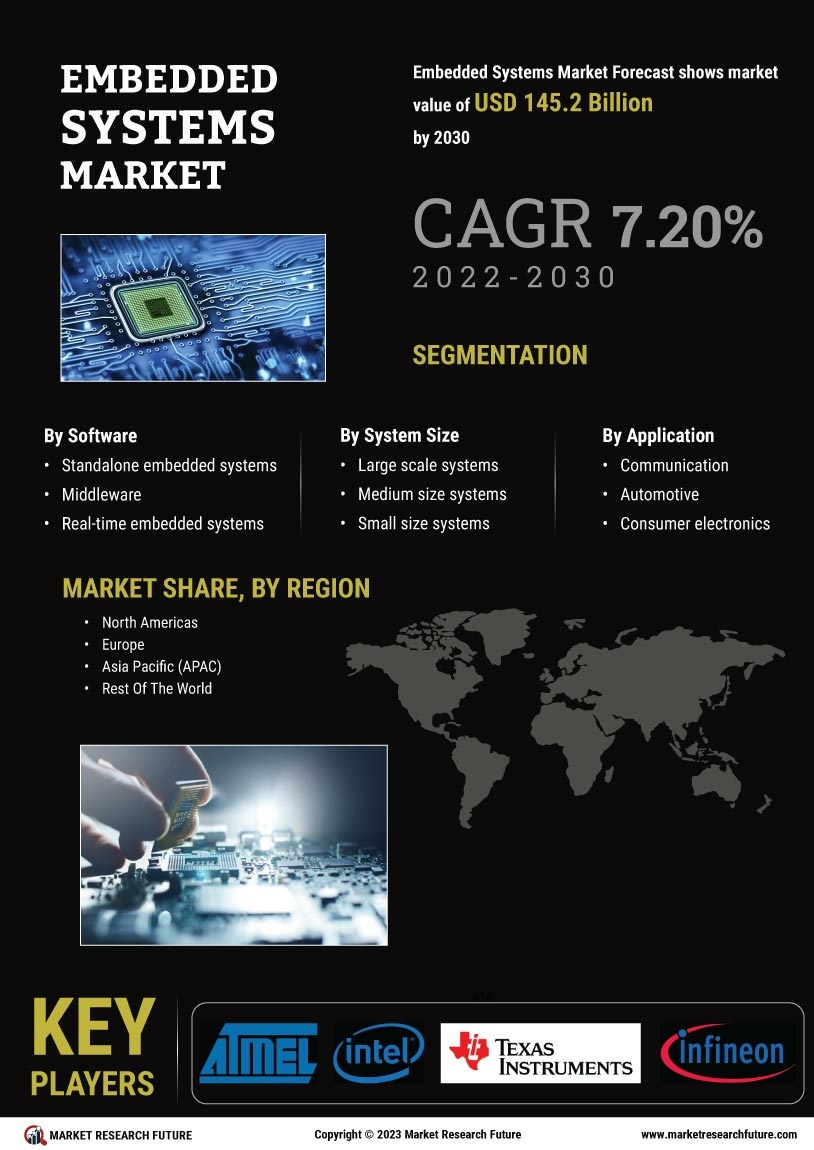
Embedded Systems Market Infographic
Purchase Options

Embedded Systems Market Summary

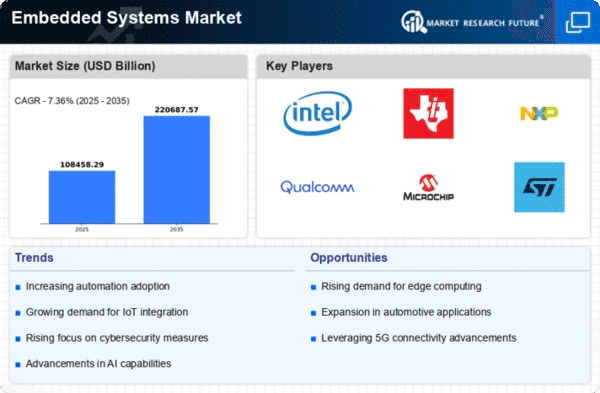
As per MRFR analysis, the Embedded Systems Market Size was estimated at 101023.0 USD Billion in 2024. The Embedded Systems industry is projected to grow from 108460.34 USD Billion in 2025 to 220687.57 USD Billion by 2035, exhibiting a compound annual growth rate (CAGR) of 7.36 during the forecast period 2025 - 2035.

Key Market Trends & Highlights

The Embedded Systems Market is poised for substantial growth driven by technological advancements and increasing demand across various sectors.

  • The integration of AI and Machine Learning is transforming embedded systems, enhancing their capabilities and efficiency.
  • North America remains the largest market, while Asia-Pacific is emerging as the fastest-growing region in the embedded systems landscape.
  • Consumer Electronics continues to dominate the market, whereas Automotive is rapidly gaining traction as a key growth segment.
  • Rising demand for IoT devices and advancements in automotive technology are significant drivers propelling market expansion.

Market Size & Forecast

2024 Market Size 101023.0 (USD Billion)
2035 Market Size 220687.57 (USD Billion)
CAGR (2025 - 2035) 7.36%

Major Players

Intel Corporation (US), Texas Instruments (US), NXP Semiconductors (NL), Qualcomm Incorporated (US), Microchip Technology Inc. (US), STMicroelectronics (CH), Analog Devices, Inc. (US), Renesas Electronics Corporation (JP), Infineon Technologies AG (DE), Broadcom Inc. (US)

Our Impact
Enabled $4.3B Revenue Impact for Fortune 500 and Leading Multinationals
Partnering with 2000+ Global Organizations Each Year
30K+ Citations by Top-Tier Firms in the Industry

Embedded Systems Market Trends

The Embedded Systems Market is currently experiencing a dynamic evolution, driven by advancements in technology and increasing demand across various sectors. This market encompasses a wide array of applications, including automotive, consumer electronics, healthcare, and industrial automation. As devices become more interconnected, the need for efficient and reliable embedded systems has intensified. Companies are focusing on enhancing performance while minimizing power consumption, which appears to be a critical factor in product development. Furthermore, the integration of artificial intelligence and machine learning into embedded systems is likely to reshape functionalities, enabling smarter and more adaptive devices. In addition, the Embedded Systems Market is witnessing a shift towards open-source platforms and collaborative development environments. This trend suggests that organizations are increasingly recognizing the benefits of shared resources and community-driven innovation. As a result, the market landscape is becoming more competitive, with new entrants challenging established players. Moreover, the emphasis on cybersecurity within embedded systems is growing, as vulnerabilities in connected devices pose significant risks. Overall, the Embedded Systems Market is poised for continued growth, with emerging technologies and collaborative approaches driving its future trajectory.

Integration of AI and Machine Learning

The incorporation of artificial intelligence and machine learning into embedded systems is transforming their capabilities. This trend indicates a movement towards smarter devices that can learn from data and adapt to user needs, enhancing overall functionality.

Shift to Open-Source Platforms

There is a noticeable transition towards open-source platforms within the Embedded Systems Market. This shift suggests that companies are leveraging community-driven resources to foster innovation and reduce development costs.

Focus on Cybersecurity

As the number of connected devices increases, the emphasis on cybersecurity in embedded systems is intensifying. This trend highlights the necessity for robust security measures to protect against potential vulnerabilities and threats.

Embedded Systems Market Drivers

Healthcare Innovations

The healthcare sector is rapidly adopting embedded systems to improve patient care and streamline operations. From medical devices to telehealth solutions, embedded systems are integral to enhancing diagnostic capabilities and monitoring patient health. The Global Embedded Systems Market Industry is benefiting from this trend, as healthcare providers seek to leverage technology for better outcomes. Innovations such as wearable health monitors and smart medical devices are becoming commonplace, driving demand for embedded solutions. This growth is indicative of a broader shift towards technology-driven healthcare, which is likely to expand the market significantly in the coming years.

Market Growth Projections

The Global Embedded Systems Market Industry is poised for substantial growth in the coming years. Projections indicate that the market will reach 136.0 USD Billion in 2024 and is expected to expand to 229.6 USD Billion by 2035. This growth trajectory reflects a compound annual growth rate of 4.88% from 2025 to 2035. The increasing integration of embedded systems across various sectors, including automotive, healthcare, and telecommunications, underscores the market's potential. As industries continue to innovate and adopt advanced technologies, the embedded systems market is likely to thrive, driven by evolving consumer demands and technological advancements.

Rising Demand for Smart Devices

The increasing proliferation of smart devices across various sectors is a primary driver of the Global Embedded Systems Market Industry. As consumers and businesses alike seek enhanced functionality and connectivity, the demand for embedded systems in smartphones, wearables, and home automation devices continues to surge. In 2024, the market is projected to reach 136.0 USD Billion, reflecting a robust growth trajectory. This trend is likely to persist as advancements in Internet of Things (IoT) technology further integrate embedded systems into everyday applications, thereby expanding their market presence and driving innovation.

Automotive Sector Transformation

The automotive industry is undergoing a significant transformation, largely fueled by the integration of embedded systems. With the rise of electric vehicles and autonomous driving technologies, the Global Embedded Systems Market Industry is experiencing heightened demand for sophisticated embedded solutions. These systems are essential for managing vehicle functions, enhancing safety features, and improving overall user experience. As the automotive sector evolves, it is anticipated that the market will grow substantially, potentially reaching 229.6 USD Billion by 2035. This shift indicates a strong correlation between automotive advancements and the embedded systems market.

Industrial Automation and Control

Industrial automation is a critical driver for the Global Embedded Systems Market Industry, as manufacturers increasingly adopt smart technologies to enhance operational efficiency. Embedded systems play a vital role in automating processes, monitoring equipment, and ensuring quality control. The push towards Industry 4.0 is propelling investments in embedded solutions, which are essential for real-time data processing and analytics. As industries strive for greater productivity and reduced operational costs, the embedded systems market is expected to witness a compound annual growth rate of 4.88% from 2025 to 2035, underscoring the importance of these technologies in modern manufacturing.

Telecommunications Infrastructure Development

The expansion of telecommunications infrastructure is a significant driver for the Global Embedded Systems Market Industry. As global connectivity increases, the demand for embedded systems in networking equipment, routers, and communication devices is on the rise. These systems are crucial for managing data traffic and ensuring reliable communication services. With the rollout of 5G technology, the need for advanced embedded solutions is expected to escalate, facilitating faster and more efficient data transmission. This trend highlights the interdependence between telecommunications advancements and the embedded systems market, suggesting a robust growth outlook.

Market Segment Insights

By Application: Consumer Electronics (Largest) vs. Automotive (Fastest-Growing)

The Embedded Systems Market displays diverse application segments, with Consumer Electronics holding the largest share. This segment includes smart devices, wearables, and home automation, emphasizing convenience and enhanced user experience. Automotive, on the other hand, represents the fastest-growing segment, fueled by advancements in autonomous driving technology and increased integration of cutting-edge embedded solutions in vehicles. As these industries adopt embedded systems, the market dynamics reflect shifting consumer needs and technological advancements.

Application: Consumer Electronics (Dominant) vs. Automotive (Emerging)

Consumer Electronics segments dominate the Embedded Systems Market due to the high demand for interconnected devices that enhance everyday life. This includes products like smartphones, tablets, and smart home devices that require robust embedded systems for functionality and performance. Traditionally, the automotive sector has been slower to adopt embedded systems; however, it is now emerging rapidly, driven by advancements in vehicle automation, infotainment systems, and increased focus on safety features. The shift towards electric vehicles and smart transportation systems signifies a notable transition for automotive applications, marking it as an essential area for future growth and innovation.

By End Use: Embedded Software (Largest) vs. Embedded Hardware (Fastest-Growing)

The Embedded Systems Market is witnessing a diverse distribution of market share among its end-use components. Embedded Software dominates this segment, significantly influencing overall architectural efficiency and operational flexibility. Conversely, Embedded Hardware, while currently smaller in share, is rapidly expanding as manufacturers increasingly prioritize the development of optimized hardware solutions and integration for advanced functionality. Growth trends within the segment suggest a robust inclination toward Embedded Hardware, driven by technological advancements and demand for more sophisticated devices. As IoT and AI technologies evolve, they catalyze a propulsion in hardware design and integration strategies, igniting faster growth in this segment. Meanwhile, Embedded Software remains critical for ensuring device functionality and user experience, enhancing its market share further.

Embedded Software (Dominant) vs. Embedded Firmware (Emerging)

Embedded Software is firmly established as the dominant force in the Embedded Systems Market, playing a crucial role in managing and facilitating the functionality of various devices. It encompasses a range of applications vital for performance optimization and seamless user experiences. The push towards more complex embedded applications, especially in IoT ecosystems, continues to solidify its market position. In contrast, Embedded Firmware is viewed as an emerging segment characterized by its specific role in providing low-level control for devices. As technology evolves, the importance of firmware grows, underscoring its necessity in ensuring system integrity and security. This segment is expected to gain traction as manufacturers look for ways to enhance device capabilities and security through improved firmware solutions.

By Technology: Microcontrollers (Largest) vs. Digital Signal Processors (Fastest-Growing)

In the Embedded Systems Market, Microcontrollers hold the largest share due to their versatility and wide-ranging applications in consumer electronics, automotive, and industrial sectors. Digital Signal Processors (DSPs) are observing remarkable growth, fueled by increasing demand for high-performance signal processing in audio, video, and communications systems. Field Programmable Gate Arrays (FPGAs) and Application Specific Integrated Circuits (ASICs) also contribute to the market but with smaller shares compared to Microcontrollers and DSPs.

Microcontrollers: Dominant vs. Digital Signal Processors: Emerging

Microcontrollers are renowned for their simplicity, cost-effectiveness, and ubiquitous presence across various devices, making them the backbone of many embedded systems. Their ability to integrate multiple functionalities on a single chip allows manufacturers to optimize product designs and reduce costs. On the other hand, Digital Signal Processors are emerging as a critical technology in real-time computing applications. Their specialized architecture is tailored for intensive mathematical calculations, which is essential in industries like telecommunications and automotive. As the market moves towards more sophisticated technologies like IoT and AI, the demand for DSPs is rising, indicating a shift towards more complex embedded solutions.

By Form Factor: Integrated Circuits (Largest) vs. System on Chip (Fastest-Growing)

The Embedded Systems Market showcases a diverse range of form factors, with Integrated Circuits leading the market due to their compact design and high efficiency. Modules and Single Board Computers also hold considerable shares, catering to different applications across industries. As technology evolves, the distribution reflects the growing demand for more integrated solutions, with customers increasingly favoring form factors that offer enhanced performance and reliability. In terms of growth, System on Chip (SoC) is identified as the fastest-growing segment within the Embedded Systems Market. The rapid advancement in IoT and smart technology applications is driving the demand for SoCs. These solutions combine essential components into a single chip, enabling manufacturers to create smaller, more efficient devices that align with the trends of miniaturization and integration in modern technology.

Integrated Circuits (Dominant) vs. System on Chip (Emerging)

Integrated Circuits are characterized by their ability to perform complex functions in a compact size, making them a dominant force in the Embedded Systems Market. They are widely utilized in various devices due to their efficiency and reliability, serving as the backbone of most electronic applications. Conversely, System on Chip is emerging as a critical player, integrating all components of a computer or other electronic system onto a single chip. This innovation allows for reduced power consumption, smaller physical size, and enhanced performance, appealing to sectors focused on automation and connectivity, particularly in IoT applications.

Get more detailed insights about Embedded Systems Market

Regional Insights

North America : Innovation and Leadership Hub

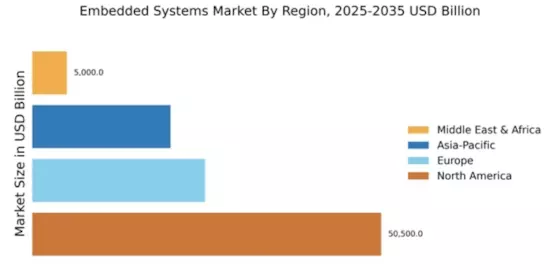
North America continues to lead the Embedded Systems Market, holding a significant share of 50,500.0. The region's growth is driven by advancements in technology, increasing demand for IoT devices, and robust investments in R&D. Regulatory support for innovation and a strong focus on cybersecurity are also key catalysts for market expansion. The presence of major tech companies further fuels this growth, making it a pivotal region for embedded systems development. The competitive landscape in North America is characterized by key players such as Intel Corporation, Texas Instruments, and Qualcomm. These companies are at the forefront of innovation, driving advancements in microcontrollers and processors. The U.S. remains the largest market, with Canada and Mexico also contributing to the regional growth. The collaboration between industry and government initiatives enhances the ecosystem, ensuring a steady flow of innovation and market leadership.

Europe : Emerging Market with Potential

Europe's Embedded Systems Market is poised for growth, with a market size of 25,000.0. The region is witnessing increased adoption of smart technologies across various sectors, including automotive and healthcare. Regulatory frameworks promoting digital transformation and sustainability are significant drivers of this growth. The European Union's initiatives to enhance digital infrastructure further support the embedded systems landscape, making it a promising market for future investments. Leading countries in Europe include Germany, France, and the Netherlands, where key players like NXP Semiconductors and STMicroelectronics are based. The competitive landscape is evolving, with a focus on innovation and collaboration among tech firms and research institutions. The presence of a skilled workforce and strong governmental support for technology initiatives positions Europe as a competitive player in The Embedded Systems.

Asia-Pacific : Rapid Growth and Innovation

The Asia-Pacific region is rapidly emerging as a powerhouse in the Embedded Systems Market, with a market size of 20,000.0. The growth is fueled by increasing demand for consumer electronics, automotive applications, and smart manufacturing solutions. Countries like China and Japan are leading this trend, supported by government initiatives aimed at enhancing technological capabilities and infrastructure. The region's focus on innovation and digital transformation is driving significant investments in embedded systems. China stands out as a major player, with companies like Renesas Electronics and Broadcom making substantial contributions to the market. Japan also plays a crucial role, with a strong emphasis on R&D and advanced manufacturing. The competitive landscape is characterized by a mix of established firms and emerging startups, fostering a dynamic environment for growth and innovation in embedded systems.

Middle East and Africa : Emerging Market with Challenges

The Middle East and Africa region is gradually developing its Embedded Systems Market, currently valued at 5,000.0. The growth is driven by increasing investments in technology and infrastructure, particularly in sectors like telecommunications and automotive. However, challenges such as regulatory hurdles and varying levels of technological adoption across countries remain. Governments are increasingly recognizing the importance of digital transformation, which is expected to catalyze market growth in the coming years. Countries like South Africa and the UAE are leading the way in adopting embedded systems, with a focus on enhancing local capabilities. The competitive landscape is still evolving, with both local and international players vying for market share. As the region continues to invest in technology and innovation, the embedded systems market is expected to expand significantly, presenting opportunities for growth and development.

Embedded Systems Market Regional Image

Key Players and Competitive Insights

The Embedded Systems Market is currently characterized by a dynamic competitive landscape, driven by rapid technological advancements and increasing demand across various sectors, including automotive, consumer electronics, and industrial automation. Key players such as Intel Corporation (US), Texas Instruments (US), and NXP Semiconductors (NL) are strategically positioning themselves through innovation and partnerships. Intel Corporation (US) focuses on enhancing its product offerings in edge computing and AI integration, while Texas Instruments (US) emphasizes localized manufacturing to optimize supply chains. NXP Semiconductors (NL) is actively pursuing collaborations with automotive manufacturers to advance smart vehicle technologies, collectively shaping a competitive environment that prioritizes technological differentiation and strategic alliances.
In terms of business tactics, companies are increasingly localizing manufacturing to mitigate supply chain disruptions and enhance responsiveness to market demands. The market structure appears moderately fragmented, with a mix of established players and emerging startups. This fragmentation allows for diverse innovation pathways, although the collective influence of key players like Qualcomm Incorporated (US) and Microchip Technology Inc. (US) remains substantial, as they leverage their extensive resources to drive market trends.
In November 2025, Qualcomm Incorporated (US) announced a strategic partnership with a leading automotive manufacturer to develop next-generation connected vehicle platforms. This collaboration is poised to enhance Qualcomm's position in the automotive sector, aligning with the growing trend of integrating advanced connectivity solutions into vehicles. The partnership underscores the importance of collaboration in driving innovation and meeting the evolving needs of the automotive market.
In October 2025, Microchip Technology Inc. (US) launched a new series of microcontrollers designed specifically for IoT applications. This product introduction reflects Microchip's commitment to addressing the burgeoning demand for IoT solutions, positioning the company favorably within the embedded systems landscape. The focus on IoT aligns with broader market trends emphasizing connectivity and smart technology integration.
In September 2025, NXP Semiconductors (NL) expanded its portfolio by acquiring a startup specializing in AI-driven embedded solutions. This acquisition not only enhances NXP's technological capabilities but also signifies a strategic move towards integrating AI into embedded systems, which is increasingly becoming a critical differentiator in the market. The integration of AI technologies is likely to redefine competitive dynamics, as companies strive to offer smarter, more efficient solutions.
As of December 2025, current competitive trends in the Embedded Systems Market are heavily influenced by digitalization, sustainability, and AI integration. Strategic alliances are becoming increasingly vital, as companies recognize the need to collaborate to stay ahead in a rapidly evolving landscape. The shift from price-based competition to a focus on innovation, technology, and supply chain reliability is evident, suggesting that future competitive differentiation will hinge on the ability to deliver cutting-edge solutions that meet the demands of a tech-savvy consumer base.

Key Companies in the Embedded Systems Market include

Industry Developments

  • Q2 2024: NXP Semiconductor launched its scalable wireless MCUs series to handle tough IoT and industrial problems NXP Semiconductors introduced a new series of scalable wireless microcontroller units (MCUs) designed to address complex IoT and industrial applications, expanding its embedded systems portfolio.
  • Q2 2024: Samsung announced collaboration with AMD to advance 5G virtualized RAN (vRAN) for network transformation Samsung and AMD entered a strategic collaboration to develop advanced 5G virtualized radio access network (vRAN) solutions, leveraging embedded systems to optimize mobile network performance.

Future Outlook

Embedded Systems Market Future Outlook

The Embedded Systems Market is projected to grow at a 7.36% CAGR from 2025 to 2035, driven by advancements in IoT, AI integration, and increased automation.

New opportunities lie in:

  • Development of AI-driven embedded solutions for smart appliances.
  • Expansion into automotive embedded systems for enhanced safety features.
  • Creation of customized embedded systems for healthcare monitoring devices.

By 2035, the Embedded Systems Market is expected to be robust, driven by innovation and diverse applications.

Market Segmentation

Embedded Systems Market End Use Outlook

  • Embedded Software
  • Embedded Hardware
  • Embedded Firmware
  • Embedded Systems Integration

Embedded Systems Market Technology Outlook

  • Microcontrollers
  • Digital Signal Processors
  • Field Programmable Gate Arrays
  • Application Specific Integrated Circuits

Embedded Systems Market Application Outlook

  • Consumer Electronics
  • Automotive
  • Healthcare
  • Industrial Automation
  • Telecommunications

Embedded Systems Market Form Factor Outlook

  • Integrated Circuits
  • Modules
  • Single Board Computers
  • System on Chip

Report Scope

MARKET SIZE 2024 101023.0(USD Billion)
MARKET SIZE 2025 108460.34(USD Billion)
MARKET SIZE 2035 220687.57(USD Billion)
COMPOUND ANNUAL GROWTH RATE (CAGR) 7.36% (2025 - 2035)
REPORT COVERAGE Revenue Forecast, Competitive Landscape, Growth Factors, and Trends
BASE YEAR 2024
Market Forecast Period 2025 - 2035
Historical Data 2019 - 2024
Market Forecast Units USD Billion
Key Companies Profiled Intel Corporation (US), Texas Instruments (US), NXP Semiconductors (NL), Qualcomm Incorporated (US), Microchip Technology Inc. (US), STMicroelectronics (CH), Analog Devices, Inc. (US), Renesas Electronics Corporation (JP), Infineon Technologies AG (DE), Broadcom Inc. (US)
Segments Covered Application, End Use, Technology, Form Factor
Key Market Opportunities Integration of artificial intelligence in Embedded Systems Market enhances automation and efficiency across various industries.
Key Market Dynamics Rising demand for automation drives innovation and competition in the embedded systems market across various industries.
Countries Covered North America, Europe, APAC, South America, MEA

Market Highlights

Author
Aarti Dhapte
Team Lead - Research

She holds an experience of about 6+ years in Market Research and Business Consulting, working under the spectrum of Information Communication Technology, Telecommunications and Semiconductor domains. Aarti conceptualizes and implements a scalable business strategy and provides strategic leadership to the clients. Her expertise lies in market estimation, competitive intelligence, pipeline analysis, customer assessment, etc.

Leave a Comment

FAQs

What is the projected market size of the Embedded Systems Market by 2035?

The projected market size of the Embedded Systems Market by 2035 is expected to reach 200.0 USD Billion.

What is the expected CAGR for the Embedded Systems Market from 2025 to 2035?

The expected CAGR for the Embedded Systems Market from 2025 to 2035 is 4.71%.

Which region is expected to have the largest market share in the Embedded Systems Market by 2032?

North America is expected to have the largest market share in the Embedded Systems Market, valued at 80.0 USD Billion by 2032.

What will the market size of the Consumer Electronics application be in 2032?

The market size of the Consumer Electronics application in the Embedded Systems Market is expected to reach 45.0 USD Billion by 2032.

How much is the Automotive application valued in the Embedded Systems Market by 2032?

The Automotive application in the Embedded Systems Market is valued at 60.0 USD Billion by 2032.

What is the projected market size for the Healthcare application by 2032?

The projected market size for the Healthcare application in the Embedded Systems Market is expected to reach 30.0 USD Billion by 2032.

Who are some of the key players in the Embedded Systems Market?

Key players in the Embedded Systems Market include Microchip Technology, Siemens, NXP Semiconductors, and Qualcomm.

What is the estimated market size for the APAC region in 2032?

The estimated market size for the APAC region in the Embedded Systems Market is expected to be 60.0 USD Billion by 2032.

What is the anticipated market size for the Industrial Automation application in 2032?

The anticipated market size for the Industrial Automation application in the Embedded Systems Market is expected to reach 35.0 USD Billion by 2032.

What is the expected market size of the Telecommunications application by 2032?

The expected market size of the Telecommunications application in the Embedded Systems Market is anticipated to be 20.0 USD Billion by 2032.

Download Free Sample

Kindly complete the form below to receive a free sample of this Report

Compare Licence

×
Features License Type
Single User Multiuser License Enterprise User
Price $4,950 $5,950 $7,250
Maximum User Access Limit 1 User Upto 10 Users Unrestricted Access Throughout the Organization
Free Customization
Direct Access to Analyst
Deliverable Format
Platform Access
Discount on Next Purchase 10% 15% 15%
Printable Versions