×
Request Free Sample ×

Kindly complete the form below to receive a free sample of this Report

* Please use a valid business email

Leading companies partner with us for data-driven Insights

clients tt-cursor
Hero Background

E-Tailing Solution Market

ID: MRFR/SEM/33889-HCR
200 Pages
Aarti Dhapte
February 2026

E-Tailing Solution Market Size, Share and Research Report By Platform Type (Web-based, Mobile Applications, Social Media), By Payment Method (Credit Card, Debit Card, Digital Wallet, Bank Transfer), By Product Type (Electronics, Clothing, Home Appliances, Beauty Products, Groceries), By Business Model (Business to Consumer, Consumer to Consumer, Business to Business) and By Regional (North America, Europe, South America, Asia Pacific, Middle East and Africa) - Industry Forecast Till 2035

Share:
Download PDF ×

We do not share your information with anyone. However, we may send you emails based on your report interest from time to time. You may contact us at any time to opt-out.

E Tailing Solution Market Infographic
Purchase Options

E-Tailing Solution Market Summary

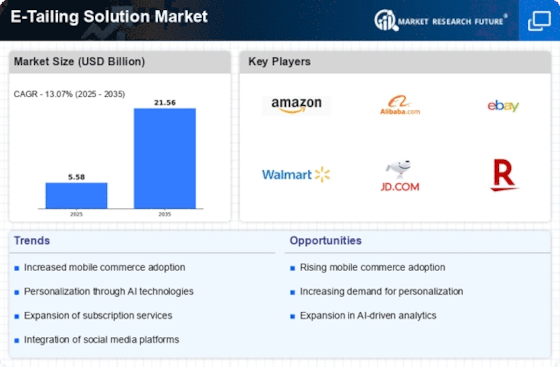
As per Market Research Future analysis, the E-Tailing Solution Market Size was estimated at 5.58 USD Billion in 2024. The E-Tailing Solution industry is projected to grow from 6.31 USD Billion in 2025 to 21.56 USD Billion by 2035, exhibiting a compound annual growth rate (CAGR) of 13.07% during the forecast period 2025 - 2035

Key Market Trends & Highlights

The E-Tailing Solution Market is experiencing dynamic growth driven by technological advancements and changing consumer preferences.

  • Personalization through technology is becoming increasingly prevalent, enhancing customer engagement and satisfaction.
  • Mobile commerce is expanding rapidly, particularly in the Asia-Pacific region, as consumers increasingly prefer shopping via mobile applications.
  • Sustainability and ethical practices are gaining traction, influencing purchasing decisions across various demographics.
  • The integration of advanced technologies and the rise of social commerce are key drivers propelling the market forward, particularly in North America.

Market Size & Forecast

2024 Market Size 5.58 (USD Billion)
2035 Market Size 21.56 (USD Billion)
CAGR (2025 - 2035) 13.07%

Major Players

Amazon (US), Alibaba (CN), eBay (US), Walmart (US), JD.com (CN), Rakuten (JP), Target (US), Zalando (DE), Flipkart (IN)

Our Impact
Enabled $4.3B Revenue Impact for Fortune 500 and Leading Multinationals
Partnering with 2000+ Global Organizations Each Year
30K+ Citations by Top-Tier Firms in the Industry

E-Tailing Solution Market Trends

The E-Tailing Solution Market is currently experiencing a transformative phase, characterized by rapid technological advancements and evolving consumer preferences. As digital shopping becomes increasingly prevalent, businesses are compelled to adopt innovative solutions that enhance user experience and streamline operations. This market appears to be driven by the integration of artificial intelligence and machine learning, which facilitate personalized shopping experiences and optimize inventory management. Furthermore, the rise of mobile commerce is reshaping how consumers interact with brands, suggesting a shift towards more accessible and convenient purchasing options. In addition, the growing emphasis on sustainability and ethical practices is influencing consumer choices, prompting retailers to adopt eco-friendly solutions. This trend indicates a potential shift in market dynamics, as businesses that prioritize sustainability may gain a competitive edge. Overall, the E-Tailing Solution Market seems poised for continued growth, with various factors converging to create a dynamic landscape that could redefine the future of online retailing.

Personalization through Technology

The E-Tailing Solution Market is witnessing a surge in the use of advanced technologies to deliver personalized shopping experiences. Retailers are increasingly leveraging data analytics and artificial intelligence to understand consumer behavior, enabling them to tailor product recommendations and marketing strategies. This trend not only enhances customer satisfaction but also fosters brand loyalty, as consumers are more likely to engage with brands that recognize their individual preferences.

Mobile Commerce Expansion

The proliferation of smartphones and mobile applications is significantly impacting the E-Tailing Solution Market. Consumers are increasingly utilizing mobile devices for shopping, leading to a shift in how retailers approach their online presence. This trend suggests that businesses must optimize their platforms for mobile use, ensuring seamless navigation and payment processes to cater to the growing number of mobile shoppers.

Sustainability and Ethical Practices

There is a notable shift towards sustainability within the E-Tailing Solution Market, as consumers become more conscious of their purchasing decisions. Retailers are responding by adopting eco-friendly practices and promoting sustainable products. This trend indicates that businesses prioritizing ethical considerations may not only attract environmentally aware consumers but also enhance their brand image in a competitive marketplace.

E-Tailing Solution Market Drivers

Rise of Social Commerce

The E-Tailing Solution Market is witnessing a significant rise in social commerce, where social media platforms serve as vital channels for product discovery and sales. This trend is driven by the increasing number of consumers who utilize social media for shopping inspiration. Data indicates that nearly 70% of consumers are influenced by social media when making purchasing decisions. As platforms like Instagram and Facebook enhance their shopping features, businesses are compelled to adapt their strategies to leverage these channels effectively. This shift not only broadens the reach of e-tailers but also creates a more interactive shopping experience, thereby contributing to the growth of the E-Tailing Solution Market.

Increased Focus on Data Security

In the E-Tailing Solution Market, the heightened focus on data security is becoming increasingly paramount as consumers become more aware of privacy concerns. With the rise in online transactions, e-tailers are compelled to implement robust security measures to protect customer data. Recent surveys indicate that over 80% of consumers are concerned about their personal information being compromised during online shopping. Consequently, e-tailers are investing in advanced encryption technologies and compliance with data protection regulations to build trust with their customers. This emphasis on data security not only safeguards consumer information but also enhances the credibility of the E-Tailing Solution Market as a whole.

Integration of Advanced Technologies

The E-Tailing Solution Market is experiencing a notable shift towards the integration of advanced technologies such as artificial intelligence, machine learning, and augmented reality. These technologies enhance customer experiences by providing personalized recommendations and immersive shopping environments. For instance, AI-driven chatbots are increasingly utilized to assist customers in real-time, thereby improving engagement and satisfaction. According to recent data, the adoption of AI in e-tailing is projected to grow at a compound annual growth rate of over 30% in the coming years. This technological evolution not only streamlines operations but also fosters customer loyalty, which is crucial for sustained growth in the E-Tailing Solution Market.

Emergence of Subscription-Based Models

The E-Tailing Solution Market is experiencing a notable emergence of subscription-based models, which offer consumers convenience and value through regular deliveries of products. This model appeals particularly to consumers seeking hassle-free shopping experiences. Data suggests that subscription e-commerce is expected to grow at a rate of approximately 18% annually over the next few years. By providing curated selections and exclusive offers, e-tailers can foster customer loyalty and increase lifetime value. This trend reflects a shift in consumer preferences towards personalized and convenient shopping solutions, thereby driving growth within the E-Tailing Solution Market.

Growing Demand for Omnichannel Retailing

The E-Tailing Solution Market is significantly influenced by the growing demand for omnichannel retailing, which integrates various shopping channels to provide a seamless customer experience. Consumers increasingly expect the ability to transition effortlessly between online and offline shopping. Recent statistics reveal that retailers employing omnichannel strategies achieve a 91% higher retention rate compared to those that do not. This trend compels e-tailers to invest in technologies that facilitate inventory management and customer relationship management across multiple platforms. As a result, the E-Tailing Solution Market is evolving to meet these consumer expectations, thereby enhancing overall customer satisfaction and loyalty.


Market Segment Insights

By Platform Type: Web-based (Largest) vs. Mobile Applications (Fastest-Growing)

In the E-Tailing Solution Market, web-based platforms hold the largest share, dominating the landscape with a steady user base that prefers traditional shopping experiences online. Mobile applications, while a smaller segment of the market currently, are rapidly gaining traction, encouraged by the increasing penetration of smartphones and the convenience they offer to consumers. Social media platforms are also emerging as significant players, leveraging their vast user bases to facilitate direct shopping experiences.

Web-based (Dominant) vs. Mobile Applications (Emerging)

Web-based platforms serve as the cornerstone of the E-Tailing Solution Market, providing a comprehensive shopping experience with rich content and user-friendly interfaces that attract a diverse range of consumers. Meanwhile, mobile applications are emerging as a key growth area, capturing the attention of tech-savvy consumers who prefer shopping on-the-go and seek personalized experiences. This shift reflects broader consumer trends, with an increasing preference for convenience, real-time engagement, and seamless integration of shopping with daily digital interactions. As both platforms evolve, they will continue to shape the e-tailing landscape.

By Payment Method: Credit Card (Largest) vs. Digital Wallet (Fastest-Growing)

The E-Tailing Solution Market showcases a diverse landscape of payment methods, with Credit Cards leading the share among consumers, followed closely by Debit Cards and emerging alternatives like Digital Wallets. Credit Cards account for the largest segment due to their widespread acceptance and trust, while Debit Cards follow as a preferred choice for everyday transactions, offering direct access to consumer funds with less credit reliance. Digital Wallets are rapidly gaining traction, especially among younger demographics and tech-savvy consumers, who favor convenience and security in their online purchases, further diversifying the payment landscape. Growth trends for the Payment Method segment are being driven primarily by technological advancements, with the increasing prevalence of mobile and online shopping creating a higher demand for seamless payment solutions. The adoption of Digital Wallets is experiencing exponential growth, spurred by their ability to integrate with e-commerce platforms and provide expedited payment processing. Additionally, loyalty programs and promotional incentives offered by e-tailing businesses are enticing consumers to explore various payment methods, thus influencing the overall dynamics of payment preferences in this evolving market segment.

Credit Card (Dominant) vs. Digital Wallet (Emerging)

In the E-Tailing Solution Market, Credit Cards maintain a dominant position due to their popularity and reliability among consumers for online transactions. They are often associated with consumer trust, security, and convenience, allowing for easier access to credit and rewards programs that enhance customer loyalty. On the other hand, Digital Wallets represent the emerging trend as they offer innovative features such as contactless payment, faster checkouts, and enhanced security measures, appealing to younger generations who prefer tech-friendly solutions. As both segments continue to evolve, the competitive landscape is seeing a blend of traditional and modern payment solutions, which cater to a wider audience and enhance user experiences.

By Product Type: Electronics (Largest) vs. Clothing (Fastest-Growing)

In the E-Tailing Solution Market, the distribution of market share among product types shows that Electronics remain the largest segment, driven by the consistent demand for the latest gadgets and technology. The Clothing segment follows closely, with a growing prevalence in online shopping habits as consumers increasingly prefer the convenience of purchasing apparel online. Other segments like Beauty Products, Home Appliances, and Groceries are also gaining traction, although they hold a smaller share compared to the leading categories.

Electronics: Dominant vs. Clothing: Emerging

Electronics dominate the E-Tailing Solution Market due to the continuous innovation and frequent introduction of new technologies, ensuring a steady consumer interest in items such as smartphones, laptops, and gaming consoles. This segment benefits from a tech-savvy customer base that values ease of online purchasing, often leading to higher conversion rates. On the other hand, Clothing is emerging as a rapidly growing segment, boosted by the rise of fashion influencers and trends through social media platforms. This segment caters to a diverse audience, offering a wide range of styles and options, thereby enhancing its appeal and driving online sales growth.

By Business Model: Business to Consumer (Largest) vs. Consumer to Consumer (Fastest-Growing)

The E-Tailing Solution Market is significantly shaped by the distribution of its business model segments. The Business to Consumer (B2C) segment currently holds the largest share, benefiting from direct interactions between businesses and consumers and leveraging online platforms for extensive product offerings. The Consumer to Consumer (C2C) segment, fueled by advancements in technology and social media, is witnessing rapid growth, allowing consumers to transact with each other in innovative ways. The ongoing expansion of e-commerce is propelling growth across these segments, with B2C continuing to dominate due to established e-tailing giants. However, the rise of C2C platforms reflects a shifting consumer behavior towards peer-to-peer selling, accentuated by the desire for local and personalized shopping experiences. Additionally, the Business to Business (B2B) segment remains stable, focusing on wholesale distributions and partnerships that cater to various e-tailing businesses.

Business to Consumer: Dominant vs. Consumer to Consumer: Emerging

In the E-Tailing Solution Market, the Business to Consumer (B2C) model is currently the dominant segment, characterized by established online retailers providing goods and services directly to individual consumers. This model thrives on widespread internet usage, with brands creating omnichannel strategies to enhance customer experience and retention. On the other hand, the Consumer to Consumer (C2C) segment is an emerging force, encompassing platforms that enable individuals to sell directly to other consumers, often facilitated by social media and specialized apps. This segment appeals to consumers seeking unique products and competitive pricing, with platforms harnessing user-generated content and community engagement to drive success. As consumer preferences evolve, both segments will adapt to changing market dynamics.

Get more detailed insights about E-Tailing Solution Market

Regional Insights

North America : E-Commerce Leader

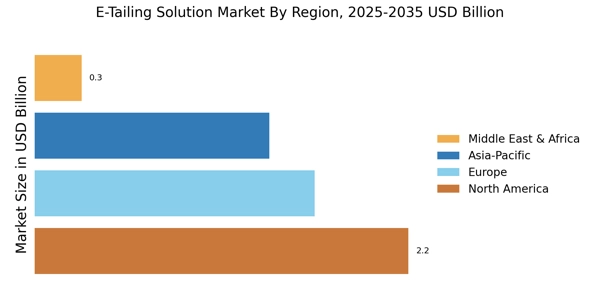
North America is the largest market for e-tailing solutions, holding approximately 40% of the global market share. The region's growth is driven by high internet penetration, advanced logistics infrastructure, and a strong consumer preference for online shopping. Regulatory support for digital commerce and innovations in payment systems further catalyze market expansion. The U.S. is the primary contributor, followed by Canada, which is rapidly adopting e-commerce solutions.

Europe : Diverse Market Dynamics

Europe is the second-largest market for e-tailing solutions, accounting for around 30% of the global share. The region benefits from a diverse consumer base and increasing mobile commerce adoption. Regulatory frameworks, such as the GDPR, enhance consumer trust and data protection, fostering a conducive environment for e-tailing. Countries like Germany and the UK lead the market, with significant contributions from France and the Nordics, showcasing a competitive landscape with local and international players.

Asia-Pacific : Emerging E-Tailing Powerhouse

Asia-Pacific is witnessing explosive growth in the e-tailing sector, driven by rising disposable incomes, urbanization, and a tech-savvy population. This region holds about 25% of the global market share, with China being the largest player, followed by India and Japan. The competitive landscape is marked by the presence of major players like Alibaba and JD.com, alongside local startups. Government initiatives to promote digital payments and e-commerce further bolster market expansion.

Middle East and Africa : Untapped Market Potential

The Middle East and Africa represent a growing market for e-tailing solutions, currently holding around 5% of the global share. Factors such as increasing internet access, mobile penetration, and a young population are driving demand. Countries like South Africa and the UAE are leading the charge, with significant investments in logistics and technology. The competitive landscape is evolving, with both local and international players vying for market share, supported by government initiatives to enhance digital commerce.

E-Tailing Solution Market Regional Image

Key Players and Competitive Insights

The E-Tailing Solution Market is characterized by rapid evolution and intense competition, driven by changing consumer behaviors, the prevalence of digital technologies, and the integration of e-commerce into everyday life. This market encompasses various online retail platforms that facilitate the buying and selling of goods and services through electronic means. The competitive landscape is shaped by the presence of several key players who continually innovate and adapt to meet consumer expectations. Factors such as customer service, user experience, logistics management, and technological advancements play crucial roles in determining the success of businesses in this sector. 
As more consumers gravitate towards online shopping, understanding the competitive dynamics within this market is essential for stakeholders seeking to gain a foothold or expand their operations. Rakuten stands out in the E-Tailing Solution Market due to its robust platform that offers a diverse range of products and services, catering to a wide audience. The company's e-commerce ecosystem is built on a strong loyalty program that encourages repeat purchases and fosters customer retention. Rakuten's strengths lie in its strong brand recognition and strategic partnerships, which enhance its product offerings and market reach.
Its commitment to technology-driven innovation enables Rakuten to deliver personalized shopping experiences powered by data analytics and user insights. Furthermore, the company's integration of various services, including payment solutions and content delivery, creates a seamless shopping experience, solidifying its presence in the competitive e-tailing landscape. 
Walmart has made significant strides in the E-Tailing Solution Market as one of the largest retailers in the world, transitioning its traditional business model into a powerful online platform. The company leverages its extensive supply chain and vast inventory to offer consumers a wide array of products at competitive prices. Walmart’s strengths in the e-tailing space include its exceptional logistics capabilities, which allow for fast and efficient delivery options, including same-day delivery in some locations. The integration of a robust online shopping experience with its brick-and-mortar stores enhances convenience for customers.
Walmart also focuses on customer-centric initiatives such as simplified returns and a user-friendly website, which contribute to higher consumer satisfaction and loyalty. The company's significant investment in technology and e-commerce infrastructure has positioned it as a formidable competitor in the global e-tailing arena.

Key Companies in the E-Tailing Solution Market include

Industry Developments

Recent news developments in the E-Tailing Solution Market have highlighted significant expansions and strategic moves by leading companies. Amazon has continued to innovate with its Prime offerings, enhancing customer loyalty through exclusive deals and services, while Walmart has rolled out new strategies to bolster its online presence, competing aggressively with rivals. Meanwhile, Rakuten is investing in technology to improve its e-commerce platform, furthering its market footprint. In the Asia-Pacific region, JD.com is expanding its logistics capabilities to enhance delivery efficiency, which is crucial for e-tailing growth.

Mergers and acquisitions in the sector have included Best Buy's acquisition of personalized tech service firms to enhance their customer experience and Shopify's acquiring several technology companies to enrich their e-commerce solutions. Notably, Etsy has seen a significant rise in market capitalization as it caters to the growing demand for unique products. The valuations of companies like Alibaba and Zalando are impacted by the rising trend of online shopping and evolving consumer habits, signifying rapid growth in the market. The competitive landscape remains dynamic as companies adapt to changing consumer preferences and technological advancements.

Future Outlook

E-Tailing Solution Market Future Outlook

The E-Tailing Solution Market is projected to grow at a 13.07% CAGR from 2025 to 2035, driven by technological advancements, increased online shopping, and enhanced customer experiences.

New opportunities lie in:

  • Integration of AI-driven personalized shopping experiences
  • Expansion of mobile commerce platforms
  • Development of advanced logistics and supply chain solutions

By 2035, the E-Tailing Solution Market is expected to be robust, reflecting substantial growth and innovation.

Market Segmentation

E Tailing Solution Market Product Type Outlook

  • Electronics
  • Clothing
  • Home Appliances
  • Beauty Products
  • Groceries

E Tailing Solution Market Platform Type Outlook

  • Web-based
  • Mobile Applications
  • Social Media

E Tailing Solution Market Business Model Outlook

  • Business to Consumer
  • Consumer to Consumer
  • Business to Business

E Tailing Solution Market Payment Method Outlook

  • Credit Card
  • Debit Card
  • Digital Wallet
  • Bank Transfer

Report Scope

MARKET SIZE 2024 5.58(USD Billion)
MARKET SIZE 2025 6.31(USD Billion)
MARKET SIZE 2035 21.56(USD Billion)
COMPOUND ANNUAL GROWTH RATE (CAGR) 13.07% (2025 - 2035)
REPORT COVERAGE Revenue Forecast, Competitive Landscape, Growth Factors, and Trends
BASE YEAR 2024
Market Forecast Period 2025 - 2035
Historical Data 2019 - 2024
Market Forecast Units USD Billion
Key Companies Profiled Amazon (US), Alibaba (CN), eBay (US), Walmart (US), JD.com (CN), Rakuten (JP), Target (US), Zalando (DE), Flipkart (IN)
Segments Covered Platform Type, Payment Method, Product Type, Business Model, Regional
Key Market Opportunities Integration of artificial intelligence to enhance personalized shopping experiences in the E-Tailing Solution Market.
Key Market Dynamics Rising consumer demand for personalized shopping experiences drives innovation in E-Tailing Solution technologies and services.
Countries Covered North America, Europe, APAC, South America, MEA
Leave a Comment

FAQs

What is the current valuation of the E-Tailing Solution Market in 2025?

The E-Tailing Solution Market is valued at 5.58 USD Billion in 2024 and is expected to grow significantly in the coming years.

What is the projected market size for the E-Tailing Solution Market by 2035?

The market is projected to reach 21.56 USD Billion by 2035, indicating robust growth.

What is the expected CAGR for the E-Tailing Solution Market during the forecast period 2025 - 2035?

The expected CAGR for the E-Tailing Solution Market during the forecast period 2025 - 2035 is 13.07%.

Which platform type generates the highest revenue in the E-Tailing Solution Market?

Web-based platforms generated 2.79 USD Billion in 2024 and are projected to reach 10.78 USD Billion by 2035.

How do mobile applications perform in the E-Tailing Solution Market?

Mobile applications generated 1.67 USD Billion in 2024 and are expected to grow to 6.56 USD Billion by 2035.

What payment method is anticipated to dominate the E-Tailing Solution Market?

Digital wallets, which generated 1.79 USD Billion in 2024, are projected to reach 7.02 USD Billion by 2035.

Which product type is expected to see the most growth in the E-Tailing Solution Market?

Electronics, which generated 1.67 USD Billion in 2024, are projected to grow to 6.42 USD Billion by 2035.

What business model is likely to lead the E-Tailing Solution Market?

The Business to Consumer model, which generated 3.34 USD Billion in 2024, is expected to reach 12.92 USD Billion by 2035.

Who are the key players in the E-Tailing Solution Market?

Key players include Amazon, Alibaba, eBay, Walmart, JD.com, Rakuten, Target, Zalando, and Flipkart.

What trends are influencing the E-Tailing Solution Market in 2025?

Trends such as increased mobile application usage and the rise of digital wallets are shaping the market landscape.

Download Free Sample

Kindly complete the form below to receive a free sample of this Report

Compare Licence

×
Features License Type
Single User Multiuser License Enterprise User
Price $4,950 $5,950 $7,250
Maximum User Access Limit 1 User Upto 10 Users Unrestricted Access Throughout the Organization
Free Customization
Direct Access to Analyst
Deliverable Format
Platform Access
Discount on Next Purchase 10% 15% 15%
Printable Versions