×
Request Free Sample ×

Kindly complete the form below to receive a free sample of this Report

* Please use a valid business email

Leading companies partner with us for data-driven Insights

clients tt-cursor
Hero Background

Diisononyl Phthalate Market

ID: MRFR/CnM/5977-HCR
140 Pages
Chitranshi Jaiswal
February 2026

Diisononyl Phthalate (DINP) Market Research Report Information by Application (Flooring & Roofing, Wires & Cables, Hoses & Tubes, Insulation), End-Use Industry (Automotive, Construction, Electricals, Footwear, Toy Making, Plastics), and Region — Global Forecast till 2035

Share:
Download PDF ×

We do not share your information with anyone. However, we may send you emails based on your report interest from time to time. You may contact us at any time to opt-out.

Diisononyl Phthalate Market Infographic
Purchase Options

Diisononyl Phthalate Market Summary

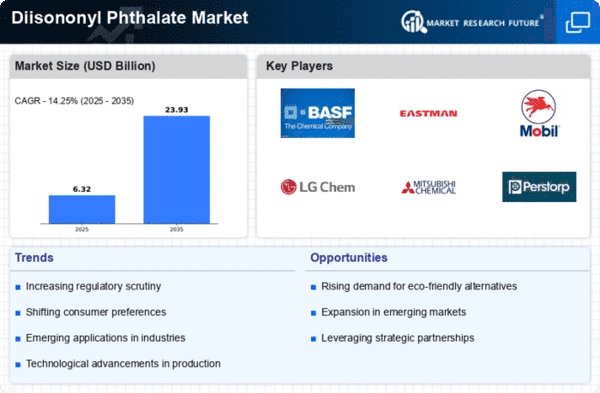
As per MRFR analysis, the Diisononyl Phthalate Market Size was estimated at 5.53 USD Billion in 2024. The Diisononyl Phthalate industry is projected to grow from 6.31 in 2025 to 23.93 by 2035, exhibiting a compound annual growth rate (CAGR) of 14.25 during the forecast period 2025 - 2035.

Key Market Trends & Highlights

The Diisononyl Phthalate Market is poised for growth driven by sustainability and regulatory trends.

  • North America remains the largest market for Diisononyl Phthalate, reflecting robust demand across various applications.
  • Asia-Pacific is emerging as the fastest-growing region, propelled by increasing industrial activities and urbanization.
  • The plastics segment dominates the market, while the coatings segment is witnessing rapid growth due to evolving consumer preferences.
  • Rising demand in automotive applications and expansion in the construction sector are key drivers influencing market dynamics.

Market Size & Forecast

2024 Market Size 5.53 (USD Billion)
2035 Market Size 23.93 (USD Billion)
CAGR (2025 - 2035) 14.25%

Major Players

BASF SE (DE), Eastman Chemical Company (US), ExxonMobil Chemical (US), LG Chem Ltd. (KR), Mitsubishi Chemical Corporation (JP), Perstorp Holding AB (SE), Shin-Etsu Chemical Co., Ltd. (JP), SABIC (SA), Valtris Specialty Chemicals (US)

Our Impact
Enabled $4.3B Revenue Impact for Fortune 500 and Leading Multinationals
Partnering with 2000+ Global Organizations Each Year
30K+ Citations by Top-Tier Firms in the Industry

Diisononyl Phthalate Market Trends

The Diisononyl Phthalate Market is currently experiencing a notable evolution, driven by various factors that influence its demand and application across multiple industries. This chemical compound, primarily utilized as a plasticizer, is integral in enhancing the flexibility and durability of products such as polyvinyl chloride (PVC). As industries increasingly prioritize sustainability, there appears to be a growing interest in alternative plasticizers, which may impact the traditional usage of diisononyl phthalate. However, its established role in manufacturing processes suggests that it will continue to hold a significant position in the market for the foreseeable future. Moreover, regulatory frameworks surrounding chemical safety and environmental impact are becoming more stringent. This trend compels manufacturers to adapt their practices and explore innovative solutions that align with these evolving standards. The Diisononyl Phthalate Market, therefore, seems poised for transformation, as stakeholders navigate the balance between compliance and operational efficiency. As the market progresses, it is likely that advancements in technology and shifts in consumer preferences will further shape the landscape, potentially leading to new applications and enhanced product formulations that leverage the unique properties of diisononyl phthalate.

Sustainability Initiatives

There is a discernible shift towards sustainability within the Diisononyl Phthalate Market. Manufacturers are increasingly exploring eco-friendly alternatives and practices to meet consumer demand for greener products. This trend may lead to the development of bio-based plasticizers, which could challenge the traditional dominance of diisononyl phthalate.

Regulatory Compliance

The tightening of regulations regarding chemical safety is influencing the Diisononyl Phthalate Market. Companies are compelled to adhere to stricter guidelines, which may drive innovation in product formulations and manufacturing processes. This compliance focus could result in enhanced safety profiles for diisononyl phthalate applications.

Technological Advancements

Technological progress is playing a crucial role in shaping the Diisononyl Phthalate Market. Innovations in production techniques and material science are likely to enhance the efficiency and performance of diisononyl phthalate in various applications. This trend may open new avenues for its use in industries such as automotive and construction.

Diisononyl Phthalate Market Drivers

Market Trends and Projections

The Global Diisononyl Phthalate Market Industry is characterized by dynamic trends and projections that highlight its growth potential. In 2024, the market is anticipated to reach 5.02 USD Billion, with a projected compound annual growth rate of 9.28% from 2025 to 2035. This growth trajectory reflects the increasing adoption of Diisononyl Phthalate Market across various applications, including automotive, construction, and consumer goods. As industries continue to evolve and adapt to changing regulations and consumer preferences, the market is likely to expand significantly, potentially reaching 13.3 USD Billion by 2035.

Expansion in Construction Activities

The Global Diisononyl Phthalate Market Industry is significantly influenced by the expansion of construction activities across various regions. As urbanization accelerates, the demand for construction materials that incorporate Diisononyl Phthalate Market as a plasticizer is likely to increase. This trend is particularly evident in emerging economies where infrastructure development is a priority. The versatility of Diisononyl Phthalate Market in enhancing the performance of construction materials positions it as a key ingredient in the industry. Consequently, the market is poised for growth, potentially reaching 13.3 USD Billion by 2035, driven by the ongoing construction boom.

Growing Demand from Automotive Sector

The Global Diisononyl Phthalate Market Industry experiences a notable surge in demand driven by the automotive sector. As manufacturers increasingly prioritize flexible and durable materials for vehicle interiors, the use of Diisononyl Phthalate Market in plasticizers becomes essential. This trend aligns with the industry's shift towards lightweight materials to enhance fuel efficiency. In 2024, the market is projected to reach 5.02 USD Billion, with expectations of significant growth as the automotive sector continues to expand. The anticipated compound annual growth rate of 9.28% from 2025 to 2035 further underscores the potential of this market segment.

Technological Advancements in Production

The Global Diisononyl Phthalate Market Industry is poised for growth due to technological advancements in production processes. Innovations that enhance the efficiency and sustainability of Diisononyl Phthalate Market manufacturing are likely to attract investment and increase production capacity. These advancements may lead to reduced costs and improved product quality, making Diisononyl Phthalate Market more appealing to manufacturers across various sectors. As a result, the market could experience a robust growth trajectory, with projections indicating a rise to 13.3 USD Billion by 2035, reflecting the positive impact of these technological developments.

Rising Awareness of Health and Safety Standards

The Global Diisononyl Phthalate Market Industry is increasingly shaped by rising awareness of health and safety standards among consumers and manufacturers. As stakeholders become more informed about the potential risks associated with certain chemicals, there is a growing preference for safer alternatives. Diisononyl Phthalate Market, recognized for its relatively lower toxicity compared to other phthalates, may benefit from this shift in consumer perception. This trend is likely to drive demand, contributing to the market's growth, which is expected to reach 5.02 USD Billion in 2024 and continue expanding towards 13.3 USD Billion by 2035.

Regulatory Support for Eco-Friendly Alternatives

The Global Diisononyl Phthalate Market Industry benefits from regulatory frameworks that encourage the use of safer, eco-friendly alternatives. Governments worldwide are increasingly implementing regulations aimed at reducing harmful substances in consumer products, which may lead to a shift towards Diisononyl Phthalate Market as a preferred plasticizer. This regulatory support is crucial as it not only enhances product safety but also aligns with global sustainability goals. As a result, manufacturers are likely to invest in Diisononyl Phthalate Market, anticipating a market growth trajectory that could see the industry reach 13.3 USD Billion by 2035.


Market Segment Insights

By Application: Plastics (Largest) vs. Coatings (Fastest-Growing)

In the Diisononyl Phthalate (DINP) market, the application segment is divided into various categories, notably plastics, coatings, adhesives, textiles, and rubber. Among these, plastics hold the largest share due to their widespread use in various consumer products and industrial applications. This dominance is attributed to the compatibility of DINP with PVC, leading to enhanced flexibility and durability in plastic products. Coatings, while currently smaller in market share, are quickly gaining traction, leveraging DINP's properties to improve performance in protective and decorative coatings.

Plastics: Dominant vs. Coatings: Emerging

Plastics remain the dominant application for Diisononyl Phthalate, primarily due to rising demand in industries such as construction, automotive, and consumer goods. Their versatility makes them ideal for a wide range of applications, ensuring continuous growth. Meanwhile, coatings are emerging as a significant segment fueled by innovations in formulation that utilize DINP to enhance durability and resistance to environmental factors. The adoption of advanced coatings in construction and automotive sectors is expected to spur demand, as these industries prioritize longevity and performance. As both segments evolve, their respective roles in the DINP market will likely be influenced by regulatory changes and environmental considerations.

By End Use: Automotive (Largest) vs. Healthcare (Fastest-Growing)

The Diisononyl Phthalate (DINP) market exhibits varied demand across its end-use applications, with the automotive sector commanding the largest market share. It relies heavily on DINP for the production of durable interiors, flexible components, and as a stabilizer in plastics. Following automotive, the construction and consumer goods sectors also contribute significantly to the market, utilizing DINP in roofing membranes, flooring, and household products, though to a lesser extent. As growth trends evolve, the healthcare sector is emerging rapidly as a significant user of DINP, spurred on by a rising demand for flexible medical devices and packaging. Furthermore, industries like electronics are increasingly endorsing safer, plastic formulations, thus presenting a unique opportunity for growth in the coming years.

Automotive: Dominant vs. Healthcare: Emerging

The automotive sector remains the dominant force in the Diisononyl Phthalate market, primarily due to its extensive use in manufacturing durable automotive components, insulation, and wires. This sector not only drives innovation in the application of DINP but also provides a stable demand reservoir owing to the consistent growth in vehicle production. On the other hand, the healthcare sector is poised to emerge as a significant player, driven by the increased focus on biocompatibility and the need for medical-grade plastics. This sector is undergoing rapid evolution as manufacturers seek to incorporate DINP in various medical devices, ensuring flexibility and safety. While automotive applications are well-established, the healthcare sector is gaining momentum quickly, indicating a dynamic shift in market preferences.

By Distribution Channel: Direct Sales (Largest) vs. Online Sales (Fastest-Growing)

In the Diisononyl Phthalate market, the distribution of sales across channels indicates a dominant preference for Direct Sales, which remains the largest segment due to established relationships and consistent demand from industrial users. This channel ensures that customers receive products directly from manufacturers, ensuring quality and reliability. Meanwhile, Online Sales have emerged as a significant player, attracting an increasing number of businesses that prioritize convenience and accessibility, leading to a growth trajectory that outpaces traditional sales methods.

Direct Sales (Dominant) vs. Online Sales (Emerging)

Direct Sales in the Diisononyl Phthalate market is characterized by long-standing relationships between manufacturers and consumers, providing a stable channel that promotes trust and loyalty. This approach caters primarily to large-scale industrial clients who require consistent and bulk quantities, allowing for tailored services and pricing agreements. Conversely, Online Sales represent an emerging trend where the market is witnessing a shift towards digital transactions. This channel caters to a diverse customer base, from small businesses to individuals, leveraging technology to provide a seamless purchasing experience. The convenience, wider reach, and potential for cost savings position Online Sales as a key area for future growth in the market.

By Formulation Type: Flexible PVC (Largest) vs. Polyurethane (Fastest-Growing)

The Diisononyl Phthalate (DINP) market reveals a diverse landscape in its formulation type segment, with Flexible PVC commanding the largest share. This formulation is favored for its versatility and efficacy in various applications, particularly in flooring and plastic products. Rigid PVC, on the other hand, holds a significant position, though it typically ranks below flexible formulations. Polyethylene and polyurethane are also key players but have smaller market shares, suggesting that flexible and rigid variants continue to dominate the market composition.

Flexible PVC (Dominant) vs. Polyurethane (Emerging)

Flexible PVC, characterized by its excellent flexibility and durability, dominates the formulation type in the Diisononyl Phthalate market, primarily utilized in consumer goods, automotive applications, and construction. Its adaptability to various environmental conditions makes it a preferred choice among manufacturers. Conversely, polyurethane is rapidly emerging due to its superior performance characteristics, such as resilience and thermal stability. These properties make polyurethane increasingly sought after in high-performance applications such as insulation and automotive coatings. As environmental regulations toughen, both segments are focusing on sustainability, with polyurethane striving to capture a larger market share with greener alternatives.

By Regulatory Compliance: REACH (Largest) vs. TSCA (Fastest-Growing)

In the Diisononyl Phthalate Market, regulatory compliance significantly influences product formulations and market dynamics. Among the primary compliance frameworks, REACH dominates due to its extensive regulations in the European market, holding the largest share in compliance adherence. In contrast, the Toxic Substances Control Act (TSCA) is rapidly gaining traction, especially in North America, as manufacturers increasingly emphasize compliance to meet stringent environmental and health safety standards.

REACH (Dominant) vs. TSCA (Emerging)

REACH compliance stands as the dominant regulatory force in the Diisononyl Phthalate Market, primarily due to its stringent guidelines aimed at ensuring chemical safety within the European Union. Companies manufacturing or importing Diisononyl Phthalate must adhere to comprehensive safety data submissions and risk assessments, which enhances product credibility and market acceptance. On the other hand, TSCA is an emerging regulatory framework with growing significance, particularly in the United States. Its recent updates focus on increasing oversight and facilitating safer chemical use, driving companies to adapt and innovate to comply, thus provisioning a competitive edge in the market.

Get more detailed insights about Diisononyl Phthalate Market

Regional Insights

North America : Market Leader in Phthalates

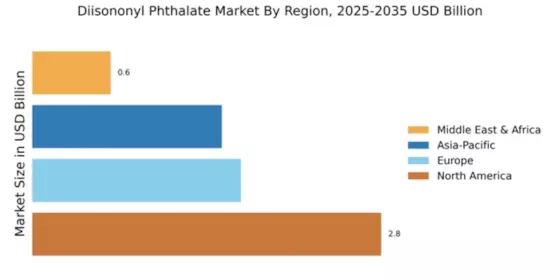
North America is poised to maintain its leadership in the Diisononyl Phthalate market, holding a significant share of 2.76 million metric tons in 2024. The region's growth is driven by robust demand in the automotive and construction sectors, alongside stringent regulations promoting safer chemical alternatives. The increasing focus on sustainability and eco-friendly products further propels market expansion, as manufacturers adapt to evolving consumer preferences. The United States stands as the primary market contributor, with key players like BASF SE, Eastman Chemical Company, and ExxonMobil Chemical leading the charge. The competitive landscape is characterized by innovation and strategic partnerships, as companies invest in R&D to enhance product offerings. The presence of established firms ensures a stable supply chain, catering to diverse industrial applications and reinforcing North America's market dominance.

Europe : Regulatory Framework Driving Growth

Europe's Diisononyl Phthalate market is projected to reach 1.65 million metric tons by 2025, driven by stringent regulations aimed at reducing harmful chemical exposure. The REACH regulation and other environmental policies are pivotal in shaping market dynamics, pushing manufacturers towards safer alternatives. The growing awareness of health and environmental impacts is fostering demand for compliant products, thus enhancing market growth. Germany and France are the leading countries in this region, with a strong presence of key players such as BASF SE and Perstorp Holding AB. The competitive landscape is marked by innovation and compliance with regulatory standards, as companies strive to meet consumer demands for safer and more sustainable products. This focus on regulatory adherence positions Europe as a significant player in The Diisononyl Phthalate.

Asia-Pacific : Emerging Market with Growth Potential

The Asia-Pacific region is witnessing a surge in demand for Diisononyl Phthalate, with a market size of 1.5 million metric tons anticipated by 2025. This growth is fueled by rapid industrialization, particularly in countries like China and India, where the automotive and construction sectors are expanding. Additionally, increasing urbanization and rising disposable incomes are driving consumer demand for products containing phthalates, further propelling market growth. China is the dominant player in the region, supported by local manufacturers and international companies like LG Chem Ltd. and Mitsubishi Chemical Corporation. The competitive landscape is evolving, with firms focusing on innovation and sustainability to capture market share. As regulations become more stringent, companies are adapting their strategies to align with environmental standards, ensuring a robust market presence in Asia-Pacific.

Middle East and Africa : Developing Market with Challenges

The Middle East and Africa region is gradually emerging in the Diisononyl Phthalate market, with a projected size of 0.62 million metric tons by 2025. The growth is primarily driven by increasing industrial activities and a rising demand for plasticizers in various applications. However, challenges such as regulatory hurdles and limited local production capabilities may hinder rapid expansion. The focus on infrastructure development in countries like Saudi Arabia and South Africa is expected to boost market prospects. In this region, South Africa and the UAE are leading the market, with a growing presence of international players. Companies are increasingly investing in local production facilities to meet regional demand and reduce import dependency. The competitive landscape is characterized by a mix of established firms and emerging players, striving to enhance their market position through strategic initiatives and partnerships.

Diisononyl Phthalate Market Regional Image

Key Players and Competitive Insights

The Diisononyl Phthalate Market is characterized by a competitive landscape that is increasingly shaped by innovation, sustainability, and strategic partnerships. Key players such as BASF SE (DE), Eastman Chemical Company (US), and ExxonMobil Chemical (US) are actively pursuing strategies that enhance their market positioning. BASF SE (DE) focuses on sustainable product development, which aligns with global regulatory trends favoring eco-friendly alternatives. Eastman Chemical Company (US) emphasizes innovation in its product offerings, particularly in developing high-performance plasticizers that cater to diverse applications. ExxonMobil Chemical (US) is leveraging its extensive supply chain capabilities to optimize production efficiency and reduce costs, thereby enhancing its competitive edge.The market structure appears moderately fragmented, with several players vying for market share. Key business tactics include localizing manufacturing to meet regional demands and optimizing supply chains to ensure reliability and cost-effectiveness. This competitive environment is influenced by the collective actions of major companies, which often engage in strategic collaborations to enhance their operational capabilities and market reach.

In November BASF SE (DE) announced a partnership with a leading technology firm to develop a new line of bio-based plasticizers. This strategic move is significant as it not only reinforces BASF's commitment to sustainability but also positions the company to meet the growing demand for environmentally friendly alternatives in the plasticizer market. The collaboration is expected to enhance BASF's product portfolio and strengthen its market presence.

In October Eastman Chemical Company (US) launched a new product line that incorporates advanced recycling technologies. This initiative is crucial as it aligns with the increasing regulatory pressures for sustainable practices and positions Eastman as a leader in innovation within the industry. The introduction of these products is likely to attract environmentally conscious customers and expand Eastman's market share.

In September ExxonMobil Chemical (US) completed the expansion of its production facility in Texas, aimed at increasing its output of Diisononyl Phthalate. This expansion is strategically important as it enhances ExxonMobil's ability to meet rising global demand while optimizing production costs. The facility is expected to utilize advanced technologies that improve efficiency and reduce environmental impact, further solidifying ExxonMobil's competitive position.

As of December current trends in the Diisononyl Phthalate Market indicate a strong shift towards digitalization, sustainability, and the integration of AI technologies. Strategic alliances among key players are increasingly shaping the competitive landscape, fostering innovation and enhancing supply chain reliability. The focus appears to be shifting from price-based competition to differentiation through technological advancements and sustainable practices. This evolution suggests that companies that prioritize innovation and sustainability will likely emerge as leaders in the market.

Key Companies in the Diisononyl Phthalate Market include

Industry Developments

  • Q1 2024: BASF expands plasticizer production capacity at Ludwigshafen site BASF announced the expansion of its plasticizer production facility in Ludwigshafen, Germany, to meet growing demand for Diisononyl Phthalate Market (DINP) in Europe. The expansion is expected to increase annual output by 20% and strengthen BASF’s position in the European plasticizer market.
  • Q2 2024: ExxonMobil launches new high-purity Diisononyl Phthalate Market grade for medical applications ExxonMobil introduced a new high-purity grade of Diisononyl Phthalate Market (DINP) designed for use in medical devices and sensitive applications, aiming to address stricter regulatory requirements and growing demand in the healthcare sector.
  • Q2 2024: LG Chem signs long-term supply agreement for Diisononyl Phthalate Market with major European PVC manufacturer LG Chem secured a multi-year contract to supply Diisononyl Phthalate Market (DINP) to a leading European PVC producer, reinforcing its presence in the European market and ensuring stable supply for flexible PVC applications.
  • Q3 2024: INEOS completes acquisition of Asian DINP production facility INEOS announced the acquisition of a major Diisononyl Phthalate Market (DINP) manufacturing plant in Southeast Asia, expanding its global footprint and increasing its production capacity to serve the growing Asia-Pacific market.
  • Q3 2024: Evonik opens new R&D center for plasticizer innovation in Marl, Germany Evonik inaugurated a new research and development center focused on plasticizer technologies, including Diisononyl Phthalate Market (DINP), to accelerate product innovation and support sustainable solutions for the plastics industry.
  • Q4 2024: European Commission grants conditional approval for BASF’s new DINP formulation The European Commission conditionally approved BASF’s new Diisononyl Phthalate Market (DINP) formulation for use in food contact materials, following a comprehensive safety review and updated regulatory compliance measures.
  • Q4 2024: ExxonMobil and SABIC announce joint venture to build DINP plant in Saudi Arabia ExxonMobil and SABIC revealed plans for a joint venture to construct a large-scale Diisononyl Phthalate Market (DINP) production facility in Saudi Arabia, targeting increased demand in the Middle East and Asia.
  • Q1 2025: BASF appoints new head of global plasticizers business BASF named Dr. Anna Müller as the new global head of its plasticizers division, including Diisononyl Phthalate Market (DINP), as part of its strategy to drive innovation and growth in specialty chemicals.
  • Q1 2025: ExxonMobil secures major contract to supply DINP for automotive applications in China ExxonMobil signed a significant supply agreement with a leading Chinese automotive manufacturer to provide Diisononyl Phthalate Market (DINP) for use in flexible PVC components, supporting the rapid expansion of China’s automotive sector.
  • Q2 2025: LG Chem announces investment in eco-friendly DINP production technology LG Chem committed to investing in new technology for producing Diisononyl Phthalate Market (DINP) with a reduced environmental footprint, aiming to meet stricter global regulations and customer demand for sustainable plasticizers.
  • Q2 2025: European Chemicals Agency updates REACH registration for DINP The European Chemicals Agency (ECHA) updated the REACH registration for Diisononyl Phthalate Market (DINP), reflecting new data on safety and use restrictions, impacting manufacturers and importers across the EU.
  • Q3 2025: INEOS signs partnership with Japanese firm for DINP distribution in Asia INEOS entered a strategic partnership with a major Japanese chemical distributor to expand the reach of its Diisononyl Phthalate Market (DINP) products in the Asian market, enhancing supply chain efficiency and customer service.

Intended Audience

    • Diisononyl Phthalate Market manufacturers
    • Traders and distributors of Diisononyl Phthalate Market
    • Research and development institutes
    • Potential investors
    • Raw material suppliers
    • Nationalized laboratories

Future Outlook

Diisononyl Phthalate Market Future Outlook

The Diisononyl Phthalate Market is projected to grow at a 14.25% CAGR from 2025 to 2035, driven by increasing demand in automotive and construction sectors.

New opportunities lie in:

  • Expansion into bio-based alternatives for sustainability
  • Development of specialized formulations for niche applications
  • Strategic partnerships with manufacturers in emerging markets

By 2035, the market is expected to achieve robust growth, solidifying its position in the global chemical industry.

Market Segmentation

Diisononyl Phthalate Market End Use Outlook

  • Automotive
  • Construction
  • Consumer Goods
  • Electronics
  • Healthcare

Diisononyl Phthalate Market Application Outlook

  • Plastics
  • Coatings
  • Adhesives
  • Textiles
  • Rubber

Diisononyl Phthalate Market Formulation Type Outlook

  • Flexible PVC
  • Rigid PVC
  • Polyurethane
  • Polyethylene

Diisononyl Phthalate Market Distribution Channel Outlook

  • Direct Sales
  • Online Sales
  • Retail Sales
  • Wholesale

Diisononyl Phthalate Market Regulatory Compliance Outlook

  • REACH
  • TSCA
  • EPA
  • FDA

Report Scope

MARKET SIZE 20245.53(USD Billion)
MARKET SIZE 20256.31(USD Billion)
MARKET SIZE 203523.93(USD Billion)
COMPOUND ANNUAL GROWTH RATE (CAGR)14.25% (2025 - 2035)
REPORT COVERAGERevenue Forecast, Competitive Landscape, Growth Factors, and Trends
BASE YEAR2024
Market Forecast Period2025 - 2035
Historical Data2019 - 2024
Market Forecast UnitsUSD Billion
Key Companies ProfiledBASF SE (DE), Eastman Chemical Company (US), ExxonMobil Chemical (US), LG Chem Ltd. (KR), Mitsubishi Chemical Corporation (JP), Perstorp Holding AB (SE), Shin-Etsu Chemical Co., Ltd. (JP), SABIC (SA), Valtris Specialty Chemicals (US)
Segments CoveredApplication, End Use, Distribution Channel, Formulation Type, Regulatory Compliance
Key Market OpportunitiesGrowing demand for eco-friendly plasticizers drives innovation in the Diisononyl Phthalate Market.
Key Market DynamicsRising regulatory scrutiny and shifting consumer preferences drive innovation in the Diisononyl Phthalate Market.
Countries CoveredNorth America, Europe, APAC, South America, MEA

Market Highlights

Author
Chitranshi Jaiswal
Research Analyst Level I

In her 3 years of experience in the market research field, she has handled critical cross-domain projects. She has an in-depth knowledge of market estimation & analysis, problem-solving, primary as well as secondary research, and team management.She holds an engineering degree and is an MBA professional from a well-known university, capable of evaluating the market and competitive conditions. An exceptional strategist with excellent communication skills and a passion for delivering cutting-edge & practical insights for the market. Proficient in multi-tasking, and can successfully deal with competing demands, while maintaining complete confidentiality. Generated business through active client and project development, networking, and high-quality responses. Her knowledge and skills have helped in making solid business decisions, securing funding from investors, and avoiding business failures.

Leave a Comment

FAQs

At what CAGR is the diisononyl phthalate market projected to grow during the forecast period?

The diisononyl phthalate market is projected to grow at a 7% CAGR between 2025-2035.

What will be the value of the diisononyl phthalate market during the forecast period?

The diisononyl phthalate market is predicted to touch USD 9.5 billion by 2035.

Which region will dominate the diisononyl phthalate market?

Asia Pacific will dominate the diisononyl phthalate market.

What are the key factors driving the diisononyl phthalate market?

Growing demand from automotive sector and rapidly growing electrical industry are adding market growth.

Which factors may limit the diisononyl phthalate market growth?

Volatility in raw material prices may limit market growth.

Download Free Sample

Kindly complete the form below to receive a free sample of this Report

Compare Licence

×
Features License Type
Single User Multiuser License Enterprise User
Price $4,950 $5,950 $7,250
Maximum User Access Limit 1 User Upto 10 Users Unrestricted Access Throughout the Organization
Free Customization
Direct Access to Analyst
Deliverable Format
Platform Access
Discount on Next Purchase 10% 15% 15%
Printable Versions