×
Request Free Sample ×

Kindly complete the form below to receive a free sample of this Report

* Please use a valid business email

Leading companies partner with us for data-driven Insights

clients tt-cursor
Hero Background

Digital Camera Market

ID: MRFR/SEM/1701-HCR
200 Pages
Aarti Dhapte
February 2026

Digital Camera Market Size, Share and Research Report By Product Type (Single Reflex, Non-Reflex), By Lens Type (Fixed Lens, Interchangeable Lens), By Sensing Technology (CCD, CMOS), By Application (Personal, Professional) and By Regional (North America, Europe, South America, Asia Pacific, Middle East and Africa) - Industry Forecast Till 2035

Share:
Download PDF ×

We do not share your information with anyone. However, we may send you emails based on your report interest from time to time. You may contact us at any time to opt-out.

Digital Camera Market Infographic
Purchase Options

Digital Camera Market Summary

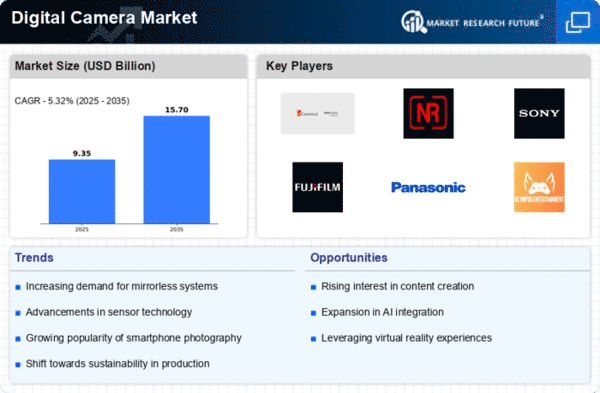
As per Market Research Future analysis, the Digital Camera Market Size was estimated at 8.88 USD Billion in 2024. The Digital Camera industry is projected to grow from 9.35 USD Billion in 2025 to 15.7 USD Billion by 2035, exhibiting a compound annual growth rate (CAGR) of 5.32% during the forecast period 2025 – 2035. This expansion reflects steady digital camera market growth, supported by evolving camera industry trends, increasing adoption across consumer and professional segments, and favorable digital camera industry statistics globally.

Key Market Trends & Highlights

The Digital Camera Market is experiencing a transformative shift towards advanced technologies and changing consumer preferences.

  • The rise of mirrorless cameras is reshaping the competitive landscape, particularly in North America.
  • Integration with mobile technology is becoming increasingly prevalent, appealing to a broader audience in the Asia-Pacific region.
  • Sustainability is gaining traction among consumers, influencing purchasing decisions across various demographics.
  • Technological advancements in imaging and the increased demand for content creation are driving growth in both the photography and videography segments.

Market Size & Forecast

2024 Market Size 8.88 (USD Billion)
2035 Market Size 15.7 (USD Billion)
CAGR (2025 - 2035) 5.32%

Major Players

Canon (JP), Nikon (JP), Sony (JP), Fujifilm (JP), Panasonic (JP), Olympus (JP), GoPro (US), Ricoh (JP), Leica (DE). These companies play a pivotal role in shaping the digital camera business through innovation, pricing strategies, and global distribution, contributing significantly to overall digital camera sales figures and digital camera sales trends.

Our Impact
Enabled $4.3B Revenue Impact for Fortune 500 and Leading Multinationals
Partnering with 2000+ Global Organizations Each Year
30K+ Citations by Top-Tier Firms in the Industry

Digital Camera Market Trends

The Digital Camera Market is currently experiencing a dynamic evolution, driven by advancements in technology and shifting consumer preferences. As photography becomes increasingly integrated with social media and digital sharing platforms, demand continues to rise, reinforcing long-term digital camera market trends. Manufacturers are focusing on enhancing features such as image stabilization, low-light performance, and connectivity options, aligning with insights from ongoing digital camera industry analysis and broader camera industry analysis. Furthermore, the emergence of mirrorless cameras has introduced a new level of versatility and compactness, appealing to a broader audience and influencing digital camera demographics across age groups and professional categories.

In addition to technological innovations, sustainability is becoming a focal point within the digital camera industry. Consumers are increasingly aware of environmental impacts, prompting brands to adopt eco-friendly practices. This shift supports a comprehensive camera industry overview that emphasizes ethical manufacturing and responsible sourcing. As the market evolves, these factors are expected to play a crucial role in shaping future offerings and global digital camera market research outcomes.

Rise of Mirrorless Cameras

The transition from traditional DSLRs to mirrorless systems highlights key camera industry trends, as these cameras offer compact designs without compromising image quality. This evolution continues to influence digital camera market analysis and adoption patterns worldwide.

Integration with Mobile Technology

Digital cameras are increasingly incorporating features that enhance connectivity with smartphones and tablets. This integration supports digital camera marketing strategies by enabling seamless sharing and editing, appealing to tech-savvy users and content creators.

Focus on Sustainability

There is a noticeable shift towards environmentally friendly practices within the camera industry, reflecting growing consumer demand for eco-conscious products and long-term sustainability in the cameras industry.

Digital Camera Market Drivers

Technological Advancements

The Digital Camera Market Industry is experiencing rapid technological advancements, which significantly enhance the functionality and performance of digital cameras. Innovations such as improved sensor technology, higher resolution capabilities, and advanced image processing algorithms are driving consumer interest. For instance, the introduction of mirrorless cameras has revolutionized the market by offering compact designs without compromising on image quality. As a result, the market is projected to reach 8.87 USD Billion in 2024, reflecting the growing demand for high-performance imaging devices. These advancements not only cater to professional photographers but also appeal to amateur enthusiasts, thereby broadening the consumer base.

Integration of Smart Features

The integration of smart features into digital cameras is a notable driver within the Digital Camera Industry. Features such as Wi-Fi connectivity, Bluetooth pairing, and mobile app integration enhance user experience by allowing seamless sharing and editing of images. This trend aligns with the growing consumer expectation for convenience and connectivity in technology. As digital cameras become more user-friendly and versatile, they attract a wider audience, including casual users and tech-savvy individuals. This shift is likely to contribute to a compound annual growth rate of 5.32% from 2025 to 2035, indicating a robust growth trajectory for the industry.

Rising Popularity of Photography

The Global Digital Camera Industry is witnessing a surge in the popularity of photography as a hobby and profession. This trend is fueled by social media platforms that encourage users to share high-quality images, thus increasing the demand for advanced digital cameras. The proliferation of photography-related content has led to a growing community of enthusiasts who seek better equipment to enhance their skills. As a result, the market is expected to grow significantly, with projections indicating a value of 15.7 USD Billion by 2035. This increasing interest in photography not only drives sales but also fosters innovation within the industry, as manufacturers strive to meet evolving consumer needs.

Market Trends and Growth Projections

The Global Digital Camera Market Industry is characterized by various trends that indicate a positive growth trajectory. Current projections suggest that the market will reach 8.87 USD Billion in 2024, with a compound annual growth rate of 5.32% anticipated from 2025 to 2035. This growth is driven by factors such as technological advancements, rising photography popularity, and increased demand for content creation. Additionally, the expansion into emerging markets presents new opportunities for manufacturers to tap into a growing consumer base. These trends collectively suggest a robust future for the digital camera market, as it adapts to changing consumer preferences and technological innovations.

Increased Demand for Content Creation

The Global Digital Camera Industry is significantly influenced by the increasing demand for content creation across various platforms. With the rise of influencers, vloggers, and content creators, there is a heightened need for high-quality imaging equipment. Digital cameras are essential tools for producing professional-grade content, which drives consumer investment in advanced models. This trend is expected to sustain market growth, as more individuals and businesses recognize the value of high-quality visuals in digital marketing and social media engagement. Consequently, the market is projected to reach 8.87 USD Billion in 2024, reflecting the growing importance of visual content in communication strategies.

Emerging Markets and Consumer Base Expansion

The Global Digital Camera Market Industry is poised for growth due to the expansion of emerging markets. Regions such as Asia-Pacific and Latin America are witnessing an increase in disposable income, leading to greater consumer spending on photography equipment. As more individuals in these regions gain access to digital cameras, the market is likely to experience a significant boost. This trend is further supported by the increasing availability of affordable yet high-quality digital cameras, which cater to a broader audience. The anticipated growth in these markets is expected to contribute to the overall market value, with projections indicating a rise to 15.7 USD Billion by 2035.


Market Segment Insights

By Application: Photography (Largest) vs. Videography (Fastest-Growing)

In the Digital Camera Market, the application segment reveals a diverse landscape where Photography holds the largest share, while Videography continues to expand rapidly, driven by demand for video cameras for filming movies and professional content creation. This evolution aligns with broader digital camera market segmentation trends.

Photography (Dominant) vs. Videography (Emerging)

Photography remains dominant due to strong professional adoption, while videography is emerging as demand rises for advanced cameras for filming movies and high-definition recording capabilities. This segment benefits from high consumer investment in equipment and accessories, ensuring a robust market presence. Conversely, Videography is recognized as an emerging force, fueled by technological advancements in video capabilities, appealing to both hobbyists and professionals alike. As content consumption trends shift towards video, this segment is expected to see significant growth, supported by innovations in high-definition recording and streaming capabilities.

By Camera Type: Digital Single-Lens Reflex (Largest) vs. Mirrorless (Fastest-Growing)

In the Digital Camera Market, the distribution of market share among different camera types reveals that Digital Single-Lens Reflex (DSLR) cameras continue to dominate, appealing to professional photographers and enthusiasts alike. These cameras hold a significant share due to their superior image quality and versatility. However, Mirrorless cameras are quickly becoming a popular alternative, as they offer similar quality in a more compact form factor and with advanced features, thus capturing a larger audience over time.

Digital Single-Lens Reflex (Dominant) vs. Mirrorless (Emerging)

DSLR cameras retain a strong position, while mirrorless cameras reflect changing digital camera market trends driven by portability, smart features, and consumer convenience. Their dominance is supported by a loyal user base and a wealth of accessories, which enhances their functionality. Conversely, Mirrorless cameras represent an emerging segment, appealing to tech-savvy consumers looking for portability without sacrificing quality. With faster autofocus systems and superior video capabilities, they attract both amateur and professional photographers. Mirrorless technology is continuously evolving, offering advanced features that challenge traditional DSLRs, indicating a dynamic shift in consumer behavior within the digital camera market.

By Sensor Type: Full-Frame (Largest) vs. APS-C (Fastest-Growing)

The Digital Camera Market has seen a diverse distribution in sensor types, with Full-Frame sensors holding the largest market share due to their superior image quality and performance. Meanwhile, APS-C sensors have been rapidly gaining traction, appealing to a wide range of consumers from photography enthusiasts to professionals due to their balance of performance and price. The popularity of these sensor types indicates a broader trend towards versatility and portability in digital imaging.

Full-Frame (Dominant) vs. APS-C (Emerging)

Full-Frame sensors are defined by their larger physical size, which directly contributes to their exceptional performance in low-light conditions and wider dynamic range. This has made them a preferred choice for professional photographers aiming for the highest image quality. In contrast, the APS-C segment is emerging with significant momentum, offering a more affordable and lightweight alternative without sacrificing too much in terms of image quality. APS-C sensors are especially popular among amateur photographers and videographers, leading to a broader market appeal and fostering growth in this segment.

By Price Range: Entry-Level (Largest) vs. Luxury (Fastest-Growing)

In the Digital Camera Market, the price range segment showcases a diverse distribution among various value categories. The Entry-Level segment dominates the market, capturing a significant portion of the consumer base with its affordability and accessibility. Following closely are the Mid-Range and High-End segments, which target enthusiasts and serious photographers seeking enhanced features and performance. The Professional segment, while smaller, caters to a niche audience with specialized needs in photography.

Entry-Level (Dominant) vs. Luxury (Emerging)

The Entry-Level segment is characterized by its affordability, appealing to novice photographers and casual users who prioritize ease of use and basic functionality. This segment typically features compact designs, user-friendly interfaces, and decent image quality, making it an excellent choice for beginners. Conversely, the Luxury segment is an emerging force within the Digital Camera Market, attracting affluent consumers who seek premium quality, advanced features, and exclusivity. Luxury cameras often come equipped with cutting-edge technology, superior craftsmanship, and personalized options, positioning them as aspirational products. As the demand for high-end photography experiences grows, this segment is seeing rapid growth, driven by the increasing popularity of professional photography and vlogging.

By User Type: Enthusiast (Largest) vs. Professional (Fastest-Growing)

The Digital Camera Market exhibits a diverse segment distribution among different user types. The Enthusiast segment holds the largest market share, driven by a growing number of photography hobbyists seeking quality imaging solutions. In contrast, the Professional segment, though smaller, is rapidly expanding as more photographers and videographers adopt digital technologies for high-end projects. This shift towards professional-grade equipment is changing the dynamics of market share in favor of users seeking advanced features and superior quality.

Enthusiast: Dominant vs. Professional: Emerging

The Enthusiast segment in the Digital Camera Market represents dedicated hobbyists who prioritize quality and performance in their camera choices. Known for their passion and commitment, Enthusiasts often invest in high-quality lenses and accessories, resulting in significant brand loyalty and repeat purchases. On the other hand, the Professional segment is characterized by individuals who utilize cameras in commercial applications, such as photography and videography for events or marketing purposes. Professionals demand advanced technical specifications and reliability, which drives the development of high-performance cameras. As this market grows, manufacturers are focusing on meeting the specific needs of these users, enhancing features tailored for professionals.

Get more detailed insights about Digital Camera Market

Regional Insights

North America : Stable Market with Innovation

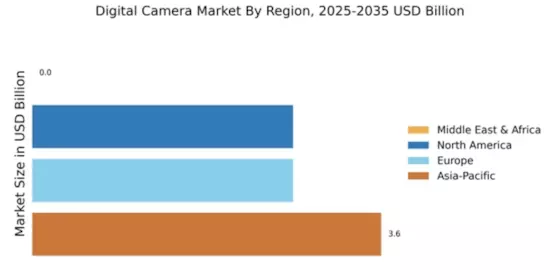
North America continues to lead the digital camera market, holding a significant share of 3.55 billion in 2024. North America continues to lead the digital camera market, driven by strong consumer demand, innovation, and robust digital camera sales figures. The region's growth is driven by increasing consumer demand for high-quality imaging and advancements in technology. Regulatory support for digital innovation and environmental standards further catalyze market expansion. The rise of social media and content creation has also fueled demand for versatile camera systems, enhancing the market's growth trajectory.

The competitive landscape in North America is robust, featuring key players such as Canon, Nikon, and Sony, which dominate the market with innovative products. The U.S. remains the largest market, driven by a tech-savvy population and a strong photography culture. Companies are focusing on enhancing user experience through smart features and connectivity options, ensuring they meet the evolving needs of consumers. The presence of major brands and continuous product launches solidify North America's position as a digital camera powerhouse.

Europe : Diverse Market with Strong Demand

Europe's digital camera market, also at $2.66B, is experiencing a resurgence driven by a renewed interest in photography and videography. The region benefits from a diverse consumer base, with increasing demand for high-end cameras among enthusiasts and professionals. Regulatory frameworks promoting sustainability and innovation are key growth catalysts, encouraging manufacturers to adopt eco-friendly practices and enhance product offerings. Germany, the UK, and France are leading markets, with strong competition among key players like Fujifilm, Panasonic, and Leica. The competitive landscape is marked by a blend of traditional and emerging brands, each vying for market share through innovative features and marketing strategies. The presence of a well-established retail network further supports the growth of the digital camera segment in Europe.

Asia-Pacific : Leading Market with High Growth

Asia-Pacific demonstrates strong expansion, particularly in digital camera market in India and digital camera industry in India, where rising incomes and content creation drive demand. Increased availability of digital cameras in Indian market continues to strengthen regional performance. Countries like China and India are leading this growth, with a rising interest in photography and content creation. Regulatory initiatives aimed at promoting technological advancements and digital literacy are also contributing to market expansion, making high-quality cameras more accessible to consumers.

The competitive landscape is vibrant, with major players like Sony and Canon investing heavily in the region. Japan remains a key market, known for its technological innovations and high-quality products. The presence of local brands is also notable, as they cater to specific consumer needs and preferences. As the demand for digital content continues to rise, the Asia-Pacific market is set to become a significant player in the global digital camera industry.

Middle East and Africa : Emerging Market with Potential

The Middle East and Africa (MEA) digital camera market, currently valued at $0.0B, presents significant growth opportunities as consumer interest in photography rises. Factors such as increasing disposable income and the proliferation of social media are driving demand for digital cameras. Regulatory initiatives aimed at boosting technology adoption and improving infrastructure are expected to catalyze market growth in the coming years. Countries like South Africa and the UAE are emerging as key players in the market, with a growing number of local and international brands entering the space. The competitive landscape is evolving, with companies focusing on affordability and accessibility to capture the interest of a broader consumer base. As the market matures, the presence of established brands will likely enhance competition and innovation.

Digital Camera Market Regional Image

Key Players and Competitive Insights

The Digital Camera Market is currently characterized by a dynamic competitive landscape, driven by technological advancements and evolving consumer preferences. Major players influence global digital camera business dynamics through product launches and partnerships, reinforcing the long-term stability of the digital camera industry. Major players such as Canon (JP), Nikon (JP), and Sony (JP) are at the forefront, each adopting distinct strategies to maintain their market positions. Canon (JP) emphasizes innovation in imaging technology, focusing on high-performance mirrorless cameras, while Nikon (JP) has been enhancing its product line with a strong emphasis on user-friendly features and robust performance. Sony (JP), on the other hand, leverages its expertise in sensor technology to deliver superior image quality, thereby appealing to both amateur and professional photographers. Collectively, these strategies contribute to a competitive environment that is increasingly defined by innovation and technological prowess. In terms of business tactics, companies are localizing manufacturing and optimizing supply chains to enhance efficiency and reduce costs. The market structure appears moderately fragmented, with several key players exerting influence over various segments. This fragmentation allows for niche players to thrive, while larger companies focus on consolidating their market share through strategic partnerships and acquisitions. The collective influence of these key players shapes the market dynamics, fostering an environment where innovation is paramount. In November 2025, Canon (JP) announced the launch of its latest mirrorless camera, which integrates advanced AI features for enhanced image processing. This strategic move not only showcases Canon's commitment to innovation but also positions the company to capture a larger share of the growing market for AI-driven photography solutions. The introduction of such technology is likely to resonate with tech-savvy consumers seeking cutting-edge features in their photography equipment. Similarly, in October 2025, Nikon (JP) unveiled a new line of compact cameras designed specifically for vlogging and content creation. This strategic pivot reflects Nikon's recognition of the burgeoning demand for portable, high-quality cameras among social media influencers and content creators. By targeting this niche market, Nikon aims to differentiate itself and expand its customer base, potentially leading to increased sales and brand loyalty. In September 2025, Sony (JP) entered into a strategic partnership with a leading software company to enhance its camera's connectivity features. This collaboration aims to streamline the user experience by integrating cloud-based services for seamless photo sharing and editing. Such initiatives indicate Sony's proactive approach to adapting to consumer needs, particularly in an era where digital connectivity is increasingly vital for photographers. As of December 2025, current trends in the Digital Camera Market are heavily influenced by digitalization, sustainability, and AI integration. The shift towards sustainable practices is becoming more pronounced, with companies exploring eco-friendly materials and production methods. Strategic alliances are also shaping the competitive landscape, as firms collaborate to enhance technological capabilities and market reach. Looking ahead, competitive differentiation is likely to evolve, with a pronounced shift from price-based competition to a focus on innovation, technology, and supply chain reliability. This evolution suggests that companies that prioritize these aspects will be better positioned to thrive in an increasingly competitive market.

Key Companies in the Digital Camera Market include

Industry Developments

  • Q3 2025: China Is the World's Largest Photography Market So Far in 2025 CIPA's year-to-date statistics for January through June 2025 show that China has become the largest market for digital camera purchases, surpassing the Americas, with a significant surge in camera shipments in April, May, and June driven by increased demand and anticipation of U.S. tariffs.
  • Q3 2025: 2025 is poised to be the best year for cameras since 2019 According to CIPA data released in August 2025, the first half of the year saw 4.3 million cameras shipped globally, with compact camera shipments reaching their highest levels since 2021 and overall shipments up 116.6% compared to the same period in 2024.

Future Outlook

Digital Camera Market Future Outlook

The Digital Camera Market is projected to grow at a 5.32% CAGR from 2024 to 2035, driven by innovation, rising content creation, and expanding professional use cases such as cameras for filming movies and video cameras for filming movies. By 2035, the market is expected to demonstrate robust innovation and diversification across applications.

New opportunities lie in:

  • Development of AI-driven camera features for enhanced user experience. Expansion into emerging markets with affordable product lines. Partnerships with social media platforms for integrated sharing solutions.

By 2035, the Digital Camera Market is expected to achieve robust growth and innovation.

Market Segmentation

Digital Camera Market User Type Outlook

  • Amateur
  • Enthusiast
  • Professional
  • Commercial
  • Educational

Digital Camera Market Application Outlook

  • Photography
  • Videography
  • Surveillance
  • Scientific Research
  • Industrial Use

Digital Camera Market Camera Type Outlook

  • Digital Single-Lens Reflex
  • Mirrorless
  • Compact
  • Action
  • Instant

Digital Camera Market Price Range Outlook

  • Entry-Level
  • Mid-Range
  • High-End
  • Professional
  • Luxury

Digital Camera Market Sensor Type Outlook

  • Full-Frame
  • APS-C
  • Micro Four Thirds
  • 1-Inch
  • Medium Format

Report Scope

MARKET SIZE 2024 8.88(USD Billion)
MARKET SIZE 2025 9.35(USD Billion)
MARKET SIZE 2035 15.7(USD Billion)
COMPOUND ANNUAL GROWTH RATE (CAGR) 5.32% (2025 - 2035)
REPORT COVERAGE Revenue Forecast, Competitive Landscape, Growth Factors, and Trends
BASE YEAR 2024
Market Forecast Period 2025 - 2035
Historical Data 2019 - 2024
Market Forecast Units USD Billion
Key Companies Profiled Canon (JP), Nikon (JP), Sony (JP), Fujifilm (JP), Panasonic (JP), Olympus (JP), GoPro (US), Ricoh (JP), Leica (DE)
Segments Covered Application, Camera Type, Sensor Type, Price Range, User Type
Key Market Opportunities Integration of artificial intelligence in Digital Camera Market enhances user experience and image quality.
Key Market Dynamics Technological advancements and evolving consumer preferences drive competitive dynamics in the digital camera market.
Countries Covered North America, Europe, APAC, South America, MEA

Market Highlights

Author
Aarti Dhapte
Team Lead - Research

She holds an experience of about 6+ years in Market Research and Business Consulting, working under the spectrum of Information Communication Technology, Telecommunications and Semiconductor domains. Aarti conceptualizes and implements a scalable business strategy and provides strategic leadership to the clients. Her expertise lies in market estimation, competitive intelligence, pipeline analysis, customer assessment, etc.

Leave a Comment

FAQs

What was the expected market size of the Digital Camera Market by 2024?

The Digital Camera Market was valued at 8.87 USD Billion by 2024.

What is the projected market size for the Digital Camera Market in 2035?

By 2035, the Digital Camera Market is anticipated to reach a value of 15.69 USD Billion.

What is the expected CAGR for the Digital Camera Market from 2025 to 2035?

The expected CAGR for the Digital Camera Market from 2025 to 2035 is 5.31%.

Which product type dominates the Digital Camera Market?

The Single Reflex product type dominated the market with a value of 5.2 USD Billion in 2024.

What was the market value of Non-Reflex cameras in 2024?

The market value for Non-Reflex cameras was 3.67 USD Billion in 2024.

Which region held the largest market share in 2024?

North America held the largest market share with a value of 2.65 USD Billion in 2024.

What is the projected market growth for the Asia Pacific region from 2024 to 2035?

The Asia Pacific region is projected to grow from 3.1 USD Billion in 2024 to 5.55 USD Billion by 2035.

What is the expected market size for Europe in 2035?

The expected market size for Europe in 2035 is 3.78 USD Billion.

Who are the key players in the Digital Camera Market?

Key players in the market include Leica, Nikon, Canon, Fujifilm, and Sony, among others.

What are the growth drivers for the Digital Camera Market going forward?

The growth drivers include advancements in technology and increasing demand for high-quality imaging systems.

Download Free Sample

Kindly complete the form below to receive a free sample of this Report

Compare Licence

×
Features License Type
Single User Multiuser License Enterprise User
Price $4,950 $5,950 $7,250
Maximum User Access Limit 1 User Upto 10 Users Unrestricted Access Throughout the Organization
Free Customization
Direct Access to Analyst
Deliverable Format
Platform Access
Discount on Next Purchase 10% 15% 15%
Printable Versions