×
Request Free Sample ×

Kindly complete the form below to receive a free sample of this Report

* Please use a valid business email

Leading companies partner with us for data-driven Insights

clients tt-cursor
Hero Background

Coal Based Activated Carbon Market

ID: MRFR/CnM/7992-HCR
111 Pages
Chitranshi Jaiswal
February 2026

Coal-Based Activated Carbon Market Research Report By Application (Air Purification, Water Treatment, Industrial Processes, Food and Beverage, Pharmaceuticals), By Type (Powdered Activated Carbon, Granular Activated Carbon, Cylindrical Activated Carbon), By End Use Industry (Environmental Protection, Chemical Manufacturing, Electronics, Mining, Healthcare), By Form (Pellets, Powder, Spherical) and By Regional (North America, Europe, South America, Asia Pacific, Middle East and Africa) - Forecast to 2035

Share:
Download PDF ×

We do not share your information with anyone. However, we may send you emails based on your report interest from time to time. You may contact us at any time to opt-out.

Coal Based Activated Carbon Market Infographic
Purchase Options

Coal Based Activated Carbon Market Summary

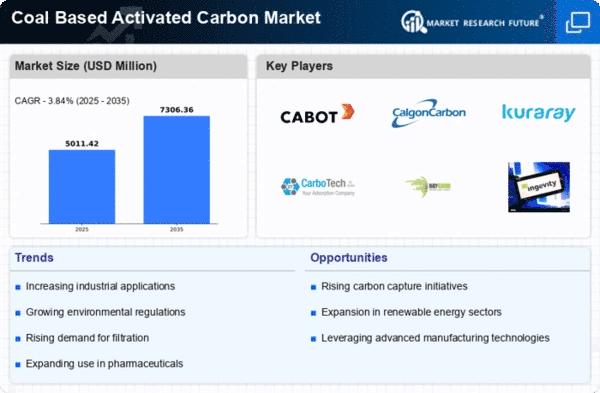
As per MRFR analysis, the Coal Based Activated Carbon Market Size was estimated at 4826.1 USD Million in 2024. The Coal Based Activated Carbon industry is projected to grow from 5011.52 USD Million in 2025 to 7306.36 USD Million by 2035, exhibiting a compound annual growth rate (CAGR) of 3.84 during the forecast period 2025 - 2035.

Key Market Trends & Highlights

The Coal Based Activated Carbon Market is experiencing robust growth driven by increasing demand across various sectors.

  • North America remains the largest market for coal based activated carbon, primarily due to its extensive industrial applications.
  • The Asia-Pacific region is emerging as the fastest-growing market, fueled by rising environmental concerns and regulatory compliance.
  • The air treatment segment holds the largest share, while the water treatment segment is witnessing the most rapid growth.
  • Key market drivers include increasing industrial applications and advancements in production technologies, which are propelling demand across multiple sectors.

Market Size & Forecast

2024 Market Size 4826.1 (USD Million)
2035 Market Size 7306.36 (USD Million)
CAGR (2025 - 2035) 3.84%

Major Players

Cabot Corporation (US), Calgon Carbon Corporation (US), Kuraray Co Ltd (JP), Carbotech AC GmbH (DE), Haycarb PLC (LK), Ingevity Corporation (US), Activated Carbon Technologies (US), Evoqua Water Technologies (US)

Our Impact
Enabled $4.3B Revenue Impact for Fortune 500 and Leading Multinationals
Partnering with 2000+ Global Organizations Each Year
30K+ Citations by Top-Tier Firms in the Industry

Coal Based Activated Carbon Market Trends

The Coal Based Activated Carbon Market is currently experiencing a dynamic phase characterized by evolving applications and increasing demand across various sectors. Industries such as water treatment, air purification, and food processing are driving the need for high-quality activated carbon products. This surge in demand is likely influenced by heightened awareness regarding environmental sustainability and the necessity for effective filtration solutions. Furthermore, the market appears to be adapting to technological advancements, which may enhance the efficiency and effectiveness of activated carbon in diverse applications. In addition, the regulatory landscape surrounding environmental protection is becoming more stringent, compelling industries to seek reliable solutions for pollutant removal. This trend suggests that the Coal Based Activated Carbon Market could witness further growth as companies strive to comply with these regulations. The interplay between innovation, regulatory pressures, and market demand indicates a complex yet promising future for this sector, as stakeholders navigate the challenges and opportunities that lie ahead.

Rising Demand in Water Treatment

The need for effective water purification solutions is escalating, leading to increased utilization of coal based activated carbon in treatment processes. This trend reflects a broader commitment to ensuring safe drinking water and meeting regulatory standards.

Technological Advancements

Innovations in production techniques and application methods are enhancing the performance of coal based activated carbon. These advancements may improve adsorption capacities and broaden the scope of applications, making activated carbon more versatile.

Regulatory Compliance and Environmental Awareness

Growing environmental regulations are prompting industries to adopt cleaner technologies. The Coal Based Activated Carbon Market is likely to benefit from this shift, as companies seek sustainable solutions for pollutant management.

Coal Based Activated Carbon Market Drivers

Growth in Air Pollution Control Initiatives

The Global Coal-Based Activated Carbon Market Industry is significantly influenced by the escalating need for air pollution control measures. Governments worldwide are implementing stringent regulations to combat air quality deterioration, which has led to increased adoption of activated carbon in air filtration systems. This material effectively adsorbs harmful gases and particulates, making it essential for industries such as power generation and manufacturing. As environmental regulations tighten, the market is expected to expand, with projections indicating a growth to 7.31 USD Billion by 2035. This growth is indicative of a broader commitment to improving air quality and public health.

Rising Demand for Water Treatment Solutions

The Global Coal-Based Activated Carbon Market Industry experiences a notable surge in demand for water treatment solutions. This trend is largely driven by increasing concerns regarding water quality and the necessity for effective filtration systems. Activated carbon is widely recognized for its ability to remove contaminants, including chlorine, volatile organic compounds, and heavy metals from water. As urbanization progresses and industrial activities expand, the need for advanced water purification technologies intensifies. The market is projected to reach 4.83 USD Billion in 2024, reflecting a robust growth trajectory as municipalities and industries invest in sustainable water treatment solutions.

Expanding Applications in Pharmaceutical Industry

The Global Coal-Based Activated Carbon Market Industry is witnessing an expansion in applications within the pharmaceutical sector. Activated carbon is utilized for drug purification and as an excipient in various formulations, enhancing the efficacy and safety of pharmaceutical products. The increasing focus on drug quality and patient safety drives the demand for high-purity activated carbon. As pharmaceutical companies strive to meet regulatory standards and consumer expectations, the market is likely to benefit from this trend. The anticipated compound annual growth rate of 3.84% from 2025 to 2035 suggests a sustained interest in activated carbon solutions within this critical industry.

Technological Advancements in Production Processes

The Global Coal-Based Activated Carbon Market Industry is positively impacted by technological advancements in production processes. Innovations in activation methods and material sourcing have led to enhanced performance characteristics of activated carbon, making it more effective for various applications. These advancements not only improve the efficiency of activated carbon but also reduce production costs, thereby increasing its accessibility to a broader range of industries. As manufacturers adopt these new technologies, the market is poised for growth, with a projected increase in demand across sectors such as water treatment, air purification, and industrial applications.

Increasing Awareness of Environmental Sustainability

The Global Coal-Based Activated Carbon Market Industry is significantly shaped by the growing awareness of environmental sustainability. As consumers and businesses alike prioritize eco-friendly practices, the demand for sustainable materials, including activated carbon, is on the rise. This shift is particularly evident in industries such as food and beverage, where activated carbon is used for decolorization and purification processes. The emphasis on sustainability is likely to drive innovation and investment in activated carbon technologies, contributing to market growth. The industry's responsiveness to these trends may enhance its reputation and market share in the coming years.


Market Segment Insights

By Application: Air Treatment (Largest) vs. Water Treatment (Fastest-Growing)

In the Coal Based Activated Carbon Market, the application segment is characterized by significant diversity. Air Treatment holds the largest share, driven by stringent environmental regulations and the growing demand for air purification technologies. In contrast, Water Treatment is recognized as the fastest-growing segment, propelled by increasing water contamination concerns and rising investments in wastewater treatment facilities. Industrial Processes and Food and Beverage applications also contribute notably, although they represent a smaller portion of the overall market.

Air Treatment (Dominant) vs. Water Treatment (Emerging)

The Air Treatment application is a dominant force in the Coal Based Activated Carbon Market, utilized primarily for air pollution control. Its widespread adoption is fueled by the need for compliance with environmental regulations and the growing demand for cleaner air in urban areas. On the other hand, Water Treatment is rapidly emerging, driven by heightened awareness regarding water quality and the necessity for effective filtration solutions. Technologies in water treatment are evolving, with activated carbon playing a pivotal role in removing contaminants. Both segments leverage the unique properties of coal-based activated carbon, ensuring effective adsorption capabilities essential for performance.

By End Use Industry: Chemical (Largest) vs. Environmental (Fastest-Growing)

In the Coal Based Activated Carbon Market, the End Use Industry segment showcases distinct patterns among its segment values. The Chemical sector holds the largest market share, primarily due to its extensive use in various applications such as gas purification and water treatment. Following closely is the Environmental segment, driven by rising environmental regulations that compel industries to adopt cleaner technologies. Other notable segments include Mining, Food and Beverage, and Pharmaceutical, each contributing significantly to the overall comparative marketplace.

Chemical (Dominant) vs. Environmental (Emerging)

The Chemical segment in the Coal Based Activated Carbon Market is characterized by its broad application base, particularly in solvents, catalytic processes, and chromatography. This sector remains dominant due to its well-established infrastructure and the necessity for effective separation and purification processes. Conversely, the Environmental segment has emerged as a fast-growing area, largely influenced by the increasing global focus on sustainability and environmental protection. This sector's growth is marked by innovations in waste treatment and air purification technologies. As consumers and regulators push for greener solutions, the Environmental segment is expected to expand rapidly, often leveraging advancements in filtration technologies.

By Form: Granular Activated Carbon (Largest) vs. Powdered Activated Carbon (Fastest-Growing)

In the Coal Based Activated Carbon Market, the 'Form' segment is characterized by three distinct categories: Granular Activated Carbon, Powdered Activated Carbon, and Pelletized Activated Carbon. Granular Activated Carbon holds the largest market share, serving a variety of applications due to its superior adsorption capacity and ease of handling. On the other hand, Powdered Activated Carbon is rapidly gaining ground as industries increasingly leverage its effectiveness in applications requiring quick and efficient absorption properties, thus positioning it as the fastest-growing segment in this market. The growth trends in this segment are significantly influenced by the rising demand for air and water purification technologies, as well as stringent environmental regulations that mandate the use of activated carbon in industrial applications. The versatility of both Granular and Powdered Activated Carbons in various end-user industries, including pharmaceuticals, food and beverages, and automotive, further accelerates their adoption. Additionally, the increasing focus on sustainable solutions is propelling the growth of Pelletized Activated Carbon, which is gaining traction for its efficiency in adsorption and reduced pressure drop in fixed-bed operations.

Granular Activated Carbon (Dominant) vs. Pelletized Activated Carbon (Emerging)

Granular Activated Carbon (GAC) stands out as the dominant force in the Coal Based Activated Carbon Market due to its widespread applications in water treatment, air purification, and more. Its granular structure not only facilitates efficient flow rates but also enhances adsorption capacity, making it preferred by various industries. Conversely, Pelletized Activated Carbon (PAC) is emerging as a strong contender in this segment. With its compact form, PAC offers advantages in fixed-bed operation, where low-pressure drop and high mechanical strength are critical. Several industries are beginning to recognize the potential of PAC for various applications, including wastewater treatment and gas phase adsorption, which boosts its market presence. Though still overshadowed by GAC, the growing emphasis on operational efficiency positions PAC well for future growth.

By Production Method: Physical Activation (Largest) vs. Chemical Activation (Fastest-Growing)

In the Coal Based Activated Carbon Market, Physical Activation holds the largest share due to its established production methods and widespread applications across various industries. This segment utilizes thermal processes to enhance the adsorption properties of carbon, making it a preferred choice in water treatment and air purification applications. Meanwhile, Chemical Activation, although currently smaller in share, is gaining traction as innovative chemical treatments enhance pore structure and surface area, catering to specialized applications in pharmaceuticals and food industries. The growth trends in the Production Method segment are heavily influenced by environmental regulations and the increasing demand for high-performance activated carbon. As markets shift towards sustainability, Chemical Activation is emerging as the fastest-growing method driven by the need for more efficient pores and adsorption capabilities. This trend is bolstered by advances in technology and an increasing preference for chemical processes that offer better performance, making Chemical Activation an attractive choice for manufacturers aiming to innovate and meet regulatory standards.

Physical Activation (Dominant) vs. Steam Activation (Emerging)

Physical Activation, utilizing heat to create porous activated carbon, dominates the Coal Based Activated Carbon Market because of its efficiency and the simplicity of the process. It is highly effective for larger scale applications such as air and water filtration. The established production techniques and cost-effectiveness contribute to its dominant position. In contrast, Steam Activation is emerging as a notable alternative, particularly suited for producing activated carbon with higher surface areas and microporosity. This method, while more complex and often more expensive, is gaining attention in applications requiring specific adsorption characteristics, such as in the food and beverage industry. The growth of Steam Activation is indicative of a shift towards specialization in activated carbon products, focusing on enhancing performance in niche markets.

By Adsorption Capacity: High Capacity (Largest) vs. Medium Capacity (Fastest-Growing)

In the Coal Based Activated Carbon Market, the distribution of adsorption capacity segments reveals that high capacity activated carbon dominates the market due to its efficacy in various applications, including air and water treatment. Medium capacity options are also gaining traction, particularly in niche applications, making them an increasingly vital part of the market. Conversely, low capacity activated carbons are less favored and see a decline in demand as industries shift toward more efficient solutions. Growth trends indicate that the medium capacity segment is the fastest-growing within the adsorption capacity category. This shift is driven by the increasing demand for sustainable solutions and the development of innovative materials that enhance adsorption properties. These trends point toward a greater focus on efficiency and the search for cost-effective alternatives in environmental applications, positioning medium capacity activated carbon as a critical component of future market developments.

High Capacity (Dominant) vs. Medium Capacity (Emerging)

High capacity activated carbon is recognized for its superior adsorption efficiency, making it a dominant player in the Coal Based Activated Carbon Market. This type excels in removing contaminants from air and water, making it a preferred choice in large-scale industrial applications. The high capacity variants are particularly favored in sectors requiring stringent purification standards, such as pharmaceuticals and food processing. On the other hand, medium capacity activated carbon has begun to emerge as a valuable alternative, with growing applications in less demanding environments. As industries prioritize sustainability and cost-effectiveness, medium capacity options are gaining attention due to their adequate performance and reduced operational costs, thus securing a firm footing in niche markets.

Get more detailed insights about Coal Based Activated Carbon Market

Regional Insights

North America : Established Market with Growth Potential

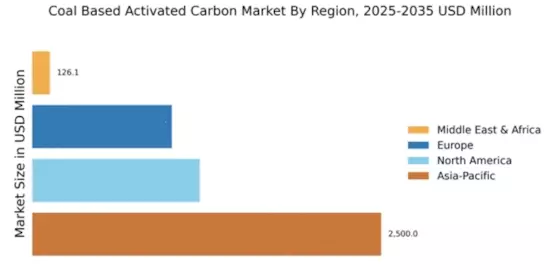
The North American coal-based activated carbon market is projected to reach $1,200.0 million by December 2025, driven by increasing environmental regulations and a growing demand for air and water purification. The region's focus on sustainability and pollution control is propelling market growth, with industries such as water treatment and food processing leading the demand. Regulatory frameworks are encouraging the adoption of activated carbon solutions, enhancing market dynamics. The United States is the leading country in this region, hosting key players like Cabot Corporation and Calgon Carbon Corporation. The competitive landscape is characterized by innovation and strategic partnerships among major companies. The presence of advanced manufacturing facilities and a robust distribution network further strengthens the market position of these players, ensuring a steady supply of activated carbon products.

Europe : Regulatory-Driven Market Expansion

Europe's coal-based activated carbon market is expected to reach $1,000.0 million by December 2025, fueled by stringent environmental regulations and a shift towards sustainable practices. The European Union's commitment to reducing carbon emissions and improving air quality is driving demand for activated carbon in various applications, including industrial processes and wastewater treatment. The region's focus on circular economy principles is also enhancing market growth. Germany and the UK are the leading countries in this market, with significant contributions from companies like Carbotech AC GmbH and Haycarb PLC. The competitive landscape is marked by innovation and a strong emphasis on research and development. European manufacturers are increasingly investing in advanced technologies to improve product efficiency and sustainability, positioning themselves as leaders in the global market. "The European market is witnessing a significant shift towards sustainable activated carbon solutions, driven by regulatory frameworks and consumer demand," European Commission report.

Asia-Pacific : Emerging Powerhouse in Market

The Asia-Pacific region is projected to dominate the coal-based activated carbon market, reaching $2,500.0 million by December 2025. This growth is primarily driven by rapid industrialization, urbanization, and increasing environmental awareness among consumers. Countries in this region are investing heavily in water and air purification technologies, which are essential for public health and environmental sustainability. The demand for activated carbon is expected to surge as industries seek effective solutions to meet regulatory standards. China and Japan are the leading countries in this market, with significant contributions from key players like Kuraray Co Ltd. The competitive landscape is characterized by a mix of local and international companies, all vying for market share. The presence of a robust manufacturing base and a growing focus on innovation are key factors that enhance the region's market position, making it a focal point for activated carbon production and consumption.

Middle East and Africa : Emerging Market with Growth Potential

The Middle East and Africa coal-based activated carbon market is expected to reach $126.1 million by December 2025, driven by increasing industrial activities and a growing need for water and air purification solutions. The region's focus on improving environmental standards and public health is propelling market growth. Additionally, investments in infrastructure and industrial development are expected to further boost demand for activated carbon products. South Africa and the UAE are the leading countries in this region, with a growing presence of international players. The competitive landscape is evolving, with local manufacturers increasingly entering the market to meet rising demand. The presence of key players and a focus on sustainable practices are expected to enhance the market's growth trajectory, positioning the region as a significant player in The Coal Based Activated Carbon.

Coal Based Activated Carbon Market Regional Image

Key Players and Competitive Insights

The Coal Based Activated Carbon Market is currently characterized by a competitive landscape that is both dynamic and multifaceted. Key growth drivers include increasing environmental regulations, heightened demand for water treatment solutions, and the rising need for air purification technologies. Major players such as Cabot Corporation (US), Calgon Carbon Corporation (US), and Kuraray Co Ltd (JP) are strategically positioned to leverage these trends. For instance, Cabot Corporation (US) focuses on innovation in product development, particularly in enhancing the adsorption capabilities of their activated carbon products, which appears to be a critical factor in maintaining their competitive edge. Similarly, Calgon Carbon Corporation (US) emphasizes regional expansion and partnerships, particularly in emerging markets, to bolster its market presence and operational efficiency.In terms of business tactics, companies are increasingly localizing manufacturing to reduce logistics costs and enhance supply chain resilience. The market structure is moderately fragmented, with a mix of large multinational corporations and smaller regional players. This fragmentation allows for a diverse range of products and services, yet the collective influence of key players like Ingevity Corporation (US) and Evoqua Water Technologies (US) is significant, as they drive innovation and set industry standards.

In November Ingevity Corporation (US) announced a strategic partnership with a leading water treatment firm to develop advanced filtration solutions utilizing their proprietary activated carbon technology. This collaboration is poised to enhance Ingevity's product offerings and expand its market reach, particularly in the municipal water treatment sector, which is experiencing robust growth due to increasing regulatory pressures.

In October Calgon Carbon Corporation (US) unveiled a new manufacturing facility in Southeast Asia, aimed at localizing production to meet the growing demand in the region. This move not only reduces transportation costs but also positions Calgon Carbon to respond more swiftly to market needs, thereby enhancing its competitive positioning in a rapidly evolving landscape.

In September Kuraray Co Ltd (JP) launched a new line of eco-friendly activated carbon products, which are derived from sustainable sources. This initiative reflects a broader industry trend towards sustainability and positions Kuraray as a leader in environmentally responsible manufacturing practices, appealing to a growing segment of environmentally conscious consumers.

As of December the competitive trends in the Coal Based Activated Carbon Market are increasingly defined by digitalization, sustainability, and the integration of advanced technologies such as AI. Strategic alliances are becoming more prevalent, as companies recognize the need to collaborate to enhance innovation and operational efficiency. The competitive differentiation is likely to evolve from traditional price-based competition to a focus on technological advancements, product innovation, and supply chain reliability, suggesting a transformative shift in how companies compete in this market.

Key Companies in the Coal Based Activated Carbon Market include

Industry Developments

The Coal-Based Activated Carbon Market is currently witnessing significant developments as companies like Kureha Corporation, Jacobi Carbons, and Calgon Carbon Corporation adapt to increasing environmental regulations and demand for sustainable solutions. Recent investments in technology by Advent Technologies and Ingevity Corporation have paved the way for heightened efficiency in production processes, enhancing the performance of activated carbon products. Haycarb PLC and Silcarbon Aktivkohle GmbH are also focusing on expanding their capacities to meet the surging demand in various industries, including water treatment and air purification.

Moreover, reports of merger activities highlight the strategic movements within the market, with companies seeking to consolidate their positions. These shifts appear to be fostering a more competitive landscape, as demonstrated by potential synergies among players such as Merck KGaA and Cabot Carbon Limited. The overall market valuation is gradually increasing, attributed to rising end-user applications and continuous innovation, which is impacting both pricing strategies and supply chain dynamics across the sector. As evolving environmental concerns drive demand, organizations are actively reshaping their approaches to maintain relevance and meet market expectations.

Future Outlook

Coal Based Activated Carbon Market Future Outlook

The Coal Based Activated Carbon Market is projected to grow at a 3.84% CAGR from 2025 to 2035, driven by increasing environmental regulations and demand for air and water purification.

New opportunities lie in:

  • Expansion into emerging markets with tailored product offerings.
  • Development of innovative recycling processes for activated carbon.
  • Strategic partnerships with water treatment facilities for bulk supply contracts.

By 2035, the market is expected to solidify its position as a key player in environmental solutions.

Market Segmentation

Coal Based Activated Carbon Market Form Outlook

  • Granular Activated Carbon
  • Powdered Activated Carbon
  • Pelletized Activated Carbon

Coal Based Activated Carbon Market Application Outlook

  • Air Treatment
  • Water Treatment
  • Industrial Processes
  • Food and Beverage
  • Pharmaceuticals

Coal Based Activated Carbon Market End Use Industry Outlook

  • Chemical
  • Mining
  • Environmental
  • Food and Beverage
  • Pharmaceutical

Coal Based Activated Carbon Market Production Method Outlook

  • Physical Activation
  • Chemical Activation
  • Steam Activation

Coal Based Activated Carbon Market Adsorption Capacity Outlook

  • Low Capacity
  • Medium Capacity
  • High Capacity

Report Scope

MARKET SIZE 20244826.1(USD Million)
MARKET SIZE 20255011.52(USD Million)
MARKET SIZE 20357306.36(USD Million)
COMPOUND ANNUAL GROWTH RATE (CAGR)3.84% (2025 - 2035)
REPORT COVERAGERevenue Forecast, Competitive Landscape, Growth Factors, and Trends
BASE YEAR2024
Market Forecast Period2025 - 2035
Historical Data2019 - 2024
Market Forecast UnitsUSD Million
Key Companies ProfiledCabot Corporation (US), Calgon Carbon Corporation (US), Kuraray Co Ltd (JP), Carbotech AC GmbH (DE), Haycarb PLC (LK), Ingevity Corporation (US), Activated Carbon Technologies (US), Evoqua Water Technologies (US)
Segments CoveredApplication, End Use Industry, Form, Production Method, Adsorption Capacity
Key Market OpportunitiesGrowing demand for sustainable water treatment solutions drives innovation in the Coal Based Activated Carbon Market.
Key Market DynamicsRising demand for coal based activated carbon driven by stringent environmental regulations and industrial applications.
Countries CoveredNorth America, Europe, APAC, South America, MEA
Leave a Comment

FAQs

What is the compound annual growth rate (CAGR) for the Global Coal-Based Activated Carbon Market from 2025 to 2034?

Coal Based Activated Carbon Market is projected to register a CAGR of 3.84% from 2025-2035

Which application has the highest market value in the Global Coal-Based Activated Carbon Market in 2024?

The Air Purification segment holds the highest market value at 1.5 USD Billion in 2024.

How is the Global Coal-Based Activated Carbon Market segmented by region in 2024?

In 2024, the market sizes by region are North America at 1.2 USD Billion, Europe at 1.1 USD Billion, APAC at 1.4 USD Billion, South America at 0.5 USD Billion, and MEA at 0.28 USD Billion.

What is the projected market value for the Water Treatment application in 2035?

The Water Treatment application is projected to reach a value of 1.8 USD Billion by 2035.

Who are the key players in the Global Coal-Based Activated Carbon Market?

Some major players include Kureha Corporation, Jacobi Carbons, Haycarb PLC, and Calgon Carbon Corporation.

What is the expected market value for the Industrial Processes segment in 2035?

The Industrial Processes segment is expected to reach 1.0 USD Billion in 2035.

What is the projected market growth for North America by 2035?

The North American market is projected to grow to 1.7 USD Billion by 2035.

Which market segment is expected to grow the fastest from 2025 to 2035?

The Air Purification segment is expected to witness significant growth during the forecast period.

What is the anticipated market size for the Pharmaceuticals application in 2035?

The Pharmaceuticals application is expected to be valued at 0.58 USD Billion in 2035.

Download Free Sample

Kindly complete the form below to receive a free sample of this Report

Compare Licence

×
Features License Type
Single User Multiuser License Enterprise User
Price $4,950 $5,950 $7,250
Maximum User Access Limit 1 User Upto 10 Users Unrestricted Access Throughout the Organization
Free Customization
Direct Access to Analyst
Deliverable Format
Platform Access
Discount on Next Purchase 10% 15% 15%
Printable Versions