×
Request Free Sample ×

Kindly complete the form below to receive a free sample of this Report

* Please use a valid business email

Leading companies partner with us for data-driven Insights

clients tt-cursor
Hero Background

China Telerehabilitation Market

ID: MRFR/HC/50191-HCR
200 Pages
Rahul Gotadki
February 2026

China Telerehabilitation Market Research Report: Size, Share, Trend Analysis By Component (Hardware, Software), By Services (Clinical Assessment, Clinical Therapy), By Therapy (Physical Therapy, Occupational Therapy, Others) and By Applications (Cardiovascular, Orthopedic, Neurology, Pediatric, Others) - Growth Outlook & Industry Forecast 2025 To 2035

Share:
Download PDF ×

We do not share your information with anyone. However, we may send you emails based on your report interest from time to time. You may contact us at any time to opt-out.

China Telerehabilitation Market Infographic
Purchase Options

China Telerehabilitation Market Summary

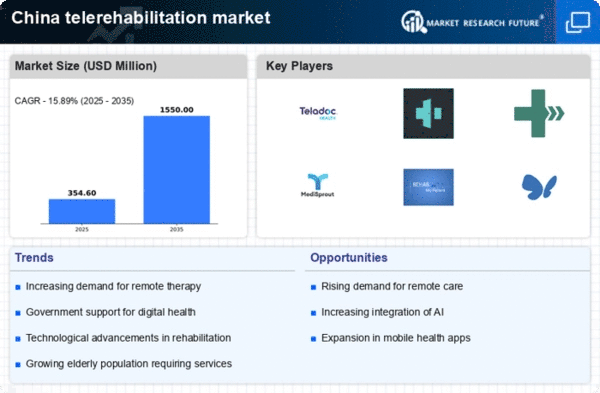
As per Market Research Future analysis, the China Telerehabilitation Market size was estimated at 305.98 USD Million in 2024. The Telerehabilitation market is projected to grow from 354.6 USD Million in 2025 to 1550.0 USD Million by 2035, exhibiting a compound annual growth rate (CAGR) of 15.8% during the forecast period 2025 - 2035

Key Market Trends & Highlights

The China telerehabilitation market is experiencing robust growth driven by technological advancements and increasing demand for rehabilitation services.

  • Technological advancements are enhancing the effectiveness and accessibility of telerehabilitation services.
  • The largest segment in the market is the physical rehabilitation segment, while the fastest-growing segment is the mental health rehabilitation segment.
  • Regulatory support is fostering a favorable environment for the expansion of telerehabilitation services across China.
  • Rising demand for rehabilitation services and growing awareness of telehealth benefits are key drivers propelling market growth.

Market Size & Forecast

2024 Market Size 305.98 (USD Million)
2035 Market Size 1550.0 (USD Million)
CAGR (2025 - 2035) 15.89%

Major Players

Teladoc Health (US), Doxy.me (US), Physitrack (GB), MediSprout (US), Rehab My Patient (GB), SimplePractice (US), Hinge Health (US), Kareo (US)

Our Impact
Enabled $4.3B Revenue Impact for Fortune 500 and Leading Multinationals
Partnering with 2000+ Global Organizations Each Year
30K+ Citations by Top-Tier Firms in the Industry

China Telerehabilitation Market Trends

The China Telerehabilitation Market is experiencing notable growth, driven by advancements in technology and increasing demand for remote healthcare solutions. In recent years, there has been a marked shift towards digital health services, which has been facilitated by improved internet connectivity and the proliferation of mobile devices. This trend appears to be particularly pronounced in urban areas, where access to healthcare professionals can be limited. As a result, patients are increasingly turning to telerehabilitation as a viable alternative to traditional in-person therapy, which may be less accessible or convenient. Moreover, the regulatory environment is evolving to support the expansion of telerehabilitation services. Government initiatives aimed at promoting telehealth are likely to enhance the adoption of these services. This includes the establishment of guidelines and reimbursement policies that encourage healthcare providers to integrate telerehabilitation into their practice. The growing awareness of the benefits of remote rehabilitation, such as increased patient engagement and reduced travel time, suggests that the telerehabilitation market will continue to expand in the coming years, potentially transforming the landscape of rehabilitation services in the region.

Technological Advancements

The telerehabilitation market is significantly influenced by rapid technological innovations. Enhanced video conferencing tools, wearable devices, and mobile applications are facilitating real-time monitoring and interaction between patients and healthcare providers. These advancements not only improve the quality of care but also increase patient adherence to rehabilitation protocols.

Regulatory Support

There is a growing trend of supportive regulatory frameworks that aim to promote the use of telerehabilitation services. Government policies are increasingly recognizing the importance of telehealth, leading to the establishment of reimbursement models that incentivize healthcare providers to offer remote rehabilitation options. This regulatory backing is likely to foster greater acceptance and integration of telerehabilitation into standard care practices.

Patient-Centric Approaches

The telerehabilitation market is witnessing a shift towards more patient-centric care models. Healthcare providers are increasingly focusing on personalized rehabilitation plans that cater to individual patient needs. This approach not only enhances patient satisfaction but also improves outcomes, as tailored interventions are more likely to engage patients in their recovery process.

China Telerehabilitation Market Drivers

Focus on Cost-Effectiveness

Cost considerations are becoming increasingly important in the healthcare landscape of China, influencing the growth of the telerehabilitation market. Telerehabilitation services often present a more cost-effective alternative to traditional rehabilitation methods, reducing travel expenses and time for both patients and providers. As healthcare costs continue to rise, the demand for affordable rehabilitation solutions is expected to increase. Studies suggest that telerehabilitation can reduce overall treatment costs by up to 40%, making it an attractive option for both patients and healthcare systems. This focus on cost-effectiveness is likely to drive the expansion of the telerehabilitation market, as stakeholders seek to optimize resource allocation while maintaining high-quality care.

Government Initiatives and Funding

The Chinese government is increasingly recognizing the importance of rehabilitation services, leading to various initiatives and funding opportunities aimed at enhancing the telerehabilitation market. Policies promoting digital health solutions and telemedicine are being implemented to improve healthcare access, particularly in underserved regions. In recent years, the government has allocated substantial budgets to support the development of telehealth infrastructure, which includes telerehabilitation services. This financial backing is expected to bolster the market, as it encourages healthcare providers to adopt telerehabilitation solutions. With government support, the telerehabilitation market is likely to witness accelerated growth and improved service delivery across the country.

Integration of Advanced Technologies

The telerehabilitation market in China is experiencing a transformation due to the integration of advanced technologies such as artificial intelligence (AI) and virtual reality (VR). These technologies enhance the effectiveness of rehabilitation programs by providing personalized treatment plans and immersive experiences for patients. For instance, AI algorithms can analyze patient data to tailor exercises that suit individual needs, while VR can simulate real-life scenarios for practice. The market is projected to grow at a CAGR of approximately 25% over the next five years, driven by these technological advancements. This integration not only improves patient engagement but also streamlines the delivery of rehabilitation services, making them more accessible and efficient.

Growing Awareness of Telehealth Benefits

There is a notable increase in awareness regarding the benefits of telehealth services among both healthcare providers and patients in China. This growing recognition is significantly impacting the telerehabilitation market, as more individuals are seeking remote rehabilitation options. Patients appreciate the convenience and flexibility that telerehabilitation offers, allowing them to engage in therapy from the comfort of their homes. Surveys indicate that approximately 70% of patients express a preference for telehealth services over traditional in-person visits. This shift in patient attitudes is likely to drive the adoption of telerehabilitation solutions, leading to a more robust market presence and improved patient satisfaction.

Rising Demand for Rehabilitation Services

The increasing prevalence of chronic diseases and disabilities in China is driving the demand for rehabilitation services. As the population ages, the need for effective rehabilitation solutions becomes more pronounced. The telerehabilitation market is poised to benefit from this trend, as it offers convenient access to rehabilitation services for patients who may have mobility issues or live in remote areas. According to recent estimates, the number of individuals requiring rehabilitation services in China is expected to rise by over 30% in the next decade. This surge in demand presents a significant opportunity for the telerehabilitation market to expand its reach and improve patient outcomes through innovative digital solutions.


Market Segment Insights

By Component: Hardware (Largest) vs. Software (Fastest-Growing)

In the China telerehabilitation market, the hardware segment holds the largest market share. This segment is characterized by a wide range of physical devices, including sensors, wearable technology, and therapeutic equipment, which are essential for effective rehabilitation practices. On the other hand, the software segment is witnessing rapid growth, attributed to the increasing demand for innovative solutions that enhance patient engagement and improve therapeutic outcomes. The growth trends in the component segment are driven by technological advancements and an increasing emphasis on remote healthcare solutions. The integration of artificial intelligence and machine learning in software applications is transforming how rehabilitation is delivered, making it more efficient and personalized. Moreover, the growing prevalence of chronic diseases in China is propelling demand for both hardware and software solutions, ensuring a robust growth trajectory for these segments.

Hardware (Dominant) vs. Software (Emerging)

The hardware segment is dominant in the China telerehabilitation market, as it provides the foundational tools necessary for effective rehabilitation practices. This includes devices designed for both monitoring and facilitating therapeutic exercises, ensuring patient safety and promoting recovery. Meanwhile, the software segment is emerging rapidly, emphasizing telecommunication technologies and user-friendly interfaces. Software solutions often complement hardware by offering analytics, progress tracking, and virtual therapy sessions, yielding an integrated approach to patient care. While hardware is essential for the physical aspect of rehabilitation, software innovations are crucial for enhancing user experience and engagement, thus representing a dynamic interplay in this growing market.

By Services: Clinical Assessment (Largest) vs. Clinical Therapy (Fastest-Growing)

In the China telerehabilitation market, the market share distribution reveals that Clinical Assessment holds the largest portion, as it is crucial for establishing the baseline for patient treatment. Clinical Therapy, however, is gaining momentum and has become a significant component of patient care, leveraging technology to deliver remote services effectively. The COVID-19 pandemic has further accentuated the need for such services, facilitating a shift towards more comprehensive rehabilitation solutions. The growth trends in this segment are driven by advancements in digital health technologies and the increasing acceptance of telehealth practices by both patients and healthcare providers. Clinical Therapy is emerging as the fastest-growing segment due to the rising demand for remote care options, enhanced patient engagement, and the convenience of personalized therapy programs. Additionally, government policies promoting telehealth services are contributing to this upward growth trajectory in the China telerehabilitation market.

Clinical Assessment (Dominant) vs. Clinical Therapy (Emerging)

In the China telerehabilitation market, Clinical Assessment is recognized as the dominant segment, providing essential evaluations that guide patient rehab strategies. It involves comprehensive diagnostic tools that enable healthcare professionals to tailor interventions effectively. On the other hand, Clinical Therapy is emerging as a crucial complement to assessment, utilizing innovative methods such as virtual sessions and mobile applications to deliver therapy remotely. This segment appeals mainly to patients seeking more flexible, accessible treatment options. As more individuals turn to digital methods for their rehabilitation needs, both segments will continue to evolve, with a strong focus on integration and enhanced patient outcomes.

By Therapy: Physical Therapy (Largest) vs. Occupational Therapy (Fastest-Growing)

In the China telerehabilitation market, the distribution of the therapy segment highlights Physical Therapy as the largest contributor, showcasing its pivotal role in rehabilitation services. Following closely, Occupational Therapy is identified as the fastest-growing area, reflecting an increasing recognition of its importance in enhancing patient recovery and mobility. This dynamic reveals a competitive landscape where both categories are essential to meeting diverse patient needs. Growth trends in the China telerehabilitation market are significantly driven by technological advancements and increased acceptance among healthcare providers. The rising patient demand for remote therapy solutions, particularly post-pandemic, is propelling Occupational Therapy to the forefront of growth. Additionally, supportive government policies that encourage telehealth initiatives further bolster both therapy types, paving the way for expansive market development and enhanced patient accessibility.

Physical Therapy (Dominant) vs. Occupational Therapy (Emerging)

Physical Therapy remains a dominant force in the China telerehabilitation market, characterized by its comprehensive approach to addressing musculoskeletal ailments and injuries. It benefits from strong referral networks and established protocols in conventional healthcare. On the other hand, Occupational Therapy is emerging rapidly, focusing on improving daily living activities and work-related skills. This segment leverages innovative techniques and personalized interventions, appealing especially to a younger, tech-savvy demographic. As both segments evolve, they complement each other, enhancing overall patient outcomes in the rehabilitation process.

By Application: Orthopedic (Largest) vs. Neurology (Fastest-Growing)

In the China telerehabilitation market, the application segment shows a diverse distribution among its key values. Orthopedic rehabilitation dominates this segment, capturing a significant share due to the increasing prevalence of musculoskeletal disorders and the growing number of orthopedic surgeries. Meanwhile, neurology has emerged as a notable player and is rapidly gaining traction, attributed to the surging number of stroke patients and neurological conditions requiring rehabilitation solutions. Growth trends within this segment indicate a strong upward trajectory for both orthopedic and neurology applications. The demand for telerehabilitation services has surged, driven by technological advancements in telehealth and increasing awareness regarding the benefits of remote rehabilitation. Additionally, the integration of AI and real-time monitoring capabilities is enhancing the effectiveness of these applications, further accelerating market growth.

Orthopedic (Dominant) vs. Neurology (Emerging)

The orthopedic segment remains the dominant force within the China telerehabilitation market, attributed to a robust patient base and the ongoing rise in surgical interventions for musculoskeletal issues. Patients are increasingly opting for telerehabilitation as it offers convenience and flexibility, allowing them to engage in recovery without frequent clinic visits. Conversely, the neurology segment is emerging, fueled by a growing focus on addressing neurological conditions through innovative rehabilitation methods. This includes tackling the rehabilitation needs of stroke survivors and patients with brain injuries. As telerehabilitation technology evolves, both segments are expected to leverage advanced digital tools, enhancing patient outcomes and increasing the market’s appeal.

Get more detailed insights about China Telerehabilitation Market

Key Players and Competitive Insights

The telerehabilitation market exhibits a dynamic competitive landscape characterized by rapid technological advancements and increasing demand for remote healthcare solutions. Key players such as Teladoc Health (US), Hinge Health (US), and Physitrack (GB) are strategically positioned to leverage innovation and digital transformation to enhance their service offerings. Teladoc Health (US) focuses on expanding its telehealth services, while Hinge Health (US) emphasizes digital musculoskeletal care, indicating a trend towards specialized telehealth solutions. Collectively, these strategies contribute to a competitive environment that is increasingly defined by technological integration and patient-centric approaches.The market structure appears moderately fragmented, with numerous players vying for market share. Key business tactics include localizing services to meet regional needs and optimizing supply chains to enhance service delivery. This fragmentation allows for diverse offerings, yet the influence of major players like Teladoc Health (US) and Hinge Health (US) is substantial, as they set benchmarks for quality and innovation that smaller companies often strive to emulate.

In October Teladoc Health (US) announced a partnership with a leading AI firm to enhance its telehealth platform, integrating advanced analytics to improve patient outcomes. This strategic move is likely to bolster Teladoc's competitive edge by providing more personalized care solutions, thereby attracting a broader patient base. The integration of AI into their services may also streamline operations, reducing costs and improving efficiency.

In September Hinge Health (US) launched a new digital program aimed at chronic pain management, which utilizes real-time data analytics to tailor treatment plans for individual patients. This initiative underscores Hinge Health's commitment to innovation in musculoskeletal care, potentially positioning the company as a leader in this niche market. By focusing on personalized treatment, Hinge Health may enhance patient engagement and satisfaction, which are critical in the telerehabilitation sector.

In August Physitrack (GB) expanded its operations into the Asian market, establishing partnerships with local healthcare providers to offer its tele-rehabilitation services. This strategic expansion reflects a growing trend of internationalization among key players, as they seek to tap into emerging markets with increasing healthcare demands. By localizing its offerings, Physitrack may effectively address specific regional needs, thereby enhancing its competitive positioning.

As of November the telerehabilitation market is increasingly shaped by trends such as digitalization, AI integration, and sustainability. Strategic alliances among companies are fostering innovation and enhancing service delivery capabilities. The competitive differentiation is likely to evolve from traditional price-based competition towards a focus on technological innovation and supply chain reliability. Companies that prioritize these aspects may find themselves better positioned to thrive in an increasingly complex market.

Key Companies in the China Telerehabilitation Market include

Industry Developments

The China Telerehabilitation Market has recently experienced significant developments, driven by advancements in digital health technologies and increasing demand for remote patient care, particularly during and after the COVID-19 pandemic. Companies like Bytedance, Alibaba Health Information Technology, and Tencent are expanding their telehealth services, enhancing access to rehabilitation programs through mobile applications and online platforms. In September 2023, Ping An Good Doctor announced a partnership with WeDoctor to integrate their services for improved patient outcomes. 

Additionally, in August 2023, Baidu invested in ZhongAn Online P&C Insurance to develop AI-driven telerehabilitation solutions. In the past two to three years, there has been a notable increase in market valuation, with organizations such as iFlytek and JD Health reporting significant growth attributed to their innovative telehealth initiatives. The Chinese government's push for digital health transformation and support for telemedicine is also facilitating market expansion. With an increasing focus on improving patient care and leveraging technology for healthcare delivery, the telerehabilitation sector in China is positioned for substantial growth and evolving capabilities.

Future Outlook

China Telerehabilitation Market Future Outlook

The Telerehabilitation Market in China is projected to grow at a 15.89% CAGR from 2025 to 2035, driven by technological advancements and increasing demand for remote healthcare solutions.

New opportunities lie in:

  • Development of AI-driven rehabilitation software solutions
  • Expansion of telehealth partnerships with hospitals
  • Creation of subscription-based remote monitoring services

By 2035, the telerehabilitation market is expected to be robust, reflecting substantial growth and innovation.

Market Segmentation

China Telerehabilitation Market Therapy Outlook

  • Physical Therapy
  • Occupational Therapy
  • Others

China Telerehabilitation Market Services Outlook

  • Clinical Assessment
  • Clinical Therapy

China Telerehabilitation Market Component Outlook

  • Hardware
  • Software

China Telerehabilitation Market Application Outlook

  • Cardiovascular
  • Orthopedic
  • Neurology
  • Pediatric
  • Others

Report Scope

MARKET SIZE 2024 305.98(USD Million)
MARKET SIZE 2025 354.6(USD Million)
MARKET SIZE 2035 1550.0(USD Million)
COMPOUND ANNUAL GROWTH RATE (CAGR) 15.89% (2025 - 2035)
REPORT COVERAGE Revenue Forecast, Competitive Landscape, Growth Factors, and Trends
BASE YEAR 2024
Market Forecast Period 2025 - 2035
Historical Data 2019 - 2024
Market Forecast Units USD Million
Key Companies Profiled Teladoc Health (US), Doxy.me (US), Physitrack (GB), MediSprout (US), Rehab My Patient (GB), SimplePractice (US), Hinge Health (US), Kareo (US)
Segments Covered Component, Services, Therapy, Application
Key Market Opportunities Integration of advanced digital health technologies enhances accessibility in the telerehabilitation market.
Key Market Dynamics Rising demand for remote rehabilitation services drives innovation and competition in the telerehabilitation market.
Countries Covered China
Leave a Comment

FAQs

What is the projected market size of the China Telerehabilitation Market by 2035?

The China Telerehabilitation Market is expected to reach a valuation of 1819.0 million USD by the year 2035.

What will be the market size of the China Telerehabilitation Market in 2024?

In 2024, the market size of the China Telerehabilitation Market is anticipated to be valued at 306.0 million USD.

What is the expected compound annual growth rate (CAGR) for the market from 2025 to 2035?

The expected CAGR for the China Telerehabilitation Market from 2025 to 2035 is 17.591%.

Which component of the market is expected to show higher growth by 2035, hardware or software?

By 2035, the software component is projected to reach 1099.0 million USD, while hardware is expected to be valued at 720.0 million USD.

Who are the major players in the China Telerehabilitation Market?

Key players in the market include Bytedance, Alibaba Health Information Technology, Tencent, and WeDoctor among others.

How much is the hardware segment valued at in 2024?

The hardware segment of the China Telerehabilitation Market is valued at 122.0 million USD in 2024.

What will be the software segment's market value in 2024?

In 2024, the software segment is anticipated to be valued at 184.0 million USD.

What are the growth opportunities in the China Telerehabilitation Market?

Growth opportunities in the market arise from the increasing adoption of telehealth and advancements in digital healthcare technology.

What challenges are currently facing the China Telerehabilitation Market?

Challenges include regulatory hurdles and the need for high-quality internet infrastructure in rural areas.

What is the impact of technological advancements on the market's growth?

Technological advancements are significantly driving growth by enhancing remote patient monitoring and rehabilitation services.

Download Free Sample

Kindly complete the form below to receive a free sample of this Report

Compare Licence

×
Features License Type
Single User Multiuser License Enterprise User
Price $4,950 $5,950 $7,250
Maximum User Access Limit 1 User Upto 10 Users Unrestricted Access Throughout the Organization
Free Customization
Direct Access to Analyst
Deliverable Format
Platform Access
Discount on Next Purchase 10% 15% 15%
Printable Versions