×
Request Free Sample ×

Kindly complete the form below to receive a free sample of this Report

* Please use a valid business email

Leading companies partner with us for data-driven Insights

clients tt-cursor
Hero Background

China Teledermatology Market

ID: MRFR/HC/49988-HCR
200 Pages
Rahul Gotadki
February 2026

China Teledermatology Market Research Report By Technology (Store and Forward, Real-Time Consultation, Remote Patient Monitoring), By End Use (Hospitals, Diagnostic Laboratories, Home Healthcare), By Application (Skin Cancer Diagnosis, Psoriasis Treatment, Dermatological Consultation) and By Service Model (Cloud-Based Services, Web-Based Services, Software as a Service) - Growth & Industry Forecast 2025 To 2035

Share:
Download PDF ×

We do not share your information with anyone. However, we may send you emails based on your report interest from time to time. You may contact us at any time to opt-out.

China Teledermatology Market Infographic
Purchase Options

China Teledermatology Market Summary

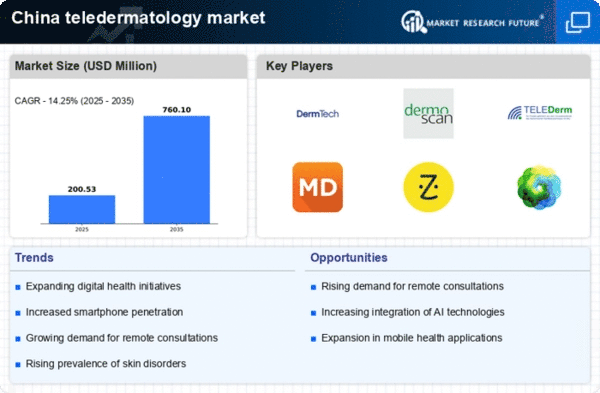
As per Market Research Future analysis, the China teledermatology market Size was estimated at 175.52 USD Million in 2024. The Teledermatology market is projected to grow from 200.53 USD Million in 2025 to 760.1 USD Million by 2035, exhibiting a compound annual growth rate (CAGR) of 14.2% during the forecast period 2025 - 2035

Key Market Trends & Highlights

The China teledermatology market is experiencing robust growth driven by technological advancements and increasing patient engagement.

  • Technological integration is enhancing the efficiency and accessibility of teledermatology services across China.
  • The regulatory landscape is evolving, facilitating smoother implementation of telehealth solutions in dermatology.
  • Patient engagement is on the rise, with more individuals seeking remote consultations for skin-related issues.
  • The market is primarily driven by the rising incidence of skin disorders and advancements in digital health technologies.

Market Size & Forecast

2024 Market Size 175.52 (USD Million)
2035 Market Size 760.1 (USD Million)
CAGR (2025 - 2035) 14.25%

Major Players

DermTech (US), DermoScan (DE), TeleDerm (US), MDLIVE (US), Zocdoc (US), SkinVision (NL), HealthTap (US), Doxy.me (US)

Our Impact
Enabled $4.3B Revenue Impact for Fortune 500 and Leading Multinationals
Partnering with 2000+ Global Organizations Each Year
30K+ Citations by Top-Tier Firms in the Industry

China Teledermatology Market Trends

The teledermatology market is experiencing notable growth, driven by advancements in technology and increasing demand for accessible healthcare solutions. In recent years, the integration of artificial intelligence and machine learning into dermatological practices has enhanced diagnostic accuracy and efficiency. This trend appears to be fostering a shift towards remote consultations, allowing patients to receive timely care without the need for in-person visits. Furthermore, the rising prevalence of skin conditions, coupled with a growing awareness of dermatological health, is likely to propel the market forward. As teledermatology becomes more mainstream, regulatory frameworks are evolving to support its implementation, ensuring that patients receive safe and effective care. In addition, the teledermatology market is witnessing a surge in mobile health applications that facilitate virtual consultations and follow-ups. These platforms are designed to improve patient engagement and streamline communication between healthcare providers and patients. The convenience of accessing dermatological services from home is appealing to many, particularly in urban areas where time constraints are prevalent. As technology continues to advance, the potential for teledermatology to transform traditional dermatological practices seems promising, indicating a shift towards more patient-centered care models.

Technological Integration

The incorporation of advanced technologies, such as artificial intelligence and machine learning, is reshaping the teledermatology market. These innovations enhance diagnostic capabilities, enabling quicker and more accurate assessments of skin conditions. As a result, healthcare providers can offer improved services, which may lead to increased patient satisfaction and trust.

Regulatory Developments

Regulatory bodies are adapting to the rise of teledermatology, establishing guidelines that ensure the safety and efficacy of remote consultations. This trend indicates a growing recognition of teledermatology as a legitimate practice, which could enhance its acceptance among both healthcare professionals and patients.

Patient Engagement

The rise of mobile health applications is fostering greater patient engagement in the teledermatology market. These platforms facilitate seamless communication between patients and healthcare providers, allowing for timely consultations and follow-ups. Enhanced engagement may lead to better health outcomes and increased adherence to treatment plans.

China Teledermatology Market Drivers

Increased Healthcare Accessibility

The teledermatology market is significantly influenced by the growing emphasis on healthcare accessibility in China. With a vast population and uneven distribution of healthcare resources, many individuals face challenges in accessing specialized dermatological care. Teledermatology offers a viable solution by bridging the gap between patients and healthcare providers, particularly in rural and underserved areas. The Chinese government has been actively promoting telehealth initiatives, which further supports the expansion of teledermatology services. As a result, the market is expected to witness a surge in demand, as more patients seek convenient and efficient ways to address their skin health concerns.

Rising Incidence of Skin Disorders

The increasing prevalence of skin disorders in China is a primary driver for the teledermatology market. Reports indicate that skin conditions such as acne, eczema, and psoriasis affect a significant portion of the population, with estimates suggesting that around 30% of individuals experience some form of skin issue. This growing incidence necessitates accessible dermatological care, which teledermatology can provide. The convenience of remote consultations allows patients to receive timely diagnoses and treatment plans without the need for in-person visits. As awareness of skin health continues to rise, the demand for teledermatology services is likely to expand, thereby propelling the market forward.

Cost-Effectiveness of Teledermatology

Cost considerations play a crucial role in the growth of the teledermatology market in China. Teledermatology services often present a more affordable alternative to traditional in-person consultations. Patients can save on travel expenses and time, while healthcare providers can reduce overhead costs associated with physical facilities. Studies suggest that teledermatology can lower the overall cost of dermatological care by up to 40%, making it an attractive option for both patients and insurers. As the economic landscape evolves, the demand for cost-effective healthcare solutions is likely to drive further adoption of teledermatology services across the country.

Growing Awareness of Telehealth Benefits

The increasing awareness of the benefits associated with telehealth is a significant driver for the teledermatology market in China. As more individuals become informed about the advantages of remote consultations, including convenience, reduced waiting times, and access to specialists, the acceptance of teledermatology is likely to rise. Educational campaigns and outreach efforts by healthcare organizations are contributing to this awareness, highlighting the effectiveness of teledermatology in managing skin conditions. This shift in perception is expected to lead to a higher uptake of teledermatology services, thereby fostering market growth in the coming years.

Advancements in Digital Health Technologies

Technological advancements in digital health are transforming the teledermatology market in China. Innovations such as artificial intelligence (AI) and machine learning are enhancing diagnostic accuracy and efficiency. For instance, AI algorithms can analyze images of skin conditions with remarkable precision, potentially improving patient outcomes. The integration of mobile applications and telecommunication platforms facilitates seamless communication between patients and dermatologists. As these technologies become more sophisticated, they are expected to drive adoption rates, with projections indicating a growth rate of approximately 25% annually in the coming years. This trend underscores the importance of technology in shaping the future of dermatological care.


Market Segment Insights

By Technology: Store and Forward (Largest) vs. Real-Time Consultation (Fastest-Growing)

In the China teledermatology market, the Store and Forward segment currently holds the largest share, capitalizing on its ability to enable asynchronous communication and efficient diagnosis. Meanwhile, Real-Time Consultation is emerging as the fastest-growing segment, reflecting the growing demand for immediate access to dermatological care through digital platforms. Remote Patient Monitoring also holds a notable position, catering to patients needing ongoing skin condition management without frequent clinic visits. Growth trends in this segment are primarily driven by an increasing reliance on technology in healthcare delivery, a rise in awareness regarding skin health, and the convenience offered by teledermatology solutions. The growing smartphone penetration and improved internet connectivity further accelerate the adoption of teledermatology methods, particularly Real-Time Consultation, which addresses urgent patient needs effectively. As healthcare continues to evolve digitally, these segments are poised for dynamic growth in the coming years.

Technology: Store and Forward (Dominant) vs. Real-Time Consultation (Emerging)

Store and Forward technology remains the dominant force in the China teledermatology market, offering a practical solution for transferring high-resolution images and patient data for review at a later time. Its effectiveness in handling numerous cases without immediate patient interaction makes it a staple in the dermatology sector. On the other hand, Real-Time Consultation is emerging as a key player, catering to the urgent need for immediate dermatologist patient interaction. This segment capitalizes on advancements in video conferencing technology and is particularly desirable among younger patients seeking quick solutions. Overall, this duality of dominant and emerging technologies illustrates a robust and adaptable market that meets diverse patient needs.

By End Use: Hospitals (Largest) vs. Home Healthcare (Fastest-Growing)

In the China teledermatology market, the end use segment is primarily dominated by hospitals, which hold a significant share of the market. These institutions play a crucial role in delivering teledermatology services, as they are equipped with advanced technology and professional expertise. Diagnostic laboratories also contribute to the segment but to a lesser extent, focusing on providing reliable test results that support teledermatological consultations. Home healthcare is emerging as a vital player, gaining traction due to the increasing demand for remote patient monitoring. The growth trends for the end use segment in the China teledermatology market are influenced by several factors, including technological advancements and changing consumer preferences. The COVID-19 pandemic accelerated the shift towards telehealth, particularly in home healthcare, which is now recognized as the fastest-growing segment due to its convenience and accessibility. As patients seek effective dermatological care from the comfort of their homes, hospitals are adapting by incorporating teledermatology into their services, ensuring they remain competitive in this evolving landscape.

Hospitals (Dominant) vs. Home Healthcare (Emerging)

Hospitals are the dominant force in the end use segment of the China teledermatology market, leveraging their established infrastructure and trained personnel to deliver high-quality healthcare services. They offer a comprehensive range of teledermatology treatments that cater to various patient needs, ensuring thorough diagnostic processes and effective treatment plans. On the other hand, home healthcare is emerging as a rapidly growing segment, driven by the increasing preference for remote healthcare solutions. This shift is being propelled by patients' desires for convenience and the rising adoption of telehealth technologies. Home healthcare solutions provide personalized care through remote consultations, empowering patients to receive timely dermatological advice without the need for physical visits.

By Application: Skin Cancer Diagnosis (Largest) vs. Psoriasis Treatment (Fastest-Growing)

Within the application segment of the China teledermatology market, Skin Cancer Diagnosis stands as the largest contributor, holding a significant share due to the rising prevalence of skin cancer and the increasing awareness about early diagnosis. Psoriasis Treatment, while smaller in share, is recognized for its rapid growth rate as more patients seek effective management solutions through remote consultations and treatments. Growth trends in this segment are significantly influenced by advancements in telemedicine technology, regulatory support, and the increased demand for accessible care in dermatological health. The COVID-19 pandemic accelerated the adoption of teledermatology, leading to increased patient willingness to utilize these services. Additionally, a growing geriatric population is driving demand for skin cancer diagnosis, while the younger demographics are increasingly seeking treatment for conditions like psoriasis, contributing to the segment's dynamic landscape.

Skin Cancer Diagnosis (Dominant) vs. Psoriasis Treatment (Emerging)

Skin Cancer Diagnosis is currently the dominant segment in the teledermatology applications, characterized by its crucial role in ensuring early detection and treatment of skin cancers, which are on the rise. This segment thrives on established protocols, a wide range of diagnostic tools, and a strong emphasis on prevention. Conversely, Psoriasis Treatment is an emerging segment that is gaining traction due to an increase in patients seeking effective therapy options. This segment is marked by innovative treatment modalities, including biologics and personalized medicine, catering to a tech-savvy patient base that prefers remote consultations and convenience. Both segments are expected to innovate and evolve continuously, given the increasing integration of technology in healthcare.

By Service Model: Cloud-Based Services (Largest) vs. Software as a Service (Fastest-Growing)

In the China teledermatology market, the distribution of service models highlights the dominance of cloud-based services, which capture a significant portion of the market share. Web-based services also play a role, but their share is comparatively smaller, showcasing a clear preference for cloud solutions among providers and patients alike. The competitive landscape suggests that as technology advances, cloud-based platforms are becoming increasingly preferred due to their scalability and accessibility. Growth trends within this segment indicate a robust increase in demand for software as a service (SaaS) models, which are emerging rapidly due to the need for flexible and efficient telemedicine solutions. Factors driving this growth include the increasing adoption of digital health technologies, improved internet infrastructure, and a rising demand for remote healthcare services. As teledermatology continues to evolve, SaaS offerings are expected to gain traction, providing innovative solutions that cater to the market's dynamic needs.

Cloud-Based Services (Dominant) vs. Web-Based Services (Emerging)

Cloud-based services in the China teledermatology market are characterized by their ability to provide scalable solutions that meet the complex demands of healthcare providers and patients. These services allow for easy access to dermatological consultations and data management, enhancing the overall patient experience. As the dominant model, cloud-based services are preferred for their reliability and enhanced functionalities, which include data security and ease of integration. On the other hand, web-based services are emerging but are not as widely adopted due to limitations in functionality and connectivity issues. However, they still play an important role in the market by providing basic teledermatology services, acting as a stepping stone for greater technological adoption.

Get more detailed insights about China Teledermatology Market

Key Players and Competitive Insights

The teledermatology market in China is characterized by a rapidly evolving competitive landscape, driven by technological advancements and increasing consumer demand for accessible healthcare solutions. Key players such as DermTech (US), MDLIVE (US), and SkinVision (NL) are strategically positioning themselves through innovation and partnerships. DermTech (US) focuses on enhancing its diagnostic capabilities through advanced genomic testing, while MDLIVE (US) emphasizes expanding its telehealth services to include comprehensive dermatological care. SkinVision (NL) leverages AI technology to improve skin cancer detection, thereby enhancing patient outcomes. Collectively, these strategies contribute to a dynamic competitive environment, fostering innovation and improving service delivery in the market.In terms of business tactics, companies are increasingly localizing their operations to better cater to the Chinese market. This includes optimizing supply chains and establishing partnerships with local healthcare providers. The competitive structure of the teledermatology market appears moderately fragmented, with several players vying for market share. However, the influence of major companies is significant, as they set benchmarks for service quality and technological integration, thereby shaping market dynamics.

In October DermTech (US) announced a partnership with a leading Chinese healthcare provider to enhance its genomic testing services in the region. This strategic move is likely to bolster DermTech's presence in the Chinese market, allowing it to tap into a growing demand for personalized dermatological care. By collaborating with local entities, DermTech aims to navigate regulatory challenges more effectively while expanding its customer base.

In September MDLIVE (US) launched a new teledermatology platform specifically designed for the Chinese market, featuring multilingual support and localized content. This initiative reflects MDLIVE's commitment to addressing the unique needs of Chinese consumers, potentially increasing its market penetration. The platform's user-friendly interface and comprehensive service offerings may enhance patient engagement and satisfaction, positioning MDLIVE as a formidable competitor in the region.

In August SkinVision (NL) secured a strategic investment from a prominent Chinese venture capital firm, aimed at accelerating its AI-driven skin cancer detection technology. This investment is expected to facilitate SkinVision's expansion efforts in China, enabling the company to enhance its technological capabilities and reach a broader audience. The infusion of capital may also support further research and development, solidifying SkinVision's competitive edge in the teledermatology space.

As of November current trends in the teledermatology market include a pronounced shift towards digitalization and AI integration, which are reshaping competitive dynamics. Strategic alliances are becoming increasingly vital, as companies seek to leverage complementary strengths to enhance service offerings. Looking ahead, competitive differentiation is likely to evolve, with a greater emphasis on innovation and technology rather than price-based competition. Companies that prioritize reliable supply chains and cutting-edge solutions may emerge as leaders in this burgeoning market.

Key Companies in the China Teledermatology Market include

Industry Developments

Recent developments in the China Teledermatology Market reflect a growing trend toward digital health solutions. Notable companies like WeDoctor and Ping An Good Doctor continue to enhance their platforms, offering virtual consultations and comprehensive skin care management. In July 2023, Tencent Healthcare expanded its teledermatology services, enabling quicker access to dermatological care. Meanwhile, Bihua launched an AI-driven diagnostic tool in August 2023, aimed at improving accuracy in skin cancer detection. Current affairs show an increased regulatory focus on telemedicine in China, with government backing promoting digital health initiatives to enhance healthcare access, especially in rural areas. 

In terms of market valuation, the overall telemedicine segment, including dermatology, has experienced a significant surge, with projections indicating a potential valuation increase of over 30% by 2025. Furthermore, in terms of mergers and acquisitions, a notable development occurred in September 2023 when AliHealth acquired a stake in YiZhiSheng, signaling potential synergy in teledermatological services and technology integration. Such dynamics highlight a rapidly evolving landscape where established health tech companies are actively shaping the future of dermatological healthcare in China.

Future Outlook

China Teledermatology Market Future Outlook

The Teledermatology Market in China is projected to grow at a 14.25% CAGR from 2025 to 2035, driven by technological advancements, increasing skin disorders, and rising demand for remote healthcare services.

New opportunities lie in:

  • Development of AI-driven diagnostic tools for enhanced accuracy.
  • Expansion of mobile teledermatology applications for patient engagement.
  • Partnerships with local clinics for integrated telehealth services.

By 2035, the teledermatology market is expected to achieve substantial growth and innovation.

Market Segmentation

China Teledermatology Market End Use Outlook

  • Hospitals
  • Diagnostic Laboratories
  • Home Healthcare

China Teledermatology Market Technology Outlook

  • Store and Forward
  • Real-Time Consultation
  • Remote Patient Monitoring

China Teledermatology Market Application Outlook

  • Skin Cancer Diagnosis
  • Psoriasis Treatment
  • Dermatological Consultation

China Teledermatology Market Service Model Outlook

  • Cloud-Based Services
  • Web-Based Services
  • Software as a Service

Report Scope

MARKET SIZE 2024 175.52(USD Million)
MARKET SIZE 2025 200.53(USD Million)
MARKET SIZE 2035 760.1(USD Million)
COMPOUND ANNUAL GROWTH RATE (CAGR) 14.25% (2025 - 2035)
REPORT COVERAGE Revenue Forecast, Competitive Landscape, Growth Factors, and Trends
BASE YEAR 2024
Market Forecast Period 2025 - 2035
Historical Data 2019 - 2024
Market Forecast Units USD Million
Key Companies Profiled DermTech (US), DermoScan (DE), TeleDerm (US), MDLIVE (US), Zocdoc (US), SkinVision (NL), HealthTap (US), Doxy.me (US)
Segments Covered Technology, End Use, Application, Service Model
Key Market Opportunities Integration of artificial intelligence in teledermatology enhances diagnostic accuracy and patient engagement.
Key Market Dynamics Rapid technological advancements and regulatory support drive growth in the teledermatology market.
Countries Covered China
Leave a Comment

FAQs

What is the expected market size of the China Teledermatology Market in 2024?

The China Teledermatology Market is expected to be valued at 175.2 million USD in 2024.

What is the projected market size for the China Teledermatology Market in 2035?

By 2035, the market is projected to reach a value of 1250.0 million USD.

What is the expected compound annual growth rate (CAGR) for the China Teledermatology Market from 2025 to 2035?

The expected CAGR for the market is 19.558 percent from 2025 to 2035.

Which technology segment of the China Teledermatology Market is expected to grow significantly by 2035?

The Store and Forward segment is anticipated to grow to 500.0 million USD by 2035.

What is the 2024 market value for Real-Time Consultation in the China Teledermatology Market?

The Real-Time Consultation segment is valued at 55.0 million USD in 2024.

What are some of the key players in the China Teledermatology Market?

Major players include WeDoctor, Lenovo Health, and Ping An Good Doctor among others.

What market value is expected for Remote Patient Monitoring in 2035?

The Remote Patient Monitoring segment is projected to reach 375.0 million USD by 2035.

How significant is the Store and Forward segment in the market in 2024?

The Store and Forward segment accounts for 70.0 million USD in market value in 2024.

What are the growth opportunities in the China Teledermatology Market?

The market presents opportunities in technological advancements and the increasing demand for remote healthcare services.

What challenges does the China Teledermatology Market face?

Challenges include regulatory challenges and the need for robust cybersecurity measures in telemedicine.

Download Free Sample

Kindly complete the form below to receive a free sample of this Report

Compare Licence

×
Features License Type
Single User Multiuser License Enterprise User
Price $4,950 $5,950 $7,250
Maximum User Access Limit 1 User Upto 10 Users Unrestricted Access Throughout the Organization
Free Customization
Direct Access to Analyst
Deliverable Format
Platform Access
Discount on Next Purchase 10% 15% 15%
Printable Versions