×
Request Free Sample ×

Kindly complete the form below to receive a free sample of this Report

* Please use a valid business email

Leading companies partner with us for data-driven Insights

clients tt-cursor
Hero Background

China Retail Logistics Market

ID: MRFR/PCM/47239-HCR
111 Pages
Snehal Singh
February 2026

China Retail Logistics Market Research Report: By Solution (Commerce enablement, Supply chain solutions, Reverse logistics & liquidation, Transportation Management, Others), By Type (Conventional retail logistics, E-commerce retail logistics), andBy Mode of Transport (Roadways, Railways, Airways, Waterways)- Forecast to 2035

Share:
Download PDF ×

We do not share your information with anyone. However, we may send you emails based on your report interest from time to time. You may contact us at any time to opt-out.

China Retail Logistics Market Infographic
Purchase Options

China Retail Logistics Market Summary

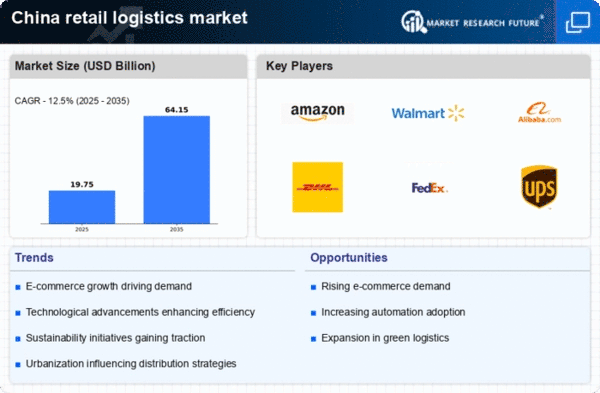
As per Market Research Future analysis, the China retail logistics market size was estimated at 17.56 USD Billion in 2024. The China retail logistics market is projected to grow from 19.75 USD Billion in 2025 to 64.15 USD Billion by 2035, exhibiting a compound annual growth rate (CAGR) of 12% during the forecast period 2025 - 2035

Key Market Trends & Highlights

The China retail logistics market is experiencing robust growth driven by technological advancements and evolving consumer preferences.

  • Technological integration is reshaping logistics operations, enhancing efficiency and reducing costs.
  • Sustainability initiatives are becoming increasingly vital as consumers demand eco-friendly practices in logistics.
  • Collaborative supply chains are emerging as a strategy to optimize resources and improve service delivery.
  • E-commerce growth and urbanization trends are key drivers propelling the market forward.

Market Size & Forecast

2024 Market Size 17.56 (USD Billion)
2035 Market Size 64.15 (USD Billion)
CAGR (2025 - 2035) 12.5%

Major Players

Amazon (US), Walmart (US), Alibaba (CN), DHL (DE), FedEx (US), UPS (US), XPO Logistics (US), Maersk (DK), Kuehne + Nagel (CH)

Our Impact
Enabled $4.3B Revenue Impact for Fortune 500 and Leading Multinationals
Partnering with 2000+ Global Organizations Each Year
30K+ Citations by Top-Tier Firms in the Industry

China Retail Logistics Market Trends

The retail logistics market is currently experiencing a transformative phase, driven by advancements in technology and evolving consumer expectations. The integration of automation and artificial intelligence is reshaping supply chain operations, enhancing efficiency and accuracy. Companies are increasingly adopting smart logistics solutions, which streamline processes and reduce operational costs. Furthermore, the rise of e-commerce has intensified the demand for rapid delivery services, compelling logistics providers to innovate and adapt their strategies. This shift is not merely a response to market pressures but also reflects a broader trend towards sustainability and environmental responsibility. As businesses seek to minimize their carbon footprints, eco-friendly logistics practices are gaining traction, influencing decision-making at all levels. In addition, the retail logistics market is witnessing a surge in collaboration among stakeholders. Partnerships between retailers, logistics firms, and technology providers are becoming more common, fostering a more integrated approach to supply chain management. This collaborative spirit is essential for navigating the complexities of modern logistics, where agility and responsiveness are paramount. As the landscape continues to evolve, the focus on customer-centric solutions and innovative technologies will likely define the future of logistics operations, ensuring that businesses remain competitive in an increasingly dynamic environment.

Technological Integration

The retail logistics market is seeing a significant shift towards the adoption of advanced technologies. Automation, artificial intelligence, and data analytics are being utilized to enhance operational efficiency. These technologies enable real-time tracking, inventory management, and predictive analytics, which help businesses respond swiftly to market demands.

Sustainability Initiatives

There is a growing emphasis on sustainability within the retail logistics market. Companies are increasingly implementing eco-friendly practices, such as optimizing transportation routes and utilizing electric vehicles. This trend reflects a commitment to reducing environmental impact while meeting consumer expectations for responsible business practices.

Collaborative Supply Chains

The retail logistics market is characterized by an increase in collaboration among various stakeholders. Retailers, logistics providers, and technology firms are forming strategic partnerships to create more integrated supply chains. This collaboration enhances flexibility and responsiveness, allowing businesses to better meet customer needs.

China Retail Logistics Market Drivers

E-commerce Growth

The rapid expansion of e-commerce in China is a primary driver of the retail logistics market. With online retail sales projected to reach approximately $2 trillion by 2025, logistics operations must adapt to accommodate the increasing volume of orders. This surge in e-commerce necessitates efficient warehousing and distribution networks, as consumers demand faster delivery times. The retail logistics market is thus compelled to innovate, leveraging technology to streamline operations and enhance customer satisfaction. Furthermore, the rise of mobile commerce is influencing logistics strategies, as businesses seek to optimize their supply chains for mobile platforms. As a result, logistics providers are investing in advanced tracking systems and automated solutions to meet the evolving needs of e-commerce businesses.

Urbanization Trends

China's ongoing urbanization is significantly impacting the retail logistics market. As more people migrate to urban areas, the demand for goods and services increases, necessitating efficient logistics solutions. Urban centers are becoming densely populated, which presents challenges for last-mile delivery. The retail logistics market must adapt to these challenges by developing innovative delivery methods, such as drone technology and smart lockers. Additionally, urbanization is driving the need for localized distribution centers to ensure timely deliveries. According to recent data, urban areas are expected to account for over 70% of China's population by 2030, further emphasizing the importance of efficient logistics in urban settings.

Consumer Behavior Shifts

Shifts in consumer behavior are driving changes in the retail logistics market. As consumers increasingly prioritize convenience and speed, logistics providers must adapt their services accordingly. The demand for same-day and next-day delivery options is rising, compelling logistics companies to optimize their supply chains. Additionally, consumers are becoming more environmentally conscious, leading to a preference for sustainable delivery options. This shift is prompting the retail logistics market to explore eco-friendly packaging and transportation methods. Data indicates that over 60% of consumers in urban areas are willing to pay extra for sustainable delivery options, highlighting the need for logistics providers to align their strategies with evolving consumer preferences.

Technological Advancements

Technological advancements are revolutionizing the retail logistics market in China. The integration of artificial intelligence (AI) and machine learning is enhancing supply chain efficiency by enabling predictive analytics and real-time tracking. These technologies allow logistics providers to optimize routes, reduce costs, and improve delivery times. Furthermore, the adoption of automation in warehouses is streamlining operations, reducing labor costs, and minimizing errors. The retail logistics market is also witnessing the rise of blockchain technology, which enhances transparency and security in transactions. As these technologies continue to evolve, they are likely to reshape the logistics landscape, making it more efficient and responsive to market demands.

Government Policies and Regulations

Government policies in China play a crucial role in shaping the retail logistics market. Recent initiatives aimed at improving infrastructure and reducing trade barriers are likely to enhance logistics efficiency. For instance, the implementation of the Belt and Road Initiative is expected to facilitate smoother logistics operations across borders, potentially increasing trade volumes. Moreover, regulations concerning environmental sustainability are prompting logistics companies to adopt greener practices. The retail logistics market is thus influenced by these policies, as companies strive to comply with new regulations while maintaining competitiveness. The government's focus on technological advancement in logistics also suggests a future where automation and digitalization become standard practices.


Market Segment Insights

By Type: E-commerce retail logistics (Largest) vs. Conventional retail logistics (Fastest-Growing)

In the China retail logistics market, the distribution of market share is clearly tilted towards E-commerce retail logistics, which has established itself as the largest segment. This dominance is attributed to the rapid growth of online shopping and changes in consumer behavior towards convenience and accessibility. Conventional retail logistics, while still significant, is witnessing a slower growth in comparison as traditional shopping habits evolve into more digital-first approaches. The growth trends indicate a robust surge in the demand for E-commerce retail logistics driven by the proliferation of mobile commerce and the increasing penetration of internet services. Meanwhile, Conventional retail logistics is adapting to an emerging trend where businesses aim to integrate online and offline channels, marking it as the fastest-growing in response to this shift. The convenience and speed offered by online platforms continue to provide impetus to this segment's expansion.

E-commerce retail logistics: Dominant vs. Conventional retail logistics: Emerging

E-commerce retail logistics has firmly established itself as the dominant force in the China retail logistics market, characterized by its focus on swift delivery, technology integration, and a consumer-centric approach. This segment is leveraging advancements in logistics technology and data analytics to enhance operational efficiency and customer satisfaction. Conversely, Conventional retail logistics, while still relevant, is classified as an emerging segment that is undergoing significant transformations. It is increasingly adopting strategies to bridge the gap with E-commerce logistics, incorporating innovative solutions, and focusing on experiential shopping to remain competitive. The interplay between these segments illustrates a dynamic landscape where adaptability and innovation are crucial for success.

By Solution: Commerce enablement (Largest) vs. Supply chain solutions (Fastest-Growing)

In the China retail logistics market, the 'Solution' segment showcases a diverse distribution among its values, with commerce enablement taking the lead as the largest segment. Supply chain solutions, while significant, are rapidly gaining traction and are identified as the fastest-growing value. Other components such as reverse logistics & liquidation and transportation management hold substantial shares but trail behind the foremost two in terms of growth potential. The growth trends within the solution segment are being driven by technological advancements and the increasing need for efficient operations in retail logistics. As e-commerce continues to thrive in China, demand for robust commerce enablement solutions has soared, enabling businesses to optimize their sales processes. Concurrently, supply chain solutions are evolving to enhance flexibility and responsiveness, capturing the attention of retailers striving for agility in a dynamic market landscape.

Commerce Enablement: Dominant vs. Supply Chain Solutions: Emerging

Commerce enablement stands as the dominant force in the solution segment, characterized by its capacity to facilitate seamless transactions and enhance customer engagement. This aspect empowers retailers to leverage data analytics, mobile platforms, and payment technologies to streamline operations. Conversely, supply chain solutions, while emerging, are rapidly adapting to the complexities of logistics, emphasizing integration and efficiency. These solutions are focused on optimizing inventory management and reducing lead times, making them vital for retailers looking to improve their overall supply chain resilience. The interplay between these values illustrates a competitive ecosystem where retail players are constantly seeking innovative ways to enhance their logistics capabilities.

By Mode of Transport: Roadways (Largest) vs. Railways (Fastest-Growing)

In the China retail logistics market, the mode of transport is predominantly dominated by roadways, capturing a significant share due to the extensive network of roads and highways facilitating quick deliveries. Roadways are essential for last-mile distribution, making them the preferred choice for many retailers. Railways are emerging as a robust competitor, leveraging their capacity and cost-effectiveness, especially for bulk goods and long-distance transportation. Growth trends indicate that railways are the fastest-growing mode of transport, driven by a surge in demand for efficient logistics solutions. The expansion of railway infrastructure, enhanced technology, and the government's push for greener alternatives are major contributors to this growth. Moreover, the shift towards sustainability is encouraging retailers to consider railways for reducing their carbon footprint, making it a viable alternative for future logistics strategies.

Roadways: Dominant vs. Railways: Emerging

In the context of the China retail logistics market, roadways stand out as the dominant mode of transport, offering unparalleled flexibility and ease of access for urban and rural deliveries alike. This mode of transport seamlessly supports the burgeoning e-commerce sector, facilitating timely deliveries and better customer satisfaction. On the other hand, railways are emerging strongly, characterized by their ability to transport large volumes over long distances at competitive costs. They are increasingly being recognized for their efficiency and environmental benefits, appealing to logistics providers focused on sustainability. This dual dynamic of roadways' dominance and railways' emergence highlights a shifting landscape in logistics, adapting to the needs of modern retail operations.

Get more detailed insights about China Retail Logistics Market

Key Players and Competitive Insights

The retail logistics market in China is characterized by intense competition and rapid evolution, driven by the increasing demand for efficient supply chain solutions and the rise of e-commerce. Major players such as Alibaba (CN), Amazon (US), and DHL (DE) are at the forefront, each adopting distinct strategies to enhance their operational capabilities. Alibaba (CN) focuses on leveraging its extensive digital ecosystem to streamline logistics, while Amazon (US) emphasizes innovation through technology and automation. DHL (DE) is enhancing its service offerings by investing in sustainable logistics solutions, which reflects a broader trend towards environmental responsibility in the sector. Collectively, these strategies contribute to a dynamic competitive landscape, where agility and technological advancement are paramount.Key business tactics within the market include localizing manufacturing and optimizing supply chains to reduce costs and improve delivery times. The competitive structure appears moderately fragmented, with several key players exerting influence over various segments. This fragmentation allows for niche players to thrive, while larger companies leverage their scale to dominate the market. The interplay between these dynamics shapes the overall competitive environment, fostering innovation and responsiveness to consumer demands.

In September Alibaba (CN) announced a partnership with a leading AI firm to enhance its logistics operations through predictive analytics. This strategic move is likely to improve inventory management and optimize delivery routes, thereby increasing efficiency and reducing operational costs. Such advancements may position Alibaba (CN) as a leader in logistics technology, further solidifying its market presence.

In October Amazon (US) unveiled a new automated fulfillment center in Shanghai, which is expected to significantly reduce delivery times for urban customers. This investment underscores Amazon's commitment to enhancing its logistics capabilities and reflects a broader trend towards automation in the industry. The center's advanced robotics and AI systems may provide Amazon (US) with a competitive edge in meeting the growing demands of e-commerce.

In August DHL (DE) launched a green logistics initiative aimed at reducing carbon emissions across its supply chain. This initiative includes the deployment of electric vehicles and the use of renewable energy sources in its operations. By prioritizing sustainability, DHL (DE) not only addresses regulatory pressures but also aligns with consumer preferences for environmentally friendly practices, potentially enhancing its brand reputation and customer loyalty.

As of November the retail logistics market is increasingly defined by trends such as digitalization, sustainability, and the integration of AI technologies. Strategic alliances among key players are shaping the competitive landscape, fostering collaboration that enhances service offerings and operational efficiencies. Looking ahead, competitive differentiation is likely to evolve from traditional price-based competition towards a focus on innovation, technological advancements, and supply chain reliability. Companies that successfully navigate these trends may secure a more robust position in the market.

Key Companies in the China Retail Logistics Market include

Industry Developments

The China Retail Logistics Market is experiencing significant developments, particularly with major players like Meituan, SF Express, JD.com, and Alibaba Group enhancing their service offerings. In September 2023, JD.com announced the expansion of its logistics infrastructure by establishing several new fulfillment centers, aiming to reduce delivery times and improve service quality.

Meanwhile, SFSF Express has been increasingly integrating advanced technology into its operations to optimize supply chain efficiency. The market is also witnessing substantial growth, driven by the ongoing digital transformation in retail, with Cainiao Network's logistics solutions becoming increasingly vital for e-commerce operations.

Recent mergers include the strategic collaboration between ZTO Express and several regional delivery firms aimed at consolidating operations and improving service efficiency, reported in August 2023. In addition, Alibaba Group has been investing in automated warehousing technologies to streamline logistics processes, reflecting the industry's shift toward greater automation.

Over the past few years, the China retail logistics market has been registering robust growth, with a valuation increase fueled by surges in e-commerce demand and significant government support for infrastructure development in logistics.

Future Outlook

China Retail Logistics Market Future Outlook

The retail logistics market in China is projected to grow at a 12.5% CAGR from 2025 to 2035, driven by e-commerce expansion, technological advancements, and consumer demand for faster delivery.

New opportunities lie in:

  • Integration of AI-driven inventory management systems
  • Expansion of last-mile delivery networks using drones
  • Development of automated warehousing solutions for efficiency

By 2035, the retail logistics market is expected to be robust, driven by innovation and increased consumer expectations.

Market Segmentation

China Retail Logistics Market Type Outlook

  • Conventional retail logistics
  • E-commerce retail logistics

China Retail Logistics Market Solution Outlook

  • Commerce enablement
  • Supply chain solutions
  • Reverse logistics & liquidation
  • Transportation Management
  • Others

China Retail Logistics Market Mode of Transport Outlook

  • Roadways
  • Railways
  • Airways
  • Waterways

Report Scope

MARKET SIZE 2024 17.56(USD Billion)
MARKET SIZE 2025 19.75(USD Billion)
MARKET SIZE 2035 64.15(USD Billion)
COMPOUND ANNUAL GROWTH RATE (CAGR) 12.5% (2025 - 2035)
REPORT COVERAGE Revenue Forecast, Competitive Landscape, Growth Factors, and Trends
BASE YEAR 2024
Market Forecast Period 2025 - 2035
Historical Data 2019 - 2024
Market Forecast Units USD Billion
Key Companies Profiled Amazon (US), Walmart (US), Alibaba (CN), DHL (DE), FedEx (US), UPS (US), XPO Logistics (US), Maersk (DK), Kuehne + Nagel (CH)
Segments Covered Type, Solution, Mode of Transport
Key Market Opportunities Integration of advanced automation and artificial intelligence in the retail logistics market enhances efficiency and reduces costs.
Key Market Dynamics Evolving consumer preferences drive innovation in retail logistics, emphasizing speed, efficiency, and sustainability in operations.
Countries Covered China
Leave a Comment

FAQs

What is the expected market size of the China Retail Logistics Market in 2024?

The China Retail Logistics Market is expected to be valued at 17.56 USD Billion in 2024.

What is the projected market growth of the China Retail Logistics Market by 2035?

By 2035, the market is anticipated to reach a valuation of 72.9 USD Billion.

What is the expected compound annual growth rate (CAGR) for the China Retail Logistics Market from 2025 to 2035?

The expected CAGR for the China Retail Logistics Market is 13.817% during the period from 2025 to 2035.

Which segment of the China Retail Logistics Market is projected to grow the most by 2035?

The Supply Chain Solutions segment is projected to grow significantly, reaching 21.0 USD Billion by 2035.

Who are the key players dominating the China Retail Logistics Market?

Major players in the market include Meituan, SF Express, DHL China, JD.com, and Alibaba Group.

What market value is expected for Commerce Enablement in the China Retail Logistics Market by 2035?

Commerce Enablement is expected to be valued at 15.0 USD Billion by 2035.

How is Reverse Logistics & Liquidation expected to perform by 2035 in the market?

Reverse Logistics & Liquidation is projected to reach a value of 8.5 USD Billion by 2035.

What is the estimated market size for Transportation Management in 2024?

Transportation Management is estimated to have a market size of 4.06 USD Billion in 2024.

What challenges might affect the growth of the China Retail Logistics Market?

Challenges may include evolving consumer preferences and increasing competition in the logistics space.

What opportunities exist within the China Retail Logistics Market for emerging players?

Emerging players may find opportunities in technology integration and enhancing last-mile delivery solutions.

Download Free Sample

Kindly complete the form below to receive a free sample of this Report

Compare Licence

×
Features License Type
Single User Multiuser License Enterprise User
Price $4,950 $5,950 $7,250
Maximum User Access Limit 1 User Upto 10 Users Unrestricted Access Throughout the Organization
Free Customization
Direct Access to Analyst
Deliverable Format
Platform Access
Discount on Next Purchase 10% 15% 15%
Printable Versions