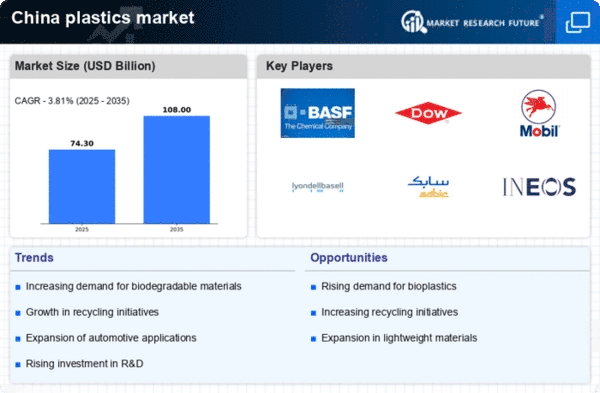
The plastics market in China is characterized by a dynamic competitive landscape, driven by increasing demand across various sectors, including automotive, packaging, and construction. Key players such as BASF SE (Germany), Dow Inc. (US), and SABIC (Saudi Arabia) are actively shaping the market through strategic initiatives focused on innovation and sustainability. BASF SE (Germany) emphasizes its commitment to sustainable solutions, while Dow Inc. (US) is enhancing its product portfolio to meet the evolving needs of customers. These strategies collectively foster a competitive environment that prioritizes technological advancement and environmental responsibility.In terms of business tactics, companies are increasingly localizing manufacturing to reduce costs and enhance supply chain efficiency. The market structure appears moderately fragmented, with several key players exerting considerable influence. This fragmentation allows for a diverse range of products and services, yet the presence of major corporations like ExxonMobil Chemical (US) and LyondellBasell Industries N.V. (Netherlands) suggests a competitive tension that drives innovation and market responsiveness.
In October Dow Inc. (US) announced a strategic partnership with a leading Chinese packaging firm to develop biodegradable plastics tailored for the local market. This collaboration is significant as it aligns with global sustainability trends and positions Dow as a frontrunner in eco-friendly solutions, potentially enhancing its market share in the rapidly growing biodegradable segment.
In September SABIC (Saudi Arabia) launched a new line of high-performance polymers designed specifically for the automotive industry. This move is indicative of SABIC's strategy to penetrate niche markets and cater to the increasing demand for lightweight materials that improve fuel efficiency. By focusing on innovation in product development, SABIC aims to solidify its competitive edge in a sector that is becoming increasingly reliant on advanced materials.
In August LyondellBasell Industries N.V. (Netherlands) expanded its production capacity in China by investing in a new facility dedicated to producing recycled plastics. This investment reflects a broader industry trend towards circular economy practices and positions LyondellBasell as a leader in sustainable manufacturing. The strategic importance of this expansion lies in its potential to meet the growing regulatory pressures for recycling and sustainability in the Chinese market.
As of November the competitive trends in the plastics market are increasingly defined by digitalization, sustainability, and the integration of artificial intelligence. Strategic alliances are becoming more prevalent, enabling companies to leverage shared resources and expertise. The shift from price-based competition to a focus on innovation and technology is evident, as firms prioritize supply chain reliability and sustainable practices. Looking ahead, competitive differentiation will likely evolve, with companies that invest in advanced technologies and sustainable solutions poised to lead the market.