×
Request Free Sample ×

Kindly complete the form below to receive a free sample of this Report

* Please use a valid business email

Leading companies partner with us for data-driven Insights

clients tt-cursor
Hero Background

China Managed Network Services Market

ID: MRFR/ICT/63765-HCR
200 Pages
Aarti Dhapte
February 2026

China Managed Network Services Market Size, Share and Trends Analysis Report By Service Type (Managed LAN/ WPN Networks, Managed Wi-Fi, Managed IP/ VPN, Managed Network Monitoring, Managed WAN, Managed Network Security, Other Services), By Organization Size (Small and Medium Enterprises, Large Enterprises), By Deployment Mode (On-Cloud, On-Premises) and By Vertical (BFSI, IT & Telecommunications, Retail & E-Commerce, Manufacturing, Government, Healthcare) - Forecast to 2035

Share:
Download PDF ×

We do not share your information with anyone. However, we may send you emails based on your report interest from time to time. You may contact us at any time to opt-out.

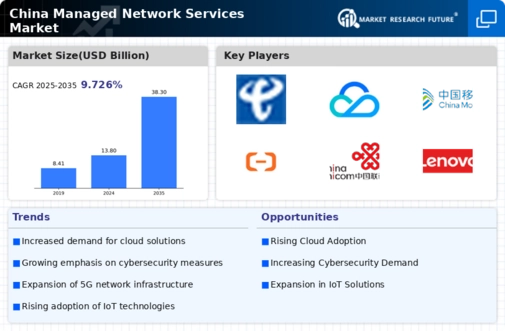
China Managed Network Services Market Infographic
Purchase Options

China Managed Network Services Market Summary

As per analysis, the The China managed network services market. is projected to grow from USD 34.07 Billion in 2025 to USD 67.74 Billion by 2035, exhibiting a compound annual growth rate (CAGR) of 7.1% during the forecast period (2025 - 2035).

Key Market Trends & Highlights

The China managed network services market is poised for robust growth driven by technological advancements and increasing demand for security solutions.

  • The network security segment remains the largest, reflecting a heightened focus on safeguarding digital assets.
  • Cloud services emerge as the fastest-growing segment, driven by the increasing shift towards digital transformation.
  • Telecommunications continues to dominate the market, while healthcare is rapidly gaining traction as a key sector.
  • The growing adoption of cloud services and rising cybersecurity concerns are pivotal drivers shaping the market landscape.

Market Size & Forecast

2024 Market Size 31.85 (USD Billion)
2035 Market Size 67.74 (USD Billion)
CAGR (2025 - 2035) 7.1%

Major Players

China Telecom (CN), China Unicom (CN), China Mobile (CN), Huawei Technologies (CN), ZTE Corporation (CN), Baidu (CN), Alibaba Group (CN), Tencent Holdings (CN)

Our Impact
Enabled $4.3B Revenue Impact for Fortune 500 and Leading Multinationals
Partnering with 2000+ Global Organizations Each Year
30K+ Citations by Top-Tier Firms in the Industry

China Managed Network Services Market Trends

The china managed network services market is currently experiencing a transformative phase, driven by the increasing demand for efficient and secure network solutions. Organizations across various sectors are recognizing the necessity of outsourcing their network management to specialized providers, which allows them to focus on core business activities. This shift is largely influenced by the rapid advancements in technology, particularly in cloud computing and cybersecurity. As businesses seek to enhance operational efficiency, the reliance on managed services is likely to grow, fostering a competitive landscape among service providers. Furthermore, the regulatory environment in China is evolving, with government initiatives aimed at promoting digital transformation and enhancing network infrastructure. This creates a conducive atmosphere for the expansion of managed network services, as companies align their strategies with national objectives. In addition, The China managed network services market. is witnessing a surge in the adoption of artificial intelligence and machine learning technologies. These innovations are being integrated into network management solutions, enabling providers to offer more proactive and predictive services. As organizations strive for greater agility and responsiveness, the ability to leverage data analytics for network optimization becomes increasingly valuable. The interplay between technological advancements and market demands suggests a dynamic future for managed network services in China, where adaptability and innovation will be key drivers of success.

Increased Demand for Cybersecurity Solutions

As cyber threats continue to evolve, organizations in China are prioritizing cybersecurity within their managed network services. This trend indicates a growing awareness of the importance of safeguarding sensitive data and maintaining compliance with regulatory standards. Service providers are responding by enhancing their security offerings, which may include advanced threat detection and incident response capabilities.

Integration of AI and Automation

The incorporation of artificial intelligence and automation into managed network services is becoming more prevalent. This trend suggests that service providers are leveraging these technologies to improve operational efficiency and reduce human error. By automating routine tasks, organizations can focus on strategic initiatives, potentially leading to enhanced service delivery.

Focus on Compliance and Regulatory Alignment

With the increasing complexity of regulations in China, businesses are seeking managed network services that ensure compliance with local laws. This trend highlights the necessity for service providers to stay informed about regulatory changes and adapt their offerings accordingly. Organizations are likely to favor partners who demonstrate a strong understanding of compliance requirements.

China Managed Network Services Market Drivers

Emergence of 5G Technology

The rollout of 5G technology in China is poised to revolutionize the managed network services market. With its promise of ultra-fast connectivity and low latency, 5G is expected to enable new applications and services that require robust network capabilities. The china managed network services market stands to benefit significantly from this technological advancement, as businesses seek managed services that can support the demands of 5G. In 2025, the number of 5G users in China was projected to reach over 500 million, indicating a substantial market opportunity for service providers. This surge in connectivity will likely drive the need for enhanced network management solutions, as organizations aim to optimize their 5G deployments. Consequently, the emergence of 5G technology is expected to be a key driver of growth in the china managed network services market, fostering innovation and new service offerings.

Rising Cybersecurity Concerns

Cybersecurity remains a paramount concern for organizations across China, driving the demand for managed network services. With the increasing frequency of cyber threats, businesses are compelled to invest in robust security measures. The china managed network services market is witnessing a surge in demand for services that offer advanced security protocols, threat detection, and incident response capabilities. In 2025, the cybersecurity market in China was estimated to reach 40 billion USD, underscoring the critical need for managed services that can safeguard sensitive data and ensure compliance with regulatory standards. As organizations prioritize cybersecurity, managed network service providers are likely to enhance their offerings, integrating advanced security features into their service portfolios. This trend not only addresses immediate security concerns but also fosters long-term trust and reliability in the china managed network services market.

Government Initiatives and Support

The Chinese government has been actively promoting the development of the managed network services market through various initiatives and policies. The 'Made in China 2025' strategy emphasizes the importance of advanced technologies, including managed network services, to enhance the country's competitiveness. Additionally, government funding and support for digital infrastructure projects are likely to bolster the growth of the china managed network services market. In 2025, investments in digital infrastructure were projected to exceed 100 billion USD, indicating a strong commitment to enhancing connectivity and network capabilities. These initiatives not only create a favorable environment for managed network service providers but also encourage businesses to adopt these services as part of their digital transformation strategies. Consequently, the alignment of government policies with market needs is expected to significantly contribute to the expansion of the china managed network services market.

Growing Adoption of Cloud Services

The increasing adoption of cloud services in China is a pivotal driver for the managed network services market. As enterprises migrate to cloud-based solutions, the demand for managed network services that ensure seamless connectivity and security rises. In 2025, the cloud services market in China was valued at approximately 20 billion USD, reflecting a robust growth trajectory. This trend indicates that businesses are seeking reliable managed network services to facilitate their cloud operations, thereby enhancing the overall efficiency of the china managed network services market. Furthermore, the integration of cloud services with managed networks allows for improved scalability and flexibility, which are essential for modern enterprises. As organizations continue to embrace digital transformation, the reliance on managed network services is expected to intensify, further propelling the growth of the china managed network services market.

Increased Focus on Operational Efficiency

Organizations in China are increasingly prioritizing operational efficiency, which is driving the demand for managed network services. By outsourcing network management, businesses can focus on their core competencies while ensuring that their network infrastructure is optimized for performance. The china managed network services market is experiencing a shift as companies recognize the potential cost savings and productivity gains associated with managed services. In 2025, it was estimated that companies could reduce operational costs by up to 30% through the adoption of managed network services. This trend suggests that businesses are not only looking for reliable connectivity but also for solutions that enhance their overall operational efficiency. As the competitive landscape intensifies, the emphasis on efficiency is likely to propel the growth of the china managed network services market, as organizations seek to leverage technology for better performance.


Market Segment Insights

By Service Type: Network Security (Largest) vs. Cloud Services (Fastest-Growing)

In the China managed network services market, Network Security holds the largest share, underscoring the critical importance placed on protecting digital assets in this digitally evolving landscape. Network Monitoring and Data Management also contribute significantly but are relatively smaller in share. The increased focus on cybersecurity and regulatory compliance has anchored Network Security as the central pillar of service type offerings in this market, reflecting growing awareness among organizations of potential threats. Growth trends within this segment indicate a surge in demand for Cloud Services, which is now recognized as the fastest-growing category. Enterprises are increasingly migrating to the cloud, drawn by the promise of scalability, flexibility, and cost efficiency. Such trends are bolstered by the ongoing digital transformation across sectors, leading to a heightened reliance on managed network services as organizations seek agility and innovation in their network operations.

Network Security (Dominant) vs. Cloud Services (Emerging)

The dominance of Network Security in the China managed network services market is largely attributed to the escalating number of cyber threats that organizations face today. As a leading service type, it encompasses a range of solutions aimed at safeguarding network infrastructures and sensitive information from unauthorized access and cyber-attacks. Coupled with stringent governmental regulations and compliance mandates, this segment has seen sustained investment and focus from businesses. On the other hand, Cloud Services, while still in the emerging phase, has gained traction due to its ability to provide enhanced operational flexibility and scalability. Increasing adoption of remote work and digital collaboration tools is propelling this segment forward, establishing cloud solutions as essential for organizations looking to innovate and streamline their network operations. As businesses continue to embrace this paradigm shift, Cloud Services is poised to emerge as a crucial element of future managed network offerings.

By End User: Telecommunications (Largest) vs. Healthcare (Fastest-Growing)

In the China managed network services market, the end user segment is primarily driven by telecommunications, which holds the largest share among the various sectors. The demand for robust network services in this industry is propelled by the increasing need for reliable connectivity, especially as telecom providers expand their infrastructure to support 5G and other advanced technologies. On the other hand, the healthcare sector is emerging rapidly, identified as the fastest-growing segment in managed network services. This growth is fueled by the increasing digitization of health services, telemedicine, and the necessity for secure, reliable networks that can handle sensitive patient data efficiently. Healthcare facilities are investing significantly in managed services to enhance operational efficiency and patient care delivery.

Telecommunications (Dominant) vs. Healthcare (Emerging)

The telecommunications segment is the dominant player in the China managed network services market, characterized by its vast infrastructure and heavy investments in network technology. Companies in this sector are focusing on enhancing connectivity and service offerings, particularly with the rollout of 5G networks. This dominance is supported by continuous demand for data services, improved network reliability, and the expansion of IoT applications. Conversely, the healthcare segment is viewed as an emerging sector, experiencing rapid growth due to increasing reliance on technology in patient care and management. Healthcare providers are adopting managed network services to facilitate telehealth services, ensure data security, and improve overall operational effectiveness. This increasing focus on digital transformation in healthcare underlines its potential to become a prominent contributor in the managed network services landscape.

By Deployment Model: On-Premises (Largest) vs. Cloud-Based (Fastest-Growing)

In the China managed network services market, the deployment model segment reflects a competitive landscape dominated by On-Premises solutions, which hold the largest share. This segment is favored by organizations seeking greater control over their IT infrastructure. In contrast, Cloud-Based solutions, while smaller in share, are rapidly gaining traction among companies looking for flexibility and cost-effectiveness in their network management. This shift is indicative of a broader trend towards digital transformation within Chinese enterprises.

On-Premises (Dominant) vs. Cloud-Based (Emerging)

On-Premises deployment models remain dominant in the China managed network services landscape due to their ability to provide heightened security and control for businesses. Organizations in sectors with stringent compliance requirements prefer this model, as it allows for tailored solutions that meet specific operational needs. Conversely, Cloud-Based services are emerging due to their scalability and lower upfront costs, appealing to startups and companies aiming to quickly adapt to changing market conditions. The increasing adoption of hybrid models, which combine both approaches, further exemplifies the evolution of business needs in the region.

By Network Type: Local Area Network (Largest) vs. Virtual Private Network (Fastest-Growing)

In the China managed network services market, the Local Area Network (LAN) serves as the largest segment, capitalizing on its prevalent use in educational institutions, corporate offices, and urban environments. LAN solutions cater to a substantial portion of the network service requirements due to their ability to provide high-speed internet connection and support for a range of applications. In contrast, the Virtual Private Network (VPN) segment, while smaller in market share, has been growing rapidly, driven by the increasing demand for remote access and heightened security concerns in data transmission across public networks. As more businesses and individuals embrace digital transformation, the growth trajectory of VPN services is projected to continue upward. Key drivers include the rising trend of remote work, the necessity for secure connections while accessing corporate resources, and regulatory compliance requirements which have made VPNs essential. On the other hand, the Wide Area Network (WAN) remains important but is expected to grow at a slower rate as organizations transition from traditional connectivity solutions to more agile ones like SD-WAN that leverage cloud technologies and integrated services.

Local Area Network (Dominant) vs. Virtual Private Network (Emerging)

The Local Area Network (LAN) in China's managed network services market is characterized by its widespread adoption, particularly among enterprises and educational setups, thanks to its efficient handling of large data traffic within localized settings. LAN provides essential services like high-speed internet access, interconnectivity of devices, and supports various applications on-site. Conversely, the Virtual Private Network (VPN) is emerging as a critical solution for modern businesses, focusing on secure and encrypted connections over the internet, especially for remote workers. As organizations seek to secure their online activities, VPNs are becoming increasingly vital in safeguarding sensitive data against cyber threats, thereby driving their fast-growing adoption in a changing workplace landscape.

Get more detailed insights about China Managed Network Services Market

Key Players and Competitive Insights

The managed network services market in China is characterized by a dynamic competitive landscape, driven by rapid technological advancements and increasing demand for digital transformation. Key players such as China Telecom (CN), China Unicom (CN), and Huawei Technologies (CN) are at the forefront, each adopting distinct strategies to enhance their market positioning. China Telecom (CN) focuses on expanding its cloud services and enhancing network security, while China Unicom (CN) emphasizes partnerships with global tech firms to bolster its service offerings. Huawei Technologies (CN), on the other hand, is heavily investing in AI and 5G technologies, which positions it as a leader in innovation within the sector. Collectively, these strategies contribute to a competitive environment that is increasingly centered around technological prowess and service diversification.

In terms of business tactics, companies are localizing manufacturing and optimizing supply chains to enhance operational efficiency. The market structure appears moderately fragmented, with several key players exerting influence over various segments. This fragmentation allows for a diverse range of services, catering to different customer needs, while also fostering competition that drives innovation and service quality.

In December 2025, China Telecom (CN) announced a strategic partnership with a leading AI firm to develop advanced network management solutions. This collaboration is expected to enhance their service delivery capabilities, allowing for more efficient network operations and improved customer experiences. The strategic importance of this partnership lies in its potential to leverage AI for predictive analytics, thereby optimizing network performance and reducing downtime.

In November 2025, Huawei Technologies (CN) launched a new suite of managed services aimed at small and medium-sized enterprises (SMEs). This initiative is significant as it addresses the growing demand for affordable yet robust network solutions among SMEs, a segment that has been historically underserved. By targeting this demographic, Huawei not only expands its customer base but also strengthens its competitive edge in the managed services market.

In October 2025, China Unicom (CN) unveiled a new cloud-based managed service platform designed to integrate seamlessly with existing IT infrastructures. This move is crucial as it positions China Unicom to capture a larger share of the cloud services market, which is rapidly gaining traction among enterprises seeking to enhance operational agility. The platform's ability to facilitate smooth transitions to cloud environments is likely to attract a diverse clientele, further solidifying China Unicom's market presence.

As of January 2026, current trends in the managed network services market are heavily influenced by digitalization, sustainability, and AI integration. Strategic alliances are becoming increasingly vital, as companies recognize the need to collaborate to enhance service offerings and technological capabilities. Looking ahead, competitive differentiation is expected to evolve, shifting from traditional price-based competition to a focus on innovation, technology, and supply chain reliability. This transition underscores the importance of agility and responsiveness in meeting the ever-changing demands of the market.

Key Companies in the China Managed Network Services Market include

Industry Developments

The China Managed Network Services Market is witnessing significant activity, with major players like Huawei Technologies, Tencent Cloud, and Alibaba Cloud expanding their service offerings.

In June 2025, China's Ministry of Industry and Information Technology issued new rules to speed up the rollout of managed network services. These rules stress the need for 5G infrastructure and smart city digitalization to improve public safety and city management.  In April 2025, Huawei teamed up with China Mobile to extend its managed network service offerings. 

The aim was to employ AI to optimize networks and integrate cloud services to help businesses across China with their digital transformation efforts. In the first half of 2025, top Chinese cloud providers like Alibaba Cloud and Tencent Cloud launched advanced managed network solutions that included edge computing and cybersecurity improvements to meet the growing needs of the manufacturing and logistics sectors under government-backed digital economy policies.

The overall market has seen substantial growth with a valuation exceeding USD 15 billion, as businesses progressively adopt managed services to enhance operational efficiency amid increasing digital transformation trends. Recent initiatives by China Mobile are also notable, as they invest heavily in 5G and cloud services to augment their managed service capabilities. These developments indicate an increasingly competitive landscape aimed at providing comprehensive managed network solutions in China.

Future Outlook

China Managed Network Services Market Future Outlook

The China managed network services market is projected to grow at a 7.1% CAGR from 2025 to 2035, driven by digital transformation, increased cloud adoption, and enhanced cybersecurity needs.

New opportunities lie in:

  • Expansion of AI-driven network optimization solutions.
  • Development of tailored managed security services for SMEs.
  • Integration of IoT management platforms into existing services.

By 2035, the market is expected to be robust, reflecting substantial growth and innovation.

Market Segmentation

China Managed Network Services Market End User Outlook

  • Telecommunications
  • Healthcare
  • Retail
  • Manufacturing

China Managed Network Services Market Network Type Outlook

  • Local Area Network
  • Wide Area Network
  • Virtual Private Network

China Managed Network Services Market Service Type Outlook

  • Network Monitoring
  • Network Security
  • Data Management
  • Cloud Services

China Managed Network Services Market Deployment Model Outlook

  • On-Premises
  • Cloud-Based
  • Hybrid

Report Scope

MARKET SIZE 202431.85(USD Billion)
MARKET SIZE 202534.07(USD Billion)
MARKET SIZE 203567.74(USD Billion)
COMPOUND ANNUAL GROWTH RATE (CAGR)7.1% (2024 - 2035)
REPORT COVERAGERevenue Forecast, Competitive Landscape, Growth Factors, and Trends
BASE YEAR2024
Market Forecast Period2025 - 2035
Historical Data2019 - 2024
Market Forecast UnitsUSD Billion
Key Companies ProfiledChina Telecom (CN), China Unicom (CN), China Mobile (CN), Huawei Technologies (CN), ZTE Corporation (CN), Baidu (CN), Alibaba Group (CN), Tencent Holdings (CN)
Segments CoveredService Type, End User, Deployment Model, Network Type
Key Market OpportunitiesIntegration of artificial intelligence in managed network services enhances operational efficiency and customer experience.
Key Market DynamicsRising demand for secure, scalable solutions drives innovation in China's managed network services market.
Countries CoveredChina
Leave a Comment

FAQs

What is the current valuation of the China managed network services market?

The market valuation was 31.85 USD Billion in 2024.

What is the projected market size for the China managed network services market by 2035?

The market is projected to reach 67.74 USD Billion by 2035.

What is the expected CAGR for the China managed network services market during the forecast period?

The expected CAGR for the market from 2025 to 2035 is 7.1%.

Which companies are the key players in the China managed network services market?

Key players include China Telecom, China Unicom, China Mobile, Huawei Technologies, ZTE Corporation, Baidu, Alibaba Group, and Tencent Holdings.

What are the main service types in the China managed network services market?

Main service types include Network Monitoring, Network Security, Data Management, and Cloud Services.

How much is the Network Security segment valued at in 2026?

The Network Security segment is valued at 16.0 USD Billion in 2026.

What is the projected value of Cloud Services by 2035?

Cloud Services is projected to reach 27.24 USD Billion by 2035.

Which end-user sectors are driving the China managed network services market?

The Telecommunications, Healthcare, Retail, and Manufacturing sectors are key end-users.

What is the expected value of the Telecommunications segment in 2026?

The Telecommunications segment is expected to be valued at 20.0 USD Billion in 2026.

What deployment models are prevalent in the China managed network services market?

Prevalent deployment models include On-Premises, Cloud-Based, and Hybrid.

Download Free Sample

Kindly complete the form below to receive a free sample of this Report

Compare Licence

×
Features License Type
Single User Multiuser License Enterprise User
Price $4,950 $5,950 $7,250
Maximum User Access Limit 1 User Upto 10 Users Unrestricted Access Throughout the Organization
Free Customization
Direct Access to Analyst
Deliverable Format
Platform Access
Discount on Next Purchase 10% 15% 15%
Printable Versions