×
Request Free Sample ×

Kindly complete the form below to receive a free sample of this Report

* Please use a valid business email

Leading companies partner with us for data-driven Insights

clients tt-cursor
Hero Background

China Industrial Sugar Market

ID: MRFR/FnB/46307-HCR
128 Pages
Varsha More
February 2026

China Industrial Sugar Market Size, Share, Industry Trend & Analysis Research Report By Application (Food and Beverages, Pharmaceuticals, Personal Care Products, Animal Feed, Biofuels), By Type (Granulated Sugar, Liquid Sugar, Powdered Sugar, Brown Sugar), By Source (Sugarcane, Sugar Beet, Corn, Palm) andBy End Use (Industrial, Commercial, Retail)- Forecast to 2035

Share:
Download PDF ×

We do not share your information with anyone. However, we may send you emails based on your report interest from time to time. You may contact us at any time to opt-out.

China Industrial Sugar Market Infographic
Purchase Options

China Industrial Sugar Market Summary

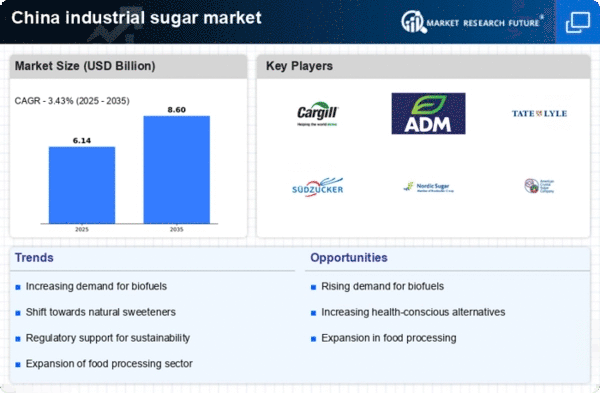
As per Market Research Future analysis, the China industrial sugar market size was estimated at 5.94 USD Billion in 2024. The China industrial sugar market is projected to grow from 6.14 USD Billion in 2025 to 8.6 USD Billion by 2035, exhibiting a compound annual growth rate (CAGR) of 3.4% during the forecast period 2025 - 2035

Key Market Trends & Highlights

The China industrial sugar market is experiencing a shift towards sustainability and health-conscious trends, driven by technological advancements and consumer preferences.

  • Sustainability initiatives are increasingly shaping production practices in the industrial sugar market.
  • The food and beverage sector remains the largest segment, while health-conscious products are the fastest-growing segment.
  • Technological advancements in production are enhancing efficiency and reducing environmental impact.
  • Rising demand from the food and beverage sector and consumer preferences for natural sweeteners are key drivers of market growth.

Market Size & Forecast

2024 Market Size 5.94 (USD Billion)
2035 Market Size 8.6 (USD Billion)
CAGR (2025 - 2035) 3.43%

Major Players

Cargill (US), Archer Daniels Midland (US), Tate & Lyle (GB), Südzucker (DE), Nordzucker (DE), American Crystal Sugar Company (US), Cosan (BR), Wilmar International (SG), Mitr Phol Sugar Corporation (TH)

Our Impact
Enabled $4.3B Revenue Impact for Fortune 500 and Leading Multinationals
Partnering with 2000+ Global Organizations Each Year
30K+ Citations by Top-Tier Firms in the Industry

China Industrial Sugar Market Trends

The industrial sugar market is currently experiencing notable shifts driven by factors such as the growing food and beverage sector and health-conscious consumer preferences. Demand for industrial sugar is influenced by the growing food and beverage sector, which increasingly seeks sweeteners for diverse applications. Additionally, the rise of health-conscious consumers is prompting manufacturers to explore alternative sweetening solutions, potentially impacting traditional sugar consumption patterns. Furthermore, the regulatory landscape surrounding sugar production and usage is evolving, with authorities emphasizing sustainability and health considerations. This dynamic environment suggests that stakeholders must remain agile to adapt to changing consumer preferences and regulatory requirements. In the present context, the industrial sugar market is poised for transformation. Innovations in production methods and the introduction of new products may reshape the competitive landscape. As companies strive to meet the demands of a more discerning consumer base, the focus on quality and sustainability is likely to intensify. Overall, the industrial sugar market is navigating a complex interplay of factors that could redefine its future trajectory, necessitating careful monitoring and strategic planning by industry participants.

Sustainability Initiatives

The industrial sugar market is witnessing a growing emphasis on sustainability practices. Producers are increasingly adopting eco-friendly methods to reduce environmental impact. This trend aligns with global efforts to promote responsible sourcing and production, reflecting a shift towards more sustainable practices in the industry.

Health-Conscious Consumer Trends

There is a noticeable shift in consumer preferences towards healthier alternatives in the industrial sugar market. As awareness of health issues rises, manufacturers are exploring options such as natural sweeteners and low-calorie substitutes. This trend indicates a potential decline in traditional sugar usage as consumers seek better choices.

Technological Advancements in Production

Technological innovations are playing a crucial role in shaping the industrial sugar market. Enhanced production techniques are being developed to improve efficiency and reduce costs. These advancements may lead to increased competitiveness among producers, allowing them to meet the evolving demands of the market.

China Industrial Sugar Market Drivers

Government Policies and Regulations

Government policies in China play a crucial role in shaping the industrial sugar market. The Chinese government has implemented various regulations aimed at stabilizing sugar prices and ensuring fair competition among producers. For instance, import tariffs on sugar have been adjusted to protect domestic producers, which influences market dynamics. Additionally, the government has introduced initiatives to promote sustainable agricultural practices, which may impact sugar production methods. As of 2025, these policies are expected to create a more favorable environment for local sugar manufacturers, potentially enhancing their competitiveness in the industrial sugar market. The regulatory landscape is thus a significant driver, as it directly affects production costs, pricing strategies, and market entry for new players.

Export Opportunities in Emerging Markets

China's industrial sugar market is poised to benefit from increasing export opportunities in emerging markets. As global demand for sugar rises, particularly in regions such as Southeast Asia and Africa, Chinese sugar producers are exploring new avenues for growth. In 2025, it is projected that exports could account for approximately 15% of total sugar production in China. This trend is driven by competitive pricing and the ability to meet international quality standards. Furthermore, the expansion of trade agreements and partnerships with other countries enhances the potential for Chinese sugar exports. This development not only supports the industrial sugar market but also contributes to the overall economic growth of the country, as it diversifies revenue streams for producers.

Consumer Preferences for Natural Sweeteners

There is a noticeable shift in consumer preferences towards natural sweeteners, which is impacting the industrial sugar market in China. As health consciousness rises, many consumers are seeking alternatives to refined sugars, prompting manufacturers to adapt their product offerings. This trend is reflected in the increasing popularity of products containing natural sweeteners such as stevia and agave syrup. As of 2025, it is estimated that the demand for natural sweeteners could grow by 25%, influencing the formulation of various food and beverage products. Consequently, the industrial sugar market must navigate this evolving landscape by balancing traditional sugar production with the rising demand for healthier alternatives. This shift in consumer behavior presents both challenges and opportunities for producers in the industrial sugar market.

Rising Demand from Food and Beverage Sector

The food and beverage sector in China is experiencing a notable surge in demand for industrial sugar, driven by the growing population and urbanization. As of 2025, the sector accounts for approximately 60% of the total sugar consumption in the country. This trend is likely to continue, as consumers increasingly seek sweetened products, including soft drinks, baked goods, and confectionery items. The industrial sugar market is thus positioned to benefit from this rising demand, as manufacturers strive to meet consumer preferences. Furthermore, the expansion of the food processing industry, which relies heavily on sugar as a key ingredient, further propels the growth of the industrial sugar market. This dynamic indicates a robust outlook for sugar producers and suppliers in China, as they adapt to the evolving needs of the food and beverage sector.

Technological Innovations in Sugar Production

Technological advancements in sugar production are transforming the industrial sugar market in China. Innovations such as precision agriculture, automated processing, and improved extraction techniques are enhancing efficiency and yield. As of 2025, it is estimated that these technologies could increase sugar production efficiency by up to 20%. This improvement not only reduces costs for producers but also addresses environmental concerns associated with traditional sugar farming practices. The adoption of such technologies is likely to attract investments in the industrial sugar market, as companies seek to modernize their operations and meet the growing demand for sugar. Consequently, the integration of technology into production processes is a pivotal driver of growth in the industrial sugar market.


Market Segment Insights

By Application: Food and Beverages (Largest) vs. Pharmaceuticals (Fastest-Growing)

In the China industrial sugar market, the Food and Beverages sector holds a dominant position, accounting for a significant share among various applications. This sector benefits from the growing consumption of processed foods and beverages influenced by changing dietary preferences and lifestyle shifts. Conversely, Pharmaceuticals represent the fastest-growing segment, driven by increased demand for medications and health supplements that utilize sugar as an essential ingredient in formulations and delivery systems. The growth trends in the China industrial sugar market are influenced by various factors, including the rising disposable income of consumers, urbanization, and the expanding health-consciousness of the population. The Food and Beverages segment continues to thrive due to innovations in product development, while Pharmaceuticals is witnessing a surge thanks to advances in medical research and technology that necessitate the use of sugars in drug formulations and therapies. This dynamic interplay showcases the evolving demands and opportunities within the market.

Food and Beverages: Dominant vs. Pharmaceuticals: Emerging

The Food and Beverages segment is characterized by its vast and diverse range of applications, including soft drinks, confectionery, dairy products, and baked goods. This part of the market thrives on consumer preferences for sweetening agents that enhance flavor and preservation. With an ever-increasing inclination towards convenience foods, this segment is expected to maintain its robust position. On the other hand, the Pharmaceuticals segment is emerging rapidly, leveraging sugar's functionality in delivering active ingredients effectively. This sector is characterized by innovation, as companies develop new formulations that incorporate sugars for enhanced effectiveness in drugs. The growth in the health and wellness trend has further propelled the use of sugars in dietary supplements, making Pharmaceuticals a pivotal area in the evolving landscape of the China industrial sugar market.

By Type: Granulated Sugar (Largest) vs. Liquid Sugar (Fastest-Growing)

In the China industrial sugar market, Granulated Sugar holds the largest market share, catering to various sectors like food and beverages. In contrast, Liquid Sugar has emerged as a fast-growing segment, showing strong demand from the food service and beverage industry due to its ease of incorporation into products. The diversification of applications and the increasing preference for convenience sweetness among consumers further influence the market dynamics. The growth of Liquid Sugar is driven by evolving consumer preferences and the rising trend of ready-to-eat meals. Additionally, the demand for premium sugar solutions supports Liquid Sugar's expansion, while Granulated Sugar remains favored due to its versatility. As health consciousness grows, the inclination towards lower-calorie liquid sweeteners also enhances its market presence, reflecting a shift in consumption patterns.

Granulated Sugar (Dominant) vs. Liquid Sugar (Emerging)

Granulated Sugar is considered the dominant type in the industry, primarily used by both consumers and manufacturers for its versatility in baking and cooking. Its established presence in the market is supported by widespread application across multiple sectors like confectionery and food production. Conversely, Liquid Sugar is emerging rapidly, gaining traction among both consumers and businesses due to its enhanced mixability and convenience. This segment caters to a modern market that appreciates the ease of use in beverages and processed foods. Both segments, while distinct, showcase how traditional and innovative sugar products coexist and compete within the China industrial sugar market.

By Source: Sugarcane (Largest) vs. Sugar Beet (Fastest-Growing)

In the China industrial sugar market, Sugarcane commands the largest share due to its well-established cultivation practices and processing infrastructure. Sugar Beet follows as a promising contributor, with significant market presence driven by innovative agricultural techniques. Corn and Palm are also present but hold smaller shares, primarily addressing niche segments within the market landscape. The growth trends for Sugar Beet are particularly noteworthy, as advancements in agricultural technology enhance yield and reduce production costs. Additionally, government policies favoring sustainability and the reduction of import dependencies are giving rise to increased domestic production of these sources. Overall, the market is witnessing an evolution, with traditional sources like Sugarcane facing competition from emerging options such as Sugar Beet.

Sugarcane (Dominant) vs. Sugar Beet (Emerging)

Sugarcane remains a dominant source in the China industrial sugar market, characterized by its extensive agricultural support and established supply chains. The crop benefits from favorable climatic conditions and has historically been the mainstay of sugar production. In contrast, Sugar Beet is emerging as a viable alternative, particularly gaining traction due to its ability to produce sugar in cooler climates, making it adaptable to diverse agricultural environments. The cultivation of Sugar Beet is being propelled by innovative breeding techniques and government initiatives aimed at promoting crop diversity. Both segment values showcase unique advantages that could shape the future landscape of sugar production in the market.

By End Use: Industrial (Largest) vs. Commercial (Fastest-Growing)

The market share distribution among the segment values in the China industrial sugar market reveals industrial use as the largest segment, significantly driving overall market demand. The commercial segment is emerging rapidly, reflecting a growing diversity of applications across food services and retail chains. This dynamic is reshaping traditional usages and highlighting the significance of adaptability in product offerings. Growth trends indicate that while industrial usage remains dominant due to its extensive applications in food production and processing, the commercial segment is gaining traction, driven by increasing consumer demand for sweetened products and innovative service applications. Factors such as urbanization, rising disposable incomes, and changing dietary preferences are contributing to this growth, making the commercial segment a focal point for future investments and marketing strategies.

Industrial (Dominant) vs. Commercial (Emerging)

Industrial sugar is characterized by its bulk usage in food manufacturing processes, including confectionery, beverages, and processed foods. This segment is well-established, benefiting from existing supply chains and robust demand stability. On the other hand, the commercial segment is emerging as a key player, focusing on retail and food service industries that require more tailored sugar solutions. These commercial applications often emphasize quality, packaging, and diverse product lines to meet varying consumer tastes. Both segments are crucial, yet they operate under different dynamics where industrial sugar seeks efficiency and cost-effectiveness, while commercial sugar responds to trend-sensitive consumer preferences.

Get more detailed insights about China Industrial Sugar Market

Key Players and Competitive Insights

The industrial sugar market in China is characterized by a competitive landscape that is increasingly shaped by innovation, sustainability, and strategic partnerships. Key players such as Cargill (US), Archer Daniels Midland (US), and Tate & Lyle (GB) are actively pursuing strategies that emphasize technological advancements and regional expansion. Cargill (US), for instance, has been focusing on enhancing its supply chain efficiency and sustainability practices, which appears to resonate well with the growing consumer demand for environmentally friendly products. Meanwhile, Archer Daniels Midland (US) has been investing in digital transformation initiatives to optimize its operations, thereby positioning itself as a leader in the market. Tate & Lyle (GB) is also making strides in product innovation, particularly in developing sugar alternatives, which reflects a broader trend towards health-conscious consumption. Collectively, these strategies contribute to a dynamic competitive environment where adaptability and forward-thinking are paramount.
The business tactics employed by these companies often include localizing manufacturing and optimizing supply chains to enhance responsiveness to market demands. The competitive structure of the market is moderately fragmented, with several key players exerting influence over pricing and product offerings. This fragmentation allows for a diverse range of products and innovations, although it also necessitates that companies remain vigilant in their strategic approaches to maintain market share.
In October 2025, Cargill (US) announced a partnership with a local technology firm to develop a new digital platform aimed at improving supply chain transparency and efficiency. This strategic move is likely to enhance Cargill's operational capabilities, allowing for better tracking of sugar production and distribution processes, which could lead to cost reductions and improved customer satisfaction. The emphasis on digital solutions aligns with broader industry trends towards increased automation and data-driven decision-making.
In September 2025, Archer Daniels Midland (US) launched a new line of organic sugar products, catering to the rising consumer preference for organic and natural ingredients. This initiative not only diversifies their product portfolio but also positions the company to capture a growing segment of health-conscious consumers. The strategic importance of this move lies in its potential to enhance brand loyalty and market penetration in a competitive landscape where consumer preferences are rapidly evolving.
In August 2025, Tate & Lyle (GB) expanded its research and development facilities in China, focusing on the development of low-calorie sweeteners. This expansion is indicative of the company's commitment to innovation and reflects a strategic response to the increasing demand for healthier sugar alternatives. By investing in R&D, Tate & Lyle is likely to strengthen its competitive edge and foster long-term growth in a market that is becoming increasingly health-oriented.
As of November 2025, current competitive trends in the industrial sugar market are heavily influenced by digitalization, sustainability, and the integration of artificial intelligence. Strategic alliances are becoming more prevalent, as companies seek to leverage each other's strengths to enhance their market positions. The competitive differentiation is expected to evolve from traditional price-based competition towards a focus on innovation, technology, and supply chain reliability. This shift suggests that companies that prioritize these aspects will likely emerge as leaders in the market, adapting to the changing landscape and consumer expectations.

Key Companies in the China Industrial Sugar Market include

Industry Developments

Recent developments in the China Industrial Sugar Market have highlighted the increasing demand for sugar from various sectors, particularly in the food and beverage industry. Notably, China's sugar production in 2023 is projected to reach approximately 10.5 million tons as the country continues to adapt to rising consumption trends. Amidst this growth, mergers and acquisitions have marked significant activity, with China National Sugar and Alcohol Group engaged in discussions for a potential collaboration with Beijing Shunxin Agriculture Co to enhance their supply chain logistics, as indicated in September 2023.

Furthermore, Cofco Corporation has been reported to expand its offerings by acquiring a stake in Guangxi Yulin Sugar Industry Co, enhancing its market reach. In recent years, companies like China AgriIndustries Holdings and Hua Yi Group have seen an expansion in market valuations bolstered by investments in technology and sustainability practices. Regulatory changes in the domestic sugar market are also enabling more competitive practices, as the government aims to increase overall production efficiency by 2024. These dynamics reflect a shifting landscape in China's sugar industry, emphasizing both growth opportunities and strategic partnerships.


Future Outlook

China Industrial Sugar Market Future Outlook

The Industrial Sugar Market in China is projected to grow at a 3.43% CAGR from 2025 to 2035, driven by rising demand in food and beverage sectors, and biofuel production.

New opportunities lie in:

  • Expansion of sugar refining facilities to enhance production efficiency.
  • Development of specialty sugars for health-conscious consumers.
  • Investment in automated supply chain technologies to reduce operational costs.

By 2035, the industrial sugar market is expected to achieve robust growth, driven by innovation and strategic investments.

Market Segmentation

China Industrial Sugar Market Type Outlook

  • Granulated Sugar
  • Liquid Sugar
  • Powdered Sugar
  • Brown Sugar

China Industrial Sugar Market Source Outlook

  • Sugarcane
  • Sugar Beet
  • Corn
  • Palm

China Industrial Sugar Market End Use Outlook

  • Industrial
  • Commercial
  • Retail

China Industrial Sugar Market Application Outlook

  • Food and Beverages
  • Pharmaceuticals
  • Personal Care Products
  • Animal Feed
  • Biofuels

Report Scope

MARKET SIZE 2024 5.94(USD Billion)
MARKET SIZE 2025 6.14(USD Billion)
MARKET SIZE 2035 8.6(USD Billion)
COMPOUND ANNUAL GROWTH RATE (CAGR) 3.43% (2025 - 2035)
REPORT COVERAGE Revenue Forecast, Competitive Landscape, Growth Factors, and Trends
BASE YEAR 2024
Market Forecast Period 2025 - 2035
Historical Data 2019 - 2024
Market Forecast Units USD Billion
Key Companies Profiled Cargill (US), Archer Daniels Midland (US), Tate & Lyle (GB), Südzucker (DE), Nordzucker (DE), American Crystal Sugar Company (US), Cosan (BR), Wilmar International (SG), Mitr Phol Sugar Corporation (TH)
Segments Covered Application, Type, Source, End Use
Key Market Opportunities Adoption of sustainable production methods in the industrial sugar market enhances competitiveness and meets regulatory demands.
Key Market Dynamics Rising demand for sustainable production methods drives innovation in the industrial sugar market.
Countries Covered China
Leave a Comment

FAQs

What is the expected market size of the China Industrial Sugar Market in 2024?

The China Industrial Sugar Market is expected to be valued at 5.5 USD Billion in 2024.

How will the market size change by 2035?

By 2035, the China Industrial Sugar Market is projected to grow to 9.2 USD Billion.

What is the CAGR for the China Industrial Sugar Market from 2025 to 2035?

The market is expected to experience a CAGR of 4.788% during the forecast period from 2025 to 2035.

Which segment is the largest application for industrial sugar in China?

The Food and Beverages segment is the largest application, valued at 2.4 USD Billion in 2024.

What is the projected value of the Food and Beverages segment in 2035?

The Food and Beverages segment is expected to grow to 4.0 USD Billion by 2035.

Who are the key players in the China Industrial Sugar Market?

Major players include Tongaat Hulett, China AgriIndustries Holdings, and Cofco Corporation, among others.

What is the market value for the Pharmaceuticals application in 2024?

The Pharmaceuticals application is valued at 1.1 USD Billion in 2024.

How much is the Animal Feed segment expected to be valued in 2035?

The Animal Feed segment is projected to reach 1.2 USD Billion by 2035.

What challenges are currently facing the China Industrial Sugar Market?

The market faces challenges such as fluctuating raw material prices and increasing regulatory pressures.

What opportunities exist for growth in the China Industrial Sugar Market?

Emerging trends in biofuels and health-conscious products present significant growth opportunities in the market.

Download Free Sample

Kindly complete the form below to receive a free sample of this Report

Compare Licence

×
Features License Type
Single User Multiuser License Enterprise User
Price $4,950 $5,950 $7,250
Maximum User Access Limit 1 User Upto 10 Users Unrestricted Access Throughout the Organization
Free Customization
Direct Access to Analyst
Deliverable Format
Platform Access
Discount on Next Purchase 10% 15% 15%
Printable Versions