×
Request Free Sample ×

Kindly complete the form below to receive a free sample of this Report

* Please use a valid business email

Leading companies partner with us for data-driven Insights

clients tt-cursor
Hero Background

UK Industrial Sugar Market

ID: MRFR/FnB/46256-HCR
128 Pages
Snehal Singh
February 2026

UK Industrial Sugar Market Size, Share, Industry Trend & Analysis Research Report By Application (Food and Beverages, Pharmaceuticals, Personal Care Products, Animal Feed, Biofuels), By Type (Granulated Sugar, Liquid Sugar, Powdered Sugar, Brown Sugar), By Source (Sugarcane, Sugar Beet, Corn, Palm) andBy End Use (Industrial, Commercial, Retail)- Forecast to 2035

Share:
Download PDF ×

We do not share your information with anyone. However, we may send you emails based on your report interest from time to time. You may contact us at any time to opt-out.

UK Industrial Sugar Market Infographic
Purchase Options

UK Industrial Sugar Market Summary

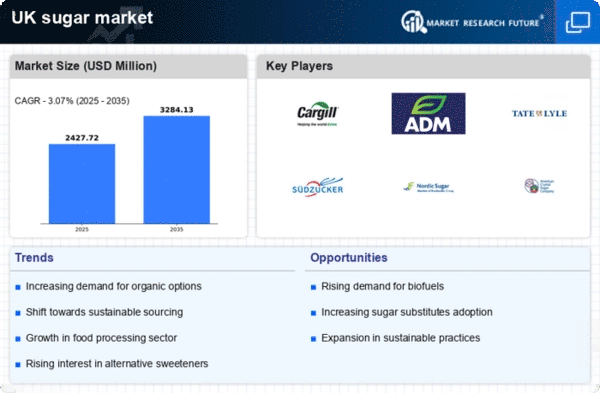
As per Market Research Future analysis, the UK industrial sugar market size was estimated at 2355.41 USD Million in 2024. The UK industrial sugar market is projected to grow from 2427.72 USD Million in 2025 to 3284.13 USD Million by 2035, exhibiting a compound annual growth rate (CAGR) of 3.0% during the forecast period 2025 - 2035

Key Market Trends & Highlights

The UK industrial sugar market is currently experiencing a transformative shift driven by evolving consumer preferences and regulatory frameworks.

  • The market is witnessing a notable shift towards alternative sweeteners as consumers become more health-conscious.
  • Regulatory impacts are shaping sugar consumption patterns, leading to increased scrutiny on sugar pricing and usage.
  • Sustainability in production practices is gaining traction, reflecting a broader trend towards environmentally friendly manufacturing.
  • Rising demand from the food and beverage sector and consumer health trends are key drivers influencing the market dynamics.

Market Size & Forecast

2024 Market Size 2355.41 (USD Million)
2035 Market Size 3284.13 (USD Million)
CAGR (2025 - 2035) 3.07%

Major Players

Cargill (US), Archer Daniels Midland (US), Tate & Lyle (GB), Südzucker (DE), Nordzucker (DE), American Crystal Sugar Company (US), Wilmar International (SG), Cosan (BR), Rogers Sugar (CA)

Our Impact
Enabled $4.3B Revenue Impact for Fortune 500 and Leading Multinationals
Partnering with 2000+ Global Organizations Each Year
30K+ Citations by Top-Tier Firms in the Industry

UK Industrial Sugar Market Trends

The industrial sugar market in the UK is currently experiencing significant changes driven by evolving consumer preferences and regulatory changes. The demand for industrial sugar is influenced by various sectors, including food and beverage, pharmaceuticals, and biofuels. As health consciousness rises among consumers, there is a noticeable shift towards alternative sweeteners, which may impact traditional sugar consumption patterns. Additionally, the UK government has implemented policies aimed at reducing sugar intake, further shaping market dynamics. This regulatory environment could lead to increased innovation in product offerings, as manufacturers seek to adapt to changing consumer demands while complying with new guidelines. Moreover, The industrial sugar market is witnessing advancements in production technologies that enhance efficiency and sustainability. The focus on reducing environmental impact is prompting companies to explore more sustainable sourcing and production methods. This trend aligns with broader global movements towards sustainability, suggesting that the industrial sugar market in the UK could see a transformation in how sugar is produced and consumed. As the market evolves, stakeholders must remain vigilant to adapt to these changes and capitalize on emerging opportunities.

Shift Towards Alternative Sweeteners

There is a growing trend in the industrial sugar market towards the adoption of alternative sweeteners. This shift is driven by increasing health awareness among consumers, leading to a decline in traditional sugar consumption. Manufacturers are responding by diversifying their product lines to include natural and artificial sweeteners, catering to the changing preferences of health-conscious consumers.

Regulatory Impact on Sugar Consumption

The UK government has introduced various regulations aimed at reducing sugar consumption, particularly in processed foods and beverages. These policies are influencing manufacturers to reformulate products, which may lead to a decrease in demand for traditional industrial sugar. Companies are likely to invest in research and development to create lower-sugar alternatives that comply with these regulations.

Sustainability in Production Practices

Sustainability is becoming a focal point in the industrial sugar market, with companies increasingly adopting eco-friendly production practices. This trend is driven by consumer demand for sustainable products and the need to comply with environmental regulations. As a result, manufacturers are exploring innovative methods to reduce waste and improve energy efficiency in sugar production.

UK Industrial Sugar Market Drivers

Export Opportunities in Emerging Markets

The industrial sugar market in the UK is witnessing potential growth through export opportunities in emerging markets. Countries in Asia and Africa are experiencing rising sugar consumption due to population growth and urbanization. As the UK seeks to expand its trade relationships, the industrial sugar market could capitalize on these emerging markets, which may offer lucrative opportunities for exporters. Recent statistics suggest that UK sugar exports have increased by approximately 15% over the past year, indicating a growing interest in British sugar products abroad. This trend may continue as international demand for high-quality sugar rises, positioning the UK as a key player in the global sugar trade. Such developments could lead to increased production capacities and investments in the industrial sugar market.

Regulatory Changes Impacting Sugar Pricing

Regulatory changes are a significant factor affecting the industrial sugar market. In the UK, government policies aimed at reducing sugar consumption have led to the implementation of sugar taxes and stricter labeling requirements. These regulations can influence pricing strategies within the industrial sugar market, as producers may need to adjust their pricing to remain competitive while complying with new standards. Recent analyses indicate that sugar prices have fluctuated due to these regulatory impacts, with some producers facing increased costs associated with compliance. As the regulatory landscape continues to evolve, the industrial sugar market must navigate these challenges, which could lead to shifts in market dynamics and pricing structures.

Rising Demand from Food and Beverage Sector

The food and beverage sector remains a primary driver for the industrial sugar market. In the UK, the demand for processed foods and beverages continues to grow, with a notable increase in the consumption of sugary products. Recent data indicates that the food and beverage industry accounts for approximately 60% of the total sugar consumption in the UK. This trend is likely to persist as manufacturers seek to enhance product taste and appeal. Additionally, the rise of convenience foods, coupled with changing consumer preferences towards sweetened beverages, suggests that the industrial sugar market will experience sustained growth. As companies innovate to meet consumer demands, the industrial sugar market is poised to benefit from this increasing demand, potentially leading to higher production volumes and market expansion.

Consumer Health Trends Influencing Sugar Usage

Consumer health trends are increasingly influencing the dynamics of the industrial sugar market. As awareness of health issues related to sugar consumption rises, many consumers are seeking to reduce their sugar intake. This shift is prompting manufacturers to reformulate products, leading to a potential decline in traditional sugar usage. However, this trend also opens avenues for the industrial sugar market to innovate by developing healthier alternatives and low-calorie sweeteners. The market may see a rise in demand for sugar substitutes that cater to health-conscious consumers, thereby creating a dual challenge and opportunity for producers. As the industrial sugar market adapts to these changing consumer preferences, it may need to balance traditional sugar production with the growing demand for healthier options.

Technological Advancements in Sugar Production

Technological advancements play a crucial role in shaping the industrial sugar market. Innovations in production techniques, such as improved extraction methods and refining processes, have enhanced efficiency and reduced costs. In the UK, the adoption of automation and data analytics in sugar manufacturing has led to increased productivity and quality control. For instance, the implementation of precision agriculture techniques has allowed sugar beet farmers to optimize yields, thereby contributing to a more robust supply chain. These advancements not only improve the profitability of sugar producers but also align with sustainability goals, as they often result in lower energy consumption and waste generation. Consequently, the industrial sugar market is likely to benefit from these technological improvements, fostering a more competitive landscape.


Market Segment Insights

By Application: Food and Beverages (Largest) vs. Pharmaceuticals (Fastest-Growing)

In the UK industrial sugar market, the application segment witnesses a varied distribution of market share, with Food and Beverages holding the largest portion. This sector dominates the demand for sugar, primarily due to its extensive use in diverse products, including soft drinks, baked goods, and confectionery. Meanwhile, the Pharmaceuticals segment, while smaller in share, showcases significant promise for growth, driven by the increasing incorporation of sugar as a sweetener in medicines and health products. The growth trends within the application segment indicate a noteworthy rise in demand for both established and emerging sectors. Food and Beverages will continue to thrive, fueled by consumer preferences for sweeter products. Conversely, the Pharmaceuticals segment is gaining momentum through innovations focusing on sugar-based formulations. The rising health consciousness among consumers also pushes the Personal Care Products and Animal Feed segments into a favorable growth trajectory, with companies increasingly recognizing the multifaceted applications of sugar in these areas.

Food and Beverages (Dominant) vs. Pharmaceuticals (Emerging)

The Food and Beverages segment stands as the dominant force in the UK industrial sugar market, characterized by its broad application in various culinary and beverage products. Its established market position is reinforced by continuous demand for sweetened goods. In contrast, the Pharmaceuticals segment is recognized as an emerging player, leveraging the unique properties of sugar for enhancing drug delivery systems and patient adherence. While the Food and Beverages segment enjoys stability, the Pharmaceuticals sector is poised for expansion, driven by innovations targeting sweetness in therapeutic products. Both segments reflect diverse consumer needs, with Food and Beverages focused on indulgence and Pharmaceuticals emphasizing health and wellness.

By Type: Granulated Sugar (Largest) vs. Liquid Sugar (Fastest-Growing)

In the UK industrial sugar market, market share distribution among segment values reveals that granulated sugar remains the largest, catering to various industrial applications such as food production and beverages. Liquid sugar follows closely, gaining traction due to its convenience in manufacturing processes, especially in beverages and sauces. Meanwhile, powdered sugar and brown sugar hold smaller portions of the market, primarily used in specific food products and confections. Growth trends in this segment are significantly influenced by rising demand for convenience and efficiency in production. Liquid sugar is experiencing the fastest growth, driven by its ease of use in formulations and a shift in consumer preferences towards ready-to-drink beverages. Additionally, health-conscious trends are promoting the use of alternative sugars, including brown sugar, leading to increased exploration and potential growth in their niche markets.

Granulated Sugar (Dominant) vs. Powdered Sugar (Emerging)

Granulated sugar is the dominant player in the UK industrial sugar market, widely used across various sectors including food, beverages, and health products due to its versatile nature and cost-effectiveness. On the other hand, powdered sugar, while emerging, is also gaining popularity for its specific applications in the confectionery industry. With a fine texture that allows for better incorporation in icings and toppings, powdered sugar is carving out a niche among artisanal bakers and specialty food producers. The adaptability of both sugar types is driven by changing consumer preferences, regulatory environments, and innovations in processing and packaging that enhance their appeal in today's market.

By Source: Sugarcane (Largest) vs. Sugar Beet (Fastest-Growing)

In the UK industrial sugar market, the source segment is predominantly driven by sugarcane, achieving the largest market share. Sugarcane holds a significant portion of the overall supply, mainly due to its efficiency in production and established processing infrastructure. Meanwhile, sugar beet also presents a substantial presence, catering to domestic demand and contributing to the local agricultural economy, albeit with a slightly smaller share compared to sugarcane. Recent trends indicate that sugar beet is the fastest-growing segment within the source category. Factors driving this growth include increasing agricultural advancements, shifting consumer preferences toward locally sourced products, and government initiatives supporting beet cultivation. As the market adapts, it demonstrates a growing inclination for diverse sugar sources, ensuring sustainability and resilience.

Sugarcane: Dominant vs. Sugar Beet: Emerging

Sugarcane is recognized as the dominant source of sugar in the UK industrial sugar market, largely due to its high yield and established cultivation practices. This segment benefits from robust supply chains and international trade, allowing for competitive pricing and availability. In contrast, sugar beet emerges as a key player, reflecting the market's shift towards local production and sustainability. Although it currently holds a smaller market share, its growth potential is bolstered by advancements in farming techniques, promising higher yields and better quality. As environmental concerns gain traction among consumers, sugar beet's rising status highlights the industry's transition towards more sustainable sourcing practices, thus enriching the competitive landscape.

By End Use: Industrial (Largest) vs. Retail (Fastest-Growing)

In the UK industrial sugar market, the segment distribution reveals that the Industrial sector holds the largest share due to its extensive applications in food production and manufacturing processes. Commercial usage also plays a significant role, catering to businesses that utilize sugar in various offerings, while the Retail segment continues to emerge with growing consumer demand for sweeteners at the grassroots level. Growth trends indicate that the Industrial segment remains stable, driven by the continued demand from food and beverage manufacturers. Conversely, the Retail segment demonstrates rapid growth as consumers increasingly seek products with natural sugar alternatives and health-conscious sweeteners. The Commercial segment shows consistent growth as businesses adapt to evolving consumer preferences, further supporting the market dynamics.

Industrial (Dominant) vs. Retail (Emerging)

The Industrial segment of the UK industrial sugar market is characterized by its significant volume consumption in the production of various food items, showcasing stability and resilience. It serves as a dominant player, supplying ample quantities of sugar to large manufacturers focusing on bulk production. On the other hand, the Retail sector is emerging rapidly, adapting to changing consumer preferences towards convenience and health. This segment has started to thrive with a diverse product range that includes organic and specialty sugars, catering to the evolving tastes of individual consumers. The adaptability of the Retail segment indicates a shift in market dynamics, illustrating a response to consumer demand for healthier alternatives while the Industrial segment maintains its foundational role.

Get more detailed insights about UK Industrial Sugar Market

Key Players and Competitive Insights

The industrial sugar market in the UK is characterized by a competitive landscape that is increasingly shaped by innovation, sustainability, and strategic partnerships. Key players such as Tate & Lyle (GB), Cargill (US), and Archer Daniels Midland (US) are actively pursuing strategies that emphasize product diversification and technological advancements. Tate & Lyle (GB), for instance, has focused on enhancing its product portfolio with low-calorie sweeteners, which aligns with the growing consumer demand for healthier alternatives. Meanwhile, Cargill (US) has been investing in digital transformation initiatives to optimize its supply chain and improve operational efficiency, thereby reinforcing its market position. These strategies collectively contribute to a dynamic competitive environment where adaptability and innovation are paramount.
The business tactics employed by these companies reflect a concerted effort to localize manufacturing and optimize supply chains. The market structure appears moderately fragmented, with several players vying for market share. However, the influence of major companies like Tate & Lyle (GB) and Cargill (US) is substantial, as they leverage their extensive resources and expertise to shape market trends and consumer preferences. This competitive structure fosters an environment where smaller players may struggle to keep pace, thereby reinforcing the dominance of established firms.
In October 2025, Tate & Lyle (GB) announced a strategic partnership with a leading biotechnology firm to develop sustainable sugar alternatives. This collaboration is expected to enhance Tate & Lyle's capabilities in producing innovative sweeteners that cater to the health-conscious consumer segment. The strategic importance of this move lies in its potential to position Tate & Lyle as a frontrunner in the sustainable sugar market, aligning with global trends towards environmentally friendly products.
In September 2025, Cargill (US) launched a new digital platform aimed at streamlining its supply chain operations. This initiative is designed to enhance transparency and efficiency, allowing Cargill to respond more swiftly to market demands. The significance of this development cannot be overstated, as it reflects a broader trend within the industry towards digitalization, which is likely to redefine operational standards and customer engagement strategies.
In August 2025, Archer Daniels Midland (US) expanded its production capacity in the UK by investing in a new facility dedicated to specialty sugars. This expansion is indicative of ADM's commitment to meeting the rising demand for customized sugar solutions in various food applications. The strategic importance of this investment lies in its potential to enhance ADM's competitive edge by providing tailored products that meet specific customer needs, thereby fostering customer loyalty and market penetration.
As of November 2025, the competitive trends within the industrial sugar market are increasingly defined by digitalization, sustainability, and the integration of advanced technologies such as AI. Strategic alliances are becoming more prevalent, as companies recognize the value of collaboration in driving innovation and enhancing supply chain resilience. Looking ahead, it is likely that competitive differentiation will evolve from traditional price-based competition to a focus on innovation, technology integration, and reliability in supply chains. This shift underscores the necessity for companies to adapt and innovate continuously to maintain their competitive positions in an ever-evolving market.

Key Companies in the UK Industrial Sugar Market include

Industry Developments

Recent developments in the UK Industrial Sugar Market include the ongoing challenges related to rising production costs and tight labor supply, which have influenced pricing and overall market dynamics. Companies such as British Sugar and Tate and Lyle have been focusing on sustainable practices and the integration of technology to boost productivity. Growth in the valuation of companies like Cargill and Olam International has been driven by increased demand for specialty sugars, which are finding applications in healthier food formulations.

There have been no significant mergers or acquisitions reported in this sector in the recent months of September and October 2023 pertaining to key players like Whitworths and Illovo Sugar. Additionally, historic changes in the market landscape, such as the acquisition of British Sugar by AB Sugar back in April 2021, continue to influence competitive strategies. The UK government has also noted that the sugar industry contributes significantly to rural economies, promoting local employment and sustainable agricultural practices. Overall, shifts towards healthier product offerings and sustainability are shaping current affairs in the UK Industrial Sugar Market.

Future Outlook

UK Industrial Sugar Market Future Outlook

The Industrial Sugar Market is projected to grow at 3.07% CAGR from 2025 to 2035, driven by increasing demand in food and beverage sectors, biofuel production, and innovative applications.

New opportunities lie in:

  • Expansion of specialty sugar products for health-conscious consumers.
  • Investment in automated sugar processing technologies to enhance efficiency.
  • Development of sustainable sourcing strategies to meet regulatory demands.

By 2035, the industrial sugar market is expected to achieve robust growth, driven by innovation and sustainability.

Market Segmentation

UK Industrial Sugar Market Type Outlook

  • Granulated Sugar
  • Liquid Sugar
  • Powdered Sugar
  • Brown Sugar

UK Industrial Sugar Market Source Outlook

  • Sugarcane
  • Sugar Beet
  • Corn
  • Palm

UK Industrial Sugar Market End Use Outlook

  • Industrial
  • Commercial
  • Retail

UK Industrial Sugar Market Application Outlook

  • Food and Beverages
  • Pharmaceuticals
  • Personal Care Products
  • Animal Feed
  • Biofuels

Report Scope

MARKET SIZE 2024 2355.41(USD Million)
MARKET SIZE 2025 2427.72(USD Million)
MARKET SIZE 2035 3284.13(USD Million)
COMPOUND ANNUAL GROWTH RATE (CAGR) 3.07% (2025 - 2035)
REPORT COVERAGE Revenue Forecast, Competitive Landscape, Growth Factors, and Trends
BASE YEAR 2024
Market Forecast Period 2025 - 2035
Historical Data 2019 - 2024
Market Forecast Units USD Million
Key Companies Profiled Cargill (US), Archer Daniels Midland (US), Tate & Lyle (GB), Südzucker (DE), Nordzucker (DE), American Crystal Sugar Company (US), Wilmar International (SG), Cosan (BR), Rogers Sugar (CA)
Segments Covered Application, Type, Source, End Use
Key Market Opportunities Growing demand for sustainable production methods in the industrial sugar market presents significant opportunities.
Key Market Dynamics Shifts in consumer preferences towards sustainable sourcing drive innovation in the industrial sugar market.
Countries Covered UK
Leave a Comment

FAQs

What is the expected market size of the UK Industrial Sugar Market in 2024?

The UK Industrial Sugar Market is expected to be valued at 2.79 billion USD in 2024.

What will the market size be by 2035?

By 2035, the UK Industrial Sugar Market is projected to reach a value of 4.41 billion USD.

What is the expected CAGR for the UK Industrial Sugar Market from 2025 to 2035?

The expected CAGR for the UK Industrial Sugar Market during the period from 2025 to 2035 is 4.253 percent.

Which is the largest application segment in the UK Industrial Sugar Market?

The largest application segment is Food and Beverages, valued at 1.15 billion USD in 2024.

What are the projected values for the Pharmaceuticals application by 2035?

The Pharmaceuticals application in the UK Industrial Sugar Market is expected to be valued at 1.03 billion USD by 2035.

Who are the key players in the UK Industrial Sugar Market?

Key players include Olam International, Whitworths, Palsgaard, Cargill, and British Sugar, among others.

What is the expected market size for Personal Care Products by 2035?

The market size for Personal Care Products is projected to be 0.74 billion USD by 2035.

What is the expected value for the Animal Feed application segment in 2024?

The Animal Feed application segment is expected to be valued at 0.3 billion USD in 2024.

How much is the Biofuels application segment expected to grow by 2035?

The Biofuels application segment is anticipated to grow to 0.39 billion USD by 2035.

What challenges and opportunities exist in the UK Industrial Sugar Market?

Challenges include regulatory pressures, while opportunities are driven by increasing demand in food and biofuel applications.

Download Free Sample

Kindly complete the form below to receive a free sample of this Report

Compare Licence

×
Features License Type
Single User Multiuser License Enterprise User
Price $4,950 $5,950 $7,250
Maximum User Access Limit 1 User Upto 10 Users Unrestricted Access Throughout the Organization
Free Customization
Direct Access to Analyst
Deliverable Format
Platform Access
Discount on Next Purchase 10% 15% 15%
Printable Versions