×
Request Free Sample ×

Kindly complete the form below to receive a free sample of this Report

* Please use a valid business email

Leading companies partner with us for data-driven Insights

clients tt-cursor
Hero Background

China Gpon Technology Market

ID: MRFR/ICT/58894-HCR
200 Pages
Aarti Dhapte
February 2026

China GPON Technology Market Size, Share and Trends Analysis Report By Technology (2.5G PON, XG-PON, XGS-PON, NG-PON2), By Component (Optical Network Terminal, Optical Line Terminal), and By Application (FTTH, Other FTTx, Mobile Backhaul) - Forecast to 2035

Share:
Download PDF ×

We do not share your information with anyone. However, we may send you emails based on your report interest from time to time. You may contact us at any time to opt-out.

China Gpon Technology Market Infographic
Purchase Options

China Gpon Technology Market Summary

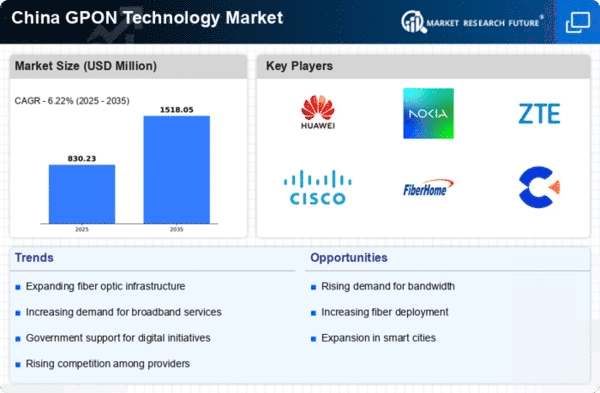
As per Market Research Future analysis, the China Gpon Technology Market size was estimated at 781.61 USD Million in 2024. The Gpon Technology market is projected to grow from 830.23 USD Million in 2025 to 1518.05 USD Million by 2035, exhibiting a compound annual growth rate (CAGR) of 6.2% during the forecast period 2025 - 2035

Key Market Trends & Highlights

The China GPON technology market is poised for substantial growth driven by increasing demand for high-speed internet and government initiatives.

  • The market is experiencing a rising demand for high-speed internet, particularly in urban areas.
  • Government initiatives for broadband expansion are significantly influencing market dynamics.
  • The integration of advanced technologies is becoming a key focus for service providers aiming to enhance user experience.
  • Major market drivers include increasing urbanization and connectivity needs, alongside government support for digital infrastructure.

Market Size & Forecast

2024 Market Size 781.61 (USD Million)
2035 Market Size 1518.05 (USD Million)
CAGR (2025 - 2035) 6.22%

Major Players

Huawei (CN), Nokia (FI), ZTE (CN), Cisco (US), FiberHome (CN), Calix (US), ADTRAN (US), Mitsubishi Electric (JP)

Our Impact
Enabled $4.3B Revenue Impact for Fortune 500 and Leading Multinationals
Partnering with 2000+ Global Organizations Each Year
30K+ Citations by Top-Tier Firms in the Industry

China Gpon Technology Market Trends

The China Gpon Technology Market is currently experiencing a notable transformation, driven by the increasing demand for high-speed internet connectivity. This shift is largely attributed to the rapid digitalization across various sectors, including education, healthcare, and entertainment. As urbanization continues to rise, the need for robust broadband infrastructure becomes more pressing. Consequently, service providers are investing heavily in gpon technology to enhance their offerings and meet consumer expectations. The integration of advanced technologies, such as artificial intelligence and machine learning, is also playing a crucial role in optimizing network performance and management. Moreover, government initiatives aimed at expanding broadband access in rural and underserved areas are likely to further stimulate growth in the gpon technology market. These efforts may include subsidies and incentives for telecommunications companies to deploy fiber-optic networks. As a result, the market is poised for significant expansion, with a focus on improving service quality and reducing operational costs. The ongoing evolution of consumer preferences towards seamless connectivity and high-speed internet is expected to shape the future landscape of this market, making it a critical area for investment and development.

Rising Demand for High-Speed Internet

The gpon technology market is witnessing an upsurge in demand for high-speed internet services. This trend is driven by the increasing reliance on digital platforms for work, education, and entertainment. As consumers seek faster and more reliable connections, service providers are compelled to upgrade their infrastructure, leading to greater adoption of gpon technology.

Government Initiatives for Broadband Expansion

Government policies aimed at enhancing broadband access are significantly influencing the gpon technology market. Initiatives focused on providing subsidies and incentives for telecommunications companies to expand fiber-optic networks are likely to foster growth. These efforts are particularly aimed at bridging the digital divide in rural and underserved regions.

Integration of Advanced Technologies

The integration of advanced technologies into the gpon technology market is becoming increasingly prevalent. Innovations such as artificial intelligence and machine learning are being utilized to optimize network performance and management. This trend not only enhances service delivery but also improves operational efficiency for service providers.

China Gpon Technology Market Drivers

Rising Adoption of Smart Technologies

The proliferation of smart technologies in China is significantly influencing the gpon technology market. As consumers and businesses increasingly adopt smart devices, the demand for high-speed internet connectivity intensifies. Smart homes, smart cities, and industrial automation require robust and reliable internet infrastructure, which gpon technology can provide. The market is projected to grow as more households and enterprises seek to integrate smart solutions, with estimates suggesting a potential increase in market size by over 25% in the next five years. This trend indicates a shift towards more interconnected environments, where gpon technology plays a crucial role in ensuring seamless connectivity and data transmission. The gpon technology market is thus likely to experience a surge in demand driven by the need for efficient and high-capacity networks.

Competitive Landscape and Market Innovation

The competitive landscape within the gpon technology market is evolving, with numerous players striving to innovate and capture market share. Companies are investing in research and development to enhance their offerings, leading to the introduction of advanced gpon solutions that cater to diverse consumer needs. This innovation is crucial in a market where differentiation is key to attracting customers. The gpon technology market is witnessing a surge in partnerships and collaborations aimed at leveraging technological advancements. As competition intensifies, it is anticipated that the market will experience a growth rate of approximately 15% over the next few years, driven by the introduction of new products and services that enhance user experience and network performance.

Demand for Enhanced Data Transmission Speeds

As data consumption continues to rise in China, the demand for enhanced data transmission speeds is becoming increasingly critical. The gpon technology market is well-positioned to address this need, as it offers superior bandwidth capabilities compared to traditional copper networks. With the average internet speed in urban areas reaching approximately 100 Mbps, there is a growing expectation for even faster connections. This trend is likely to drive investments in gpon technology, as service providers seek to upgrade their networks to meet consumer demands. The gpon technology market is expected to see a significant uptick in deployment activities, with projections indicating a potential market growth of around 20% in the coming years, driven by the need for faster and more reliable internet services.

Government Support for Digital Infrastructure

The Chinese government has been actively promoting the development of digital infrastructure, which is a key driver for the gpon technology market. Initiatives aimed at enhancing broadband access and digital services are being implemented across the country. The government has set ambitious targets to increase fiber-optic coverage, with plans to connect over 90% of households to high-speed internet by 2025. This commitment is expected to inject substantial investment into the gpon technology market, fostering innovation and expansion. The gpon technology market stands to gain from these government initiatives, as they create a conducive environment for the deployment of advanced fiber-optic networks. The anticipated growth in infrastructure spending could lead to a market increase of approximately 30% over the next few years.

Increasing Urbanization and Connectivity Needs

The rapid urbanization in China is driving the demand for enhanced connectivity solutions, particularly in metropolitan areas. As urban populations grow, the need for reliable and high-speed internet access becomes paramount. The gpon technology market is poised to benefit from this trend, as it offers the necessary infrastructure to support the increasing number of connected devices and services. With urban areas projected to house over 70% of the population by 2030, the gpon technology market is likely to see substantial growth. This urbanization trend necessitates the deployment of advanced fiber-optic networks, which are essential for meeting the connectivity demands of smart cities and IoT applications. Consequently, the gpon technology market is expected to expand significantly to accommodate these evolving needs.


Market Segment Insights

By Technology: XGS-PON (Largest) vs. NG-PON2 (Fastest-Growing)

In the China gpon technology market, the segmentation shows that XGS-PON holds the largest portion of the market share due to its robust capabilities in providing high-speed internet access. This technology is widely adopted due to its efficiency in managing large bandwidth demands. In comparison, 2.5G PON and XG-PON also occupy significant shares, though they are gradually being overshadowed by XGS-PON as the preferred choice for new installations. Growth trends in the China gpon technology market indicate a strong push towards XGS-PON with its versatility to support various applications, which is becoming increasingly relevant as digital demand rises. The NG-PON2 technology, labeled as the fastest-growing segment, is gaining traction as it supports advanced features like increased flexibility and enhanced service agility, appealing particularly to service providers looking to meet evolving customer needs.

Technology: XGS-PON (Dominant) vs. NG-PON2 (Emerging)

XGS-PON, as the dominant technology in the China gpon technology market, is known for its ability to deliver symmetrical speeds and is particularly favored by enterprises requiring reliable connectivity. Its high capacity and efficiency further strengthen its market position, attracting investments from major telecom players. On the other hand, NG-PON2, as an emerging segment, is distinguished by its capability to support a variety of service requirements and the flexibility it provides for future upgrades. This positions NG-PON2 as an attractive option for operators looking to modernize their infrastructure without substantial overhauls, indicating promising growth potential in the coming years.

By Component: Optical Network Terminal (Largest) vs. Optical Line Terminal (Fastest-Growing)

The market share distribution in the China gpon technology market shows that Optical Network Terminals (ONT) hold the largest share, leveraging the growing demand for high-speed internet connectivity across urban and suburban areas. In contrast, Optical Line Terminals (OLT) are emerging rapidly, driven by the expansion of fiber optic networks and increasing investments in telecommunications infrastructure. Growth trends indicate a significant rise in the adoption of ONTs, attributed to their critical role in delivering high-speed internet to end-users. OLTs, on the other hand, are recognized as the fastest-growing component due to the ongoing advancements in GPON technology and increasing reliance on centralized management systems. The drive for better bandwidth capacity and improved network efficiencies are key factors influencing this segment's growth.

Technology: ONT (Dominant) vs. OLT (Emerging)

Optical Network Terminals (ONT) are dominant in the China gpon technology market due to their essential function in connecting end-users to high-speed fiber networks. They facilitate seamless internet access and support various applications, making them integral to modern telecommunications. ONTs are preferred for their reliability and performance, catering to residential and commercial users alike. Conversely, Optical Line Terminals (OLT) are rapidly emerging as a key technology, orchestrating network traffic and enabling efficient data transmission. Their growth is propelled by advancements in fiber optic technologies, which enhance network scalability and performance. As the need for high-capacity networks increases, both ONTs and OLTs are poised to play substantial roles in the evolution of the telecommunications landscape.

By Application: FTTH (Largest) vs. Mobile Backhaul (Fastest-Growing)

In the China gpon technology market, the distribution of market share among the application segments reveals a clear leader. FTTH is the largest segment, capturing a significant proportion of users who prefer fiber-to-the-home solutions due to their reliability and speed. Other FTTx solutions also have a noticeable presence, but they do not match the sheer volume of FTTH. Mobile Backhaul is increasingly recognized, driven by the rise in mobile data consumption and the need for robust connectivity. Growth trends in the China gpon technology market indicate a strong upward trajectory for Mobile Backhaul, as mobile networks evolve to support high-speed data demands. While FTTH remains dominant, the proliferation of mobile devices and IoT applications is pushing Mobile Backhaul to become a critical area of investment. Enhanced demand for seamless connectivity and better service delivery mechanisms are key drivers fueling this growth.

FTTH (Dominant) vs. Mobile Backhaul (Emerging)

FTTH stands out as the dominant application segment in the China gpon technology market, characterized by its extensive deployment in residential areas and robust performance metrics. Its ability to deliver high-speed internet directly to homes makes it the preferred choice for consumers seeking reliable connectivity. Conversely, Mobile Backhaul, while emerging, is rapidly gaining traction as mobile users demand more bandwidth. This segment focuses on the infrastructure required to connect cell sites to the broader network and is essential for enabling 5G and enhanced mobile services. The ongoing transition to a more mobile-centric lifestyle makes Mobile Backhaul a pivotal area that is increasingly important in the competitive landscape.

Get more detailed insights about China Gpon Technology Market

Key Players and Competitive Insights

The gpon technology market in China is characterized by a dynamic competitive landscape, driven by rapid advancements in telecommunications infrastructure and increasing demand for high-speed internet connectivity. Key players such as Huawei (CN), ZTE (CN), and Nokia (FI) are at the forefront, each employing distinct strategies to enhance their market positioning. Huawei (CN) focuses on innovation and R&D, investing heavily in next-generation technologies, while ZTE (CN) emphasizes regional expansion and partnerships to bolster its market share. Nokia (FI), on the other hand, is leveraging its expertise in digital transformation to offer integrated solutions that cater to the evolving needs of service providers. Collectively, these strategies contribute to a competitive environment that is both collaborative and competitive, as companies seek to differentiate themselves through technological advancements and service offerings.In terms of business tactics, localizing manufacturing and optimizing supply chains are critical for these companies. The market structure appears moderately fragmented, with several players vying for dominance. However, the influence of major companies like Huawei (CN) and ZTE (CN) is substantial, as they command significant market shares and drive innovation. Their ability to adapt to local market conditions and consumer preferences enhances their competitive edge, allowing them to respond swiftly to emerging trends and demands.

In October Huawei (CN) announced a strategic partnership with a leading Chinese telecommunications provider to deploy a new generation of gpon technology across urban areas. This collaboration is expected to enhance network capacity and improve service delivery, positioning Huawei (CN) as a key player in the urban digital infrastructure landscape. The strategic importance of this partnership lies in its potential to solidify Huawei's (CN) market presence and drive further adoption of its advanced technologies in densely populated regions.

In September ZTE (CN) launched an innovative gpon solution aimed at enhancing energy efficiency in telecommunications networks. This initiative aligns with global sustainability trends and positions ZTE (CN) as a leader in environmentally friendly technology. The strategic significance of this move is underscored by the growing emphasis on sustainable practices within the industry, which could attract environmentally conscious customers and partners.

In August Nokia (FI) unveiled a new AI-driven analytics platform designed to optimize network performance for service providers. This development reflects Nokia's (FI) commitment to integrating AI into its offerings, enhancing operational efficiency and customer experience. The strategic relevance of this platform lies in its potential to provide service providers with actionable insights, thereby improving service reliability and customer satisfaction.

As of November current competitive trends in the gpon technology market are increasingly defined by digitalization, sustainability, and AI integration. Strategic alliances are becoming more prevalent, as companies recognize the value of collaboration in navigating complex market dynamics. Looking ahead, competitive differentiation is likely to evolve, shifting from price-based competition to a focus on innovation, technology, and supply chain reliability. This transition suggests that companies will need to invest in cutting-edge technologies and sustainable practices to maintain their competitive edge in an ever-evolving market.

Key Companies in the China Gpon Technology Market include

Industry Developments

In 2023, Huawei introduced the OptiXstar MA5800 series OLTs, which provide 60% increased transmission speeds, enhanced traffic management, and AI-driven predictive maintenance features. The OLTs facilitate more efficient upgrades for XGS-PON deployment and enhance operational and maintenance efficiency, resulting in a reduction of downtime by approximately 28% in China's fixed broadband networks.In 2023, ZTE launched the ZXA10 C300 GPON OLT platform, intended for versatile deployment in FTTH, FTTO, and mobile transport applications. It facilitates multi-mode coexistence and scalability, thereby strengthening ZTE's leading role in Chinese operator networks.

ZTE obtained a market share of approximately 40–50% in China Mobile’s XG/XGS-PON procurement and achieved the leading position in China Telecom’s 10G and XGS-PON tenders, surpassing competitors such as Huawei, FiberHome, and Nokia Shanghai Bell.In July 2023, FiberHome introduced its AN6000 GPON OLT series, emphasizing enhanced network efficiency and high reliability in densely populated urban areas, resulting in substantial operator deployments across multiple provinces.

In October 2023, the China Telecom Research Institute verified the first ITU-T compliant solution that allows GPON, XGS-PON, and 50G-PON to coexist on a single ODN network using MPM optical modules. Downstream and upstream throughput achieved 42 Gbps and 17 Gbps, respectively. The solution is anticipated to facilitate widespread commercialization throughout China by late 2025.

Future Outlook

China Gpon Technology Market Future Outlook

The GPON Technology Market is projected to grow at a 6.22% CAGR from 2025 to 2035, driven by increasing demand for high-speed internet and advancements in fiber optics.

New opportunities lie in:

  • Expansion of fiber optic infrastructure in rural areas
  • Development of integrated smart city solutions
  • Partnerships with telecom operators for enhanced service delivery

By 2035, the market is expected to achieve substantial growth, driven by technological advancements and increased adoption.

Market Segmentation

China Gpon Technology Market Component Outlook

  • Optical Network Terminal
  • Optical Line Terminal

China Gpon Technology Market Technology Outlook

  • 2.5G PON
  • XG-PON
  • XGS-PON
  • NG-PON2

China Gpon Technology Market Application Outlook

  • FTTH
  • Other FTTx
  • Mobile Backhaul

Report Scope

MARKET SIZE 2024 781.61(USD Million)
MARKET SIZE 2025 830.23(USD Million)
MARKET SIZE 2035 1518.05(USD Million)
COMPOUND ANNUAL GROWTH RATE (CAGR) 6.22% (2025 - 2035)
REPORT COVERAGE Revenue Forecast, Competitive Landscape, Growth Factors, and Trends
BASE YEAR 2024
Market Forecast Period 2025 - 2035
Historical Data 2019 - 2024
Market Forecast Units USD Million
Key Companies Profiled Huawei (CN), Nokia (FI), ZTE (CN), Cisco (US), FiberHome (CN), Calix (US), ADTRAN (US), Mitsubishi Electric (JP)
Segments Covered Technology, Component, Application
Key Market Opportunities Expansion of fiber optic infrastructure driven by increasing demand for high-speed internet access.
Key Market Dynamics Rising demand for high-speed internet drives competitive innovation in the gpon technology market.
Countries Covered China
Leave a Comment

FAQs

What is the expected market value of the China GPON Technology Market in 2024?

The China GPON Technology Market is expected to be valued at 773.85 million USD in 2024.

What will the market size reach by 2035?

By 2035, the market size is projected to reach 1617.0 million USD.

What is the expected CAGR for the China GPON Technology Market from 2025 to 2035?

The expected CAGR for the market from 2025 to 2035 is approximately 6.929%.

Which segment has the largest market value in 2024 within the China GPON Technology Market?

The 2.5G PON segment holds the largest market value at 250.0 million USD in 2024.

What is the market size of the XG-PON segment in 2024?

The XG-PON segment is valued at 200.0 million USD in 2024.

What are the key players in the China GPON Technology Market?

Major players in the market include Cisco, ZTE, Adtran, FiberHome, Huawei, and Nokia.

What will be the value of the NG-PON2 segment by 2035?

The NG-PON2 segment is expected to grow to 357.0 million USD by 2035.

How is the XGS-PON segment projected to change by 2035?

The XGS-PON segment's market value is expected to reach 360.0 million USD by 2035.

What opportunities exist in the China GPON Technology Market?

There are significant opportunities for growth driven by increasing demand for high-speed internet and advanced networking solutions.

What challenges might impact the growth of this market?

Challenges such as rapid technological changes and competition among key players can impact market growth.

Download Free Sample

Kindly complete the form below to receive a free sample of this Report

Compare Licence

×
Features License Type
Single User Multiuser License Enterprise User
Price $4,950 $5,950 $7,250
Maximum User Access Limit 1 User Upto 10 Users Unrestricted Access Throughout the Organization
Free Customization
Direct Access to Analyst
Deliverable Format
Platform Access
Discount on Next Purchase 10% 15% 15%
Printable Versions