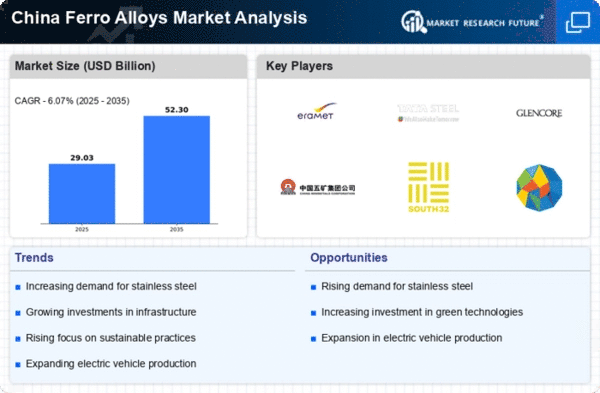
The ferro alloys market in China is characterized by a competitive landscape that is both dynamic and multifaceted. Key growth drivers include the increasing demand for steel production, advancements in technology, and a growing emphasis on sustainability. Major players such as China Minmetals Corporation (CN), Tata Steel (IN), and Glencore (CH) are strategically positioned to leverage these trends. China Minmetals Corporation (CN) focuses on vertical integration and expanding its production capabilities, while Tata Steel (IN) emphasizes innovation in alloy production processes. Glencore (CH) is enhancing its supply chain efficiency through digital transformation initiatives, collectively shaping a competitive environment that is increasingly reliant on technological advancements and sustainable practices.The market structure appears moderately fragmented, with several key players exerting influence over various segments. Business tactics such as localizing manufacturing and optimizing supply chains are prevalent among these companies. For instance, many firms are establishing production facilities closer to raw material sources to mitigate supply chain disruptions and reduce costs. This localized approach not only enhances operational efficiency but also aligns with the growing demand for sustainable practices in production.
In September China Minmetals Corporation (CN) announced a strategic partnership with a leading technology firm to develop advanced ferro alloy production techniques. This collaboration is expected to enhance production efficiency and reduce carbon emissions, aligning with global sustainability goals. The strategic importance of this partnership lies in its potential to position China Minmetals as a leader in environmentally friendly production methods, thereby attracting environmentally conscious clients and investors.
In October Tata Steel (IN) unveiled a new initiative aimed at increasing the use of recycled materials in its ferro alloy production. This move is significant as it not only addresses the growing demand for sustainable practices but also reduces dependency on virgin raw materials. By integrating recycled materials, Tata Steel is likely to enhance its competitive edge while contributing to a circular economy, which is becoming increasingly important in the industry.
In August Glencore (CH) launched a digital platform designed to optimize its supply chain operations in the ferro alloys sector. This platform utilizes AI and machine learning to predict demand fluctuations and streamline logistics. The strategic importance of this initiative is profound, as it positions Glencore to respond more effectively to market changes, thereby enhancing its operational resilience and customer satisfaction.
As of November current competitive trends in the ferro alloys market are heavily influenced by digitalization, sustainability, and the integration of AI technologies. Strategic alliances are increasingly shaping the landscape, allowing companies to pool resources and expertise to tackle common challenges. Looking ahead, competitive differentiation is likely to evolve from traditional price-based competition to a focus on innovation, technological advancements, and supply chain reliability. This shift underscores the importance of adapting to market demands and leveraging technology to maintain a competitive edge.