×
Request Free Sample ×

Kindly complete the form below to receive a free sample of this Report

* Please use a valid business email

Leading companies partner with us for data-driven Insights

clients tt-cursor
Hero Background

China Diesel Engine Catalyst Market

ID: MRFR/AT/56546-HCR
200 Pages
Sejal Akre
February 2026

China Diesel Engine Catalyst Market Research Report By Technology (DOC, DPF, SCR, Others)- Forecast to 2035

Share:
Download PDF ×

We do not share your information with anyone. However, we may send you emails based on your report interest from time to time. You may contact us at any time to opt-out.

China Diesel Engine Catalyst Market Infographic
Purchase Options

China Diesel Engine Catalyst Market Summary

As per analysis, the China diesel engine catalyst market is projected to grow from USD 2.29 Billion in 2025 to USD 4.34 Billion by 2035, exhibiting a compound annual growth rate (CAGR) of 6.69% during the forecast period (2025 - 2035).

Key Market Trends & Highlights

The China diesel engine catalyst market is poised for growth driven by regulatory pressures and technological innovations.

  • The automotive segment remains the largest contributor to the diesel engine catalyst market, reflecting robust demand for heavy-duty vehicles.
  • The industrial segment is currently the fastest-growing, indicating a shift towards more efficient catalytic solutions in various applications.
  • Selective catalytic reduction technology dominates the market, while diesel oxidation catalysts are experiencing rapid growth due to evolving emission standards.
  • Key market drivers include stringent regulatory influence on emission standards and the increasing demand for sustainable practices in the automotive sector.

Market Size & Forecast

2024 Market Size 2.13 (USD Billion)
2035 Market Size 4.34 (USD Billion)
CAGR (2025 - 2035) 6.69%

Major Players

BASF (DE), Johnson Matthey (GB), Umicore (BE), Haldor Topsoe (DK), Yara International (NO), Tenneco (US), Continental (DE), Eaton (US)

Our Impact
Enabled $4.3B Revenue Impact for Fortune 500 and Leading Multinationals
Partnering with 2000+ Global Organizations Each Year
30K+ Citations by Top-Tier Firms in the Industry

China Diesel Engine Catalyst Market Trends

The China Diesel Engine Catalyst Market is currently experiencing a transformative phase, driven by stringent environmental regulations and a growing emphasis on reducing emissions from diesel engines. The Chinese government has implemented a series of policies aimed at curbing air pollution, which has led to increased demand for advanced catalytic technologies. This shift is not merely a response to regulatory pressures; it also reflects a broader societal commitment to sustainability and cleaner air. As a result, manufacturers are investing in research and development to create more efficient catalysts that can meet these evolving standards. Moreover, the market landscape is characterized by a competitive environment where domestic and international players vie for market share. The rise of electric vehicles and alternative fuel sources poses challenges, yet it also presents opportunities for innovation within the china diesel engine catalyst market. Companies are exploring hybrid solutions that integrate traditional diesel technologies with emerging alternatives. This dynamic interplay between regulation, innovation, and competition is likely to shape the future trajectory of the market, making it a focal point for stakeholders in the automotive and environmental sectors.

Regulatory Influence on Market Dynamics

The china diesel engine catalyst market is significantly shaped by government regulations aimed at reducing emissions. Policies mandating stricter emission standards compel manufacturers to innovate and enhance their catalytic technologies. This regulatory framework not only drives demand for advanced catalysts but also encourages collaboration between industry players and regulatory bodies to ensure compliance and sustainability.

Technological Advancements in Catalytic Solutions

Innovation plays a crucial role in the china diesel engine catalyst market, with ongoing research focused on developing more efficient and durable catalysts. Advances in materials science and engineering are leading to the creation of catalysts that can operate effectively under diverse conditions. This technological evolution is essential for meeting the increasing performance expectations of diesel engines while adhering to environmental standards.

Shift Towards Sustainable Practices

There is a noticeable trend towards sustainability within the china diesel engine catalyst market, as stakeholders recognize the importance of eco-friendly practices. Companies are increasingly adopting sustainable manufacturing processes and exploring the use of recyclable materials in catalyst production. This shift not only aligns with regulatory requirements but also resonates with the growing consumer demand for environmentally responsible products.

China Diesel Engine Catalyst Market Drivers

Shift Towards Sustainable Practices

The growing awareness of environmental issues among consumers and industries is driving a shift towards sustainable practices within the china diesel engine catalyst market. Companies are increasingly adopting eco-friendly technologies and materials in their manufacturing processes to align with global sustainability goals. This trend is reflected in the rising demand for catalysts that not only meet regulatory requirements but also contribute to lower carbon footprints. In 2025, it is projected that the market for sustainable diesel engine catalysts will account for over 30% of the total market share, indicating a significant shift in consumer preferences. Additionally, partnerships between manufacturers and environmental organizations are fostering the development of innovative solutions that promote sustainability. This evolving landscape suggests that the china diesel engine catalyst market is poised for transformation as it adapts to the demands of a more environmentally conscious society.

Export Opportunities in Global Markets

The expansion of the china diesel engine catalyst market is not limited to domestic demand; it also presents significant export opportunities. As global markets increasingly prioritize emission control technologies, Chinese manufacturers are well-positioned to capitalize on this trend. The competitive pricing and advanced technological capabilities of Chinese catalyst producers make them attractive suppliers for international markets. In 2025, it is estimated that exports of diesel engine catalysts from China could reach USD 500 million, driven by demand from regions such as Europe and North America, where stringent emission regulations are in place. This potential for growth in exports not only enhances the profitability of manufacturers but also solidifies China's position as a key player in The china diesel engine catalyst market. The interplay between domestic and international demand is likely to shape the future trajectory of the china diesel engine catalyst market.

Increasing Demand for Heavy-Duty Vehicles

The robust growth of the heavy-duty vehicle segment in China is a crucial driver for the china diesel engine catalyst market. As urbanization and infrastructure development continue to accelerate, the demand for heavy-duty trucks and buses is on the rise. This trend is further supported by government initiatives aimed at enhancing transportation efficiency and reducing logistics costs. In 2025, the heavy-duty vehicle market in China is expected to grow by approximately 15%, leading to a corresponding increase in the need for effective diesel engine catalysts. These vehicles require advanced catalytic solutions to meet stringent emission standards while maintaining performance. Consequently, manufacturers are focusing on developing specialized catalysts tailored for heavy-duty applications, thereby expanding their product offerings within the china diesel engine catalyst market.

Regulatory Influence on Emission Standards

The stringent emission regulations imposed by the Chinese government significantly drive the china diesel engine catalyst market. The Ministry of Ecology and Environment has established increasingly rigorous standards, such as the National VI emission standards, which necessitate the use of advanced catalytic solutions. These regulations compel manufacturers to adopt diesel engine catalysts that can effectively reduce harmful emissions, including nitrogen oxides and particulate matter. As a result, the market is witnessing a surge in demand for high-performance catalysts that comply with these standards. In 2025, the market for diesel engine catalysts in China was valued at approximately USD 1.5 billion, reflecting the growing emphasis on environmental sustainability and compliance with regulatory frameworks. This trend is likely to continue, further propelling the growth of the china diesel engine catalyst market.

Technological Advancements in Catalytic Solutions

Innovations in catalytic technology are pivotal in shaping the china diesel engine catalyst market. The development of new materials, such as advanced precious metal catalysts and non-precious metal alternatives, enhances the efficiency and effectiveness of diesel engine catalysts. These advancements not only improve the conversion rates of harmful emissions but also extend the lifespan of the catalysts, thereby reducing overall operational costs for manufacturers. In 2025, the introduction of novel catalytic formulations is expected to increase the market share of high-performance catalysts by approximately 20%. Furthermore, the integration of digital technologies, such as IoT and AI, into catalyst monitoring systems is anticipated to optimize performance and maintenance schedules. This technological evolution is likely to create a competitive edge for companies operating within the china diesel engine catalyst market.


Market Segment Insights

By Application: Automotive (Largest) vs. Industrial (Fastest-Growing)

In the China Diesel Engine Catalyst Market, the application segment is primarily distributed among automotive, industrial, marine, and power generation sectors. The automotive segment holds the largest market share, driven by the increasing demand for diesel vehicles and stricter emission regulations. Following close behind, the industrial segment is rapidly expanding due to the growth in manufacturing and construction activities across the country, reflecting a significant shift towards cleaner technologies in diesel engines. As environmental concerns rise, growth trends in the diesel engine catalyst market are leaning towards the adoption of advanced emission control technologies. The industrial application is noted as the fastest-growing segment, supported by investments in green technology and government initiatives promoting cleaner industrial operations. Furthermore, the automotive sector continues to evolve as manufacturers innovate and comply with stringent emission standards, so both segments are poised for substantial growth in the coming years.

Automotive (Dominant) vs. Industrial (Emerging)

The automotive segment in the China diesel engine catalyst market is characterized by its dominance owing to the vast number of diesel vehicles in operation and the continuous introduction of new models featuring advanced catalyst technologies. This segment prioritizes performance and efficiency, providing significant environmental benefits through reduced emissions. Conversely, the industrial segment is emerging as a vital player, adapting to the rising demand for sustainability in industrial processes. This segment encompasses a diverse range of applications, including construction equipment and machinery that require robust and efficient catalytic solutions. Both segments underscore the market's shift toward innovative solutions aimed at minimizing environmental impact and comply with regulatory requirements.

By Catalyst Type: Selective Catalytic Reduction (Largest) vs. Diesel Oxidation Catalyst (Fastest-Growing)

In the China Diesel Engine Catalyst Market, the segment distribution reveals that Selective Catalytic Reduction (SCR) holds the largest share, driven by stringent emission regulations and extensive application in commercial vehicles. Diesel Oxidation Catalysts (DOC) follow closely, reflecting their importance in reducing particulate matter and carbon monoxide. Lean NOx Traps (LNT) and Three-Way Catalysts (TWC) also contribute to the market but have smaller shares. The diverse needs of the automotive sector and regulatory pressures significantly shape this segment's landscape.

Technology: SCR (Dominant) vs. DOC (Emerging)

Selective Catalytic Reduction (SCR) technology stands as the dominant force within the diesel engine catalyst market in China, recognized for its efficiency in reducing nitrogen oxides in exhaust gases. Its widespread adoption is largely due to its compatibility with modern diesel engines aimed at meeting rigorous emission standards. On the rise, Diesel Oxidation Catalysts (DOC) are categorically emerging, showcasing an increasing demand for their ability to mitigate unburnt hydrocarbons and soot emissions, especially within urban settings. Their growing acceptance is fueled by the dual focus on performance enhancement and environmental compliance, positioning them as a vital component in the progressive transition towards cleaner diesel technology.

By End Use: Heavy-Duty Vehicles (Largest) vs. Construction Equipment (Fastest-Growing)

In the China Diesel Engine Catalyst Market, Heavy-Duty Vehicles dominate the end-use segment, significantly impacting overall market share distribution. As demand for heavy transport and logistics grows, this segment consistently shows robust utilization of diesel engine catalysts to meet stringent emission standards. In contrast, segments such as Light-Duty Vehicles and Agricultural Machinery hold a smaller share but are crucial for specific applications, particularly in urban commuting and farming practices. The growth trends for diesel engine catalysts in construction equipment are particularly noteworthy, with this segment projected to grow at an accelerated pace. Factors driving this growth include the ongoing infrastructure projects initiated by the government and the increasing need for efficient machinery that complies with environmental regulations. The push for sustainability and cleaner emissions is further propelling the adoption of advanced diesel engine catalysts across various end-use applications.

Heavy-Duty Vehicles (Dominant) vs. Agricultural Machinery (Emerging)

Heavy-Duty Vehicles represent a dominant segment in the China diesel engine catalyst market, primarily due to their extensive use in logistics and transportation sectors. These vehicles are essential for long-haul transportation, which necessitates effective emission control technologies. On the other hand, Agricultural Machinery is emerging as a significant segment, driven by the modernization of farming practices and increasing mechanization. While Heavy-Duty Vehicles continue to benefit from established market presence and technological advancements, Agricultural Machinery is rapidly evolving, thanks to innovations aimed at enhancing productivity and efficiency while meeting environmental standards. Both segments are crucial in shaping the market landscape, balancing traditional heavy transport needs with the growing requirements of sustainable agriculture.

Get more detailed insights about China Diesel Engine Catalyst Market

Key Players and Competitive Insights

The competitive dynamics within the diesel engine catalyst market in China are characterized by a blend of innovation, strategic partnerships, and a focus on sustainability. Key growth drivers include stringent environmental regulations and the increasing demand for cleaner emissions from diesel engines. Major players such as BASF (DE), Johnson Matthey (GB), and Umicore (BE) are actively shaping the landscape through their operational strategies. BASF (DE) emphasizes innovation in catalyst technology, while Johnson Matthey (GB) focuses on expanding its footprint in the Asian market through strategic collaborations. Umicore (BE) is also enhancing its capabilities in recycling and sustainable materials, which collectively influences the competitive environment by pushing for higher standards in emissions control and efficiency.

In terms of business tactics, companies are increasingly localizing manufacturing to reduce costs and enhance supply chain efficiency. The market structure appears moderately fragmented, with several key players holding substantial market shares. This fragmentation allows for a diverse range of products and innovations, yet the collective influence of these major companies drives a competitive atmosphere that encourages continuous improvement and adaptation to regulatory changes.

In December 2025, BASF (DE) announced the launch of a new line of advanced diesel catalysts designed to meet the latest emissions standards in China. This strategic move is significant as it not only reinforces BASF's commitment to sustainability but also positions the company to capture a larger share of the growing market for low-emission technologies. The introduction of these catalysts is expected to enhance performance while reducing harmful emissions, aligning with the regulatory landscape.

In November 2025, Johnson Matthey (GB) entered into a partnership with a leading Chinese automotive manufacturer to develop next-generation diesel catalysts. This collaboration is pivotal as it allows Johnson Matthey to leverage local expertise and accelerate the development of tailored solutions for the Chinese market. Such partnerships are likely to enhance product relevance and market penetration, thereby strengthening the company's competitive position.

In October 2025, Umicore (BE) expanded its recycling capabilities by investing in a new facility in China dedicated to recovering precious metals from spent catalysts. This strategic investment underscores Umicore's focus on sustainability and resource efficiency, which are increasingly important in the current market. By enhancing its recycling operations, Umicore not only reduces environmental impact but also secures a supply chain for critical materials, thereby reinforcing its competitive edge.

As of January 2026, the competitive trends in the diesel engine catalyst market are increasingly defined by digitalization, sustainability, and the integration of advanced technologies such as AI. Strategic alliances are becoming more prevalent, enabling companies to pool resources and expertise to address complex challenges. The shift from price-based competition to a focus on innovation, technology, and supply chain reliability is evident, suggesting that future differentiation will hinge on the ability to deliver advanced, sustainable solutions that meet evolving regulatory demands.

Key Companies in the China Diesel Engine Catalyst Market include

Industry Developments

Recent developments in the China Diesel Engine Catalyst Market have been marked by significant shifts in regulatory frameworks and technological advancements. The Chinese government continues to strengthen its environment-related regulations, pushing manufacturers like BASF, Tenneco, and Honeywell to innovate towards cleaner diesel solutions. In terms of current affairs, a notable focus has been on sustainability initiatives that drive growth in market valuation across companies such as China Petrochemical Corporation and Geely Automobile, reflecting a broader trend in China towards greener technology. 

In the past few years, major events included Yara International's engagement in promoting cleaner emissions by collaborating with local firms and FAW Group’s investment in advanced catalytic systems as of June 2022. Moreover, the market has seen a surge in demand for high-performance catalysts, propelling companies like Umicore and Johnson Matthey to expand their production capacities. Recent mergers and acquisitions, notably an undisclosed partnership between Great Wall Motors and Futaba Industrial in July 2023 aiming to enhance catalyst efficiency, are reshaping competitive dynamics within the sector.

Continued growth in the market overall is expected as these companies respond to stringent emission control policies and consumer demand for sustainable automotive solutions.

Future Outlook

China Diesel Engine Catalyst Market Future Outlook

The China diesel engine catalyst market is projected to grow at a 6.69% CAGR from 2025 to 2035, driven by stringent emissions regulations and technological advancements.

New opportunities lie in:

  • Development of advanced catalyst formulations for improved efficiency.
  • Expansion into emerging markets with tailored product offerings.
  • Investment in R&D for next-generation catalytic technologies.

By 2035, the market is expected to be robust, driven by innovation and regulatory compliance.

Market Segmentation

China Diesel Engine Catalyst Market End Use Outlook

  • Heavy-Duty Vehicles
  • Light-Duty Vehicles
  • Construction Equipment
  • Agricultural Machinery

China Diesel Engine Catalyst Market Application Outlook

  • Automotive
  • Industrial
  • Marine
  • Power Generation

China Diesel Engine Catalyst Market Catalyst Type Outlook

  • Selective Catalytic Reduction
  • Diesel Oxidation Catalyst
  • Lean NOx Trap
  • Three-Way Catalyst

Report Scope

MARKET SIZE 20242.13(USD Billion)
MARKET SIZE 20252.29(USD Billion)
MARKET SIZE 20354.34(USD Billion)
COMPOUND ANNUAL GROWTH RATE (CAGR)6.69% (2024 - 2035)
REPORT COVERAGERevenue Forecast, Competitive Landscape, Growth Factors, and Trends
BASE YEAR2024
Market Forecast Period2025 - 2035
Historical Data2019 - 2024
Market Forecast UnitsUSD Billion
Key Companies ProfiledBASF (DE), Johnson Matthey (GB), Umicore (BE), Haldor Topsoe (DK), Yara International (NO), Tenneco (US), Continental (DE), Eaton (US)
Segments CoveredApplication, Catalyst Type, End Use
Key Market OpportunitiesIncreasing demand for low-emission technologies drives innovation in the china diesel engine catalyst market.
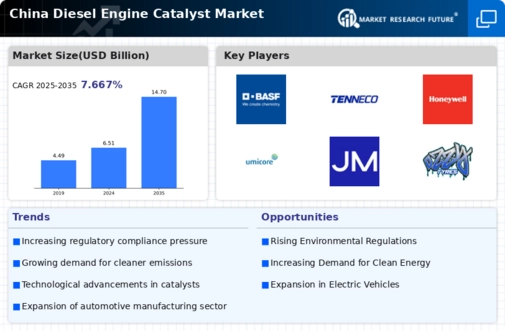
Key Market DynamicsRegulatory pressures drive innovation in diesel engine catalysts, enhancing emissions control technologies across China's automotive sector.
Countries CoveredChina
Leave a Comment

FAQs

What is the current valuation of the China diesel engine catalyst market?

The market valuation was 2.13 USD Billion in 2024.

What is the projected market size for the China diesel engine catalyst market by 2035?

The market is projected to reach 4.34 USD Billion by 2035.

What is the expected CAGR for the China diesel engine catalyst market during the forecast period?

The expected CAGR for the market from 2025 to 2035 is 6.69%.

Which companies are considered key players in the China diesel engine catalyst market?

Key players include BASF, Johnson Matthey, Umicore, Haldor Topsoe, Yara International, Tenneco, Continental, and Eaton.

What are the main applications of diesel engine catalysts in China?

The main applications include Automotive, Industrial, Marine, and Power Generation.

How does the Automotive segment perform in the China diesel engine catalyst market?

The Automotive segment was valued at 0.85 USD Billion in 2024 and is expected to grow to 1.75 USD Billion by 2035.

What is the valuation of the Selective Catalytic Reduction segment?

The Selective Catalytic Reduction segment was valued at 0.85 USD Billion in 2024 and is projected to reach 1.75 USD Billion by 2035.

What is the expected growth for the Heavy-Duty Vehicles segment in the market?

The Heavy-Duty Vehicles segment was valued at 0.85 USD Billion in 2024 and is anticipated to grow to 1.75 USD Billion by 2035.

What types of catalysts are utilized in the China diesel engine catalyst market?

The types of catalysts include Selective Catalytic Reduction, Diesel Oxidation Catalyst, Lean NOx Trap, and Three-Way Catalyst.

What is the projected growth for the Diesel Oxidation Catalyst segment?

The Diesel Oxidation Catalyst segment was valued at 0.65 USD Billion in 2024 and is expected to reach 1.3 USD Billion by 2035.

Download Free Sample

Kindly complete the form below to receive a free sample of this Report

Compare Licence

×
Features License Type
Single User Multiuser License Enterprise User
Price $4,950 $5,950 $7,250
Maximum User Access Limit 1 User Upto 10 Users Unrestricted Access Throughout the Organization
Free Customization
Direct Access to Analyst
Deliverable Format
Platform Access
Discount on Next Purchase 10% 15% 15%
Printable Versions







