×
Request Free Sample ×

Kindly complete the form below to receive a free sample of this Report

* Please use a valid business email

Leading companies partner with us for data-driven Insights

clients tt-cursor
Hero Background

China Biomass Market

ID: MRFR/CnM/63919-HCR
111 Pages
Chitranshi Jaiswal
February 2026

China Biomass Market Research Report By Feedstock (Food Crop, Non-Food Crop, Wood, Agricultural Residue, Municipal Solid Waste (MSW), Microalgae, Others), By Technology (Combined Heat and Power (CHP), Anaerobic Digestion and Feedstockification, Co-Firing, Landfill Feedstock), By Product (Biodiesel, Bio-methanol, Bio-Feedstock, Others) and By End Use (Industrial, Commercial, Residential) - Forecast to 2035.

Share:
Download PDF ×

We do not share your information with anyone. However, we may send you emails based on your report interest from time to time. You may contact us at any time to opt-out.

China Biomass Market Infographic
Purchase Options

China Biomass Market Summary

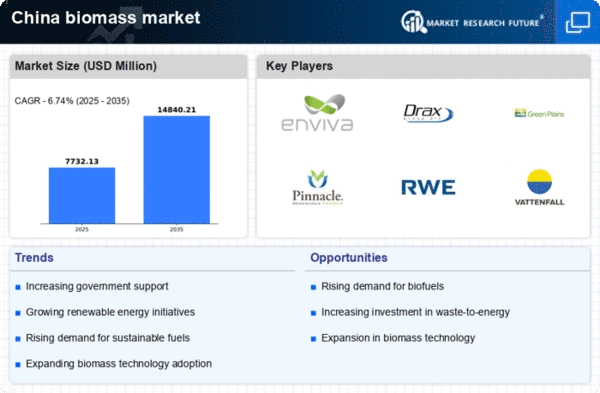
As per Market Research Future analysis, the China biomass market Size was estimated at 7243.89 USD Million in 2024. The Biomass market is projected to grow from 7732.13 USD Million in 2025 to 14840.21 USD Million by 2035, exhibiting a compound annual growth rate (CAGR) of 6.7% during the forecast period 2025 - 2035

Key Market Trends & Highlights

The China biomass market is experiencing robust growth driven by government initiatives and rising consumer demand.

  • Government initiatives are fostering a favorable environment for biomass energy development.
  • Technological advancements are enhancing the efficiency of biomass conversion processes.
  • The largest segment in the market is agricultural residues, while the fastest-growing segment is energy crops.
  • Regulatory support for renewable energy and increasing agricultural residue utilization are key drivers of market expansion.

Market Size & Forecast

2024 Market Size 7243.89 (USD Million)
2035 Market Size 14840.21 (USD Million)
CAGR (2025 - 2035) 6.74%

Major Players

Enviva Holdings (US), Drax Group (GB), Green Plains Inc (US), Pinnacle Renewable Energy (CA), RWE AG (DE), Vattenfall AB (SE), Fortum Oyj (FI), Biomass Energy Ltd (AU)

Our Impact
Enabled $4.3B Revenue Impact for Fortune 500 and Leading Multinationals
Partnering with 2000+ Global Organizations Each Year
30K+ Citations by Top-Tier Firms in the Industry

China Biomass Market Trends

The biomass market in China is currently experiencing notable growth, driven by increasing energy demands and a strong governmental push towards renewable energy sources. The Chinese government has implemented various policies aimed at promoting the use of biomass as a sustainable alternative to fossil fuels. This shift is not only aimed at reducing greenhouse gas emissions but also at enhancing energy security. Furthermore, advancements in technology are facilitating the efficient conversion of biomass into energy, which appears to be attracting investments from both domestic and international stakeholders. In addition to policy support, the biomass market is witnessing a rise in public awareness regarding environmental issues. Consumers are increasingly seeking cleaner energy options, which is likely to bolster the demand for biomass-derived products. The integration of biomass into the energy mix is seen as a viable solution to address both energy needs and environmental concerns. As the market evolves, it may also lead to innovations in biomass processing and utilization, further enhancing its appeal as a renewable energy source.

Government Initiatives

The Chinese government is actively promoting the biomass market through various initiatives and policies. These measures include financial incentives for biomass energy projects and regulatory frameworks that support the development of biomass technologies. Such initiatives are designed to encourage investment and innovation within the sector.

Technological Advancements

Recent technological advancements in biomass conversion processes are enhancing efficiency and reducing costs. Innovations in gasification and anaerobic digestion are particularly noteworthy, as they enable more effective energy extraction from biomass materials. This trend is likely to attract further investment and improve the overall viability of biomass energy.

Rising Consumer Demand

There is a growing consumer demand for sustainable energy solutions in China. As awareness of environmental issues increases, more individuals and businesses are seeking cleaner energy alternatives. This shift in consumer behavior is expected to drive the growth of the biomass market, as it aligns with broader sustainability goals.

Market Segment Insights

By Feedstock: Food Crop (Largest) vs. Agricultural Residue (Fastest-Growing)

The feedstock segment in the China biomass market showcases a diverse composition, with food crops taking the lead in market share due to their established role in bioenergy production. Following closely are agricultural residues, which, along with non-food crops, wood, and municipal solid waste, contribute significantly to the overall feedstock supply. Each of these categories has its specific applications and strengths, contributing to a well-rounded feedstock market. The growth trends for this segment indicate a strong shift towards using agricultural residues, which are recognized for their potential in sustainable energy solutions. This rise is facilitated by advancements in conversion technologies and increasing investments in research and development. Additionally, microalgae and wood are gaining traction as innovative feedstock options, propelled by environmental concerns and a push for renewable energy sources, marking significant developments in the feedstock landscape.

Food Crop (Dominant) vs. Agricultural Residue (Emerging)

Food crops are the dominant force in the feedstock segment, primarily due to their abundant availability and established infrastructure for bioenergy production. They encompass a range of materials including corn, wheat, and sugarcane, which are processed into biofuels and bioproducts. However, agricultural residues are emerging as a valuable contender in this market; they represent a sustainable and cost-effective feedstock that helps reduce waste while supporting renewable energy initiatives. Agricultural residues include by-products from crop harvests, such as straw and husks, and are becoming increasingly recognized for their efficiency in energy production. Their growth is supported by innovations in processing methods, aiming to enhance biomass utilization efficiency and reduce environmental impact.

By Technology: Combined Heat and Power (CHP) (Largest) vs. Anaerobic Digestion (Fastest-Growing)

In the China biomass market, the distribution of market share among the various technology segments reveals a clear hierarchy. Combined Heat and Power (CHP) stands as the dominant technology, capturing a significant portion of the overall market. Meanwhile, Anaerobic Digestion, while not as large, is rapidly gaining traction and shows the highest growth rate among the segments. As environmental concerns rise, these technologies are increasingly recognized for their contributions to sustainable energy production. Growth trends within the China biomass market demonstrate a strong shift towards renewable energy sources. The demand for CHP systems is propelled by their efficiency in energy generation and heat recovery. Conversely, Anaerobic Digestion is emerging as the preferred solution for waste management and energy conversion, driven by policy support and technological advancements. The push for greener technologies underscores the critical role of these segments in the future energy landscape.

Technology: CHP (Dominant) vs. Anaerobic Digestion (Emerging)

Combined Heat and Power (CHP) technology is characterized by its ability to produce both electricity and useful heat from a single energy source, making it highly efficient and appealing for industrial applications. Its established presence in the China biomass market is supported by a robust infrastructure and favorable policy framework. In contrast, Anaerobic Digestion is gaining recognition as an emerging technology focusing on converting organic materials into biogas. This process not only reduces waste but also serves as an effective method for energy production, thus aligning with sustainability goals. The growth potential of Anaerobic Digestion is further fueled by innovations and the increasing need for waste management solutions, positioning it as a vital player in the evolving energy landscape.

By Product: Biodiesel (Largest) vs. Biogas (Fastest-Growing)

The China biomass market is characterized by a diverse array of product segments, with biodiesel leading in market share. This dominance is attributed to the well-established infrastructure and production capabilities for biodiesel, making it a preferred choice among consumers and industry players. Following biodiesel, biogas is gaining traction, though its market presence is currently smaller. Biomethanol and other alternative products are also part of the market but hold a relatively minor share compared to the leading segments. In terms of growth trends, biogas is noted as the fastest-growing segment, fueled by increasing environmental concerns and favorable government policies promoting renewable energy sources. The rising demand for cleaner energy solutions, alongside advancements in biogas production technologies, are key drivers behind its rapid growth. The overall market is evolving, with biodiesel remaining strong while emerging segments like biogas adapt to consumer needs and environmental goals.

Biodiesel (Dominant) vs. Biogas (Emerging)

Biodiesel stands out as the dominant product in the China biomass market, benefiting from an extensive supply chain and established production methods. It is widely used in transportation and energy sectors, making it a critical component of the renewable energy landscape. Although biogas currently represents an emerging segment, it is rapidly gaining popularity due to its potential as a sustainable energy source derived from organic waste. The versatility of biogas, which can be used for electricity generation, heating, and vehicle fuel, enhances its appeal. Furthermore, innovations in biogas technology and processes are expected to further accelerate its adoption, ultimately positioning it as a key player in the future of renewable energy.

By End Use: Industrial (Largest) vs. Residential (Fastest-Growing)

The China biomass market demonstrates a diverse distribution of end-use applications. The industrial segment holds the largest share, driven by significant energy consumption in manufacturing and processing industries. Meanwhile, the commercial sector follows closely, catering to businesses looking for sustainable energy solutions. The residential segment, while smaller in comparison, is rapidly gaining traction as more households adopt renewable energy sources for heating and cooking, contributing to a growing demand in this sector. Growth trends in the end-use segment are being fueled by various factors, including government initiatives promoting renewable energy and increasing awareness of environmental sustainability. The industrial segment benefits from large-scale investments in biomass energy plants, while the residential sector sees a shift towards innovative solutions like biomass stoves and heating systems. This dynamic landscape highlights both the robust nature of industrial applications and the emerging potential of residential uses as they gain popularity among consumers.

Industrial (Dominant) vs. Residential (Emerging)

The industrial segment of the China biomass market stands out as the dominant force, characterized by large-scale operations that utilize biomass for energy generation, heating, and processing. Industries such as manufacturing and agriculture are primary consumers, drawn by the efficiency and cost-effectiveness of biomass. Conversely, the residential segment represents an emerging market, characterized by increasing adoption of biomass technologies among consumers seeking environmentally friendly options for home heating and cooking. This segment is marked by innovation, with new products like biomass-fired stoves gaining popularity. The growth of the residential sector is indicative of changing consumer preferences and is supported by governmental policies aimed at promoting home energy independence and sustainability.

Get more detailed insights about China Biomass Market

Key Players and Competitive Insights

The biomass market exhibits a dynamic competitive landscape characterized by a growing emphasis on sustainability and innovation. Key players such as Enviva Holdings (US), Drax Group (GB), and RWE AG (DE) are actively shaping the market through strategic initiatives aimed at enhancing operational efficiency and expanding their market presence. Enviva Holdings (US) focuses on producing sustainable wood pellets, leveraging its extensive supply chain to meet increasing demand in Europe and Asia. Drax Group (GB) is transitioning from coal to biomass, investing heavily in carbon capture technologies, which positions it as a leader in the decarbonization of energy production. RWE AG (DE) is enhancing its biomass portfolio through strategic acquisitions, aiming to diversify its energy mix and reduce carbon emissions, thereby reinforcing its commitment to sustainability.The business tactics employed by these companies reflect a concerted effort to optimize supply chains and localize manufacturing processes. The market structure appears moderately fragmented, with several players vying for market share while also collaborating on sustainability initiatives. This competitive environment is influenced by the collective actions of these key players, who are increasingly focused on aligning their operations with global sustainability goals.

In September Enviva Holdings (US) announced a partnership with a leading European energy company to supply biomass for renewable energy generation. This collaboration is strategically significant as it not only expands Enviva's market reach but also reinforces its commitment to providing sustainable energy solutions in line with European Union regulations. The partnership is expected to enhance Enviva's production capabilities and solidify its position in the European market.

In October Drax Group (GB) unveiled plans to invest £200 million in carbon capture and storage technology at its biomass facilities. This investment is pivotal as it underscores Drax's commitment to reducing its carbon footprint and transitioning to a more sustainable energy model. By integrating advanced technologies, Drax aims to enhance its operational efficiency while contributing to the UK's climate goals.

In August RWE AG (DE) completed the acquisition of a biomass production facility in Eastern Europe, which is anticipated to increase its biomass output by 30%. This strategic move is indicative of RWE's broader strategy to diversify its energy portfolio and enhance its sustainability credentials. The acquisition not only boosts RWE's production capacity but also aligns with its long-term vision of becoming a leader in renewable energy.

As of November the competitive trends in the biomass market are increasingly defined by digitalization, sustainability, and the integration of advanced technologies such as AI. Strategic alliances among key players are shaping the current landscape, fostering innovation and collaboration. Looking ahead, competitive differentiation is likely to evolve from traditional price-based competition to a focus on technological innovation, supply chain reliability, and sustainable practices. This shift suggests that companies will need to invest in R&D and forge strategic partnerships to maintain a competitive edge in an increasingly complex market.


Key Companies in the China Biomass Market include

Industry Developments

There have been significant developments in the China Biomass Market recently. The China National Energy Administration announced in October 2023 that the government aims to increase biomass energy's contribution to the national energy mix significantly. This initiative aligns with China's broader goals of reducing carbon emissions and promoting renewable energy sources. Companies like China Shenhua Energy Company and Longyuan Power Group are actively participating in expanding their biomass projects, focusing on technologies to enhance energy conversion efficiency.

In regard to mergers and acquisitions, GCL-Poly Energy Holdings has been exploring partnerships to strengthen its biomass energy portfolio, although no specific recent deals have been publicly documented yet. In the past couple of years, Jiangsu Yangjie Electronic Technology Co. has expanded its biomass energy initiatives. China Three Gorges Corporation has invested heavily in developing biomass-to-energy projects, contributing to their market valuation growth. From January 2021 to October 2023, the market has seen substantial growth due to government subsidies, technological advancements, and increased awareness of sustainable energy solutions.

These developments showcase the rising importance of biomass energy in China's transition towards a more sustainable energy landscape.

Future Outlook

China Biomass Market Future Outlook

The biomass market in China is projected to grow at a 6.74% CAGR from 2025 to 2035, driven by renewable energy policies, technological advancements, and increasing energy demands.

New opportunities lie in:

  • Development of advanced biomass gasification technologies for industrial applications.
  • Expansion of biomass supply chains to enhance logistics efficiency.
  • Investment in biomass energy storage solutions to stabilize supply and demand.

By 2035, the biomass market is expected to achieve substantial growth, positioning itself as a key energy source.

Market Segmentation

China Biomass Market End Use Outlook

  • Industrial
  • Commercial
  • Residential

China Biomass Market Product Outlook

  • Biodiesel
  • Biomethanol
  • Biogas
  • Others

China Biomass Market Feedstock Outlook

  • Food Crop
  • Non-Food Crop
  • Wood
  • Agricultural Residue
  • Municipal Solid Waste (MSW)
  • Microalgae
  • Others

China Biomass Market Technology Outlook

  • Combined Heat and Power (CHP)
  • Anaerobic Digestion
  • Gasification
  • Co-Firing
  • Landfill Gas

Report Scope

MARKET SIZE 2024 7243.89(USD Million)
MARKET SIZE 2025 7732.13(USD Million)
MARKET SIZE 2035 14840.21(USD Million)
COMPOUND ANNUAL GROWTH RATE (CAGR) 6.74% (2025 - 2035)
REPORT COVERAGE Revenue Forecast, Competitive Landscape, Growth Factors, and Trends
BASE YEAR 2024
Market Forecast Period 2025 - 2035
Historical Data 2019 - 2024
Market Forecast Units USD Million
Key Companies Profiled Enviva Holdings (US), Drax Group (GB), Green Plains Inc (US), Pinnacle Renewable Energy (CA), RWE AG (DE), Vattenfall AB (SE), Fortum Oyj (FI), Biomass Energy Ltd (AU)
Segments Covered Feedstock, Technology, Product, End Use
Key Market Opportunities Advancements in biomass conversion technologies enhance efficiency and sustainability in the biomass market.
Key Market Dynamics Rising demand for sustainable energy sources drives innovation and competition in the biomass market.
Countries Covered China
Leave a Comment

FAQs

What is the expected market size of the China Biomass Market in 2024?

The China Biomass Market is expected to be valued at 9.66 USD Billion in 2024.

What will be the market size of the China Biomass Market by 2035?

By 2035, the China Biomass Market is projected to reach a value of 16.5 USD Billion.

What is the expected CAGR for the China Biomass Market from 2025 to 2035?

The expected CAGR for the China Biomass Market from 2025 to 2035 is 4.988%.

Which feedstock segment holds the largest market share in the China Biomass Market in 2024?

In 2024, the Wood segment holds the largest market share, valued at 2.53 USD Billion.

What is the projected market value of the Food Crop feedstock by 2035?

The Food Crop feedstock is projected to be valued at 3.73 USD Billion by 2035.

Who are the major players in the China Biomass Market?

Key players include China Three Gorges Corporation, GCL-Poly Energy Holdings, and China Shenhua Energy Company, among others.

What is the expected value of the Agricultural Residue feedstock in 2024?

The Agricultural Residue feedstock is expected to be valued at 1.86 USD Billion in 2024.

What will be the market size for Municipal Solid Waste by 2035?

The market size for Municipal Solid Waste is projected to be 1.83 USD Billion by 2035.

What are the growth drivers for the China Biomass Market from 2025 to 2035?

Growth drivers include increasing demand for renewable energy and advancements in biomass technology.

What challenges are currently facing the China Biomass Market?

Challenges include competition from other renewable energy sources and the need for improved processing technologies.

Download Free Sample

Kindly complete the form below to receive a free sample of this Report

Compare Licence

×
Features License Type
Single User Multiuser License Enterprise User
Price $4,950 $7,250 $
Maximum User Access Limit 1 User Upto 10 Users Unrestricted Access Throughout the Organization
Free Customization
Direct Access to Analyst
Deliverable Format
Platform Access
Discount on Next Purchase 10% 15% 15%
Printable Versions