×
Request Free Sample ×

Kindly complete the form below to receive a free sample of this Report

* Please use a valid business email

Leading companies partner with us for data-driven Insights

clients tt-cursor
Hero Background

China Asset Tracking Software Market

ID: MRFR/ICT/60682-HCR
200 Pages
Aarti Dhapte
February 2026

China Asset Tracking Software Market Size, Share and Trends Analysis Report By Component (Software, Service), By Deployment (Cloud, On-Premise), By Organization size (SMEs, Large Enterprises), and By Vertical (BFSI, Retail, Government, Automotive, Manufacturing)-Forecast to 2035

Share:
Download PDF ×

We do not share your information with anyone. However, we may send you emails based on your report interest from time to time. You may contact us at any time to opt-out.

China Asset Tracking Software Market Infographic
Purchase Options

China Asset Tracking Software Market Summary

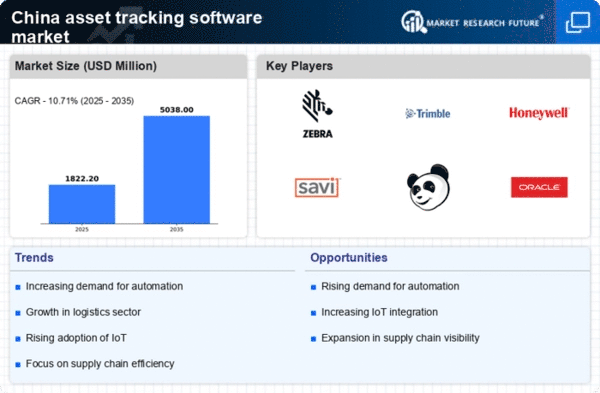
As per Market Research Future analysis, the China Asset Tracking Software Market size was estimated at 1645.92 USD Million in 2024. The Asset Tracking-software market is projected to grow from 1822.2 USD Million in 2025 to 5038.0 USD Million by 2035, exhibiting a compound annual growth rate (CAGR) of 10.7% during the forecast period 2025 - 2035

Key Market Trends & Highlights

The China asset tracking-software market is experiencing robust growth driven by technological advancements and increasing demand for real-time solutions.

  • The integration of IoT technologies is transforming asset tracking capabilities across various sectors.
  • Data security remains a critical focus as organizations seek to protect sensitive information in asset management.
  • Customization and scalability are becoming essential features for software solutions to meet diverse business needs.
  • Rising demand for real-time tracking and government initiatives are key drivers propelling market expansion.

Market Size & Forecast

2024 Market Size 1645.92 (USD Million)
2035 Market Size 5038.0 (USD Million)
CAGR (2025 - 2035) 10.71%

Major Players

Zebra Technologies (US), Trimble Inc (US), Honeywell International Inc (US), Savi Technology (US), Asset Panda (US), Oracle Corporation (US), IBM Corporation (US), Trackforce (US)

Our Impact
Enabled $4.3B Revenue Impact for Fortune 500 and Leading Multinationals
Partnering with 2000+ Global Organizations Each Year
30K+ Citations by Top-Tier Firms in the Industry

China Asset Tracking Software Market Trends

The China Asset Tracking Software Market is experiencing notable growth, driven by the increasing need for businesses to monitor and manage their assets efficiently. In China, the rapid expansion of industries such as logistics, manufacturing, and retail has heightened the demand for advanced tracking solutions. Companies are increasingly adopting these technologies to enhance operational efficiency, reduce losses, and improve inventory management. Furthermore, the integration of Internet of Things (IoT) devices with asset tracking software is transforming how organizations collect and analyze data, leading to more informed decision-making processes. Moreover, the regulatory environment in China is evolving, with government initiatives aimed at promoting digital transformation across various sectors. This shift is likely to encourage more enterprises to invest in asset tracking solutions, as they seek to comply with new standards and improve their competitive edge. As businesses recognize the value of real-time visibility into their assets, the asset tracking-software market is poised for continued expansion, reflecting broader trends in technology adoption and operational optimization.

Integration of IoT Technologies

The asset tracking-software market is increasingly integrating IoT technologies, allowing for real-time data collection and monitoring. This trend enhances the accuracy of asset management and provides businesses with actionable insights, thereby improving operational efficiency.

Focus on Data Security

As organizations adopt asset tracking solutions, there is a growing emphasis on data security. Companies are prioritizing software that offers robust security features to protect sensitive information, reflecting a broader concern for cybersecurity in the digital age.

Customization and Scalability

The demand for customizable and scalable asset tracking solutions is rising. Businesses seek software that can adapt to their specific needs and grow alongside their operations, ensuring long-term viability and effectiveness in asset management.

China Asset Tracking Software Market Drivers

Growing Adoption of Mobile Solutions

The growing adoption of mobile solutions is transforming the asset tracking-software market in China. With the proliferation of smartphones and mobile devices, businesses are increasingly seeking mobile-compatible tracking solutions that allow for on-the-go asset management. This trend is particularly relevant in industries such as construction and field services, where real-time access to asset information is crucial. The market is projected to expand by approximately 16% as mobile solutions become more prevalent. These applications enable users to track assets from remote locations, enhancing flexibility and responsiveness. Furthermore, the integration of mobile technology with existing tracking systems is likely to improve user experience and operational efficiency. As mobile solutions continue to gain traction, they are expected to play a significant role in shaping the future of the asset tracking-software market.

Rising Demand for Real-Time Tracking

The asset tracking-software market in China is experiencing a notable surge in demand for real-time tracking solutions. This trend is largely driven by the increasing need for businesses to monitor their assets continuously, ensuring optimal utilization and minimizing losses. In 2025, the market is projected to grow by approximately 15%, reflecting a shift towards more dynamic asset management strategies. Companies are increasingly adopting software that provides instant updates on asset locations and conditions, which is crucial for sectors such as logistics and manufacturing. The ability to access real-time data enhances decision-making processes and operational efficiency, thereby solidifying the importance of real-time tracking in the asset tracking-software market. As organizations strive for greater transparency and accountability, the demand for such solutions is likely to continue its upward trajectory.

Government Initiatives and Regulations

Government initiatives in China are playing a pivotal role in shaping the asset tracking-software market. Regulatory frameworks aimed at enhancing supply chain transparency and asset management efficiency are being implemented. For instance, the Chinese government has introduced policies that encourage the adoption of advanced tracking technologies across various industries. These initiatives not only promote compliance but also foster innovation within the asset tracking-software market. As a result, businesses are increasingly investing in software solutions that align with these regulations, leading to a projected market growth of around 12% in the coming years. The emphasis on regulatory compliance is likely to drive the demand for sophisticated tracking systems that can provide accurate data and reporting capabilities, thereby enhancing overall operational effectiveness.

Increased Focus on Supply Chain Efficiency

The asset tracking-software market is being propelled by an increased focus on supply chain efficiency among Chinese enterprises. As businesses strive to streamline operations and reduce costs, the need for effective asset management solutions has become paramount. Companies are recognizing that efficient tracking of assets can lead to significant improvements in inventory management and logistics. In 2025, the market is anticipated to grow by about 14%, driven by the demand for software that enhances visibility and control over supply chains. This focus on efficiency is prompting organizations to invest in comprehensive tracking systems that provide insights into asset performance and location, ultimately leading to better decision-making and resource optimization. The emphasis on supply chain efficiency is likely to remain a key driver in the asset tracking-software market.

Technological Advancements in Software Solutions

Technological advancements are significantly influencing the asset tracking-software market in China. The integration of artificial intelligence (AI) and machine learning (ML) into tracking solutions is enhancing their capabilities, allowing for predictive analytics and improved asset management. These innovations enable businesses to anticipate asset needs and optimize resource allocation, which is particularly beneficial in sectors such as retail and logistics. The market is expected to witness a growth rate of approximately 18% as companies increasingly seek to leverage these technologies for competitive advantage. Furthermore, advancements in cloud computing are facilitating the deployment of scalable tracking solutions, making them accessible to a broader range of businesses. As technology continues to evolve, the asset tracking-software market is likely to adapt, offering more sophisticated and efficient solutions.


Market Segment Insights

By Deployment: Cloud (Largest) vs. On-Premise (Fastest-Growing)

In the China asset tracking-software market, the deployment segment showcases a distinct division with Cloud solutions dominating the landscape. This segment has successfully captured a significant market share, attributed to its flexibility, scalability, and lower upfront costs. Conversely, the On-Premise segment, though currently smaller in market share, is experiencing rapid growth as businesses increasingly seek tailored solutions that offer complete control over their data and security. The growth of On-Premise deployment can be attributed to factors such as heightened security concerns and compliance regulations, which drive organizations to adopt in-house solutions. Cloud deployment, while still leading, has shifted towards a more integrated approach, combining SaaS with IoT technology, resulting in enhanced data analytics and real-time tracking capabilities to meet evolving customer demands. This duality exemplifies the diverse preferences within the market, catering to various business needs.

Deployment: Cloud (Dominant) vs. On-Premise (Emerging)

Cloud deployment is characterized by its scalable architecture, ease of use, and lower maintenance costs, making it the favored choice for many businesses within the China asset tracking-software market. It enables real-time data access and integration with other systems, facilitating smarter decision-making and operational efficiency. On the other hand, On-Premise solutions are gaining traction among businesses that prioritize data security and customization. These solutions allow companies to have full control over their assets, ensuring compliance with local regulations. Both segments address distinct needs, with Cloud being the most widely adopted and On-Premise showing potential for substantial growth as organizations seek flexibility and enhanced data protection.

By Component: Software (Largest) vs. Service (Fastest-Growing)

In the China asset tracking-software market, the distribution of market share is notably skewed towards the software segment, which dominates the landscape due to its comprehensive functionalities and adaptability. The demand for robust tracking capabilities and data-driven insights has propelled the software segment to a leading position, while the service segment, despite its smaller share, is gaining traction as businesses increasingly seek integrated solutions that combine software with value-added services. Growth trends within the component segment indicate that while software solutions remain the primary focus, the service segment is on an upward trajectory, driven by the need for enhanced customer support, system integration, and maintenance services. This shift reflects a broader trend in the industry where companies are recognizing the importance of a holistic approach to asset management, thereby creating opportunities for service providers to expand and innovate in response to market demands.

Software (Dominant) vs. Service (Emerging)

The software component of the asset tracking-software market is characterized by its extensive capabilities, including real-time tracking, analytics, and automation features that cater to a wide range of industries. Its dominant position is attributed to ongoing advancements in technology and increasing adoption rates among businesses seeking operational efficiencies. On the other hand, the service component represents an emerging segment, focusing on implementation, training, and customer support. As organizations prioritize seamless integration of tracking solutions, the demand for services that enhance software functionalities is rising, marking a significant shift towards a more service-oriented market approach.

By Organization Size: SMEs (Largest) vs. Large Enterprises (Fastest-Growing)

In the China asset tracking-software market, SMEs dominate the landscape, capturing a significant market share due to their wide adoption of technology for improved operational efficiency. These small and medium-sized enterprises leverage asset tracking solutions to enhance inventory management and reduce losses, making them a primary force in the segment. Meanwhile, large enterprises are also carving out a substantial presence, exhibiting robust growth as they seek to optimize supply chain processes and enhance asset visibility through sophisticated software solutions. The growth trends in this segment are notably driven by the increasing need for real-time tracking and management of assets in various industries. The rapid digital transformation across sectors coupled with rising investments in infrastructure has propelled large enterprises to adopt advanced asset tracking software at a faster pace. This emerging trend indicates a shift as larger organizations seek competitive advantages through innovation in asset management, leading to accelerated growth in the sector.

SMEs (Dominant) vs. Large Enterprises (Emerging)

SMEs in the China asset tracking-software market are characterized by their agility and adaptability, enabling them to implement cost-effective solutions quickly. This segment thrives due to low entry barriers and the increasing recognition of the importance of asset tracking in daily operations. In contrast, large enterprises are emerging with a focus on integration and scalability of advanced asset tracking systems that cater to complex supply chains and large-scale operations. These enterprises invest heavily in customized solutions to meet specific needs, thereby enhancing efficiency and decision-making processes across multiple departments. Overall, while SMEs remain dominant due to their widespread adoption, large enterprises are rapidly evolving as significant players fostering innovation in the asset tracking space.

By Vertical: BFSI (Largest) vs. Retail (Fastest-Growing)

In the China asset tracking-software market, the market share distribution is primarily led by the BFSI segment, which capitalizes on the increasing demand for security and regulatory compliance. Retail follows closely as a significant player, leveraging asset tracking to enhance inventory management and customer experience. The government sector holds a notable share as well, driven by initiatives focusing on public safety and efficiency. The automotive and manufacturing sectors are also gaining traction but are currently less dominant than BFSI and retail. Looking into growth trends within these verticals, retail is identified as the fastest-growing segment, propelled by the rise in e-commerce and the demand for real-time inventory management solutions. BFSI maintains a strong position, supported by the rapid digital transformation in banking and finance that emphasizes asset tracking for security. The automotive sector is also anticipated to witness growth, as manufacturers increasingly adopt tracking technologies to streamline operations and enhance supply chain transparency.

BFSI (Dominant) vs. Retail (Emerging)

The BFSI sector in the China asset tracking-software market stands as the dominant force, driven by the need for advanced asset management solutions to comply with stringent regulations and enhance security measures. Financial institutions are investing significantly in technology that provides real-time tracking and monitoring of assets, which is crucial in safeguarding against fraud and mismanagement. On the other hand, the retail sector, while emerging, is rapidly adopting asset tracking software to facilitate inventory control and boost operational efficiency. Retailers are increasingly focusing on integrating seamless tracking solutions within their operations to meet the growing expectations of customers for prompt service and availability of products, making it a vital area for future growth.

Get more detailed insights about China Asset Tracking Software Market

Key Players and Competitive Insights

The asset tracking-software market in China is characterized by a dynamic competitive landscape, driven by rapid technological advancements and increasing demand for efficient asset management solutions. Key players such as Zebra Technologies (US), Trimble Inc (US), and Honeywell International Inc (US) are at the forefront, each adopting distinct strategies to enhance their market presence. Zebra Technologies (US) focuses on innovation through the development of advanced RFID and IoT solutions, while Trimble Inc (US) emphasizes regional expansion and partnerships to bolster its service offerings. Honeywell International Inc (US) is leveraging digital transformation initiatives to integrate AI and machine learning into its asset tracking solutions, thereby enhancing operational efficiency and customer satisfaction. Collectively, these strategies contribute to a competitive environment that is increasingly centered around technological innovation and customer-centric solutions.In terms of business tactics, companies are localizing manufacturing and optimizing supply chains to better serve the Chinese market. The competitive structure appears moderately fragmented, with several players vying for market share. However, the influence of major companies is substantial, as they set industry standards and drive technological advancements. This competitive dynamic encourages smaller firms to innovate and differentiate their offerings, thereby fostering a vibrant market ecosystem.

In October Zebra Technologies (US) announced a strategic partnership with a leading Chinese logistics firm to enhance its asset tracking capabilities within the region. This collaboration is expected to leverage Zebra's advanced tracking technologies and the logistics firm's extensive network, potentially improving supply chain visibility and operational efficiency for both parties. Such partnerships are indicative of a broader trend where companies seek to combine strengths to address local market needs effectively.

In September Trimble Inc (US) launched a new suite of asset tracking solutions tailored specifically for the construction sector in China. This launch is significant as it aligns with the growing demand for real-time tracking and management of construction assets, which can lead to reduced downtime and improved project timelines. By focusing on sector-specific solutions, Trimble is likely positioning itself as a leader in niche markets, thereby enhancing its competitive edge.

In August Honeywell International Inc (US) unveiled an AI-driven asset tracking platform designed to optimize inventory management for retail businesses in China. This platform integrates machine learning algorithms to predict inventory needs and reduce waste, reflecting a shift towards sustainability and efficiency in asset management. Such innovations not only cater to current market demands but also align with global trends towards environmentally responsible business practices.

As of November the asset tracking-software market is increasingly defined by trends such as digitalization, sustainability, and AI integration. Strategic alliances are becoming more prevalent, as companies recognize the value of collaboration in enhancing their technological capabilities and market reach. Looking ahead, competitive differentiation is likely to evolve from traditional price-based competition to a focus on innovation, technology, and supply chain reliability. This shift underscores the importance of adaptability and forward-thinking strategies in maintaining a competitive advantage in a rapidly changing market.

Key Companies in the China Asset Tracking Software Market include

Industry Developments

In order to improve inventory visibility and delivery accuracy, JD.com extended its smart logistics infrastructure in March 2023 by implementing IoT-enabled RFID and GIS-based real-time package monitoring throughout its extensive warehouse network.

Hexagon's HxGN EAM solution, which includes AI-powered Asset Twin and predictive analytics tools that are widely used in global manufacturing environments, including China, won the "Best Digital Transformation for Asset Management" award at the International Maintenance Conference in January 2024.

Since 2023, Alibaba Cloud has been providing its Blockchain-as-a-Service (BaaS) platform to retail and logistics partners for product traceability and tamper-resistant auditability. As part of its smart factory deployments, Huawei has expanded its asset tracking portfolio by integrating cloud services and IoT sensors.

By integrating asset tracking into its ERP solutions, SAP has aided business clients in China. A number of pilot tracking systems in Chinese industrial facilities are also supported by Cisco and Microsoft Azure IoT infrastructures.

Because of their wider tech portfolios, some vendors are considered present under the relaxed requirement even though they don't have any current activity reported. In conclusion, the three most notable verified asset tracking innovations in China's market since January 2023 are Alibaba's blockchain traceability service, Hexagon's award-winning APM tools, and JD.com's logistics tracking.

Future Outlook

China Asset Tracking Software Market Future Outlook

The Asset Tracking Software Market in China is projected to grow at a 10.71% CAGR from 2025 to 2035, driven by technological advancements and increasing demand for operational efficiency.

New opportunities lie in:

  • Integration of AI-driven analytics for predictive maintenance
  • Development of IoT-enabled asset tracking devices
  • Expansion of cloud-based solutions for real-time data access

By 2035, the market is expected to achieve substantial growth and innovation.

Market Segmentation

China Asset Tracking Software Market Vertical Outlook

  • BFSI
  • Retail
  • Government
  • Automotive
  • Manufacturing

China Asset Tracking Software Market Component Outlook

  • Software
  • Service

China Asset Tracking Software Market Deployment Outlook

  • Cloud
  • On-Premise

China Asset Tracking Software Market Organization Size Outlook

  • SMEs
  • Large Enterprises

Report Scope

MARKET SIZE 2024 1645.92(USD Million)
MARKET SIZE 2025 1822.2(USD Million)
MARKET SIZE 2035 5038.0(USD Million)
COMPOUND ANNUAL GROWTH RATE (CAGR) 10.71% (2025 - 2035)
REPORT COVERAGE Revenue Forecast, Competitive Landscape, Growth Factors, and Trends
BASE YEAR 2024
Market Forecast Period 2025 - 2035
Historical Data 2019 - 2024
Market Forecast Units USD Million
Key Companies Profiled Zebra Technologies (US), Trimble Inc (US), Honeywell International Inc (US), Savi Technology (US), Asset Panda (US), Oracle Corporation (US), IBM Corporation (US), Trackforce (US)
Segments Covered Deployment, Component, Organization Size, Vertical
Key Market Opportunities Integration of Internet of Things (IoT) technology enhances efficiency in the asset tracking-software market.
Key Market Dynamics Rising demand for real-time tracking solutions drives innovation in asset tracking-software within the competitive landscape.
Countries Covered China
Leave a Comment

FAQs

What is the projected market size of the China Asset Tracking Software Market in 2024?

The projected market size of the China Asset Tracking Software Market in 2024 is estimated to be 1.83 USD billion.

What is the expected market value for the China Asset Tracking Software Market by 2035?

By 2035, the overall market for the China Asset Tracking Software is expected to reach a value of 6.16 USD billion.

What is the anticipated compound annual growth rate (CAGR) for the China Asset Tracking Software Market from 2025 to 2035?

The anticipated CAGR for the China Asset Tracking Software Market from 2025 to 2035 is expected to be 11.678%.

Which component of the China Asset Tracking Software Market is projected to have the highest value in 2035?

The Software component of the China Asset Tracking Software Market is projected to be valued at 2.35 USD billion in 2035.

What is the expected value of the Service component in the China Asset Tracking Software Market in 2024?

The Service component in the China Asset Tracking Software Market is expected to be valued at 1.16 USD billion in 2024.

Who are the major players in the China Asset Tracking Software Market?

Major players in the market include Zebra Technologies, JD.com, Wipro, Oracle, Tencent, and Huawei.

What is the market size of the Software component in the China Asset Tracking Software Market in 2024?

The market size of the Software component in the China Asset Tracking Software Market is valued at 0.67 USD billion in 2024.

What growth drivers are influencing the China Asset Tracking Software Market?

Key growth drivers for the market include the increasing demand for efficient asset management and the rise of IoT technology.

How does the China Asset Tracking Software Market's growth rate compare to other global markets?

The growth rate of the China Asset Tracking Software Market is competitive, with a significant CAGR expected over the forecast period.

What are the potential challenges facing the China Asset Tracking Software Market?

Challenges in the market may include technological advancements and the need for integration with existing systems.

Download Free Sample

Kindly complete the form below to receive a free sample of this Report

Compare Licence

×
Features License Type
Single User Multiuser License Enterprise User
Price $4,950 $5,950 $7,250
Maximum User Access Limit 1 User Upto 10 Users Unrestricted Access Throughout the Organization
Free Customization
Direct Access to Analyst
Deliverable Format
Platform Access
Discount on Next Purchase 10% 15% 15%
Printable Versions