×
Request Free Sample ×

Kindly complete the form below to receive a free sample of this Report

* Please use a valid business email

Leading companies partner with us for data-driven Insights

clients tt-cursor
Hero Background

China Anti Counterfeit Packaging Market

ID: MRFR/PCM/54169-HCR
200 Pages
Snehal Singh
February 2026

China Anti-Counterfeit Packaging Market China Anti-Counterfeit Packaging Market Research Report: By Technology (Mass Encoding, RFID, Holograms, Forensic Markers, Tampers Evidence, Others) andBy End-use Industry (Pharmaceuticals, Food & Beverage, Automotive, Personal Care, Electrical & Electronics, Luxury Goods, Others)- Forecast to 2035

Share:
Download PDF ×

We do not share your information with anyone. However, we may send you emails based on your report interest from time to time. You may contact us at any time to opt-out.

China Anti Counterfeit Packaging Market Infographic
Purchase Options

China Anti Counterfeit Packaging Market Summary

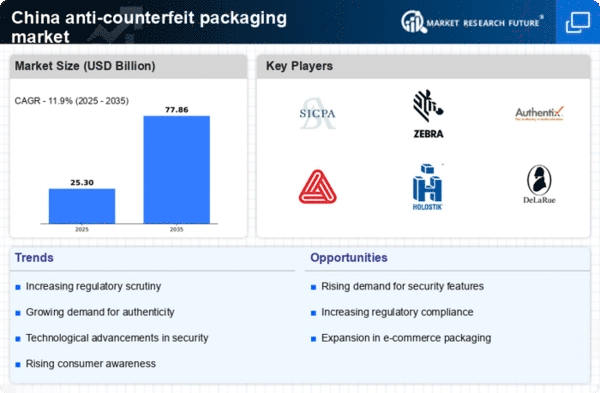
As per Market Research Future analysis, the China Anti Counterfeit Packaging Market size was estimated at 22.61 USD Billion in 2024. The Anti-counterfeit Packaging market is projected to grow from 25.3 USD Billion in 2025 to 77.86 USD Billion by 2035, exhibiting a compound annual growth rate (CAGR) of 11% during the forecast period 2025 - 2035

Key Market Trends & Highlights

The China anti-counterfeit packaging market is experiencing robust growth driven by technological advancements and increasing consumer demand for authenticity.

  • Technological integration in packaging solutions is enhancing the effectiveness of anti-counterfeit measures.
  • Regulatory influence is shaping the market landscape, compelling companies to adopt stringent compliance protocols.
  • Consumer awareness regarding counterfeit products is rising, leading to increased demand for secure packaging solutions.
  • Rising counterfeit incidents and government regulations are major drivers propelling the market forward.

Market Size & Forecast

2024 Market Size 22.61 (USD Billion)
2035 Market Size 77.86 (USD Billion)
CAGR (2025 - 2035) 11.9%

Major Players

SICPA (CH), Zebra Technologies (US), Authentix (US), Avery Dennison (US), Holostik (IN), De La Rue (GB), Tesa (DE), Kao Corporation (JP)

Our Impact
Enabled $4.3B Revenue Impact for Fortune 500 and Leading Multinationals
Partnering with 2000+ Global Organizations Each Year
30K+ Citations by Top-Tier Firms in the Industry

China Anti Counterfeit Packaging Market Trends

The China Anti Counterfeit Packaging Market is currently experiencing notable growth, driven by increasing concerns over product authenticity and safety. As consumers become more aware of counterfeit goods, manufacturers are compelled to adopt advanced packaging solutions that ensure product integrity. This trend is particularly pronounced in sectors such as pharmaceuticals, food and beverages, and luxury goods, where the implications of counterfeiting can be severe. Regulatory bodies are also playing a crucial role by implementing stringent guidelines that mandate the use of anti-counterfeit measures, thereby fostering a more secure marketplace. In addition, technological advancements are reshaping the landscape of the anti counterfeit-packaging market. Innovations such as QR codes, holograms, and RFID tags are being integrated into packaging designs, enhancing traceability and consumer engagement. These technologies not only deter counterfeiters but also empower consumers to verify the authenticity of products easily. As the market evolves, collaboration between manufacturers, technology providers, and regulatory authorities appears essential to create a robust framework that addresses the challenges posed by counterfeiting. The future of the anti counterfeit-packaging market seems promising, with ongoing investments in research and development likely to yield even more sophisticated solutions.

Technological Integration

The integration of advanced technologies is transforming the anti counterfeit-packaging market. Innovations such as QR codes, holograms, and RFID tags are becoming commonplace, enhancing product traceability and consumer interaction. These technologies serve to deter counterfeiters while providing consumers with tools to verify authenticity.

Regulatory Influence

Regulatory bodies are increasingly influencing the anti counterfeit-packaging market by enforcing stringent guidelines. These regulations compel manufacturers to adopt anti-counterfeit measures, thereby creating a more secure environment for consumers. Compliance with these regulations is becoming essential for market players.

Consumer Awareness

There is a growing awareness among consumers regarding the risks associated with counterfeit products. This heightened consciousness is driving demand for secure packaging solutions. As consumers prioritize authenticity and safety, manufacturers are responding by investing in anti-counterfeit technologies.

China Anti Counterfeit Packaging Market Drivers

Rising Counterfeit Incidents

The increasing prevalence of counterfeit products in China has become a pressing concern for various industries, particularly in pharmaceuticals, electronics, and luxury goods. Reports indicate that the anti-counterfeit packaging market is experiencing heightened demand as businesses seek to protect their brand integrity and consumer trust. In 2025, it is estimated that counterfeit goods could account for approximately 10% of the total market value in these sectors. This alarming trend compels manufacturers to invest in advanced packaging solutions that deter counterfeiting, thereby driving growth in the anti counterfeit-packaging market. The urgency to combat counterfeit products is further amplified by the potential financial losses and reputational damage that companies face, making it imperative for them to adopt effective anti-counterfeiting measures.

Consumer Demand for Authenticity

As consumers in China become more discerning, there is a growing demand for authentic products. This shift in consumer behavior is significantly impacting the anti-counterfeit packaging market, as individuals seek assurance that the products they purchase are genuine. Surveys indicate that over 70% of consumers express concern about counterfeit goods, prompting brands to adopt robust anti-counterfeiting measures. In response, companies are increasingly investing in packaging solutions that clearly communicate authenticity, such as tamper-evident seals and unique identifiers. This trend is likely to continue, with the anti counterfeit-packaging market expected to expand as brands prioritize consumer trust and product integrity. The emphasis on authenticity is reshaping packaging strategies, making it a critical driver of market growth.

E-commerce Growth and Challenges

The rapid expansion of e-commerce in China presents both opportunities and challenges for the anti counterfeit-packaging market. With online sales projected to reach $2 trillion by 2025, the risk of counterfeit products infiltrating e-commerce platforms is escalating. This situation is prompting retailers and manufacturers to enhance their packaging solutions to ensure product authenticity during transit. The anti counterfeit-packaging market is likely to see a surge in demand as businesses seek to implement secure packaging that protects against counterfeiting in the online space. Additionally, the need for effective return and refund policies further emphasizes the importance of reliable packaging solutions. As e-commerce continues to thrive, the anti counterfeit-packaging market is positioned to grow in response to these evolving challenges.

Government Regulations and Compliance

The regulatory landscape in China is evolving, with the government implementing stricter laws and guidelines to combat counterfeiting. These regulations are compelling businesses to adopt anti counterfeit-packaging solutions to ensure compliance and avoid penalties. In 2025, it is anticipated that the enforcement of these regulations will drive a 20% increase in demand for anti counterfeit-packaging solutions across various sectors. Companies are increasingly recognizing the importance of adhering to these regulations not only to avoid legal repercussions but also to enhance their brand reputation. The anti-counterfeit packaging market is thus experiencing growth as businesses invest in compliant packaging solutions that meet regulatory standards, ensuring product safety and consumer trust.

Technological Advancements in Packaging

Innovations in packaging technology are significantly influencing the anti-counterfeit packaging market in China. The integration of features such as QR codes, holograms, and RFID tags enhances product traceability and authenticity verification. As of 2025, the market for smart packaging solutions is projected to grow at a CAGR of 15%, reflecting the increasing adoption of these technologies. Companies are leveraging these advancements to create packaging that not only protects against counterfeiting but also engages consumers through interactive features. This technological evolution is crucial for businesses aiming to stay competitive in a market where consumer safety and product authenticity are paramount. The anti counterfeit-packaging market is thus positioned to benefit from these innovations, as they provide effective deterrents against counterfeit activities.


Market Segment Insights

By Technology: Holography (Largest) vs. RFID (Fastest-Growing)

In the current landscape, the China anti-counterfeit packaging market sees holography leading in market share, boasting a significant portion due to its advanced visual appeal and effectiveness. RFID follows closely as a fast-growing technology, gaining traction for its efficiency in tracking and identifying products seamlessly, which is highly valued in various sectors.

Technology: Holography (Dominant) vs. RFID (Emerging)

Holography stands out as the dominant force in anti-counterfeit packaging, attracting various industries for its authenticating capabilities that are visually striking and difficult to replicate. In contrast, RFID technology is emerging rapidly, propelled by the demand for automation and real-time inventory management, assuring brands robust protection against counterfeiting. Both technologies exhibit unique strengths: while holography offers robust engagement through intricate designs, RFID emphasizes functionality with data communication capabilities that enhance supply chain integrity.

By Packaging Type: Labels (Largest) vs. Tapes (Fastest-Growing)

The segmentation of the market showcases a diverse distribution among niche packaging types. Labels dominate the China anti-counterfeit packaging market, featuring prominently due to their versatility and efficiency in brand protection. Tapes, while traditionally subordinate, are experiencing increased adoption driven by innovative technologies enhancing their security features, allowing them to capture a growing market share. Emerging trends reveal that sustainability and innovation are key drivers in this segment. Labels benefit from their established place in the market, yet tapes are racing ahead as businesses prioritize cost-effective and adaptable solutions. The growing emphasis on e-commerce and the need for better counterfeit protection fuel the shift towards tapes, marking them as the fastest-growing segment in this landscape.

Labels (Dominant) vs. Tapes (Emerging)

Labels serve as a cornerstone in the China anti counterfeit-packaging market, providing essential branding and security functionalities. Their extensive use across various sectors indicates a robust market position, significantly bolstering anti-counterfeiting measures. In contrast, tapes, traditionally less prominent, are gaining traction, characterized by their adaptability and cost-efficiency. They are particularly favored in logistics and e-commerce due to their ease of use and effective sealing capabilities. While labels are often seen as a dominant solution, tapes are becoming an emerging force as companies seek versatile options that guarantee product integrity and appeal to evolving market needs.

By End Use Industry: Food and Beverages (Largest) vs. Pharmaceuticals (Fastest-Growing)

In the anti-counterfeit packaging market, the Food and Beverages segment holds the largest market share, reflecting the widespread need for consumer safety and quality assurance. With increasing incidents of counterfeit products in this industry, businesses are investing significantly in advanced packaging solutions to maintain brand integrity and consumer trust. The Pharmaceuticals segment follows closely, experiencing rapid growth due to stringent regulations and heightened awareness about drug authenticity, leading to a greater adoption of anti counterfeit technologies. Growth trends in the anti counterfeit-packaging market are significantly driven by the rising demand for protection against brand impersonation and product tampering. The Food and Beverages sector is primarily focusing on integrating smart packaging technologies such as QR codes and holograms, while Pharmaceuticals are experiencing the fastest growth as healthcare providers and manufacturers emphasize product traceability and verification processes. This trend is further augmented by increasing government initiatives aimed at combating counterfeit activities, fostering innovation and adoption of secure packaging solutions across various sectors.

Food and Beverages: Dominant vs. Pharmaceuticals: Emerging

The Food and Beverages segment is currently the dominant player in the anti counterfeit-packaging market, characterized by its wide range of anti counterfeit solutions aimed at ensuring product authenticity and safety. Companies are integrating intricate features such as tamper-proof seals and digital labeling to protect their products from imitation. Meanwhile, the Pharmaceuticals sector is emerging as a critical focus area, spurred by escalating regulations and a pressing need for transparency. As counterfeit medications pose serious health risks, pharmaceutical companies are rapidly adopting innovative packaging technologies like serialization and anti-counterfeiting labels. This shift highlights a significant trend where consumer safety is becoming paramount, encouraging continuous investment and development in effective packaging solutions.

By Level of Security: High (Largest) vs. Basic (Fastest-Growing)

In the China anti-counterfeit packaging market, the level of security segment showcases a diverse distribution of market share among the categories of Basic, Intermediate, and High security solutions. Currently, High security solutions dominate the market, claiming the largest share due to their effectiveness in combating counterfeit products and enhancing brand protection. Conversely, Basic solutions, while having a smaller share, are increasingly appealing to budget-conscious companies looking for cost-effective anti-counterfeiting measures. Growth trends in this segment are primarily driven by the increasing awareness of product authenticity among consumers and the significant investments by companies looking to safeguard their brands. High security solutions are witnessing steady demand, as industries prioritize robust protection mechanisms. Meanwhile, Basic solutions are emerging rapidly, attracting businesses aiming to implement basic anti-counterfeit practices at lower costs. This dynamic landscape reflects a shift in priorities as companies seek to balance security needs with budgetary constraints.

Basic (Emerging) vs. High (Dominant)

Basic solutions in the anti-counterfeit packaging market are designed for companies seeking affordable options to enhance product security. These solutions often involve simpler technologies, making them accessible for smaller businesses or those just beginning to implement anti-counterfeiting measures. Their appeal lies in cost-effectiveness, allowing a broader range of companies to participate in the anti-counterfeit movement. On the other hand, High security solutions are characterized by advanced technologies and comprehensive security features that provide maximum brand protection. They are positioned as the dominant choice for industries with high-value products, ensuring that brands can effectively combat counterfeit threats while maintaining consumer trust. The contrasting characteristics of these segments illustrate a market that is evolving with diverse security needs.

Get more detailed insights about China Anti Counterfeit Packaging Market

Key Players and Competitive Insights

The anti counterfeit-packaging market in China is characterized by a dynamic competitive landscape, driven by increasing consumer awareness and stringent regulatory frameworks. Key players are actively engaging in innovative strategies to enhance their market positioning. For instance, SICPA (CH) has focused on integrating advanced digital solutions into its product offerings, thereby enhancing traceability and security features. Similarly, Zebra Technologies (US) emphasizes the development of smart packaging solutions that leverage IoT technology, which appears to resonate well with the growing demand for real-time monitoring and data analytics in supply chains. These strategic initiatives collectively contribute to a competitive environment that is increasingly centered around technological advancement and customer-centric solutions.In terms of business tactics, companies are localizing manufacturing to reduce lead times and optimize supply chains, which is particularly crucial in a market as vast as China. The competitive structure of this market is moderately fragmented, with several players vying for market share. However, the influence of major companies like Avery Dennison (US) and De La Rue (GB) is notable, as they continue to set benchmarks in quality and innovation, thereby shaping the overall market dynamics.

In October Avery Dennison (US) announced the launch of a new line of sustainable anti-counterfeit labels designed to meet the growing demand for eco-friendly packaging solutions. This strategic move not only aligns with global sustainability trends but also positions the company as a leader in environmentally responsible practices within the anti-counterfeit sector. The introduction of these labels is likely to attract environmentally conscious consumers and businesses, enhancing brand loyalty and market penetration.

In September De La Rue (GB) expanded its partnership with a leading Chinese technology firm to develop blockchain-based solutions for secure packaging. This collaboration is significant as it underscores the increasing importance of blockchain technology in ensuring product authenticity and traceability. By leveraging blockchain, De La Rue (GB) aims to provide clients with enhanced security features, which could potentially lead to increased adoption of their solutions across various industries.

In August Holostik (IN) launched a new anti-counterfeit holographic solution tailored for the pharmaceutical sector. This innovation is particularly relevant given the rising concerns over counterfeit drugs in China. By addressing a critical need within the market, Holostik (IN) not only strengthens its product portfolio but also enhances its competitive edge in a sector that demands high levels of security and trust.

As of November the competitive trends in the anti counterfeit-packaging market are increasingly defined by digitalization, sustainability, and the integration of AI technologies. Strategic alliances among key players are shaping the landscape, fostering innovation and enhancing operational efficiencies. Looking ahead, it appears that competitive differentiation will evolve from traditional price-based competition to a focus on innovation, technological advancements, and supply chain reliability. This shift suggests that companies that prioritize these aspects are likely to gain a substantial advantage in the marketplace.

Key Companies in the China Anti Counterfeit Packaging Market include

Industry Developments

The China Anti-Counterfeit Packaging Market has witnessed significant developments recently, driven by increasing concerns over product authenticity and safety. Toppan Printing has been actively expanding its portfolio of security features, focusing on holographic technology. Appvion is also enhancing its offerings with advanced digital printing techniques to improve traceability. In September 2023, it was noted that Guanhao signed a collaborative agreement with Seiko Instruments to integrate anti-counterfeit solutions in consumer goods, showcasing a trend towards stronger partnerships in the sector.

Notably, the market has experienced substantial growth, with estimates projecting a surge in market valuation owing to heightened regulations from Chinese authorities aimed at combating counterfeiting, bolstered by tech advancements from companies like Zebra Technologies and Authentix. In the merger and acquisition landscape, March 2023 saw Markem-Imaje acquire Microtrace, enhancing its anti-counterfeit capabilities within China. The proactive measures taken by these companies are indicative of their commitment to securing brands and consumer confidence, marking a robust trajectory for the industry in the coming years.

Future Outlook

China Anti Counterfeit Packaging Market Future Outlook

The anti counterfeit-packaging market in China is projected to grow at 11.9% CAGR from 2025 to 2035, driven by technological advancements and increasing regulatory pressures.

New opportunities lie in:

  • Integration of blockchain technology for enhanced traceability.
  • Development of smart packaging solutions with embedded sensors.
  • Expansion of anti-counterfeit services in e-commerce platforms.

By 2035, the market is expected to achieve substantial growth and innovation.

Market Segmentation

China Anti Counterfeit Packaging Market Technology Outlook

  • Holography
  • RFID
  • Barcodes
  • Digital Watermarking
  • Invisible Printing

China Anti Counterfeit Packaging Market Packaging Type Outlook

  • Labels
  • Tapes
  • Shrink Sleeves
  • Boxes
  • Pouches

China Anti Counterfeit Packaging Market End Use Industry Outlook

  • Food and Beverages
  • Pharmaceuticals
  • Cosmetics
  • Electronics
  • Automotive

China Anti Counterfeit Packaging Market Level of Security Outlook

  • Basic
  • Intermediate
  • High

Report Scope

MARKET SIZE 2024 22.61(USD Billion)
MARKET SIZE 2025 25.3(USD Billion)
MARKET SIZE 2035 77.86(USD Billion)
COMPOUND ANNUAL GROWTH RATE (CAGR) 11.9% (2025 - 2035)
REPORT COVERAGE Revenue Forecast, Competitive Landscape, Growth Factors, and Trends
BASE YEAR 2024
Market Forecast Period 2025 - 2035
Historical Data 2019 - 2024
Market Forecast Units USD Billion
Key Companies Profiled SICPA (CH), Zebra Technologies (US), Authentix (US), Avery Dennison (US), Holostik (IN), De La Rue (GB), Tesa (DE), Kao Corporation (JP)
Segments Covered Technology, Packaging Type, End Use Industry, Level of Security
Key Market Opportunities Integration of advanced digital technologies enhances security in the anti counterfeit-packaging market.
Key Market Dynamics Rising regulatory scrutiny drives innovation in anti counterfeit-packaging solutions across various industries in China.
Countries Covered China
Leave a Comment

FAQs

What is the expected market size of the China Anti-Counterfeit Packaging Market in 2024?

The market is expected to be valued at 20.0 billion USD in 2024.

What is the projected market size for the China Anti-Counterfeit Packaging Market by 2035?

By 2035, the market is projected to reach a value of 75.0 billion USD.

What is the expected CAGR for the China Anti-Counterfeit Packaging Market from 2025 to 2035?

The market is expected to grow at a CAGR of 12.768% during the forecast period.

Which technology segments will dominate the China Anti-Counterfeit Packaging Market in terms of market value in 2024?

In 2024, RFID is expected to dominate with 6.0 billion USD, followed by Mass Encoding at 5.0 billion USD.

What will be the market value of Holograms within the China Anti-Counterfeit Packaging Market by 2035?

The Holograms segment is anticipated to reach a market value of 17.5 billion USD by 2035.

What are the key applications driving the growth of the China Anti-Counterfeit Packaging Market?

Key applications include consumer goods, pharmaceuticals, and electronics, among others.

Who are the major players in the China Anti-Counterfeit Packaging Market?

Major players include Toppan Printing, Appvion, DatamaxO'Neil, and Zebra Technologies.

What is the projected market value of Forensic Markers within the China Anti-Counterfeit Packaging Market in 2035?

Forensic Markers are projected to reach a market value of 8.5 billion USD by 2035.

Which technology segment is expected to grow the fastest in the China Anti-Counterfeit Packaging Market by 2035?

RFID is anticipated to show significant growth, reaching 22.0 billion USD by 2035.

What challenges does the China Anti-Counterfeit Packaging Market face in the upcoming years?

Challenges include increasing competition and the need for continuous technological innovation.

Download Free Sample

Kindly complete the form below to receive a free sample of this Report

Compare Licence

×
Features License Type
Single User Multiuser License Enterprise User
Price $4,950 $5,950 $7,250
Maximum User Access Limit 1 User Upto 10 Users Unrestricted Access Throughout the Organization
Free Customization
Direct Access to Analyst
Deliverable Format
Platform Access
Discount on Next Purchase 10% 15% 15%
Printable Versions