×
Request Free Sample ×

Kindly complete the form below to receive a free sample of this Report

* Please use a valid business email

Leading companies partner with us for data-driven Insights

clients tt-cursor
Hero Background

China AI in Fintech Market

ID: MRFR/ICT/56895-HCR
200 Pages
Aarti Dhapte
February 2026

China AI in Fintech Market Size, Share and Research Report: By Application (Fraud Detection, Risk Management, Customer Service, Investment Management, Regulatory Compliance), By End Use (Banking, Insurance, Investment Firms, Payment Services), By Technology (Machine Learning, Natural Language Processing, Computer Vision, Robotic Process Automation) and By Deployment Type (On-Premises, Cloud-Based)- Industry Forecast to 2035

Share:
Download PDF ×

We do not share your information with anyone. However, we may send you emails based on your report interest from time to time. You may contact us at any time to opt-out.

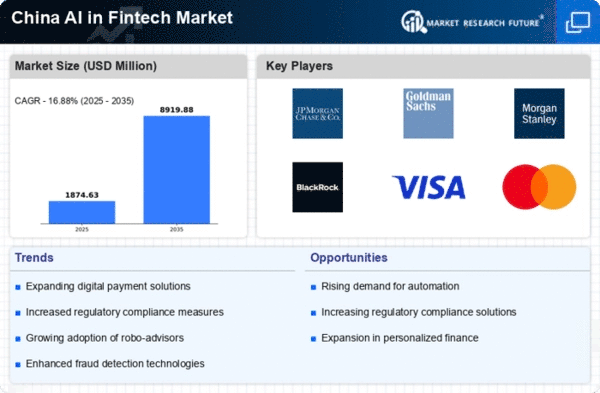
China AI in Fintech Market Infographic
Purchase Options

China AI in Fintech Market Summary

As per Market Research Future analysis, the China AI in Fintech Market size was estimated at 1603.89 USD Million in 2024. The Ai In-fintech market is projected to grow from 1874.63 USD Million in 2025 to 8919.88 USD Million by 2035, exhibiting a compound annual growth rate (CAGR) of 16.8% during the forecast period 2025 - 2035

Key Market Trends & Highlights

The China AI in Fintech Market is poised for substantial growth driven by technological advancements and increasing demand for personalized services.

  • The market is experiencing enhanced customer experience through AI-driven solutions, particularly in the retail banking segment.
  • Innovations in risk management are becoming prevalent, especially within the insurance sector, as firms seek to mitigate financial uncertainties.
  • Regulatory adaptation is facilitating the integration of AI technologies, ensuring compliance while fostering innovation in the fintech landscape.
  • Technological advancements in AI and growing demand for personalization are key drivers propelling the market forward.

Market Size & Forecast

2024 Market Size 1603.89 (USD Million)
2035 Market Size 8919.88 (USD Million)
CAGR (2025 - 2035) 16.88%

Major Players

JPMorgan Chase (US), Goldman Sachs (US), Morgan Stanley (US), BlackRock (US), Visa (US), Mastercard (US), Ant Group (CN), PayPal (US), Square (US)

Our Impact
Enabled $4.3B Revenue Impact for Fortune 500 and Leading Multinationals
Partnering with 2000+ Global Organizations Each Year
30K+ Citations by Top-Tier Firms in the Industry

China AI in Fintech Market Trends

The China AI in Fintech Market is experiencing notable growth, driven by advancements in artificial intelligence technologies and increasing demand for innovative financial solutions. Financial institutions are increasingly adopting AI-driven tools to enhance customer experiences, streamline operations, and improve risk management. This trend is particularly evident in areas such as fraud detection, credit scoring, and personalized financial services. As a result, the market is evolving rapidly, with new players entering the space and established firms investing heavily in AI capabilities. Moreover, regulatory frameworks are adapting to accommodate the integration of AI in financial services. Authorities are recognizing the potential benefits of AI while also addressing concerns related to data privacy and security. This balancing act is crucial for fostering innovation while ensuring consumer protection. The ai in-fintech market is likely to continue expanding as technology matures and more stakeholders recognize the advantages of AI-driven solutions. The interplay between technological advancements and regulatory developments will shape the future landscape of this dynamic market.

Enhanced Customer Experience

The ai in-fintech market is increasingly focused on improving customer interactions through personalized services. AI algorithms analyze user data to tailor financial products and services, enhancing user satisfaction and engagement. This trend indicates a shift towards more customer-centric approaches in financial services.

Risk Management Innovations

Innovations in risk management are becoming a hallmark of the ai in-fintech market. AI technologies are employed to assess credit risk and detect fraudulent activities more effectively. This capability not only protects financial institutions but also fosters trust among consumers.

Regulatory Adaptation

As the ai in-fintech market evolves, regulatory bodies are adapting to the new landscape. Authorities are developing frameworks that support innovation while ensuring compliance with data protection laws. This regulatory evolution is essential for the sustainable growth of AI in financial services.

China AI in Fintech Market Drivers

Rising Cybersecurity Concerns

As the digital transformation of financial services accelerates, cybersecurity concerns are becoming a critical driver for the ai in-fintech market in China. Financial institutions are increasingly targeted by cyber threats, prompting a heightened focus on AI-driven security solutions. The market for AI in cybersecurity is expected to grow by 25% annually, as firms seek to protect sensitive data and maintain customer trust. By employing AI technologies for threat detection and response, financial organizations can enhance their security posture, thereby fostering confidence in their services. This growing emphasis on cybersecurity is likely to propel further investment in AI solutions within the fintech sector.

Technological Advancements in AI

The rapid evolution of artificial intelligence technologies is a primary driver for the ai in-fintech market in China. Innovations in machine learning, natural language processing, and data analytics are enabling financial institutions to enhance their service offerings. For instance, the integration of AI algorithms in credit scoring and fraud detection has shown to improve accuracy by up to 30%. As a result, financial companies are increasingly investing in AI solutions, with expenditures projected to reach $10 billion by 2026. This technological momentum not only streamlines operations but also fosters a competitive edge in a crowded marketplace.

Regulatory Support for Innovation

The regulatory landscape in China is evolving to support innovation within the ai in-fintech market. Authorities are implementing frameworks that encourage the adoption of AI technologies while ensuring consumer protection. Recent initiatives have focused on creating a conducive environment for fintech innovation, which is likely to stimulate market growth. For example, the People's Bank of China has introduced guidelines that facilitate the use of AI in risk assessment and compliance. This regulatory support not only mitigates barriers to entry for new players but also enhances the credibility of AI solutions in the financial sector.

Growing Demand for Personalization

Consumer expectations for personalized financial services are driving the ai in-fintech market in China. As clients seek tailored solutions, financial institutions are leveraging AI to analyze vast amounts of data and deliver customized products. Reports indicate that 70% of consumers prefer personalized experiences, prompting banks to adopt AI-driven tools for customer segmentation and targeted marketing. This shift towards personalization is expected to enhance customer loyalty and retention, with the potential to increase revenue by 15% for firms that effectively implement these strategies. Consequently, the ai in-fintech market is witnessing a surge in demand for innovative, personalized financial solutions.

Increased Investment in Fintech Startups

The influx of venture capital into fintech startups is significantly impacting the ai in-fintech market in China. Investors are increasingly recognizing the potential of AI-driven solutions to disrupt traditional financial services. In 2025, investments in fintech are projected to exceed $30 billion, with a substantial portion directed towards AI technologies. This trend is fostering a vibrant ecosystem where startups can innovate and scale rapidly. As these companies develop cutting-edge AI applications, they contribute to the overall growth of the market, enhancing competition and driving advancements in service delivery.


Market Segment Insights

By Application: Fraud Detection (Largest) vs. Risk Management (Fastest-Growing)

In the China AI in Fintech Market, the application of AI technologies has led to significant advancements across various segments. Fraud detection currently holds the largest market share, driven by increasing cyber threats and the necessity for stronger security measures. On the other hand, risk management is emerging as the fastest-growing sector within this market, capitalizing on the need for more sophisticated risk assessment tools as financial environments become increasingly complex. Growth trends in these segments are being propelled by rapid advancements in AI technology and regulatory demands. The rise in digital transactions and online financial services has heightened the requirement for effective fraud detection solutions, while risk management benefits from innovations like predictive analytics and machine learning. These drivers indicate a thriving ecosystem where businesses increasingly rely on AI for enhanced operational efficiency and regulatory compliance.

Fraud Detection (Dominant) vs. Risk Management (Emerging)

Fraud detection serves as the dominant application in the China ai in-fintech market, characterized by advanced algorithms and real-time analytics that detect suspicious activities. Companies are investing heavily in AI-driven systems to enhance their fraud prevention tactics, leveraging vast amounts of transaction data. In contrast, risk management is emerging rapidly, with institutions adopting AI tools to refine their risk analysis and decision-making processes. This segment is characterized by its ability to provide real-time insights into potential risks, enabling businesses to make informed decisions swiftly. The competition in both areas is intensifying, with players striving to innovate and maintain a competitive edge, responding to the evolving demands of the financial landscape.

By End Use: Banking (Largest) vs. Insurance (Fastest-Growing)

In the China AI in Fintech Market, the distribution of market share among the end-use segments reveals that banking remains the dominant player, capturing the largest portion of the market. Following closely, insurance is emerging as a critical segment, gaining traction as businesses increasingly turn to AI solutions for customer risk assessment and fraud detection. Investment firms and payment services are also significant, yet they lag behind in terms of overall market share. Growth trends indicate that while banking is expanding steadily due to the ongoing digital transformation, the insurance sector is the fastest-growing segment, fueled by increasing demand for personalized services and enhanced data analytics capabilities. Factors driving this growth include the adoption of AI for more efficient claim processing, personalized customer interaction, and improved risk profiling, leading to a shift in how insurance services are delivered in the rapidly evolving marketplace.

Banking: Dominant vs. Insurance: Emerging

The banking segment in the China ai in-fintech market is characterized by its substantial market share and established infrastructure, leveraging AI technologies for enhanced customer experiences and operational efficiency. Banks are deploying AI for various applications including customer service, credit scoring, and risk management, solidifying their position at the forefront of fintech innovations. On the other hand, the insurance segment, while currently smaller, is characterized as an emerging growth area. The integration of AI in insurance allows for more sophisticated underwriting and personalized policy offerings, appealing to a tech-savvy customer base. The combination of regulatory support and technological advancements positions insurance to capture more market share, creating a dynamic interplay in the financial services landscape.

By Technology: Machine Learning (Largest) vs. Robotic Process Automation (Fastest-Growing)

Machine Learning holds the largest market share in the China AI in Fintech Market, driven by its widespread application in predictive analytics, credit scoring, and risk assessment. Natural Language Processing and Computer Vision also contribute significantly, with specific roles in customer service and transaction security respectively. However, Robotic Process Automation is rapidly gaining traction, reflecting a shift towards automation in financial processes, indicating a dynamically evolving landscape within the market. Growth trends indicate that the demand for Machine Learning solutions is fueled by the increasing necessity for data-driven decision-making and personalization in services. On the other hand, Robotic Process Automation is emerging as a game changer for efficiency and cost reduction. The integration of AI technologies across various financial services promotes innovation and competitive advantages, ensuring sustained growth in this segment.

Technology: Machine Learning (Dominant) vs. Robotic Process Automation (Emerging)

Machine Learning is a dominant force in the China ai in-fintech market, recognized for its ability to analyze vast datasets and uncover patterns that drive business decisions. With its applications in fraud detection and customer insights, it stands at the forefront of technological advancement. Conversely, Robotic Process Automation has emerged as a key player, focusing on automating repetitive tasks and enhancing operational efficiency. This segment’s growth is primarily driven by the need for reducing manual intervention while increasing accuracy. Together, these technologies are shaping the future of financial services in China, fostering an environment of innovation and improved service delivery.

By Deployment Type: Cloud-Based (Largest) vs. On-Premises (Fastest-Growing)

In the China ai in-fintech market, the deployment type segment is characterized by a significant preference for cloud-based solutions, which currently hold the largest share of the market. This trend is largely driven by the flexibility, scalable infrastructure, and cost-effectiveness that cloud-based systems offer, making them the go-to choice for many fintech companies looking to innovate rapidly. On the other hand, the on-premises deployment type is witnessing a surge in interest, particularly among enterprises that prioritize data security and compliance, which propels their growth as they adapt to evolving market needs. The growth trajectory for cloud-based deployment is bolstered by advancements in cloud computing technologies and increasing adoption of AI as a service. Conversely, on-premises solutions are emerging as the fastest-growing segment as they cater to the demand for greater control over data management and privacy. The combination of these diverging trends indicates a dynamic landscape in the deployment type segment, where organizations are strategically choosing their deployment models based on specific operational requirements and regulatory considerations.

Cloud-Based (Dominant) vs. On-Premises (Emerging)

Cloud-based deployment in the China ai in-fintech market leads the segment with its widespread adoption and robust capabilities. It allows fintech companies to leverage advanced technologies, including AI and big data analytics, without the need for heavy upfront investments. The ability to access services remotely and scale operations effortlessly positions cloud solutions as the dominant force in the market. In contrast, on-premises deployment is gaining traction, especially among large enterprises that require enhanced security and data privacy controls. These solutions often involve significant initial investments and ongoing maintenance costs, but they offer organizations complete control over their IT infrastructure. As businesses evolve, they recognize the importance of balancing agility with security, driving the on-premises segment to emerge as a viable alternative.

Get more detailed insights about China AI in Fintech Market

Key Players and Competitive Insights

The ai in-fintech market in China is characterized by a rapidly evolving competitive landscape, driven by technological advancements and increasing consumer demand for digital financial services. Major players such as Ant Group (CN), JPMorgan Chase (US), and Goldman Sachs (US) are strategically positioning themselves to leverage artificial intelligence for enhanced customer experiences and operational efficiencies. Ant Group (CN) focuses on integrating AI into its payment systems and risk management processes, while JPMorgan Chase (US) emphasizes innovation through substantial investments in AI-driven analytics and customer service solutions. Goldman Sachs (US) is also enhancing its trading platforms with AI capabilities, indicating a collective shift towards data-driven decision-making that shapes the competitive environment.The market structure appears moderately fragmented, with a mix of established financial institutions and emerging fintech companies. Key players are employing various business tactics, such as localizing services to cater to regional preferences and optimizing supply chains to enhance service delivery. This competitive structure allows for a dynamic interplay among companies, fostering innovation and collaboration while also intensifying competition.

In October Ant Group (CN) announced a partnership with a leading AI research institute to develop advanced machine learning algorithms aimed at improving fraud detection in real-time transactions. This strategic move is likely to bolster Ant Group's reputation as a leader in secure digital payments, enhancing consumer trust and potentially increasing market share in the competitive landscape.

In September JPMorgan Chase (US) launched a new AI-powered investment advisory service designed to provide personalized financial advice to retail clients. This initiative not only reflects the bank's commitment to digital transformation but also positions it to capture a growing segment of tech-savvy investors seeking tailored financial solutions. The strategic importance of this service lies in its potential to differentiate JPMorgan Chase from traditional advisory services, appealing to a younger demographic.

In August Goldman Sachs (US) expanded its AI capabilities by acquiring a fintech startup specializing in predictive analytics for investment strategies. This acquisition is indicative of a broader trend where established financial institutions seek to enhance their technological prowess through strategic mergers and acquisitions. By integrating advanced analytics into its operations, Goldman Sachs (US) aims to improve its competitive edge in the investment banking sector.

As of November the competitive trends in the ai in-fintech market are increasingly defined by digitalization, sustainability, and the integration of AI technologies. Strategic alliances among key players are shaping the landscape, fostering innovation and collaboration. Looking ahead, competitive differentiation is likely to evolve from traditional price-based competition to a focus on innovation, technological advancements, and supply chain reliability. Companies that can effectively harness AI and form strategic partnerships will likely emerge as leaders in this dynamic market.

Key Companies in the China AI in Fintech Market include

Industry Developments

In August 2023, Ant Financial announced plans to enhance its AI capabilities to streamline financial services, improving customer experience significantly. Meanwhile, Ping An Technology has launched an AI-driven platform aimed at risk assessment for financial institutions, which is a crucial development for the sector.

Notably, in July 2023, JD.com expanded its fintech offerings by acquiring a stake in a local AI startup, supporting its strategy of embedding advanced technology further into its services. Additionally, WeBank has been focusing on enhancing its AI algorithms for credit scoring, which is likely to impact market dynamics positively. 

Companies such as Lufax and Huabei continue to innovate in the digital lending space, leveraging machine learning for better decision-making. Overall, the valuation of firms in this sector has been increasing, driven by investments and adoption of AI technologies, reflecting the growing importance of AI in the Chinese fintech landscape.

Future Outlook

China AI in Fintech Market Future Outlook

The AI in Fintech Market is projected to grow at a 16.88% CAGR from 2025 to 2035, driven by technological advancements, regulatory support, and increasing demand for personalized financial services.

New opportunities lie in:

  • Development of AI-driven credit scoring systems for enhanced risk assessment.
  • Implementation of automated compliance solutions to streamline regulatory processes.
  • Creation of personalized investment advisory platforms utilizing machine learning algorithms.

By 2035, the ai in-fintech market is expected to achieve substantial growth, driven by innovation and evolving consumer needs.

Market Segmentation

China AI in Fintech Market End Use Outlook

  • Banking
  • Insurance
  • Investment Firms
  • Payment Services

China AI in Fintech Market Technology Outlook

  • Machine Learning
  • Natural Language Processing
  • Computer Vision
  • Robotic Process Automation

China AI in Fintech Market Application Outlook

  • Fraud Detection
  • Risk Management
  • Customer Service
  • Investment Management
  • Regulatory Compliance

China AI in Fintech Market Deployment Type Outlook

  • On-Premises
  • Cloud-Based

Report Scope

MARKET SIZE 2024 1603.89(USD Million)
MARKET SIZE 2025 1874.63(USD Million)
MARKET SIZE 2035 8919.88(USD Million)
COMPOUND ANNUAL GROWTH RATE (CAGR) 16.88% (2025 - 2035)
REPORT COVERAGE Revenue Forecast, Competitive Landscape, Growth Factors, and Trends
BASE YEAR 2024
Market Forecast Period 2025 - 2035
Historical Data 2019 - 2024
Market Forecast Units USD Million
Key Companies Profiled JPMorgan Chase (US), Goldman Sachs (US), Morgan Stanley (US), BlackRock (US), Visa (US), Mastercard (US), Ant Group (CN), PayPal (US), Square (US)
Segments Covered Application, End Use, Technology, Deployment Type
Key Market Opportunities Integration of advanced machine learning algorithms enhances risk assessment and fraud detection in the ai in-fintech market.
Key Market Dynamics Rapid technological advancements drive competitive dynamics in the ai in-fintech market, reshaping consumer engagement and regulatory frameworks.
Countries Covered China
Leave a Comment

FAQs

What is the expected market value of the China AI in Fintech Market in 2024?

The China AI in Fintech Market is expected to be valued at 826.2 million USD in 2024.

What will be the market size of the China AI in Fintech Market by 2035?

By 2035, the market is projected to reach a valuation of 4442.0 million USD.

What is the expected compound annual growth rate (CAGR) for the China AI in Fintech Market from 2025 to 2035?

The market is anticipated to grow at a CAGR of 16.522% from 2025 to 2035.

Which application in the China AI in Fintech Market has the highest valuation in 2024?

Fraud Detection has the highest valuation in 2024, estimated at 200.0 million USD.

How much is the investment management segment expected to be valued in 2035?

The Investment Management segment is projected to be valued at 1300.0 million USD by 2035.

Who are the key players in the China AI in Fintech Market?

Major players include Baidu, Alibaba Group, Ping An Technology, Tencent, and Ant Financial.

What will be the expected market size for Customer Service in 2035?

The Customer Service application is expected to reach a market size of 1000.0 million USD by 2035.

What is the expected valuation for Regulatory Compliance in 2024?

Regulatory Compliance is valued at 66.2 million USD in 2024.

What growth opportunities exist in the China AI in Fintech Market?

Significant growth opportunities arise from advancements in fraud detection, risk management, and customer service applications.

What challenges does the China AI in Fintech Market face?

Challenges include regulatory hurdles and the need for robust data security measures.

Download Free Sample

Kindly complete the form below to receive a free sample of this Report

Compare Licence

×
Features License Type
Single User Multiuser License Enterprise User
Price $4,950 $5,950 $7,250
Maximum User Access Limit 1 User Upto 10 Users Unrestricted Access Throughout the Organization
Free Customization
Direct Access to Analyst
Deliverable Format
Platform Access
Discount on Next Purchase 10% 15% 15%
Printable Versions