×
Request Free Sample ×

Kindly complete the form below to receive a free sample of this Report

* Please use a valid business email

Leading companies partner with us for data-driven Insights

clients tt-cursor
Hero Background

Cervical Cancer Diagnostics Market

ID: MRFR/HS/7676-HCR
100 Pages
Rahul Gotadki
February 2026

Cervical Cancer Diagnostic Market Research Report: Size, Share, Trend Analysis By Diagnostic Method (Pap Smear Tests, HPV Testing, Visual Inspection with Acetic Acid (VIA), Colposcopy), By Sample Type (Cervical Scrape, Endocervical Curettage, Vaginal Swabs), By End Users (Hospitals, Diagnostic Laboratories, Research Institutes), By Technology Type (Molecular Diagnostics, Immunohistochemistry), By Age Group (Under 30, 30-45, Above 45) and By Regional (North America, Europe, South America, Asia Pacific, Middle East and Africa) - Growth Outlook & Industry Forecast 2025 To 2035

Share:
Download PDF ×

We do not share your information with anyone. However, we may send you emails based on your report interest from time to time. You may contact us at any time to opt-out.

Cervical Cancer Diagnostics Market Infographic
Purchase Options

Cervical Cancer Diagnostics Market Summary

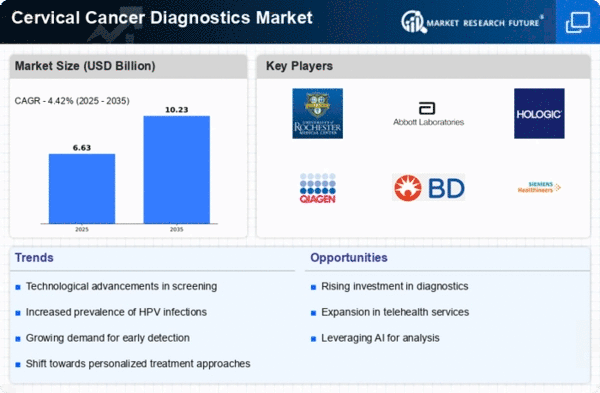
As per MRFR analysis, the Cervical Cancer Diagnostics Market Size was estimated at 6.35 USD Billion in 2024. The Cervical Cancer Diagnostics industry is projected to grow from 6.63 USD Billion in 2025 to 10.23 USD Billion by 2035, exhibiting a compound annual growth rate (CAGR) of 4.42 during the forecast period 2025 - 2035.

Key Market Trends & Highlights

The Cervical Cancer Diagnostics Market is experiencing robust growth driven by technological advancements and increased awareness.

  • Technological advancements in diagnostic tools are enhancing the accuracy and efficiency of cervical cancer detection.
  • North America remains the largest market, while the Asia-Pacific region is emerging as the fastest-growing market for cervical cancer diagnostics.
  • The Pap Smear Test continues to dominate the market, whereas HPV testing is rapidly gaining traction as a preferred diagnostic method.
  • Rising incidence of cervical cancer and increased government funding for preventive healthcare are key drivers propelling market growth.

Market Size & Forecast

2024 Market Size 6.35 (USD Billion)
2035 Market Size 10.23 (USD Billion)
CAGR (2025 - 2035) 4.42%

Major Players

Roche (CH), Abbott (US), Hologic (US), Qiagen (NL), BD (US), Siemens Healthineers (DE), Thermo Fisher Scientific (US), Genomic Health (US)

Our Impact
Enabled $4.3B Revenue Impact for Fortune 500 and Leading Multinationals
Partnering with 2000+ Global Organizations Each Year
30K+ Citations by Top-Tier Firms in the Industry

Cervical Cancer Diagnostics Market Trends

The Cervical Cancer Diagnostics Market is currently experiencing a transformative phase, driven by advancements in technology and an increasing awareness of women's health issues. The integration of innovative diagnostic tools, such as liquid-based cytology and HPV testing, appears to enhance the accuracy and efficiency of cervical cancer detection. Furthermore, the growing emphasis on preventive healthcare and early diagnosis is likely to propel the demand for these diagnostic solutions. As healthcare systems worldwide prioritize screening programs, the market is poised for substantial growth, reflecting a shift towards proactive health management. In addition, the rising prevalence of cervical cancer in various regions underscores the necessity for effective diagnostic methods. This trend is further supported by government initiatives aimed at improving screening rates and access to healthcare services. The collaboration between public health organizations and private entities seems to foster the development of novel diagnostic technologies, which may lead to improved patient outcomes. Overall, the Cervical Cancer Diagnostics Market is evolving, with a focus on enhancing diagnostic capabilities and expanding access to essential healthcare services for women globally.

Technological Advancements

The Cervical Cancer Diagnostics Market is witnessing a surge in technological innovations, particularly in the realm of diagnostic tools. Enhanced imaging techniques and molecular diagnostics are emerging, which may significantly improve the accuracy of cervical cancer detection. These advancements not only facilitate earlier diagnosis but also contribute to more personalized treatment approaches.

Increased Awareness and Education

There is a growing awareness regarding cervical cancer and its prevention among women globally. Educational campaigns and outreach programs are likely to play a crucial role in encouraging regular screenings. This heightened awareness may lead to increased demand for diagnostic services, thereby expanding the market.

Government Initiatives and Policies

Government efforts to promote cervical cancer screening and vaccination programs are influencing the Cervical Cancer Diagnostics Market. Policies aimed at increasing access to healthcare services and funding for diagnostic technologies could enhance screening rates. Such initiatives may create a more favorable environment for market growth.

Cervical Cancer Diagnostics Market Drivers

Increasing Incidence of Cervical Cancer

The rising incidence of cervical cancer globally is a primary driver for the Global Cervical Cancer Diagnostic Market Industry. According to the World Health Organization, cervical cancer remains a leading cause of cancer-related deaths among women, particularly in low- and middle-income countries. This alarming trend underscores the need for effective diagnostic tools, as early detection significantly improves survival rates. The market is projected to grow from 6.35 USD Billion in 2024 to 10.2 USD Billion by 2035, reflecting a growing awareness and demand for cervical cancer screening and diagnostic services.

Market Segment Insights

By Test Type: Pap Smear Test (Largest) vs. HPV Testing (Fastest-Growing)

In the Cervical Cancer Diagnostics Market, the Pap Smear Test remains the most widely utilized diagnostic method, accounting for a significant portion of the market share. Its long-standing history and established efficacy in detecting abnormal cervical cells continue to make it a preferred choice among practitioners. In contrast, HPV Testing has emerged as a pivotal player, capitalizing on advances in technology and increased awareness of HPV's role in cervical cancer. This shift is gradually transforming the diagnostic landscape.

Pap Smear Test (Dominant) vs. HPV Testing (Emerging)

The Pap Smear Test, being the dominant diagnostic method, is characterized by its effectiveness in detecting precancerous changes in cervical cells, which has led to early interventions and improved patient outcomes. Meanwhile, HPV Testing is rapidly gaining traction as an emerging method, given its ability to identify high-risk HPV strains which are directly linked to cervical cancer. This testing method is particularly appealing due to its higher sensitivity compared to Pap Smear Tests. The growing prevalence of HPV awareness programs and recommendations from health authorities are further driving its adoption, making it a critical component of cervical cancer screening protocols.

By End User: Hospitals (Largest) vs. Diagnostic Laboratories (Fastest-Growing)

The Cervical Cancer Diagnostics Market is primarily dominated by hospitals, which hold a significant share due to their comprehensive resources and infrastructure for advanced diagnostic procedures. Hospitals often have access to cutting-edge technology and specialized personnel, enabling them to conduct a wide array of cervical cancer tests effectively. In contrast, diagnostic laboratories are emerging as the fastest-growing segment, benefitting from the increasing demand for specialized testing and the expansion of laboratory services.

Hospitals (Dominant) vs. Clinics (Emerging)

Hospitals play a critical role in the Cervical Cancer Diagnostics Market, characterized by their ability to offer a full spectrum of diagnostic services. They are equipped with modern imaging technologies and skilled healthcare professionals, making them the primary choice for patients seeking diagnosis and treatment for cervical cancer. On the other hand, clinics represent an emerging segment in this market, attracting patients looking for accessible and cost-effective testing options. These clinics are strategically positioned to cater to local communities, providing convenient services that drive patient engagement and early diagnosis.

By Technology: Liquid-Based Cytology (Largest) vs. Molecular Diagnostics (Fastest-Growing)

The Cervical Cancer Diagnostics Market is increasingly driven by various technological advancements. Liquid-Based Cytology (LBC) holds the largest market share, primarily favored for its enhanced accuracy and effectiveness in detecting abnormalities in cervical cells. It effectively replaces traditional Pap smears, thus propelling its dominance in clinical practice. On the other hand, Molecular Diagnostics is swiftly capturing attention due to its ability to detect HPV (Human Papillomavirus) at a molecular level, which is critical in assessing cervical cancer risk, making it a key player in the evolving diagnostic landscape.

Technology: LBC (Dominant) vs. Molecular Diagnostics (Emerging)

Liquid-Based Cytology (LBC) is recognized for its superior sensitivity and specificity in cervical cancer screening, positioning it as the dominant technology within the market. Its ability to preserve cell samples in a liquid medium minimizes the chances of artifact-induced errors, contributing to more reliable results. Conversely, Molecular Diagnostics is rapidly establishing itself as an emerging technology in cervical cancer diagnosis. It focuses on identifying HPV infections through advanced testing methods, allowing for targeted patient management. This approach not only aids in early detection but also enhances personalized treatment strategies, reflecting the growing trend towards molecular-based diagnostic solutions in gynecological oncology.

By Age Group: 25-34 Years (Largest) vs. 15-24 Years (Fastest-Growing)

The cervical cancer diagnostics market displays a diverse distribution across various age groups, with the 25-34 years segment holding the largest share due to increased awareness and targeted screening programs. This age group benefits from preventive health initiatives, resulting in higher demonstration rates. In contrast, the 15-24 years segment, while currently smaller, is rapidly gaining traction as public health campaigns emphasize the importance of early diagnosis, making this demographic the fastest-growing segment in the market.

25-34 Years: Dominant vs. 15-24 Years: Emerging

The 25-34 years age group represents the dominant segment in cervical cancer diagnostics, fueled by proactive health measures and a growing understanding of HPV's implications on cervical health. This group not only shows strong engagement with clinical screening but also actively participates in vaccination programs. Alternatively, the 15-24 years segment is emerging due to rising health education focusing on early detection and prevention strategies. This demographic is increasingly participating in screening initiatives influenced by social awareness programs, suggesting a shift towards preventive healthcare that may further elevate their market presence in the future.

By Screening Method: Routine Screening (Largest) vs. Self-Sampling (Fastest-Growing)

In the Cervical Cancer Diagnostics Market, the routine screening method is currently the largest segment, accounting for the majority of market share. This method involves systematic examinations, which are recommended to be conducted regularly to detect any early signs of cervical cancer. In contrast, self-sampling is emerging as a new favorite among patients due to its convenience and privacy, quickly gaining traction in the market and attracting a growing share of users looking for less invasive options.

Routine Screening (Dominant) vs. Self-Sampling (Emerging)

Routine screening, being the dominant approach, typically involves healthcare professionals conducting regular Pap smears and HPV tests in clinical settings, which have proven effective in early detection. This method is often supported by health guidelines, reinforcing its preferred status among medical practitioners. On the other hand, self-sampling is an emerging trend that allows women to collect their samples in the comfort of their homes, thus improving accessibility and adherence to screening recommendations. This method is particularly appealing to those who may face barriers in visiting healthcare facilities, thereby enhancing participation in cervical cancer prevention efforts.

Get more detailed insights about Cervical Cancer Diagnostics Market

Regional Insights

North America : Market Leader in Diagnostics

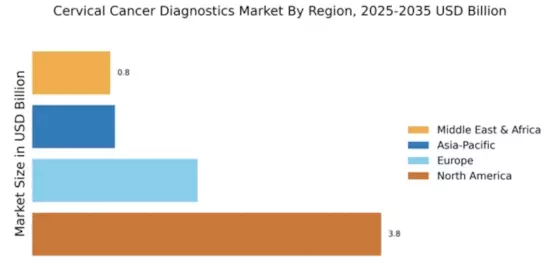
North America is poised to maintain its leadership in the Cervical Cancer Diagnostics Market, holding a significant market share of $3.8 billion as of 2024. The region's growth is driven by increasing awareness of cervical cancer screening, advancements in diagnostic technologies, and supportive regulatory frameworks. The demand for innovative diagnostic solutions is further fueled by government initiatives aimed at improving women's health outcomes and reducing cervical cancer incidence rates. The United States stands out as the leading country in this market, with major players like Roche, Abbott, and Hologic driving competition and innovation. The presence of established healthcare infrastructure and a high prevalence of cervical cancer screening programs contribute to the region's robust market dynamics. Additionally, partnerships between key players and healthcare providers enhance the availability of advanced diagnostic tools, ensuring that North America remains at the forefront of cervical cancer diagnostics.

Europe : Emerging Regulatory Frameworks

Europe is witnessing a growing Cervical Cancer Diagnostics Market, valued at $1.8 billion in 2024. The region's growth is significantly influenced by evolving regulatory frameworks and increased funding for cancer screening programs. Countries are implementing policies to enhance early detection and treatment, which is expected to drive demand for advanced diagnostic technologies. The emphasis on preventive healthcare and public awareness campaigns further supports market expansion across Europe. Leading countries such as Germany, France, and the UK are at the forefront of this market, with a competitive landscape featuring key players like Qiagen and Siemens Healthineers. The presence of innovative diagnostic solutions and a strong focus on research and development contribute to the region's growth. Collaborative efforts between government bodies and private sectors are enhancing the accessibility of cervical cancer diagnostics, ensuring that Europe remains a vital player in this field.

Asia-Pacific : Rapidly Growing Market Potential

The Asia-Pacific region is emerging as a significant player in the Cervical Cancer Diagnostics Market, with a market size of $0.9 billion in 2024. The growth is driven by increasing healthcare investments, rising awareness about cervical cancer, and the implementation of national screening programs. Governments are focusing on improving healthcare access and affordability, which is expected to boost demand for diagnostic solutions in the coming years. The region's diverse population and varying healthcare needs present unique opportunities for market expansion. Countries like China and India are leading the charge, with a growing number of healthcare facilities adopting advanced diagnostic technologies. The competitive landscape includes key players such as BD and Thermo Fisher Scientific, who are actively working to enhance their market presence. The collaboration between public health initiatives and private sector innovations is crucial for addressing the rising cervical cancer burden in this region, making it a focal point for future growth.

Middle East and Africa : Emerging Market with Challenges

The Middle East and Africa region is gradually developing its Cervical Cancer Diagnostics Market, valued at $0.85 billion in 2024. The growth is primarily driven by increasing awareness of cervical cancer and the need for improved healthcare infrastructure. Governments are beginning to recognize the importance of early detection and are implementing initiatives to enhance screening programs. However, challenges such as limited access to healthcare facilities and varying levels of public awareness remain significant barriers to market growth. Countries like South Africa and Kenya are leading the market, with efforts to improve diagnostic capabilities and increase access to screening. The competitive landscape is characterized by the presence of both local and international players, including Genomic Health. Collaborative efforts between governments and NGOs are essential for addressing the cervical cancer burden, making this region a potential growth area for diagnostics in the coming years.


Cervical Cancer Diagnostics Market Regional Image

Key Players and Competitive Insights

The Cervical Cancer Diagnostics Market is characterized by a dynamic competitive landscape, driven by technological advancements, increasing awareness of cervical cancer screening, and a growing emphasis on early detection. Major players such as Roche (CH), Abbott (US), and Hologic (US) are strategically positioned to leverage innovation and partnerships to enhance their market presence. Roche (CH) focuses on integrating advanced molecular diagnostics into its product offerings, while Abbott (US) emphasizes expanding its portfolio through strategic acquisitions. Hologic (US) is dedicated to enhancing its digital health solutions, which collectively shape a competitive environment that prioritizes innovation and patient-centric approaches.Key business tactics within the market include localizing manufacturing and optimizing supply chains to enhance efficiency and reduce costs. The competitive structure appears moderately fragmented, with several key players exerting influence over market dynamics. This fragmentation allows for a diverse range of products and services, catering to varying regional needs and preferences, while also fostering competition that drives innovation.

In November Roche (CH) announced the launch of a new HPV testing platform designed to improve the accuracy and speed of cervical cancer diagnostics. This strategic move is significant as it aligns with the growing demand for rapid and reliable testing solutions, potentially positioning Roche as a leader in the market. The introduction of this platform may enhance patient outcomes by facilitating earlier detection and treatment options.

In October Abbott (US) expanded its collaboration with local healthcare providers in emerging markets to increase access to cervical cancer screening. This initiative is crucial as it not only broadens Abbott's market reach but also addresses the pressing need for accessible healthcare solutions in underserved regions. By fostering partnerships, Abbott is likely to enhance its brand reputation and drive growth in these markets.

In September Hologic (US) unveiled a new AI-driven analytics tool aimed at improving the interpretation of cervical cancer screening results. This development underscores Hologic's commitment to integrating cutting-edge technology into its diagnostic processes. The use of AI may significantly enhance diagnostic accuracy and efficiency, thereby reinforcing Hologic's competitive edge in the market.

As of December current trends in the Cervical Cancer Diagnostics Market indicate a strong focus on digitalization, sustainability, and the integration of AI technologies. Strategic alliances among key players are shaping the landscape, fostering innovation and enhancing product offerings. The competitive differentiation is likely to evolve from traditional price-based competition to a focus on technological advancements, reliability in supply chains, and the ability to deliver innovative solutions that meet the needs of healthcare providers and patients alike.

Key Companies in the Cervical Cancer Diagnostics Market include

Industry Developments

  • Q2 2024: BD Launches BD Onclarity™ HPV Assay in Japan for Cervical Cancer Screening Becton, Dickinson and Company (BD) announced the launch of its BD Onclarity™ HPV Assay in Japan after receiving regulatory approval, expanding access to advanced HPV testing for cervical cancer diagnostics in the Japanese market.
  • Q2 2024: Hologic Receives CE Mark for Genius™ Digital Diagnostics System for Cervical Cancer Screening Hologic, Inc. announced it has received the CE Mark for its Genius™ Digital Diagnostics System, enabling the commercial launch of its AI-powered cervical cancer screening platform in Europe.
  • Q1 2024: Qiagen Expands Partnership with BioNTech to Develop Next-Generation HPV Diagnostic Tests Qiagen announced an expanded collaboration with BioNTech to co-develop next-generation molecular diagnostic tests for HPV, aiming to improve early detection of cervical cancer.
  • Q3 2024: Fujirebio Launches New Automated HPV Test for Cervical Cancer Screening in Europe Fujirebio announced the European launch of its new automated HPV test, designed to enhance the accuracy and efficiency of cervical cancer screening programs.
  • Q2 2024: OncoHealth Raises $40 Million Series C to Advance AI-Driven Cervical Cancer Diagnostics Market OncoHealth secured $40 million in Series C funding to accelerate the development and commercialization of its AI-powered cervical cancer diagnostic platform.
  • Q1 2024: FDA Approves Roche’s cobas® HPV Test for Use on cobas® 5800 System The FDA approved Roche’s cobas® HPV Test for use on the cobas® 5800 System, expanding the test’s availability for cervical cancer screening in the United States.
  • Q2 2025: Thermo Fisher Scientific Launches New HPV Genotyping Assay for Cervical Cancer Diagnostics Market Thermo Fisher Scientific announced the commercial launch of a new HPV genotyping assay, designed to provide more precise risk stratification in cervical cancer diagnostics.
  • Q1 2025: Abbott Receives CE Mark for Alinity m HR HPV Assay for Cervical Cancer Screening Abbott announced it has received the CE Mark for its Alinity m HR HPV Assay, enabling broader use of its high-risk HPV test for cervical cancer screening across Europe.
  • Q3 2024: BD Opens New Manufacturing Facility in Ireland to Expand Cervical Cancer Diagnostic Production BD (Becton, Dickinson and Company) opened a new manufacturing facility in Ireland dedicated to increasing production capacity for its cervical cancer diagnostic products.
  • Q2 2024: Genedrive Secures NHS Contract for Point-of-Care HPV Test in UK Cervical Cancer Screening Genedrive announced it has secured a contract with the UK National Health Service (NHS) to supply its rapid point-of-care HPV test for use in cervical cancer screening programs.
  • Q1 2025: Biocept Appoints New CEO to Lead Expansion in Cervical Cancer Diagnostics Market Biocept, Inc. announced the appointment of a new Chief Executive Officer to drive the company’s strategic expansion in the cervical cancer diagnostics sector.
  • Q2 2025: Roche Launches Next-Generation Digital Pathology Solution for Cervical Cancer Diagnosis Roche announced the launch of its next-generation digital pathology solution, designed to improve diagnostic accuracy and workflow efficiency in cervical cancer diagnosis.

Future Outlook

Cervical Cancer Diagnostics Market Future Outlook

The Cervical Cancer Diagnostics Market is projected to grow at a 4.42% CAGR from 2025 to 2035, driven by technological advancements, increasing awareness, and rising screening initiatives.

New opportunities lie in:

  • Development of AI-driven diagnostic tools for enhanced accuracy.
  • Expansion of telehealth services for remote patient monitoring.
  • Partnerships with healthcare providers for integrated screening programs.

By 2035, the market is expected to achieve substantial growth, reflecting advancements in diagnostics and increased global health initiatives.

Market Segmentation

Cervical Cancer Diagnostics Market End User Outlook

  • Hospitals
  • Diagnostic Laboratories
  • Research Institutes
  • Clinics

Cervical Cancer Diagnostics Market Age Group Outlook

  • 15-24 Years
  • 25-34 Years
  • 35-44 Years
  • 45-54 Years
  • 55 Years and Above

Cervical Cancer Diagnostics Market Test Type Outlook

  • Pap Smear Test
  • HPV Testing
  • Colposcopy
  • Biopsy
  • Molecular Testing

Cervical Cancer Diagnostics Market Technology Outlook

  • Liquid-Based Cytology
  • Visual Inspection with Acetic Acid
  • Molecular Diagnostics
  • Immunohistochemistry

Cervical Cancer Diagnostics Market Screening Method Outlook

  • Routine Screening
  • Targeted Screening
  • Self-Sampling
  • Follow-Up Screening

Report Scope

MARKET SIZE 20246.35(USD Billion)
MARKET SIZE 20256.63(USD Billion)
MARKET SIZE 203510.23(USD Billion)
COMPOUND ANNUAL GROWTH RATE (CAGR)4.42% (2025 - 2035)
REPORT COVERAGERevenue Forecast, Competitive Landscape, Growth Factors, and Trends
BASE YEAR2024
Market Forecast Period2025 - 2035
Historical Data2019 - 2024
Market Forecast UnitsUSD Billion
Key Companies ProfiledRoche (CH), Abbott (US), Hologic (US), Qiagen (NL), BD (US), Siemens Healthineers (DE), Thermo Fisher Scientific (US), Genomic Health (US)
Segments CoveredTest Type, End User, Technology, Age Group, Screening Method
Key Market OpportunitiesIntegration of artificial intelligence in Cervical Cancer Diagnostics enhances accuracy and efficiency in screening processes.
Key Market DynamicsTechnological advancements in diagnostic tools are reshaping cervical cancer screening and detection methodologies.
Countries CoveredNorth America, Europe, APAC, South America, MEA
Leave a Comment

FAQs

What is the projected growth of the Cervical Cancer Diagnostic market?

The Cervical Cancer Diagnostic market is the expected increase in total market value of 10.23 USD billion over a defined forecast period 2025–2035. It is driven by factors such as demand trends, technological advances, regulatory changes, and geographic expansion.

What is the size of the Cervical Cancer Diagnostic market?

Cervical Cancer Diagnostic market size was valued at approximately 6.35 billion USD in 2024. This figure will reach 10.23 billion USD covering all regions (America, Europe, Asia, MEA and ROW), focusing its segments / services / distribution channels till 2035.

What is the CAGR of the Cervical Cancer Diagnostic market?

Cervical Cancer Diagnostic market is expected to grow at a CAGR of 4.42% between 2025 and 2035.

How much will the Cervical Cancer Diagnostic market be worth by 2035?

Cervical Cancer Diagnostic market is expected to be worth of 10.23 billion USD, reflecting growth driven by usage, technology and global demands by the end of 2035.

How will the Cervical Cancer Diagnostic market perform over the next 10 years?

Over the next 10 years the Cervical Cancer Diagnostic market is expected to shift from usd billion 6.35 to 10.23 billion USD, led by adoption of advanced tech, demographic trends, regulatory approvals, with potential headwinds from 2025 to 2035.

Which region holds the largest market share in the Cervical Cancer Diagnostic Market in 2024?

North America holds the largest market share in the Cervical Cancer Diagnostic Market, with a value of 2.28 USD Billion in 2024.

How much is the HPV Testing segment expected to be valued by 2035?

The HPV Testing segment of the Cervical Cancer Diagnostic Market is expected to be valued at 3.15 USD Billion by 2035.

Which companies are considered key players in the Cervical Cancer Diagnostic Market?

Key players in the Cervical Cancer Diagnostic Market include Roche, Abbott Laboratories, Genomic Health, and Hologic, among others.

What is the market value of the Visual Inspection with Acetic Acid (VIA) segment in 2024?

The Visual Inspection with Acetic Acid (VIA) segment is valued at 1.24 USD Billion in 2024.

What is the expected market value of the Colposcopy segment by 2035?

The Colposcopy segment is expected to be valued at 1.5 USD Billion by 2035.

Download Free Sample

Kindly complete the form below to receive a free sample of this Report

Compare Licence

×
Features License Type
Single User Multiuser License Enterprise User
Price $4,950 $5,950 $7,250
Maximum User Access Limit 1 User Upto 10 Users Unrestricted Access Throughout the Organization
Free Customization
Direct Access to Analyst
Deliverable Format
Platform Access
Discount on Next Purchase 10% 15% 15%
Printable Versions