×
Request Free Sample ×

Kindly complete the form below to receive a free sample of this Report

* Please use a valid business email

Leading companies partner with us for data-driven Insights

clients tt-cursor
Hero Background

Central Fill Pharmacy Automation System Market

ID: MRFR/MED/7666-HCR
128 Pages
Garvit Vyas
February 2026

Central Fill Pharmacy Automation System Market Research Report By Product Type (Central Fill Automation Systems, Robot-based Central Fill Automation Systems, Conventional Central Fill Automation Systems), By Pharmacy Type (Inpatient Pharmacy, Outpatient Pharmacy, Long-Term Care Pharmacy), By Function (Vial Filling, Syringe Filling, Bulk Powder Filling, Combination (Vial, Syringe, and Powder)), By Dose Preparation (Single-Dose, Multi-Dose, Both Single- and Multi-Dose), By Output Capacity (100 doses per hour, 100-500 doses per hour, >500 doses per hour) and By Regional (North America, Europe, South America, Asia Pacific, Middle East and Africa) - Growth & Industry Forecast 2025 To 2035

Share:
Download PDF ×

We do not share your information with anyone. However, we may send you emails based on your report interest from time to time. You may contact us at any time to opt-out.

Central Fill Pharmacy Automation System Market Infographic
Purchase Options

Central Fill Pharmacy Automation System Market Summary

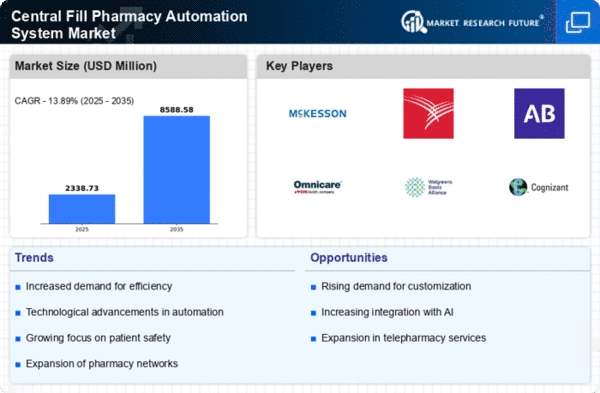
As per MRFR analysis, the Central Fill Pharmacy Automation System Market Size was estimated at 2053.5 USD Million in 2024. The Central Fill Pharmacy Automation System industry is projected to grow from 2338.77 USD Million in 2025 to 8588.58 USD Million by 2035, exhibiting a compound annual growth rate (CAGR) of 13.89 during the forecast period 2025 - 2035.

Key Market Trends & Highlights

The Central Fill Pharmacy Automation System Market is poised for substantial growth driven by efficiency demands and technological advancements.

  • The market experiences increased demand for efficiency, particularly in North America, which remains the largest market.
  • Regulatory compliance and standardization are becoming critical factors influencing market dynamics across both North America and Asia-Pacific.
  • Integration of advanced technologies is reshaping the landscape, with the medication dispensing segment leading in market share.
  • Rising prescription volumes and cost reduction initiatives are major drivers propelling growth, especially in the retail pharmacy segment.

Market Size & Forecast

2024 Market Size 2053.5 (USD Million)
2035 Market Size 8588.58 (USD Million)
CAGR (2025 - 2035) 13.89%

Major Players

McKesson Corporation (US), Cardinal Health (US), AmerisourceBergen (US), Omnicare (US), Walgreens Boots Alliance (US), Cognizant Technology Solutions (US), Parata Systems (US), ScriptPro (US), RxSafe (US)

Our Impact
Enabled $4.3B Revenue Impact for Fortune 500 and Leading Multinationals
Partnering with 2000+ Global Organizations Each Year
30K+ Citations by Top-Tier Firms in the Industry

Central Fill Pharmacy Automation System Market Trends

The Central Fill Pharmacy Automation System Market is currently experiencing a transformative phase, driven by advancements in technology and the increasing demand for efficiency in pharmaceutical operations. Automation systems are being integrated into pharmacies to streamline the medication dispensing process, reduce human error, and enhance overall productivity. This shift towards automation appears to be a response to the growing complexity of medication management and the need for improved patient safety. As pharmacies seek to optimize their workflows, the adoption of these systems is likely to rise, reflecting a broader trend towards digitization in healthcare. Moreover, the Central Fill Pharmacy Automation System Market is influenced by regulatory changes and the push for standardized practices across the industry. Stakeholders are increasingly recognizing the potential of automation to not only improve operational efficiency but also to ensure compliance with stringent regulations. This evolving landscape suggests that the market will continue to expand as more pharmacies invest in technology that supports their operational goals. The integration of artificial intelligence and machine learning into these systems may further enhance their capabilities, providing pharmacies with tools to better manage inventory and predict patient needs.

Increased Demand for Efficiency

The Central Fill Pharmacy Automation System Market is witnessing a heightened demand for operational efficiency. Pharmacies are increasingly adopting automation to streamline workflows, minimize errors, and enhance service delivery. This trend reflects a broader movement towards optimizing pharmacy operations.

Regulatory Compliance and Standardization

Regulatory changes are shaping the Central Fill Pharmacy Automation System Market, as pharmacies strive to meet compliance requirements. Automation systems are being recognized for their ability to support standardized practices, ensuring adherence to industry regulations and enhancing patient safety.

Integration of Advanced Technologies

The integration of advanced technologies, such as artificial intelligence and machine learning, is emerging as a key trend in the Central Fill Pharmacy Automation System Market. These innovations are expected to enhance system capabilities, enabling pharmacies to better manage inventory and anticipate patient needs.

Central Fill Pharmacy Automation System Market Drivers

Market Growth Projections

The Global Central Fill Pharmacy Automation System Market Industry is poised for substantial growth, with projections indicating an increase from 2.05 USD Billion in 2024 to 8.59 USD Billion by 2035. This growth trajectory suggests a compound annual growth rate (CAGR) of 13.91% from 2025 to 2035. Such figures reflect the increasing adoption of automation technologies in pharmacies, driven by the need for enhanced efficiency, accuracy, and patient safety. The market's expansion is likely to attract investments and innovations, further solidifying its position within the healthcare landscape.

Growing Focus on Patient Safety

The growing focus on patient safety is a significant driver in the Global Central Fill Pharmacy Automation System Market Industry. As healthcare systems worldwide prioritize patient outcomes, the adoption of automated pharmacy systems is seen as a means to enhance safety and reduce medication errors. This trend is underscored by the projected market growth from 2.05 USD Billion in 2024 to 8.59 USD Billion by 2035, indicating a robust CAGR of 13.91% from 2025 to 2035. By improving accuracy and efficiency in medication dispensing, these systems contribute to better health outcomes and patient satisfaction.

Regulatory Support and Compliance

Regulatory support is increasingly influencing the Global Central Fill Pharmacy Automation System Market Industry. Governments and health authorities are establishing guidelines that encourage the adoption of automated systems to ensure compliance with safety standards. This regulatory backing not only promotes the use of advanced technologies but also instills confidence among healthcare providers regarding the efficacy of these systems. As the market continues to expand, the alignment of automation systems with regulatory requirements will likely drive growth, contributing to the anticipated rise from 2.05 USD Billion in 2024 to 8.59 USD Billion by 2035.

Rising Demand for Prescription Accuracy

The Global Central Fill Pharmacy Automation System Market Industry experiences a notable increase in demand for prescription accuracy. As medication errors can lead to severe health complications, healthcare providers are increasingly adopting automation systems to enhance precision in dispensing. This trend is further supported by the projected market growth from 2.05 USD Billion in 2024 to an anticipated 8.59 USD Billion by 2035, reflecting a compound annual growth rate (CAGR) of 13.91% from 2025 to 2035. Such advancements not only improve patient safety but also streamline pharmacy operations, thereby enhancing overall healthcare delivery.

Technological Advancements in Automation

Technological advancements play a critical role in shaping the Global Central Fill Pharmacy Automation System Market Industry. Innovations such as artificial intelligence and machine learning are being integrated into pharmacy automation systems, enhancing their capabilities in medication management and patient safety. These technologies facilitate real-time data analysis and improve decision-making processes, which are essential for modern pharmacy operations. As a result, the market is expected to grow significantly, with projections indicating an increase from 2.05 USD Billion in 2024 to 8.59 USD Billion by 2035, driven by a CAGR of 13.91% from 2025 to 2035.

Cost Efficiency and Operational Streamlining

Cost efficiency remains a pivotal driver within the Global Central Fill Pharmacy Automation System Market Industry. By automating the medication dispensing process, pharmacies can significantly reduce labor costs and minimize the risk of human error. The implementation of these systems allows for better inventory management and reduces waste, which is crucial in an era where healthcare costs are under scrutiny. As the market evolves, the financial benefits associated with automation are likely to attract more stakeholders, contributing to the projected growth from 2.05 USD Billion in 2024 to 8.59 USD Billion by 2035.


Market Segment Insights

By Application: Medication Dispensing (Largest) vs. Inventory Management (Fastest-Growing)

In the Central Fill Pharmacy Automation System Market, the 'Application' segment showcases significant diversity, with Medication Dispensing leading the market share due to its vital role in enhancing pharmacy efficiency. Following closely is Inventory Management, which is gaining traction as pharmacies look to optimize stock levels and reduce waste. Other noteworthy applications include Prescription Processing, Patient Safety, and Data Management, each contributing to a well-rounded growth landscape but at a smaller scale than the top two applications that dominate this market.

Medication Dispensing (Dominant) vs. Inventory Management (Emerging)

Medication Dispensing remains the dominant application within the Central Fill Pharmacy Automation System Market, showcasing its critical position as pharmacies increasingly rely on automated solutions to manage high prescription volumes while ensuring accuracy and timeliness. Inventory Management, on the other hand, is emerging rapidly as a necessary function for pharmacies aiming to minimize stock discrepancies and streamline supply chains. The integration of real-time tracking and inventory analytics enhances its appeal, qualifying it as a key player in the market. Both segments are intertwined, as effective inventory management enhances the efficiency of medication dispensing, showcasing the interdependent nature of these applications.

By End Use: Retail Pharmacy (Largest) vs. Hospital Pharmacy (Fastest-Growing)

In the Central Fill Pharmacy Automation System Market, the Retail Pharmacy segment holds the largest share, primarily due to the increasing demand for accessible medication management solutions. Retail pharmacies play a crucial role in offering automated dispensing systems that enhance efficiency and reduce human error, catering to a large customer base and aiding in better medication adherence. On the other hand, the Hospital Pharmacy segment is witnessing remarkable growth as healthcare facilities strive to improve operational efficiency and patient safety. The integration of advanced automation technologies in hospitals supports streamlined medication dispensing processes, contributing to the segment's rapid expansion.

Retail Pharmacy (Dominant) vs. Mail Order Pharmacy (Emerging)

The Retail Pharmacy segment remains dominant in the Central Fill Pharmacy Automation System market, primarily due to its extensive reach and customer interaction. Retail pharmacies leverage automation systems to optimize inventory management, improve the accuracy of medication dispensing, and enhance overall customer service. In contrast, the Mail Order Pharmacy segment is emerging as a significant player by appealing to patients seeking convenience and accessibility. The rise of telehealth services and online prescription refills has spurred the growth of mail order pharmacies, enabling them to cater to patients who prefer receiving medications at home. As both segments evolve, they are responding to consumer preferences and technological advancements in the pharmacy automation landscape.

By Technology: Robotic Systems (Largest) vs. Automated Storage and Retrieval Systems (Fastest-Growing)

The Central Fill Pharmacy Automation System market exhibits a diverse range of technologies, with robotic systems holding the largest market share. These systems streamline medication dispensing processes, increase accuracy, and enhance efficiency, making them integral to modern pharmacy operations. In contrast, automated storage and retrieval systems are emerging rapidly, attracting investments due to their ability to minimize retrieval times and optimize storage space, resulting in significant operational cost savings for pharmacies.

Technology: Robotic Systems (Dominant) vs. Automated Storage and Retrieval Systems (Emerging)

Robotic systems are pivotal in the Central Fill Pharmacy Automation landscape, facilitating high-volume medication dispensing with precision and reducing human error significantly. These systems often integrate seamlessly with existing inventory management processes, ensuring a steady flow of medications to fulfill patient needs efficiently. On the other hand, automated storage and retrieval systems are gaining traction as the fastest-growing segment, driven by their capacity to efficiently organize and retrieve large inventories. These systems enhance space utilization in pharmacies, drive down operational costs, and respond swiftly to dispensing demands, which positions them as a critical component in the evolving pharmacy environment.

By Component: Dispensing Units (Largest) vs. Software Interfaces (Fastest-Growing)

In the Central Fill Pharmacy Automation System Market, Dispensing Units represent the largest segment, holding a significant share of the overall market. Their critical role in improving efficiency and accuracy in medication dispensing has made them essential for modern pharmacies. Conveyors and Control Systems follow closely, showcasing their importance in streamlining the workflow within pharmacy operations. Software Interfaces are building momentum, driven by the need for integrated solutions that enhance connectivity and user experience.

Dispensing Units (Dominant) vs. Software Interfaces (Emerging)

Dispensing Units are a dominant segment within the Central Fill Pharmacy Automation System Market due to their pivotal role in ensuring accurate and efficient medication dispensing. They are designed to handle large volumes of prescriptions, minimizing human error and optimizing workflow in pharmacy settings. On the other hand, Software Interfaces are emerging as a vital component, gaining traction as pharmacies seek integrated solutions that promote communication and data interchange among various systems. The adoption of advanced software solutions is fueled by the rising demand for improved operational efficiency and enhanced patient safety, setting the stage for significant growth in this segment.

By Service Type: Installation Services (Largest) vs. Maintenance Services (Fastest-Growing)

In the Central Fill Pharmacy Automation System Market, the 'Service Type' segment showcases a diverse range of services, with Installation Services leading in market share. This prominence is attributed to the growing demand for efficient and streamlined pharmacy operations. Maintenance Services, while not the largest, are emerging rapidly as pharmacies recognize the critical need for consistent system performance and reliability. As technology evolves, demand for skilled maintenance services continues to surge, allowing it to gain substantial market traction and consumer attention. The evolution of pharmacy automation systems drives the growth of various service types. Installation Services benefit from the initial setup phase of a new pharmacy automation system, whereas Maintenance Services thrive on the long-term need for system upkeep and enhancement. Consequently, the focus on operational efficiency, regulatory compliance, and integration of advanced pharmacy technologies fosters growth in Consulting and Training Services, further strengthening the overall service spectrum in this market.

Installation Services (Dominant) vs. Consulting Services (Emerging)

Installation Services have established their dominance in the Central Fill Pharmacy Automation System Market by ensuring that pharmacies can seamlessly integrate automated systems into their workflows. These services are critical during the initial stages of implementing automation, as they set up the necessary frameworks for efficiency and compliance. On the other hand, Consulting Services are emerging as a vital adjunct, guiding pharmacies in maximizing the benefits of automation through tailored strategies and operational improvements. As new technologies unfold, pharmacies increasingly rely on experts to inform their decisions, highlighting a shift towards a strategy-driven approach in service utilization. Both segments contribute significantly to enhancing the operational landscape of pharmacy automation.

Get more detailed insights about Central Fill Pharmacy Automation System Market

Regional Insights

North America : Market Leader in Automation

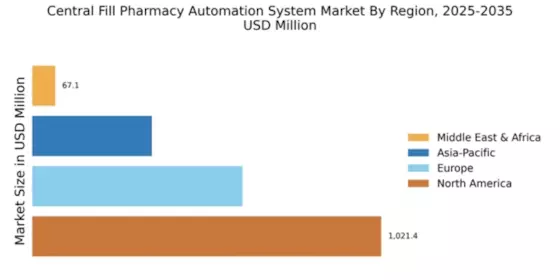
North America is poised to maintain its leadership in the Central Fill Pharmacy Automation System market, holding a significant market share of 1021.4 million. The growth is driven by increasing demand for efficient pharmacy operations, regulatory support for automation, and a rising focus on patient safety. The region's advanced healthcare infrastructure and technological innovations further bolster this trend, making it a hub for automation solutions. The competitive landscape is characterized by major players such as McKesson Corporation, Cardinal Health, and Walgreens Boots Alliance, which dominate the market. These companies are investing heavily in R&D to enhance their offerings and improve operational efficiencies. The presence of a robust supply chain and favorable government policies also contribute to the region's strong market position, ensuring continued growth in the coming years.

Europe : Emerging Market Potential

Europe is witnessing a growing interest in Central Fill Pharmacy Automation Systems, with a market size of €615.0 million. The region's growth is fueled by increasing healthcare expenditures, a shift towards digital health solutions, and regulatory initiatives aimed at improving medication safety and efficiency. Countries like Germany and the UK are leading this transformation, supported by favorable policies that encourage automation in pharmacies. The competitive landscape in Europe features key players such as Omnicare and ScriptPro, who are expanding their market presence through strategic partnerships and technological advancements. The region's diverse healthcare systems and varying regulations present both challenges and opportunities for market players. As European countries continue to invest in healthcare technology, the demand for automation systems is expected to rise significantly.

Asia-Pacific : Rapid Growth and Adoption

Asia-Pacific is emerging as a significant player in the Central Fill Pharmacy Automation System market, with a market size of $350.0 million. The region's growth is driven by increasing urbanization, a rising aging population, and a growing demand for efficient healthcare solutions. Governments are also implementing policies to support healthcare automation, which is expected to further accelerate market growth in the coming years. Leading countries in this region include Japan and Australia, where the adoption of pharmacy automation systems is gaining momentum. The competitive landscape is evolving, with both local and international players vying for market share. Companies are focusing on innovation and customization to meet the unique needs of diverse healthcare systems across Asia-Pacific, positioning themselves for future growth.

Middle East and Africa : Emerging Market Opportunities

The Middle East and Africa region is gradually recognizing the potential of Central Fill Pharmacy Automation Systems, with a market size of $67.1 million. The growth is driven by increasing healthcare investments, a rising demand for efficient pharmacy operations, and government initiatives aimed at improving healthcare delivery. Countries like the UAE and South Africa are leading the charge, focusing on enhancing their healthcare infrastructure. The competitive landscape is still developing, with a mix of local and international players entering the market. Key players are exploring partnerships and collaborations to expand their reach and improve service delivery. As the region continues to invest in healthcare technology, the demand for pharmacy automation systems is expected to grow, presenting significant opportunities for market entrants.

Central Fill Pharmacy Automation System Market Regional Image

Key Players and Competitive Insights

The Central Fill Pharmacy Automation System Market is currently characterized by a dynamic competitive landscape, driven by the increasing demand for efficiency and accuracy in pharmaceutical dispensing. Key players such as McKesson Corporation (US), Cardinal Health (US), and AmerisourceBergen (US) are strategically positioned to leverage technological advancements and enhance operational efficiencies. These companies are focusing on innovation and digital transformation, which appears to be a common thread in their strategies, collectively shaping a competitive environment that emphasizes automation and integrated solutions.In terms of business tactics, companies are increasingly localizing manufacturing and optimizing supply chains to respond to regional demands effectively. The market structure is moderately fragmented, with several key players exerting considerable influence. This fragmentation allows for a variety of solutions and innovations, fostering a competitive atmosphere where companies must continuously adapt to maintain their market positions.

In November McKesson Corporation (US) announced a partnership with a leading AI technology firm to enhance its pharmacy automation systems. This collaboration aims to integrate advanced machine learning algorithms into their existing platforms, potentially improving accuracy in medication dispensing and inventory management. Such a strategic move underscores McKesson's commitment to leveraging technology to streamline operations and enhance service delivery.

In October Cardinal Health (US) launched a new line of automated dispensing systems designed specifically for long-term care facilities. This initiative reflects Cardinal Health's focus on addressing the unique needs of this sector, thereby expanding its market reach. The introduction of these systems is likely to enhance patient safety and operational efficiency, positioning Cardinal Health as a leader in specialized pharmacy automation solutions.

In September AmerisourceBergen (US) expanded its distribution network by acquiring a regional pharmacy automation company. This acquisition is expected to bolster AmerisourceBergen's capabilities in providing comprehensive pharmacy solutions, thereby enhancing its competitive edge. The strategic importance of this move lies in the potential for increased market share and improved service offerings, which could significantly impact the company's growth trajectory.

As of December current competitive trends in the Central Fill Pharmacy Automation System Market are heavily influenced by digitalization, sustainability, and AI integration. Strategic alliances are increasingly shaping the landscape, allowing companies to pool resources and expertise. Looking ahead, competitive differentiation is likely to evolve from traditional price-based competition to a focus on innovation, technology, and supply chain reliability. This shift suggests that companies must prioritize not only cost efficiency but also the development of cutting-edge solutions to meet the evolving needs of the market.

Key Companies in the Central Fill Pharmacy Automation System Market include

Industry Developments

  • Q2 2024: Swisslog Healthcare Launches Next-Generation Central Fill Pharmacy Automation Solution Swisslog Healthcare announced the launch of its latest central fill pharmacy automation system, designed to improve prescription fulfillment speed and accuracy for large pharmacy chains and mail-order pharmacies.
  • Q1 2024: BD Expands Central Fill Pharmacy Automation Capabilities with New Facility in North America BD opened a new state-of-the-art facility dedicated to central fill pharmacy automation, aiming to meet growing demand for automated prescription fulfillment in the U.S. market.
  • Q2 2024: ARxIUM Announces Strategic Partnership with Major U.S. Pharmacy Chain for Central Fill Automation ARxIUM entered into a multi-year agreement to provide its central fill pharmacy automation systems to a leading U.S. pharmacy chain, supporting high-volume prescription processing.
  • Q2 2024: Agilent Technologies Acquires Automation Startup to Enhance Central Fill Pharmacy Solutions Agilent Technologies completed the acquisition of a pharmacy automation startup specializing in AI-driven prescription verification, expanding its central fill pharmacy automation portfolio.
  • Q1 2024: Becton, Dickinson and Company (BD) Receives FDA Clearance for New Central Fill Pharmacy Automation Device BD received FDA clearance for its latest automated medication dispensing device, designed for use in central fill pharmacy operations to improve safety and efficiency.
  • Q2 2024: Swisslog Healthcare Secures Contract to Automate Central Fill Operations for Regional Health System Swisslog Healthcare was awarded a contract to implement its central fill pharmacy automation system at a major regional health system, aiming to streamline prescription fulfillment.
  • Q1 2024: ARxIUM Launches New Robotic Dispensing Platform for Central Fill Pharmacies ARxIUM introduced a new robotic dispensing platform designed to increase throughput and accuracy in central fill pharmacy environments.
  • Q2 2024: Capsa Healthcare Acquires Pharmacy Automation Firm to Expand Central Fill Offerings Capsa Healthcare acquired a pharmacy automation company specializing in central fill solutions, strengthening its position in the automated prescription fulfillment market.
  • Q1 2024: Parata Systems Announces Partnership with National Mail-Order Pharmacy for Central Fill Automation Parata Systems entered into a partnership to provide its central fill automation technology to a national mail-order pharmacy, supporting large-scale prescription processing.
  • Q2 2024: Omnicell Appoints New Head of Central Fill Pharmacy Automation Division Omnicell announced the appointment of a new executive to lead its central fill pharmacy automation division, focusing on innovation and market expansion.
  • Q1 2024: ScriptPro Launches Cloud-Based Central Fill Pharmacy Management Platform ScriptPro introduced a new cloud-based platform for managing central fill pharmacy operations, enabling real-time monitoring and workflow optimization.
  • Q2 2024: BD Reports Major Central Fill Pharmacy Automation Contract Win in Quarterly Filing BD disclosed in its quarterly SEC filing that it secured a significant contract to supply central fill pharmacy automation systems to a large U.S. healthcare provider.

Future Outlook

Central Fill Pharmacy Automation System Market Future Outlook

The Central Fill Pharmacy Automation System Market is projected to grow at a 13.89% CAGR from 2025 to 2035, driven by technological advancements, increasing demand for efficiency, and rising healthcare costs.

New opportunities lie in:

  • Integration of AI-driven inventory management systems
  • Expansion into telepharmacy services for remote areas
  • Development of customizable automation solutions for diverse pharmacy needs

By 2035, the market is expected to be robust, driven by innovation and strategic expansions.

Market Segmentation

Central Fill Pharmacy Automation System Market End Use Outlook

  • Retail Pharmacy
  • Hospital Pharmacy
  • Mail Order Pharmacy
  • Long-Term Care Pharmacy

Central Fill Pharmacy Automation System Market Component Outlook

  • Dispensing Units
  • Conveyors
  • Control Systems
  • Software Interfaces

Central Fill Pharmacy Automation System Market Technology Outlook

  • Robotic Systems
  • Automated Storage and Retrieval Systems
  • Software Solutions
  • Barcode Scanning Systems

Central Fill Pharmacy Automation System Market Application Outlook

  • Medication Dispensing
  • Inventory Management
  • Prescription Processing
  • Patient Safety
  • Data Management

Central Fill Pharmacy Automation System Market Service Type Outlook

  • Installation Services
  • Maintenance Services
  • Consulting Services
  • Training Services

Report Scope

MARKET SIZE 20242053.5(USD Million)
MARKET SIZE 20252338.77(USD Million)
MARKET SIZE 20358588.58(USD Million)
COMPOUND ANNUAL GROWTH RATE (CAGR)13.89% (2025 - 2035)
REPORT COVERAGERevenue Forecast, Competitive Landscape, Growth Factors, and Trends
BASE YEAR2024
Market Forecast Period2025 - 2035
Historical Data2019 - 2024
Market Forecast UnitsUSD Million
Key Companies ProfiledMcKesson Corporation (US), Cardinal Health (US), AmerisourceBergen (US), Omnicare (US), Walgreens Boots Alliance (US), Cognizant Technology Solutions (US), Parata Systems (US), ScriptPro (US), RxSafe (US)
Segments CoveredApplication, End Use, Technology, Component, Service Type
Key Market OpportunitiesIntegration of artificial intelligence enhances efficiency in the Central Fill Pharmacy Automation System Market.
Key Market DynamicsRising demand for efficiency drives technological advancements in Central Fill Pharmacy Automation Systems, reshaping competitive dynamics.
Countries CoveredNorth America, Europe, APAC, South America, MEA
Leave a Comment

FAQs

What is the projected growth of the Central Fill Pharmacy Automation System market?

The Central Fill Pharmacy Automation System market is the expected increase in total market value of 8.59 USD billion over a defined forecast period 2025–2035. It is driven by factors such as demand trends, technological advances, regulatory changes, and geographic expansion.

What is the size of the Central Fill Pharmacy Automation System market?

Central Fill Pharmacy Automation System market size was valued at approximately 2.05 billion USD in 2024. This figure will reach 8.59 billion USD covering all regions (America, Europe, Asia, MEA and ROW), focusing its segments / services / distribution channels till 2035.

What is the CAGR of the Central Fill Pharmacy Automation System market?

Central Fill Pharmacy Automation System market is expected to grow at a CAGR of 13.89% between 2025 and 2035.

How much will the Central Fill Pharmacy Automation System market be worth by 2035?

Central Fill Pharmacy Automation System market is expected to be worth of 8.59 billion USD, reflecting growth driven by usage, technology and global demands by the end of 2035.

How will the Central Fill Pharmacy Automation System market perform over the next 10 years?

Over the next 10 years the Central Fill Pharmacy Automation System market is expected to shift from usd billion 2.05 to 8.59 billion USD, led by adoption of advanced tech, demographic trends, regulatory approvals, with potential headwinds from 2025 to 2035.

Which region is expected to dominate the Global Central Fill Pharmacy Automation System Market?

North America is expected to dominate the global central fill pharmacy automation system market throughout the forecast period, owing to the increasing adoption of advanced healthcare technologies and the presence of key market players in the region.

What are the key factors driving the growth of the Global Central Fill Pharmacy Automation System Market?

The increasing demand for efficient and accurate drug dispensing, the rising prevalence of chronic diseases, and the growing adoption of automation in healthcare settings are the primary factors fueling the growth of the central fill pharmacy automation system market.

Who are the key competitors in the Global Central Fill Pharmacy Automation System Market?

Key players in the central fill pharmacy automation system market include Omnicell, Inc., BD (Becton, Dickinson and Company), Swisslog Healthcare, Baxter International Inc., and McKesson Corporation.

What are the major applications of Central Fill Pharmacy Automation Systems?

Central fill pharmacy automation systems are primarily used in hospitals, retail pharmacies, and long-term care facilities for the automated dispensing of medications, reducing medication errors and improving patient safety.

What are the challenges faced by the Global Central Fill Pharmacy Automation System Market?

The high cost of implementation and maintenance, concerns related to data security and privacy, and the need for skilled personnel to operate and maintain these systems are some of the challenges faced by the central fill pharmacy automation system market.

Download Free Sample

Kindly complete the form below to receive a free sample of this Report

Compare Licence

×
Features License Type
Single User Multiuser License Enterprise User
Price $4,950 $5,950 $7,250
Maximum User Access Limit 1 User Upto 10 Users Unrestricted Access Throughout the Organization
Free Customization
Direct Access to Analyst
Deliverable Format
Platform Access
Discount on Next Purchase 10% 15% 15%
Printable Versions