×
Request Free Sample ×

Kindly complete the form below to receive a free sample of this Report

* Please use a valid business email

Leading companies partner with us for data-driven Insights

clients tt-cursor
Hero Background

Canning Machine Market

ID: MRFR/EnP/37312-HCR
128 Pages
Priya Nagrale
February 2026

Canning Machine Market Research Report: By Machine Type (Automatic Canning Machines, Semi-Automatic Canning Machines, Manual Canning Machines, Laboratory Canning Machines), By End User (Food and Beverage Industry, Pharmaceutical Industry, Cosmetic Industry, Chemical Industry), By Can Type (Metal Cans, Glass Cans, Plastic Cans, Composite Cans), By Operational Mode (Continual, Batch, Mobile) and By Regional (North America, Europe, South America, Asia Pacific, Middle East and Africa) - Forecast to 2035

Share:
Download PDF ×

We do not share your information with anyone. However, we may send you emails based on your report interest from time to time. You may contact us at any time to opt-out.

Canning Machine Market Infographic
Purchase Options

Canning Machine Market Summary

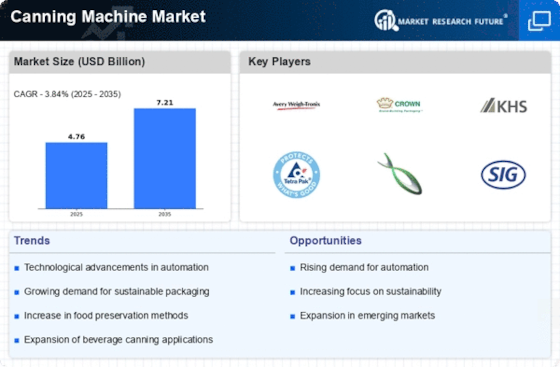
As per Market Research Future analysis, the Canning Machine Market Size was estimated at 4.759 USD Billion in 2024. The Canning Machine industry is projected to grow from 4.942 USD Billion in 2025 to 7.205 USD Billion by 2035, exhibiting a compound annual growth rate (CAGR) of 3.84% during the forecast period 2025 - 2035

Key Market Trends & Highlights

The Canning Machine Market is experiencing robust growth driven by technological advancements and rising consumer demand.

  • Automation and technology integration are reshaping the canning machine landscape, enhancing efficiency and productivity.
  • Sustainability initiatives are becoming increasingly vital, as manufacturers seek eco-friendly practices in production.
  • The food and beverage industry remains the largest segment, while the pharmaceutical industry is emerging as the fastest-growing sector.
  • Technological advancements in canning machines and the growing demand for packaged foods are key drivers propelling market expansion.

Market Size & Forecast

2024 Market Size 4.759 (USD Billion)
2035 Market Size 7.205 (USD Billion)
CAGR (2025 - 2035) 3.84%

Major Players

Avery Weigh-Tronix (GB), Crown Holdings (US), KHS GmbH (DE), Tetra Pak (SE), Marel (IS), Scholle IPN (US), Ossid (US), Cozzoli Machine Company (US), Fowler Products (US)

Our Impact
Enabled $4.3B Revenue Impact for Fortune 500 and Leading Multinationals
Partnering with 2000+ Global Organizations Each Year
30K+ Citations by Top-Tier Firms in the Industry

Canning Machine Market Trends

The Canning Machine Market is currently experiencing a dynamic evolution, driven by various factors that influence production efficiency and consumer preferences. As manufacturers strive to enhance operational capabilities, there is a noticeable shift towards automation and advanced technology integration. This trend appears to be fueled by the need for increased productivity and reduced labor costs, which are critical in a competitive landscape. Furthermore, sustainability concerns are prompting companies to adopt eco-friendly practices, leading to innovations in canning processes that minimize waste and energy consumption. In addition, the demand for convenience foods continues to rise, which seems to be propelling the growth of the Canning Machine Market. Consumers increasingly favor ready-to-eat products, thereby encouraging manufacturers to invest in canning solutions that ensure product longevity and safety. This evolving consumer behavior indicates a potential for further advancements in canning technology, as businesses seek to meet the changing needs of their clientele. Overall, the Canning Machine Market is poised for significant transformation, with trends suggesting a future that prioritizes efficiency, sustainability, and consumer satisfaction.

Automation and Technology Integration

The Canning Machine Market is witnessing a trend towards automation, as manufacturers increasingly incorporate advanced technologies into their production lines. This shift aims to enhance efficiency, reduce operational costs, and improve product quality. Automated systems are likely to streamline processes, allowing for faster production cycles and minimizing human error.

Sustainability Initiatives

There is a growing emphasis on sustainability within the Canning Machine Market, as companies seek to adopt environmentally friendly practices. This trend may involve the development of machines that utilize less energy and generate less waste during the canning process. Such initiatives not only address environmental concerns but also appeal to eco-conscious consumers.

Rising Demand for Convenience Foods

The increasing consumer preference for convenience foods is shaping the Canning Machine Market. As more individuals seek ready-to-eat options, manufacturers are likely to invest in canning technologies that enhance product preservation and safety. This trend suggests a potential for innovation in canning methods to cater to evolving consumer tastes.

Canning Machine Market Drivers

Expansion of Emerging Markets

The Canning Machine Market is poised for growth due to the expansion of emerging markets. As economies in regions such as Asia-Pacific and Latin America continue to develop, there is a rising demand for canned products driven by urbanization and changing dietary habits. Recent market analyses suggest that the Asia-Pacific region alone is expected to witness a growth rate of over 6% in the canned food sector by 2027. This trend is encouraging manufacturers to invest in canning technologies that cater to the specific needs of these markets. Additionally, the increasing availability of modern retail channels is facilitating the distribution of canned goods, further propelling market growth. As a result, the Canning Machine Market is likely to benefit from the burgeoning opportunities presented by these emerging markets.

Growing Demand for Packaged Foods

The Canning Machine Market is significantly influenced by the increasing demand for packaged foods. As consumers seek convenience and longer shelf life in their food products, manufacturers are turning to canning as a viable preservation method. Recent statistics indicate that the packaged food sector is expected to grow at a compound annual growth rate of approximately 5% over the next five years. This surge in demand is prompting food producers to invest in advanced canning machines to meet consumer preferences. Additionally, the rise in on-the-go lifestyles is further propelling the need for ready-to-eat canned products. Consequently, the Canning Machine Market is poised for expansion as it adapts to these evolving consumer trends, ensuring that manufacturers can efficiently meet the rising demand for packaged foods.

Sustainability and Eco-Friendly Practices

The Canning Machine Market is increasingly aligning with sustainability and eco-friendly practices. As environmental concerns gain traction, manufacturers are seeking ways to reduce waste and energy consumption in the canning process. The adoption of energy-efficient canning machines and recyclable packaging materials is becoming a priority for many companies. Recent studies indicate that the market for sustainable packaging is expected to grow significantly, with a projected increase of 7% annually. This shift towards sustainability not only appeals to environmentally conscious consumers but also helps companies reduce operational costs. Consequently, the Canning Machine Market is likely to see a rise in demand for machines that support sustainable practices, reflecting a broader commitment to environmental responsibility within the food production sector.

Focus on Food Safety and Quality Standards

In the Canning Machine Market, the emphasis on food safety and quality standards is becoming increasingly paramount. Regulatory bodies are implementing stringent guidelines to ensure that canned products meet safety requirements, which in turn drives the need for advanced canning technologies. Manufacturers are compelled to invest in high-quality canning machines that comply with these regulations, thereby enhancing product safety and quality. Data suggests that The Canning Machine Market is projected to reach USD 20 billion by 2026, indicating a growing focus on safety across the food supply chain. As a result, the Canning Machine Market is likely to benefit from this trend, as companies prioritize investments in equipment that not only meets regulatory standards but also enhances consumer trust in canned products.

Technological Advancements in Canning Machines

The Canning Machine Market is experiencing a notable transformation due to rapid technological advancements. Innovations such as automated canning lines and smart technology integration are enhancing efficiency and precision in the canning process. For instance, the introduction of IoT-enabled machines allows for real-time monitoring and predictive maintenance, which can reduce downtime and operational costs. According to recent data, the adoption of advanced canning technologies is projected to increase productivity by up to 30% over the next few years. This trend not only improves the quality of canned products but also meets the growing consumer demand for high-quality, safe food products. As manufacturers invest in these technologies, the Canning Machine Market is likely to witness significant growth, driven by the need for enhanced production capabilities.


Market Segment Insights

By Machine Type: Automatic Canning Machines (Largest) vs. Semi-Automatic Canning Machines (Fastest-Growing)

The Canning Machine Market is distinctly segmented into automatic, semi-automatic, manual, and laboratory canning machines. Automatic canning machines dominate the market due to their efficiency and reliability, catering to high-volume production needs. Semi-automatic machines, while smaller in market share, are rapidly gaining traction for their balance between manual control and automation, making them popular among small to medium-sized manufacturers.

Canning Machines: Automatic (Dominant) vs. Semi-Automatic (Emerging)

Automatic canning machines are the backbone of large-scale food processing operations. They offer exceptional speed, precision, and reliability, which are critical for high-volume bottling requirements. These machines often feature advanced automation technologies, reducing labor costs and enhancing production efficiency. Conversely, semi-automatic canning machines are becoming increasingly popular due to their flexibility and lower upfront costs, appealing particularly to artisanal producers and smaller operations that require a manageable level of automation without losing control of the process. The growing demand for customizable production solutions is propelling this segment forward, marking it as an emerging player in the market.

By End User: Food and Beverage Industry (Largest) vs. Pharmaceutical Industry (Fastest-Growing)

The canning machine market is primarily dominated by the Food and Beverage Industry, which holds the largest share of end-user applications. This sector continuously drives demand for efficient canning solutions to meet consumer preferences for preserved foods that are safe and retain nutritional value. In contrast, the Pharmaceutical Industry is experiencing rapid growth in canning solutions, as there is an increasing need for drug packaging that ensures safety and extends shelf life for medications.

Food and Beverage Industry: Dominant vs. Pharmaceutical Industry: Emerging

The Food and Beverage Industry is characterized by its robust demand for canning machines, driven by the necessity for preserving food products in a convenient, long-lasting format. This segment emphasizes innovation in canning technologies to enhance quality and freshness while complying with strict safety standards. On the other hand, the Pharmaceutical Industry is emerging as a significant growth area for canning machines, as manufacturers seek advanced canning solutions for packaging drugs and nutraceuticals. This segment emphasizes precision and sterility in packaging, reflecting the industry's focus on ensuring product integrity and safety throughout the supply chain.

By Can Type: Metal Cans (Largest) vs. Glass Cans (Fastest-Growing)

In the Canning Machine Market, the segment distribution is led by Metal Cans, which hold the largest share amongst the various can types. This popularity stems from their durability, recyclability, and overall efficiency in canning processes. Metal Cans are favored across multiple industries, including food and beverage, due to their ability to preserve product integrity and extend shelf life. Glass Cans follow with a notable presence, particularly in premium markets, valued for their aesthetic appeal and sustainability aspects. Growth trends show that Glass Cans are rapidly gaining traction as consumer preferences shift towards eco-friendly packaging options. The increasing awareness surrounding environmental sustainability drives manufacturers to innovate with Glass Cans, making them lighter and more economical. The advent of advanced canning technologies also supports the expansion of both Metal and Glass Cans, ensuring these segments remain competitive and responsive to market demands.

Metal Cans (Dominant) vs. Glass Cans (Emerging)

Metal Cans dominate the canning landscape due to their exceptional strength and resistance to rust, making them suitable for a wide range of products, including beverages and food items. This segment has established a strong market position, largely attributed to their economic production processes and effective preservation qualities. While traditional Metal Cans remain unrivaled in durability, Glass Cans are emerging as a viable alternative, particularly in segments that prioritize sustainability and customer perception. Glass Cans are increasingly used for premium products, reflecting quality and health, leading to their rapid adoption. The transition to eco-friendliness in packaging is enabling Glass Cans to carve out a prominent niche as consumers gravitate towards sustainable options.

By Operational Mode: Batch (Largest) vs. Mobile (Fastest-Growing)

In the Canning Machine Market, the operational mode segment is divided primarily into three categories: Continual, Batch, and Mobile. Currently, Batch cans hold the largest market share due to their consistency and efficiency in high-volume production settings. Meanwhile, Continual and Mobile modes are gaining traction, with Mobile emerging as a popular choice among smaller manufacturers and vendors, making it more competitive in terms of market penetration.

Batch (Dominant) vs. Mobile (Emerging)

Batch operational mode has established itself as a dominant player in the Canning Machine Market, primarily favored for its ability to handle large volumes efficiently. This mode allows for flexibility in production schedules and is well-suited for businesses with consistent manufacturing demands. On the other hand, the Mobile operational mode is increasingly being recognized as an emerging alternative. It caters to smaller businesses and those seeking on-site canning solutions, promoting convenience and reduce costs associated with transportation. The portability of mobile machines is driving their adoption, especially in markets with fluctuating demand and entrepreneurial ventures looking for adaptability.

Get more detailed insights about Canning Machine Market

Regional Insights

North America : Market Leader in Canning

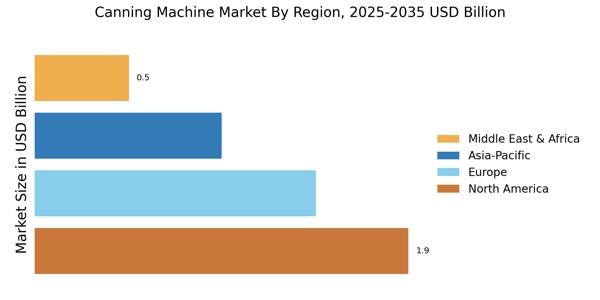
North America is the largest market for canning machines, holding approximately 40% of the global market share. The region's growth is driven by increasing demand for packaged food and beverages, coupled with stringent food safety regulations. The U.S. and Canada are the primary contributors, with a focus on innovation and sustainability in packaging solutions. Regulatory support for food safety standards further propels market growth, ensuring high-quality production processes. The competitive landscape in North America is robust, featuring key players such as Crown Holdings and Scholle IPN. The presence of advanced manufacturing technologies and a strong distribution network enhances market dynamics. Additionally, the region benefits from significant investments in R&D, leading to the development of efficient and eco-friendly canning solutions. This competitive edge positions North America as a leader in The Canning Machine Market.

Europe : Innovation and Sustainability Focus

Europe is the second-largest market for canning machines, accounting for approximately 30% of the global market share. The region's growth is fueled by increasing consumer preference for sustainable packaging and the rise of ready-to-eat meals. Countries like Germany and France are at the forefront, supported by stringent EU regulations that promote food safety and environmental sustainability, driving demand for advanced canning technologies. The competitive landscape in Europe is characterized by a mix of established players and innovative startups. Key companies such as KHS GmbH and Tetra Pak are leading the charge in developing cutting-edge canning solutions. The region's emphasis on sustainability and efficiency in production processes is reshaping the market, encouraging investments in new technologies. This focus on innovation positions Europe as a significant player in The Canning Machine Market.

Asia-Pacific : Emerging Market Potential

Asia-Pacific is rapidly emerging as a significant player in the canning machine market, holding approximately 20% of the global market share. The region's growth is driven by rising disposable incomes, urbanization, and changing consumer lifestyles that favor convenience foods. Countries like China and India are leading this growth, supported by government initiatives aimed at boosting food processing industries and enhancing food safety standards. The competitive landscape in Asia-Pacific is evolving, with both local and international players vying for market share. Companies such as Marel and Ossid are expanding their presence, focusing on innovative canning solutions tailored to regional needs. The increasing demand for packaged food products and beverages is fostering a dynamic market environment, making Asia-Pacific a key region for future growth in the canning machine sector.

Middle East and Africa : Untapped Market Opportunities

The Middle East and Africa represent an emerging frontier in the canning machine market, holding approximately 10% of the global market share. The region's growth is driven by increasing investments in food processing and packaging industries, alongside a growing population that demands convenient food options. Countries like South Africa and the UAE are leading the charge, supported by government initiatives to enhance food security and promote local manufacturing. The competitive landscape in this region is characterized by a mix of local and international players. Companies are increasingly focusing on adapting their products to meet local tastes and preferences. The presence of key players such as Cozzoli Machine Company and Fowler Products is enhancing market dynamics. As the region continues to develop its food processing capabilities, the canning machine market is poised for significant growth in the coming years.

Canning Machine Market Regional Image

Key Players and Competitive Insights

The competitive insights of the Global Canning Machine Market reveal a landscape characterized by innovation, technological advancements, and a diverse range of manufacturing solutions that cater to a variety of industries, including food and beverage, pharmaceuticals, and consumer goods. Stakeholders in this market continuously strive to enhance operational efficiency, extend product shelf life, and meet the evolving needs of consumers. As demand for packaged products rises globally, companies are focusing on maximizing automation, reducing costs, and improving sustainability practices.
The competitive dynamics involve established players working alongside newer entrants, fostering a robust environment where differentiation through technology and service offerings becomes critical for capturing market share. Thus, a comprehensive understanding of competitive positioning is essential for stakeholders seeking to navigate this multifaceted market.Tetra Pak stands out in the Global Canning Machine Market primarily due to its robust portfolio of innovative canning solutions designed for the food and beverage sector. The company's strengths lie in its extensive experience and expertise, providing comprehensive services that encompass design, manufacturing, and maintenance of canning machinery.
Tetra Pak is well-regarded for its high-quality standards and emphasis on food safety, which resonates strongly with manufacturers seeking reliable solutions. The company's globally recognized brand also plays a pivotal role in attracting partnerships and collaborations within the industry. Furthermore, Tetra Pak's commitment to sustainability through the development of eco-friendly packaging and energy-efficient machinery fosters a competitive advantage, meeting the increasing regulatory demands and consumer preferences for environmentally conscious products.Multivac is another key player in the Global Canning Machine Market, known for its advanced packaging solutions that include state-of-the-art canning machinery tailored for a wide array of applications.
With a strong presence in various global markets, Multivac leverages its comprehensive knowledge of processing and packaging technologies to provide integrated solutions that enhance productivity and efficiency. The company’s emphasis on innovation is central to its market strategy, enabling it to offer cutting-edge equipment that minimizes downtime and maximizes throughput for its clients. Multivac’s responsive approach to customer needs allows it to deliver customized solutions that align perfectly with the unique demands of the canning sector.
Moreover, its focus on continuous improvement and investment in research and development solidifies its standing as a forward-thinking leader in the canning equipment market, further enhancing its competitiveness.

Key Companies in the Canning Machine Market include

Industry Developments

The Global Canning Machine Market has witnessed significant developments recently, particularly driven by the growing demand for packaged food and sustainability initiatives. Tetra Pak and Krones AG are advancing their technologies for efficient canning solutions to reduce waste and enhance production efficiency. Multivac and Marel are emphasizing automation and integration of smart technologies to improve operational efficiency. In terms of mergers and acquisitions, Crown Holdings has been making strategic moves to enhance its market presence, although specific details of recent activities are not publicly disclosed.

Additionally, companies like Sealed Air Corporation are focusing on environmentally friendly packaging solutions, aligning with global sustainability trends. Overall, the market valuation for players such as Festo, Ishida, and Schneider Electric is expanding, propelled by the increasing consumer preference for canned products and innovations in manufacturing processes. Furthermore, Omron Corporation is incorporating advanced robotics to streamline operations, indicating a trend toward more automated solutions in canning processes. The collective strides made by these companies are shaping a competitive landscape aimed at meeting the evolving needs within the Global Canning Machine Market.

Future Outlook

Canning Machine Market Future Outlook

The Canning Machine Market is projected to grow at a 3.84% CAGR from 2025 to 2035, driven by automation, sustainability, and increasing demand for packaged foods.

New opportunities lie in:

  • Integration of IoT for real-time monitoring and efficiency optimization.
  • Development of eco-friendly canning solutions to meet sustainability goals.
  • Expansion into emerging markets with tailored canning technologies.

By 2035, the Canning Machine Market is expected to achieve robust growth and innovation.

Market Segmentation

Canning Machine Market Can Type Outlook

  • Metal Cans
  • Glass Cans
  • Plastic Cans
  • Composite Cans

Canning Machine Market End User Outlook

  • Food and Beverage Industry
  • Pharmaceutical Industry
  • Cosmetic Industry
  • Chemical Industry

Canning Machine Market Machine Type Outlook

  • Automatic Canning Machines
  • Semi-Automatic Canning Machines
  • Manual Canning Machines
  • Laboratory Canning Machines

Canning Machine Market Operational Mode Outlook

  • Continual
  • Batch
  • Mobile

Report Scope

MARKET SIZE 20244.759(USD Billion)
MARKET SIZE 20254.942(USD Billion)
MARKET SIZE 20357.205(USD Billion)
COMPOUND ANNUAL GROWTH RATE (CAGR)3.84% (2025 - 2035)
REPORT COVERAGERevenue Forecast, Competitive Landscape, Growth Factors, and Trends
BASE YEAR2024
Market Forecast Period2025 - 2035
Historical Data2019 - 2024
Market Forecast UnitsUSD Billion
Key Companies ProfiledAvery Weigh-Tronix (GB), Crown Holdings (US), KHS GmbH (DE), Tetra Pak (SE), Marel (IS), Scholle IPN (US), Ossid (US), Cozzoli Machine Company (US), Fowler Products (US)
Segments CoveredMachine Type, End User, Can Type, Operational Mode, Regional
Key Market OpportunitiesIntegration of automation and smart technology enhances efficiency in the Canning Machine Market.
Key Market DynamicsTechnological advancements and sustainability concerns drive innovation and competition in the canning machine market.
Countries CoveredNorth America, Europe, APAC, South America, MEA
Leave a Comment

FAQs

What is the projected market valuation of the Canning Machine Market by 2035?

The Canning Machine Market is projected to reach a valuation of 7.205 USD Billion by 2035.

What was the market valuation of the Canning Machine Market in 2024?

In 2024, the Canning Machine Market was valued at 4.759 USD Billion.

What is the expected CAGR for the Canning Machine Market during the forecast period 2025 - 2035?

The expected CAGR for the Canning Machine Market during the forecast period 2025 - 2035 is 3.84%.

Which segment of the Canning Machine Market had the highest valuation in 2024?

In 2024, the Food and Beverage Industry segment had the highest valuation at 2.5 USD Billion.

What are the projected valuations for Automatic Canning Machines by 2035?

The projected valuation for Automatic Canning Machines is expected to reach 2.3 USD Billion by 2035.

Which key players are leading the Canning Machine Market?

Key players in the Canning Machine Market include Crown Holdings, KHS GmbH, and Tetra Pak.

What is the expected growth for Semi-Automatic Canning Machines from 2024 to 2035?

Semi-Automatic Canning Machines are projected to grow from 1.2 USD Billion in 2024 to 1.8 USD Billion by 2035.

How does the valuation of Glass Cans compare to Plastic Cans in 2024?

In 2024, Glass Cans were valued at 1.2 USD Billion, while Plastic Cans were valued at 1.0 USD Billion.

What is the projected valuation for the Chemical Industry segment by 2035?

The projected valuation for the Chemical Industry segment is expected to reach 1.105 USD Billion by 2035.

What operational mode is expected to see the highest growth in the Canning Machine Market?

The Mobile operational mode is expected to grow from 1.429 USD Billion in 2024 to 2.296 USD Billion by 2035.

Download Free Sample

Kindly complete the form below to receive a free sample of this Report

Compare Licence

×
Features License Type
Single User Multiuser License Enterprise User
Price $4,950 $5,950 $7,250
Maximum User Access Limit 1 User Upto 10 Users Unrestricted Access Throughout the Organization
Free Customization
Direct Access to Analyst
Deliverable Format
Platform Access
Discount on Next Purchase 10% 15% 15%
Printable Versions