×
Request Free Sample ×

Kindly complete the form below to receive a free sample of this Report

* Please use a valid business email

Leading companies partner with us for data-driven Insights

clients tt-cursor
Hero Background

US Machine 2 Machine Connections Market

ID: MRFR/SEM/14763-HCR
100 Pages
Garvit Vyas
February 2026

United States Machine 2 Machine Connections Industry Research Report to 2032

Share:
Download PDF ×

We do not share your information with anyone. However, we may send you emails based on your report interest from time to time. You may contact us at any time to opt-out.

US Machine 2 Machine Connections Market Infographic
Purchase Options

US Machine 2 Machine Connections Market Summary

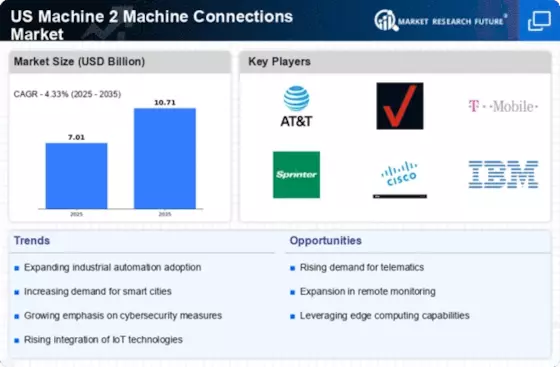
As per analysis, the US Machine 2 Machine Connections Market is projected to grow from USD 6.72 Billion in 2024 to USD 10.71 Billion by 2035, exhibiting a compound annual growth rate (CAGR) of 4.33% during the forecast period (2025 - 2035).

Key Market Trends & Highlights

The US Machine 2 Machine Connections Market is poised for robust growth driven by technological advancements and increasing demand for smart solutions.

  • The telematics segment remains the largest contributor to the M2M connections market, reflecting the growing integration of connected vehicles.
  • Smart metering is emerging as the fastest-growing segment, driven by the need for efficient energy management and consumption monitoring.
  • In the automotive sector, the demand for connected vehicles continues to surge, while healthcare applications are rapidly expanding due to advancements in remote patient monitoring.
  • Key market drivers include the growing demand for smart devices and advancements in wireless communication technologies, which are enhancing M2M connectivity.

Market Size & Forecast

2024 Market Size 6.72 (USD Billion)
2035 Market Size 10.71 (USD Billion)
CAGR (2025 - 2035) 4.33%

Major Players

AT&T (US), Verizon (US), T-Mobile (US), Sprint (US), Cisco Systems (US), IBM (US), Oracle (US), GE (US), Honeywell (US)

Our Impact
Enabled $4.3B Revenue Impact for Fortune 500 and Leading Multinationals
Partnering with 2000+ Global Organizations Each Year
30K+ Citations by Top-Tier Firms in the Industry

US Machine 2 Machine Connections Market Trends

The US Machine 2 Machine Connections Market is currently experiencing a transformative phase, driven by advancements in technology and increasing demand for automation across various sectors. The proliferation of Internet of Things (IoT) devices is reshaping how industries operate, leading to enhanced efficiency and productivity. As organizations seek to optimize their operations, the integration of M2M connections becomes crucial. This market is characterized by a diverse range of applications, including smart cities, healthcare, and transportation, each contributing to the overall growth and evolution of M2M technologies. Furthermore, the regulatory environment in the United States is adapting to support the expansion of M2M connectivity, fostering innovation and investment in this sector. In addition, the US Machine 2 Machine Connections Market is witnessing a shift towards more secure and reliable communication protocols. As concerns regarding data privacy and cybersecurity continue to rise, businesses are prioritizing solutions that ensure the integrity of their M2M systems. This trend is likely to influence the development of new technologies and standards, as stakeholders aim to create a robust framework for M2M communications. Overall, the market appears poised for sustained growth, with various factors indicating a promising future for M2M connections in the United States.

Increased Adoption of IoT Solutions

The US Machine 2 Machine Connections Market is seeing a marked increase in the adoption of Internet of Things (IoT) solutions. This trend is largely driven by the need for enhanced operational efficiency and real-time data analytics. Industries such as manufacturing, agriculture, and logistics are increasingly integrating IoT devices to streamline processes and improve decision-making. As a result, M2M connections are becoming essential for businesses aiming to remain competitive in a rapidly evolving landscape.

Focus on Security and Data Privacy

In the context of the US Machine 2 Machine Connections Market, there is a growing emphasis on security and data privacy. As M2M systems become more prevalent, concerns regarding potential vulnerabilities and data breaches are prompting organizations to invest in robust security measures. This trend indicates a shift towards developing secure communication protocols and standards that protect sensitive information, thereby fostering trust among users and stakeholders.

Regulatory Support for M2M Technologies

The regulatory landscape in the United States is evolving to support the growth of M2M technologies. Policymakers are recognizing the importance of M2M connections in driving innovation and economic development. This trend suggests that future regulations may facilitate the deployment of M2M solutions, encouraging investment and collaboration among industry players. As regulations adapt, the US Machine 2 Machine Connections Market is likely to benefit from a more conducive environment for technological advancement.

US Machine 2 Machine Connections Market Drivers

Growing Demand for Smart Devices

The US Machine 2 Machine Connections Market is experiencing a notable surge in demand for smart devices across various sectors. This trend is driven by the increasing integration of connected devices in homes, industries, and healthcare. According to recent data, the number of connected devices in the US is projected to reach over 30 billion by 2026, significantly boosting M2M connections. This proliferation of smart devices necessitates robust M2M communication solutions, thereby enhancing the market's growth potential. As consumers and businesses alike seek to leverage the benefits of automation and real-time data, the demand for M2M connections is likely to escalate, positioning the US as a leader in the global M2M landscape.

Emerging Applications in Healthcare

The US Machine 2 Machine Connections Market is increasingly influenced by the emergence of innovative applications in the healthcare sector. The integration of M2M technologies in telemedicine, remote patient monitoring, and health data management is transforming the way healthcare services are delivered. With the rise of wearable health devices and connected medical equipment, the demand for reliable M2M connections is on the rise. According to industry forecasts, the healthcare M2M market is expected to grow significantly, driven by the need for improved patient outcomes and operational efficiencies. As healthcare providers continue to adopt M2M solutions, the market is poised for substantial expansion.

Rising Investment in Smart Infrastructure

The US Machine 2 Machine Connections Market is benefiting from a significant increase in investment in smart infrastructure projects. Government initiatives aimed at modernizing transportation, energy, and communication systems are creating a favorable environment for M2M technologies. For example, the US Department of Transportation has been promoting smart transportation systems that rely on M2M connections for traffic management and safety. This investment not only enhances public services but also stimulates demand for M2M solutions in various applications. As cities and states allocate funds for smart infrastructure, the M2M market is likely to experience robust growth, driven by the need for interconnected systems.

Increased Focus on Automation and Efficiency

The US Machine 2 Machine Connections Market is witnessing a heightened emphasis on automation and operational efficiency across various sectors. Industries such as manufacturing, logistics, and agriculture are increasingly adopting M2M technologies to streamline processes and reduce costs. For instance, the implementation of M2M solutions in supply chain management has been shown to enhance tracking and inventory management, leading to improved efficiency. As organizations strive to remain competitive, the integration of M2M connections is becoming essential. This trend is expected to drive substantial growth in the market, as businesses recognize the value of real-time data and automated systems in optimizing their operations.

Advancements in Wireless Communication Technologies

The evolution of wireless communication technologies is a pivotal driver for the US Machine 2 Machine Connections Market. Innovations such as 5G technology are set to revolutionize M2M communications by providing faster data transfer rates and lower latency. This advancement enables a broader range of applications, from autonomous vehicles to smart city infrastructure. The Federal Communications Commission (FCC) has been actively promoting the rollout of 5G networks, which is expected to enhance connectivity for M2M devices significantly. As these technologies mature, they will likely facilitate the deployment of more sophisticated M2M solutions, thereby expanding the market's scope and capabilities.


Market Segment Insights

By Application: Telematics (Largest) vs. Smart Metering (Fastest-Growing)

In the US Machine 2 Machine Connections Market, the application segment is comprised of Telematics, Smart Metering, Industrial Automation, Healthcare, and Transportation. Among these, Telematics holds the largest share, driven by the expanding need for connected vehicle solutions and fleet management systems. Smart Metering, on the other hand, is gaining ground rapidly, reflecting a strong shift towards energy efficiency and remote monitoring of utilities that resonates with both consumers and regulators alike.

Telematics (Dominant) vs. Smart Metering (Emerging)

Telematics is established as the dominant player in the application segment due to its significant integration within the automotive sector, facilitating real-time data exchange and analytics. It encompasses various applications, including vehicle tracking and diagnostics, positioning it as a critical driver of efficiency and safety. Conversely, Smart Metering is emerging rapidly, fueled by an increasing demand for automated utilities management and regulatory pressure for energy conservation. This segment is characterized by advanced sensors and communication technologies, allowing utility companies to enhance operational efficiency and deliver better service to customers. As both segments evolve, they are likely to intersect, leveraging IoT innovations for enhanced functionalities.

By End Use: Automotive (Largest) vs. Healthcare (Fastest-Growing)

In the US Machine 2 Machine (M2M) Connections Market, the automotive sector holds the largest market share, driven by the increasing integration of connected technologies in vehicles. This segment encompasses applications such as telematics, remote diagnostics, and fleet management, which enhance vehicle performance and user experience. Following closely, the healthcare sector is witnessing exponential growth as more health devices and systems become interconnected, supporting telehealth and patient monitoring solutions.

Automotive: Dominant vs. Healthcare: Emerging

The automotive sector remains dominant in the M2M Connections Market due to the continuous advancements in connected car technologies. Major manufacturers are investing heavily in platforms that allow for real-time data exchange, which enhances safety and offers improved customer services, such as navigation and infotainment. Conversely, the healthcare segment is rapidly emerging, propelled by the demand for better patient care and health management through remote monitoring. Innovations such as wearable health devices and internet-enabled medical systems are driving this growth, making healthcare one of the most promising areas for M2M connectivity due to its potential to streamline operations and enhance patient outcomes.

By Technology: Cellular (Largest) vs. Satellite (Fastest-Growing)

In the US Machine 2 Machine Connections Market, the Cellular technology segment holds the largest share, driven by its widespread adoption across various industries, including automotive, healthcare, and manufacturing. Its robust infrastructure and the ability to provide stable and high-speed connectivity make it a preferred choice for critical applications. Conversely, the Satellite segment, while not as large as Cellular, is witnessing rapid growth due to its capability to connect remote areas lacking cellular coverage and its importance in many IoT applications.

Technology: Cellular (Dominant) vs. Satellite (Emerging)

Cellular technology remains dominant in the US Machine 2 Machine Connections Market due to its extensive coverage and reliability. Its applications span multiple industries, ensuring consistent connectivity for devices that require real-time data transmission. Meanwhile, Satellite technology is emerging rapidly as it fills the gaps in coverage, especially in rural and hard-to-reach regions. The potential for satellite IoT applications is substantial, as advancements in satellite technology are enabling better data rates and reduced latency. As more enterprises seek comprehensive connectivity solutions, Satellite is on track to become a more significant player in the market.

By Connectivity Type: Wireless (Largest) vs. Wired (Fastest-Growing)

In the US Machine 2 Machine Connections Market, the connectivity type segment is led by wireless connections, which dominate the market due to their extensive range and ease of deployment. They account for the largest share as businesses increasingly adopt wireless technologies for their flexibility and the growing demand for IoT devices. Conversely, wired connections maintain a significant presence, especially in industrial settings, where reliability and speed are crucial factors in operations, but they are facing stiff competition from their wireless counterparts. Growth trends indicate a shift towards accelerated wireless adoption, driven by advancements in cellular networks such as 5G, which significantly enhance data transmission speeds and lower latency. Wired connections, however, are experiencing a rapid increase as businesses upgrade their infrastructure to support hybrid models that leverage both connectivity types, ensuring robustness in communication for mission-critical applications. This dual approach reflects a growing recognition of the advantages offered by both wired and wireless solutions, allowing for greater operational flexibility.

Connectivity: Wireless (Dominant) vs. Wired (Emerging)

Wireless connectivity has emerged as the dominant force in the US Machine 2 Machine Connections Market, offering exceptional ease of integration and scalability, essential for diverse applications ranging from smart grids to telehealth. With the rise of Internet of Things (IoT) devices, wireless technologies are increasingly favored for their ability to support a multitude of connections without the need for extensive physical infrastructure. Meanwhile, wired connectivity is experiencing an emergent phase where businesses are recognizing the benefits of stable and secure connections, especially in environments that require substantial data handling, such as manufacturing and logistics. The growing adoption of hybrid systems that leverage both wireless and wired connectivity highlights the need for flexibility while also addressing concerns regarding reliability and latency.

By Data Transmission Type: Real-time (Largest) vs. Event-driven (Fastest-Growing)

In the US Machine 2 Machine Connections Market, the data transmission type segment is characterized by three primary categories: real-time, batch, and event-driven. Real-time connections hold the largest share of the market, reflecting a strong preference for instantaneous data transfer among industries such as healthcare, automotive, and logistics. Batch transmission, while important, has a relatively smaller market presence and is typically used in scenarios where immediate data delivery is less critical. Event-driven transmission is rapidly gaining traction as businesses seek to leverage real-time insights triggered by specific conditions or events.

Data Transmission Type: Real-time (Dominant) vs. Event-driven (Emerging)

Real-time data transmission is currently the dominant mode within the US Machine 2 Machine Connections Market, owing to its ability to facilitate immediate responsiveness and decision-making processes. This method is integral to applications that require constant monitoring and real-time analytics, particularly in sectors like telemedicine and automated manufacturing. In contrast, event-driven transmission is emerging as a significant trend, favored for its efficiency in reducing unnecessary data flow. This method allows for data to be sent only in response to specific triggers, making it highly effective for applications in smart home technology and IoT environments where resource optimization is key.

Get more detailed insights about US Machine 2 Machine Connections Market

Key Players and Competitive Insights

The Machine 2 Machine Connections Market is characterized by a dynamic competitive landscape, driven by rapid technological advancements and increasing demand for automation across various sectors. Key players such as AT&T (US), Verizon (US), and Cisco Systems (US) are strategically positioning themselves through innovation and partnerships. AT&T (US) has focused on enhancing its IoT capabilities, while Verizon (US) emphasizes its 5G network to support M2M applications. Cisco Systems (US) is leveraging its expertise in networking to provide integrated solutions that facilitate seamless connectivity, thereby shaping a competitive environment that prioritizes technological integration and customer-centric solutions.
The market structure appears moderately fragmented, with several players vying for market share through localized strategies and supply chain optimization. Companies are increasingly localizing manufacturing to reduce lead times and enhance responsiveness to market demands. This collective influence of key players fosters a competitive atmosphere where agility and innovation are paramount, allowing firms to adapt to evolving customer needs and technological trends.
In December 2025, AT&T (US) announced a partnership with a leading automotive manufacturer to develop advanced telematics solutions aimed at enhancing vehicle connectivity. This strategic move is significant as it not only expands AT&T's footprint in the automotive sector but also aligns with the growing trend of smart vehicles, thereby positioning the company as a leader in M2M connectivity solutions.
In November 2025, Verizon (US) launched a new suite of IoT solutions designed to optimize supply chain operations for retail businesses. This initiative underscores Verizon's commitment to leveraging its 5G infrastructure to provide real-time data analytics and connectivity, which are crucial for enhancing operational efficiency. Such advancements are likely to solidify Verizon's competitive edge in the M2M market by addressing the specific needs of retail clients.
In October 2025, Cisco Systems (US) unveiled a new platform that integrates AI capabilities into its M2M solutions, aimed at improving predictive maintenance for industrial applications. This development is particularly noteworthy as it reflects the increasing importance of AI in driving operational efficiencies and reducing downtime, thereby enhancing the value proposition of Cisco's offerings in the M2M space.
As of January 2026, current competitive trends indicate a strong focus on digitalization, sustainability, and AI integration within the Machine 2 Machine Connections Market. Strategic alliances are increasingly shaping the landscape, enabling companies to pool resources and expertise to drive innovation. The shift from price-based competition to a focus on technological differentiation and supply chain reliability is evident, suggesting that future competitive dynamics will hinge on the ability to innovate and deliver integrated solutions that meet the evolving demands of customers.

Key Companies in the US Machine 2 Machine Connections Market include

Future Outlook

US Machine 2 Machine Connections Market Future Outlook

The US Machine 2 Machine Connections Market is projected to grow at a 4.33% CAGR from 2025 to 2035, driven by advancements in IoT, automation, and data analytics.

New opportunities lie in:

  • Development of smart grid technologies for energy management. Integration of AI-driven analytics in M2M systems. Expansion of telehealth solutions leveraging M2M connectivity.

By 2035, the market is expected to be robust, driven by innovative applications and increased connectivity.

Market Segmentation

US Machine 2 Machine Connections Market End Use Outlook

  • Automotive
  • Manufacturing
  • Energy
  • Healthcare
  • Retail

US Machine 2 Machine Connections Market Technology Outlook

  • Cellular
  • Satellite
  • Wi-Fi
  • Bluetooth
  • Zigbee

US Machine 2 Machine Connections Market Application Outlook

  • Telematics
  • Smart Metering
  • Industrial Automation
  • Healthcare
  • Transportation

US Machine 2 Machine Connections Market Connectivity Type Outlook

  • Wired
  • Wireless
  • Hybrid

US Machine 2 Machine Connections Market Data Transmission Type Outlook

  • Real-time
  • Batch
  • Event-driven

Report Scope

MARKET SIZE 2024 6.72(USD Billion)
MARKET SIZE 2025 7.04(USD Billion)
MARKET SIZE 2035 10.71(USD Billion)
COMPOUND ANNUAL GROWTH RATE (CAGR) 4.33% (2024 - 2035)
REPORT COVERAGE Revenue Forecast, Competitive Landscape, Growth Factors, and Trends
BASE YEAR 2024
Market Forecast Period 2025 - 2035
Historical Data 2019 - 2024
Market Forecast Units USD Billion
Key Companies Profiled AT&T (US), Verizon (US), T-Mobile (US), Sprint (US), Cisco Systems (US), IBM (US), Oracle (US), GE (US), Honeywell (US)
Segments Covered Application, End Use, Technology, Connectivity Type, Data Transmission Type
Key Market Opportunities Expansion of 5G infrastructure enhances connectivity for the US Machine 2 Machine Connections Market.
Key Market Dynamics Rising demand for automation drives growth in the US Machine to Machine Connections Market amid evolving regulatory frameworks.
Countries Covered US
Leave a Comment

FAQs

What is the current valuation of the US Machine 2 Machine Connections Market?

As of 2024, the market valuation was 6.72 USD Billion.

What is the projected market size for the US Machine 2 Machine Connections Market by 2035?

The market is projected to reach 10.71 USD Billion by 2035.

What is the expected CAGR for the US Machine 2 Machine Connections Market during the forecast period 2025 - 2035?

The expected CAGR for the market during this period is 4.33%.

Which segments are expected to show significant growth in the US Machine 2 Machine Connections Market?

Segments such as Telematics and Industrial Automation are anticipated to grow notably, with valuations reaching 2.4 and 2.8 USD Billion respectively by 2035.

How do the key players influence the US Machine 2 Machine Connections Market?

Key players like AT&T and Verizon are likely to drive innovation and competition, shaping market dynamics significantly.

What are the projected valuations for the Automotive segment by 2035?

The Automotive segment is projected to grow to 2.12 USD Billion by 2035.

What is the expected growth for the Wireless connectivity type in the US Machine 2 Machine Connections Market?

The Wireless connectivity type is expected to increase to 5.3 USD Billion by 2035.

How does the Healthcare segment perform in the US Machine 2 Machine Connections Market?

The Healthcare segment is projected to grow from 1.0 USD Billion in 2024 to 1.5 USD Billion by 2035.

What is the anticipated growth for the Cellular technology segment by 2035?

The Cellular technology segment is expected to reach 4.25 USD Billion by 2035.

What trends are emerging in the US Machine 2 Machine Connections Market regarding data transmission types?

Real-time data transmission is projected to grow to 4.25 USD Billion by 2035, indicating a shift towards more immediate data processing.

Download Free Sample

Kindly complete the form below to receive a free sample of this Report

Compare Licence

×
Features License Type
Single User Multiuser License Enterprise User
Price $4,950 $5,950 $7,250
Maximum User Access Limit 1 User Upto 10 Users Unrestricted Access Throughout the Organization
Free Customization
Direct Access to Analyst
Deliverable Format
Platform Access
Discount on Next Purchase 10% 15% 15%
Printable Versions