×
Request Free Sample ×

Kindly complete the form below to receive a free sample of this Report

* Please use a valid business email

Leading companies partner with us for data-driven Insights

clients tt-cursor
Hero Background

Canada Web Content Management Software Market

ID: MRFR/ICT/61731-HCR
200 Pages
Aarti Dhapte
February 2026

Canada Web Content Management Software Market Size, Share and Trends Analysis Report By Component (Solution, Services), By Deployment (Cloud, Premise), By Organization Size (SME’s, Large) and By Industry (Food and Beverage, Media & Entertainment, Retail, Education, Healthcare) - Forecast to 2035

Share:
Download PDF ×

We do not share your information with anyone. However, we may send you emails based on your report interest from time to time. You may contact us at any time to opt-out.

Canada Web Content Management Software Market Infographic
Purchase Options

Canada Web Content Management Software Market Summary

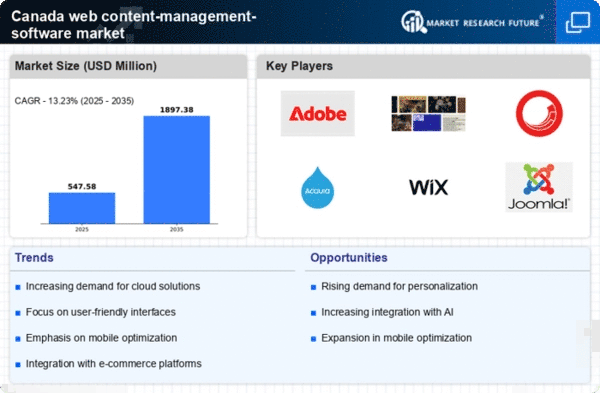
As per Market Research Future analysis, the Canada Web Content Management Software Market size was estimated at 483.6 USD Million in 2024. The Web Content-management-software market is projected to grow from 547.58 USD Million in 2025 to 1897.38 USD Million by 2035, exhibiting a compound annual growth rate (CAGR) of 13.2% during the forecast period 2025 - 2035

Key Market Trends & Highlights

The Canada web content-management-software market is experiencing a transformative shift towards advanced technologies and user-centric solutions.

  • The integration of AI and automation is reshaping content management processes, enhancing efficiency and personalization.
  • Cloud-based solutions are becoming increasingly prevalent, driven by the need for scalability and remote accessibility.
  • Mobile optimization is a critical focus, as businesses aim to deliver seamless experiences across devices.
  • The growing demand for digital content and increased focus on user experience are key drivers propelling market growth.

Market Size & Forecast

2024 Market Size 483.6 (USD Million)
2035 Market Size 1897.38 (USD Million)
CAGR (2025 - 2035) 13.23%

Major Players

Adobe (US), WordPress (US), Sitecore (DK), Acquia (US), Wix (IL), Joomla (US), Drupal (US), Kentico (CZ)

Our Impact
Enabled $4.3B Revenue Impact for Fortune 500 and Leading Multinationals
Partnering with 2000+ Global Organizations Each Year
30K+ Citations by Top-Tier Firms in the Industry

Canada Web Content Management Software Market Trends

The Canada Web Content Management Software Market in Canada is currently experiencing significant changes. This evolution is driven by the increasing demand for digital content and the necessity for businesses to maintain an online presence. Organizations are recognizing the importance of effective content management systems to streamline operations, enhance user engagement, and improve overall digital strategies. As a result, there is a growing emphasis on integrating advanced features such as artificial intelligence and machine learning into these platforms. This integration appears to facilitate better content personalization and automation, which are becoming essential for businesses aiming to stay competitive in a rapidly changing digital landscape. Moreover, the market is witnessing a shift towards cloud-based solutions, which offer scalability and flexibility that traditional on-premises systems may lack. This trend suggests that companies are prioritizing cost-effective solutions that can adapt to their evolving needs. Additionally, the rise of mobile content consumption is influencing the development of web content-management-software, as organizations seek to optimize their platforms for various devices. Overall, the web content-management-software market in Canada is poised for continued growth, with innovations and user-centric approaches likely shaping its future.

Integration of AI and Automation

The incorporation of artificial intelligence and automation tools into web content-management-software is becoming increasingly prevalent. This trend indicates that businesses are seeking to enhance user experiences through personalized content delivery and streamlined workflows. AI-driven analytics may provide insights that help organizations tailor their content strategies more effectively.

Shift to Cloud-Based Solutions

There is a noticeable transition towards cloud-based web content-management-software, as organizations recognize the benefits of flexibility and scalability. This shift suggests that companies are looking for cost-effective solutions that can easily adapt to changing demands, allowing for more efficient content management.

Mobile Optimization

The growing trend of mobile content consumption is influencing the development of web content-management-software. Organizations are focusing on optimizing their platforms for mobile devices, which indicates a response to changing user behaviors and preferences. This trend highlights the importance of ensuring that content is accessible and engaging across various devices.

Canada Web Content Management Software Market Drivers

Growing Demand for Digital Content

The increasing demand for digital content in Canada is a primary driver for the web content-management-software market. As businesses and organizations strive to enhance their online presence, the need for effective content management solutions has surged. In 2025, it is estimated that the digital content creation market in Canada will reach approximately $2 billion, reflecting a growth rate of around 15% annually. This trend indicates that companies are investing more in digital marketing strategies, necessitating robust content management systems to streamline their operations. Furthermore, the rise of e-commerce and online services has amplified the requirement for efficient content management, as businesses seek to engage customers through various digital channels. Consequently, the web content-management-software market is expected to experience substantial growth as organizations adapt to these evolving digital demands.

Increased Focus on User Experience

User experience (UX) has become a critical factor in the success of digital platforms, driving the web content-management-software market in Canada. Organizations are increasingly recognizing that a seamless and engaging user experience can lead to higher customer satisfaction and retention rates. In 2025, it is projected that companies investing in UX improvements will see a return on investment of up to 300%. This focus on UX compels businesses to adopt advanced content management solutions that facilitate personalized and interactive content delivery. As a result, the web content-management-software market is likely to expand, as organizations seek tools that enable them to create, manage, and optimize content effectively. The emphasis on user-centric design and functionality is expected to shape the development of new features and capabilities within content management systems.

Regulatory Compliance and Data Security

The increasing emphasis on regulatory compliance and data security is a significant driver for the web content-management-software market in Canada. With the implementation of stringent data protection regulations, such as the Personal Information Protection and Electronic Documents Act (PIPEDA), organizations are compelled to adopt content management solutions that ensure compliance. In 2025, it is anticipated that the market for compliance-focused software will grow by approximately 20%, as businesses prioritize data security and privacy. This trend indicates a shift towards content management systems that offer robust security features, including encryption and access controls. As organizations navigate the complexities of regulatory requirements, the demand for web content-management-software that addresses these challenges is likely to increase, further propelling market growth.

Rise of Remote Work and Collaboration Tools

The rise of remote work in Canada has significantly influenced the web content-management-software market. As organizations adapt to flexible work arrangements, the need for collaborative tools that facilitate content creation and management has become paramount. In 2025, it is projected that the remote collaboration software market will reach $1.5 billion, reflecting a growth rate of 25%. This shift necessitates content management solutions that support real-time collaboration, version control, and easy access to digital assets. Consequently, the web content-management-software market is expected to expand as businesses seek to implement systems that enhance teamwork and productivity in a remote work environment. The integration of collaboration features into content management platforms is likely to become a key differentiator in the competitive landscape.

Emergence of Omnichannel Marketing Strategies

The emergence of omnichannel marketing strategies is driving the web content-management-software market in Canada. As businesses strive to provide a cohesive customer experience across multiple channels, the demand for integrated content management solutions has intensified. In 2025, it is estimated that companies employing omnichannel strategies will achieve a 30% increase in customer engagement. This trend highlights the necessity for content management systems that can seamlessly distribute content across various platforms, including websites, social media, and email. As organizations recognize the importance of a unified approach to customer interactions, the web content-management-software market is likely to witness substantial growth. The ability to manage and analyze content performance across channels will become increasingly vital for businesses aiming to enhance their marketing effectiveness.


Market Segment Insights

By Component: Solution (Largest) vs. Services (Fastest-Growing)

The Canada web content-management-software market is largely dominated by the Solution segment, which represents the largest share of the market. This segment encompasses a wide range of offerings that cater to various business needs, harnessing robust functionalities that streamline web content management processes. Conversely, the Services segment, while smaller, is gaining traction due to the increasing demand for consultancy and support services, as businesses look for tailored solutions to optimize their content management strategies. Growth trends indicate a significant rise in the Services segment as organizations prioritize enhanced user experiences and efficient content delivery. The increasing complexity of digital content has sparked a growing need for professional services that can ensure seamless implementation and ongoing support. This trend is fueled by advancements in technology, which are enabling more companies to adopt web content management solutions, thereby driving demand for supplementary services that ensure optimal performance and user satisfaction.

Solutions: Dominant vs. Services: Emerging

The Solution segment is the dominant player in the Canada web content-management-software market, recognized for its extensive array of tools that facilitate web content creation, management, and distribution. Solutions are often seen as foundational aspects for businesses looking to maintain a strong online presence. Meanwhile, the Services segment is emerging rapidly, characterized by offerings that include training, consulting, and technical support. As more organizations embark on digital transformation journeys, the need for specialized services increases, allowing the Services sector to flourish. With customizable options available, businesses can leverage these services to enhance their overall web content management capabilities, catering to specific operational requirements and user demands.

By Deployment: Cloud (Largest) vs. Premise (Fastest-Growing)

In the deployment segment of the Canada web content-management-software market, Cloud solutions hold the largest market share, driven by their flexibility and scalability. Businesses are increasingly opting for Cloud-based services due to the ease of integration and lower upfront costs. In contrast, the Premise deployment model is gaining traction among organizations that require enhanced security and data control, marking its place as a significant contender within this segment. The growth trends for both deployment types reveal a dynamic shift in preferences. Cloud deployment is continuously evolving, with advancements in technology making it more accessible and user-friendly. On the other hand, the Premise model is emerging as the fastest-growing option, spurred by businesses prioritizing data sovereignty and compliance regulations. This dual growth showcases the market's diverse needs and the strategic choices companies must make regarding their content management solutions.

Cloud (Dominant) vs. Premise (Emerging)

Cloud deployment in the Canada web content-management-software market is characterized by its wide adoption, providing businesses with the necessary tools for efficient content management without the hassle of extensive infrastructure. Companies favor the cloud for its cost-effectiveness and quick deployment capabilities. Conversely, the Premise deployment model is seeing a surge in interest as organizations demand more control over their data and privacy. This is particularly appealing to sectors with strict regulatory requirements. While Cloud remains the dominant force, the rising popularity of Premise solutions signifies an emerging opportunity and highlights the market's need for diverse deployment options catering to various organizational needs.

By Industry: Food and Beverage (Largest) vs. Media & Entertainment (Fastest-Growing)

The Canada web content-management-software market demonstrates a diverse array of demands across various industries, with the Food and Beverage sector dominating the landscape. This segment benefits from robust consumer engagement strategies and the growing trend of eCommerce, allowing it to maintain a significant share of the market. Following closely are the Media & Entertainment and Retail sectors, which also display noteworthy contributions to the overall market share, driven by digital transformation and customer-centric initiatives. Growth trends indicate that the Media & Entertainment sector is evolving as the fastest-growing segment within the Canada web content-management-software market. This growth is primarily fueled by an increase in digital content consumption and a shift towards online platforms. Factors such as the rising demand for interactive user experiences and personalized content offerings underscore the industry's expansion. Additionally, Education and Healthcare sectors are experiencing gradual growth due to increasing investments in digital infrastructure and content delivery solutions.

Food and Beverage: Dominant vs. Media & Entertainment: Emerging

The Food and Beverage segment stands as a dominant force in the Canada web content-management-software market due to its established presence and deep-rooted customer loyalty. Brands in this sector leverage content management solutions to enhance customer engagement through tailored experiences and seamless eCommerce functionalities. Conversely, the Media & Entertainment sector is emerging rapidly, fueled by a burgeoning digital audience and innovative content delivery methods. Organizations in this industry are increasingly adopting web content-management systems to streamline their content workflows, thus enhancing their reach and improving user interaction. This transition is pivotal in capitalizing on new opportunities in an increasingly competitive landscape.

By Organization Size: SMEs (Largest) vs. Large (Fastest-Growing)

In the Canada web content-management-software market, SMEs hold a significant market share, demonstrating their dominance in the landscape. This segment benefits from the growing need for scalable and cost-effective solutions, catering to a variety of industries. The proliferation of digital operations among SMEs drives their preference for web content management solutions, making them a pivotal player in the market. Conversely, the Large organization segment is recognized as the fastest-growing category, propelled by substantial investments in advanced digital technologies. Larger companies are increasingly leveraging sophisticated content-management tools to enhance operational efficiency and improve customer engagement. This trend indicates a shift in the market dynamics, with Large organizations adapting quickly to the evolving digital landscape and seeking robust, integrated solutions.

SMEs (Dominant) vs. Large (Emerging)

In the Canada web content-management-software market, SMEs are identified as the dominant force due to their agility and adaptability in adopting innovative technologies. This segment is primarily characterized by its need for user-friendly and cost-effective solutions that facilitate efficient content management and distribution. On the other hand, Large organizations represent the emerging segment, characterized by more complex requirements and a focus on scalability and security. These businesses often seek high-end functionalities and integrations to support extensive digital strategies, marking a significant contrast with the SMEs' approach. Both segments exhibit unique characteristics that influence their purchasing behaviors, reflecting the diverse needs of organizations in the market.

Get more detailed insights about Canada Web Content Management Software Market

Key Players and Competitive Insights

The web content-management-software market in Canada is characterized by a dynamic competitive landscape, driven by rapid technological advancements and evolving consumer expectations. Key players such as Adobe (US), WordPress (US), and Sitecore (DK) are at the forefront, each adopting distinct strategies to enhance their market positioning. Adobe (US) focuses on integrating artificial intelligence into its offerings, thereby enhancing user experience and operational efficiency. Meanwhile, WordPress (US) emphasizes community-driven development and customization, appealing to a broad spectrum of users from small businesses to large enterprises. Sitecore (DK) is strategically positioned towards enterprise-level solutions, leveraging its robust analytics capabilities to provide personalized content delivery, which is increasingly vital in today’s digital environment.The business tactics employed by these companies reflect a moderately fragmented market structure, where collaboration and innovation are paramount. Localizing services and optimizing supply chains are common strategies, allowing these firms to cater to regional preferences while maintaining operational efficiency. The collective influence of these key players shapes a competitive environment that encourages continuous improvement and adaptation to market demands.

In September Adobe (US) announced the launch of its new AI-driven content management system, which aims to streamline content creation and enhance user engagement through predictive analytics. This strategic move is significant as it positions Adobe (US) to capitalize on the growing demand for intelligent content solutions, potentially increasing its market share in a competitive landscape. The integration of AI not only enhances the user experience but also allows for more efficient content management processes, which could lead to higher customer retention rates.

In August WordPress (US) unveiled a new suite of plugins designed to enhance e-commerce capabilities for small businesses. This initiative reflects WordPress's commitment to empowering smaller enterprises by providing them with tools that facilitate online sales and customer engagement. By focusing on the needs of small businesses, WordPress (US) strengthens its market presence and fosters loyalty among its user base, which is crucial in a competitive market.

In October Sitecore (DK) entered into a strategic partnership with a leading analytics firm to enhance its data-driven marketing solutions. This collaboration is poised to elevate Sitecore's offerings by integrating advanced analytics into its content management systems, thereby enabling clients to make more informed decisions based on consumer behavior. Such partnerships are indicative of a trend towards collaborative innovation, which is essential for maintaining a competitive edge in the rapidly evolving digital landscape.

As of November the competitive trends within the web content-management-software market are increasingly defined by digitalization, sustainability, and the integration of AI technologies. Strategic alliances are becoming more prevalent, as companies recognize the value of collaboration in driving innovation and enhancing service offerings. Looking ahead, competitive differentiation is likely to evolve from traditional price-based competition to a focus on technological innovation, reliability in supply chains, and the ability to deliver personalized customer experiences. This shift underscores the importance of adaptability and forward-thinking strategies in navigating the complexities of the current market.

Key Companies in the Canada Web Content Management Software Market include

Industry Developments

Recent developments in the Canada Web Content Management Software Market highlight significant growth and activity among key players. Companies such as Kentico, Oracle, Microsoft, and Adobe are increasingly focusing on integrating artificial intelligence into their management systems to improve user experience and content personalization. Notably, in August 2023, Acquia announced the acquisition of a local content automation startup, enhancing its offerings for Drupal users in Canada. Additionally, the Canadian government's push for digital transformation across various sectors has driven demand for robust content management solutions, with organizations like Sitecore and Episerver benefiting from increased adoption rates. 

The market is valued at approximately CAD 1.2 billion, reflecting a positive growth trajectory in recent years, particularly influenced by remote work dynamics initiated by the pandemic. Companies are now competing to enhance functionalities and streamline content delivery across digital platforms, catering to the evolving needs of Canadian enterprises. In late 2022, IBM launched an initiative to support Canadian businesses in optimizing their content management processes, further stimulating the market. These trends indicate a bustling landscape shaped by both innovation and strategic collaborations among major players.

Future Outlook

Canada Web Content Management Software Market Future Outlook

The Web Content Management Software Market is projected to grow at a 13.23% CAGR from 2025 to 2035, driven by digital transformation and increasing demand for personalized content.

New opportunities lie in:

  • Integration of AI-driven content personalization tools
  • Expansion into mobile content management solutions
  • Development of subscription-based pricing models for SMEs

By 2035, the market is expected to achieve substantial growth and innovation.

Market Segmentation

Canada Web Content Management Software Market Industry Outlook

  • Food and Beverage
  • Media & Entertainment
  • Retail
  • Education
  • Healthcare

Canada Web Content Management Software Market Component Outlook

  • Solution
  • Services

Canada Web Content Management Software Market Deployment Outlook

  • Cloud
  • Premise

Canada Web Content Management Software Market Organization Size Outlook

  • SMEs
  • Large

Report Scope

MARKET SIZE 2024 483.6(USD Million)
MARKET SIZE 2025 547.58(USD Million)
MARKET SIZE 2035 1897.38(USD Million)
COMPOUND ANNUAL GROWTH RATE (CAGR) 13.23% (2025 - 2035)
REPORT COVERAGE Revenue Forecast, Competitive Landscape, Growth Factors, and Trends
BASE YEAR 2024
Market Forecast Period 2025 - 2035
Historical Data 2019 - 2024
Market Forecast Units USD Million
Key Companies Profiled Adobe (US), WordPress (US), Sitecore (DK), Acquia (US), Wix (IL), Joomla (US), Drupal (US), Kentico (CZ)
Segments Covered Component, Deployment, Industry, Organization Size
Key Market Opportunities Integration of artificial intelligence enhances user experience in the web content-management-software market.
Key Market Dynamics Growing demand for user-friendly interfaces drives competition among web content-management-software providers in Canada.
Countries Covered Canada
Leave a Comment

FAQs

What is the expected market size of the Canada Web Content Management Software Market in 2024?

The Canada Web Content Management Software Market is expected to be valued at 725.4 USD Million in 2024.

What is the projected market size for the Canada Web Content Management Software Market by 2035?

By 2035, the Canada Web Content Management Software Market is anticipated to reach 3042.0 USD Million.

What is the expected compound annual growth rate (CAGR) for the Canada Web Content Management Software Market from 2025 to 2035?

The expected CAGR for the Canada Web Content Management Software Market from 2025 to 2035 is 13.92 percent.

What were the market values for solutions and services in the Canada Web Content Management Software Market in 2024?

In 2024, the market value for solutions is expected to be 435.0 USD Million, while services are projected at 290.4 USD Million.

What will be the market values for solutions and services in the Canada Web Content Management Software Market by 2035?

By 2035, the market value for solutions is projected to grow to 1805.0 USD Million and services to 1237.0 USD Million.

Who are the key players in the Canada Web Content Management Software Market?

Major players in the market include Kentico, Oracle, Microsoft, Contentful, and Acquia, among others.

What are some key opportunities driving growth in the Canada Web Content Management Software Market?

Opportunities are driven by increasing digital content consumption and the need for businesses to enhance customer engagement.

What are the main challenges faced by the Canada Web Content Management Software Market?

Challenges include rapid technological advancements and the need for continuous updates to meet user requirements.

How is current global economic conditions impacting the Canada Web Content Management Software Market?

Current global economic conditions may affect investment decisions and resource allocation within the Canada Web Content Management Software Market.

What are the anticipated applications of web content management software in Canada?

Anticipated applications include content creation, website management, digital marketing, and user engagement analytics.

Download Free Sample

Kindly complete the form below to receive a free sample of this Report

Compare Licence

×
Features License Type
Single User Multiuser License Enterprise User
Price $4,950 $5,950 $7,250
Maximum User Access Limit 1 User Upto 10 Users Unrestricted Access Throughout the Organization
Free Customization
Direct Access to Analyst
Deliverable Format
Platform Access
Discount on Next Purchase 10% 15% 15%
Printable Versions