×
Request Free Sample ×

Kindly complete the form below to receive a free sample of this Report

* Please use a valid business email

Leading companies partner with us for data-driven Insights

clients tt-cursor
Hero Background

Canada Virtual Reality Market

ID: MRFR/ICT/60277-HCR
200 Pages
Aarti Dhapte
February 2026

Canada Virtual Reality Market Size, Share and Research Report: By Component (Hardware, Software), By Device Type (Head-Mounted Displays, Gesture Tracking Device, Projectors and Display Walls, 3D Cameras), By Technology (Non-Immersive, Semi-Immersive, Fully Immersive) and By Vertical (Consumer Electronics, Aerospace and Defense, Healthcare, Commercial, Industrial)-Forecast to 2035

Share:
Download PDF ×

We do not share your information with anyone. However, we may send you emails based on your report interest from time to time. You may contact us at any time to opt-out.

Canada Virtual Reality Market Infographic
Purchase Options

Canada Virtual Reality Market Summary

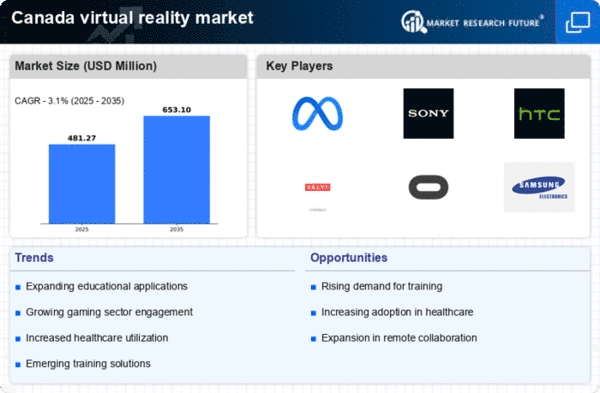
As per Market Research Future analysis, the Canada Virtual Reality Market size was estimated at 466.8 USD Million in 2024. The Virtual Reality market is projected to grow from 481.27 USD Million in 2025 to 653.1 USD Million by 2035, exhibiting a compound annual growth rate (CAGR) of 3% during the forecast period 2025 - 2035

Key Market Trends & Highlights

The Canada virtual reality market is experiencing robust growth driven by diverse applications and technological advancements.

  • The education segment is witnessing increased adoption of virtual reality technologies to enhance learning experiences.
  • Healthcare applications are expanding, with VR being utilized for training and therapeutic purposes.
  • Social virtual reality platforms are growing rapidly, reflecting a shift towards immersive social interactions.
  • Technological advancements in hardware and rising interest in gaming and entertainment are key drivers of market growth.

Market Size & Forecast

2024 Market Size 466.8 (USD Million)
2035 Market Size 653.1 (USD Million)
CAGR (2025 - 2035) 3.1%

Major Players

Meta Platforms (US), Sony (JP), HTC (TW), Valve Corporation (US), Oculus (US), Samsung Electronics (KR), Microsoft (US), Google (US), Pimax (CN)

Our Impact
Enabled $4.3B Revenue Impact for Fortune 500 and Leading Multinationals
Partnering with 2000+ Global Organizations Each Year
30K+ Citations by Top-Tier Firms in the Industry

Canada Virtual Reality Market Trends

The Canada Virtual Reality Market is currently experiencing a notable transformation, driven by advancements in technology and increasing consumer interest. As immersive experiences become more accessible, various sectors are exploring the potential applications of virtual reality. Industries such as gaming, education, and healthcare are particularly keen on integrating this technology to enhance user engagement and improve outcomes. The growing availability of affordable hardware and software solutions is likely to further stimulate market growth, as more individuals and organizations recognize the benefits of virtual reality. Moreover, the rise of social virtual reality platforms indicates a shift in how users interact with digital environments. This trend suggests that the virtual reality market is not only about individual experiences but also about fostering community and collaboration. As developers continue to innovate, the potential for virtual reality to revolutionize communication and social interaction appears promising. The ongoing investment in research and development may lead to new applications and improved user experiences, solidifying the market's position as a key player in the technology landscape.

Increased Adoption in Education

Educational institutions are increasingly incorporating virtual reality into their curricula. This trend allows students to engage in immersive learning experiences, enhancing understanding and retention of complex subjects. By simulating real-world scenarios, educators can provide practical training that traditional methods may not offer.

Expansion in Healthcare Applications

The healthcare sector is exploring virtual reality for various applications, including surgical training and patient therapy. This technology offers innovative solutions for pain management and rehabilitation, indicating a growing recognition of its potential to improve patient outcomes and streamline medical training.

Growth of Social Virtual Reality Platforms

Social virtual reality platforms are gaining traction, enabling users to interact in shared virtual spaces. This trend reflects a shift towards community-oriented experiences, where individuals can connect, collaborate, and socialize in immersive environments, potentially transforming how people engage with one another online.

Canada Virtual Reality Market Drivers

Technological Advancements in Hardware

The virtual reality market in Canada is experiencing a surge due to rapid advancements in hardware technology. Innovations in graphics processing units (GPUs), head-mounted displays (HMDs), and motion tracking systems are enhancing user experiences. For instance, the introduction of lightweight, high-resolution HMDs has made virtual reality more accessible and appealing to consumers. As of 2025, the market for VR hardware in Canada is projected to reach approximately $1.5 billion, reflecting a growth rate of around 25% annually. This growth is driven by both consumer demand for immersive experiences and the increasing availability of affordable VR devices. Consequently, the virtual reality market is poised for significant expansion as these technological improvements continue to evolve.

Integration of VR in Corporate Training

The virtual reality market in Canada is witnessing a notable increase in the integration of VR technologies in corporate training programs. Companies are recognizing the potential of virtual reality to provide realistic training simulations that enhance learning outcomes. Industries such as manufacturing, healthcare, and retail are adopting VR for training purposes, leading to improved employee performance and safety. Reports indicate that organizations utilizing VR training can reduce training costs by up to 30% while increasing retention rates. This trend suggests that the virtual reality market is becoming an essential tool for businesses aiming to enhance workforce skills and efficiency, thereby driving market growth.

Government Support and Funding Initiatives

The virtual reality market in Canada is benefiting from increased government support and funding initiatives aimed at fostering innovation in technology. Various provincial and federal programs are providing financial assistance to startups and established companies developing VR solutions. For instance, the Canadian government has allocated millions in grants to support research and development in immersive technologies. This financial backing is likely to stimulate growth within the virtual reality market, encouraging the development of new applications across sectors such as education, healthcare, and entertainment. As a result, the market is expected to expand as more companies enter the space, driven by this supportive environment.

Rising Interest in Gaming and Entertainment

The virtual reality market in Canada is significantly influenced by the growing interest in gaming and entertainment. As gaming technology evolves, consumers are increasingly seeking immersive experiences that virtual reality can provide. The Canadian gaming industry is projected to generate over $3 billion in revenue by 2025, with a substantial portion attributed to VR gaming. This trend is further supported by the increasing number of VR titles being developed, which cater to diverse audiences. The virtual reality market is thus benefiting from this heightened interest, as more gamers invest in VR systems to enhance their gaming experiences. This shift towards immersive entertainment is likely to drive further growth in the sector.

Growing Demand for Virtual Reality in Tourism

The virtual reality market in Canada is experiencing growth due to the increasing demand for VR applications in the tourism sector. As travel experiences become more competitive, tourism operators are leveraging virtual reality to offer immersive previews of destinations and attractions. This innovative approach allows potential travelers to explore locations virtually before making travel decisions. Reports indicate that the use of VR in tourism can enhance customer engagement and satisfaction, leading to increased bookings. Consequently, the virtual reality market is likely to see a rise in investments from tourism companies seeking to differentiate themselves in a crowded market, further propelling growth.


Market Segment Insights

By Component: Hardware (Largest) vs. Software (Fastest-Growing)

In the Canada virtual reality market, the component segment is predominantly driven by hardware, which holds the largest market share. This segment includes a range of devices such as headsets, sensors, and controllers, contributing significantly to the overall market dynamics. While hardware remains the backbone of VR experiences, the software segment is rapidly closing the gap, offering essential applications and platforms that enhance user engagement and functionality. The software segment is emerging as the fastest-growing area within the component segment, fueled by increasing demand for immersive applications across entertainment, education, and healthcare sectors. Factors such as rising consumer awareness and advancements in VR technology are propelling software development, leading to innovative solutions that cater to various industries. This growth trend indicates a shifting landscape where software plays a critical role in delivering seamless and enriched VR experiences.

Hardware: Dominant vs. Software: Emerging

Hardware has established itself as the dominant component in the Canada virtual reality market, characterized by robust demand for high-performance headsets and accessories. This segment is marked by continual advancements in technology, allowing for enhanced performance and user experiences. In contrast, the software segment is emerging rapidly, highlighting the increasing importance of content development and user interaction. The software encompasses a diverse range of applications, including gaming, training simulations, and social experiences, and is supported by investments aimed at innovation. This dual focus on both hardware and software illustrates the market's dynamic nature, as each component continually influences the other to drive overall growth.

By Device Type: Head-Mounted Displays (Largest) vs. Gesture Tracking Devices (Fastest-Growing)

In the Canada virtual reality market, Head-Mounted Displays hold the largest segment share as they are the most widely adopted device type among consumers and enterprises alike. Their immersive experience has made them a preferred choice in gaming, training, and experiential marketing, driving substantial market presence compared to other devices. Conversely, Gesture Tracking Devices, while smaller in market share, demonstrate significant potential for growth influenced by advancements in interactive technology and user preference for seamless experiences. The growth of Gesture Tracking Devices is fueled by increasing demand for immersive experiences across various sectors, including education, healthcare, and entertainment. Innovative applications, such as gesture-based control in virtual environments, entice developers to invest in this technology, positioning it as the fastest-growing segment. As industries explore enhanced human-computer interaction, the market for Gesture Tracking Devices is poised for rapid expansion, complementing the established Head-Mounted Displays segment.

Head-Mounted Displays (Dominant) vs. Gesture Tracking Devices (Emerging)

Head-Mounted Displays are the dominant device type in the Canada virtual reality market, characterized by their cutting-edge technology and widespread adoption in various applications, including gaming, education, and professional training. This device type offers users an immersive experience that enhances engagement and interaction. On the other hand, Gesture Tracking Devices are emerging as a vital segment, offering unique capabilities that enable natural interactions in virtual environments. The rapid evolution of sensor technologies and software solutions is making this segment attractive for developers looking to create more intuitive user interfaces. As industries begin to leveragethese devices for innovative applications, Gesture Tracking Devices are expected to complement the dominance of Head-Mounted Displays by enhancing user experiences.

By Technology: Non-Immersive (Largest) vs. Fully Immersive (Fastest-Growing)

In the Canada virtual reality market, the Non-Immersive segment holds the largest market share, appealing to a broad audience with its accessible and user-friendly approach. On the other hand, the Fully Immersive segment, while smaller in share, is rapidly gaining traction due to advancements in technology and increasing demand for more engaging and immersive experiences. This dynamic distribution showcases the varied preferences among consumers. Growth in the Fully Immersive segment is driven by technological innovations and rising investments from key players in the market. Enhanced hardware and software capabilities are paving the way for more realistic experiences, attracting new users. Additionally, the increasing integration of virtual reality in sectors such as gaming, education, and training further propels its growth, highlighting the shifting consumer inclination towards more immersive technologies.

Technology: Non-Immersive (Dominant) vs. Fully Immersive (Emerging)

The Non-Immersive segment remains dominant in the Canada virtual reality market, primarily due to its affordability and ease of access. It appeals to casual users and businesses seeking cost-effective VR solutions, facilitating a wide range of applications from gaming to simulations. Conversely, the Fully Immersive segment is emerging as a significant player, capturing the interest of tech enthusiasts and enterprises looking for cutting-edge experiences. This segment offers a high degree of interactivity and realism, which is increasingly essential in sectors like training and marketing, positioning it for robust growth as technology evolves.

By Vertical: Healthcare (Largest) vs. Consumer Electronics (Fastest-Growing)

In the Canada virtual reality market, the segment distribution showcases that healthcare holds the largest market share due to its increased adoption in medical training and therapy applications. Following this, the consumer electronics segment is witnessing rapid growth as VR gaming and entertainment gains popularity among consumers, driving innovation and investment in this space. Growth trends indicate that the healthcare segment is propelled by technological advancements and the emphasis on immersive training solutions, whereas the consumer electronics sector is expanding owing to changing consumer preferences towards interactive experiences. The rise of new gaming titles and enhanced VR hardware is supporting this growth, reflecting a dynamic shift within the market's verticals.

Healthcare (Dominant) vs. Consumer Electronics (Emerging)

The healthcare segment is dominating the Canada virtual reality market, characterized by its utilization in surgical training, mental health treatments, and patient rehabilitation. This dominance is attributed to significant investments in VR technologies that enhance educational outcomes and patient engagement. Conversely, the consumer electronics segment, marked as emerging, is rapidly evolving. It is heavily focused on VR gaming, where immersive experiences are being enriched, attracting a broader audience. The increasing availability of affordable VR headsets and the surge in gaming content are facilitating this growth, fostering a competitive landscape that challenges traditional entertainment forms.

Get more detailed insights about Canada Virtual Reality Market

Key Players and Competitive Insights

The virtual reality market in Canada is characterized by a dynamic competitive landscape, driven by rapid technological advancements and increasing consumer demand for immersive experiences. Major players such as Meta Platforms (US), Sony (JP), and HTC (TW) are strategically positioned to leverage innovation and partnerships to enhance their market presence. Meta Platforms (US) focuses on expanding its ecosystem through software and hardware integration, while Sony (JP) emphasizes high-quality content creation and user engagement. HTC (TW) is concentrating on enterprise solutions, indicating a shift towards professional applications of virtual reality. Collectively, these strategies contribute to a competitive environment that is increasingly focused on user experience and technological integration.Key business tactics within the market include localizing manufacturing and optimizing supply chains to enhance efficiency and reduce costs. The competitive structure appears moderately fragmented, with several key players vying for market share. This fragmentation allows for diverse offerings and innovation, as companies seek to differentiate themselves through unique value propositions. The influence of major players is significant, as their strategic decisions often set industry standards and trends.

In October Meta Platforms (US) announced a partnership with a leading Canadian gaming studio to develop exclusive virtual reality content. This collaboration is likely to enhance Meta's content library, attracting more users to its platform and reinforcing its position as a leader in the market. The strategic importance of this move lies in its potential to create a unique user experience that could drive higher engagement and retention rates.

In September Sony (JP) unveiled its latest virtual reality headset, which features advanced haptic feedback technology. This innovation is expected to elevate the immersive experience for users, setting a new benchmark in the industry. The introduction of this product not only showcases Sony's commitment to innovation but also positions the company to capture a larger share of the consumer market, particularly among gamers seeking cutting-edge technology.

In August HTC (TW) expanded its enterprise solutions by launching a new virtual reality training program tailored for the healthcare sector. This strategic move highlights HTC's focus on professional applications, which may open new revenue streams and solidify its reputation as a leader in VR for business. The importance of this initiative lies in its potential to address the growing demand for virtual training solutions in various industries, particularly in healthcare, where immersive training can enhance learning outcomes.

As of November current trends in the virtual reality market include a strong emphasis on digitalization, sustainability, and the integration of artificial intelligence. Strategic alliances are increasingly shaping the competitive landscape, as companies collaborate to enhance their technological capabilities and market reach. Looking ahead, competitive differentiation is likely to evolve from traditional price-based competition to a focus on innovation, technology, and supply chain reliability. This shift suggests that companies that prioritize unique offerings and sustainable practices may gain a competitive edge in the rapidly evolving virtual reality market.

Key Companies in the Canada Virtual Reality Market include

Industry Developments

Recent developments in the Canada Virtual Reality Market reflect a vibrant ecosystem with significant activities from notable companies. Nvidia's advancements in GPU technology have further fueled the capabilities of VR applications. Significant changes in the market valuation are evident as investments in companies like HTC and Microsoft have shown a notable increase, attributing to the booming demand for immersive experiences in various sectors.

Notably, Epic Games has secured substantial funding to enhance its Unreal Engine for VR applications, catering to the Canadian gaming community. There have been no recent high-profile mergers or acquisitions reported among companies such as Valve Corporation, Unity Technologies, or Meta Platforms in Canada, suggesting a current focus on organic growth and innovation rather than consolidation. Overall, the Canadian market remains dynamic and poised for growth in the Virtual Reality sector.

Future Outlook

Canada Virtual Reality Market Future Outlook

The Virtual Reality Market in Canada is projected to grow at a 3.1% CAGR from 2025 to 2035, driven by technological advancements, increased adoption in various sectors, and enhanced user experiences.

New opportunities lie in:

  • Development of immersive training programs for corporate sectors
  • Expansion of VR content creation services for entertainment
  • Integration of VR solutions in healthcare for patient treatment and therapy

By 2035, the market is expected to achieve substantial growth, reflecting its evolving role in diverse industries.

Market Segmentation

Canada Virtual Reality Market Vertical Outlook

  • Consumer Electronics
  • Aerospace and Defense
  • Healthcare
  • Commercial
  • Industrial

Canada Virtual Reality Market Component Outlook

  • Hardware
  • Software

Canada Virtual Reality Market Technology Outlook

  • Non-Immersive
  • Semi-Immersive
  • Fully Immersive

Canada Virtual Reality Market Device Type Outlook

  • Head-Mounted Displays
  • Gesture Tracking Devices
  • Projectors and Display Walls
  • 3D Cameras

Report Scope

MARKET SIZE 2024 466.8(USD Million)
MARKET SIZE 2025 481.27(USD Million)
MARKET SIZE 2035 653.1(USD Million)
COMPOUND ANNUAL GROWTH RATE (CAGR) 3.1% (2025 - 2035)
REPORT COVERAGE Revenue Forecast, Competitive Landscape, Growth Factors, and Trends
BASE YEAR 2024
Market Forecast Period 2025 - 2035
Historical Data 2019 - 2024
Market Forecast Units USD Million
Key Companies Profiled Meta Platforms (US), Sony (JP), HTC (TW), Valve Corporation (US), Oculus (US), Samsung Electronics (KR), Microsoft (US), Google (US), Pimax (CN)
Segments Covered Component, Device Type, Technology, Vertical
Key Market Opportunities Integration of virtual reality in education enhances immersive learning experiences and engagement.
Key Market Dynamics Growing consumer interest in immersive experiences drives innovation and competition in the virtual reality market.
Countries Covered Canada
Leave a Comment

FAQs

What is the expected market size of the Canada Virtual Reality Market in 2024?

The Canada Virtual Reality Market is expected to be valued at 520.0 million USD in 2024.

What is the projected market size by the year 2035?

By 2035, the Canada Virtual Reality Market is projected to reach a value of 11,450.0 million USD.

What is the compound annual growth rate (CAGR) for the market from 2025 to 2035?

The Canada Virtual Reality Market is expected to grow at a CAGR of 32.456% from 2025 to 2035.

Which segment of the Canada Virtual Reality Market has the highest value in 2024?

In 2024, the Hardware segment of the Canada Virtual Reality Market is valued at 200.0 million USD.

How much is the Software segment expected to be valued in 2035?

The Software segment of the Canada Virtual Reality Market is expected to reach 6,450.0 million USD in 2035.

Who are the key players in the Canada Virtual Reality Market?

Major players in the Canada Virtual Reality Market include companies like Sony Interactive Entertainment, Nvidia, and Magic Leap.

What is the market value of the Hardware segment in 2035?

The Hardware segment of the Canada Virtual Reality Market is expected to be valued at 5,000.0 million USD in 2035.

What are some key growth drivers for the Canada Virtual Reality Market?

Key growth drivers include advancements in technology and increasing applications of virtual reality across various industries.

What opportunities exist within the Canada Virtual Reality Market?

Opportunities in the market include expanding applications in healthcare, education, and entertainment industries.

How is the competitive landscape shaping the Canada Virtual Reality Market?

The competitive landscape features significant innovation and investment from leading players, intensifying market strategies.

Download Free Sample

Kindly complete the form below to receive a free sample of this Report

Compare Licence

×
Features License Type
Single User Multiuser License Enterprise User
Price $4,950 $5,950 $7,250
Maximum User Access Limit 1 User Upto 10 Users Unrestricted Access Throughout the Organization
Free Customization
Direct Access to Analyst
Deliverable Format
Platform Access
Discount on Next Purchase 10% 15% 15%
Printable Versions