×
Request Free Sample ×

Kindly complete the form below to receive a free sample of this Report

* Please use a valid business email

Leading companies partner with us for data-driven Insights

clients tt-cursor
Hero Background

Canada Virtual Reality Therapy Market

ID: MRFR/ICT/56480-HCR
200 Pages
Garvit Vyas
February 2026

Canada Virtual Reality Therapy Market Size, Share and Trends Analysis Report By Technology (Full Immersive VR, Semi-Immersive VR, Non-Immersive VR), By Device (Head Mount, Gesture Control, Projectors),and By Application (Phobia Treatment, Robotic Surgery, Visualization, Rehabilitation, Treatment Of Post-Traumatic Stress Disorder, Treatment Of Autism, Surgery Simulation) - Forecast to 2035

Share:
Download PDF ×

We do not share your information with anyone. However, we may send you emails based on your report interest from time to time. You may contact us at any time to opt-out.

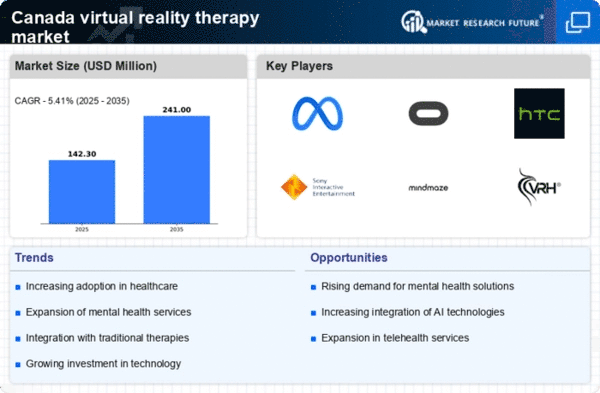
Canada Virtual Reality Therapy Market Infographic
Purchase Options

Canada Virtual Reality Therapy Market Summary

As per Market Research Future analysis, the Canada virtual reality-therapy market Size was estimated at 135.0 USD Million in 2024. The Canada virtual reality-therapy market is projected to grow from 142.3 USD Million in 2025 to 241.0 USD Million by 2035, exhibiting a compound annual growth rate (CAGR) of 5.4% during the forecast period 2025 - 2035

Key Market Trends & Highlights

The Canada virtual reality-therapy market is experiencing robust growth driven by technological advancements and increasing mental health awareness.

  • The largest segment in the Canada virtual reality-therapy market is mental health treatment, reflecting a growing acceptance of VR as a therapeutic tool.
  • The fastest-growing segment is pain management, indicating a shift towards innovative solutions for chronic pain relief.
  • Integration of VR with traditional therapeutic practices is becoming more prevalent, enhancing treatment efficacy and patient engagement.
  • Technological advancements in VR equipment and growing awareness of mental health issues are key drivers propelling market expansion.

Market Size & Forecast

2024 Market Size 135.0 (USD Million)
2035 Market Size 241.0 (USD Million)
CAGR (2025 - 2035) 5.41%

Major Players

Meta Platforms (US), Oculus (US), HTC (TW), Sony Interactive Entertainment (JP), MindMaze (CH), VRHealth (IL), Psious (ES), BehaVR (US)

Our Impact
Enabled $4.3B Revenue Impact for Fortune 500 and Leading Multinationals
Partnering with 2000+ Global Organizations Each Year
30K+ Citations by Top-Tier Firms in the Industry

Canada Virtual Reality Therapy Market Trends

The virtual reality-therapy market is experiencing notable growth. This growth is driven by advancements in technology and an increasing acceptance of innovative treatment methods. In Canada, healthcare providers are increasingly integrating virtual reality into therapeutic practices, recognizing its potential to enhance patient engagement and improve treatment outcomes. This trend is particularly evident in mental health treatment, where immersive experiences are utilized to address conditions such as anxiety and PTSD. The ability to simulate real-world scenarios in a controlled environment allows therapists to tailor interventions to individual needs, fostering a more personalized approach to care. Moreover, the rising prevalence of mental health issues among Canadians has prompted a shift towards alternative therapies, including virtual reality. As awareness of mental health challenges grows, so does the demand for effective treatment options. The virtual reality-therapy market appears poised for further expansion, with ongoing research and development efforts aimed at refining therapeutic applications. Collaboration between technology developers and healthcare professionals is likely to yield innovative solutions that enhance the efficacy of virtual reality interventions, ultimately benefiting patients across various demographics. This synergy between technology and healthcare may redefine therapeutic practices in the coming years, making virtual reality a staple in modern treatment protocols.

Increased Adoption in Mental Health Treatment

The virtual reality therapy market is witnessing a surge in the adoption of immersive technologies for mental health treatment. Therapists are utilizing virtual environments to help patients confront and manage anxiety, phobias, and PTSD. This approach allows for controlled exposure to triggering situations, facilitating gradual desensitization and coping strategies.

Integration with Traditional Therapeutic Practices

There is a growing trend of integrating virtual reality with traditional therapeutic practices. Healthcare providers are combining conventional methods with immersive experiences to enhance patient engagement and treatment effectiveness. This hybrid approach appears to offer a more comprehensive treatment plan, addressing both psychological and emotional needs.

Focus on Research and Development

The virtual reality-therapy market is experiencing a heightened focus on research and development initiatives. Ongoing studies aim to explore the efficacy of virtual reality interventions across various therapeutic domains. This emphasis on evidence-based practices is likely to drive innovation and improve the overall quality of virtual reality applications in therapy.

Canada Virtual Reality Therapy Market Drivers

Support from Healthcare Institutions

Healthcare institutions in Canada are increasingly recognizing the potential of virtual reality as a therapeutic tool. This support is crucial for the growth of the virtual reality-therapy market, as institutions are beginning to integrate VR into their treatment protocols. Notably, hospitals and clinics are allocating budgets for innovative therapies, with some institutions reporting investments of up to $500,000 in VR technology for mental health programs. This institutional backing not only legitimizes the use of VR in therapy but also encourages further research and development in the field. As more healthcare providers adopt VR solutions, the market is expected to expand, driven by the need for effective and engaging treatment options that can enhance patient outcomes.

Rising Popularity of Telehealth Services

The increasing popularity of telehealth services in Canada is another key driver for the virtual reality-therapy market. As more patients seek remote therapy options, the integration of VR into telehealth platforms appears to offer a unique solution that combines the benefits of virtual interaction with immersive therapeutic experiences. Current estimates suggest that telehealth usage has surged by over 50% in recent years, indicating a shift in how mental health services are delivered. This trend is likely to continue, as patients appreciate the convenience and accessibility of remote therapy. The virtual reality-therapy market stands to benefit from this shift, as practitioners can leverage VR technology to enhance telehealth sessions, providing patients with engaging and effective treatment options from the comfort of their homes.

Growing Awareness of Mental Health Issues

In recent years, there has been a marked increase in awareness surrounding mental health issues in Canada. This societal shift is driving demand for innovative treatment options, including those offered by the virtual reality-therapy market. As more individuals seek help for conditions such as anxiety, depression, and PTSD, the need for effective therapeutic solutions becomes paramount. Reports indicate that approximately 1 in 5 Canadians experience mental health challenges, highlighting the urgency for accessible treatment methods. The virtual reality-therapy market is well-positioned to address this need, offering unique, engaging, and effective therapeutic experiences that resonate with a tech-savvy population. This growing awareness is likely to propel the market forward, as both practitioners and patients recognize the potential benefits of VR in therapy.

Technological Advancements in VR Equipment

The rapid evolution of virtual reality technology is a pivotal driver for the virtual reality-therapy market. Enhanced hardware capabilities, such as improved graphics and motion tracking, are making VR experiences more immersive and effective. In Canada, the market for VR equipment is projected to grow significantly, with estimates suggesting a compound annual growth rate (CAGR) of around 30% over the next five years. This technological progress not only enhances user experience but also broadens the scope of applications in therapeutic settings, making VR a more appealing option for mental health professionals. As VR equipment becomes more accessible and affordable, its integration into therapeutic practices is likely to increase, thereby expanding the virtual reality-therapy market in Canada.

Increased Funding for Mental Health Initiatives

The Canadian government and various organizations are increasingly allocating funds to mental health initiatives, which is a significant driver for the virtual reality-therapy market. Recent budgets have seen a rise in mental health funding by approximately 10%, reflecting a commitment to improving mental health services across the country. This financial support is crucial for the development and implementation of innovative therapies, including those utilizing virtual reality. As funding becomes more available, research institutions and therapy providers are likely to explore VR applications more thoroughly, potentially leading to breakthroughs in treatment efficacy. This influx of resources is expected to stimulate growth in the virtual reality-therapy market, as new programs and technologies emerge to meet the rising demand for mental health services.


Market Segment Insights

By Technology: Full Immersive VR (Largest) vs. Semi-Immersive VR (Fastest-Growing)

In the Canada virtual reality-therapy market, the distribution of market share among various technology segments reveals a clear preference for Full Immersive VR, which captures the largest share due to its comprehensive simulation capabilities that provide users with highly engaging experiences. Semi-Immersive VR follows as a rapidly growing segment, increasingly adopted in therapeutic applications for its balance between engagement and accessibility. Non-Immersive VR, while present, maintains a smaller footprint as it offers a less impactful experience compared to its immersive counterparts. Growth trends in the Canada virtual reality-therapy market are driven by advancements in VR technology and a growing recognition of the effectiveness of VR in therapeutic interventions. Full Immersive VR is anticipated to sustain its dominance as organizations invest in enhancing VR hardware and software. Moreover, the rising awareness of mental health issues is propelling demand for innovative therapeutic solutions, placing Semi-Immersive VR in a prime position for growth as it provides an efficient option for overcoming logistical and spatial constraints associated with full immersion.

Technology: Full Immersive VR (Dominant) vs. Semi-Immersive VR (Emerging)

Full Immersive VR currently stands as the dominant technology in the Canada virtual reality-therapy market, characterized by its ability to provide users with a fully engaging and interactive environment that mimics real-life scenarios, making it ideal for therapeutic purposes. Its comprehensive approach allows for deep immersion, which is essential for effective treatment outcomes in various mental health conditions. Meanwhile, Semi-Immersive VR is emerging as a favored alternative due to its flexibility and lower cost compared to Full Immersive VR. It offers therapeutic benefits through interactive elements while being more adaptable for users with limited access to extensive VR setups. Together, these two segments reflect the diverse needs and preferences of users within therapeutic settings.

By Device: Head Mount (Largest) vs. Gesture Control (Fastest-Growing)

In the Canada virtual reality-therapy market, the distribution of market share among various device types highlights Head Mounts as the largest segment, capturing a significant portion of user preferences. Gesture Control systems, while currently trailing behind, are rapidly gaining traction, indicating an evolving landscape where users are increasingly looking for more interactive and intuitive solutions. Projectors, although valuable, are less popular among therapy applications compared to Head Mounts and Gesture Controls, reflecting changing technological trends. The growth trends in this segment are being propelled by advancements in immersive technology and user demand for enhanced engagement. As healthcare providers and therapists recognize the therapeutic benefits of VR, they are increasingly turning to devices that offer seamless interaction and user-friendly experiences. The rising adoption of Head Mounts demonstrates their effectiveness in delivering personalized therapy sessions, while the swift expansion of Gesture Control reflects a strong market shift towards innovative engagement tools that enhance patient experience and outcomes.

Head Mount (Dominant) vs. Gesture Control (Emerging)

Head Mount devices are the dominant technology in the Canada virtual reality-therapy market, known for providing immersive experiences that effectively engage users in therapeutic practices. Their ability to create personalized environments tailored to individual needs has made them a preferred choice among therapists. In contrast, Gesture Control systems represent the emerging technology in this segment, offering interactive capabilities that allow users to engage with virtual environments through natural movements. This not only enhances the user experience but also contributes to better therapeutic outcomes. As developments in both technologies continue, the distinct characteristics of Head Mounts and the innovative approach of Gesture Controls illustrate a dynamic market where user preference and technological advancement drive expansion.

By Application: Phobia Treatment (Largest) vs. Treatment of Post-Traumatic Stress Disorder (Fastest-Growing)

In the Canada virtual reality-therapy market, the application segment is predominantly led by phobia treatment, which captures a significant market share due to its increasing adoption for anxiety-related therapies. Other applications such as rehabilitation and treatment of autism also contribute substantially, yet they hold lesser shares compared to phobia treatment. This distribution highlights the robust demand for virtual reality solutions in addressing phobias, especially among younger demographics seeking innovative therapy options. Growth trends indicate a rising interest in virtual reality therapies for treatment of post-traumatic stress disorder (PTSD), recognized as the fastest-growing area in this segment. As mental health awareness increases, more healthcare providers are exploring VR technologies for immersive exposure therapy. Factors such as advancements in VR technology and a growing body of clinical evidence supporting its efficacy are driving this upward trend, making it an exciting area for investment and development in the market.

Phobia Treatment (Dominant) vs. Treatment of Post-Traumatic Stress Disorder (Emerging)

Phobia treatment remains the dominant application within the Canada virtual reality-therapy market due to its effectiveness in transforming traditional exposure therapies into immersive experiences. It utilizes engaging environments that allow patients to confront their fears at their own pace. On the other hand, the treatment of post-traumatic stress disorder (PTSD) is rapidly emerging, harnessing VR's potential to replicate traumatic scenarios in a controlled manner, aiding therapy. This segment benefits from increased research backing its methodologies, along with endorsements from mental health professionals advocating for virtual reality as a viable therapeutic tool. With a focus on both these applications, the market is well-positioned for growth, as demand for innovative therapeutic solutions expands.

Get more detailed insights about Canada Virtual Reality Therapy Market

Key Players and Competitive Insights

The virtual reality-therapy market is currently characterized by a dynamic competitive landscape, driven by technological advancements and increasing acceptance of VR solutions in therapeutic settings. Key players such as Meta Platforms (US), HTC (TW), and MindMaze (CH) are at the forefront, each adopting distinct strategies to enhance their market presence. Meta Platforms (US) focuses on innovation through continuous development of its VR hardware and software, aiming to integrate social interaction features into therapeutic applications. Meanwhile, HTC (TW) emphasizes partnerships with healthcare providers to expand its VR therapy offerings, thereby enhancing its operational focus on user experience and accessibility. MindMaze (CH) leverages its expertise in neuroscience to create tailored VR solutions, positioning itself as a leader in cognitive rehabilitation. Collectively, these strategies contribute to a competitive environment that is increasingly collaborative yet fiercely innovative.
In terms of business tactics, companies are localizing manufacturing and optimizing supply chains to enhance efficiency and reduce costs. The market structure appears moderately fragmented, with several players vying for dominance while also collaborating on various initiatives. This fragmentation allows for a diverse range of therapeutic applications, catering to different patient needs and preferences. The collective influence of these key players shapes the market dynamics, fostering an environment where innovation is paramount.
In October 2025, Meta Platforms (US) announced a strategic partnership with a leading Canadian healthcare provider to pilot a new VR therapy program aimed at treating anxiety disorders. This collaboration is significant as it not only expands Meta's reach into the Canadian market but also validates the efficacy of VR solutions in clinical settings. The partnership is expected to enhance patient engagement and provide valuable data for further development of VR therapeutic applications.
In September 2025, HTC (TW) launched a new VR headset specifically designed for therapeutic use, featuring advanced sensory feedback technology. This move is crucial as it demonstrates HTC's commitment to enhancing user experience and therapeutic outcomes. By focusing on the unique needs of therapists and patients, HTC aims to differentiate itself in a crowded market, potentially increasing its market share.
In August 2025, MindMaze (CH) secured a €10M investment to expand its research and development efforts in VR therapy. This funding is pivotal as it allows MindMaze to accelerate the development of its cognitive rehabilitation tools, which are increasingly being recognized for their effectiveness in treating neurological conditions. The investment underscores the growing interest in VR solutions and the potential for significant advancements in therapeutic applications.
As of November 2025, current trends in the virtual reality-therapy market include a strong emphasis on digitalization, AI integration, and sustainability. Strategic alliances are increasingly shaping the competitive landscape, enabling companies to pool resources and expertise to drive innovation. Looking ahead, it appears that competitive differentiation will evolve from traditional price-based competition to a focus on technological innovation, enhanced user experiences, and reliable supply chains. This shift suggests that companies that prioritize these aspects may gain a competitive edge in the rapidly evolving market.

Key Companies in the Canada Virtual Reality Therapy Market include

Industry Developments

The Canada Virtual Reality Therapy Market has seen significant developments recently, particularly with companies like MindMotion and AppliedVR making strides in therapeutic applications for neurological rehabilitation. In October 2023, Immertec announced a new partnership aimed at enhancing virtual reality experiences for patient rehabilitation, showcasing the increasing integration of advanced technologies in healthcare. The market has experienced growth in valuation as demand for mental health solutions rises, with companies like Virtually Better and Psious reporting increased use of their platforms for anxiety and PTSD treatments.

Recent mergers include Vicarious Surgical acquiring a Canadian technology firm in September 2023 to expand its virtual reality surgical training capabilities, reflecting a trend towards consolidation in the sector. Additionally, Firsthand Technology has introduced a new VR program aimed at pain management and recovery, reinforcing the therapeutic potential of these technologies. Over the last couple of years, regulatory support from the Canadian government targeting mental health innovation has further boosted market dynamics, highlighting the nation's commitment to advancing healthcare through technology. The growth trajectory is expected to continue, driven by increased acceptance and application of virtual reality in therapeutic contexts.

Future Outlook

Canada Virtual Reality Therapy Market Future Outlook

The virtual reality-therapy market is projected to grow at a 5.41% CAGR from 2025 to 2035, driven by technological advancements, increasing mental health awareness, and demand for innovative treatment solutions.

New opportunities lie in:

  • Development of tailored VR therapy applications for specific mental health disorders.
  • Partnerships with healthcare providers for integrated VR therapy solutions.
  • Expansion into corporate wellness programs utilizing VR for stress management.

By 2035, the market is expected to achieve substantial growth, positioning itself as a key player in therapeutic innovations.

Market Segmentation

Canada Virtual Reality Therapy Market Device Outlook

  • Head Mount
  • Gesture Control
  • Projectors

Canada Virtual Reality Therapy Market Technology Outlook

  • Full Immersive VR
  • Semi-Immersive VR
  • Non-Immersive VR

Canada Virtual Reality Therapy Market Application Outlook

  • Phobia Treatment
  • Robotic Surgery
  • Visualization
  • Rehabilitation
  • Treatment of Post-Traumatic Stress Disorder
  • Treatment of Autism
  • Surgery Simulation

Report Scope

MARKET SIZE 2024 135.0(USD Million)
MARKET SIZE 2025 142.3(USD Million)
MARKET SIZE 2035 241.0(USD Million)
COMPOUND ANNUAL GROWTH RATE (CAGR) 5.41% (2025 - 2035)
REPORT COVERAGE Revenue Forecast, Competitive Landscape, Growth Factors, and Trends
BASE YEAR 2024
Market Forecast Period 2025 - 2035
Historical Data 2019 - 2024
Market Forecast Units USD Million
Key Companies Profiled Meta Platforms (US), Oculus (US), HTC (TW), Sony Interactive Entertainment (JP), MindMaze (CH), VRHealth (IL), Psious (ES), BehaVR (US)
Segments Covered Technology, Device, Application
Key Market Opportunities Integration of advanced technologies enhances therapeutic applications in the virtual reality-therapy market.
Key Market Dynamics Growing adoption of virtual reality-therapy driven by technological advancements and increasing consumer acceptance in mental health treatment.
Countries Covered Canada
Leave a Comment

FAQs

What is the projected market size of the Canada Virtual Reality Therapy Market in 2024?

The Canada Virtual Reality Therapy Market is expected to be valued at 126.0 million USD in 2024.

What is the estimated market value for the Canada Virtual Reality Therapy Market by 2035?

By 2035, the Canada Virtual Reality Therapy Market is projected to reach a value of 180.0 million USD.

What is the expected compound annual growth rate (CAGR) for the Canada Virtual Reality Therapy Market from 2025 to 2035?

The expected CAGR for the Canada Virtual Reality Therapy Market from 2025 to 2035 is 3.296%.

How is the Canada Virtual Reality Therapy Market segmented by technology?

The market is segmented into Full Immersive VR, Semi-Immersive VR, and Non-Immersive VR.

What will be the market value for Full Immersive VR in 2035?

The market value for Full Immersive VR is expected to be 70.0 million USD in 2035.

What is the market size for Semi-Immersive VR expected to be in 2024?

The market size for Semi-Immersive VR is projected to be 40.0 million USD in 2024.

Who are some major players in the Canada Virtual Reality Therapy Market?

Key players include Enteraction, Immertec, Virtually Better, and MindMotion among others.

What is the expected market size for Non-Immersive VR in 2035?

The Non-Immersive VR market segment is projected to reach 50.0 million USD by 2035.

What are the key applications driving the growth of the Canada Virtual Reality Therapy Market?

Key applications include mental health treatment, rehabilitation, and pain management solutions.

What opportunities and challenges may impact the Canada Virtual Reality Therapy Market?

Emerging technologies and increasing adoption will present growth opportunities, while regulatory hurdles may pose challenges.

Download Free Sample

Kindly complete the form below to receive a free sample of this Report

Compare Licence

×
Features License Type
Single User Multiuser License Enterprise User
Price $4,950 $5,950 $7,250
Maximum User Access Limit 1 User Upto 10 Users Unrestricted Access Throughout the Organization
Free Customization
Direct Access to Analyst
Deliverable Format
Platform Access
Discount on Next Purchase 10% 15% 15%
Printable Versions