×
Request Free Sample ×

Kindly complete the form below to receive a free sample of this Report

* Please use a valid business email

Leading companies partner with us for data-driven Insights

clients tt-cursor
Hero Background

Canada Stevia Market

ID: MRFR/FnB/56208-HCR
128 Pages
Snehal Singh
February 2026

Canada Stevia Market Size, Share, Industry Trend & Analysis Research Report: By Type (Liquid Extract, Powder Extract, Stevia Leaves), By Nature (Organic, Regularaa), By Application (Residential/Retail, Commercial, Dairy and Frozen Desserts, Bakery and Confectionery, Sweet and Savory Snacks, Tabletop Sweeteners, Packaged Food Products, Beverages, Dietary Supplements, Others) andBy Distribution Channel (Offline, Online)- Forecast to 2035

Share:
Download PDF ×

We do not share your information with anyone. However, we may send you emails based on your report interest from time to time. You may contact us at any time to opt-out.

Canada Stevia Market Infographic
Purchase Options

Canada Stevia Market Summary

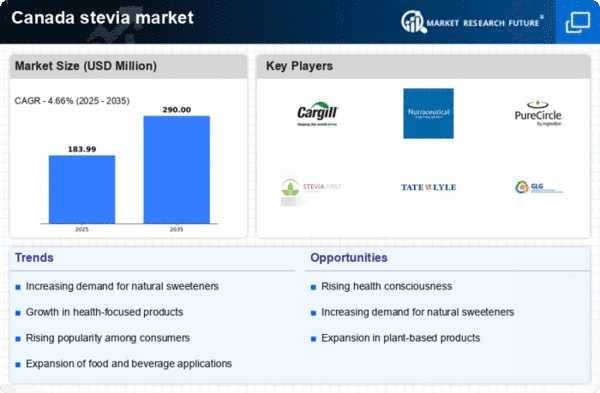
As per Market Research Future analysis, the Canada Stevia Market size was estimated at 175.8 USD Million in 2024. The Stevia market is projected to grow from 183.99 USD Million in 2025 to 290.0 USD Million by 2035, exhibiting a compound annual growth rate (CAGR) of 4.6% during the forecast period 2025 - 2035

Key Market Trends & Highlights

The Canada stevia market is experiencing a robust growth trajectory driven by health trends and consumer preferences.

  • The largest segment in the Canada stevia market is the food and beverage sector, which continues to expand rapidly.
  • The fastest-growing segment is the dietary supplements category, reflecting a shift towards health-oriented products.
  • Rising health consciousness among consumers is propelling the demand for natural sweeteners like stevia.
  • Key market drivers include increasing demand for natural sweeteners and regulatory support for natural ingredients.

Market Size & Forecast

2024 Market Size 175.8 (USD Million)
2035 Market Size 290.0 (USD Million)
CAGR (2025 - 2035) 4.66%

Major Players

Cargill (US), Nutraceutical Corporation (US), Pure Circle (MY), Stevia First Corporation (US), Tate & Lyle (GB), GLG Life Tech Corporation (CA), Sunwin Stevia International (CN), Herbochem (IN)

Our Impact
Enabled $4.3B Revenue Impact for Fortune 500 and Leading Multinationals
Partnering with 2000+ Global Organizations Each Year
30K+ Citations by Top-Tier Firms in the Industry

Canada Stevia Market Trends

The Canada Stevia Market in Canada is experiencing notable growth, driven by increasing consumer demand for natural sweeteners. As health consciousness rises, many individuals are seeking alternatives to traditional sugars, which are often linked to various health issues. Stevia, derived from the leaves of the Stevia rebaudiana plant, offers a zero-calorie option that appeals to those looking to reduce caloric intake while still enjoying sweetness. This shift in consumer preferences is reflected in the expanding range of stevia-based products available in the market, including beverages, baked goods, and dairy items. Furthermore, the regulatory environment in Canada supports the use of stevia, as Health Canada has approved its use as a sweetener, which further encourages manufacturers to innovate and incorporate stevia into their offerings. In addition to health trends, the stevia market is also influenced by sustainability considerations. Consumers are increasingly aware of the environmental impact of their food choices, leading to a preference for products that are sustainably sourced. Stevia, being a plant-based sweetener, aligns well with this trend, as it requires less land and water compared to traditional sugar crops. As a result, companies are likely to emphasize the sustainable aspects of their stevia products in marketing efforts. Overall, the stevia market in Canada appears poised for continued expansion, driven by health trends and a growing emphasis on sustainability in food production.

Rising Health Consciousness

The increasing awareness of health issues related to sugar consumption is driving demand for stevia as a natural sweetener. Consumers are actively seeking alternatives that do not contribute to weight gain or other health concerns, making stevia an attractive option.

Sustainability Focus

There is a growing emphasis on sustainability within the food industry, with consumers preferring products that are environmentally friendly. Stevia, being a plant-based sweetener, is perceived as a more sustainable choice compared to traditional sugar, which may enhance its appeal.

Product Innovation

Manufacturers are increasingly developing new products that incorporate stevia, ranging from beverages to snacks. This trend reflects the versatility of stevia as an ingredient and the industry's response to consumer preferences for healthier options.

Canada Stevia Market Drivers

Rising Incidence of Lifestyle Diseases

The increasing prevalence of lifestyle diseases such as obesity and diabetes in Canada significantly impacts the stevia market. As more individuals are diagnosed with these conditions, there is a heightened awareness of the need for dietary changes, including the reduction of sugar intake. Consequently, the demand for low-calorie sweeteners like stevia is expected to rise. Market analysis suggests that the stevia market could see a growth of around 12% as consumers actively seek healthier options to manage their health. This trend presents a substantial opportunity for manufacturers to develop and promote stevia-based products tailored to health-conscious consumers.

Increasing Demand for Natural Sweeteners

The stevia market in Canada experiences a notable surge in demand for natural sweeteners, driven by a growing consumer preference for healthier alternatives to sugar. As health awareness rises, consumers are increasingly seeking products that do not contribute to weight gain or health issues associated with excessive sugar consumption. This trend is reflected in the market data, which indicates that the sales of stevia-based products have increased by approximately 15% annually over the past three years. The stevia market is thus positioned to benefit from this shift, as more food and beverage manufacturers incorporate stevia into their formulations to cater to health-conscious consumers.

Regulatory Support for Natural Ingredients

The stevia market in Canada is bolstered by favorable regulatory frameworks that support the use of natural ingredients in food products. Health Canada has recognized stevia as a safe alternative to sugar, which encourages manufacturers to adopt stevia in their products. This regulatory endorsement not only enhances consumer confidence but also stimulates innovation within the stevia market. As a result, companies are more likely to invest in research and development to create new stevia-based products, potentially leading to a market growth rate of 10% over the next five years. This supportive environment is crucial for the expansion of the stevia market.

Expansion of Food and Beverage Applications

The versatility of stevia as a sweetener is driving its adoption across various food and beverage applications in Canada. From baked goods to beverages, the stevia market is witnessing an expansion as manufacturers explore innovative ways to incorporate stevia into their products. This diversification is supported by consumer demand for low-calorie and sugar-free options, which is projected to grow by 20% in the next few years. As more companies recognize the potential of stevia, the market is likely to experience increased competition and product variety, further solidifying its position in the Canadian food landscape.

Consumer Education and Awareness Initiatives

The stevia market in Canada benefits from ongoing consumer education and awareness initiatives that highlight the advantages of using stevia as a sugar substitute. Various organizations and health advocates are actively promoting the benefits of stevia, emphasizing its natural origins and health benefits. This increased awareness is crucial for driving consumer acceptance and adoption of stevia-based products. The stevia market is likely to see a positive impact from these initiatives, as informed consumers are more inclined to choose stevia over traditional sweeteners. This trend could lead to a projected market growth of 8% as consumers become more knowledgeable about the benefits of stevia.


Market Segment Insights

By Application: Food and Beverages (Largest) vs. Nutraceuticals (Fastest-Growing)

In the Canada stevia market, the application segment is predominantly led by Food and Beverages, which holds the largest share. This segment benefits from the increasing demand for natural sweeteners as consumers shift towards healthier lifestyle choices. Following closely, the Nutraceuticals segment is witnessing rapid growth due to rising health consciousness and the increasing incorporation of stevia in dietary supplements. The growth trends reveal a marked increase in the use of stevia across various applications, with Food and Beverages remaining a consistent leader. The focus on organic and natural ingredients is driving the demand in the Nutraceuticals sector, positioning it as a promising area for growth as companies innovate to meet consumer preferences for health-oriented products.

Food and Beverages: Dominant vs. Nutraceuticals: Emerging

The Food and Beverages segment continues to dominate the Canada stevia market, characterized by its broad applications in beverages, snacks, and confectionery items. Consumer preferences are leaning towards low-calorie sweeteners, making this segment crucial for product formulation. Conversely, the Nutraceuticals segment, recognized as emerging, is gaining traction with the integration of stevia into health supplements. This growth is propelled by increasing awareness of health benefits, along with successful product launches that cater to consumer demand for natural ingredients. As both segments evolve, collaboration between food manufacturers and health product developers will enhance innovation in product offerings.

By Form: Liquid (Largest) vs. Powder (Fastest-Growing)

In the Canada stevia market, the 'Form' segment is characterized by three main values: Liquid, Powder, and Granular. Among these, Liquid holds the largest market share, appealing to consumers for its convenience and versatility in various applications, particularly in beverages and cooking. Powder and Granular forms follow, catering to different consumer preferences and uses. The market distribution is primarily influenced by consumer trends towards healthier sweetening options, where Liquid's easy incorporation into recipes drives its dominant market position. Looking towards growth trends, the Powder segment is emerging as the fastest-growing value within the 'Form' category. This growth is driven by an increasing consumer demand for natural sweeteners in culinary applications, alongside rising health-conscious lifestyles promoting sugar alternatives. Innovative product developments and marketing strategies further enhance the attractiveness of Powder options for consumers seeking convenient, calorie-free sweetening solutions, making it a key player in the evolving market landscape.

Liquid (Dominant) vs. Powder (Emerging)

The Liquid form is a dominant player in the Canada stevia market, largely favored for its ease of use in beverages and recipes, appealing to both consumers and food manufacturers. It provides a straightforward solution for those looking to reduce sugar intake without compromising on taste. In contrast, the Powder form is rapidly emerging as a popular choice, especially among health-conscious consumers seeking versatile sweetening options for cooking and baking. The Powder's ability to be used in baking and as a tabletop sweetener positions it uniquely to capture a growing share of the market as more consumers transition to natural sweeteners. Both forms present strong value propositions, catering to evolving consumer preferences.

By Nature: Organic (Largest) vs. Conventional (Fastest-Growing)

Within the Canada stevia market, the distribution of market share between organic and conventional segments showcases a clear preference for organic products. Organic stevia is favored by consumers who prioritize natural and sustainable options. This preference is driven by growing health consciousness and environmental concerns among consumers, solidifying organic's position as the largest segment in the market. Conversely, the conventional segment is exhibiting promising growth trends, quickly becoming the fastest-growing segment. This growth is largely attributed to its affordability and accessibility compared to organic options. Increased production efficiencies and marketing strategies aimed at highlighting the benefits of conventional stevia are anticipated to drive consumer interest and demand, making this a dynamic phase for this segment.

Organic: Dominant vs. Conventional: Emerging

The organic segment within the Canada stevia market stands out as a dominant force, characterized by its strong alignment with health trends and consumer preferences for natural products. Organic stevia not only meets the demand for clean-label ingredients but also benefits from premium pricing in an increasingly competitive landscape. On the other hand, the conventional segment is emerging as a viable alternative due to its cost-effectiveness and wider availability. While conventional stevia appeals to a broader audience, particularly cost-conscious consumers, it is essential for producers to communicate its quality and value to enhance its market position. Both segments have unique strengths that contribute to the evolving dynamics of the market.

By Distribution Channel: Online (Largest) vs. Offline (Fastest-Growing)

In the Canada stevia market, the distribution channels have distinct market shares. The online segment holds a dominant position due to the growing trend of e-commerce and digital shopping preferences among consumers. Conversely, offline channels, including specialty stores and modern trade, still capture a significant portion of the market but are steadily being surpassed by online sales as consumers increasingly value convenience and accessibility. Growth trends in the Canada stevia market reflect a notable shift towards online distribution. The rising awareness of health benefits associated with stevia drives both online and offline sales, though the latter is witnessing the fastest growth. Online platforms are capitalizing on this trend by enhancing user experience, providing extensive product information, and offering competitive prices, thus attracting a larger customer base seeking stevia products.

Online (Dominant) vs. Offline (Emerging)

The online distribution channel in the Canada stevia market stands out as the dominant force, leveraging modern technology to reach a broader audience. With the increasing reliance on digital platforms for purchasing decisions, online sales of stevia products are supported by strategic marketing, targeted advertising, and an extensive range of available products. In contrast, the offline channel, while still significant, represents an emerging landscape that is adapting to the preferences of consumers. Specialty stores and modern trade are focusing on enhancing customer experiences through personalized service and product education, which helps in maintaining their relevance amid the growth of online purchasing. This shift indicates a dynamic where both channels have unique strengths contributing to the overall market landscape.

Get more detailed insights about Canada Stevia Market

Key Players and Competitive Insights

The stevia market in Canada is characterized by a dynamic competitive landscape, driven by increasing consumer demand for natural sweeteners and a growing awareness of health and wellness. Key players such as Cargill (US), Tate & Lyle (GB), and GLG Life Tech Corporation (CA) are strategically positioned to leverage innovation and sustainability in their operations. Cargill (US) focuses on expanding its product portfolio through research and development, while Tate & Lyle (GB) emphasizes partnerships to enhance its market reach. GLG Life Tech Corporation (CA) is dedicated to localizing its manufacturing processes, which not only optimizes supply chains but also aligns with consumer preferences for locally sourced products. Collectively, these strategies contribute to a competitive environment that is increasingly focused on quality and sustainability.The business tactics employed by these companies reflect a moderately fragmented market structure, where local and international players vie for market share. Localizing manufacturing and optimizing supply chains are critical tactics that enhance operational efficiency and responsiveness to market demands. The influence of key players is significant, as they set benchmarks for quality and innovation, thereby shaping consumer expectations and competitive dynamics.

In October Cargill (US) announced a partnership with a Canadian agricultural firm to enhance its stevia cultivation practices. This strategic move is likely to bolster Cargill's supply chain resilience and ensure a consistent quality of raw materials, which is essential in meeting the rising demand for stevia-based products. Such collaborations may also facilitate knowledge transfer and innovation in sustainable farming practices.

In September Tate & Lyle (GB) launched a new line of stevia-based sweeteners aimed at the beverage industry, highlighting its commitment to innovation. This product line is expected to cater to the growing trend of healthier beverage options, positioning Tate & Lyle as a leader in the natural sweetener segment. The introduction of this line reflects a strategic response to consumer preferences for low-calorie and natural ingredients.

In August GLG Life Tech Corporation (CA) expanded its production capacity by investing in advanced extraction technologies. This investment is indicative of GLG's focus on enhancing product quality and meeting the increasing demand for stevia. By adopting cutting-edge technologies, GLG is likely to improve its competitive edge and respond effectively to market trends.

As of November the competitive trends in the stevia market are increasingly defined by digitalization, sustainability, and the integration of AI in production processes. Strategic alliances are becoming more prevalent, as companies recognize the value of collaboration in driving innovation and efficiency. Looking ahead, competitive differentiation is expected to evolve, with a shift from price-based competition to a focus on innovation, technology, and supply chain reliability. This transition underscores the importance of adapting to consumer preferences and market dynamics in a rapidly changing landscape.

Key Companies in the Canada Stevia Market include

Industry Developments

The Canada Stevia Market has seen notable developments recently, particularly regarding growth in market valuation among key players such as Tate and Lyle, Cargill, and Sweet Green Fields. As the demand for natural sweeteners rises, the market has grown significantly, with Canadian consumers increasingly favoring stevia over artificial sweeteners. In December 2022, SweeGen announced a partnership focused on leveraging innovative sweetening solutions, which align with consumer health trends. Additionally, Stevia Corp has reported an increase in production capacity to meet the burgeoning demand for stevia extracts.

Regarding mergers and acquisitions, there have been discussions involving ADM and Pure Circle concerning a potential regional collaboration, although specific details on the transaction are yet to be disclosed publicly. No definitive acquisitions were reported in the last few months involving the targeted companies. The last two to three years have also witnessed various legislative changes promoting the use of plant-based sweeteners aimed at reducing sugar intake among Canadians, enhancing growth potential for stevia-related companies. The recent growth trends and strategic partnerships are likely to continue shaping the industry dynamics in Canada.

Future Outlook

Canada Stevia Market Future Outlook

The Stevia Market in Canada is projected to grow at a 4.66% CAGR from 2025 to 2035, driven by rising health consciousness and demand for natural sweeteners.

New opportunities lie in:

  • Developing stevia-based product lines for the beverage industry
  • Implementing direct-to-consumer online sales platforms
  • Expanding partnerships with health food retailers for exclusive products

By 2035, the stevia market is expected to achieve robust growth and increased market penetration.

Market Segmentation

Canada Stevia Market Form Outlook

  • Liquid
  • Powder
  • Granular

Canada Stevia Market Nature Outlook

  • Organic
  • Conventional

Canada Stevia Market Application Outlook

  • Food and Beverages
  • Pharmaceuticals
  • Cosmetics
  • Nutraceuticals
  • Animal Feed

Canada Stevia Market Distribution Channel Outlook

  • Online
  • Offline
  • Modern Trade
  • Specialty Stores

Report Scope

MARKET SIZE 2024 175.8(USD Million)
MARKET SIZE 2025 183.99(USD Million)
MARKET SIZE 2035 290.0(USD Million)
COMPOUND ANNUAL GROWTH RATE (CAGR) 4.66% (2025 - 2035)
REPORT COVERAGE Revenue Forecast, Competitive Landscape, Growth Factors, and Trends
BASE YEAR 2024
Market Forecast Period 2025 - 2035
Historical Data 2019 - 2024
Market Forecast Units USD Million
Key Companies Profiled Cargill (US), Nutraceutical Corporation (US), Pure Circle (MY), Stevia First Corporation (US), Tate & Lyle (GB), GLG Life Tech Corporation (CA), Sunwin Stevia International (CN), Herbochem (IN)
Segments Covered Application, Form, Nature, Distribution Channel
Key Market Opportunities Growing consumer demand for natural sweeteners drives innovation in the stevia market.
Key Market Dynamics Rising consumer demand for natural sweeteners drives innovation and competition in the stevia market.
Countries Covered Canada
Leave a Comment

FAQs

What is the expected market size of the Canada Stevia Market in 2024?

The Canada Stevia Market is expected to be valued at 60.0 million USD in 2024.

What is the projected market size for the Canada Stevia Market by 2035?

By 2035, the overall market is projected to reach a valuation of 200.0 million USD.

What is the CAGR for the Canada Stevia Market from 2025 to 2035?

The expected CAGR for the Canada Stevia Market from 2025 to 2035 is 11.567%.

Which type of Stevia product is expected to dominate the market by 2035?

By 2035, the Powder Extract segment is projected to dominate with a valuation of 90.0 million USD.

What are the estimated values for Liquid Extract and Stevia Leaves by 2035?

Liquid Extract is expected to be valued at 70.0 million USD, while Stevia Leaves will reach 40.0 million USD.

Who are the key players in the Canada Stevia Market?

Major players include Tate & Lyle, ADM, Sweet Green Fields, SweeGen, and Cargill among others.

What is the market size of the Powder Extract type in 2024?

The Powder Extract segment is valued at 25.0 million USD in the year 2024.

How is the Liquid Extract segment projected to grow from 2024 to 2035?

The Liquid Extract segment is expected to grow from 20.0 million USD in 2024 to 70.0 million USD by 2035.

What opportunities exist within the Canada Stevia Market for new entrants?

There are emerging trends focused on health and natural sweeteners, which present significant opportunities.

What trends are currently influencing the Canada Stevia Market?

There is a growing consumer preference for natural sweeteners, driving the demand for stevia extracts.

Download Free Sample

Kindly complete the form below to receive a free sample of this Report

Compare Licence

×
Features License Type
Single User Multiuser License Enterprise User
Price $4,950 $5,950 $7,250
Maximum User Access Limit 1 User Upto 10 Users Unrestricted Access Throughout the Organization
Free Customization
Direct Access to Analyst
Deliverable Format
Platform Access
Discount on Next Purchase 10% 15% 15%
Printable Versions