×
Request Free Sample ×

Kindly complete the form below to receive a free sample of this Report

* Please use a valid business email

Leading companies partner with us for data-driven Insights

clients tt-cursor
Hero Background

Canada Reciprocating Compressor Market

ID: MRFR/EnP/53109-HCR
128 Pages
Snehal Singh
February 2026

Canada Reciprocating Compressor Market Research Report By Type (Portable, Stationary, single acting, double acting, diaphragm), By Lubrication (Oil-Free, Oil-Filled), By Stage Type (single stage, multi-stage) and By End User (oil & gas, pharmaceutical, chemical plants, refrigeration plants, manufacturing, automotive, others) - Forecast to 2035

Share:
Download PDF ×

We do not share your information with anyone. However, we may send you emails based on your report interest from time to time. You may contact us at any time to opt-out.

Canada Reciprocating Compressor Market Infographic
Purchase Options

Canada Reciprocating Compressor Market Summary

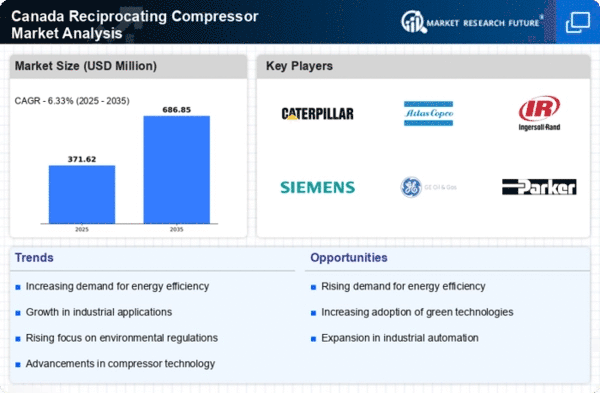
As per Market Research Future analysis, the Canada reciprocating compressor market size was estimated at 349.5 USD Million in 2024.. The Canada reciprocating compressor market is projected to grow from 371.62 USD Million in 2025 to 686.85 USD Million by 2035, exhibiting a compound annual growth rate (CAGR) of 6.3% during the forecast period 2025 - 2035

Key Market Trends & Highlights

The Canada reciprocating compressor market is experiencing a dynamic shift driven by technological advancements and sustainability initiatives.

  • Technological advancements are enhancing the efficiency and performance of reciprocating compressors across various applications.
  • The focus on sustainability is prompting manufacturers to develop eco-friendly compressor solutions that reduce emissions and energy consumption.
  • Customization and flexibility in design are becoming increasingly important to meet the diverse needs of end-users in different sectors.
  • The rising demand in the oil and gas sector and the expansion of industrial applications are key drivers propelling market growth.

Market Size & Forecast

2024 Market Size 349.5 (USD Million)
2035 Market Size 686.85 (USD Million)
CAGR (2025 - 2035) 6.33%

Major Players

Caterpillar Inc (US), Atlas Copco AB (SE), Ingersoll Rand Inc (US), Siemens AG (DE), GE Oil & Gas (US), Parker Hannifin Corporation (US), Boge Compressors (DE), Hitachi Ltd (JP), Kirloskar Pneumatic Company Limited (IN)

Our Impact
Enabled $4.3B Revenue Impact for Fortune 500 and Leading Multinationals
Partnering with 2000+ Global Organizations Each Year
30K+ Citations by Top-Tier Firms in the Industry

Canada Reciprocating Compressor Market Trends

The reciprocating compressor market in Canada is currently experiencing a notable evolution, driven by various factors including technological advancements and increasing demand across multiple sectors. Industries such as oil and gas, manufacturing, and refrigeration are significantly contributing to the growth of this market. The emphasis on energy efficiency and sustainability is prompting manufacturers to innovate and develop compressors that not only meet performance standards but also adhere to environmental regulations. This shift towards greener technologies appears to be reshaping the competitive landscape, as companies strive to offer solutions that align with both operational efficiency and ecological responsibility. In addition, the market is witnessing a trend towards customization, where end-users seek tailored solutions to meet specific operational needs. This demand for bespoke products is likely to encourage manufacturers to enhance their research and development efforts. Furthermore, the integration of smart technologies into reciprocating compressors is becoming increasingly prevalent, allowing for improved monitoring and control. As the market continues to evolve, it seems poised for further growth, driven by innovation and a commitment to meeting the diverse needs of various industries.

Technological Advancements

The reciprocating compressor market is seeing rapid technological advancements that enhance efficiency and performance. Innovations in materials and design are leading to more durable and reliable compressors, which are crucial for industries that rely on continuous operation. Furthermore, the integration of smart technologies allows for real-time monitoring, optimizing performance and reducing downtime.

Sustainability Focus

There is a growing emphasis on sustainability within the reciprocating compressor market. Companies are increasingly prioritizing energy-efficient solutions that comply with environmental regulations. This trend is not only driven by regulatory requirements but also by consumer demand for greener products, prompting manufacturers to innovate in ways that reduce emissions and energy consumption.

Customization and Flexibility

The demand for customized solutions is rising within the reciprocating compressor market. End-users are seeking compressors tailored to their specific operational requirements, which encourages manufacturers to offer flexible designs and configurations. This trend reflects a broader shift towards personalized service and solutions in industrial applications.

Canada Reciprocating Compressor Market Drivers

Growth in Renewable Energy Sector

The growth of the renewable energy sector in Canada is emerging as a potential driver for the reciprocating compressor market. As the country invests in alternative energy sources, such as hydrogen and biogas, the need for efficient gas compression solutions becomes critical. Reciprocating compressors are well-suited for these applications due to their ability to handle varying gas compositions and pressures. The market could see an increase in demand as more renewable energy projects are initiated, potentially leading to a market valuation of $1.5 billion by 2030. This shift towards renewable energy may create new opportunities for manufacturers within the reciprocating compressor market.

Rising Demand in Oil and Gas Sector

The oil and gas sector in Canada is experiencing a notable resurgence, which appears to be driving the growth of the reciprocating compressor market. As exploration and production activities ramp up, the need for efficient and reliable compression solutions becomes paramount. In 2025, the sector is projected to contribute significantly to the overall market, with an estimated value of $2 billion. This demand is likely to be fueled by the increasing extraction of unconventional resources, necessitating advanced compressor technologies to handle varying pressures and flow rates. Consequently, manufacturers are focusing on developing high-performance reciprocating compressors tailored for this sector, thereby enhancing their market presence.

Technological Innovations in Design

Technological innovations in the design of reciprocating compressors are playing a crucial role in shaping the market landscape in Canada. Recent advancements, such as the integration of smart technologies and IoT capabilities, are enhancing operational efficiency and reliability. These innovations allow for real-time monitoring and predictive maintenance, which can significantly reduce downtime and operational costs. As industries increasingly seek to optimize their processes, the demand for technologically advanced compressors is expected to rise. This trend may lead to a more competitive environment within the reciprocating compressor market, as companies strive to offer cutting-edge solutions.

Expansion of Industrial Applications

The reciprocating compressor market is witnessing an expansion in industrial applications across various sectors in Canada. Industries such as manufacturing, food processing, and pharmaceuticals are increasingly adopting these compressors for their operational needs. The market is expected to grow at a CAGR of 5.5% from 2025 to 2030, driven by the need for efficient gas compression in production processes. Furthermore, the versatility of reciprocating compressors allows them to be utilized in diverse applications, from refrigeration to pneumatic conveying. This adaptability is likely to attract more industries, thereby bolstering the market's growth trajectory.

Government Regulations and Standards

Government regulations in Canada are becoming increasingly stringent regarding emissions and energy efficiency, which may positively impact the reciprocating compressor market. Compliance with these regulations often necessitates the adoption of advanced compressor technologies that minimize environmental impact. As a result, manufacturers are investing in research and development to create compressors that meet these standards while maintaining high performance. The market could see a shift towards eco-friendly models, potentially increasing their market share. This regulatory landscape is likely to drive innovation and enhance the competitiveness of the reciprocating compressor market.


Market Segment Insights

By Type: Portable (Largest) vs. Stationary (Fastest-Growing)

In the Canada reciprocating compressor market, the Portable segment accounts for a significant share of the market due to its versatility and ease of use in varied applications. This segment is preferred by small-scale industries and contractors who require mobility and adaptability in their equipment. On the other hand, the Stationary segment is witnessing rapid growth, driven by the increasing demand for high-capacity compressed air solutions in large industrial applications and manufacturing plants. The growth trends show that while the Portable segment remains dominant, the Stationary segment is emerging as the fastest-growing segment due to advancements in technology and increased efficiencies. Factors such as urbanization, an uptick in infrastructure projects, and the need for reliable compressed air systems in manufacturing are propelling the growth of stationary compressors. These trends indicate a dynamic shift in preferences toward more robust and capable stationary solutions in the near future.

Portable (Dominant) vs. Stationary (Emerging)

The Portable segment of the Canada reciprocating compressor market is characterized by its compact design and mobility, making it ideal for various temporary applications, including construction sites and maintenance jobs. These compressors are typically lightweight and can operate effectively in remote locations without the need for a permanent installation. Conversely, the Stationary segment is more suited for heavy-duty industrial operations, providing a constant and reliable air supply. With their increased capacity and advanced technologies, stationary compressors are becoming the choice for larger facilities and manufacturing units that require sustained performance and high efficiency. The dynamic between these segments indicates a market that caters to both immediate, flexible needs and long-term operational demands.

By Lubrication: Oil-Free (Largest) vs. Oil Filled (Fastest-Growing)

In the Canada reciprocating compressor market, the lubrication segment is primarily divided into oil-free and oil filled compressors. Currently, oil-free compressors hold the largest market share due to their superior energy efficiency and decreasing maintenance costs. The adoption of oil-free systems is rising significantly, particularly in sectors like food and beverage and pharmaceuticals, where the risk of contamination is a major concern. Growth trends indicate a shift towards oil filled compressors, which are emerging as the fastest-growing segment within the lubrications category. This is attributed to their higher efficiency and durability in high-demand applications. Industries prioritizing cost-effectiveness are increasingly leaning towards oil filled compressors, driving innovation in this segment and enhancing performance benchmarks.

Lubrication: Oil-Free (Dominant) vs. Oil Filled (Emerging)

Oil-free compressors are known for their clean operation and minimal environmental impact, making them the dominant choice in applications where air purity is critical. They are widely utilized in sectors requiring stringent hygiene standards, such as pharmaceuticals and food processing. Conversely, oil filled compressors are noted for their reliability and ability to withstand harsher operating conditions, thus making them an emerging alternative in the market. The transition towards oil filled systems is driven by advancements in technology that enhance their efficiency and lower operational costs, positioning them effectively to capture an increasing share of the market.

By Stage Type: Single Stage (Largest) vs. Multi Stage (Fastest-Growing)

In the Canada reciprocating compressor market, the distribution of market share between Single Stage and Multi Stage segment types reveals a clear leader. The Single Stage compressors dominate the segment, boasting a significant share of the market due to their widespread applications in various industries, including oil and gas, manufacturing, and HVAC systems. On the other hand, Multi Stage compressors are gaining traction as industries seek more efficiency and higher pressures, contributing to robust competition in the segment. Growth trends in the Canada reciprocating compressor market are largely driven by advancements in technology and increasing industrialization. The demand for energy-efficient solutions has propelled the Multi Stage segment to become the fastest-growing area, attracting investment and innovation. Manufacturers are focusing on enhancing performance and reducing emissions, appealing to environmentally conscious consumers while meeting the rigorous demands of modern applications.

Single Stage (Dominant) vs. Multi Stage (Emerging)

Single Stage compressors are known for their simplicity, reliability, and cost-effectiveness, making them highly favored in various applications where lower pressure is sufficient. They are primarily used in less demanding industrial settings and are appreciated for their straightforward design and ease of maintenance. Conversely, Multi Stage compressors are seen as the emerging option, designed to deliver higher pressure outputs and improved energy efficiency. They find applications in more demanding environments where performance and reliability are crucial, thus driving their rapid growth in the market. As industries continue to evolve, the preference for Multi Stage solutions is expected to rise, emphasizing the need for innovation and adaptation in compressor technologies.

By Type: Single Acting (Largest) vs. Double Acting (Fastest-Growing)

The Canada reciprocating compressor market exhibits a diverse distribution among its types, showcasing Single Acting as the largest segment. Single Acting compressors are widely adopted across various industrial applications due to their efficiency and reliability. In contrast, Double Acting compressors are witnessing rapid growth, driven by their ability to handle higher pressures and deliver better performance in demanding environments. The growth trends in this segment indicate a shift towards more advanced compressor technologies, with a notable increase in demand for Double Acting models. Factors contributing to this trend include the growing industrialization in Canada and the need for more efficient machinery. Additionally, environmental regulations are pushing industries to adopt technologies that minimize emissions, further fueling the adoption of advanced compressor types.

Single Acting (Dominant) vs. Double Acting (Emerging)

Single Acting compressors are characterized by their simplicity and cost-effectiveness, making them a popular choice in the Canada reciprocating compressor market. They are efficient in applications that require low to moderate pressure levels and are primarily used in industries such as oil and gas, refrigeration, and HVAC. In contrast, Double Acting compressors are emerging rapidly due to their enhanced efficiency and capability to deliver higher power output. They operate on both sides of the piston, which allows for continuous pressure delivery. This makes them suitable for more demanding applications in manufacturing and chemical processing, signaling a shift towards more robust solutions in the market.

By End User: Oil & Gas (Largest) vs. Pharmaceutical (Fastest-Growing)

In the Canada reciprocating compressor market, the 'End User' segment is primarily dominated by the Oil & Gas sector, which commands a significant share due to its extensive requirement for pressure and gas transportation applications. Other notable segments include Chemical Plants and Manufacturing, contributing to a well-rounded market landscape. The Pharmaceutical industry, while smaller in comparison, is gaining traction, indicating a shift in usage trends as regulatory standards and production demands evolve. The growth trends in this segment are driven by an increase in hydrocarbon production and the need for enhanced efficiency in gas processing, particularly in the Oil & Gas sector. Additionally, the Pharmaceutical industry's rapid expansion stems from advancements in biotechnology and an increased focus on innovative drug development, positioning it as the fastest-growing segment. This shifting dynamic is encouraging manufacturers to innovate, adapt their product offerings, and optimize compressor technologies to meet diverse industrial needs.

Oil & Gas (Dominant) vs. Pharmaceutical (Emerging)

The Oil & Gas sector remains the dominant player in the Canada reciprocating compressor market due to its high demand for effective gas compression and transportation solutions. This segment benefits from established infrastructure and technological advancements, making it a reliable source of revenue for compressor manufacturers. Conversely, the Pharmaceutical segment is emerging, driven by the rising need for specialized compressors capable of supporting stringent cleanliness and operational standards. This sector emphasizes reliability and high-performance capabilities, indicating an evolving market landscape where manufacturers must adapt to the rigorous demands of pharmaceutical production. As these segments continue to grow, they highlight the diverse applications and innovations in the compressor market.

Get more detailed insights about Canada Reciprocating Compressor Market

Key Players and Competitive Insights

The reciprocating compressor market in Canada exhibits a dynamic competitive landscape characterized by a blend of innovation, strategic partnerships, and regional expansion. Key players such as Caterpillar Inc (US), Atlas Copco AB (SE), and Ingersoll Rand Inc (US) are actively shaping the market through their distinct operational focuses. Caterpillar Inc (US) emphasizes technological advancements in energy efficiency, while Atlas Copco AB (SE) is known for its commitment to sustainability and digital solutions. Ingersoll Rand Inc (US) has been pursuing strategic acquisitions to enhance its product portfolio, thereby reinforcing its market position. Collectively, these strategies contribute to a competitive environment that is increasingly focused on innovation and sustainability, reflecting broader industry trends.
In terms of business tactics, companies are increasingly localizing manufacturing and optimizing supply chains to enhance operational efficiency. The market structure appears moderately fragmented, with several key players exerting influence over various segments. This fragmentation allows for a diverse range of products and services, catering to different customer needs while fostering competition among established and emerging players.
In October 2025, Caterpillar Inc (US) announced the launch of a new line of energy-efficient reciprocating compressors designed to reduce emissions by up to 30%. This strategic move not only aligns with global sustainability goals but also positions the company as a leader in environmentally friendly technology. The introduction of these compressors is expected to attract environmentally conscious customers and enhance Caterpillar's competitive edge in the market.
In September 2025, Atlas Copco AB (SE) expanded its operations in Canada by establishing a new manufacturing facility in Ontario. This facility is expected to produce advanced reciprocating compressors tailored for the North American market. The strategic importance of this expansion lies in its potential to reduce lead times and improve supply chain efficiency, thereby enhancing customer satisfaction and market responsiveness.
In August 2025, Ingersoll Rand Inc (US) completed the acquisition of a Canadian-based compressor manufacturer, which significantly bolstered its product offerings and market reach. This acquisition is likely to enhance Ingersoll Rand's competitive positioning by integrating innovative technologies and expanding its customer base in Canada. The strategic alignment of this acquisition with Ingersoll Rand's growth objectives suggests a focused approach to capturing market share.
As of November 2025, current competitive trends in the reciprocating compressor market are increasingly defined by digitalization, sustainability, and the integration of artificial intelligence. Strategic alliances among key players are shaping the landscape, fostering innovation and collaborative solutions. The shift from price-based competition to a focus on technological advancement and supply chain reliability is evident. Companies that prioritize innovation and sustainability are likely to differentiate themselves in this evolving market, suggesting a future where competitive advantage hinges on technological prowess and operational excellence.

Key Companies in the Canada Reciprocating Compressor Market include

Industry Developments

The Canada Reciprocating Compressor Market has experienced notable developments recently, with a strong emphasis on sustainable technology and energy efficiency. In September 2023, Ingersoll Rand unveiled its latest line of energy-efficient compressors designed to reduce operational costs for Canadian industries. Similarly, Atlas Copco continues to invest in innovations, with a focus on integrating smart technology into their compressor solutions. The market has seen growth in valuations of major players as demand intensifies for applications in oil and gas, manufacturing, and HVAC systems. 

Notably, in July 2023, Parker Hannifin completed its acquisition of a smaller firm specializing in pneumatic systems, enhancing its foothold in the Canadian market. Meanwhile, Baker Hughes and Cummins have announced partnerships aimed at expanding their offerings in renewable energy applications, aligning with Canada’s commitment to reduce greenhouse gas emissions. The overall market dynamics are increasingly influenced by the push for greener technologies and a shift towards automation and control systems, indicating a vibrant and evolving landscape for reciprocating compressors in Canada.

Future Outlook

Canada Reciprocating Compressor Market Future Outlook

The Reciprocating Compressor Market in Canada is projected to grow at a 6.33% CAGR from 2025 to 2035, driven by industrial expansion, energy efficiency demands, and technological advancements.

New opportunities lie in:

  • Development of energy-efficient compressor models for industrial applications.
  • Expansion into renewable energy sectors with specialized compressors.
  • Implementation of predictive maintenance solutions to enhance operational efficiency.

By 2035, the market is expected to achieve robust growth, driven by innovation and strategic investments.

Market Segmentation

Canada Reciprocating Compressor Market Type Outlook

  • Single Acting
  • Double Acting
  • Diaphragm

Canada Reciprocating Compressor Market End User Outlook

  • Oil & Gas
  • Pharmaceutical
  • Chemical Plants
  • Refrigeration Plants
  • Manufacturing
  • Automotive
  • Others

Canada Reciprocating Compressor Market Stage Type Outlook

  • Single Stage
  • Multi Stage

Canada Reciprocating Compressor Market Lubrication Outlook

  • Oil-Free
  • Oil Filled

Report Scope

MARKET SIZE 2024 349.5(USD Million)
MARKET SIZE 2025 371.62(USD Million)
MARKET SIZE 2035 686.85(USD Million)
COMPOUND ANNUAL GROWTH RATE (CAGR) 6.33% (2025 - 2035)
REPORT COVERAGE Revenue Forecast, Competitive Landscape, Growth Factors, and Trends
BASE YEAR 2024
Market Forecast Period 2025 - 2035
Historical Data 2019 - 2024
Market Forecast Units USD Million
Key Companies Profiled Caterpillar Inc (US), Atlas Copco AB (SE), Ingersoll Rand Inc (US), Siemens AG (DE), GE Oil & Gas (US), Parker Hannifin Corporation (US), Boge Compressors (DE), Hitachi Ltd (JP), Kirloskar Pneumatic Company Limited (IN)
Segments Covered Type, Lubrication, Stage Type, Type, End User
Key Market Opportunities Adoption of energy-efficient technologies drives growth in the reciprocating compressor market.
Key Market Dynamics Rising demand for energy-efficient solutions drives innovation in the reciprocating compressor market amid regulatory pressures.
Countries Covered Canada
Leave a Comment

FAQs

What is the expected market size of the Canada Reciprocating Compressor Market in 2024?

The Canada Reciprocating Compressor Market is expected to be valued at 652.4 million USD in 2024.

What will be the market size of the Canada Reciprocating Compressor Market by 2035?

By 2035, the market is projected to reach a valuation of 1001.2 million USD.

What is the expected CAGR for the Canada Reciprocating Compressor Market from 2025 to 2035?

The anticipated compound annual growth rate for the market from 2025 to 2035 is 3.97%.

What are the key players in the Canada Reciprocating Compressor Market?

Major players in the market include Atlas Copco, Linde, Ingersoll Rand, and Ariel Corporation among others.

How is the Portable segment of the Canada Reciprocating Compressor Market valued in 2024?

The Portable segment is valued at approximately 130.5 million USD in 2024.

What is the expected value of the Stationary segment by 2035?

By 2035, the Stationary segment is expected to be valued at 233.7 million USD.

What market size is projected for the double acting segment in 2024?

The double acting segment is projected to be valued at around 174.0 million USD in 2024.

What growth opportunities exist in the Canada Reciprocating Compressor Market?

Opportunities are centered on technological advancements and rising demand across various industries.

What is the expected market size for the diaphragm segment by 2035?

By 2035, the diaphragm segment is expected to reach approximately 172.7 million USD.

What are the emerging trends impacting the Canada Reciprocating Compressor Market?

Emerging trends include an increasing focus on energy efficiency and environmentally friendly compressor technologies.

Download Free Sample

Kindly complete the form below to receive a free sample of this Report

Compare Licence

×
Features License Type
Single User Multiuser License Enterprise User
Price $4,950 $5,950 $7,250
Maximum User Access Limit 1 User Upto 10 Users Unrestricted Access Throughout the Organization
Free Customization
Direct Access to Analyst
Deliverable Format
Platform Access
Discount on Next Purchase 10% 15% 15%
Printable Versions