×
Request Free Sample ×

Kindly complete the form below to receive a free sample of this Report

* Please use a valid business email

Leading companies partner with us for data-driven Insights

clients tt-cursor
Hero Background

Canada Mobile Ai Market

ID: MRFR/ICT/59549-HCR
200 Pages
Aarti Dhapte
February 2026

Canada Mobile AI Market Size, Share and Trends Analysis Report By Application (Virtual Assistants, Image Recognition, Natural Language Processing, Predictive Analytics), By Technology (Machine Learning, Deep Learning, Computer Vision, Natural Language Understanding), By Deployment Type (Cloud-Based, On-Premises, Edge Computing) and By End Use (Healthcare, Retail, Automotive, Finance, Telecommunications)-Forecast to 2035

Share:
Download PDF ×

We do not share your information with anyone. However, we may send you emails based on your report interest from time to time. You may contact us at any time to opt-out.

Canada Mobile Ai Market Infographic
Purchase Options

Canada Mobile Ai Market Summary

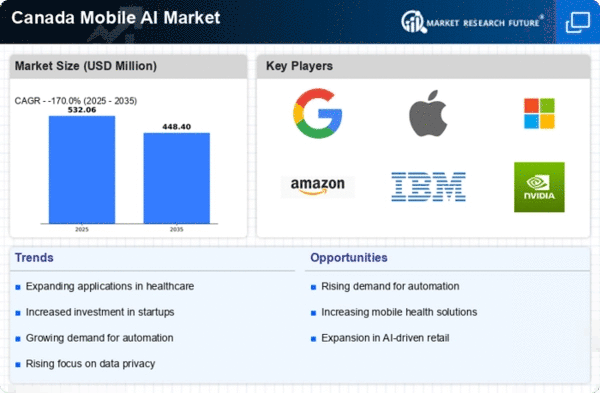
As per Market Research Future analysis, the Canada Mobile AI Market size was estimated at 541.26 USD Million in 2024. The Canada mobile ai market is projected to grow from 532.06 USD Million in 2025 to 448.4 USD Million by 2035, exhibiting a compound annual growth rate (CAGR) of 1.7% during the forecast period 2025 - 2035

Key Market Trends & Highlights

The Canada mobile AI market is poised for substantial growth driven by technological advancements and increasing consumer demand.

  • Enhanced personalization in mobile applications is becoming a key focus area for developers.
  • Integration with IoT devices is facilitating smarter and more efficient mobile AI solutions.
  • Security and privacy concerns are prompting companies to adopt more robust AI-driven measures.
  • Rising demand for mobile applications and advancements in AI technology are major drivers of market growth.

Market Size & Forecast

2024 Market Size 541.26 (USD Million)
2035 Market Size 448.4 (USD Million)
CAGR (2025 - 2035) -1.7%

Major Players

Google (US), Apple (US), Microsoft (US), Amazon (US), IBM (US), NVIDIA (US), Samsung (KR), Huawei (CN), Qualcomm (US)

Our Impact
Enabled $4.3B Revenue Impact for Fortune 500 and Leading Multinationals
Partnering with 2000+ Global Organizations Each Year
30K+ Citations by Top-Tier Firms in the Industry

Canada Mobile Ai Market Trends

The mobile ai market is experiencing notable growth, driven by advancements in technology and increasing consumer demand for intelligent applications. In Canada, the integration of artificial intelligence into mobile devices is transforming user experiences, enhancing functionalities, and providing personalized services. This evolution is evident in various sectors, including healthcare, finance, and retail, where mobile ai solutions are streamlining operations and improving decision-making processes. As organizations recognize the potential of mobile ai, investments in research and development are likely to rise, fostering innovation and competition within the market. Moreover, the regulatory environment in Canada appears to be supportive of technological advancements, encouraging the adoption of mobile ai solutions. Government initiatives aimed at promoting digital transformation and innovation are likely to further stimulate market growth. The increasing prevalence of smart devices and the demand for seamless connectivity may also contribute to the expansion of mobile ai applications. As the landscape evolves, stakeholders must remain vigilant to emerging trends and consumer preferences, ensuring that they adapt to the dynamic nature of the mobile ai market.

Enhanced Personalization

Mobile ai solutions are increasingly focused on delivering tailored experiences to users. By leveraging data analytics and machine learning, applications can provide recommendations and services that align with individual preferences, thereby improving user satisfaction and engagement.

Integration with IoT

The convergence of mobile ai with Internet of Things (IoT) technologies is becoming more pronounced. This integration allows for smarter devices that can communicate and learn from user interactions, leading to more efficient and responsive applications.

Focus on Security and Privacy

As mobile ai applications proliferate, concerns regarding data security and user privacy are rising. Developers are prioritizing robust security measures and transparent data handling practices to build trust and ensure compliance with regulatory standards.

Canada Mobile Ai Market Drivers

Advancements in AI Technology

Technological advancements in AI are significantly influencing the mobile ai market in Canada. Innovations in machine learning, natural language processing, and computer vision are enabling the development of more sophisticated mobile applications. These advancements allow for improved functionalities, such as voice recognition and image analysis, which enhance user interaction. In 2025, it is estimated that the AI technology sector will contribute over $5 billion to the Canadian economy, underscoring its importance. As companies invest in research and development, the mobile ai market is likely to see a proliferation of cutting-edge applications that harness these technologies, thereby attracting a wider user base and fostering competitive advantages.

Increased Investment in AI Startups

The mobile ai market in Canada is witnessing a surge in investment directed towards AI startups. Venture capitalists and private equity firms are increasingly recognizing the potential of AI-driven solutions, leading to a significant influx of funding. In 2025, investments in AI startups are projected to exceed $1 billion, reflecting a growing confidence in the mobile ai market. This influx of capital enables startups to innovate and develop new applications that cater to diverse consumer needs. As these startups emerge, they contribute to a dynamic ecosystem that fosters collaboration and competition, ultimately driving the growth of the mobile ai market in Canada.

Government Support for AI Initiatives

Government initiatives aimed at promoting AI development are playing a crucial role in shaping the mobile ai market in Canada. Various programs and funding opportunities are being introduced to support research, innovation, and the commercialization of AI technologies. In 2025, the Canadian government is expected to allocate over $500 million towards AI-related projects, fostering a conducive environment for growth. This support not only encourages startups and established companies to invest in AI but also enhances collaboration between academia and industry. As a result, the mobile ai market is likely to benefit from a strengthened ecosystem that drives innovation and accelerates the adoption of AI solutions across various sectors.

Rising Demand for Mobile Applications

The mobile ai market in Canada is experiencing a notable surge in demand for mobile applications. As consumers increasingly rely on smartphones for various tasks, the need for intelligent applications that enhance user experience becomes paramount. In 2025, the mobile application market is projected to reach approximately $10 billion in Canada, indicating a robust growth trajectory. This demand is driven by the desire for convenience, efficiency, and personalized experiences. Consequently, developers are integrating AI capabilities into mobile applications to meet these expectations. The mobile ai market is thus positioned to benefit from this trend, as businesses seek to leverage AI to create innovative solutions that cater to the evolving preferences of Canadian consumers.

Consumer Awareness and Adoption of AI Solutions

Consumer awareness regarding the benefits of AI solutions is on the rise in Canada, positively impacting the mobile ai market. As individuals become more informed about the capabilities of AI, they are increasingly inclined to adopt mobile applications that utilize these technologies. Surveys indicate that approximately 60% of Canadians express interest in using AI-powered applications for daily tasks, suggesting a strong market potential. This growing acceptance is prompting businesses to prioritize the integration of AI features into their offerings. The mobile ai market is thus likely to expand as more consumers seek out intelligent solutions that enhance their productivity and overall experience.


Market Segment Insights

By Application: Natural Language Processing (Largest) vs. Predictive Analytics (Fastest-Growing)

In the Canada mobile ai market, the application segment shows a diverse distribution of market shares among its key components. Virtual Assistants hold a significant portion, closely followed by Image Recognition and Natural Language Processing. However, Natural Language Processing (NLP) distinguishes itself as the largest segment due to its extensive integration across various industries, enhancing user interactions and automating tasks effectively. Predictive Analytics, while currently smaller in share, is gaining traction as businesses increasingly rely on data-driven decisions, making it a critical area for growth. Growth trends indicate a robust future for both NLP and Predictive Analytics. The demand for more sophisticated communication tools drives NLP, with advancements in machine learning and linguistic algorithms playing a vital role. Meanwhile, predictive analytics is positioned as the fastest-growing due to its application across sectors like finance, healthcare, and retail, where actionable insights are crucial for competitiveness. The convergence of AI technologies and big data analytics serves as a strong driving factor for both of these segments, promising substantial developments in the coming years.

Natural Language Processing (Dominant) vs. Predictive Analytics (Emerging)

Natural Language Processing (NLP) serves a dominant role in the Canada mobile ai market. Its applications span customer support, personal assistants, and content generation, making it integral to enhancing user experiences and operational efficiency. This technology facilitates seamless communications by understanding and processing human language, leading to improved interaction outcomes. On the other hand, Predictive Analytics, while emerging, showcases remarkable potential for growth as companies recognize the value of forecasting future trends and behaviors based on historical data. This segment is characterized by its ability to provide actionable insights, aiding businesses in making informed decisions. As more organizations adopt predictive capabilities, it is expected that this segment will experience rapid expansion, complementing the established NLP field.

By Technology: Machine Learning (Largest) vs. Deep Learning (Fastest-Growing)

In the Canada mobile ai market, Machine Learning remains the largest segment, capturing significant market share among various technological advancements. This segment's robust presence is attributed to its extensive application in mobile applications, enhancing user experiences through predictive analytics and personalized content. Following closely is Deep Learning, which, while currently smaller in share, is exhibiting rapid growth as it finds increased use in sophisticated mobile applications involving image and voice recognition. The growth trends in the technology segment are driven by the rising demand for intelligent mobile solutions and improved user interfaces. The proliferation of smartphones and advancements in mobile processing power have created a fertile ground for technologies like Deep Learning to flourish. Furthermore, increasing investments in AI development and consumer preference for more personalized interactions are propelling the growth of both Machine Learning and Deep Learning in the mobile landscape.

Technology: Machine Learning (Dominant) vs. Deep Learning (Emerging)

Machine Learning stands as the dominant technology in the Canada mobile ai market, offering flexibility and a myriad of applications from user recommendation systems to fraud detection. Its ability to analyze vast amounts of data efficiently makes it essential for mobile application development. Conversely, Deep Learning is marked as an emerging technology, distinguished by its ability to process complex data types such as images and natural language. This segment is driven by advancements in neural networks and is increasingly favored in applications involving AI-driven personal assistants and real-time data analytics. Both segments showcase unique capabilities and are pivotal for the advancement of intelligent technologies within mobile platforms.

By Deployment Type: Cloud-Based (Largest) vs. Edge Computing (Fastest-Growing)

In the Canada mobile ai market, the deployment type segment is characterized by a competitive distribution among cloud-based, on-premises, and edge computing solutions. Currently, cloud-based deployments command the largest share, benefiting from scalability and accessibility, making them attractive for a range of applications. On-premises solutions, while maintaining a substantial presence, are gradually losing ground as organizations pivot towards more flexible cloud infrastructures. Growth trends indicate that edge computing is becoming the fastest-growing segment within this market. As the demand for real-time data processing and low-latency applications increases, businesses are turning to edge solutions to enhance operational efficiency and reduce latency. Drivers such as the proliferation of IoT devices and the necessity for smart applications further fuel this segment's growth, positioning it as a future-ready choice for many enterprises.

Deployment: Cloud-Based (Dominant) vs. Edge Computing (Emerging)

Cloud-based deployment remains the dominant choice in the Canada mobile ai market due to its key advantages in scalability and ease of integration with existing workflows. Organizations appreciate the cost-effectiveness of cloud solutions, which eliminate the need for heavy upfront investments in hardware. On the other hand, edge computing is quickly emerging as a crucial alternative, particularly in scenarios demanding real-time processing capabilities. It caters to industries focused on minimizing latency, such as autonomous vehicles and smart manufacturing. Both deployment types serve distinct needs, with cloud solutions providing robust capabilities for analytics and storage, while edge computing delivers timely performance, ensuring that applications run efficiently near the source of data.

By End Use: Healthcare (Largest) vs. Retail (Fastest-Growing)

The market share distribution in the Canada mobile ai market highlights that Healthcare remains the largest segment, driven by increasing demand for personalized patient care and improved diagnostic tools. Retail follows as a significant sector, leveraging AI for customer experience enhancements and inventory management solutions. Automotive, Finance, and Telecommunications also contribute, but to a lesser extent, reflecting diverse applications of AI technologies across these industries. Growth trends indicate that the Retail segment is the fastest-growing area, spurred by the rapid digitalization of shopping experiences and the integration of AI for personalized marketing. Conversely, Healthcare benefits from ongoing technological advancements and regulatory support for AI-enhanced medical solutions. Both sectors illustrate how mobile AI is reshaping traditional boundaries and creating new opportunities within their domains.

Healthcare: Traditional (Dominant) vs. Retail: AI-Driven Solutions (Emerging)

In the Canada mobile ai market, Healthcare as a dominant segment emphasizes traditional methods such as electronic health records and telemedicine applications aimed at improving patient outcomes. With established practices and significant investment, Healthcare leads in AI integration. In contrast, Retail is emerging with AI-driven solutions that personalize customer engagement and optimize operations through real-time data analysis. As consumer preferences shift towards seamless shopping experiences, Retail's adaptive strategies in utilizing mobile AI not only enhance operational efficiency but also aid in navigating competitive landscapes, positioning it as a vibrant player in the market.

Get more detailed insights about Canada Mobile Ai Market

Key Players and Competitive Insights

The mobile AI market in Canada is characterized by a dynamic competitive landscape, driven by rapid technological advancements and increasing consumer demand for intelligent applications. Major players such as Google (US), Apple (US), and Microsoft (US) are at the forefront, each adopting distinct strategies to enhance their market presence. Google (US) focuses on innovation through its AI-driven services, while Apple (US) emphasizes user privacy and seamless integration across its ecosystem. Microsoft (US) leverages its cloud capabilities to offer AI solutions that cater to enterprise needs, thereby shaping a competitive environment that prioritizes technological prowess and user-centric approaches.Key business tactics within this market include localizing manufacturing and optimizing supply chains to enhance efficiency and responsiveness. The competitive structure appears moderately fragmented, with several key players exerting influence over various segments. This fragmentation allows for niche players to emerge, fostering innovation and competition. The collective influence of these major companies creates a robust ecosystem where collaboration and competition coexist, driving advancements in mobile AI technologies.

In October Google (US) announced a partnership with a leading Canadian telecommunications provider to enhance its AI capabilities in mobile networks. This strategic move is likely to bolster Google's position in the Canadian market by improving service delivery and expanding its user base. The partnership underscores the importance of local collaborations in enhancing technological offerings and meeting regional demands.

In September Apple (US) unveiled a new AI-driven feature for its mobile devices, aimed at improving user experience through personalized recommendations. This initiative reflects Apple's commitment to innovation and user engagement, potentially increasing customer loyalty and market share. By integrating advanced AI functionalities, Apple (US) positions itself as a leader in delivering tailored solutions that resonate with consumer preferences.

In August Microsoft (US) launched a new AI toolkit designed specifically for Canadian developers, facilitating the creation of localized applications. This strategic action not only enhances Microsoft's appeal among local developers but also strengthens its foothold in the burgeoning mobile AI sector. By providing tools that cater to regional needs, Microsoft (US) demonstrates its adaptability and commitment to fostering innovation within the Canadian market.

As of November current trends in the mobile AI market indicate a strong emphasis on digitalization, sustainability, and the integration of AI across various sectors. Strategic alliances are increasingly shaping the competitive landscape, enabling companies to pool resources and expertise. Looking ahead, competitive differentiation is expected to evolve, with a shift from price-based competition to a focus on innovation, technological advancements, and supply chain reliability. This transition suggests that companies will need to prioritize their R&D efforts and forge strategic partnerships to maintain a competitive edge in an ever-evolving market.

Key Companies in the Canada Mobile Ai Market include

Industry Developments

The Canada Mobile AI Market has seen significant growth and activity recently. In September 2023, Qualcomm announced a collaboration with Canadian telecommunications companies to enhance 5G mobile AI capabilities, which is expected to boost the performance of AI applications in mobile devices. In August 2023, NVIDIA's investment in a new AI research center in Toronto indicated a strong commitment to advancing mobile AI technologies within the region.

Regarding mergers and acquisitions, in early 2023, Intel acquired a Canadian AI startup specializing in mobile applications, aligning with their strategy to reinforce their AI portfolio. Apple announced plans to further localize its operations in Canada, focusing on mobile AI research and development which is expected to grow local employment and expertise in AI technologies.

The overall market valuation for mobile AI solutions in Canada is projected to rise, driven by increasing demand from both consumers and enterprises looking for innovative mobile applications. The ongoing advancements in mobile AI technologies highlight the rapidly evolving landscape and future potential for companies like Google, Amazon, and Huawei within this sector.

Future Outlook

Canada Mobile Ai Market Future Outlook

The mobile AI market in Canada is projected to experience a decline of -1.7% CAGR from 2025 to 2035, driven by technological advancements and evolving consumer preferences.

New opportunities lie in:

  • Development of AI-driven mobile health applications for remote patient monitoring.
  • Integration of AI in mobile payment systems to enhance security and user experience.
  • Creation of personalized AI marketing tools for small businesses to optimize customer engagement.

By 2035, the mobile AI market is expected to stabilize, adapting to new technological trends and consumer demands.

Market Segmentation

Canada Mobile Ai Market End Use Outlook

  • Healthcare
  • Retail
  • Automotive
  • Finance
  • Telecommunications

Canada Mobile Ai Market Technology Outlook

  • Machine Learning
  • Deep Learning
  • Computer Vision
  • Natural Language Understanding

Canada Mobile Ai Market Application Outlook

  • Virtual Assistants
  • Image Recognition
  • Natural Language Processing
  • Predictive Analytics

Canada Mobile Ai Market Deployment Type Outlook

  • Cloud-Based
  • On-Premises
  • Edge Computing

Report Scope

MARKET SIZE 2024 541.26(USD Million)
MARKET SIZE 2025 532.06(USD Million)
MARKET SIZE 2035 448.4(USD Million)
COMPOUND ANNUAL GROWTH RATE (CAGR) -1.7% (2025 - 2035)
REPORT COVERAGE Revenue Forecast, Competitive Landscape, Growth Factors, and Trends
BASE YEAR 2024
Market Forecast Period 2025 - 2035
Historical Data 2019 - 2024
Market Forecast Units USD Million
Key Companies Profiled Google (US), Apple (US), Microsoft (US), Amazon (US), IBM (US), NVIDIA (US), Samsung (KR), Huawei (CN), Qualcomm (US)
Segments Covered Application, Technology, Deployment Type, End Use
Key Market Opportunities Integration of advanced mobile AI solutions in consumer applications enhances user experience and drives market growth.
Key Market Dynamics Growing demand for mobile AI applications drives innovation and competition among technology providers in Canada.
Countries Covered Canada
Leave a Comment

FAQs

What is the projected market size of the Canada Mobile AI Market in 2024?

The Canada Mobile AI Market is expected to be valued at 534.6 million USD in 2024.

What is the expected market value of the Canada Mobile AI Market by 2035?

By 2035, the Canada Mobile AI Market is projected to reach a value of 1640.0 million USD.

What is the expected compound annual growth rate (CAGR) for the Canada Mobile AI Market from 2025 to 2035?

The expected CAGR for the Canada Mobile AI Market from 2025 to 2035 is 10.728%.

Which application segment holds the highest value in the Canada Mobile AI Market for 2024?

In 2024, the Virtual Assistants application segment is valued at 150.0 million USD, making it the highest.

How much will the Image Recognition application segment be worth in 2035?

The Image Recognition application segment is expected to be valued at 370.0 million USD in 2035.

Who are the key players in the Canada Mobile AI Market?

Major players include Qualcomm, SAP, NVIDIA, Intel, and Apple among others.

What is the market size for Natural Language Processing in 2024?

The Natural Language Processing application segment is valued at 130.0 million USD in 2024.

What challenges might affect the growth of the Canada Mobile AI Market?

Challenges could include technology adoption rates and regulatory compliance in the fast-evolving landscape.

What is the projected value of the Predictive Analytics segment in 2035?

The Predictive Analytics application segment is expected to be valued at 390.0 million USD by 2035.

What trends are emerging in the Canada Mobile AI Market?

Emerging trends include advancements in machine learning technology and increased usage of AI in mobile applications.

Download Free Sample

Kindly complete the form below to receive a free sample of this Report

Compare Licence

×
Features License Type
Single User Multiuser License Enterprise User
Price $4,950 $5,950 $7,250
Maximum User Access Limit 1 User Upto 10 Users Unrestricted Access Throughout the Organization
Free Customization
Direct Access to Analyst
Deliverable Format
Platform Access
Discount on Next Purchase 10% 15% 15%
Printable Versions