×
Request Free Sample ×

Kindly complete the form below to receive a free sample of this Report

* Please use a valid business email

Leading companies partner with us for data-driven Insights

clients tt-cursor
Hero Background

Canada Fixed Mobile Convergence Market

ID: MRFR/ICT/56764-HCR
200 Pages
Garvit Vyas
February 2026

Canada Fixed Mobile Convergence Market Size, Share and Trends Analysis Report By Convergence (Network Convergence, Device Convergence, Application Convergence), By Mode (Dual Mode, Single Mode), By Component (Voice, Videotelephony, Social Networking, Broadband Internet, Broadband TV) and By End-User (Home Users, Enterprises, IT & Telecommunication, BFSI, Automotive, Healthcare, Media & Entertainment, Government) - Forecast to 2035

Share:
Download PDF ×

We do not share your information with anyone. However, we may send you emails based on your report interest from time to time. You may contact us at any time to opt-out.

Canada Fixed Mobile Convergence Market Infographic
Purchase Options

Canada Fixed Mobile Convergence Market Summary

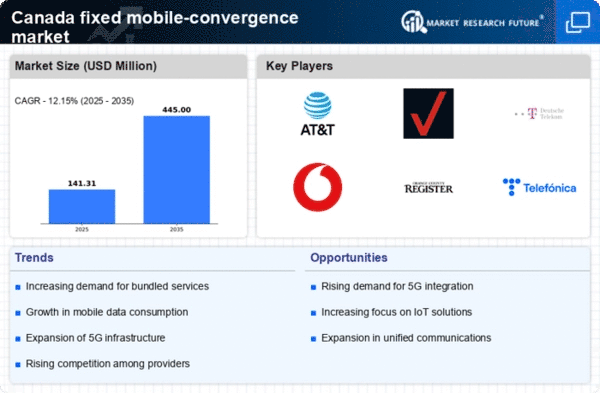
As per Market Research Future analysis, the Canada Fixed Mobile Convergence Market size was estimated at 126.0 USD Million in 2024. The Fixed Mobile-convergence market is projected to grow from 141.31 USD Million in 2025 to 445.0 USD Million by 2035, exhibiting a compound annual growth rate (CAGR) of 12.1% during the forecast period 2025 - 2035

Key Market Trends & Highlights

The Canada fixed mobile-convergence market is experiencing robust growth driven by evolving consumer demands and technological advancements.

  • The demand for bundled services is increasing as consumers seek more value from their telecommunications providers.
  • Advancements in network infrastructure are enhancing service delivery and customer experience across the market.
  • Regulatory support for innovation is fostering a competitive landscape, particularly in the largest segment of mobile services.
  • Rising consumer expectations and technological advancements in telecommunications are key drivers propelling market growth.

Market Size & Forecast

2024 Market Size 126.0 (USD Million)
2035 Market Size 445.0 (USD Million)
CAGR (2025 - 2035) 12.15%

Major Players

AT&T (US), Verizon (US), Deutsche Telekom (DE), Vodafone (GB), Orange (FR), Telefónica (ES), BT Group (GB), T-Mobile (DE), China Mobile (CN)

Our Impact
Enabled $4.3B Revenue Impact for Fortune 500 and Leading Multinationals
Partnering with 2000+ Global Organizations Each Year
30K+ Citations by Top-Tier Firms in the Industry

Canada Fixed Mobile Convergence Market Trends

The Canada Fixed Mobile Convergence Market in Canada is currently experiencing a transformative phase, driven by advancements in technology and changing consumer preferences. The integration of fixed and mobile services is becoming increasingly prevalent, as consumers seek seamless connectivity across devices. This trend is further fueled by the growing demand for high-speed internet and mobile data services, which are essential for both personal and professional use. As a result, service providers are investing in infrastructure to enhance their offerings, aiming to deliver a more cohesive user experience. Moreover, regulatory frameworks are evolving to support this convergence, encouraging competition and innovation within the sector. The Canadian government has recognized the importance of robust telecommunications services, leading to initiatives that promote investment in broadband and mobile networks. This environment appears conducive to the growth of the fixed mobile-convergence market, as stakeholders adapt to the dynamic landscape and explore new business models. The future may hold further integration of services, potentially reshaping how consumers interact with technology and access information.

Increased Demand for Bundled Services

Consumers are increasingly gravitating towards bundled offerings that combine fixed and mobile services. This trend reflects a desire for convenience and cost-effectiveness, as users prefer a single provider for their communication needs. Service providers are responding by creating attractive packages that include internet, television, and mobile plans, thereby enhancing customer loyalty and satisfaction.

Advancements in Network Infrastructure

The fixed mobile-convergence market is witnessing significant improvements in network infrastructure, particularly with the rollout of next-generation technologies. Enhanced fiber-optic networks and the expansion of 5G capabilities are enabling faster and more reliable services. This technological evolution is likely to facilitate greater integration of fixed and mobile services, providing users with a seamless experience.

Regulatory Support for Innovation

Regulatory bodies in Canada are actively promoting innovation within the fixed mobile-convergence market. By implementing policies that encourage competition and investment, these authorities are fostering an environment where new technologies and services can thrive. This support may lead to the emergence of novel business models and enhanced service offerings, ultimately benefiting consumers.

Canada Fixed Mobile Convergence Market Drivers

Rising Consumer Expectations

The fixed mobile-convergence market in Canada is experiencing a notable shift as consumer expectations evolve. With the proliferation of smart devices and high-speed internet, users demand seamless connectivity across platforms. This trend is reflected in the increasing adoption of bundled services, where consumers seek integrated solutions that combine mobile and fixed-line services. According to recent data, approximately 60% of Canadian households prefer service bundles that offer both internet and mobile plans. This growing preference indicates a significant opportunity for service providers to enhance their offerings, thereby driving competition and innovation within the fixed mobile-convergence market. As companies strive to meet these rising expectations, they are likely to invest in advanced technologies and customer-centric solutions, further propelling market growth.

Regulatory Environment and Policy Support

The regulatory environment in Canada significantly impacts the fixed mobile-convergence market. Government policies aimed at fostering competition and innovation are crucial for market growth. Recent initiatives have focused on reducing barriers to entry for new players, thereby encouraging a more diverse range of services. The Canadian Radio-television and Telecommunications Commission (CRTC) has implemented measures to promote fair competition, which is essential for the development of integrated services. As of November 2025, regulatory frameworks are increasingly supportive of technological advancements, allowing for the deployment of next-generation networks. This supportive environment not only benefits consumers through improved service offerings but also incentivizes providers to invest in the fixed mobile-convergence market, potentially leading to enhanced connectivity and service quality.

Competitive Landscape and Market Consolidation

The competitive landscape within the fixed mobile-convergence market in Canada is characterized by ongoing consolidation among telecommunications providers. Major players are increasingly merging or acquiring smaller firms to enhance their service portfolios and expand market reach. This trend is driven by the need to offer comprehensive solutions that meet diverse consumer demands. As of November 2025, the top three telecommunications companies control over 70% of the market share, indicating a concentrated environment. Such consolidation allows for economies of scale, enabling providers to invest in infrastructure and technology that support convergence. However, this also raises concerns regarding competition and pricing, as fewer players may lead to less favorable conditions for consumers. The dynamics of this competitive landscape will likely continue to evolve, influencing the overall trajectory of the fixed mobile-convergence market.

Shift Towards Remote Work and Digital Services

The shift towards remote work and digital services has a profound impact on the fixed mobile-convergence market in Canada. As businesses and individuals increasingly rely on digital communication tools, the demand for reliable and integrated connectivity solutions has surged. This trend is reflected in the growing number of remote workers, which has reached approximately 30% of the workforce as of November 2025. Consequently, service providers are compelled to enhance their offerings to cater to this new normal, integrating mobile and fixed services to ensure seamless communication. The rise of cloud-based applications and collaboration tools further emphasizes the need for robust connectivity solutions. This evolving landscape presents a significant opportunity for growth within the fixed mobile-convergence market, as providers adapt to meet the changing needs of consumers and businesses alike.

Technological Advancements in Telecommunications

Technological advancements play a crucial role in shaping the fixed mobile-convergence market in Canada. The ongoing development of 5G networks is particularly noteworthy, as it promises to enhance mobile broadband speeds and reduce latency. This evolution allows service providers to offer more reliable and faster services, which are essential for the integration of fixed and mobile solutions. As of November 2025, it is estimated that 5G coverage in urban areas has reached approximately 80%, facilitating a more robust infrastructure for convergence. Furthermore, innovations in cloud computing and IoT are enabling new service models that blend fixed and mobile capabilities. These advancements not only improve user experience but also create new revenue streams for providers, indicating a dynamic shift in the fixed mobile-convergence market.


Market Segment Insights

By Convergence: Network Convergence (Largest) vs. Device Convergence (Fastest-Growing)

In the Canada fixed mobile-convergence market, Network Convergence currently commands the largest market share, largely due to its ability to combine fixed and mobile networks effectively. This segment continues to dominate as it offers seamless connectivity and improved service efficiency, appealing to both consumers and businesses. On the other hand, Device Convergence is emerging rapidly, reflecting a growing consumer preference for multi-functional devices that integrate various connectivity options. The appeal of smart devices that support both mobile and fixed functionalities is driving this segment's growth, along with advancements in technology and user expectations for cohesive experiences across devices.

Network Convergence (Dominant) vs. Application Convergence (Emerging)

Network Convergence stands out as the dominant force in the market, providing robust solutions that efficiently merge fixed and mobile services. Its established infrastructure and widespread adoption ensure its position as a fundamental component for users seeking reliable connectivity. In contrast, Application Convergence is touted as an emerging segment that thrives on innovative applications that utilize both fixed and mobile networks. This segment encompasses services designed for seamless integration across platforms, enhancing user experience and offering personalized solutions. As applications evolve and organizations increasingly adopt digital strategies, Application Convergence is poised for significant growth.

By Mode: Dual Mode (Largest) vs. Single Mode (Fastest-Growing)

In the Canada fixed mobile-convergence market, the Dual Mode segment holds the largest market share, appealing to users who seek comprehensive solutions that blend both fixed and mobile communication capabilities. This segment is favored due to its versatility and the seamless experience it offers, allowing consumers to switch between modes effortlessly. On the other hand, the Single Mode segment, while currently smaller in terms of market share, is rapidly gaining traction as users increasingly prefer specialized offerings that cater to specific needs. This shift reflects a growing trend toward customization in services. Growth in the Canada fixed mobile-convergence market is being driven by technological advancements and changing consumer preferences. The rise in demand for fiber-optic connectivity fuels the growth of the Dual Mode segment, promoting hybrid solutions that accommodate both fixed and mobile functionalities. Meanwhile, the Single Mode segment is experiencing the fastest growth as consumers seek solutions tailored for specific applications, signaling a preference for simplicity and efficiency over the multi-functionality of Dual Mode. This dynamic is indicative of a broader trend where users are looking for optimized solutions that fit their individualized communication needs.

Dual Mode (Dominant) vs. Single Mode (Emerging)

The Dual Mode segment in the Canada fixed mobile-convergence market represents a dominant force, characterized by its extensive capabilities that integrate both fixed and mobile technologies. This segment typically attracts a wide range of customers, from individuals to businesses, emphasizing flexibility and seamless connectivity. On the opposite end, the Single Mode segment is emerging, focusing on specific applications that provide streamlined solutions. Users tapping into this segment appreciate the straightforward services it offers, striving for efficiency without the complexity of dual functionalities. The polarization between these modes showcases the diverse preferences in communication solutions, with companies adjusting their strategies to cater to these distinct user bases.

By Component: Voice (Largest) vs. Broadband Internet (Fastest-Growing)

In the Canada fixed mobile-convergence market, the Component segment is characterized by a diverse set of values, including Voice, Video Telephony, Social Networking, Broadband Internet, and Broadband TV. Voice services currently hold the largest market share within this segment, driven by ongoing demand for reliable communication solutions. Meanwhile, Broadband Internet is emerging as a significant player, showcasing a growing share due to the increasing reliance on high-speed internet for various applications and services. The growth trends within the Component segment are influenced by the dynamic technological landscape and shifting consumer preferences. Voice services continue to thrive, bolstered by advancements in VoIP technology and integrated communication solutions. On the other hand, Broadband Internet is expanding rapidly, fueled by the rising need for streaming services, remote work, and digital connectivity. The convergence of these services points towards a future where seamless integration will be crucial for user satisfaction and market competitiveness.

Voice (Dominant) vs. Broadband Internet (Emerging)

Voice services stand out as a dominant force in the Component segment, attributed to their foundational role in communication and customer engagement. This segment is characterized by traditional telephony, VoIP, and enhanced collaboration tools, catering to both personal and business needs. The reliability and accessibility of voice services make them indispensable in the day-to-day operations of many users. Conversely, Broadband Internet is recognized as an emerging force that is reshaping the market landscape. Its rapid adoption is driven by the growing demand for online content, remote collaborations, and smart technology integration. Broadband Internet's flexibility and capacity to support a variety of modern applications make it a vital component of the Canada fixed mobile-convergence market, poised for further growth as consumer habits evolve.

By End-User: Home Users (Largest) vs. Enterprises (Fastest-Growing)

The market share distribution in the Canada fixed mobile-convergence market reveals that Home Users dominate the sector, accounting for a significant portion of the user base. This segment thrives on consumer demand for seamless connectivity and convenience. Following closely behind are Enterprises, which show robust engagement driven by the need for enhanced communication efficiency and streamlined operations. The remaining segments, like Healthcare and Media & Entertainment, play critical roles but are relatively smaller in overall market impact. In terms of growth trends, the Enterprises segment is projected to experience the fastest growth, fueled by digital transformation initiatives. Industries such as BFSI and Automotive are increasingly adopting fixed mobile-convergence solutions to improve operational performance and customer interactions. Additionally, technological advancements and the rising importance of cybersecurity are driving adoption patterns across Healthcare and Government sectors, pushing these segments to adapt rapidly to changing market dynamics.

Home Users: Dominant vs. Enterprises: Emerging

Home Users in the Canada fixed mobile-convergence market represent the dominant force, primarily due to the increasing reliance on mobile devices for daily activities, including streaming, browsing, and communication. This demographic values reliable and high-speed internet as an essential utility. On the other hand, the Enterprises sector is emerging as a key player, utilizing fixed mobile-convergence to improve internal communications and facilitate remote work. Enterprises leverage integrated services to enhance productivity and reduce operational costs. As both segments evolve, the demand for innovative solutions that deliver better connectivity and service quality remains paramount, showcasing the distinct yet interconnected needs of Home Users and Enterprises.

Get more detailed insights about Canada Fixed Mobile Convergence Market

Key Players and Competitive Insights

The fixed mobile-convergence market in Canada is characterized by a dynamic competitive landscape, driven by the increasing demand for integrated communication services. Key players are actively pursuing strategies that emphasize innovation, partnerships, and digital transformation to enhance their service offerings. Notably, AT&T (US) has focused on expanding its 5G network capabilities, which appears to be a critical component of its strategy to provide seamless connectivity across devices. Similarly, Verizon (US) has been investing in enhancing its fiber-optic infrastructure, aiming to deliver high-speed internet services that complement its mobile offerings. These strategic initiatives collectively shape a competitive environment that is increasingly centered around the integration of fixed and mobile services, fostering a more cohesive user experience.
In terms of business tactics, companies are localizing their operations and optimizing supply chains to better serve the Canadian market. The competitive structure of this market seems moderately fragmented, with several key players vying for market share. The influence of major companies like Deutsche Telekom (DE) and Vodafone (GB) is notable, as they leverage their The fixed mobile-convergence market conditions. This collective presence of established firms contributes to a competitive atmosphere where innovation and customer-centric solutions are paramount.
In October 2025, Deutsche Telekom (DE) announced a strategic partnership with a Canadian technology firm to enhance its IoT capabilities. This collaboration is expected to bolster its service portfolio, allowing for more integrated solutions that cater to the growing demand for smart home technologies. The strategic importance of this move lies in its potential to position Deutsche Telekom as a leader in the IoT space, thereby enhancing its competitive edge in the fixed mobile-convergence market.
In September 2025, Vodafone (GB) launched a new initiative aimed at improving its customer service through AI-driven analytics. This initiative is designed to streamline customer interactions and provide personalized service experiences. The significance of this development is underscored by the increasing reliance on AI technologies to enhance operational efficiency and customer satisfaction, which are critical in a market where user experience is a key differentiator.
As of November 2025, the competitive trends in the fixed mobile-convergence market are heavily influenced by digitalization, sustainability, and the integration of AI technologies. Strategic alliances are becoming increasingly important, as companies recognize the value of collaboration in driving innovation. The competitive differentiation is likely to evolve from traditional price-based competition to a focus on technological advancements and supply chain reliability. This shift suggests that companies will need to invest in innovative solutions and sustainable practices to maintain their competitive positions in the market.

Key Companies in the Canada Fixed Mobile Convergence Market include

Industry Developments

In recent months, the Canada Fixed Mobile Convergence Market has witnessed significant developments. Notably, in August 2023, Shaw Communications announced its plans to enhance its broadband services in urban areas, reflecting a broader trend towards improved connectivity. In July 2023, Bell Canada and Telus expanded their partnership to bolster rural internet access, aiming to address the connectivity gap in less populated regions. There has also been growing competition as Freedom Mobile, a subsidiary of Shaw, increased its promotional offerings to attract new customers. Additionally, SaskTel introduced new fixed wireless internet solutions in August 2023, targeting remote communities.

On the mergers and acquisitions front, Bragg Communications completed the acquisition of a local internet provider in July 2023, strengthening its foothold in the Canadian market. Over the past two years, Rogers Communications has significantly invested in network infrastructure upgrades, further highlighting the competitive landscape. This strategic investment, along with rising customer demand for seamless mobile and fixed services, is contributing to the overall growth and valuation of the market, indicating a dynamic environment for telecommunications in Canada.

Future Outlook

Canada Fixed Mobile Convergence Market Future Outlook

The fixed mobile-convergence market is projected to grow at a 12.15% CAGR from 2025 to 2035, driven by technological advancements, increased demand for integrated services, and evolving consumer preferences.

New opportunities lie in:

  • Development of bundled service packages for residential customers
  • Expansion of 5G infrastructure to enhance mobile connectivity
  • Integration of IoT solutions for smart home applications

By 2035, the market is expected to achieve substantial growth, driven by innovation and consumer demand.

Market Segmentation

Canada Fixed Mobile Convergence Market Mode Outlook

  • Dual Mode
  • Single Mode

Canada Fixed Mobile Convergence Market End-User Outlook

  • Home Users
  • Enterprises
  • IT & Telecommunication
  • BFSI
  • Automotive
  • Healthcare
  • Media & Entertainment
  • Government

Canada Fixed Mobile Convergence Market Component Outlook

  • Voice
  • Video Telephony
  • Social Networking
  • Broadband Internet
  • Broadband TV

Canada Fixed Mobile Convergence Market Convergence Outlook

  • Network Convergence
  • Device Convergence
  • Application Convergence

Report Scope

MARKET SIZE 2024 126.0(USD Million)
MARKET SIZE 2025 141.31(USD Million)
MARKET SIZE 2035 445.0(USD Million)
COMPOUND ANNUAL GROWTH RATE (CAGR) 12.15% (2025 - 2035)
REPORT COVERAGE Revenue Forecast, Competitive Landscape, Growth Factors, and Trends
BASE YEAR 2024
Market Forecast Period 2025 - 2035
Historical Data 2019 - 2024
Market Forecast Units USD Million
Key Companies Profiled AT&T (US), Verizon (US), Deutsche Telekom (DE), Vodafone (GB), Orange (FR), Telefónica (ES), BT Group (GB), T-Mobile (DE), China Mobile (CN)
Segments Covered Convergence, Mode, Component, End-User
Key Market Opportunities Integration of 5G technology enhances service offerings in the fixed mobile-convergence market.
Key Market Dynamics Growing demand for integrated services drives competition and innovation in the fixed mobile-convergence market.
Countries Covered Canada
Leave a Comment

FAQs

What is the expected market size of the Canada Fixed Mobile Convergence Market in 2024?

The expected market size of the Canada Fixed Mobile Convergence Market in 2024 is valued at 126.0 million USD.

What will be the market valuation of the Canada Fixed Mobile Convergence Market by 2035?

By 2035, the Canada Fixed Mobile Convergence Market is projected to reach a valuation of 378.0 million USD.

What is the expected CAGR for the Canada Fixed Mobile Convergence Market from 2025 to 2035?

The expected compound annual growth rate (CAGR) for the Canada Fixed Mobile Convergence Market from 2025 to 2035 is 10.503%.

Which segment of the Canada Fixed Mobile Convergence Market is expected to have the highest valuation by 2035?

By 2035, the Network Convergence segment is projected to reach 135.0 million USD, making it the highest valued segment.

How much is the Device Convergence segment expected to be valued at in 2035?

The Device Convergence segment is anticipated to be valued at 112.5 million USD by the year 2035.

What is the market value for the Application Convergence segment in 2024?

In 2024, the Application Convergence segment is expected to be valued at 43.5 million USD.

Who are the major players in the Canada Fixed Mobile Convergence Market?

Some of the major players in the market include Tbaytel, Shaw Communications, Xplornet, and Bell Canada.

What opportunities are present for growth in the Canada Fixed Mobile Convergence Market?

There are significant opportunities for growth in areas such as network efficiency and integrated device solutions.

How does the Canada Fixed Mobile Convergence Market's growth compare with other regions?

The growth rate in Canada is promising, especially with a projected CAGR of over 10% during the forecast period.

What challenges does the Canada Fixed Mobile Convergence Market face?

Challenges include intense competition and the need for continuous technological advancements.

Download Free Sample

Kindly complete the form below to receive a free sample of this Report

Compare Licence

×
Features License Type
Single User Multiuser License Enterprise User
Price $4,950 $5,950 $7,250
Maximum User Access Limit 1 User Upto 10 Users Unrestricted Access Throughout the Organization
Free Customization
Direct Access to Analyst
Deliverable Format
Platform Access
Discount on Next Purchase 10% 15% 15%
Printable Versions