×
Request Free Sample ×

Kindly complete the form below to receive a free sample of this Report

* Please use a valid business email

Leading companies partner with us for data-driven Insights

clients tt-cursor
Hero Background

Canada Micro Learning Market

ID: MRFR/ICT/58857-HCR
200 Pages
Aarti Dhapte
February 2026

Canada Micro Learning Market Size, Share and Trends Analysis Report By Application (Corporate Training, Academic Learning, Personal Development, Compliance Training), By Content Type (Video, Text, Audio, Interactive), By Deployment Mode (Cloud-Based, On-Premises) and By User Type (Individuals, Educational Institutions, Corporate Organizations)- Forecast to 2035

Share:
Download PDF ×

We do not share your information with anyone. However, we may send you emails based on your report interest from time to time. You may contact us at any time to opt-out.

Canada Micro Learning Market Infographic
Purchase Options

Canada Micro Learning Market Summary

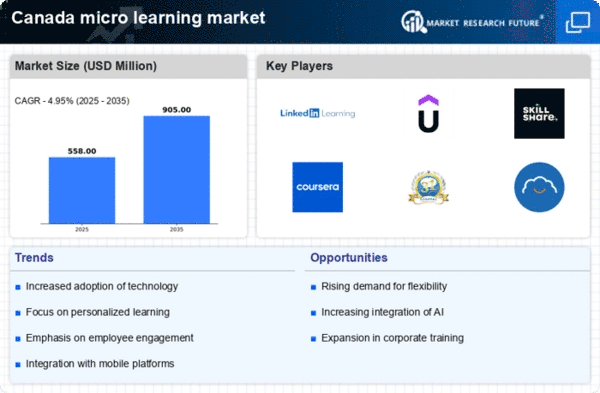
As per Market Research Future analysis, the Canada Micro Learning Market size was estimated at 531.68 USD Million in 2024. The Micro Learning market is projected to grow from 558.0 USD Million in 2025 to 905.0 USD Million by 2035, exhibiting a compound annual growth rate (CAGR) of 4.9% during the forecast period 2025 - 2035

Key Market Trends & Highlights

The Canada micro learning market is experiencing robust growth driven by technological advancements and evolving learner preferences.

  • The largest segment in the Canada micro learning market is corporate training, while the fastest-growing segment is in educational institutions..
  • There is a notable increase in the adoption of mobile learning solutions, facilitating on-the-go access to educational content.
  • Personalized learning experiences are becoming a focal point, catering to individual learner needs and preferences.
  • Key market drivers include the rising demand for flexible learning solutions and the focus on employee skill development.

Market Size & Forecast

2024 Market Size 531.68 (USD Million)
2035 Market Size 905.0 (USD Million)
CAGR (2025 - 2035) 4.95%

Major Players

LinkedIn Learning (US), Udemy (US), Skillshare (US), Coursera (US), EdApp (AU), TalentLMS (US), Grovo (US), Mindflash (US), Axonify (CA)

Our Impact
Enabled $4.3B Revenue Impact for Fortune 500 and Leading Multinationals
Partnering with 2000+ Global Organizations Each Year
30K+ Citations by Top-Tier Firms in the Industry

Canada Micro Learning Market Trends

The Canada Micro Learning Market is experiencing notable growth, driven by the increasing demand for flexible and efficient learning solutions. Organizations are recognizing the value of bite-sized content that can be easily integrated into daily routines. This approach not only enhances knowledge retention but also caters to the diverse learning preferences of individuals. As technology continues to evolve, the accessibility of micro learning platforms is improving, allowing for a wider reach across various demographics. Furthermore, the rise of mobile learning applications is facilitating on-the-go education, making it easier for learners to engage with content anytime and anywhere. In addition, the micro learning market is becoming increasingly relevant in corporate training environments. Companies are adopting these methods to upskill employees quickly and effectively, aligning training with specific job requirements. This trend is particularly evident in sectors such as technology and healthcare, where rapid advancements necessitate continuous learning. The integration of gamification and interactive elements into micro learning modules is also enhancing user engagement, making the learning experience more enjoyable and effective. Overall, the micro learning market is poised for continued expansion as it adapts to the evolving needs of learners and organizations alike.

Increased Adoption of Mobile Learning

The micro learning market is witnessing a surge in mobile learning adoption. With the proliferation of smartphones and tablets, learners are increasingly accessing educational content on their devices. This trend allows for greater flexibility and convenience, enabling users to engage with learning materials at their own pace and on their own schedule.

Focus on Personalized Learning Experiences

There is a growing emphasis on personalized learning experiences within the micro learning market. Organizations are leveraging data analytics to tailor content to individual learning styles and preferences. This customization enhances engagement and effectiveness, as learners receive materials that resonate with their specific needs.

Integration of Gamification Elements

The incorporation of gamification elements into micro learning modules is becoming more prevalent. By introducing game-like features such as rewards, challenges, and leaderboards, educational content becomes more engaging. This trend not only motivates learners but also fosters a competitive spirit, enhancing overall learning outcomes.

Canada Micro Learning Market Drivers

Focus on Employee Skill Development

In the current labor market, there is an increasing emphasis on employee skill development, which is driving growth in the micro learning market in Canada. Organizations are recognizing that continuous learning is essential for maintaining a competitive edge. As a result, many companies are adopting micro learning strategies to provide targeted training that addresses specific skill gaps. Data indicates that approximately 80% of Canadian employers believe that investing in employee development leads to improved performance and job satisfaction. This focus on skill enhancement not only benefits employees but also contributes to overall organizational success. Consequently, the micro learning market is likely to thrive as businesses prioritize ongoing education and training initiatives.

Shift Towards Remote Work and Learning

The shift towards remote work and learning is reshaping the landscape of the micro learning market in Canada. As more organizations adopt flexible work arrangements, the need for accessible and efficient training solutions has become paramount. Micro learning, with its bite-sized content and easy accessibility, aligns well with the demands of remote employees who require quick and effective learning resources. Recent surveys indicate that nearly 75% of Canadian workers prefer online training options that can be completed at their own pace. This trend suggests that the micro learning market is well-positioned to cater to the evolving needs of a remote workforce, potentially leading to increased adoption of micro learning solutions across various industries.

Growing Importance of Data-Driven Learning

The growing importance of data-driven learning is emerging as a key driver in the micro learning market in Canada. Organizations are increasingly leveraging data analytics to assess the effectiveness of their training programs and to tailor learning experiences to meet specific needs. By utilizing data insights, companies can identify knowledge gaps and measure the impact of micro learning initiatives on employee performance. Recent findings indicate that organizations that implement data-driven learning strategies see a 30% improvement in training outcomes. This focus on analytics not only enhances the effectiveness of micro learning but also supports informed decision-making regarding training investments. As data-driven approaches gain traction, the micro learning market is likely to expand, reflecting the demand for evidence-based learning solutions.

Rising Demand for Flexible Learning Solutions

The micro learning market in Canada is experiencing a notable surge in demand for flexible learning solutions. As organizations increasingly recognize the need for adaptable training methods, micro learning offers a viable alternative to traditional educational frameworks. This shift is particularly evident in sectors such as technology and healthcare, where rapid changes necessitate continuous skill development. According to recent data, approximately 70% of Canadian companies are investing in micro learning initiatives to enhance employee engagement and retention. This trend indicates a growing acknowledgment of the importance of on-demand learning resources, which can be accessed anytime and anywhere, thereby aligning with the fast-paced nature of modern work environments. Consequently, the micro learning market is poised for substantial growth as businesses seek to implement more agile training methodologies.

Technological Advancements in Learning Platforms

Technological advancements are significantly influencing the micro learning market in Canada. The proliferation of mobile devices and high-speed internet access has facilitated the development of innovative learning platforms that support micro learning methodologies. These platforms often incorporate features such as interactive content, analytics, and user-friendly interfaces, which enhance the overall learning experience. Recent statistics suggest that over 60% of Canadian learners prefer mobile-friendly content, indicating a clear shift towards digital learning solutions. Furthermore, the integration of artificial intelligence and machine learning into these platforms allows for personalized learning experiences, catering to individual learner needs. As technology continues to evolve, the micro learning market is likely to expand, driven by the demand for more engaging and effective educational tools.


Market Segment Insights

By Application: Corporate Training (Largest) vs. Compliance Training (Fastest-Growing)

The Canada micro learning market shows significant variation in market share among its application segments. Corporate Training leads with the largest share, benefiting from organizations increasingly prioritizing employee skills and knowledge enhancement. In contrast, Compliance Training is emerging as the fastest-growing segment, driven by the rising importance of regulatory requirements in various industries that mandates up-to-date training for compliance adherence. Growth trends highlight a robust demand for Corporate Training as businesses recognize the value of continuous development in maintaining a competitive edge. Meanwhile, Compliance Training's rapid expansion is fueled by heightened regulatory scrutiny and the need for organizations to mitigate risks associated with non-compliance. The focus on flexible, on-demand training solutions is expected to further propel both segments in the foreseeable future.

Corporate Training: Dominant vs. Compliance Training: Emerging

Corporate Training represents the dominant segment within the Canada micro learning market, characterized by its structured approach to employee development and a well-established infrastructure to support learning initiatives. Businesses are investing heavily in customized content and engaging learning models that align with organizational goals. Conversely, Compliance Training, an emerging segment, is gaining traction as a critical solution for industries facing stringent regulations. Its growth is supported by technology that facilitates timely updates and employee access to crucial compliance information, making it a vital component in risk management strategies. As such, both segments illustrate the market's responsiveness to evolving workforce needs and regulatory landscapes.

By Content Type: Video (Largest) vs. Interactive (Fastest-Growing)

In the Canada micro learning market, the content type segment is primarily dominated by Video, which holds the largest share, appealing to users due to its engaging visual format. Text and Audio content follow, catering to specific learning preferences while maintaining significant traction. Interactive content has emerged with a rapidly growing presence, responding to the increasing demand for participatory learning experiences. The growth trends within the content type segment are driven by the rising preference for varied learning styles. Video content thrives on its ability to convey information quickly and engagingly, while Interactive content capitalizes on technological advancements, offering immersive experiences. This shift towards more dynamic learning formats reflects the evolving expectations of learners in the Canada micro learning market, pushing traditional content types to innovate and adapt.

Video (Dominant) vs. Interactive (Emerging)

Video content is currently the dominant force in the Canada micro learning market, as it effectively conveys concepts through visual storytelling, making learning both enjoyable and impactful. It is widely favored across various demographics, particularly among younger learners, who are accustomed to consuming content in this format. Meanwhile, Interactive content represents an emerging trend, gaining traction as platforms integrate gamification, quizzes, and hands-on activities to enhance learner engagement. This type of content is appealing for its ability to foster retention and skill application. As the demand for personalized and engaging educational experiences grows, both Video and Interactive content will play crucial roles in shaping the future landscape of the learning experience.

By Deployment Mode: Cloud-Based (Largest) vs. On-Premises (Fastest-Growing)

In the Canada micro learning market, the deployment mode segment exhibits a distinct distribution between cloud-based and on-premises solutions. Currently, cloud-based offerings dominate the landscape, capturing a significant share due to their flexibility, scalability, and ease of access. Educational institutions and businesses are increasingly favoring cloud solutions, which allow for seamless updates and collaboration among users. On-premises systems, although traditionally used, are gradually losing ground as organizations look for more agile alternatives. Growth trends within this segment reveal an accelerating shift towards cloud-based deployment modes as the primary choice for many organizations. The rising demand for remote access and online learning environments is driving this trend, especially in light of recent global shifts towards digital solutions. Meanwhile, the on-premises segment, while currently trailing, is experiencing a resurgence, as some sectors seek heightened security and control over their resources, making it the fastest-growing option in this competitive market.

Cloud-Based (Dominant) vs. On-Premises (Emerging)

In the Canada micro learning market, cloud-based solutions are firmly established as the dominant deployment mode, celebrated for their accessibility and lower total cost of ownership. Offering scalable resources, these solutions can quickly adapt to varying user needs, attracting educational institutions and businesses alike. Conversely, on-premises solutions are emerging as a relevant choice for organizations that prioritize data security and customizability. These systems provide greater control over content and infrastructure, appealing to industries where regulatory compliance is critical. The growing acceptance of hybrid models suggests that both deployment modes can coexist, catering to diverse organizational requirements and preferences.

By User Type: Educational Institutions (Largest) vs. Corporate Organizations (Fastest-Growing)

In the Canada micro learning market, the user type segment showcases a diverse distribution among individuals, educational institutions, and corporate organizations. Educational institutions account for the largest share, capturing significant engagement due to their need for efficient learning solutions. Meanwhile, corporate organizations are witnessing a notable increase in adoption, reflecting a shift toward continuous learning environments driven by employee performance enhancement. Growth trends indicate that individual users are gradually embracing micro learning for personal development, yet the most pronounced expansion comes from corporate organizations. This surge is propelled by the rising awareness of learning efficiencies and the demand for on-the-job training. Educational institutions maintain a steady growth trajectory as they innovate to adapt to technological advancements and changing student expectations.

Educational Institutions (Dominant) vs. Corporate Organizations (Emerging)

Educational institutions in the Canada micro learning market hold a dominant position, characterized by their established frameworks and substantial user bases that embrace micro learning methodologies. Their focus is largely on integrating these solutions into curricula to enhance student engagement and retention. On the other hand, corporate organizations represent an emerging segment, increasingly adopting micro learning as a strategy for upskilling and enhancing workforce capabilities. These organizations recognize the flexibility and scalability of micro learning modules, aligning them with performance goals and training needs, which fosters a culture of continuous improvement. As both segments continue to evolve, the interplay between them presents unique opportunities for innovation and collaboration in the educational landscape.

Get more detailed insights about Canada Micro Learning Market

Key Players and Competitive Insights

The micro learning market in Canada is characterized by a dynamic competitive landscape, driven by the increasing demand for flexible and efficient learning solutions. Key players such as LinkedIn Learning (US), Coursera (US), and Axonify (CA) are strategically positioning themselves to capitalize on this trend. LinkedIn Learning (US) focuses on integrating its platform with professional networking capabilities, enhancing user engagement through personalized learning paths. Meanwhile, Coursera (US) emphasizes partnerships with universities and organizations to expand its course offerings, thereby appealing to a broader audience. Axonify (CA), a local player, leverages its expertise in employee training, focusing on bite-sized content that aligns with corporate learning needs. Collectively, these strategies contribute to a competitive environment that prioritizes innovation and user-centric solutions.In terms of business tactics, companies are increasingly localizing their content to cater to the Canadian market, optimizing their supply chains to ensure timely delivery of learning materials. The market appears moderately fragmented, with a mix of established players and emerging startups. This fragmentation allows for diverse offerings, yet the influence of key players remains substantial, as they set benchmarks for quality and user experience.

In October LinkedIn Learning (US) announced a new partnership with a leading Canadian university to co-develop specialized courses aimed at enhancing digital skills among students. This strategic move not only strengthens LinkedIn Learning's foothold in the educational sector but also aligns with the growing emphasis on digital literacy in the workforce. The collaboration is likely to enhance the platform's credibility and attract a younger demographic seeking relevant skills.

In September Coursera (US) launched a new initiative aimed at providing free access to select courses for Canadian non-profits. This initiative underscores Coursera's commitment to social responsibility while simultaneously expanding its user base. By offering free resources, Coursera may foster goodwill and enhance its brand image, potentially leading to increased subscriptions in the long term.

In November Axonify (CA) unveiled a new AI-driven feature that personalizes learning experiences based on user behavior and preferences. This innovation positions Axonify as a leader in adaptive learning technologies, catering to the specific needs of corporate clients. The integration of AI not only enhances user engagement but also provides valuable insights into learning effectiveness, which could be a game-changer in the corporate training landscape.

As of November the micro learning market is witnessing trends such as digitalization, AI integration, and a growing focus on sustainability. Strategic alliances among key players are shaping the competitive landscape, fostering innovation and collaboration. Looking ahead, it appears that competitive differentiation will increasingly hinge on technological advancements and the ability to deliver personalized learning experiences. The shift from price-based competition to a focus on innovation and supply chain reliability is likely to define the future trajectory of the market.

Key Companies in the Canada Micro Learning Market include

Industry Developments

The Canada Micro Learning Market has seen significant developments in recent months, marked by an increasing focus on digital education solutions amid the growing demand for flexible learning options. Companies like Skillsoft continue to enhance their platforms to cater to the evolving needs of learners and organizations. In terms of market valuation, the demand for microlearning solutions has contributed positively to the growth of firms such as Pluralsight, reflecting a robust interest in bite-sized educational content. 

Organizations like EdApp and Grovo are also gaining traction, focusing on mobile learning applications that enhance learner engagement. Between 2021 and 2023, the Canadian government emphasized digital skill development as part of its broader economic strategy, fostering a conducive environment for microlearning platforms. 

As educational institutions and businesses adapt to hybrid learning models, the microlearning landscape in Canada is expected to expand further, driven by innovative content delivery and increased accessibility to learning resources.

Future Outlook

Canada Micro Learning Market Future Outlook

The Micro learning Market is projected to grow at a 4.95% CAGR from 2025 to 2035, driven by technological advancements, increasing demand for flexible learning solutions, and the rise of remote work.

New opportunities lie in:

  • Development of mobile-first micro learning platforms for enhanced accessibility.
  • Integration of AI-driven analytics to personalize learning experiences.
  • Partnerships with corporations for tailored employee training programs.

By 2035, the micro learning market is expected to achieve substantial growth and innovation.

Market Segmentation

Canada Micro Learning Market User Type Outlook

  • Individuals
  • Educational Institutions
  • Corporate Organizations

Canada Micro Learning Market Application Outlook

  • Corporate Training
  • Academic Learning
  • Personal Development
  • Compliance Training

Canada Micro Learning Market Content Type Outlook

  • Video
  • Text
  • Audio
  • Interactive

Canada Micro Learning Market Deployment Mode Outlook

  • Cloud-Based
  • On-Premises

Report Scope

MARKET SIZE 2024 531.68(USD Million)
MARKET SIZE 2025 558.0(USD Million)
MARKET SIZE 2035 905.0(USD Million)
COMPOUND ANNUAL GROWTH RATE (CAGR) 4.95% (2025 - 2035)
REPORT COVERAGE Revenue Forecast, Competitive Landscape, Growth Factors, and Trends
BASE YEAR 2024
Market Forecast Period 2025 - 2035
Historical Data 2019 - 2024
Market Forecast Units USD Million
Key Companies Profiled LinkedIn Learning (US), Udemy (US), Skillshare (US), Coursera (US), EdApp (AU), TalentLMS (US), Grovo (US), Mindflash (US), Axonify (CA)
Segments Covered Application, Content Type, Deployment Mode, User Type
Key Market Opportunities Integration of artificial intelligence in micro learning platforms enhances personalized learning experiences.
Key Market Dynamics Rising demand for flexible learning solutions drives innovation in the micro learning market across Canada.
Countries Covered Canada
Leave a Comment

FAQs

What is the expected market size of the Canada Micro Learning Market by 2024?

By 2024, the Canada Micro Learning Market is expected to be valued at 442.75 USD Million.

What is the projected market value of the Canada Micro Learning Market in 2035?

In 2035, the market is expected to reach a valuation of 895.0 USD Million.

What is the expected CAGR for the Canada Micro Learning Market from 2025 to 2035?

The expected CAGR for the market from 2025 to 2035 is 6.607%.

Which application segment holds the largest market share in the Canada Micro Learning Market?

The Corporate Training segment is projected to have the largest market share, valued at 150.0 USD Million in 2024.

What will be the value of the Corporate Training segment in 2035?

The Corporate Training segment is expected to be valued at 300.0 USD Million in 2035.

How does the Academic Learning segment's market value change from 2024 to 2035?

The Academic Learning segment is anticipated to grow from 120.0 USD Million in 2024 to 240.0 USD Million in 2035.

What is the market size for the Personal Development segment in 2024?

The Personal Development segment is valued at 90.0 USD Million in 2024.

How is the Compliance Training segment expected to perform by 2035?

The Compliance Training segment is forecasted to reach a value of 175.0 USD Million by 2035.

Who are some key players in the Canada Micro Learning Market?

Key players include Zovio, Skillsoft, LinkedIn Learning, EdApp, and Coursera among others.

What growth drivers are influencing the Canada Micro Learning Market?

Factors such as the increasing demand for flexible learning solutions and advancements in technology are driving market growth.

Download Free Sample

Kindly complete the form below to receive a free sample of this Report

Compare Licence

×
Features License Type
Single User Multiuser License Enterprise User
Price $4,950 $5,950 $7,250
Maximum User Access Limit 1 User Upto 10 Users Unrestricted Access Throughout the Organization
Free Customization
Direct Access to Analyst
Deliverable Format
Platform Access
Discount on Next Purchase 10% 15% 15%
Printable Versions