×
Request Free Sample ×

Kindly complete the form below to receive a free sample of this Report

* Please use a valid business email

Leading companies partner with us for data-driven Insights

clients tt-cursor
Hero Background

UK Micro Learning Market

ID: MRFR/ICT/58853-HCR
200 Pages
Aarti Dhapte
February 2026

UK Micro Learning Market Research Report By Application (Corporate Training, Academic Learning, Personal Development, Compliance Training), By Content Type (Video, Text, Audio, Interactive), By Deployment Mode (Cloud-Based, On-Premises) and By User Type (Individuals, Educational Institutions, Corporate Organizations)- Forecast to 2035

Share:
Download PDF ×

We do not share your information with anyone. However, we may send you emails based on your report interest from time to time. You may contact us at any time to opt-out.

UK Micro Learning Market Infographic
Purchase Options

UK Micro Learning Market Summary

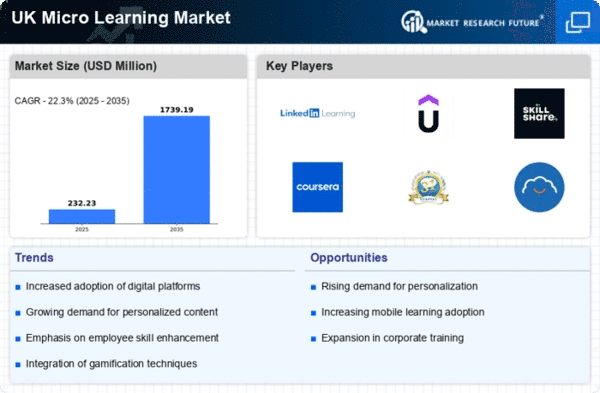
As per Market Research Future analysis, the UK micro learning market Size was estimated at 189.88 USD Million in 2024. The UK micro learning market is projected to grow from 232.23 USD Million in 2025 to 1739.19 USD Million by 2035, exhibiting a compound annual growth rate (CAGR) of 22% during the forecast period 2025 - 2035

Key Market Trends & Highlights

The UK micro learning market is experiencing robust growth driven by technological advancements and evolving training needs.

  • The largest segment in the UK micro learning market is employee training, while the fastest-growing segment is compliance training.
  • There is a notable increase in the adoption of mobile learning solutions, reflecting a shift towards on-the-go education.
  • Integration of gamification elements is becoming prevalent, enhancing engagement and retention among learners.
  • Key market drivers include the rising demand for flexible learning solutions and the emphasis on employee retention strategies.

Market Size & Forecast

2024 Market Size 189.88 (USD Million)
2035 Market Size 1739.19 (USD Million)
CAGR (2025 - 2035) 22.3%

Major Players

LinkedIn Learning (US), Udemy (US), Skillshare (US), Coursera (US), EdApp (AU), TalentLMS (US), Grovo (US), Alison (IE), Mindflash (US)

Our Impact
Enabled $4.3B Revenue Impact for Fortune 500 and Leading Multinationals
Partnering with 2000+ Global Organizations Each Year
30K+ Citations by Top-Tier Firms in the Industry

UK Micro Learning Market Trends

The micro learning market is currently experiencing a notable evolution, driven by the increasing demand for flexible and efficient learning solutions. Organizations are recognizing the value of bite-sized content that can be easily consumed in short time frames, aligning with the fast-paced nature of modern work environments. This approach not only enhances knowledge retention but also caters to the diverse learning preferences of individuals. As a result, various sectors, including education and corporate training, are integrating micro learning strategies to improve engagement and effectiveness. Furthermore, advancements in technology, such as mobile applications and online platforms, are facilitating the delivery of micro learning content, making it more accessible than ever. In addition, the micro learning market is likely to benefit from the growing emphasis on personalized learning experiences. Tailoring content to meet the specific needs of learners appears to be a priority for many organizations. This trend suggests a shift towards adaptive learning technologies that can analyze user behavior and preferences, thereby providing customized learning paths. As the micro learning market continues to mature, it is expected that innovative solutions will emerge, further enhancing the learning experience and driving adoption across various industries.

Increased Adoption of Mobile Learning

The micro learning market is witnessing a surge in mobile learning solutions. With the proliferation of smartphones and tablets, learners are increasingly accessing educational content on-the-go. This trend indicates a shift towards more flexible learning environments, allowing individuals to engage with material whenever and wherever they choose.

Focus on Employee Training and Development

Organizations are placing greater emphasis on employee training through micro learning initiatives. This approach not only enhances skill development but also promotes continuous learning within the workplace. By integrating micro learning into training programs, companies aim to improve employee performance and satisfaction.

Integration of Gamification Elements

The incorporation of gamification into micro learning strategies is becoming more prevalent. By adding game-like elements, such as rewards and challenges, the micro learning market is enhancing learner engagement. This trend suggests that organizations are recognizing the importance of making learning enjoyable and interactive.

UK Micro Learning Market Drivers

Emphasis on Employee Retention Strategies

In the competitive landscape of the UK job market, organisations are increasingly focusing on employee retention strategies, which significantly impacts the micro learning market. Companies are recognising that investing in employee development through micro learning initiatives can lead to higher job satisfaction and loyalty. By providing targeted training that addresses specific skills gaps, organisations can foster a culture of continuous improvement. Research suggests that companies that prioritise employee development see a 25% increase in retention rates. This emphasis on retention is likely to drive further investment in micro learning solutions, as businesses aim to create a more engaged and skilled workforce within the micro learning market.

Growing Importance of Compliance Training

The micro learning market in the UK is also being driven by the growing importance of compliance training across various industries. As regulatory requirements become more stringent, organisations are seeking efficient ways to ensure that employees are well-informed about compliance issues. Micro learning offers a practical solution, allowing for the delivery of concise, focused training sessions that can be easily updated as regulations change. This approach not only enhances knowledge retention but also ensures that employees remain compliant with industry standards. Recent data indicates that compliance training is a priority for 60% of UK businesses, highlighting the potential for growth in the micro learning market as organisations seek to mitigate risks associated with non-compliance.

Rising Demand for Flexible Learning Solutions

The micro learning market in the UK is experiencing a notable surge in demand for flexible learning solutions. This trend is largely driven by the need for adaptable training methods that cater to the diverse schedules of employees. Companies are increasingly recognising that traditional training methods may not align with the fast-paced work environment. As a result, micro learning modules, which allow for short, focused learning sessions, are becoming more prevalent. According to recent data, approximately 70% of UK organisations are now implementing micro learning strategies to enhance employee engagement and retention. This shift towards flexibility is likely to continue, as businesses seek to optimise their training processes and improve overall productivity within the micro learning market.

Technological Advancements in Learning Platforms

Technological advancements are playing a crucial role in shaping the micro learning market in the UK. The integration of artificial intelligence, machine learning, and data analytics into learning platforms is enhancing the effectiveness of micro learning modules. These technologies enable personalised learning experiences, allowing employees to engage with content that is tailored to their specific needs and learning styles. Furthermore, the rise of cloud-based solutions facilitates easy access to learning materials from any location, thereby promoting continuous learning. Recent statistics indicate that the adoption of advanced learning technologies has increased by 40% among UK companies, reflecting a growing recognition of the benefits these innovations bring to the micro learning market.

Increased Focus on Cost-Effective Training Solutions

The micro learning market in the UK is witnessing a shift towards cost-effective training solutions as organisations strive to optimise their training budgets. Traditional training methods often involve significant expenses related to travel, accommodation, and materials. In contrast, micro learning provides a more economical alternative, enabling companies to deliver training at a fraction of the cost. By utilising digital platforms, organisations can reach a larger audience without incurring substantial costs. Recent surveys indicate that 55% of UK companies are actively seeking to reduce training expenses, which is likely to drive the adoption of micro learning solutions. This focus on cost-effectiveness is expected to further propel the growth of the micro learning market.


Market Segment Insights

By Application: Corporate Training (Largest) vs. Personal Development (Fastest-Growing)

In the UK micro learning market, Corporate Training holds the largest share, benefiting from the increasing focus on employee upskilling and organizational growth. Academic Learning also contributes significantly, catering to educational institutions adopting digital methods. Compliance Training continues to be essential for businesses to meet regulatory requirements, while Personal Development emerges as a growing segment, driven by individual learners seeking self-improvement through flexible learning opportunities. The growth trends in this market indicate that Corporate Training will maintain its dominance as organizations recognize the importance of ongoing employee training. Meanwhile, Personal Development is gaining traction, appealing to a demographic that prioritizes self-directed learning. Factors such as technological advancements, mobile learning accessibility, and a shift towards continuous education further accelerate growth across all segments, leading to a dynamic and evolving landscape.

Corporate Training: Dominant vs. Personal Development: Emerging

Corporate Training stands out as the dominant force in the UK micro learning market, with organizations heavily investing in tools and platforms that facilitate effective employee learning. This segment focuses on enhancing workforce skills, adapting to industry changes, and promoting compliance. Personal Development, on the other hand, is an emerging segment that attracts a diverse audience interested in lifelong learning and personal growth. This shift towards self-improvement has been bolstered by the rise of online courses and an increasing appetite for flexibility in learning methods. Both segments illustrate the balancing act between structured organizational needs and individual aspirations, ensuring a rich and varied micro learning landscape.

By Content Type: Video (Largest) vs. Interactive (Fastest-Growing)

The market share distribution within the content type segment reveals that Video is the predominant format, capturing significant attention and engagement from learners. Following Video, Text, Audio, and Interactive content also have their unique market shares; however, they are comparatively smaller. Text remains popular for its straightforward delivery, while Audio is gaining traction for its convenience, allowing users to absorb information on the go. Growth trends in the UK micro learning market are shaped by increasing demand for bite-sized learning experiences, with Interactive content witnessing the fastest growth. As the digital landscape evolves, learners are gravitating towards formats that enhance engagement and retention, driving investments into interactive technologies that stimulate active participation and improve learning outcomes.

Video: Dominant vs. Interactive: Emerging

In the UK micro learning market, Video stands out as the dominant content type, favored for its ability to convey information dynamically and effectively. It caters to visual learners and tends to produce higher engagement rates, making it a preferred choice for many organizations. On the other hand, Interactive content, characterized by its user-engagement features such as quizzes and simulations, is rapidly emerging. This format not only boosts retention of knowledge but also caters to diverse learning styles, making it highly sought after among educators aiming to foster active learning environments. The versatility of these formats positions them favorably as they evolve to meet the expectations of modern learners.

By Deployment Mode: Cloud-Based (Largest) vs. On-Premises (Fastest-Growing)

In the UK micro learning market, the deployment mode segment is primarily dominated by cloud-based solutions, which have gained significant traction due to their scalability and accessibility. This mode allows organizations to implement learning solutions without heavy infrastructure investments, leading to a substantial market share compared to on-premises options. On-premises deployment, while less prevalent, is witnessing increased interest as companies prioritize data security and customization, appealing to specific organizational needs. As enterprises shift towards digital transformation, the growth trajectories of cloud-based and on-premises deployment modes are markedly different. The cloud-based segment continues to expand rapidly, driven by the demand for remote learning and flexible access. Conversely, on-premises solutions are emerging faster as businesses re-evaluate their learning strategies, focusing on security and compliance concerns. The adoption of on-premises systems is propelled by organizations wanting greater control over their data and learning environments, indicating a notable trend in the market.

Cloud-Based (Dominant) vs. On-Premises (Emerging)

Cloud-based solutions represent the dominant force within the UK micro learning market, offering easy integration and enhanced user experience for educational initiatives. Their widespread acceptance is attributed to benefits like lower setup costs, regular updates, and the ability to cater to a remote workforce. Organizations increasingly favor cloud deployments to deliver engaging micro learning experiences without the intricacies of physical infrastructure. Meanwhile, on-premises deployment is emerging as a viable alternative, particularly amongst firms with strict data governance needs. This segment appeals to those requiring tailored solutions and comprehensive data security, reflecting a shift in organizations prioritizing regulatory compliance and bespoke learning environments. The distinct characteristics of both deployment modes cater to varying organizational strategies.

By User Type: Individuals (Largest) vs. Corporate Organizations (Fastest-Growing)

In the UK micro learning market, the distribution of user types reveals that Individuals constitute the largest segment, driven by their desire for personalized learning experiences. Educational Institutions also play a significant role, catering to students and teachers who seek resources for enhancing educational outcomes. Corporate Organizations, while smaller in share compared to Individuals, are rapidly growing as companies recognize the need for continuous employee training to stay competitive. The growth trends in this segment highlight a remarkable shift towards digital learning among Corporate Organizations, which are increasingly adopting micro learning solutions to enhance workforce productivity. The individual user base continues to expand as more learners seek flexible, on-demand training options. This dual trend points to a vibrant market where different user types stimulate innovation and drive demand for varied micro learning solutions.

Individuals (Dominant) vs. Corporate Organizations (Emerging)

Individuals dominate the user types in the UK micro learning market due to their focus on self-directed learning and accessibility. This segment is characterized by a diverse demographic, including students, freelancers, and lifelong learners, all seeking tailored content that fits their personal or professional needs. Meanwhile, Corporate Organizations are emerging as a significant player, motivated by the necessity of effective training strategies to upskill employees. They leverage micro learning for its flexibility and efficiency, facilitating just-in-time learning to enhance employee performance. This ongoing transition indicates that while Individuals remain dominant in numbers, Corporate Organizations are increasingly investing in micro learning tools at a robust pace, shaping the future landscape of the market.

Get more detailed insights about UK Micro Learning Market

Key Players and Competitive Insights

The micro learning market in the UK is characterized by a dynamic competitive landscape, driven by the increasing demand for flexible and efficient learning solutions. Key players such as LinkedIn Learning (US), Udemy (US), and Alison (IE) are strategically positioned to capitalize on this trend. LinkedIn Learning (US) focuses on integrating its platform with professional networking capabilities, thereby enhancing user engagement and retention. Udemy (US), on the other hand, emphasizes a vast course catalog and partnerships with industry leaders to ensure content relevance. Alison (IE) adopts a unique approach by offering free courses with optional paid certifications, appealing to a broad audience seeking accessible education. Collectively, these strategies contribute to a competitive environment that prioritizes user-centric offerings and innovative learning methodologies.In terms of business tactics, companies are increasingly localizing their content to cater to regional preferences, which appears to enhance user satisfaction and retention. The market structure is moderately fragmented, with numerous players vying for market share. However, the influence of major companies is substantial, as they set benchmarks for quality and innovation that smaller entities strive to meet. This competitive structure fosters a diverse range of learning solutions, catering to various learner needs and preferences.

In October LinkedIn Learning (US) announced a partnership with a leading UK-based tech firm to develop specialized courses aimed at upskilling professionals in emerging technologies. This strategic move is likely to enhance LinkedIn Learning's market presence in the UK, as it aligns with the growing demand for tech-related skills. By leveraging the expertise of a local partner, LinkedIn Learning (US) may effectively tailor its offerings to meet specific market needs, thereby increasing its competitive edge.

In September Udemy (US) launched a new initiative aimed at integrating AI-driven personalized learning paths for users. This development is significant as it reflects a broader trend towards customization in education, allowing learners to engage with content that is specifically tailored to their individual needs and learning styles. Such innovations could potentially lead to higher completion rates and user satisfaction, positioning Udemy (US) favorably against its competitors.

In August Alison (IE) expanded its course offerings by introducing a series of micro-credentials in collaboration with UK universities. This strategic action not only enhances Alison's credibility but also aligns with the increasing recognition of micro-credentials in the job market. By partnering with established educational institutions, Alison (IE) may attract a more diverse learner demographic, further solidifying its position in the competitive landscape.

As of November the micro learning market is witnessing trends such as digitalization, AI integration, and a growing emphasis on sustainability. Strategic alliances among key players are shaping the landscape, fostering innovation and enhancing service delivery. The competitive differentiation is likely to evolve from traditional price-based competition towards a focus on technological advancements and supply chain reliability. Companies that prioritize innovation and user experience may emerge as leaders in this rapidly changing environment.

Key Companies in the UK Micro Learning Market include

Industry Developments

The UK Micro Learning Market has seen significant developments recently, driven by a surge in demand for flexible and efficient learning solutions. Companies such as MindTools, and, SAP Litmos, continue to expand their offerings, embracing innovative technologies to enhance user experiences. In September 2023, Alison announced partnerships aimed at integrating more interactive learning technologies, strengthening its position in the market. 

Additionally, TalentLMS made headlines with its acquisition of a smaller tech firm focused on AI-driven content delivery, reflecting the ongoing trend of consolidation in this sector. In terms of market performance, LinkedIn Learning and Coursera have reported notable growth in user enrollment, attributed to an increasing corporate focus on upskilling amidst a competitive job market. 

Noteworthy is the UK government's emphasis on digital skills training, which has prompted companies like Google Digital Garage to align their programs with national skills initiatives, further boosting the micro learning landscape. Over the past two years, events such as the rise of remote learning due to the pandemic have fundamentally changed how micro learning is perceived and utilized in professional settings across the UK.

Future Outlook

UK Micro Learning Market Future Outlook

The Micro learning Market is projected to grow at a 22.3% CAGR from 2025 to 2035, driven by technological advancements, increasing demand for flexible learning, and enhanced engagement strategies.

New opportunities lie in:

  • Development of AI-driven personalized learning platforms
  • Integration of micro learning into corporate training programs
  • Expansion of mobile learning applications for on-the-go access

By 2035, the micro learning market is expected to achieve substantial growth and innovation.

Market Segmentation

UK Micro Learning Market User Type Outlook

  • Individuals
  • Educational Institutions
  • Corporate Organizations

UK Micro Learning Market Application Outlook

  • Corporate Training
  • Academic Learning
  • Personal Development
  • Compliance Training

UK Micro Learning Market Content Type Outlook

  • Video
  • Text
  • Audio
  • Interactive

UK Micro Learning Market Deployment Mode Outlook

  • Cloud-Based
  • On-Premises

Report Scope

MARKET SIZE 2024 189.88(USD Million)
MARKET SIZE 2025 232.23(USD Million)
MARKET SIZE 2035 1739.19(USD Million)
COMPOUND ANNUAL GROWTH RATE (CAGR) 22.3% (2025 - 2035)
REPORT COVERAGE Revenue Forecast, Competitive Landscape, Growth Factors, and Trends
BASE YEAR 2024
Market Forecast Period 2025 - 2035
Historical Data 2019 - 2024
Market Forecast Units USD Million
Key Companies Profiled LinkedIn Learning (US), Udemy (US), Skillshare (US), Coursera (US), EdApp (AU), TalentLMS (US), Grovo (US), Alison (IE), Mindflash (US)
Segments Covered Application, Content Type, Deployment Mode, User Type
Key Market Opportunities Integration of artificial intelligence in micro learning platforms enhances personalized learning experiences.
Key Market Dynamics Rising demand for flexible learning solutions drives innovation in the micro learning market.
Countries Covered UK
Leave a Comment

FAQs

What is the market size of the UK Micro Learning Market in 2024?

In 2024, the UK Micro Learning Market is expected to be valued at 227.7 million USD.

What is the projected market size for the UK Micro Learning Market by 2035?

By 2035, the UK Micro Learning Market is projected to grow to 1032.5 million USD.

What is the expected CAGR for the UK Micro Learning Market from 2025 to 2035?

The UK Micro Learning Market is expected to witness a CAGR of 14.732 percent from 2025 to 2035.

Which application holds the largest share in the UK Micro Learning Market?

Corporate Training is expected to dominate the market with a projected value of 320.0 million USD by 2035.

What are the projected values for Academic Learning within the UK Micro Learning Market by 2035?

Academic Learning is anticipated to grow to 250.0 million USD by 2035.

What is the expected market size for Personal Development in 2024?

In 2024, the Personal Development segment of the UK Micro Learning Market is valued at 55.0 million USD.

How is the Compliance Training segment projected to perform by 2035?

The Compliance Training segment is expected to reach a value of 172.5 million USD by 2035.

Who are the key players in the UK Micro Learning Market?

Major players in the UK Micro Learning Market include MindTools, SAP Litmos, LinkedIn Learning, and Coursera.

What challenges might the UK Micro Learning Market face in the coming years?

The market may face challenges including content relevance and technological advancements affecting delivery methods.

What opportunities exist for growth in the UK Micro Learning Market?

Growing demand for flexible learning options and advancements in technology present significant opportunities for market growth.

Download Free Sample

Kindly complete the form below to receive a free sample of this Report

Compare Licence

×
Features License Type
Single User Multiuser License Enterprise User
Price $4,950 $5,950 $7,250
Maximum User Access Limit 1 User Upto 10 Users Unrestricted Access Throughout the Organization
Free Customization
Direct Access to Analyst
Deliverable Format
Platform Access
Discount on Next Purchase 10% 15% 15%
Printable Versions