×
Request Free Sample ×

Kindly complete the form below to receive a free sample of this Report

* Please use a valid business email

Leading companies partner with us for data-driven Insights

clients tt-cursor
Hero Background

Canada Metaverse Market

ID: MRFR/ICT/58849-HCR
200 Pages
Aarti Dhapte
February 2026

Canada Metaverse Market Size, Share and Research Report: By Component (Software, Hardware), By Platform (Desktop/Laptops, Mobile, Wearables), By Technology (Blockchain, VR & AR, Mixed Reality, Others), By Application (Online Shopping, Content Creation, Gaming, Social Media, Others) and By End User (Consumer, Enterprises)- Industry Forecast to 2035

Share:
Download PDF ×

We do not share your information with anyone. However, we may send you emails based on your report interest from time to time. You may contact us at any time to opt-out.

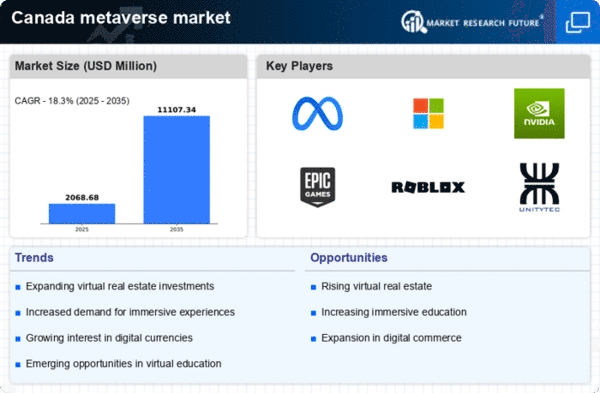
Canada Metaverse Market Infographic
Purchase Options

Canada Metaverse Market Summary

As per Market Research Future analysis, the Canada metaverse market Size was estimated at 1748.67 USD Million in 2024. The Canada metaverse market is projected to grow from 2068.68 USD Million in 2025 to 11107.34 USD Million by 2035, exhibiting a compound annual growth rate (CAGR) of 18% during the forecast period 2025 - 2035

Key Market Trends & Highlights

The Canada metaverse market is poised for substantial growth driven by technological advancements and evolving consumer preferences.

  • Investment in virtual real estate is witnessing a notable increase, indicating a shift towards digital property ownership.
  • E-commerce is expanding rapidly within virtual environments, reflecting a growing trend in online shopping experiences.
  • User privacy and security are becoming focal points for developers, as consumers demand safer digital interactions.
  • Technological advancements in VR and AR, along with the growing demand for remote collaboration tools, are key drivers of market expansion.

Market Size & Forecast

2024 Market Size 1748.67 (USD Million)
2035 Market Size 11107.34 (USD Million)
CAGR (2025 - 2035) 18.3%

Major Players

Meta Platforms (US), Microsoft (US), NVIDIA (US), Epic Games (US), Roblox Corporation (US), Unity Technologies (US), Decentraland (US), Sandbox (FR), Tencent (CN)

Our Impact
Enabled $4.3B Revenue Impact for Fortune 500 and Leading Multinationals
Partnering with 2000+ Global Organizations Each Year
30K+ Citations by Top-Tier Firms in the Industry

Canada Metaverse Market Trends

The metaverse market in Canada is currently experiencing a dynamic evolution, driven by advancements in technology and increasing consumer interest. As digital interactions become more prevalent, businesses are exploring innovative ways to engage with customers through immersive experiences. This shift is not merely a trend but appears to be a fundamental change in how individuals and organizations communicate and transact. The integration of augmented reality (AR) and virtual reality (VR) technologies is enhancing user experiences, making them more interactive and engaging. Furthermore, the rise of remote work and digital collaboration tools has accelerated the adoption of metaverse platforms, suggesting a long-term transformation in workplace dynamics. In addition, Canadian content creators and developers are increasingly contributing to the metaverse market, fostering a vibrant ecosystem. This growth is supported by government initiatives aimed at promoting digital innovation and technology adoption. As the metaverse continues to expand, it seems likely that various sectors, including education, entertainment, and retail, will increasingly leverage these platforms to enhance their offerings. The potential for economic growth within this market is substantial, indicating a promising future for stakeholders involved in the metaverse landscape.

Increased Investment in Virtual Real Estate

There is a noticeable trend towards investment in virtual real estate within the metaverse market. Companies and individuals are acquiring digital land to establish a presence in virtual environments. This trend reflects a growing recognition of the value of virtual spaces for branding and customer engagement.

Expansion of E-commerce in Virtual Environments

The metaverse market is witnessing a surge in e-commerce activities as businesses explore new avenues for sales. Virtual storefronts and immersive shopping experiences are becoming more common, allowing consumers to interact with products in innovative ways. This shift may redefine traditional retail models.

Enhanced Focus on User Privacy and Security

As the metaverse market grows, there is an increasing emphasis on user privacy and data security. Stakeholders are recognizing the importance of protecting user information in virtual environments. This trend suggests a potential shift towards more robust regulatory frameworks and best practices.

Canada Metaverse Market Drivers

Technological Advancements in VR and AR

The metaverse market in Canada is experiencing a surge due to rapid technological advancements in virtual reality (VR) and augmented reality (AR). Innovations in hardware, such as more powerful headsets and improved graphics, are enhancing user experiences. According to recent data, the VR and AR sectors are projected to grow at a CAGR of 30% over the next five years. This growth is likely to drive increased consumer engagement and investment in the metaverse market. Furthermore, as Canadian companies adopt these technologies, they are creating immersive environments that attract users and businesses alike, thereby expanding the overall market landscape.

Increased Interest in Digital Experiences

There is a notable increase in consumer interest in digital experiences, which is significantly impacting the metaverse market in Canada. As consumers seek more engaging and interactive content, businesses are responding by creating unique virtual experiences. This trend is evidenced by a 40% rise in participation in virtual events and experiences over the past year. Such engagement not only enhances brand loyalty but also drives revenue growth for companies operating within the metaverse market. As a result, businesses are likely to continue investing in innovative digital experiences to capture the attention of their target audiences.

Expansion of Gaming and Entertainment Sectors

The gaming and entertainment sectors are expanding rapidly, contributing to the growth of the metaverse market in Canada. With the increasing popularity of online gaming and virtual events, companies are exploring new ways to integrate immersive experiences into their offerings. The gaming industry alone is projected to reach $3 billion in revenue by 2025, indicating a robust market potential. This expansion is likely to attract more developers and investors to the metaverse market, fostering innovation and competition. As a result, the interplay between gaming and the metaverse is expected to create new opportunities for growth and engagement.

Growing Demand for Remote Collaboration Tools

The shift towards remote work has led to a growing demand for collaboration tools within the metaverse market in Canada. Businesses are increasingly seeking virtual environments that facilitate teamwork and communication among remote employees. Reports indicate that the market for virtual collaboration tools is expected to reach $5 billion by 2026, reflecting a significant opportunity for growth. This trend is likely to encourage companies to invest in metaverse solutions that enhance productivity and foster a sense of community among distributed teams, thereby propelling the metaverse market forward.

Supportive Government Policies and Initiatives

Supportive government policies and initiatives are playing a crucial role in shaping the metaverse market in Canada. The Canadian government has been actively promoting digital innovation and technology adoption, which is likely to encourage investment in the metaverse. Recent initiatives aimed at fostering tech startups and enhancing digital infrastructure are expected to create a conducive environment for growth. As a result, businesses may find it easier to navigate regulatory landscapes and access funding, thereby accelerating the development of the metaverse market. This supportive framework could lead to increased collaboration between public and private sectors, further driving market expansion.


Market Segment Insights

By Component Type: Hardware (Largest) vs. Software (Fastest-Growing)

The Canada metaverse market exhibits a notable division between hardware and software components. Hardware, representing the backbone of the metaverse experience, holds the largest market share. This segment includes devices such as VR headsets, AR glasses, and other peripheral technologies essential for immersive experiences. Conversely, software, which includes applications, platforms, and services necessary for the metaverse's operations, is rapidly gaining traction and shows a rising share as more companies recognize its potential. Growth trends in the Canada metaverse market are driven by increasing consumer adoption of immersive technologies and innovative applications in various sectors, including gaming, education, and virtual events. The hardware segment remains robust due to ongoing advancements in technology and reduced costs, while the software segment is propelled by a surge in demand for versatile applications that enhance user engagement and interactivity. As businesses invest more in digital twin technologies and simulation tools, the software segment is expected to outpace hardware in growth rates.

Hardware: Dominant vs. Software: Emerging

In the Canada metaverse market, hardware continues to be the dominant segment, characterized by its essential role in delivering immersive experiences to users. This includes high-performance gaming consoles, advanced VR headsets, and rich sensory peripherals that enhance user interaction within virtual spaces. On the other hand, software is emerging rapidly, fueled by innovations in application development and digital services tailored for various industries. Software solutions are becoming indispensable, facilitating seamless interactions and creating social and economic ecosystems within the metaverse. As organizations increasingly understand the benefits of virtual environments, investments in software development are likely to escalate, positioning it as a critical area for growth in the coming years.

By Platform Type: Desktop/Laptops (Largest) vs. Mobile (Fastest-Growing)

In the Canada metaverse market, the distribution of platform type usage shows that Desktop/Laptops hold a significant share, favored by users seeking robust experiences and advanced functionalities. In contrast, Mobile usage is on the rise, appealing to the on-the-go demographic, which has rapidly increased its footprint in this space. Wearables, while present, capture a smaller portion of the overall market but contribute to the multi-device engagement trend. The growth trends for these platform types indicate a clear shift towards Mobile as the fastest-growing sector, driven by advancements in mobile technology and increasing smartphone penetration. Meanwhile, Desktop/Laptops remain critical for immersive experiences, particularly in gaming and virtual events. As developers optimize content for Mobile, this segment is expected to witness accelerated adoption, further transforming user engagement patterns in the Canada metaverse market.

Desktop/Laptops (Dominant) vs. Mobile (Emerging)

Desktop/Laptops are recognized as the dominant platform in the Canada metaverse market, offering high graphical performance and extensive processing capabilities called for in complex metaverse environments. Users often prefer these devices for gaming, professional applications, and immersive virtual workplaces, thanks to their superior hardware specifications. Conversely, Mobile has emerged as an increasingly preferred platform, favored for its convenience and accessibility. The widespread use of mobile devices allows users to engage with metaverse content anywhere, anytime, driving rapid adoption. This comparative analysis reveals that while Desktop/Laptops lead in usage, Mobile is positioned to become a more significant player, catering to a broader audience through its versatility and increasing improvements in mobile applications for metaverse interactions.

By Technology Type: VR & AR (Largest) vs. Blockchain (Fastest-Growing)

In the Canada metaverse market, the technology type segment is dominated by Virtual Reality (VR) and Augmented Reality (AR), accounting for a significant market share. These technologies have become mainstream, appealing to various industries such as gaming, education, and healthcare, allowing immersive experiences that are driving their popularity. In contrast, Blockchain technology, while currently holding a smaller share, is rapidly gaining traction due to its potential for secure transactions and decentralized applications, making it a focal point for future investments. The growth trends in the technology type segment are largely driven by advancements in hardware and software, increasing consumer interest, and business adoption. VR & AR technologies are being widely recognized for their role in enhancing user engagement and providing innovative solutions. Meanwhile, Blockchain is emerging as a transformative force, offering enhanced security and transparency, particularly in virtual asset management and digital currencies. As these technologies mature, they are expected to further captivate users and foster new market opportunities.

Technology: VR & AR (Dominant) vs. Blockchain (Emerging)

VR & AR stand as the dominant technology in the Canada metaverse market, renowned for enabling immersive and interactive experiences across various applications. Their integration in gaming, training simulations, and virtual tours is a testament to their versatility and appeal to consumers and businesses alike. The rapid development of VR headsets and AR applications is enhancing accessibility and adoption, leading to a flourishing ecosystem. Conversely, Blockchain presents as an emerging technology, gaining momentum for its capacity to enable secure and transparent transactions, crucial in the realm of digital assets and virtual goods. Its application in smart contracts and decentralized platforms positions it as a key player for future growth, especially as industries seek innovative solutions to enhance security and user trust.

By Application Type: Gaming (Largest) vs. Online Shopping (Fastest-Growing)

The distribution of application types within the Canada metaverse market shows gaming as the largest segment, capturing a significant share of the market. This segment benefits from a robust user base and increasing engagement levels, translating into revenue growth. In contrast, online shopping is emerging rapidly, driven by a growing preference for immersive shopping experiences that allow consumers to interact with products in a virtual environment. Growth trends in the Canada metaverse market are propelled by advancements in technology and increasing internet penetration. Gaming continues to thrive with the introduction of new titles and innovative features that enhance user experience. Meanwhile, online shopping is harnessing the power of virtual reality and augmented reality, making the shopping experience more engaging and interactive. As brands invest in these immersive technologies, the segment is expected to expand further, appealing to a broader audience.

Gaming: Dominant vs. Online Shopping: Emerging

In the Canada metaverse market, gaming represents a dominant application type, characterized by an extensive range of interactive experiences that captivate users. This segment is supported by major gaming franchises and content creators who consistently deliver new and captivating content. The community aspect of gaming, combined with the rise of esports, further enhances its appeal. Conversely, online shopping stands out as an emerging segment within the market, leveraging immersive technologies that transform traditional retail into interactive experiences. This segment is seeing brands increasingly adopting virtual storefronts, enhancing customer engagement. As consumers grow comfortable with online shopping in virtual environments, this segment is expected to witness exponential growth, emphasizing a shift in consumer behavior towards more engaging shopping experiences.

By End User: Consumers (Largest) vs. Enterprises (Fastest-Growing)

The Canada metaverse market is witnessing significant interest across different user segments. In this landscape, consumers hold the largest share, reflecting a broad engagement in interactive and immersive experiences. This segment's appeal is driven by the increasing availability of applications that cater to entertainment, socialization, and online gaming, making it a vital portion of the market landscape. Meanwhile, enterprises are emerging as the fastest-growing segment, as more businesses begin to explore metaverse applications for training, virtual collaboration, and marketing. As organizations recognize the potential of this technology, investment and exploration in metaverse solutions are on the rise. Growth trends indicate a vibrant future for the end user segment of the Canada metaverse market. Consumers are increasingly participating through an array of platforms that enhance social interaction, gaming, and digital experiences. On the other hand, the enterprise segment is expected to grow exponentially, fueled by technological advancements and the need for innovative solutions in businesses. Adoption rates among enterprises are rising due to the demand for remote collaboration tools and VR training programs, which are gaining traction across various sectors, including education, healthcare, and real estate. This dual growth showcases how the Canada metaverse market is adapting to diverse user needs while emphasizing engagement and innovation.

Consumers: Dominant vs. Enterprises: Emerging

In the Canada metaverse market, the consumers segment is currently the most dominant player, driven by a strong preference for interactive digital experiences that resonate with today's tech-savvy individuals. This segment capitalizes on gaming, entertainment, and social networking, creating vast opportunities for developers and marketers alike. Conversely, the enterprises segment is rapidly emerging, characterized by businesses exploring the metaverse to enhance operational efficiency and engage customers innovatively. This segment is marked by its exploration of virtual environments for training purposes and collaborative workspaces, indicating a paradigm shift in how enterprises are approaching digital transformation. Together, these segments illustrate a market that is vibrant with potential, catering to both individual entertainment needs and corporate innovation.

Get more detailed insights about Canada Metaverse Market

Key Players and Competitive Insights

The metaverse market exhibits a dynamic competitive landscape characterized by rapid technological advancements and evolving consumer preferences. Key players such as Meta Platforms (US), Microsoft (US), and Epic Games (US) are at the forefront, each adopting distinct strategies to enhance their market presence. Meta Platforms (US) continues to focus on immersive social experiences, leveraging its vast user base to drive engagement within its metaverse ecosystem. Meanwhile, Microsoft (US) emphasizes enterprise solutions, integrating its cloud services with metaverse applications to facilitate remote collaboration and productivity. Epic Games (US) positions itself as a leader in gaming and interactive experiences, utilizing its Unreal Engine to create high-fidelity virtual environments that attract developers and users alike.The business tactics employed by these companies reflect a concerted effort to optimize their operations and adapt to market demands. The competitive structure of the metaverse market appears moderately fragmented, with numerous players vying for dominance. However, the collective influence of major companies shapes the market dynamics, as they engage in strategic partnerships and collaborations to enhance their offerings and expand their reach.

In September Microsoft (US) announced a partnership with a leading Canadian telecommunications provider to enhance its cloud infrastructure, aiming to improve connectivity for metaverse applications. This strategic move is likely to bolster Microsoft's position in the Canadian market, enabling it to deliver seamless experiences to users and businesses alike. The partnership underscores the importance of robust infrastructure in supporting the growing demand for metaverse solutions.

In October Epic Games (US) launched a new initiative aimed at fostering creativity among Canadian developers by providing grants and resources for metaverse projects. This initiative not only strengthens Epic's ties with the local developer community but also positions the company as a catalyst for innovation within the metaverse space. By investing in local talent, Epic Games (US) is likely to enhance its content offerings and drive user engagement.

In November Meta Platforms (US) unveiled a new feature within its metaverse platform that allows users to create and monetize virtual experiences. This strategic development is indicative of Meta's commitment to empowering creators and fostering a vibrant ecosystem. By enabling monetization, Meta Platforms (US) may attract a broader range of content creators, thereby enriching the user experience and driving platform growth.

As of November current trends in the metaverse market are heavily influenced by digitalization, sustainability, and AI integration. Strategic alliances among key players are shaping the competitive landscape, fostering innovation and collaboration. The shift from price-based competition to a focus on technological advancement and supply chain reliability is becoming increasingly evident. Companies that prioritize innovation and adaptability are likely to differentiate themselves in this evolving market, paving the way for sustained growth and success.

Key Companies in the Canada Metaverse Market include

Industry Developments

The Canada Metaverse Market has been experiencing significant developments, particularly in the realm of technology and entertainment. In recent months, companies like Epic Games have pushed forward immersive experiences using their advanced graphics technology in Canadian gaming. In July 2023, Ubisoft announced a major investment in its Toronto studio, enhancing its capabilities for developing open-world experiences within the Metaverse. Concurrently, Warped Reality has made strides in augmented reality applications, reflecting the growing interest in combining physical and digital spaces. 

Notably, there have been reported mergers involving Dapper Labs and several Canadian gaming studios aimed at expanding their NFT offerings, indicating a strategic move within the market. The valuation within the Metaverse sector has seen considerable growth, with Digital Extremes and Cryptic Studios also paving the way for innovative gameplay mechanics. 

The Canadian government is increasingly supporting tech startups through various grants, fostering a fertile environment for Metaverse development. This focus on technological advancements and collaborations is expected to further transform the landscape, as companies like Valve Corporation continue to explore new user engagement avenues in Canada.

Future Outlook

Canada Metaverse Market Future Outlook

The metaverse market in Canada is projected to grow at an 18.3% CAGR from 2025 to 2035, driven by technological advancements, increased investment, and consumer engagement.

New opportunities lie in:

  • Development of immersive training platforms for corporate clients.
  • Creation of virtual real estate marketplaces for digital assets.
  • Integration of AI-driven analytics for personalized user experiences.

By 2035, the metaverse market is expected to be a pivotal sector in Canada's digital economy.

Market Segmentation

Canada Metaverse Market End User Outlook

  • Consumers
  • Enterprises

Canada Metaverse Market Platform Type Outlook

  • Desktop/Laptops
  • Mobile
  • Wearables

Canada Metaverse Market Component Type Outlook

  • Hardware
  • Software

Canada Metaverse Market Technology Type Outlook

  • Blockchain
  • VR & AR
  • Mixed Reality
  • Others

Canada Metaverse Market Application Type Outlook

  • Gaming
  • Online Shopping
  • Content Creation
  • Social Media
  • Others

Report Scope

MARKET SIZE 2024 1748.67(USD Million)
MARKET SIZE 2025 2068.68(USD Million)
MARKET SIZE 2035 11107.34(USD Million)
COMPOUND ANNUAL GROWTH RATE (CAGR) 18.3% (2025 - 2035)
REPORT COVERAGE Revenue Forecast, Competitive Landscape, Growth Factors, and Trends
BASE YEAR 2024
Market Forecast Period 2025 - 2035
Historical Data 2019 - 2024
Market Forecast Units USD Million
Key Companies Profiled Meta Platforms (US), Microsoft (US), NVIDIA (US), Epic Games (US), Roblox Corporation (US), Unity Technologies (US), Decentraland (US), Sandbox (FR), Tencent (CN)
Segments Covered Component Type, Platform Type, Technology Type, Application Type, End User
Key Market Opportunities Integration of immersive technologies in education and training sectors presents a unique opportunity.
Key Market Dynamics Growing investment in immersive technologies drives competitive innovation within the metaverse market in Canada.
Countries Covered Canada
Leave a Comment

FAQs

What is the projected market size of the Canada Metaverse Market in 2024?

The Canada Metaverse Market is expected to be valued at 1.5 billion USD in 2024.

How much is the Canada Metaverse Market anticipated to grow by 2035?

By 2035, the Canada Metaverse Market is anticipated to reach a valuation of 73.1 billion USD.

What is the expected compound annual growth rate (CAGR) for the Canada Metaverse Market between 2025 and 2035?

The expected CAGR for the Canada Metaverse Market from 2025 to 2035 is 42.377%.

Which components are contributing to the Canada Metaverse Market and their anticipated values?

In 2024, software is valued at 0.9 billion USD and hardware at 0.6 billion USD.

What will be the market values for software and hardware components in the Canada Metaverse Market by 2035?

By 2035, software is projected to reach 41.0 billion USD and hardware 32.1 billion USD.

Who are the key players in the Canada Metaverse Market?

Major players include NVIDIA, Roblox Corporation, Epic Games, and Meta Platforms.

What are some of the key applications driving growth in the Canada Metaverse Market?

Key applications include gaming, social interaction, and virtual commerce.

How has the competitive landscape influenced the Canada Metaverse Market?

The presence of leading companies has intensified innovation and market growth in the sector.

What impact does the growth of the Canada Metaverse Market have on regional development?

The growth of the Canada Metaverse Market fosters technological advancement and job creation in the region.

What challenges does the Canada Metaverse Market face as it evolves?

Challenges include regulatory hurdles, data privacy concerns, and technological limitations.

Download Free Sample

Kindly complete the form below to receive a free sample of this Report

Compare Licence

×
Features License Type
Single User Multiuser License Enterprise User
Price $4,950 $5,950 $7,250
Maximum User Access Limit 1 User Upto 10 Users Unrestricted Access Throughout the Organization
Free Customization
Direct Access to Analyst
Deliverable Format
Platform Access
Discount on Next Purchase 10% 15% 15%
Printable Versions