×
Request Free Sample ×

Kindly complete the form below to receive a free sample of this Report

* Please use a valid business email

Leading companies partner with us for data-driven Insights

clients tt-cursor
Hero Background

Canada Data Center Colocation Market

ID: MRFR/ICT/56747-HCR
200 Pages
Aarti Dhapte
February 2026

Canada Data Center Colocation Market Size, Share and Trends Analysis Report By Type (Retail Colocation, Wholesale Colocation), By Deployment Type (Cloud, On-Premises) and By End User (BFSI, IT and telecom, Government and Defense, Healthcare)- Forecast to 2035

Share:
Download PDF ×

We do not share your information with anyone. However, we may send you emails based on your report interest from time to time. You may contact us at any time to opt-out.

Canada Data Center Colocation Market Infographic
Purchase Options

Canada Data Center Colocation Market Summary

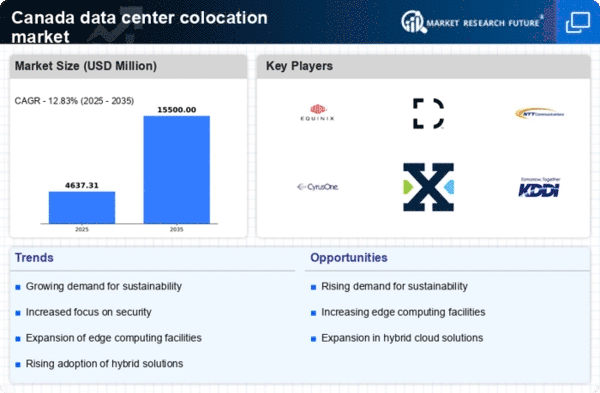
As per Market Research Future analysis, the Canada Data Center Colocation Market size was estimated at 4110.0 USD Million in 2024. The Data Center-colocation market is projected to grow from 4637.31 USD Million in 2025 to 15500.0 USD Million by 2035, exhibiting a compound annual growth rate (CAGR) of 12.8% during the forecast period 2025 - 2035

Key Market Trends & Highlights

The Canada data center-colocation market is experiencing robust growth driven by technological advancements and increasing demand for edge computing.

  • The demand for edge computing is rising as businesses seek to enhance data processing capabilities closer to the source.
  • Sustainability and energy efficiency are becoming central themes as operators strive to reduce their carbon footprint.
  • Regulatory compliance and data security are critical factors influencing investment decisions in the market.
  • Rising cloud adoption and the expansion of IoT applications are key drivers propelling the growth of the data center-colocation sector.

Market Size & Forecast

2024 Market Size 4110.0 (USD Million)
2035 Market Size 15500.0 (USD Million)
CAGR (2025 - 2035) 12.83%

Major Players

Equinix (US), Digital Realty (US), NTT Communications (JP), CyrusOne (US), Interxion (NL), KDDI (JP), Global Switch (GB), Iron Mountain (US), QTS Realty Trust (US)

Our Impact
Enabled $4.3B Revenue Impact for Fortune 500 and Leading Multinationals
Partnering with 2000+ Global Organizations Each Year
30K+ Citations by Top-Tier Firms in the Industry

Canada Data Center Colocation Market Trends

The Canada Data Center Colocation Market is experiencing notable growth, driven by increasing demand for cloud services and digital transformation across various sectors. Organizations are increasingly recognizing the need for reliable and scalable infrastructure to support their operations. This trend is particularly evident in urban areas where businesses seek to enhance their connectivity and reduce latency. As a result, the market is witnessing a surge in investments aimed at expanding existing facilities and developing new ones. Furthermore, sustainability initiatives are becoming a focal point, with companies striving to reduce their carbon footprint through energy-efficient practices and renewable energy sources. In addition, the competitive landscape is evolving, as new players enter the market, offering innovative solutions tailored to specific industry needs. This diversification is likely to enhance service offerings and drive down costs, benefiting end-users. The regulatory environment also plays a crucial role, as compliance with data protection laws and standards becomes increasingly stringent. Overall, the data center-colocation market appears poised for continued expansion, with a strong emphasis on technological advancements and sustainability initiatives shaping its future.

Increased Demand for Edge Computing

The rise of edge computing is influencing the data center-colocation market, as businesses seek to process data closer to the source. This trend is driven by the proliferation of IoT devices and the need for real-time data processing. As a result, colocation providers are likely to adapt their services to accommodate edge deployments, enhancing their infrastructure to support distributed computing.

Focus on Sustainability and Energy Efficiency

Sustainability is becoming a critical consideration within the data center-colocation market. Companies are increasingly prioritizing energy-efficient designs and renewable energy sources to minimize environmental impact. This shift not only aligns with corporate social responsibility goals but also addresses rising energy costs, making sustainable practices a strategic advantage.

Regulatory Compliance and Data Security

As data protection regulations become more stringent, the data center-colocation market is witnessing a heightened focus on compliance and security measures. Providers are investing in advanced security protocols and certifications to ensure that they meet legal requirements. This trend reflects the growing importance of safeguarding sensitive information and maintaining customer trust.

Canada Data Center Colocation Market Drivers

Rising Cloud Adoption

The increasing adoption of cloud services in Canada is a pivotal driver for the data center-colocation market. As businesses migrate their operations to the cloud, the demand for colocation services rises. In 2025, it is estimated that over 70% of Canadian enterprises utilize cloud solutions, necessitating robust infrastructure to support these services. This trend indicates a growing reliance on third-party data centers, as organizations seek to enhance scalability and flexibility. The data center-colocation market is likely to benefit from this shift, as companies prefer to leverage colocation facilities for their cloud deployments. Furthermore, the integration of hybrid cloud strategies is expected to further fuel the demand for colocation services, as businesses require secure and efficient environments to manage their data workloads.

Technological Advancements

Technological advancements in data center infrastructure are significantly influencing the data center-colocation market. Innovations such as high-density computing, advanced cooling solutions, and automation technologies are enhancing operational efficiency. In Canada, the implementation of AI and machine learning in data centers is becoming increasingly prevalent, allowing for better resource management and predictive maintenance. These advancements not only improve performance but also reduce operational costs, making colocation services more attractive to businesses. As organizations seek to optimize their IT environments, the data center-colocation market is poised to experience growth driven by these technological improvements. Moreover, the introduction of 5G technology is expected to further accelerate the demand for colocation services, as it requires robust infrastructure to support high-speed data transmission.

Increased Focus on Data Sovereignty

The emphasis on data sovereignty in Canada is emerging as a crucial driver for the data center-colocation market. With stringent regulations governing data privacy and protection, Canadian businesses are increasingly required to store their data within national borders. This trend is likely to lead to a surge in demand for colocation services, as organizations seek compliant solutions that ensure data residency. In 2025, it is projected that approximately 60% of Canadian companies will prioritize local data storage to adhere to regulatory requirements. Consequently, the data center-colocation market is expected to expand as businesses look for reliable partners to manage their data securely and in compliance with local laws. This focus on data sovereignty not only enhances trust among consumers but also positions Canadian colocation providers as essential players in the market.

Growing Demand for Disaster Recovery Solutions

The increasing awareness of the need for disaster recovery solutions is driving growth in the data center-colocation market. Canadian businesses are recognizing the importance of having robust backup and recovery strategies to mitigate risks associated with data loss. In 2025, it is estimated that over 50% of organizations in Canada will invest in colocation services specifically for disaster recovery purposes. This trend indicates a shift towards proactive risk management, as companies seek to ensure business continuity in the face of potential disruptions. The data center-colocation market is likely to benefit from this growing demand, as colocation facilities offer secure environments for data backup and recovery. Furthermore, the integration of advanced technologies in disaster recovery solutions is expected to enhance the appeal of colocation services, making them a preferred choice for businesses.

Expansion of Internet of Things (IoT) Applications

The rapid expansion of Internet of Things (IoT) applications in Canada is emerging as a significant driver for the data center-colocation market. As more devices become interconnected, the volume of data generated is increasing exponentially, necessitating efficient data management solutions. In 2025, it is projected that the number of IoT devices in Canada will exceed 1 billion, creating a substantial demand for colocation services to handle the influx of data. This trend suggests that businesses will require scalable and flexible infrastructure to support their IoT initiatives. The data center-colocation market is likely to see growth as organizations seek reliable partners to manage their IoT data effectively. Additionally, the need for low-latency processing and real-time analytics will further enhance the attractiveness of colocation services in the context of IoT applications.


Market Segment Insights

By Type: Retail Colocation (Largest) vs. Wholesale Colocation (Fastest-Growing)

In the Canada data center-colocation market, Retail Colocation holds a significant share, offering businesses flexible and scalable solutions tailored to their specific needs. This segment appeals to small and medium-sized enterprises looking for cost-effective options without the complexity of managing data centers independently. In contrast, Wholesale Colocation is gaining traction due to its ability to accommodate large-scale operations that require substantial space and resources, making it a preferred choice for larger enterprises and cloud providers. The growth of Wholesale Colocation is driven by increasing digital transformation initiatives, demand for cloud services, and the need for enhanced IT infrastructure. As organizations continue to move towards hybrid and multi-cloud strategies, Wholesale Colocation is emerging as the fastest-growing segment, driven by its capacity to provide dedicated space and power at competitive rates. Retail Colocation, while still dominant, faces pressure to innovate and enhance services to retain its client base in a rapidly evolving market.

Retail Colocation (Dominant) vs. Wholesale Colocation (Emerging)

Retail Colocation is characterized by its focus on providing individual clients with dedicated units or spaces within a data center, facilitating a more personalized service experience. It is highly regarded for its flexibility and support tailored to the needs of smaller companies or those with specific requirements. On the other hand, Wholesale Colocation typically involves larger contracts and offers extensive spaces with more power supply, catering to enterprises requiring significant resources. This segment is designed for clients looking to scale operations efficiently. Both segments play crucial roles in the ecosystem, with Retail Colocation dominating the market while Wholesale Colocation emerges as a key player, reflecting the growing demand for large-scale data storage solutions.

By Deployment Type: Cloud (Largest) vs. On-Premises (Fastest-Growing)

In the Canada data center-colocation market, the deployment type segment is largely dominated by the Cloud option, which holds a significant market share. This widespread adoption reflects the growing preference of businesses to leverage cloud solutions for their flexibility and scalability, enabling seamless operations and cost efficiencies. Meanwhile, On-Premises solutions are also gaining traction, appealing to organizations that require greater control and customization of their infrastructure, though they currently represent a smaller portion of the overall market. Growth trends within the deployment type segment highlight the transformative shift towards Cloud services, driven by factors such as increased digitalization, the rise of remote work, and an enhanced focus on security and compliance. The On-Premises segment, on the other hand, is experiencing a rapid increase in demand as businesses seek hybrid models that balance cloud convenience with on-site reliability. This dynamic interplay between the two deployment types promotes competitive developments in technology and service offerings across the market.

Cloud (Dominant) vs. On-Premises (Emerging)

The Cloud segment in the Canada data center-colocation market is characterized by its dominance, providing organizations with the ability to scale resources dynamically and access advanced technologies without the hefty upfront investment associated with traditional IT infrastructures. Businesses are increasingly adopting cloud solutions due to their inherent flexibility and ability to support a wide array of applications. Conversely, the On-Premises segment, while considered emerging, offers businesses robust control over their infrastructure and data, catering to specific security and compliance needs. This segment witnesses growth as enterprises adopt hybrid models that incorporate both cloud and on-premises solutions, aiming to optimize performance and security based on individual operational requirements.

By End-User: BFSI (Largest) vs. IT and telecom (Fastest-Growing)

In the Canada data center-colocation market, the BFSI segment holds the largest market share, driven by the increasing demand for data security and regulatory compliance among financial institutions. This demand compels organizations in the BFSI sector to adopt colocation services, ensuring enhanced data management and operational efficiency. Meanwhile, the IT and telecom sector is gaining momentum, representing the fastest-growing segment as companies migrate to cloud services and require more robust data infrastructure to support evolving technologies and user demands. The growth in the BFSI sector is primarily attributable to the rise in digital banking and online transactions, necessitating investment in secure and reliable data centers. In contrast, the IT and telecom sector is expanding due to the proliferation of IoT devices and the increasing reliance on remote work solutions, driving the need for scalable and flexible colocation services. Both segments play a crucial role in shaping the overall dynamics of the market, with BFSI leading in volume and IT and telecom rapidly closing the gap through innovation and increasing service uptake.

BFSI: Dominant vs. IT and telecom: Emerging

The BFSI sector is characterized by stringent regulatory requirements and a high emphasis on data security and compliance, making it a dominant force in the Canada data center-colocation market. Financial institutions need to ensure operational resilience, which drives them to invest heavily in colocation services that offer reliable and secure environments for critical data. On the other hand, the IT and telecom sector represents an emerging force fueled by advancements in technology such as cloud computing and 5G. This segment is rapidly evolving, with businesses seeking flexible and scalable solutions to meet growing data demands, making it a vital player in the market landscape.

Get more detailed insights about Canada Data Center Colocation Market

Key Players and Competitive Insights

The data center-colocation market exhibits a dynamic competitive landscape, characterized by rapid technological advancements and increasing demand for cloud services. Key players such as Equinix (US), Digital Realty (US), and NTT Communications (JP) are strategically positioned to leverage these trends. Equinix (US) focuses on expanding its global footprint through strategic acquisitions and partnerships, enhancing its interconnection capabilities. Digital Realty (US) emphasizes sustainability and energy efficiency, aligning its operations with the growing demand for environmentally responsible solutions. NTT Communications (JP) is investing in digital transformation initiatives, aiming to integrate AI and automation into its service offerings, thereby enhancing operational efficiency and customer experience. Collectively, these strategies shape a competitive environment that prioritizes innovation and responsiveness to market demands.
The business tactics employed by these companies reflect a nuanced understanding of the market's structure, which is moderately fragmented yet increasingly influenced by a few dominant players. Localizing operations and optimizing supply chains are critical tactics that enhance service delivery and reduce operational costs. The collective influence of these key players fosters a competitive atmosphere where agility and technological prowess are paramount, allowing them to adapt to evolving customer needs and market conditions.
In September 2025, Equinix (US) announced the acquisition of a regional data center operator, significantly expanding its presence in Canada. This strategic move not only enhances Equinix's market share but also strengthens its interconnection services, positioning the company to better serve the growing demand for hybrid cloud solutions. The acquisition is expected to facilitate improved connectivity options for customers, thereby reinforcing Equinix's competitive edge in the region.
In October 2025, Digital Realty (US) launched a new sustainability initiative aimed at reducing its carbon footprint by 50% by 2030. This initiative underscores the company's commitment to environmental stewardship and aligns with the increasing regulatory pressures for sustainable practices in the data center industry. By prioritizing energy efficiency and renewable energy sources, Digital Realty is likely to attract environmentally conscious clients, enhancing its market position.
In August 2025, NTT Communications (JP) unveiled a new AI-driven service platform designed to optimize data center operations and enhance customer service. This platform integrates advanced analytics and machine learning capabilities, allowing for real-time monitoring and predictive maintenance. The introduction of this technology not only positions NTT Communications as a leader in innovation but also addresses the growing demand for intelligent data management solutions.
As of November 2025, the competitive trends in the data center-colocation market are increasingly defined by digitalization, sustainability, and AI integration. Strategic alliances among key players are shaping the landscape, fostering collaboration that enhances service offerings and operational efficiencies. Looking ahead, competitive differentiation is expected to evolve, with a shift from price-based competition to a focus on innovation, technology, and supply chain reliability. Companies that can effectively integrate these elements into their strategies are likely to thrive in this rapidly changing environment.

Key Companies in the Canada Data Center Colocation Market include

Industry Developments

The Canada data center colocation market has seen significant developments recently, with a surge in demand due to cloud computing and digital transformation trends. Companies like Digital Realty and Equinix are expanding their footprints in major cities such as Toronto and Vancouver to accommodate this growth.

In March 2021, eStruxture announced the acquisition of all eight Canadian data centers owned by Aptum, comprising two in Montreal, five in Toronto, and one in Vancouver, along with the colocation clientele and relevant personnel. The transaction was finalized at the conclusion of April 2021, resulting in eStruxture increasing its presence to 14 facilities across the country, encompassing more than 600,000 square feet and 100 megawatts of IT capacity.

Additionally, regulatory support for clean energy initiatives is driving investments toward sustainable infrastructure within the data center sector. Over the last couple of years, Vantage Data Centers has been notable for building new locations to meet rising demand, while CyrusOne has focused on enhancing its services to clients by leveraging advanced technologies.

Future Outlook

Canada Data Center Colocation Market Future Outlook

The data center-colocation market is projected to grow at a 12.83% CAGR from 2025 to 2035, driven by increasing demand for cloud services, energy efficiency, and digital transformation.

New opportunities lie in:

  • Expansion of edge computing facilities to enhance service delivery.
  • Development of green energy solutions for sustainable operations.
  • Integration of AI-driven management systems for operational efficiency.

By 2035, the market is expected to achieve robust growth, positioning itself as a leader in technological advancements.

Market Segmentation

Canada Data Center Colocation Market Type Outlook

  • Retail Colocation
  • Wholesale Colocation

Canada Data Center Colocation Market End-User Outlook

  • BFSI
  • IT and telecom
  • Government and defense
  • Healthcare

Canada Data Center Colocation Market Deployment Type Outlook

  • Cloud
  • On-Premises

Report Scope

MARKET SIZE 2024 4110.0(USD Million)
MARKET SIZE 2025 4637.31(USD Million)
MARKET SIZE 2035 15500.0(USD Million)
COMPOUND ANNUAL GROWTH RATE (CAGR) 12.83% (2025 - 2035)
REPORT COVERAGE Revenue Forecast, Competitive Landscape, Growth Factors, and Trends
BASE YEAR 2024
Market Forecast Period 2025 - 2035
Historical Data 2019 - 2024
Market Forecast Units USD Million
Key Companies Profiled Equinix (US), Digital Realty (US), NTT Communications (JP), CyrusOne (US), Interxion (NL), KDDI (JP), Global Switch (GB), Iron Mountain (US), QTS Realty Trust (US)
Segments Covered Type, Deployment Type, End-User
Key Market Opportunities Growing demand for sustainable energy solutions in the data center-colocation market presents significant opportunities.
Key Market Dynamics Growing demand for sustainable energy solutions drives innovation in the data center-colocation market.
Countries Covered Canada
Leave a Comment

FAQs

What is the expected market size of the Canada Data Center Colocation Market in 2024?

The Canada Data Center Colocation Market is projected to be valued at 4.5 billion USD in 2024.

What is the forecasted market size for the Canada Data Center Colocation Market by 2035?

By 2035, the market is expected to reach a valuation of 18.0 billion USD.

What is the compound annual growth rate (CAGR) for the Canada Data Center Colocation Market from 2025 to 2035?

The market is expected to grow at a CAGR of 13.431% during the period from 2025 to 2035.

Which segment of the Canada Data Center Colocation Market is projected to have the highest value in 2035?

The Retail Colocation segment is estimated to be valued at 10.0 billion USD in 2035.

How much is the Wholesale Colocation segment expected to be valued at in 2035?

The Wholesale Colocation segment is projected to reach a valuation of 8.0 billion USD by 2035.

What key companies are leading the Canada Data Center Colocation Market?

Major players in the market include Digital Realty, Equinix, and Cogeco Peer 1 among others.

What value does the Retail Colocation segment hold in 2024?

In 2024, the Retail Colocation segment is valued at 2.5 billion USD.

What value does the Wholesale Colocation segment hold in 2024?

The Wholesale Colocation segment is valued at 2.0 billion USD in 2024.

What are the primary growth drivers for the Canada Data Center Colocation Market?

The primary growth drivers include rising data consumption and the increasing need for cloud services.

What impact might the current global economic situation have on the Canada Data Center Colocation Market?

The current global economic situation is likely to bring both challenges and opportunities to the market.

Download Free Sample

Kindly complete the form below to receive a free sample of this Report

Compare Licence

×
Features License Type
Single User Multiuser License Enterprise User
Price $4,950 $5,950 $7,250
Maximum User Access Limit 1 User Upto 10 Users Unrestricted Access Throughout the Organization
Free Customization
Direct Access to Analyst
Deliverable Format
Platform Access
Discount on Next Purchase 10% 15% 15%
Printable Versions