×
Request Free Sample ×

Kindly complete the form below to receive a free sample of this Report

* Please use a valid business email

Leading companies partner with us for data-driven Insights

clients tt-cursor
Hero Background

Canada Cloud Infrastructure Services Market

ID: MRFR/ICT/62813-HCR
200 Pages
Aarti Dhapte
February 2026

Canada Cloud Infrastructure Services Market Size, Share and Trends Analysis Report By Service Model (Infrastructure as a Service, Platform as a Service, Software as a Service), By Deployment Type (Public Cloud, Private Cloud, Hybrid Cloud), By End User (Small and Medium Enterprises, Large Enterprises, Government) and By Industry Vertical (IT and Telecommunications, Healthcare, Retail)- Forecast to 2035

Share:
Download PDF ×

We do not share your information with anyone. However, we may send you emails based on your report interest from time to time. You may contact us at any time to opt-out.

Canada Cloud Infrastructure Services Market Infographic
Purchase Options

Canada Cloud Infrastructure Services Market Summary

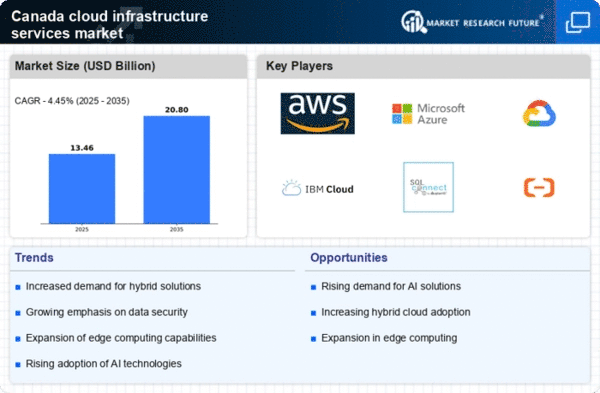
As per Market Research Future analysis, the Canada cloud infrastructure services market size was estimated at 12.89 USD Billion in 2024. The Canada cloud infrastructure-services market is projected to grow from 13.46 USD Billion in 2025 to 20.8 USD Billion by 2035, exhibiting a compound annual growth rate (CAGR) of 4.4% during the forecast period 2025 - 2035

Key Market Trends & Highlights

The Canada is undergoing a robust shift towards

  • The market is witnessing increased adoption of hybrid cloud solutions, driven by the need for flexibility and scalability.
  • A strong focus on sustainability and energy efficiency is shaping the infrastructure strategies of many organizations.
  • Enhanced security measures and compliance protocols are becoming critical as businesses navigate regulatory landscapes.
  • Key market drivers include the growing demand for scalability and the rise of data-driven decision making, particularly in the largest segment of enterprise solutions.

Market Size & Forecast

2024 Market Size 12.89 (USD Billion)
2035 Market Size 20.8 (USD Billion)
CAGR (2025 - 2035) 4.45%

Major Players

Amazon Web Services (US), Microsoft Azure (US), Google Cloud (US), IBM Cloud (US), Oracle Cloud (US), Alibaba Cloud (CN), Salesforce (US), DigitalOcean (US), Linode (US)

Our Impact
Enabled $4.3B Revenue Impact for Fortune 500 and Leading Multinationals
Partnering with 2000+ Global Organizations Each Year
30K+ Citations by Top-Tier Firms in the Industry

Canada Cloud Infrastructure Services Market Trends

The is witnessing notable growth due to Organizations are increasingly adopting cloud technologies to enhance operational efficiency and reduce costs. This shift is largely influenced by the need for businesses to remain competitive in a rapidly evolving digital landscape. As companies seek to leverage advanced technologies, the cloud infrastructure-services market is becoming a critical component of their IT strategies. Furthermore, the rise of remote work and digital transformation initiatives has accelerated the adoption of cloud services, prompting providers to innovate and expand their offerings. In addition, regulatory frameworks and government initiatives are playing a pivotal role in shaping the cloud infrastructure-services market. Policies aimed at promoting digital innovation and data sovereignty are encouraging businesses to invest in local cloud solutions. This trend is likely to foster a more robust ecosystem, enabling organizations to harness the full potential of cloud technologies while ensuring compliance with local regulations. As the market continues to evolve, stakeholders must remain vigilant to emerging trends and adapt their strategies accordingly.

Increased Adoption of Hybrid Cloud Solutions

Organizations are increasingly gravitating towards hybrid cloud models, which combine on-premises infrastructure with public cloud services. This approach offers flexibility and scalability, allowing businesses to optimize their resources based on specific needs. The hybrid model appears to be particularly appealing for sectors that require stringent data security and compliance, as it enables organizations to maintain sensitive data on private servers while leveraging the benefits of public cloud services.

Focus on Sustainability and Energy Efficiency

There is a growing emphasis on sustainability within the cloud infrastructure-services market. Companies are actively seeking solutions that minimize their carbon footprint and enhance energy efficiency. This trend is likely driven by both regulatory pressures and consumer demand for environmentally responsible practices. As a result, cloud service providers are investing in green technologies and renewable energy sources to meet these expectations.

Enhanced Security Measures and Compliance

With the increasing reliance on cloud services, security remains a top priority for organizations. The cloud infrastructure-services market is witnessing a surge in demand for advanced security solutions that protect sensitive data and ensure compliance with regulations. Providers are responding by implementing robust security frameworks and offering services that address the unique challenges associated with data protection in the cloud.

Canada Cloud Infrastructure Services Market Drivers

Growing Demand for Scalability

The is witnessing a notable surge in demand for Businesses increasingly seek flexibility to adjust their resources based on fluctuating needs. This trend is particularly pronounced among small to medium-sized enterprises (SMEs) that require cost-effective solutions without compromising performance. According to recent data, approximately 70% of Canadian SMEs are expected to adopt cloud services by 2026, driven by the need for scalability. This growing demand for scalable infrastructure is reshaping the cloud infrastructure-services market, as providers enhance their offerings to accommodate diverse business requirements. The ability to scale resources up or down efficiently allows organizations to optimize costs and improve operational efficiency, thereby fostering a more dynamic business environment.

Rise of Data-Driven Decision Making

In the cloud infrastructure-services market, the rise of data-driven decision making is a pivotal driver. Organizations in Canada are increasingly leveraging cloud-based analytics tools to derive insights from vast amounts of data. This trend is supported by the fact that over 60% of Canadian businesses are investing in data analytics capabilities, which are often hosted on cloud platforms. The ability to analyze data in real-time enhances operational efficiency and informs strategic decisions. Consequently, cloud service providers are focusing on integrating advanced analytics and machine learning capabilities into their offerings. This shift not only empowers businesses to make informed decisions but also positions the cloud infrastructure-services market as a critical enabler of innovation and competitive advantage.

Regulatory Compliance and Data Sovereignty

Regulatory compliance and data sovereignty are increasingly shaping the cloud infrastructure-services market in Canada. Organizations are compelled to adhere to stringent regulations regarding data protection and privacy, such as the Personal Information Protection and Electronic Documents Act (PIPEDA). This regulatory landscape drives businesses to seek cloud solutions that ensure compliance while maintaining data sovereignty. Approximately 40% of Canadian organizations prioritize local data storage to meet regulatory requirements. Consequently, cloud service providers are adapting their offerings to align with these compliance needs, which may include localized data centers and enhanced security measures. This focus on regulatory compliance not only influences purchasing decisions but also reinforces the importance of the cloud infrastructure-services market in supporting businesses' legal obligations.

Increased Focus on Disaster Recovery Solutions

The cloud infrastructure-services market in Canada is witnessing an increased focus on disaster recovery solutions. Organizations are recognizing the importance of robust backup and recovery systems to safeguard their data against potential threats. Recent statistics indicate that nearly 50% of Canadian businesses have experienced data loss incidents, prompting a shift towards cloud-based disaster recovery services. This trend is likely to drive investments in cloud infrastructure, as companies seek reliable solutions to ensure business continuity. Providers are responding by enhancing their disaster recovery offerings, which include automated backups and failover capabilities. As a result, the cloud infrastructure-services market is evolving to meet the growing demand for comprehensive disaster recovery solutions, thereby reinforcing its critical role in organizational resilience.

Expansion of Internet of Things (IoT) Applications

The cloud infrastructure-services market is significantly influenced by the expansion of Internet of Things (IoT) applications in Canada. As more devices become interconnected, the demand for cloud services to manage and analyze IoT data is escalating. Current estimates suggest that the number of connected IoT devices in Canada could reach 1 billion by 2027, creating a substantial need for cloud infrastructure to support data storage and processing. This trend is prompting cloud service providers to develop specialized solutions tailored for IoT applications, including edge computing capabilities. The integration of IoT with cloud services not only enhances operational efficiency but also opens new avenues for innovation within the cloud infrastructure-services market.


Market Segment Insights

By Service Model: Infrastructure as a Service (Largest) vs. Software as a Service (Fastest-Growing)

In the Canada cloud infrastructure-services market, Infrastructure as a Service (IaaS) holds the largest market share among service models, demonstrating substantial adoption in various sectors. IaaS continues to attract companies looking for scalable and flexible infrastructure solutions without the need for capital investment in physical hardware. In contrast, Software as a Service (SaaS) is experiencing rapid growth as businesses increasingly opt for subscription models that reduce upfront costs and provide continuous updates and support. The growth trends within the service model segment are driven by the increasing demand for cost-effective and agile solutions. IaaS remains a dominant player due to its capability to support a wide range of applications and workloads. Meanwhile, SaaS is emerging as a preferred choice for organizations seeking user-friendly software solutions that enhance productivity. This dual trend indicates a shift in cloud consumption models, influenced by the need for efficiency and flexibility in service delivery.

Infrastructure as a Service (Dominant) vs. Software as a Service (Emerging)

Infrastructure as a Service (IaaS) is characterized by its ability to provide on-demand compute resources through virtualization, enabling businesses to access storage, networking, and servers over the internet. Its dominance in the market is attributed to the flexibility and scalability it offers, allowing organizations to optimize their IT costs and resources. On the other hand, Software as a Service (SaaS) is emerging as a preferred model due to its straightforward implementation and subscription-based pricing. SaaS applications cater to a broad spectrum of users by promoting ease of access and regular updates, which appeal particularly to small and medium-sized enterprises. As these models evolve, their distinct characteristics cater to varying business needs within the Canada cloud infrastructure-services market.
By Deployment Type: Public Cloud (Largest) vs. Private Cloud (Fastest-Growing)

The deployment type segment in the Canada cloud infrastructure-services market exhibits an intriguing distribution among its key values. Public Cloud currently holds the largest share, providing extensive scalability and accessibility, which has made it highly appealing to various sectors. On the other hand, Private Cloud is gaining traction as organizations increasingly seek customized and secure solutions, crafting a competitive landscape within this segment. The growth trends indicate a significant shift towards hybrid solutions, fueled by the growing need for data security and privacy. Private Cloud is recognized as the fastest-growing segment, catering to enterprises that prioritize control and compliance in their cloud strategies. As businesses evolve, the demand for tailored cloud solutions is expected to drive further investment in these deployment types, enhancing overall market dynamics.

Public Cloud (Dominant) vs. Private Cloud (Emerging)

Public Cloud is known for its flexibility and cost-effectiveness, making it the dominant player in the Canada cloud infrastructure-services market. It offers a pay-as-you-go model, allowing businesses to adjust their consumption based on needs efficiently. In contrast, Private Cloud represents an emerging solution ideal for companies seeking greater security and control over their data, tailored to meet specific regulatory and compliance requirements. As organizations recognize the importance of these factors, Private Cloud solutions are rapidly being adopted, indicating a significant shift in enterprise IT strategies. The interplay between these two segments creates a dynamic environment where businesses are increasingly looking for hybrid solutions to balance performance with security.

By End User: Large Enterprises (Largest) vs. Small and Medium Enterprises (Fastest-Growing)

The market share distribution among the end user segments in the Canada cloud infrastructure-services market reveals that large enterprises hold a significant portion, reflecting their extensive resources and demand for scalable solutions. This segment leverages advanced cloud infrastructure to enhance operational efficiency and flexibility, allowing them to maintain a competitive edge. On the other hand, small and medium enterprises (SMEs) are emerging as the fastest-growing segment, driven by increasing digital transformation initiatives and the need for cost-effective solutions. SMEs are increasingly adopting cloud services to improve their business agility and reduce IT overheads, reflecting a notable shift towards cloud adoption as a strategic priority for growth.

Large Enterprises: Dominant vs. Small and Medium Enterprises: Emerging

Large enterprises in the Canada cloud infrastructure-services market represent a dominant force, characterized by their substantial investments in technology and robust demand for comprehensive cloud solutions. They primarily focus on maximizing operational efficiency and mitigating risks associated with data management. In contrast, small and medium enterprises are identified as the emerging segment, rapidly adopting cloud infrastructure to enhance their business capabilities. This trend is fueled by the need for scalable, flexible solutions that align with their growth objectives. The agility and cost-effectiveness of cloud services enable SMEs to compete more effectively while benefiting from advanced technologies traditionally available only to larger organizations.

By Industry Vertical: IT and Telecommunications (Largest) vs. Healthcare (Fastest-Growing)

In the Canada cloud infrastructure-services market, the IT and Telecommunications sector holds the largest share, driven by a robust demand for scalable and flexible solutions. Given the critical need for data management and operational efficiency, this sector continues to leverage cloud services extensively, showcasing significant dominance over others. Conversely, the Healthcare segment is emerging as the fastest-growing area, fueled by increasing digitalization and the urgent need for enhanced patient data management solutions. The growth trends are primarily influenced by the transition towards cloud-based solutions, which are becoming integral to operational strategies across sectors. Healthcare relies heavily on real-time data access and secure storage, prompting rapid adoption of cloud infrastructure. The push for innovation in healthcare, such as telemedicine and electronic health records, complements this trend, making it a focal point for future investments in the cloud infrastructure services.

IT and Telecommunications: Dominant vs. Healthcare: Emerging

The IT and Telecommunications sector is characterized by a strong demand for cloud-based services due to the increasing reliance on digital communication and data processing. This segment leads in market share as businesses seek reliable solutions for their expansive workloads and connectivity needs. On the other hand, the Healthcare segment is marked by rapid advancements in technology, focusing on cloud solutions for patient management, data analytics, and operational efficiencies. As regulations evolve and the emphasis on healthcare access grows, this sector is emerging with innovative applications and a keen interest in cloud infrastructure, positioning itself as a vital player in the market.

Get more detailed insights about Canada Cloud Infrastructure Services Market

Key Players and Competitive Insights

The cloud infrastructure-services market in Canada is characterized by intense competition and rapid growth, driven by increasing demand for digital transformation and cloud adoption across various sectors. Major players such as Amazon Web Services (US), Microsoft Azure (US), and Google Cloud (US) dominate the landscape, each employing distinct strategies to enhance their market presence. Amazon Web Services (US) focuses on continuous innovation and expanding its service offerings, while Microsoft Azure (US) emphasizes strategic partnerships and integration with its existing software ecosystem. Google Cloud (US) appears to prioritize AI and machine learning capabilities, positioning itself as a leader in advanced analytics and data management solutions. Collectively, these strategies contribute to a dynamic competitive environment, where agility and technological advancement are paramount.In terms of business tactics, companies are increasingly localizing their operations to better serve Canadian customers, optimizing supply chains to enhance efficiency and responsiveness. The market structure is moderately fragmented, with a mix of established giants and emerging players. This fragmentation allows for diverse offerings and competitive pricing, although the influence of key players remains substantial, shaping customer expectations and industry standards.

In October Amazon Web Services (US) announced the launch of a new data center in Toronto, aimed at enhancing its service delivery and reducing latency for Canadian clients. This strategic move underscores AWS's commitment to localizing its infrastructure, thereby improving customer experience and compliance with data sovereignty regulations. The establishment of this facility is likely to bolster AWS's competitive edge in the region, attracting more businesses seeking reliable cloud solutions.

In September Microsoft Azure (US) expanded its partnership with a leading Canadian telecommunications provider to enhance its cloud connectivity services. This collaboration is expected to facilitate better integration of Azure's cloud solutions with local networks, thereby improving service reliability and performance for Canadian enterprises. Such partnerships are indicative of a broader trend where cloud providers seek to leverage local expertise to enhance their offerings and customer satisfaction.

In August Google Cloud (US) unveiled a new AI-driven analytics platform tailored for the Canadian market, designed to help businesses harness data more effectively. This initiative reflects Google Cloud's strategic focus on AI integration, positioning it as a frontrunner in providing advanced analytics solutions. The introduction of this platform is likely to attract businesses looking to leverage data for competitive advantage, further intensifying the competition among cloud service providers.

As of November the competitive landscape is increasingly defined by trends such as digitalization, sustainability, and the integration of AI technologies. Strategic alliances are becoming more prevalent, as companies recognize the value of collaboration in enhancing service offerings and market reach. Looking ahead, competitive differentiation is expected to evolve, shifting from price-based competition to a focus on innovation, technological advancement, and supply chain reliability. This transition may redefine customer expectations and drive further investment in cutting-edge solutions.

Key Companies in the Canada Cloud Infrastructure Services Market include

Industry Developments

In December 2023, Amazon Web Services introduced its second Canadian infrastructure Region, AWS Canada West (Calgary), which serves as a complement to the current Canada (Central) Region in Montreal. By doing so, Canadian clients can deploy applications that are more resilient, have reduced latency, and have access to advanced services such as data analytics, machine learning, AI, and security. This also reinforces data sovereignty and regional availability.

Oracle reduced cross-border data transfer and supported compliance with Canada's data privacy regulations, including PIPEDA and Protected B classifications, by enabling NetSuite services to run natively within Oracle Cloud Infrastructure's Canadian regions (Toronto and Montreal) in August 2023. Existing Canadian NetSuite customers are being migrated to these local regions.Salesforce in 2025 expanded its Hyperforce architecture in Canada by enabling the local availability of six essential solutions: Data Cloud, AI Cloud, Marketing Cloud, Commerce Cloud, MuleSoft, and Tableau. Secure, scalable deployments within Canada are guaranteed by this update, which also addresses performance requirements, regulatory conformance, and data residency.

Future Outlook

Canada Cloud Infrastructure Services Market Future Outlook

The Cloud Infrastructure Services Market in Canada is projected to grow at a 4.45% CAGR from 2025 to 2035, driven by digital transformation and increased demand for scalable solutions.

New opportunities lie in:

  • Development of hybrid cloud solutions for enhanced flexibility
  • Expansion of edge computing services to reduce latency
  • Investment in AI-driven analytics for optimized resource management

By 2035, the market is expected to achieve robust growth and increased competitiveness.

Market Segmentation

Canada Cloud Infrastructure Services Market End User Outlook

  • Small and Medium Enterprises
  • Large Enterprises
  • Government

Canada Cloud Infrastructure Services Market Service Model Outlook

  • Infrastructure as a Service
  • Platform as a Service
  • Software as a Service

Canada Cloud Infrastructure Services Market Deployment Type Outlook

  • Public Cloud
  • Private Cloud
  • Hybrid Cloud

Canada Cloud Infrastructure Services Market Industry Vertical Outlook

  • IT and Telecommunications
  • Healthcare
  • Retail

Report Scope

MARKET SIZE 2024 12.89(USD Billion)
MARKET SIZE 2025 13.46(USD Billion)
MARKET SIZE 2035 20.8(USD Billion)
COMPOUND ANNUAL GROWTH RATE (CAGR) 4.45% (2025 - 2035)
REPORT COVERAGE Revenue Forecast, Competitive Landscape, Growth Factors, and Trends
BASE YEAR 2024
Market Forecast Period 2025 - 2035
Historical Data 2019 - 2024
Market Forecast Units USD Billion
Key Companies Profiled Amazon Web Services (US), Microsoft Azure (US), Google Cloud (US), IBM Cloud (US), Oracle Cloud (US), Alibaba Cloud (CN), Salesforce (US), DigitalOcean (US), Linode (US)
Segments Covered Service Model, Deployment Type, End User, Industry Vertical
Key Market Opportunities Adoption of advanced security solutions drives growth in the cloud infrastructure-services market.

Key Market Dynamics Growing demand for scalable solutions drives innovation and competition in the cloud infrastructure-services market.

Countries Covered Canada
Leave a Comment

FAQs

What is the expected market size for the Canada Cloud Infrastructure Services Market in 2024?

The Canada Cloud Infrastructure Services Market is expected to be valued at 4.7 USD billion in 2024.

What is the projected market value for the Canada Cloud Infrastructure Services Market by 2035?

The market is projected to reach a value of 18.0 USD billion by 2035.

What is the expected compound annual growth rate (CAGR) for the Canada Cloud Infrastructure Services Market from 2025 to 2035?

The expected CAGR for the market from 2025 to 2035 is 12.984%.

Which service model dominates the Canada Cloud Infrastructure Services Market?

Infrastructure as a Service is valued at 1.8 USD billion in 2024 and is projected to grow significantly.

What are the market values for Platform as a Service and Software as a Service in 2024?

Platform as a Service is valued at 1.2 USD billion and Software as a Service at 1.7 USD billion in 2024.

Who are the key players in the Canada Cloud Infrastructure Services Market?

Key players include Oracle, Amazon Web Services, Google Cloud, and Microsoft among others.

What is the forecasted value for Software as a Service in the Canada Cloud Infrastructure Services Market by 2035?

Software as a Service is expected to reach a value of 6.5 USD billion by 2035.

How does the growth rate of the Canada Cloud Infrastructure Services Market compare between its segments?

Each segment shows robust growth, with Infrastructure as a Service leading the market growth trajectory.

What is the anticipated market size for Infrastructure as a Service by 2035?

Infrastructure as a Service is projected to reach a market size of 7.0 USD billion by 2035.

What challenges might the Canada Cloud Infrastructure Services Market face in the near future?

Potential challenges include increasing competition and regulatory compliance impacting growth opportunities.

Download Free Sample

Kindly complete the form below to receive a free sample of this Report

Compare Licence

×
Features License Type
Single User Multiuser License Enterprise User
Price $4,950 $5,950 $7,250
Maximum User Access Limit 1 User Upto 10 Users Unrestricted Access Throughout the Organization
Free Customization
Direct Access to Analyst
Deliverable Format
Platform Access
Discount on Next Purchase 10% 15% 15%
Printable Versions