×
Request Free Sample ×

Kindly complete the form below to receive a free sample of this Report

* Please use a valid business email

Leading companies partner with us for data-driven Insights

clients tt-cursor
Hero Background

Canada Beauty Tools Market

ID: MRFR/CG/45050-HCR
128 Pages
Snehal Singh
February 2026

Canada Beauty Tools Market Size, Share, Industry Trend & Analysis Research Report By Type (Hair Care Tools, Hair straighteners, flat irons, Curling Irons, Hair Dryers, Others, Razors, Trimmers, Brushes Combs, Manicure Pedicure Tools, Nail File, Nail Cutter, Cuticle Pusher Nipper, Others), By End-Use (Household, Commercial) and By Distribution Channel (Store-Based, Non-Store-Based (Online/ E-Commerce)) - Forecast to 2035

Share:
Download PDF ×

We do not share your information with anyone. However, we may send you emails based on your report interest from time to time. You may contact us at any time to opt-out.

Canada Beauty Tools Market Infographic
Purchase Options

Canada Beauty Tools Market Summary

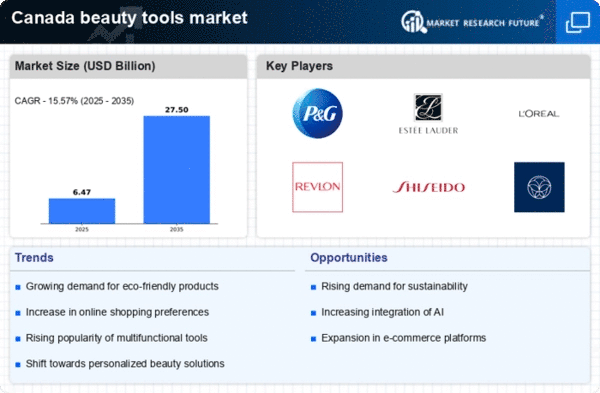
As per Market Research Future analysis, the Canada beauty tools market Size was estimated at 5.6 USD Billion in 2024. The Canada beauty tools market industry is projected to grow from 6.47 USD Billion in 2025 to 27.5 USD Billion by 2035, exhibiting a compound annual growth rate (CAGR) of 15.5% during the forecast period 2025 - 2035

Key Market Trends & Highlights

The Canada beauty tools market is experiencing a dynamic shift towards sustainability and multifunctionality.

  • The largest segment in the Canada beauty tools market is skincare tools, while the fastest-growing segment is makeup tools.
  • Sustainability is becoming a central theme, with consumers increasingly favoring eco-friendly products.
  • Influencer marketing continues to shape consumer preferences, driving demand for innovative beauty tools.
  • Technological advancements and rising disposable income are key drivers propelling market growth.

Market Size & Forecast

2024 Market Size 5.6 (USD Billion)
2035 Market Size 27.5 (USD Billion)
CAGR (2025 - 2035) 15.57%

Major Players

Procter & Gamble (US), Estée Lauder (US), L'Oréal (FR), Revlon (US), Shiseido (JP), Coty (US), Mary Kay (US), Amway (US), Avon (GB)

Our Impact
Enabled $4.3B Revenue Impact for Fortune 500 and Leading Multinationals
Partnering with 2000+ Global Organizations Each Year
30K+ Citations by Top-Tier Firms in the Industry

Canada Beauty Tools Market Trends

The beauty tools market is currently experiencing a dynamic evolution, driven by changing consumer preferences and technological advancements. In recent years, there has been a noticeable shift towards eco-friendly and sustainable products, as consumers increasingly prioritize environmental considerations in their purchasing decisions. This trend is reflected in the growing demand for tools made from biodegradable materials and those that minimize waste. Additionally, the rise of social media influencers has significantly impacted consumer behavior, with many individuals seeking tools that enhance their beauty routines and align with the latest trends showcased online. As a result, brands are adapting their offerings to cater to this new consumer landscape, focusing on innovation and quality. Moreover, the beauty tools market is witnessing a surge in the popularity of multifunctional devices. Consumers are drawn to tools that provide multiple benefits, such as skincare devices that also offer anti-aging features. This trend indicates a shift towards convenience and efficiency, as individuals seek to streamline their beauty routines. Furthermore, the increasing accessibility of online shopping platforms has facilitated the growth of this market, allowing consumers to explore a wider range of products from the comfort of their homes. Overall, the beauty tools market is poised for continued growth, driven by evolving consumer demands and technological innovations.

Sustainability Focus

There is a growing emphasis on eco-friendly beauty tools, as consumers become more aware of environmental issues. Brands are responding by developing products made from sustainable materials, which appeal to environmentally conscious shoppers.

Influencer Impact

The influence of social media personalities is reshaping consumer preferences in the beauty tools market. Many individuals are now inclined to purchase tools endorsed by their favorite influencers, leading to increased brand visibility and sales.

Multifunctional Devices

Consumers are increasingly favoring beauty tools that offer multiple functionalities. This trend reflects a desire for efficiency, as individuals seek products that can address various beauty needs in a single device.

Canada Beauty Tools Market Drivers

E-commerce Growth

The beauty tools market in Canada is witnessing a significant shift towards e-commerce, driven by changing shopping habits. With the convenience of online shopping, consumers are increasingly purchasing beauty tools through digital platforms. This trend is further accelerated by the rise of social media marketing, where brands leverage online influencers to reach wider audiences. The beauty tools market industry is likely to see e-commerce sales grow by approximately 15% annually, as more consumers prefer the ease of online transactions over traditional retail. This shift not only expands market reach but also allows for a more personalized shopping experience.

Rising Disposable Income

In Canada, the rising disposable income among consumers is significantly impacting the beauty tools market. As individuals have more financial resources, they are increasingly willing to invest in premium beauty tools that promise enhanced performance and results. This trend is particularly evident among millennials and Gen Z consumers, who prioritize quality and brand reputation. The beauty tools market industry is projected to benefit from this shift, with an expected increase in sales of high-end products. Reports suggest that the premium segment of the beauty tools market could account for over 40% of total sales by 2026, reflecting a growing preference for luxury beauty tools.

Diversity and Inclusivity

The beauty tools market in Canada is increasingly reflecting the values of diversity and inclusivity. Brands are recognizing the importance of catering to a wide range of skin tones, hair types, and beauty needs. This shift is leading to the development of tools that are designed for various demographics, ensuring that all consumers feel represented. The beauty tools market industry is likely to benefit from this trend, as brands that prioritize inclusivity may see a boost in customer loyalty and sales. Market analysis suggests that products designed with diverse consumer needs in mind could capture a significant share of the market, potentially exceeding 30% by 2027.

Health and Wellness Trends

The growing emphasis on health and wellness in Canada is influencing consumer behavior in the beauty tools market. More individuals are seeking tools that not only enhance beauty but also promote overall well-being. This trend includes the popularity of facial massagers and tools designed for skincare routines that emphasize relaxation and stress relief. The beauty tools market industry is adapting to this demand by introducing products that align with holistic health practices. Market data indicates that wellness-oriented beauty tools could see a growth rate of around 8% annually, as consumers increasingly prioritize self-care and mental health in their beauty routines.

Technological Advancements

The beauty tools market in Canada is experiencing a notable transformation due to rapid technological advancements. Innovations such as smart beauty devices, which integrate artificial intelligence and app connectivity, are becoming increasingly prevalent. These tools not only enhance user experience but also provide personalized beauty solutions. For instance, the introduction of skin analysis tools that utilize advanced sensors is gaining traction among consumers. The market for beauty tools is projected to grow at a CAGR of approximately 6.5% from 2025 to 2030, indicating a robust demand for technologically advanced products. As consumers become more tech-savvy, the beauty tools market industry is likely to see a shift towards high-tech solutions that cater to individual needs.


Market Segment Insights

By Type: Hair Care Tools (Largest) vs. Trimmers (Fastest-Growing)

In the Canada beauty tools market, the distribution of market share among segment values reveals a significant lead for Hair Care Tools, driven by consumer preference for innovative and effective hair styling devices. Other segments, such as Razors and Brushes & Combs, follow closely but lack the same level of dominance. The diversity in hair care products caters to different consumer needs, ultimately making Hair Care Tools a pivotal segment. Growth trends in the Canada beauty tools market show that while Hair Care Tools hold the largest share, Trimmers are identified as the fastest-growing segment. The rise in grooming consciousness among consumers and the increasing popularity of at-home grooming solutions drive this trend. Additionally, advancements in technology and design within the Trimmer segment lead to enhanced user experiences, fostering demand.

Hair Care Tools (Dominant) vs. Trimmers (Emerging)

Hair Care Tools are characterized by a wide range of products aimed at offering consumers efficient and versatile hair styling solutions, allowing for personalization and professional results at home. This segment encompasses tools like hair dryers, straighteners, and curling irons, which have become essential in daily beauty routines. On the other hand, Trimmers, an emerging segment, have gained momentum as consumers are increasingly leaning towards easy-maintenance grooming solutions. These tools cater to a growing desire for convenience and efficiency, with ergonomic designs and advanced features that attract a younger demographic seeking stylish and quick grooming options. Together, these segments reflect the evolving landscape of personal care priorities in Canada.

By End-Use: Household (Largest) vs. Commercial (Fastest-Growing)

In the Canada beauty tools market, the Household segment commands a significant market share, as consumers increasingly prioritize personal grooming and self-care at home. This segment includes a wide variety of products that cater to individual needs, offering convenience and accessibility which have driven its dominance in the market. On the other hand, the Commercial segment is witnessing rapid growth, fueled by the expanding beauty and wellness industry, including salons and spas that require professional-grade tools. This segment benefits from increased consumer spending on services and a trend towards regular beauty treatments, positioning itself as the fastest-growing segment in the Canada beauty tools market.

Household: Dominant vs. Commercial: Emerging

The Household segment in the Canada beauty tools market represents the dominant force, appealing to a wide consumer base with a variety of tools designed for everyday use. This segment includes items ranging from hair straighteners to skincare devices, designed for convenience and effectiveness, aligning with the trends of self-care and at-home grooming. Conversely, the Commercial segment is emerging rapidly, driven by professional service providers looking for high-quality, reliable tools. As the beauty service industry grows, this segment is poised to see accelerated demand, focusing on innovation and performance to meet both professional and customer expectations, differentiating itself in a competitive landscape.

By Distribution Channel: Store-Based (Largest) vs. Non-Store-Based (Fastest-Growing)

In the Canada beauty tools market, the distribution landscape shows a significant preference for Store-Based channels, which dominate the market. This segment captures the majority share due to established retail locations providing consumers with hands-on experiences and immediate purchases. The convenience of in-store shopping combined with promotional activities allows Store-Based channels to maintain a stronghold in consumer preferences. On the other hand, the Non-Store-Based segment, particularly Online/E-Commerce, is emerging as the fastest-growing distribution avenue. This growth is driven by changing consumer behaviors, with an increasing number of beauty enthusiasts turning to online platforms for their purchases. Factors such as convenience, a wider selection, and often, better pricing in online channels fuel this trend, indicating a significant shift towards digitization in the beauty tools market.

Store-Based (Dominant) vs. Non-Store-Based (Emerging)

The Store-Based distribution channel in the Canada beauty tools market is characterized by a wide range of products available at physical retail outlets, allowing consumers to evaluate items directly. This traditional channel dominates due to its established presence, effective merchandising, and the immediate gratification of in-person shopping. Marketing strategies within these stores often incorporate seasonal promotions and loyalty programs, further enhancing consumer attraction. Conversely, the Non-Store-Based segment, notably Online/E-Commerce, is redefining consumer interaction with beauty tools. Offering extensive product varieties and customer reviews, it appeals to a tech-savvy demographic looking for convenience and cost-effectiveness. As social media and influencer marketing gain traction, this segment is expected to continue its upward growth, transforming the overall distribution landscape.

Get more detailed insights about Canada Beauty Tools Market

Key Players and Competitive Insights

The beauty tools market in Canada is characterized by a dynamic competitive landscape, driven by innovation, consumer demand for quality, and the increasing integration of technology in beauty routines. Major players such as Procter & Gamble (US), Estée Lauder (US), and L'Oréal (FR) are at the forefront, each adopting distinct strategies to enhance their market presence. Procter & Gamble (US) focuses on sustainability and eco-friendly product lines, which resonates with the growing consumer preference for environmentally conscious brands. Estée Lauder (US) emphasizes digital transformation, leveraging e-commerce and social media to engage with younger demographics. L'Oréal (FR) is heavily investing in research and development, particularly in AI-driven beauty tools, which positions it as a leader in innovation within the sector. Collectively, these strategies contribute to a competitive environment that is increasingly centered around technological advancement and consumer engagement.Key business tactics employed by these companies include localizing manufacturing to reduce costs and optimize supply chains, which is particularly relevant in the current economic climate. The market structure appears moderately fragmented, with a mix of established brands and emerging players vying for market share. The influence of key players is substantial, as they set trends and standards that smaller companies often follow, thereby shaping the overall market dynamics.

In October Procter & Gamble (US) announced a partnership with a leading tech firm to develop smart beauty tools that utilize AI for personalized skincare recommendations. This strategic move is likely to enhance consumer experience and drive sales, as personalized solutions are increasingly sought after in the beauty industry. The collaboration underscores Procter & Gamble's commitment to innovation and positions it to capture a larger share of the tech-savvy consumer segment.

In September Estée Lauder (US) launched a new line of beauty tools designed specifically for the Asian market, incorporating local beauty rituals and preferences. This regional expansion strategy not only diversifies their product offerings but also allows Estée Lauder to tap into the lucrative Asian beauty market, which is known for its high demand for innovative beauty solutions. Such targeted approaches may strengthen brand loyalty and increase market penetration.

In August L'Oréal (FR) unveiled a new AI-driven beauty app that integrates with its beauty tools, providing users with tailored skincare routines based on their unique skin types. This initiative reflects L'Oréal's focus on digitalization and consumer engagement, potentially setting a new standard for how beauty brands interact with their customers. By enhancing the user experience through technology, L'Oréal is likely to solidify its competitive edge in the market.

As of November current trends in the beauty tools market include a pronounced shift towards digitalization, sustainability, and the integration of AI technologies. Strategic alliances are becoming increasingly important, as companies collaborate to enhance their technological capabilities and expand their product offerings. Looking ahead, competitive differentiation is expected to evolve, with a greater emphasis on innovation and technology rather than solely on price. The ability to provide reliable supply chains and cutting-edge products will likely define success in this rapidly changing landscape.

Key Companies in the Canada Beauty Tools Market include

Industry Developments

Recent developments in the Canada Beauty Tools Market have seen a surge in consumer demand for high-quality beauty tools as a result of increased interest in personal grooming and self-care. Companies such as L'Oréal and Estée Lauder have been expanding their product lines to include innovative beauty tools that cater to evolving consumer preferences. The market is witnessing significant growth, driven by advancements in technology and the integration of smart features into beauty tools, appealing particularly to younger demographics.

In the past months, there have been noticeable shifts in the industry, including a focus on eco-friendly materials and sustainable practices among major players like Unilever and Coty. Additionally, in July 2023, Conair announced the acquisition of a small Canadian beauty tool company to enhance its market presence and diversify its product offerings. This aligns with the wider trend of consolidation within the beauty sector as companies seek to gain competitive advantages through strategic mergers.

Over the past two years, the market value has shown resilience, with beauty tool sales rising robustly as more consumers invest in at-home beauty experiences, emphasizing the potential for continued growth within the sector in Canada.

Future Outlook

Canada Beauty Tools Market Future Outlook

The Beauty Tools Market in Canada is projected to grow at a 15.57% CAGR from 2025 to 2035, driven by innovation, e-commerce expansion, and consumer demand for premium products.

New opportunities lie in:

  • Development of subscription-based beauty tool services
  • Integration of AI technology for personalized beauty solutions
  • Expansion of eco-friendly and sustainable beauty tool lines

By 2035, the beauty tools market is expected to achieve substantial growth and innovation.

Market Segmentation

Canada Beauty Tools Market Type Outlook

  • Hair Care Tools
  • Razors
  • Trimmers
  • Brushes & Combs
  • Manicure & Pedicure Tools
  • Nail File
  • Nail Cutter
  • Cuticle Pusher & Nipper

Canada Beauty Tools Market End-Use Outlook

  • Household
  • Commercial

Canada Beauty Tools Market Distribution Channel Outlook

  • Store-Based
  • Non-Store-Based (Online/ E-Commerce)

Report Scope

MARKET SIZE 2024 5.6(USD Billion)
MARKET SIZE 2025 6.47(USD Billion)
MARKET SIZE 2035 27.5(USD Billion)
COMPOUND ANNUAL GROWTH RATE (CAGR) 15.57% (2025 - 2035)
REPORT COVERAGE Revenue Forecast, Competitive Landscape, Growth Factors, and Trends
BASE YEAR 2024
Market Forecast Period 2025 - 2035
Historical Data 2019 - 2024
Market Forecast Units USD Billion
Key Companies Profiled Procter & Gamble (US), Estée Lauder (US), L'Oréal (FR), Revlon (US), Shiseido (JP), Coty (US), Mary Kay (US), Amway (US), Avon (GB)
Segments Covered Type, End-Use, Distribution Channel
Key Market Opportunities Integration of smart technology in beauty tools enhances user experience and personalization.
Key Market Dynamics Rising consumer demand for eco-friendly beauty tools drives innovation and competition in the market.
Countries Covered Canada
Leave a Comment

FAQs

What regional trends are influencing the Canada Beauty Tools Market?

Increasing consumer enthusiasm for beauty and personal care products is a significant trend influencing the market in Canada.

Download Free Sample

Kindly complete the form below to receive a free sample of this Report

Compare Licence

×
Features License Type
Single User Multiuser License Enterprise User
Price $4,950 $5,950 $7,250
Maximum User Access Limit 1 User Upto 10 Users Unrestricted Access Throughout the Organization
Free Customization
Direct Access to Analyst
Deliverable Format
Platform Access
Discount on Next Purchase 10% 15% 15%
Printable Versions