×
Request Free Sample ×

Kindly complete the form below to receive a free sample of this Report

* Please use a valid business email

Leading companies partner with us for data-driven Insights

clients tt-cursor
Hero Background

Canada AI Robots Market

ID: MRFR/ICT/57149-HCR
200 Pages
Aarti Dhapte
February 2026

Canada AI Robots Market Size, Share and Research Report: By Offering (hardware, software), By Type (service robots, industrial robots), By Technology (machine learning, context awareness, computer vision, natural language processing), and By Application (law enforcement, military and defense, public relations, personal assistance and care, education & entertainment robots, healthcare, research & space exploration, industrial, stock management, others)- Industry Forecast to 2035

Share:
Download PDF ×

We do not share your information with anyone. However, we may send you emails based on your report interest from time to time. You may contact us at any time to opt-out.

Canada AI Robots Market Infographic
Purchase Options

Canada AI Robots Market Summary

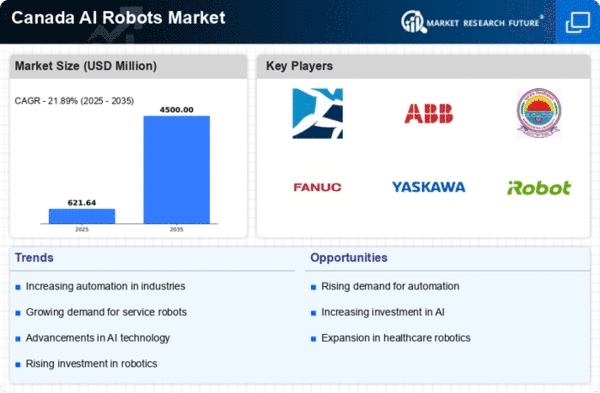
As per Market Research Future analysis, the Canada AI Robots Market size was estimated at 510.0 USD Million in 2024. The Ai Robots market is projected to grow from 621.64 USD Million in 2025 to 4500.0 USD Million by 2035, exhibiting a compound annual growth rate (CAGR) of 21.8% during the forecast period 2025 - 2035

Key Market Trends & Highlights

The Canada AI robots market is experiencing robust growth driven by technological advancements and increasing adoption across various sectors.

  • The healthcare segment is the largest, reflecting a notable increase in the adoption of AI robots for patient care and assistance.
  • Collaborative robotics is the fastest-growing segment, indicating a shift towards automation in manufacturing and logistics.
  • Government support for innovation is fostering a conducive environment for AI robot development and deployment.
  • Technological advancements in AI and rising labor costs are key drivers propelling market expansion.

Market Size & Forecast

2024 Market Size 510.0 (USD Million)
2035 Market Size 4500.0 (USD Million)
CAGR (2025 - 2035) 21.89%

Major Players

Boston Dynamics (US), ABB (CH), KUKA (DE), Fanuc (JP), Yaskawa (JP), iRobot (US), Intuitive Surgical (US), NVIDIA (US), SoftBank Robotics (JP)

Our Impact
Enabled $4.3B Revenue Impact for Fortune 500 and Leading Multinationals
Partnering with 2000+ Global Organizations Each Year
30K+ Citations by Top-Tier Firms in the Industry

Canada AI Robots Market Trends

The Canada AI Robots Market is undergoing a notable transformation., driven by advancements in technology and increasing demand across various sectors. In Canada, the integration of artificial intelligence into robotic systems is becoming more prevalent, as industries seek to enhance efficiency and productivity. This trend is particularly evident in manufacturing, healthcare, and logistics, where automation is being embraced to streamline operations and reduce costs. Furthermore, the Canadian government is actively supporting innovation in robotics through funding initiatives and research programs, which may further accelerate growth in this sector. Moreover, the rising interest in smart technologies is fostering a competitive landscape within the ai robots market. Companies are investing in research and development to create more sophisticated and versatile robotic solutions. This shift is likely to lead to the emergence of new applications, such as collaborative robots that work alongside humans, enhancing workplace safety and productivity. As the market evolves, it appears that the focus will increasingly be on creating user-friendly interfaces and improving the adaptability of robots to various environments, which could significantly influence future trends.

Increased Adoption in Healthcare

The AI robots market is witnessing a surge in the adoption of robotic systems within healthcare. Hospitals and clinics are increasingly utilizing robots for tasks such as surgery, patient monitoring, and rehabilitation. This trend is driven by the need for precision and efficiency in medical procedures, as well as the desire to improve patient outcomes.

Growth in Collaborative Robotics

Collaborative robots, or cobots, are gaining traction in various industries, including manufacturing and logistics. These robots are designed to work alongside human workers, enhancing productivity while ensuring safety. The AI robots market is likely to see a rise in the development and deployment of cobots.

Government Support for Innovation

The Canadian government is actively promoting innovation in the ai robots market through various initiatives and funding programs. This support is aimed at fostering research and development, which may lead to breakthroughs in robotic technologies. As a result, the market could experience accelerated growth and the introduction of advanced robotic solutions.

Canada AI Robots Market Drivers

Rising Labor Costs

In Canada, the escalating costs associated with labor are significantly influencing the ai robots market. As businesses face challenges in maintaining a competitive edge, many are turning to automation solutions to mitigate these expenses. The AI robots market is expected to benefit from this trend. In 2025, it is estimated that labor costs in Canada will increase by approximately 3% annually, prompting industries to invest in robotic automation. This shift not only addresses labor shortages but also allows for 24/7 operational capabilities, thereby driving the adoption of ai robots across various sectors, including manufacturing and retail.

Technological Advancements in AI

The rapid evolution of artificial intelligence technologies is a primary driver for the ai robots market in Canada. Innovations in machine learning, natural language processing, and computer vision are enhancing the capabilities of robots, making them more efficient and versatile. For instance, the integration of AI algorithms allows robots to perform complex tasks with greater accuracy. In 2025, the Canadian ai robots market is projected to reach a valuation of approximately $1.5 billion, reflecting a compound annual growth rate (CAGR) of around 15% over the next five years. This growth is indicative of the increasing reliance on AI-driven solutions across various sectors, including manufacturing, logistics, and healthcare, thereby propelling the demand for advanced robotic systems.

Government Initiatives and Funding

Government initiatives aimed at fostering innovation and technological advancement are playing a pivotal role in the growth of the ai robots market in Canada. Various funding programs and grants are being introduced to support research and development in robotics and AI technologies. In 2025, it is expected that government funding for robotics initiatives will increase by approximately 25%, providing a substantial boost to the ai robots market. This support not only encourages startups and established companies to innovate but also facilitates collaboration between academia and industry, thereby accelerating the development and deployment of advanced robotic solutions across multiple sectors.

Expansion of E-commerce and Logistics

The ongoing expansion of e-commerce in Canada is significantly impacting the ai robots market. As online shopping continues to grow, logistics and warehousing operations are increasingly reliant on automation to meet consumer demands. The AI robots market is poised for growth. In 2025, it is anticipated that the logistics sector will account for nearly 30% of the total ai robots market, driven by the need for efficient order fulfillment and inventory management. This trend underscores the importance of robotics in enhancing operational efficiency and meeting the challenges posed by the rapidly evolving retail landscape.

Increased Focus on Safety and Compliance

The heightened emphasis on workplace safety and regulatory compliance is a crucial driver for the ai robots market in Canada. Industries such as construction, manufacturing, and healthcare are increasingly adopting robotic solutions to minimize human exposure to hazardous environments. The AI robots market is likely to see a surge in demand. In 2025, it is projected that the market for safety-related robotics will account for approximately 20% of the total ai robots market. This trend indicates a growing recognition of the role that robotics can play in enhancing safety protocols, thereby fostering a more secure working environment.


Market Segment Insights

By Vehicle Type: Vans (Largest) vs. Pickup (Fastest-Growing)

In the Canada ai robots market, the distribution of vehicle types showcases Vans as the largest segment, capturing a significant portion of the market share. These vehicles are often preferred for their versatility and spacious interiors, making them suitable for various applications that require AI technology. On the other hand, Pickups are emerging rapidly, gaining traction among consumers who seek durability and performance, ideally suited for heavier tasks and outdoor activities. The growth trends in this segment indicate a notable shift towards more specialized vehicle types. The increasing demand for automation in logistics and the benefits of AI integration in handling and processing tasks are key drivers for both Vans and Pickups. Consumers show a growing preference for vehicles that not only meet traditional utility needs but also incorporate advanced technology to enhance operational efficiency and safety.

Vans (Dominant) vs. Pickup (Emerging)

Vans are currently the dominant choice in the vehicle type sector of the Canada ai robots market. Their ability to accommodate larger AI robotic systems and facilitate a range of applications makes them a preferred option for businesses requiring efficient logistics solutions. In contrast, Pickup trucks have emerged as a strong alternative, appealing to consumers who necessitate a robust vehicle for more rugged operations. The appeal of Pickups is bolstered by their aesthetic appeal and functionality, particularly in sectors like construction and agriculture, where heavy-duty performance is crucial. As technological advancements continue, both vehicle types are expected to evolve, offering enhanced capabilities that cater to the growing demands of the market.

By Type: Service Robots (Largest) vs. Industrial Robots (Fastest-Growing)

In the Canada ai robots market, the distribution of market share between the service robots and industrial robots segments reveals a clear dominance of service robots, which cater to various needs including healthcare, hospitality, and domestic assistance. Industrial robots, while still significant, hold a smaller share. However, the growing reliance on automation and efficiency in manufacturing processes contributes to the increasing adoption of these systems. Growth trends in the service robots segment are primarily driven by advancements in AI and machine learning technologies, which enhance the usability and functionality of these robots. Meanwhile, industrial robots are experiencing a surge in demand as companies seek to optimize production and reduce labor costs. The trend towards automation in diverse industries, coupled with an increasing focus on safety and precision, fuels the rapid expansion of both segments.

Service Robots (Dominant) vs. Industrial Robots (Emerging)

Service robots are established as the dominant force within the Canada ai robots market, tailored for tasks that improve convenience and efficiency in various sectors such as healthcare and retail. Their advanced capabilities allow them to interact with humans, providing personalized services that enhance customer experience. On the other hand, industrial robots are emerging, gaining traction due to their ability to streamline manufacturing processes and enhance productivity. Industries are increasingly adopting these robots to handle repetitive tasks with precision and speed, underscoring the evolving landscape and growing significance of robotics technology within the overall market.

By Technology: Machine Learning (Largest) vs. Natural Language Processing (Fastest-Growing)

In the Canada ai robots market, the distribution of market share among the technologies shows Machine Learning as the dominant player due to its extensive applications in various robotics sectors. Following closely, Context Awareness and Computer Vision also hold significant shares, while Natural Language Processing is emerging rapidly, capturing increasing attention from developers and researchers alike. Growth trends in this segment are driven by advancements in AI capabilities and increased investment in robotics from both private and public sectors. Machine Learning continues to evolve with more sophisticated algorithms, while Natural Language Processing is gaining traction due to its critical role in user interaction. Rising demand for intelligent automation solutions further boosts the overall growth of the technology segment.

Technology: Machine Learning (Dominant) vs. Natural Language Processing (Emerging)

Machine Learning remains the backbone of the Canada ai robots market, providing foundational algorithms that enable various functions in robotics, such as decision-making and predictive analysis. Its scalability and adaptability in different environments make it essential for numerous applications. On the other hand, Natural Language Processing is rapidly becoming an emerging technology, facilitating seamless human-robot interactions through enhanced understanding of language nuances. This is critical as robots are increasingly being incorporated into customer-facing roles. The ongoing research into both technologies highlights their importance, with Machine Learning leading the path and Natural Language Processing following suit with innovative breakthroughs.

By Application: Healthcare (Largest) vs. Education & Entertainment Robots (Fastest-Growing)

In the Canada ai robots market, the application segment showcases a diverse array of values, with Healthcare representing the largest share. Following closely are Law Enforcement and Military & Defense applications, which also capture significant market interest. Public Relations, Personal Assistance and Care, and Industrial applications further enrich the landscape, each contributing to the holistic growth of this segment. Although all applications are poised for growth, the importance placed on Healthcare highlights its dominance in terms of market uptake and utilization. Emerging trends are steering rapid growth within several segments, notably Education & Entertainment Robots, which are becoming increasingly favored for their innovative engagement methods. As technology advances, the demand for smarter, more interactive robots in education is expected to surge. Factors such as an increase in government funding for AI research and the growing need for robots in personal assistance are further accelerating this trend, culminating in an exciting future for the Canada ai robots market across its diverse applications.

Healthcare (Dominant) vs. Education & Entertainment Robots (Emerging)

Healthcare applications represent the dominant segment in the Canada ai robots market, characterized by innovations that enhance patient care, diagnostics, and operational efficiency within medical settings. Robots in this segment are utilized for tasks ranging from surgical assistance to elder care, significantly improving outcomes and alleviating human workload. In contrast, Education & Entertainment Robots are emerging with rapid growth, driven by technological advancements and a shift towards interactive and engaging learning environments. These robots cater to various educational settings, providing personalized learning experiences and entertainment solutions, especially in a post-pandemic world that emphasizes remote and hybrid learning scenarios.

Get more detailed insights about Canada AI Robots Market

Key Players and Competitive Insights

The ai robots market in Canada is characterized by a dynamic competitive landscape, driven by rapid technological advancements and increasing demand across various sectors, including manufacturing, healthcare, and logistics. Major players such as Boston Dynamics (US), ABB (CH), and iRobot (US) are strategically positioning themselves through innovation and partnerships. Boston Dynamics (US) focuses on enhancing its robotic capabilities, particularly in mobility and manipulation, while ABB (CH) emphasizes automation solutions that integrate AI with robotics to optimize industrial processes. iRobot (US) continues to expand its consumer robotics segment, leveraging AI to improve user experience and functionality. Collectively, these strategies contribute to a competitive environment that is increasingly focused on technological differentiation and operational efficiency.Key business tactics within the market include localizing manufacturing and optimizing supply chains to enhance responsiveness to market demands. The competitive structure appears moderately fragmented, with several key players exerting influence across different segments. This fragmentation allows for niche players to emerge, fostering innovation and competition. The collective influence of these major companies shapes market dynamics, as they strive to capture market share through unique value propositions and advanced technological offerings.

In October Boston Dynamics (US) announced a partnership with a leading logistics firm to develop autonomous delivery robots. This strategic move is significant as it positions Boston Dynamics at the forefront of the growing e-commerce sector, where demand for efficient last-mile delivery solutions is surging. The collaboration is expected to enhance operational efficiencies and reduce delivery times, thereby strengthening Boston Dynamics' market presence.

In September ABB (CH) launched a new AI-driven robotic arm designed for precision manufacturing. This innovation is crucial as it addresses the increasing need for automation in high-precision tasks, particularly in the automotive and electronics industries. By integrating AI capabilities, ABB aims to improve productivity and reduce operational costs, thereby reinforcing its competitive edge in the market.

In August iRobot (US) unveiled an upgraded version of its home cleaning robot, featuring enhanced AI algorithms for better navigation and obstacle avoidance. This development is indicative of iRobot's commitment to continuous improvement and customer satisfaction. By leveraging advanced AI, iRobot seeks to differentiate its products in a crowded consumer market, potentially increasing its market share and customer loyalty.

As of November current competitive trends in the ai robots market are heavily influenced by digitalization, sustainability, and the integration of AI technologies. Strategic alliances are becoming increasingly important, as companies recognize the value of collaboration in driving innovation and expanding market reach. Looking ahead, competitive differentiation is likely to evolve, with a shift from price-based competition to a focus on innovation, technological advancements, and supply chain reliability. This transition suggests that companies that prioritize R&D and strategic partnerships will be better positioned to thrive in the evolving landscape.

Key Companies in the Canada AI Robots Market include

Industry Developments

The Canadian robotics company Maple Advanced Robotics (MARI) won the Hannover Messe Robotics Award in February and March 2025, garnering international recognition for its AI-powered Autonomous Adaptable Robot System (AARS), which is intended for flexible, code-free industrial automation.

Attabotics, a Calgary-based company, was awarded a C$5 million Strategic Innovation Fund grant around the same time, which allowed it to expand its 3D robotic warehouse solutions and strengthened Canada's leadership in supply chain innovation powered by artificial intelligence.

Meanwhile, there were noteworthy developments in construction robotics: Promise Robotics in Edmonton and Horizon Legacy in Vancouver showcased AI-enabled robotic arms that could automate everything from wall construction to blueprint interpretation, cutting down on normal building times by half.

As part of its larger AI strategy to boost robotics integration in industries including manufacturing, healthcare, and agriculture, the Canadian government invested C$2.4 billion in AI investment in mid-2024 to complement these industrial advancements.

This coordinated momentum—from construction innovations and substantial federal investment to award-winning automation platforms and grant-backed logistics robotics—marks a revolutionary chapter in Canada's AI robotics landscape and positions the country as a global leader in intelligent automation.

Future Outlook

Canada AI Robots Market Future Outlook

The AI Robots Market is projected to grow at a 21.89% CAGR from 2025 to 2035.

New opportunities lie in:

  • Development of AI-driven agricultural robots for precision farming.
  • Integration of AI robots in healthcare for patient monitoring and assistance.
  • Creation of customizable robotic solutions for small and medium enterprises.

By 2035, the ai robots market is expected to achieve substantial growth, reflecting robust technological advancements and market demand.

Market Segmentation

Canada AI Robots Market Type Outlook

  • Service Robots
  • Industrial Robots

Canada AI Robots Market Technology Outlook

  • Machine Learning
  • Context Awareness
  • Computer Vision
  • Natural Language Processing

Canada AI Robots Market Application Outlook

  • Law Enforcement
  • Military and Defense
  • Public Relations
  • Personal Assistance and Care
  • Education & Entertainment Robots
  • Healthcare
  • Research & Space Exploration
  • Industrial
  • Stock Management
  • Others

Canada AI Robots Market Vehicle Type Outlook

  • Vans
  • Pickup

Report Scope

MARKET SIZE 2024 510.0(USD Million)
MARKET SIZE 2025 621.64(USD Million)
MARKET SIZE 2035 4500.0(USD Million)
COMPOUND ANNUAL GROWTH RATE (CAGR) 21.89% (2025 - 2035)
REPORT COVERAGE Revenue Forecast, Competitive Landscape, Growth Factors, and Trends
BASE YEAR 2024
Market Forecast Period 2025 - 2035
Historical Data 2019 - 2024
Market Forecast Units USD Million
Key Companies Profiled Boston Dynamics (US), ABB (CH), KUKA (DE), Fanuc (JP), Yaskawa (JP), iRobot (US), Intuitive Surgical (US), NVIDIA (US), SoftBank Robotics (JP)
Segments Covered Vehicle Type, Type, Technology, Application
Key Market Opportunities Growing demand for automation in manufacturing and healthcare sectors drives innovation in the ai robots market.
Key Market Dynamics Growing demand for automation in various sectors drives innovation and competition in the ai robots market.
Countries Covered Canada
Leave a Comment

FAQs

What is the expected market size of the Canada AI Robots Market in 2024?

The Canada AI Robots Market is expected to be valued at 510.3 million USD in 2024.

What will be the market value of the Canada AI Robots Market by 2035?

By 2035, the Canada AI Robots Market is projected to reach approximately 16,465.62 million USD.

What is the expected compound annual growth rate (CAGR) for the Canada AI Robots Market from 2025 to 2035?

The Canada AI Robots Market is expected to grow at a CAGR of 37.138% from 2025 to 2035.

Which segment is projected to dominate the Canada AI Robots Market in terms of hardware by 2035?

The hardware segment is projected to be valued at 6,248.02 million USD by 2035.

How much is the software segment of the Canada AI Robots Market expected to be valued at in 2035?

The software segment is anticipated to be valued at approximately 10,217.6 million USD by 2035.

Who are the key players in the Canada AI Robots Market?

Major players in the Canada AI Robots Market include Vention, Deep AI, Nanthealth, and Diligent Robotics among others.

What are the key applications driving the growth of the Canada AI Robots Market?

Key applications include automation in manufacturing, logistics, and healthcare within the Canada AI Robots Market.

What opportunities are expected to emerge in the Canada AI Robots Market by 2035?

Emerging opportunities include advancements in AI technology and increased adoption of robotic solutions in various sectors.

What challenges does the Canada AI Robots Market face currently?

Challenges include high initial investment costs and evolving regulatory frameworks impacting market dynamics.

How is the overall growth rate for the Canada AI Robots Market expected to trend?

The overall growth rate for the Canada AI Robots Market is expected to be robust, fueled by innovation and increasing demand across sectors.

Download Free Sample

Kindly complete the form below to receive a free sample of this Report

Compare Licence

×
Features License Type
Single User Multiuser License Enterprise User
Price $4,950 $5,950 $7,250
Maximum User Access Limit 1 User Upto 10 Users Unrestricted Access Throughout the Organization
Free Customization
Direct Access to Analyst
Deliverable Format
Platform Access
Discount on Next Purchase 10% 15% 15%
Printable Versions