×
Request Free Sample ×

Kindly complete the form below to receive a free sample of this Report

* Please use a valid business email

Leading companies partner with us for data-driven Insights

clients tt-cursor
Hero Background

Canada AI Insurance Market

ID: MRFR/BS/46600-HCR
200 Pages
Garvit Vyas
February 2026

Canada AI in Insurance Market Size, Share and Research Report: By Offerings Outlook (Hardware, Software, Services), By Deployment Mode (On-premise, Cloud), By Technology Outlook (Deep Learning & Machine Learning, Natural Language Processing, Computer Vision, Others), By Enterprise Size (Large Enterprise, SMEs) and By Application Outlook (Claims Management, Risk Management and Compliance, Chatbots, Others) - Industry Forecast Till 2035

Share:
Download PDF ×

We do not share your information with anyone. However, we may send you emails based on your report interest from time to time. You may contact us at any time to opt-out.

Canada AI Insurance Market Infographic
Purchase Options

Canada AI Insurance Market Summary

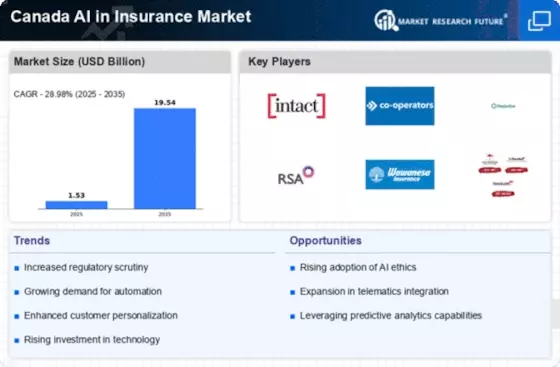
As per analysis, the Canada Ai In Insurance Market is projected to grow from USD 1.57 Billion in 2025 to USD 19.54 Billion by 2035, exhibiting a compound annual growth rate (CAGR) of 28.98% during the forecast period (2025 - 2035).

Key Market Trends & Highlights

The Canada AI in Insurance market is poised for substantial growth driven by technological advancements and evolving consumer expectations.

  • The market is witnessing enhanced customer experience through personalized insurance products.
  • Fraud detection remains the largest segment, leveraging advanced analytics for improved security.
  • Claims processing is the fastest-growing segment, driven by automation and efficiency improvements.
  • Key market drivers include enhanced data analytics capabilities and the automation of claims processing.

Market Size & Forecast

2024 Market Size 1.19 (USD Billion)
2035 Market Size 19.54 (USD Billion)
CAGR (2025 - 2035) 28.98%

Major Players

Intact Financial Corporation (CA), Aviva Canada (CA), The Co-operators Group Limited (CA), Desjardins Group (CA), RSA Canada (CA), Wawanesa Mutual Insurance Company (CA), Allstate Insurance Company of Canada (CA), Travelers Canada (CA), Economical Insurance (CA)

Our Impact
Enabled $4.3B Revenue Impact for Fortune 500 and Leading Multinationals
Partnering with 2000+ Global Organizations Each Year
30K+ Citations by Top-Tier Firms in the Industry

Canada AI Insurance Market Trends

The Canada AI in Insurance Market is currently experiencing a transformative phase, driven by advancements in artificial intelligence technologies. Insurers across the nation are increasingly adopting AI solutions to enhance operational efficiency, improve customer service, and streamline claims processing. This shift appears to be motivated by the need for greater accuracy in risk assessment and underwriting, as well as the desire to provide personalized insurance products tailored to individual customer needs. Furthermore, the integration of AI into insurance operations seems to facilitate better data analysis, enabling companies to make informed decisions and respond swiftly to market changes. In addition to operational improvements, the Canada AI in Insurance Market is witnessing a growing emphasis on regulatory compliance and data security. Insurers are recognizing the importance of adhering to stringent regulations while leveraging AI technologies. This dual focus on innovation and compliance suggests a cautious yet optimistic approach to the adoption of AI in the insurance sector. As the market evolves, it is likely that collaboration between technology providers and insurance companies will intensify, fostering an environment conducive to innovation and growth. Overall, the landscape of the Canada Ai In Insurance Market appears poised for significant developments in the coming years, driven by the ongoing integration of AI solutions into traditional insurance practices.

Enhanced Customer Experience

Insurers in Canada are increasingly utilizing AI to improve customer interactions. By implementing chatbots and virtual assistants, companies can provide immediate responses to inquiries, thereby enhancing customer satisfaction. This trend indicates a shift towards more personalized services, as AI systems analyze customer data to offer tailored recommendations.

Risk Assessment and Underwriting

The integration of AI technologies in risk assessment is becoming more prevalent among Canadian insurers. AI algorithms can analyze vast amounts of data to identify potential risks more accurately. This capability allows for more precise underwriting processes, which may lead to better pricing strategies and reduced losses for insurance providers.

Regulatory Compliance and Data Security

As the Canada Ai In Insurance Market evolves, there is a growing focus on ensuring compliance with regulatory standards. Insurers are leveraging AI to enhance data security measures, thereby protecting sensitive customer information. This trend highlights the importance of balancing innovation with adherence to legal requirements in the insurance sector.

Canada AI Insurance Market Drivers

Fraud Detection and Prevention

Fraud remains a significant challenge in the Canada Ai In Insurance Market, prompting insurers to adopt AI-driven solutions for detection and prevention. AI algorithms can analyze patterns and anomalies in claims data, identifying potential fraudulent activities with greater accuracy. In 2025, it was estimated that AI technologies reduced fraud-related losses by approximately 25 percent for Canadian insurers. This capability not only protects insurers' bottom lines but also enhances trust among policyholders. As fraud detection becomes increasingly sophisticated, the Canada Ai In Insurance Market is likely to see continued investment in AI technologies.

Automation of Claims Processing

Automation is transforming the claims processing landscape within the Canada Ai In Insurance Market. By employing AI technologies, insurers can streamline claims handling, reducing processing times and enhancing customer satisfaction. Reports indicate that automated claims processing can decrease operational costs by up to 30 percent. As a result, many Canadian insurance firms are investing in AI solutions to improve their claims management systems. This shift not only optimizes resource allocation but also fosters a more efficient claims experience for policyholders, indicating a robust growth trajectory for the Canada Ai In Insurance Market.

Enhanced Data Analytics Capabilities

The Canada Ai In Insurance Market is experiencing a surge in the adoption of advanced data analytics tools. These tools enable insurers to analyze vast amounts of data, leading to improved decision-making processes. For instance, predictive analytics can identify potential risks and customer behaviors, allowing for tailored insurance products. In 2025, it was reported that over 60 percent of Canadian insurers utilized AI-driven analytics to enhance their operational efficiency. This trend is likely to continue, as companies seek to leverage data for competitive advantage, thereby driving growth in the Canada Ai In Insurance Market.

Personalization of Insurance Products

The demand for personalized insurance products is on the rise within the Canada Ai In Insurance Market. Insurers are increasingly utilizing AI to analyze customer data and preferences, allowing them to offer tailored coverage options. This trend is supported by a 2025 survey revealing that 70 percent of Canadian consumers prefer personalized insurance solutions. By leveraging AI, insurers can create customized policies that meet individual needs, thereby enhancing customer loyalty and retention. This focus on personalization is expected to drive innovation and growth in the Canada Ai In Insurance Market.

Regulatory Compliance and Risk Management

Navigating regulatory requirements is a critical aspect of the Canada Ai In Insurance Market. Insurers are leveraging AI to ensure compliance with evolving regulations and to manage risks effectively. AI tools can automate compliance checks and monitor changes in legislation, reducing the burden on human resources. In 2025, it was reported that 55 percent of Canadian insurers utilized AI for regulatory compliance purposes. This proactive approach not only mitigates risks but also enhances operational efficiency, suggesting a promising future for the Canada Ai In Insurance Market as it adapts to regulatory challenges.


Market Segment Insights

By Application: Fraud Detection (Largest) vs. Claims Processing (Fastest-Growing)

In the Canada AI in Insurance Market, the application segment showcases a diverse distribution of uses, with Fraud Detection holding the largest share. This segment benefits from the increasing sophistication of fraudulent activities, prompting insurers to invest heavily in AI to mitigate risks. Claims Processing follows closely, gaining traction as more insurers adopt AI technologies to enhance efficiency and reduce turnaround times. The other applications, namely Underwriting, Risk Assessment, and Customer Service, also contribute to the market dynamics but to a lesser extent compared to the top two.

Fraud Detection (Dominant) vs. Claims Processing (Emerging)

Fraud Detection has emerged as a dominant force within the Canada AI in Insurance Market, owing to its capability to identify patterns and anomalies through advanced algorithms. This application not only safeguards against financial losses but also enhances regulatory compliance for insurers. On the other hand, Claims Processing is recognized as an emerging segment that is rapidly evolving due to the demand for streamlined processes. Insurers are leveraging AI to automate manual tasks, improve customer satisfaction, and accelerate claims resolution times. Together, these two applications highlight the contrasting yet complementary roles they play in transforming the insurance landscape, ensuring both security and efficiency.

By End Use: Life Insurance (Largest) vs. Health Insurance (Fastest-Growing)

In the Canada AI in Insurance Market, the End Use segment is characterized by its diverse offerings, with Life Insurance holding the largest market share. This segment encompasses various insurance services that utilize AI to improve operational efficiency and enhance customer experience. Health Insurance is emerging as a formidable contender, capturing significant attention and resources from insurers aiming to innovate their service delivery through AI technologies. Overall, these segments reflect a dynamic market landscape where strategic investments are being channeled into areas with the most promise for growth. The growth trends in the End Use segment are closely tied to the increasing adoption of AI technologies in the insurance sector. The demand for personalized services in Life Insurance is driving insurers to leverage AI for underwriting and claims processing. Meanwhile, Health Insurance is witnessing rapid growth as telemedicine and digital health solutions rise in popularity, prompting insurers to deploy AI for better risk management and customer engagement. As a result, the ongoing digital transformation is reshaping the competitive dynamics of these segments, offering new opportunities for growth and innovation.

Life Insurance (Dominant) vs. Health Insurance (Emerging)

Life Insurance serves as a dominant player in the Canada AI in Insurance Market, leveraging AI tools for risk assessment, personalized policy offerings, and efficient claims processing. Insurers in this sector are increasingly adopting machine learning algorithms to analyze historical data, allowing them to tailor products that better meet customer needs and streamline operational processes. On the other hand, Health Insurance is classified as an emerging segment, reflecting a shift towards preventative healthcare models and the integration of AI-driven analytics. Insurers are focusing on improving patient outcomes and conducting more efficient claims reviews through AI technologies. This segment's growth is fueled by an increasing emphasis on healthcare data integration and the demand for predictive analytics, making it a vital area of development in the Canadian insurance landscape.

By Technology: Machine Learning (Largest) vs. Natural Language Processing (Fastest-Growing)

In the Canada AI in Insurance market, Machine Learning holds the largest market share, driven by its widespread adoption for underwriting applications, fraud detection, and risk assessment. Natural Language Processing is gaining traction as the fastest-growing segment, supported by the increasing need for automation in customer service and claims processing. Predictive Analytics and Robotic Process Automation also play vital roles, with distinct contributions to data analysis and operational efficiencies in the insurance sector.

Technology: Machine Learning (Dominant) vs. Natural Language Processing (Emerging)

Machine Learning dominates the AI segment in the Canadian insurance market, owing to its effectiveness in analyzing vast datasets to identify patterns and make informed predictions related to risks and claims. This dominance is significant in underwriting and fraud management. On the other hand, Natural Language Processing is emerging rapidly, enhancing customer experience through chatbots and virtual assistants. Its capabilities in sentiment analysis further empower insurance companies to tailor their products effectively. While Machine Learning is established in operational functionalities, Natural Language Processing presents innovative opportunities for customer engagement.

By Deployment: Cloud-Based (Largest) vs. On-Premises (Fastest-Growing)

In the Canada AI in Insurance market, deployment methods are vital to organizational strategy and operational efficiency. Cloud-Based solutions currently dominate the market, offering high scalability and accessibility that aligns with the demands of modern insurance firms. On-Premises deployment, while less popular, has been gaining traction among businesses that prioritize data security and regulatory compliance, thus holding a notable share within the segment. Hybrid systems are also making headway, blending the strengths of both cloud and on-premises solutions as companies seek to optimize their AI capabilities.

Cloud-Based (Dominant) vs. On-Premises (Emerging)

The Cloud-Based deployment model represents a dominant approach in the Canada AI in Insurance market, providing insurers with extensive benefits such as cost-efficiency, flexibility, and rapid deployment of AI tools. This model enhances collaboration by facilitating data sharing across different platforms while reducing the need for heavy initial investments in infrastructure. On the other hand, the On-Premises deployment is viewed as an emerging trend, appealing particularly to larger firms that require stringent control over their data and compliance with regulatory frameworks. Its growing adoption signals a lasting interest in tailored solutions that ensure security while still enabling the adoption of AI technologies.

By Size of Organization: Large Enterprises (Largest) vs. Small Enterprises (Fastest-Growing)

In the Canada AI in Insurance Market, the distribution of market share reveals that Large Enterprises command a significant portion due to their established infrastructure and resources. These organizations leverage advanced AI technologies to enhance their operations and customer experiences, making them leaders in the sector. Conversely, Small Enterprises, while holding a smaller market share, are emerging rapidly as they adopt AI solutions to compete effectively and innovate in their service offerings.

Large Enterprises (Dominant) vs. Small Enterprises (Emerging)

Large Enterprises in the Canada AI in Insurance Market are characterized by their extensive resources and established presence, allowing them to implement advanced AI technologies for improved efficiency and customer engagement. Their dominance is supported by significant investments in technology and a larger client base. In contrast, Small Enterprises display emerging potential as they leverage AI to disrupt traditional models and cater to niche markets. Their agility and innovative spirit enable them to quickly adapt to market changes and adopt AI solutions, positioning them as key players in the evolving landscape of the insurance industry.

Get more detailed insights about Canada AI Insurance Market

Key Players and Competitive Insights

The Ai In Insurance Market in Canada is characterized by a dynamic competitive landscape, driven by technological advancements and evolving consumer expectations. Major players such as Intact Financial Corporation (CA), Aviva Canada (CA), and Desjardins Group (CA) are at the forefront, each adopting distinct strategies to enhance their market positioning. Intact Financial Corporation (CA) emphasizes innovation through the integration of AI-driven analytics to improve underwriting processes and customer service. Aviva Canada (CA) focuses on digital transformation, leveraging AI to streamline claims processing and enhance customer engagement. Meanwhile, Desjardins Group (CA) is pursuing strategic partnerships with tech firms to bolster its AI capabilities, thereby enhancing its product offerings and operational efficiency. Collectively, these strategies contribute to a competitive environment that prioritizes technological integration and customer-centric solutions.
The market structure appears moderately fragmented, with several key players vying for market share. Business tactics such as localizing services and optimizing supply chains are prevalent among these companies, allowing them to respond swiftly to regional demands. The collective influence of these major players shapes the competitive dynamics, as they continuously innovate and adapt to the changing landscape, thereby fostering a climate of healthy competition.
In December 2025, Intact Financial Corporation (CA) announced a partnership with a leading AI technology firm to develop predictive analytics tools aimed at enhancing risk assessment capabilities. This strategic move is likely to bolster Intact's competitive edge by enabling more accurate pricing models and improving customer satisfaction through tailored insurance solutions. The integration of advanced analytics into their operations may also streamline internal processes, leading to cost efficiencies.
In November 2025, Aviva Canada (CA) launched a new AI-powered claims management system designed to expedite the claims process significantly. This initiative is expected to reduce processing times by up to 30%, thereby enhancing customer experience and operational efficiency. By adopting such innovative technologies, Aviva positions itself as a leader in customer service within the insurance sector, potentially attracting a broader customer base.
In October 2025, Desjardins Group (CA) unveiled a new AI-driven platform aimed at personalizing insurance products for its clients. This platform utilizes machine learning algorithms to analyze customer data and preferences, allowing for tailored insurance solutions. The strategic importance of this initiative lies in its potential to enhance customer loyalty and retention, as personalized offerings are increasingly favored by consumers in the insurance market.
As of January 2026, current trends in the competitive landscape include a pronounced focus on digitalization, sustainability, and the integration of AI technologies. Strategic alliances among companies are shaping the present-day landscape, fostering innovation and enhancing service delivery. Looking ahead, competitive differentiation is likely to evolve, with a shift from price-based competition to a focus on innovation, technology, and supply chain reliability. Companies that successfully leverage these trends will likely secure a more robust market position in the future.

Key Companies in the Canada AI Insurance Market include

Industry Developments

The Canada AI in Insurance Market has witnessed significant developments in recent months, particularly in September 2023, when The Cooperators announced a strategic initiative to enhance its underwriting process through the integration of AI technologies, aiming to streamline operations and improve efficiency. Additionally, AXA Canada has been focusing on the deployment of machine learning models for better risk assessment and customer service enhancement. In September 2023, Economical Insurance launched an AI-driven platform designed to assist brokers in streamlining claims processing.

The ongoing push towards digital transformation has resulted in higher valuations for several companies within this sector. Intact Financial Corporation and Aviva Canada have both reported considerable growth attributed to their investments in AI-based technologies over the past year. The trend of mergers and acquisitions continues, with the acquisition of a tech startup by Chubb Canada in August 2023, which is expected to bolster its AI capabilities. Moreover, the Canadian government emphasizes AI-driven innovations that align with national priorities, further propelling the adoption of AI in insurance.

Future Outlook

Canada AI Insurance Market Future Outlook

The Canada AI in Insurance Market is poised for growth at 28.98% CAGR from 2025 to 2035, driven by technological advancements, regulatory support, and increasing demand for personalized services.

New opportunities lie in:

  • Development of AI-driven underwriting platforms for risk assessment. Implementation of chatbots for enhanced customer service interactions. Integration of predictive analytics for fraud detection and prevention.

By 2035, the market is expected to be robust, reflecting substantial advancements and adoption of AI technologies.

Market Segmentation

Canada AI Insurance Market End Use Outlook

  • Life Insurance
  • Health Insurance
  • Property Insurance
  • Casualty Insurance

Canada AI Insurance Market Deployment Outlook

  • Cloud-Based
  • On-Premises
  • Hybrid

Canada AI Insurance Market Technology Outlook

  • Machine Learning
  • Natural Language Processing
  • Predictive Analytics
  • Robotic Process Automation

Canada AI Insurance Market Application Outlook

  • Fraud Detection
  • Claims Processing
  • Underwriting
  • Risk Assessment
  • Customer Service

Canada AI Insurance Market Size of Organization Outlook

  • Small Enterprises
  • Medium Enterprises
  • Large Enterprises

Report Scope

MARKET SIZE 2024 1.19(USD Billion)
MARKET SIZE 2025 1.57(USD Billion)
MARKET SIZE 2035 19.54(USD Billion)
COMPOUND ANNUAL GROWTH RATE (CAGR) 28.98% (2024 - 2035)
REPORT COVERAGE Revenue Forecast, Competitive Landscape, Growth Factors, and Trends
BASE YEAR 2024
Market Forecast Period 2025 - 2035
Historical Data 2019 - 2024
Market Forecast Units USD Billion
Key Companies Profiled Intact Financial Corporation (CA), Aviva Canada (CA), The Co-operators Group Limited (CA), Desjardins Group (CA), RSA Canada (CA), Wawanesa Mutual Insurance Company (CA), Allstate Insurance Company of Canada (CA), Travelers Canada (CA), Economical Insurance (CA)
Segments Covered Application, End Use, Technology, Deployment, Size of Organization
Key Market Opportunities Integration of advanced analytics and machine learning enhances risk assessment in the Canada Ai In Insurance Market.
Key Market Dynamics Growing adoption of artificial intelligence in insurance enhances risk assessment and customer service in Canada.
Countries Covered Canada
Leave a Comment

FAQs

What is the projected market valuation of the Canada AI in Insurance Market by 2035?

The projected market valuation for the Canada AI in Insurance Market is 19.54 USD Billion by 2035.

What was the market valuation of the Canada AI in Insurance Market in 2024?

The overall market valuation was 1.19 USD Billion in 2024.

What is the expected CAGR for the Canada AI in Insurance Market during the forecast period 2025 - 2035?

The expected CAGR for the Canada AI in Insurance Market during the forecast period 2025 - 2035 is 28.98%.

Which application segment is projected to have the highest valuation by 2035?

The Claims Processing application segment is projected to reach 5.0 USD Billion by 2035.

How does the Fraud Detection segment perform in the Canada AI in Insurance Market?

The Fraud Detection segment had a valuation of 0.25 USD Billion in 2024 and is expected to grow to 4.0 USD Billion by 2035.

What are the key technologies driving the Canada AI in Insurance Market?

Key technologies include Machine Learning, which is projected to reach 7.5 USD Billion by 2035.

Which end-use segment is expected to dominate the market by 2035?

The Casualty Insurance segment is expected to dominate, with a projected valuation of 7.84 USD Billion by 2035.

What is the projected growth for small enterprises in the Canada AI in Insurance Market?

Small Enterprises are projected to grow from 0.3 USD Billion in 2024 to 4.5 USD Billion by 2035.

How does the deployment of cloud-based solutions impact the market?

Cloud-Based deployment is expected to reach 9.0 USD Billion by 2035, indicating a strong trend towards cloud solutions.

Who are the key players in the Canada AI in Insurance Market?

Key players include Intact Financial Corporation, Aviva Canada, and The Co-operators Group Limited, among others.

Download Free Sample

Kindly complete the form below to receive a free sample of this Report

Compare Licence

×
Features License Type
Single User Multiuser License Enterprise User
Price $4,950 $5,950 $7,250
Maximum User Access Limit 1 User Upto 10 Users Unrestricted Access Throughout the Organization
Free Customization
Direct Access to Analyst
Deliverable Format
Platform Access
Discount on Next Purchase 10% 15% 15%
Printable Versions