×
Request Free Sample ×

Kindly complete the form below to receive a free sample of this Report

* Please use a valid business email

Leading companies partner with us for data-driven Insights

clients tt-cursor
Hero Background

Brazil Mobile Virtual Network Operator Market

ID: MRFR/ICT/56050-HCR
200 Pages
Aarti Dhapte
February 2026

Brazil Mobile Virtual Network Operator Market Size, Share and Research Report: By Business Model (Discount MVNO, Functional MVNO, Brand MVNO, Niche MVNO), By Service Type (Prepaid Services, Postpaid Services, Data-Only Services, Voice-Only Services), By Customer Segment (Individual Consumers, Small and Medium Enterprises, Large Enterprises, Government) and By Network Infrastructure (Full MVNO, Light MVNO, Thin MVNO)- Industry Forecast to 2035

Share:
Download PDF ×

We do not share your information with anyone. However, we may send you emails based on your report interest from time to time. You may contact us at any time to opt-out.

Brazil Mobile Virtual Network Operator Market Infographic
Purchase Options

Brazil Mobile Virtual Network Operator Market Summary

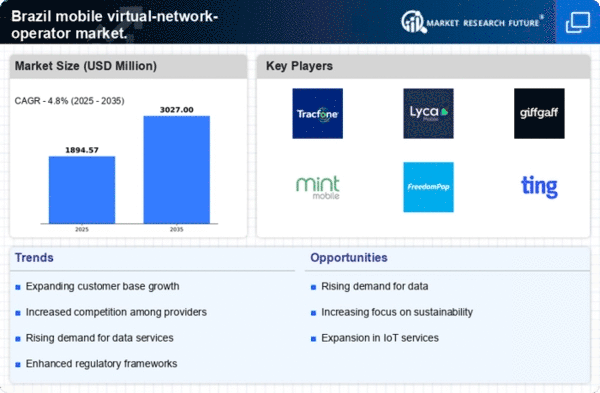
As per Market Research Future analysis, the Brazil mobile virtual-network-operator market Size was estimated at 1807.8 USD Million in 2024. The Brazil mobile virtual-network-operator market is projected to grow from 1894.57 USD Million in 2025 to 3027.0 USD Million by 2035, exhibiting a compound annual growth rate (CAGR) of 4% during the forecast period 2025 - 2035

Key Market Trends & Highlights

The Brazil mobile virtual-network-operator market is experiencing dynamic growth driven by evolving consumer preferences and technological advancements.

  • The largest segment in the Brazil mobile virtual-network-operator market is the prepaid segment, which continues to dominate due to its affordability.
  • The fastest-growing segment is the digital services segment, reflecting a shift towards integrated mobile solutions.
  • There is an increased focus on customer experience, with operators enhancing service quality to retain users.
  • Rising demand for affordable connectivity and technological advancements in network infrastructure are key drivers propelling market growth.

Market Size & Forecast

2024 Market Size 1807.8 (USD Million)
2035 Market Size 3027.0 (USD Million)
CAGR (2025 - 2035) 4.8%

Major Players

TracFone Wireless (US), Lycamobile (GB), Giffgaff (GB), Mint Mobile (US), FreedomPop (US), Ting (US), Republic Wireless (US), Lebara (GB), PosteMobile (IT)

Our Impact
Enabled $4.3B Revenue Impact for Fortune 500 and Leading Multinationals
Partnering with 2000+ Global Organizations Each Year
30K+ Citations by Top-Tier Firms in the Industry

Brazil Mobile Virtual Network Operator Market Trends

The mobile virtual-network-operator market is currently experiencing notable growth, driven by increasing consumer demand for flexible and cost-effective mobile services. This market segment allows operators to offer services without owning the underlying infrastructure, which can lead to competitive pricing and innovative service offerings. As consumers become more price-sensitive, the appeal of mobile virtual-network-operators continues to rise, particularly among younger demographics who prioritize affordability and customization in their mobile plans. Additionally, advancements in technology and the proliferation of smartphones have facilitated the entry of new players into the market, further intensifying competition. Moreover, regulatory frameworks in Brazil are evolving to support the expansion of mobile virtual-network-operators. The government has recognized the potential of this market to enhance connectivity and promote digital inclusion. As a result, policies are being implemented to streamline licensing processes and encourage investment in this sector. This supportive environment is likely to attract more entrants, fostering innovation and improving service quality. The mobile virtual-network-operator market appears poised for continued expansion, with opportunities for both established and emerging players to capture market share and meet the diverse needs of consumers.

Increased Focus on Customer Experience

Operators are prioritizing customer satisfaction by offering tailored services and personalized plans. This trend reflects a shift towards understanding consumer preferences and enhancing user engagement, which is crucial for retaining subscribers in a competitive landscape.

Adoption of Innovative Pricing Models

The mobile virtual-network-operator market is witnessing a rise in flexible pricing strategies, such as pay-as-you-go and subscription-based models. These approaches cater to diverse consumer needs, allowing users to select plans that align with their usage patterns and financial capabilities.

Expansion of Digital Services

There is a growing trend towards integrating digital services, such as mobile banking and streaming, into mobile virtual-network-operator offerings. This integration not only enhances the value proposition for consumers but also positions operators as key players in the broader digital ecosystem.

Brazil Mobile Virtual Network Operator Market Drivers

Regulatory Support for Market Entry

Regulatory support significantly influences the mobile virtual-network-operator market in Brazil. The Brazilian government has implemented policies aimed at fostering competition within the telecommunications sector, which includes facilitating the entry of MVNOs. These regulations are designed to lower barriers to entry, allowing new players to emerge and compete with established operators. As a result, the mobile virtual-network-operator market is likely to see an influx of new entrants, which could lead to increased innovation and improved service offerings for consumers. This supportive regulatory environment is expected to enhance market dynamics and stimulate growth.

Growing Interest in Niche Market Segments

The mobile virtual-network-operator market in Brazil is witnessing a growing interest in niche market segments. MVNOs are increasingly targeting specific consumer groups, such as students, expatriates, and seniors, by offering tailored services that cater to their unique needs. This strategy allows MVNOs to differentiate themselves from traditional operators and capture market share in underserved segments. As of November 2025, it is estimated that niche-focused MVNOs could account for up to 15% of the overall market. The mobile virtual-network-operator market is thus likely to benefit from this trend, as it encourages innovation and the development of specialized offerings.

Rising Demand for Affordable Connectivity

The mobile virtual-network-operator market in Brazil experiences a notable surge in demand for affordable connectivity solutions. As the cost of living continues to rise, consumers increasingly seek budget-friendly mobile plans that offer essential services without excessive charges. This trend is particularly pronounced among lower-income demographics, who prioritize value for money. In 2025, it is estimated that approximately 40% of Brazilian consumers will opt for MVNOs due to their competitive pricing strategies. The mobile virtual-network-operator market is thus positioned to capitalize on this growing demand, potentially leading to increased market share and customer acquisition for MVNOs.

Shift Towards Digital-First Consumer Behavior

The shift towards digital-first consumer behavior is reshaping the mobile virtual-network-operator market in Brazil. As consumers increasingly rely on digital platforms for communication and entertainment, MVNOs are adapting their service offerings to meet these evolving preferences. In 2025, it is anticipated that over 60% of mobile users in Brazil will prefer digital channels for customer service and account management. This trend compels MVNOs to invest in digital tools and platforms, enhancing their customer engagement strategies. The mobile virtual-network-operator market must embrace this shift to remain relevant and competitive in a rapidly changing landscape.

Technological Advancements in Network Infrastructure

Technological advancements play a crucial role in shaping the mobile virtual-network-operator market in Brazil. The ongoing development of 5G technology and improvements in network infrastructure enable MVNOs to offer enhanced services, including faster data speeds and improved coverage. As of November 2025, it is projected that 5G penetration in Brazil will reach 25%, providing MVNOs with opportunities to attract tech-savvy consumers. The mobile virtual-network-operator market must adapt to these advancements to remain competitive, ensuring that they leverage new technologies to enhance service offerings and customer satisfaction.


Market Segment Insights

By Business Model: Discount MVNO (Largest) vs. Niche MVNO (Fastest-Growing)

In the Brazil mobile virtual-network-operator market, the segment is dominated by Discount MVNOs, which capitalize on cost-effective offerings appealing to price-sensitive consumers. Functional MVNOs also hold a significant share, providing essential services while maintaining competitive pricing. Brand MVNOs attract customers through partnerships with established brands, but their share is lesser compared to the traditionally low-cost operators. Niche MVNOs, tailored for specific demographics or interests, are carving out a growing presence in this diverse market. Growth trends within this segment reveal a distinct shift toward favoring Niche MVNOs. Consumers are increasingly seeking specialized services that cater to unique needs, thereby driving these operators' growth at an accelerated pace. Additionally, the rise of digital platforms and increased competition among Discount MVNOs enhance the overall market's dynamism. As customers demand more personalized offerings, the market is likely to see further segmentation and innovation.

Discount MVNO (Dominant) vs. Niche MVNO (Emerging)

Discount MVNOs dominate the Brazil mobile virtual-network-operator market by providing value-oriented services with lower prices, attracting a broad customer base focused on affordability. Their strategies often include no-frills plans and promotions that resonate well with cost-conscious consumers. Niche MVNOs, while emerging, are increasingly capturing attention by serving specific groups, such as gamers or international travelers, with tailored packages. These operators differentiate themselves through specialized services, personalized customer experiences, and innovative marketing strategies. As the market evolves, both segments will play critical roles, with Discount MVNOs focusing on mass adoption and Niche MVNOs aiming to create loyal customer relationships through targeted solutions.

By Service Type: Prepaid Services (Largest) vs. Data-Only Services (Fastest-Growing)

In the Brazil mobile virtual-network-operator market, the service type segment is predominantly characterized by Prepaid Services, which command a significant share of the market. This segment has been traditionally favored by consumers due to its flexibility and no long-term commitment, making it a popular choice among various demographics. On the other hand, Postpaid Services also hold a notable portion but are gradually losing favor against the rising demand for more tailored offerings. Data-Only Services and Voice-Only Services are relatively smaller segments, with the former rapidly gaining traction in response to increased mobile internet usage. The growth trends within this segment point towards a clear shift in consumer preferences, favoring convenience and customization. Data-Only Services are emerging as the fastest-growing category, driven by the rising demand for mobile internet and streaming services. Meanwhile, the prepaid model continues to dominate due to economic factors and the necessity for budget control among users. The overall adaptability of mobile services is a crucial driver for this evolution, allowing operators to cater to diverse consumer needs effectively.

Prepaid Services (Dominant) vs. Data-Only Services (Emerging)

Prepaid Services remain the dominant force in the Brazil mobile virtual-network-operator market, appealing to a wide range of consumers seeking cost-effective mobile solutions without binding contracts. These services offer flexibility and budgeting control, making them attractive to price-sensitive users. In contrast, Data-Only Services represent an emerging trend, tapping into the growing demand for mobile data as users increasingly rely on internet services for communication and entertainment. This shift reflects a transformation in consumer behavior, where connectivity is prioritized. Both segments reflect the evolving landscape of e-communication, with prepaid services holding firm while data-only offerings are quickly gaining ground among tech-savvy users seeking more tailored service options.

By Customer Segment: Individual Consumers (Largest) vs. Small and Medium Enterprises (Fastest-Growing)

The customer segment distribution in the Brazil mobile virtual-network-operator market reveals a diverse array of consumer needs and usage patterns. Individual Consumers constitute the largest segment, dominating the market with substantial adoption of mobile services for personal use. Small and Medium Enterprises, while smaller in market share compared to individual consumers, are rapidly gaining traction as more businesses recognize the benefits of flexible mobile solutions tailored to their operational needs. In terms of growth trends, the rise of Small and Medium Enterprises reflects a broader shift towards mobile-based solutions in Brazil, driven by the increasing digitization of businesses and the need for cost-effective communication solutions. Trends indicate that these enterprises are prioritizing customizable plans that can adapt to their evolving demands, creating a fertile ground for innovation in service offerings. This adaptability is crucial for market players aiming to tap into the growing enterprise segment.

Individual Consumers (Dominant) vs. Small and Medium Enterprises (Emerging)

The Individual Consumers segment is characterized by a vast demographic that seeks reliable mobile networks for everyday communication, entertainment, and social connectivity. This group's dominance is attributed to the widespread penetration of smartphones and increasing mobile data usage, making them the primary revenue source in the market. Conversely, Small and Medium Enterprises, although classified as emerging, exhibit significant growth potential as they explore mobile solutions to enhance their operational efficiency. These businesses are increasingly interested in plans that offer flexibility and scalability, catering to their varying communication needs. This duality in the customer segments provides a robust market landscape, where both established and evolving needs can be addressed by service providers.

By Network Infrastructure: Full MVNO (Largest) vs. Light MVNO (Fastest-Growing)

The market share distribution among the segment values reveals that Full MVNOs hold the largest share, significantly outpacing Light and Thin MVNOs. Light MVNOs, while smaller in overall share, are on a rapid growth trajectory, appealing to niche markets with innovative business models. Thin MVNOs continue to occupy a minor segment of the market, focusing primarily on cost-efficiency and basic service offerings. Growth trends indicate a shift towards Full MVNOs as they provide comprehensive services and better control over customer experience. The rapid adoption of digital services and changing consumer preferences favor Light MVNOs, positioning them for exponential growth. Key drivers include increased competition, advancements in technology, and evolving regulatory frameworks that support the entry of new market participants.

Full MVNO (Dominant) vs. Light MVNO (Emerging)

Full MVNOs are recognized as the dominant players in the market, offering extensive service portfolios that include not only voice and messaging but also advanced data services. They operate with greater operational independence and have established robust infrastructures, allowing them to provide differentiated services. In contrast, Light MVNOs are emerging rapidly, focusing on specific customer segments and utilizing cost-effective operations to deliver personalized services. Their agility and innovative approaches enable them to capture market share quickly, appealing to value-conscious consumers and those seeking unique offerings that larger operators may overlook.

Get more detailed insights about Brazil Mobile Virtual Network Operator Market

Key Players and Competitive Insights

The mobile virtual-network-operator market in Brazil exhibits a dynamic competitive landscape characterized by rapid technological advancements and evolving consumer preferences. Key players such as TracFone Wireless (US), Lycamobile (GB), and Mint Mobile (US) are actively shaping the market through strategic initiatives aimed at enhancing customer engagement and expanding service offerings. TracFone Wireless (US) focuses on leveraging its extensive distribution network to penetrate underserved regions, while Lycamobile (GB) emphasizes competitive pricing and international calling features to attract a diverse customer base. Mint Mobile (US), on the other hand, adopts a digital-first approach, utilizing online platforms to streamline customer acquisition and service delivery, thereby enhancing operational efficiency.
The business tactics employed by these companies reflect a moderately fragmented market structure, where localized strategies and supply chain optimization play crucial roles. The collective influence of these key players fosters a competitive environment that encourages innovation and responsiveness to market demands. As companies strive to differentiate themselves, the emphasis on localized service offerings and customer-centric solutions becomes increasingly pronounced, shaping the overall market dynamics.
In October 2025, TracFone Wireless (US) announced a partnership with a local telecommunications provider to enhance its service coverage in rural areas. This strategic move is expected to significantly improve network accessibility for customers in these regions, thereby expanding TracFone's market share and reinforcing its commitment to inclusivity. The partnership aligns with the broader trend of enhancing service availability in underserved markets, which is critical for long-term growth.
In September 2025, Lycamobile (GB) launched a new promotional campaign targeting the Brazilian diaspora, offering competitive international calling rates. This initiative not only aims to attract new customers but also seeks to strengthen brand loyalty among existing users. By focusing on the needs of specific demographic segments, Lycamobile is likely to enhance its competitive positioning in a market where personalized services are increasingly valued.
In August 2025, Mint Mobile (US) introduced a subscription-based model that allows customers to customize their plans based on usage patterns. This innovative approach is indicative of a shift towards more flexible service offerings, catering to the diverse needs of consumers. By empowering customers to tailor their plans, Mint Mobile is poised to capture a larger share of the market, particularly among younger demographics who prioritize personalization and value.
As of November 2025, the competitive trends in the mobile virtual-network-operator market are increasingly defined by digitalization, sustainability, and the integration of artificial intelligence. Strategic alliances among key players are shaping the landscape, fostering collaboration that enhances service delivery and operational efficiency. Looking ahead, the competitive differentiation is likely to evolve from traditional price-based competition towards a focus on innovation, technology, and supply chain reliability. Companies that successfully navigate these trends will be better positioned to meet the demands of an increasingly discerning consumer base.

Key Companies in the Brazil Mobile Virtual Network Operator Market include

Industry Developments

Recent developments in the Brazil Mobile Virtual Network Operator Market indicate a growing trend towards consolidation and technological advancement. Notably, Correios Celular has been expanding its services to enhance connectivity across rural areas, addressing the increasing demand for reliable mobile services in underserved regions.

In September 2023, Oi Mobile announced a strategic partnership with Vivo, enhancing its capacity to deliver competitive pricing and improved network coverage. Moreover, Tim has been actively integrating advanced 5G technologies, pushing for greater market penetration among urban users. Flash Mobile has recently expanded its portfolio, and Datora is looking to leverage IoT solutions to diversify its services, meeting the evolving needs of consumers. 

The consolidation trend has also led to discussions about potential mergers, with companies like Claro and Algar Telecom showing interest in potential collaboration to compete effectively against larger players.


Future Outlook

Brazil Mobile Virtual Network Operator Market Future Outlook

The mobile virtual-network-operator market in Brazil is projected to grow at a 4.8% CAGR from 2025 to 2035, driven by technological advancements and increasing consumer demand.

New opportunities lie in:

  • Partnerships with local retailers for bundled service offerings.
  • Development of niche market segments targeting specific demographics.
  • Investment in AI-driven customer service solutions to enhance user experience.

By 2035, the market is expected to achieve robust growth and increased competitive positioning.

Market Segmentation

Brazil Mobile Virtual Network Operator Market Service Type Outlook

  • Prepaid Services
  • Postpaid Services
  • Data-Only Services
  • Voice-Only Services

Brazil Mobile Virtual Network Operator Market Business Model Outlook

  • Discount MVNO
  • Functional MVNO
  • Brand MVNO
  • Niche MVNO

Brazil Mobile Virtual Network Operator Market Customer Segment Outlook

  • Individual Consumers
  • Small and Medium Enterprises
  • Large Enterprises
  • Government

Brazil Mobile Virtual Network Operator Market Network Infrastructure Outlook

  • Full MVNO
  • Light MVNO
  • Thin MVNO

Report Scope

MARKET SIZE 2024 1807.8(USD Million)
MARKET SIZE 2025 1894.57(USD Million)
MARKET SIZE 2035 3027.0(USD Million)
COMPOUND ANNUAL GROWTH RATE (CAGR) 4.8% (2025 - 2035)
REPORT COVERAGE Revenue Forecast, Competitive Landscape, Growth Factors, and Trends
BASE YEAR 2024
Market Forecast Period 2025 - 2035
Historical Data 2019 - 2024
Market Forecast Units USD Million
Key Companies Profiled TracFone Wireless (US), Lycamobile (GB), Giffgaff (GB), Mint Mobile (US), FreedomPop (US), Ting (US), Republic Wireless (US), Lebara (GB), PosteMobile (IT)
Segments Covered Business Model, Service Type, Customer Segment, Network Infrastructure
Key Market Opportunities Expansion of mobile virtual-network-operator services leveraging 5G technology and evolving consumer preferences.
Key Market Dynamics Intensifying competition among mobile virtual-network-operators drives innovation and consumer-centric service offerings in Brazil.
Countries Covered Brazil
Leave a Comment

FAQs

What is the expected market value of the Brazil Mobile Virtual Network Operator Market in 2024?

The Brazil Mobile Virtual Network Operator Market is expected to be valued at 1.5 USD Billion in 2024.

What is the forecasted market size for the Brazil Mobile Virtual Network Operator Market in 2035?

The market is forecasted to reach 2.8 USD Billion by the year 2035.

What is the expected compound annual growth rate (CAGR) for the Brazil Mobile Virtual Network Operator Market from 2025 to 2035?

The expected CAGR for the market from 2025 to 2035 is 5.838%.

Which business model segment will dominate the Brazil Mobile Virtual Network Operator Market in 2024?

The Discount MVNO segment is anticipated to have a significant presence, valued at 0.45 USD Billion in 2024.

What will be the value of the Functional MVNO segment by 2035?

The Functional MVNO segment is expected to reach 0.65 USD Billion by 2035.

Who are the key players in the Brazil Mobile Virtual Network Operator Market?

Major players include Correios Celular, Oi, Superinternet, Vivo, and Tim among others.

What is the projected market value for the Brand MVNO segment in 2024?

The Brand MVNO segment is projected to be valued at 0.4 USD Billion in the year 2024.

What is the expected growth rate of the Niche MVNO segment by 2035?

The Niche MVNO segment is expected to grow to 0.52 USD Billion by 2035.

What are the emerging trends in the Brazil Mobile Virtual Network Operator Market?

Emerging trends include increased competition among MVNOs and the expansion of service offerings.

How does the Brazil Mobile Virtual Network Operator Market compare to other regions?

The market in Brazil shows promising growth potential compared to other Latin American regions due to its growing mobile user base.

Download Free Sample

Kindly complete the form below to receive a free sample of this Report

Compare Licence

×
Features License Type
Single User Multiuser License Enterprise User
Price $4,950 $5,950 $7,250
Maximum User Access Limit 1 User Upto 10 Users Unrestricted Access Throughout the Organization
Free Customization
Direct Access to Analyst
Deliverable Format
Platform Access
Discount on Next Purchase 10% 15% 15%
Printable Versions