×
Request Free Sample ×

Kindly complete the form below to receive a free sample of this Report

* Please use a valid business email

Leading companies partner with us for data-driven Insights

clients tt-cursor
Hero Background

Brazil Generative Ai Bfsi Market

ID: MRFR/BS/58407-HCR
200 Pages
Aarti Dhapte
February 2026

Brazil Generative AI in BFSI Market Size, Share and Research Report By Organization (Banks, Insurance Companies, Financial Service Providers, Others), By Application (Fraud Detection, Risk Assessment, Customer Experience, Algorithmic Trading, Others) and By Deployment (On-Premise, Cloud-Based)-Forecast to 2035

Share:
Download PDF ×

We do not share your information with anyone. However, we may send you emails based on your report interest from time to time. You may contact us at any time to opt-out.

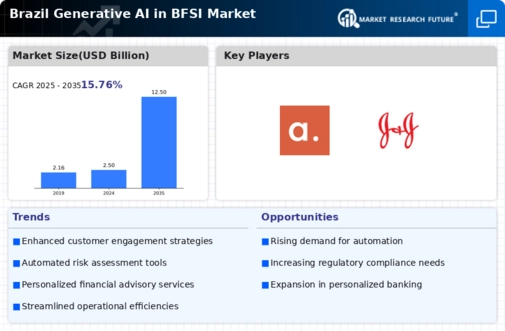
Brazil Generative Ai Bfsi Market Infographic
Purchase Options

Brazil Generative Ai Bfsi Market Summary

As per analysis, the Brazil generative ai bfsi market is projected to grow from USD 13.76 Million in 2024 to USD 149.04 Million by 2035, exhibiting a compound annual growth rate (CAGR) of 24.18% during the forecast period (2025 - 2035).

Key Market Trends & Highlights

The Brazil generative AI BFSI market is poised for substantial growth driven by automation and personalization.

  • The fraud detection segment remains the largest, reflecting a critical need for enhanced security measures in financial services.
  • Customer service automation is the fastest-growing segment, indicating a shift towards more efficient client interactions.
  • In banking, the largest segment, institutions are increasingly adopting AI to streamline operations and improve customer experiences.
  • Regulatory support for AI adoption and the growing demand for personalized financial services are key drivers propelling market expansion.

Market Size & Forecast

2024 Market Size 13.76 (USD Million)
2035 Market Size 149.04 (USD Million)
CAGR (2025 - 2035) 24.18%

Major Players

Itaú Unibanco (BR), Banco do Brasil (BR), Bradesco (BR), Santander Brasil (BR), XP Inc. (BR), BTG Pactual (BR), C6 Bank (BR), Nubank (BR), PagSeguro (BR)

Our Impact
Enabled $4.3B Revenue Impact for Fortune 500 and Leading Multinationals
Partnering with 2000+ Global Organizations Each Year
30K+ Citations by Top-Tier Firms in the Industry

Brazil Generative Ai Bfsi Market Trends

The Brazil generative AI BFSI market is currently experiencing a transformative phase, characterized by the integration of advanced technologies into financial services. This sector is witnessing a surge in the adoption of generative AI tools, which are enhancing customer experiences and streamlining operations. Financial institutions are increasingly leveraging these technologies to automate processes, improve risk management, and personalize services. The regulatory environment in Brazil is evolving, with authorities recognizing the potential of AI to drive innovation while ensuring consumer protection. As a result, there is a growing emphasis on developing frameworks that support the responsible use of AI in finance. Moreover, the competitive landscape within the Brazil generative AI BFSI market is intensifying. Traditional banks and fintech companies are both investing heavily in AI capabilities to gain a competitive edge. Collaboration between tech firms and financial institutions is becoming more common, fostering innovation and accelerating the deployment of AI solutions. This trend suggests a shift towards a more integrated approach to financial services, where AI plays a central role in shaping the future of banking and finance in Brazil. As the market continues to evolve, stakeholders must remain vigilant to the challenges and opportunities presented by this rapidly changing environment.

Increased Automation in Financial Services

The Brazil generative AI BFSI market is witnessing a notable trend towards automation. Financial institutions are adopting AI-driven solutions to streamline operations, reduce costs, and enhance efficiency. This shift allows for quicker processing of transactions and improved customer service, as AI systems can handle routine inquiries and tasks.

Enhanced Risk Management Practices

Another emerging trend in the Brazil generative AI BFSI market is the enhancement of risk management practices. AI technologies are being utilized to analyze vast amounts of data, enabling institutions to identify potential risks more effectively. This proactive approach helps in mitigating financial losses and ensuring regulatory compliance.

Personalization of Financial Products

The personalization of financial products is gaining traction within the Brazil generative AI BFSI market. Institutions are leveraging AI to analyze customer data and preferences, allowing them to tailor offerings to individual needs. This trend not only improves customer satisfaction but also fosters loyalty and retention.

Brazil Generative Ai Bfsi Market Drivers

Regulatory Support for AI Adoption

The Brazilian government has been actively promoting the adoption of artificial intelligence technologies across various sectors, including the brazil generative ai bfsi market. Recent policies have aimed to create a conducive environment for innovation, which is crucial for financial institutions looking to integrate generative AI solutions. The Central Bank of Brazil has introduced guidelines that encourage the use of AI in risk assessment and customer service, thereby enhancing operational efficiency. This regulatory support is expected to drive investment in AI technologies, with projections indicating that the financial sector could see a 20% increase in AI-related spending by 2027. Such initiatives not only foster growth in the brazil generative ai bfsi market but also position Brazil as a leader in AI adoption in Latin America.

Focus on Enhanced Cybersecurity Measures

In the context of increasing cyber threats, the focus on enhanced cybersecurity measures is becoming a critical driver in the brazil generative ai bfsi market. Financial institutions are recognizing the need to protect sensitive customer data and maintain trust. Generative AI technologies are being employed to develop advanced security protocols that can detect and mitigate potential threats in real-time. The Brazilian government has also emphasized the importance of cybersecurity in its national strategy, which aligns with the growing investment in AI-driven security solutions. As institutions prioritize cybersecurity, the integration of generative AI is expected to play a pivotal role in safeguarding the integrity of the financial system, thereby fostering confidence in the brazil generative ai bfsi market.

Advancements in Data Analytics Capabilities

The rapid advancements in data analytics capabilities are significantly influencing the brazil generative ai bfsi market. Financial institutions are increasingly adopting AI-driven analytics tools to process vast amounts of data, enabling them to make informed decisions swiftly. This trend is supported by the fact that Brazil's financial sector generates millions of data points daily, which can be harnessed for predictive modeling and risk assessment. The integration of generative AI into data analytics not only enhances operational efficiency but also improves the accuracy of financial forecasting. As a result, institutions that embrace these technologies are likely to gain a competitive edge in the evolving landscape of the brazil generative ai bfsi market.

Increased Investment in Fintech Innovations

The surge in investment in fintech innovations is a key driver for the brazil generative ai bfsi market. Venture capital funding for Brazilian fintechs has reached unprecedented levels, with estimates suggesting that investments could exceed USD 2 billion in 2026. This influx of capital is facilitating the development of generative AI solutions that enhance customer experiences and streamline operations. As fintech companies continue to innovate, traditional banks are compelled to adopt similar technologies to remain competitive. The collaboration between established financial institutions and fintech startups is likely to accelerate the integration of generative AI, further propelling growth in the brazil generative ai bfsi market.

Growing Demand for Personalized Financial Services

As consumer expectations evolve, there is a marked increase in demand for personalized financial services within the brazil generative ai bfsi market. Financial institutions are leveraging generative AI to analyze customer data and deliver tailored products and services. This trend is evidenced by a survey indicating that 75% of Brazilian consumers prefer personalized banking experiences. By utilizing AI-driven insights, banks can enhance customer engagement and satisfaction, leading to improved retention rates. The ability to offer customized solutions is likely to become a competitive differentiator in the market, prompting more institutions to invest in generative AI technologies to meet these demands.


Market Segment Insights

By Application: Fraud Detection (Largest) vs. Customer Service Automation (Fastest-Growing)

In the Brazil generative AI BFSI market, the application segment is marked by significant variability in market share among its key components. Fraud Detection remains the largest application, driven by increasing incidents of digital fraud and the growing need for advanced security measures. Customer Service Automation, on the other hand, is rapidly gaining traction as businesses seek to enhance customer experiences and operational efficiencies. Together, these applications are redefining operational frameworks across the BFSI sector.

Fraud Detection: Largest vs. Risk Management: Emerging

Fraud Detection is a dominant force within the Brazil generative AI BFSI market, primarily due to the escalating challenges faced by financial institutions in combating fraud. This segment utilizes advanced algorithms to monitor transactions in real-time, providing a robust defense against fraudulent activities. In contrast, Risk Management is an emerging segment that is seeing increased interest and investment. As organizations strive to mitigate financial and operational risks, generative AI tools are being employed to analyze vast datasets and forecast potential risks, enabling more informed decision-making. Both segments reflect a growing reliance on AI technologies to enhance security and operational integrity.

By End Use: Banking (Largest) vs. Payment Processing (Fastest-Growing)

In the Brazilian generative AI BFSI market, the end-use segments are characterized by varied market share, with banking being the largest player. The banking sector significantly utilizes generative AI to enhance customer experiences, risk management, and compliance efforts. Following closely, insurance and investment firms exhibit substantial adoption rates, while wealth management and payment processing are gaining traction. Together, these segments reflect a dynamic landscape shaped by evolving consumer expectations and technological advancements. As for growth trends, the payment processing sector has emerged as the fastest-growing segment in Brazil, driven by the surge in digital transactions and the increasing demand for automated solutions. The rapid adoption of AI technologies for fraud detection and personalized marketing is augmenting growth in the insurance and wealth management sectors as well. Overall, the BFSI market is poised for continued expansion, with generative AI serving as a vital catalyst for transformation across all segments.

Banking: Dominant vs. Payment Processing: Emerging

In the Brazilian generative AI BFSI market, banking remains the dominant segment due to its extensive utilization of advanced AI technologies for optimizing operations and enhancing customer interactions. Financial institutions are leveraging generative AI to streamline processes, ensure regulatory compliance, and improve risk assessment. On the other hand, payment processing, though emerging, is rapidly gaining importance. This segment's growth is spurred by the proliferation of digital payment methods and the increasing necessity for real-time transaction processing. As fintech innovations drive competition, payment processors are adopting generative AI for fraud prevention and improving customer service experiences. These two segments together illustrate the balance of established dominance versus emerging potential in the vibrant Brazilian BFSI landscape.

By Technology: Natural Language Processing (Largest) vs. Machine Learning (Fastest-Growing)

In the Brazil generative AI BFSI market, Natural Language Processing (NLP) holds the largest share, driven by the increasing demand for automated customer interactions and sentiment analysis. Its ability to enhance customer experience and streamline operations makes it a preferred choice for many financial institutions. Following closely, Machine Learning is emerging as the fastest-growing segment, with its applications in fraud detection and risk assessment gaining significant traction among BFSI players.

Technology: NLP (Dominant) vs. Machine Learning (Emerging)

Natural Language Processing (NLP) dominates the Brazil generative AI BFSI market due to its essential role in improving communication and interaction through automated systems. BFSI institutions utilize NLP for chatbots, virtual assistants, and analysis of customer feedback, thereby enhancing user engagement. In contrast, Machine Learning is recognized as an emerging power in this sector, harnessing vast data for predictive analytics and operational efficiencies. Its ability to learn from historical data empowers banks and financial services to better assess risk and detect anomalies, making it a vital tool for innovation in the financial landscape.

By Deployment Model: Cloud-Based (Largest) vs. On-Premises (Fastest-Growing)

In the Brazil generative AI BFSI market, the deployment model segment showcases a significant preference for cloud-based solutions, which have emerged as the largest segment due to their scalability, cost-effectiveness, and ease of access. Cloud-based deployment is favored by financial institutions looking to leverage advanced AI technology without the heavy overhead of on-premises infrastructure. Meanwhile, on-premises deployment is experiencing rapid growth as organizations, particularly those with strict regulatory requirements, seek to maintain greater control over their data and comply with security protocols. The growth trends in this segment are driven by a shift towards hybrid models as institutions aim for a combination of flexibility and control. Cloud deployments continue to benefit from innovations in AI technologies, enabling quicker adaptation to market changes. Conversely, the surge in on-premises solutions reflects heightened concerns over data privacy and the need for compliance in the BFSI sector. Hybrid deployments are emerging as a strategic choice, allowing businesses to optimize their operations across cloud and on-premises platforms.

Cloud-Based (Dominant) vs. On-Premises (Emerging)

In the Brazil generative AI BFSI market, the cloud-based deployment model stands out as the dominant choice among financial service providers. Its appeal lies in the ability to enhance collaboration, reduce costs, and facilitate quicker integration of AI solutions into existing systems. As businesses push for innovation and efficiency, adopting cloud technologies becomes essential. Conversely, the on-premises model is emerging, particularly among traditional banks and financial institutions that prioritize data sovereignty and security. This model allows for customized solutions tailored to specific regulatory requirements, providing a sense of control and reliability. As these organizations navigate the complexities of AI adoption, the evolution of both deployment models continues to shape the competitive landscape of the BFSI sector.

By User Type: Medium Enterprises (Largest) vs. Small Enterprises (Fastest-Growing)

In the Brazil generative AI market for BFSI, medium enterprises hold the largest market share, leveraging significant resources and infrastructure to implement generative AI technologies effectively. They are increasingly adopting advanced analytics and automation to enhance operational efficiency and customer experiences. Small enterprises, on the other hand, are becoming the fastest-growing segment, driven by their agility in adopting new technologies and innovative solutions that meet emerging customer demands. These small players are capitalizing on user-friendly AI tools to enhance their services without the need for extensive IT overhaul. The growth trends in this segment are influenced by several factors, including the increasing need for personalized financial services and improved customer interactions. Medium enterprises are focusing on enhancing their existing frameworks while integrating innovative AI solutions into their operations, which drives growth in this segment. Small enterprises benefit from lower entry barriers into the generative AI space, allowing them to quickly innovate and adapt. As the market continues to evolve, enterprise size will indicate varying strategic approaches to AI adoption within the BFSI sector in Brazil.

Medium Enterprises (Dominant) vs. Small Enterprises (Emerging)

In the Brazilian generative AI BFSI market, medium enterprises exemplify the dominant force, characterized by substantial investment capabilities and established customer bases. They utilize extensive data analytics to refine client interactions and optimize operational workflows, establishing themselves as leaders in AI integration. Conversely, small enterprises emerge as innovative challengers, often leveraging cost-effective and accessible AI solutions. They are adept at quickly implementing changes to meet niche market demands and enhance customer experience. The agility of small enterprises enables them to explore unique service offerings and target specific demographics effectively. While medium enterprises enjoy stability through their size and resources, small enterprises thrive on innovation and flexibility, creating a competitive landscape where both segments complement each other's growth.

Get more detailed insights about Brazil Generative Ai Bfsi Market

Key Players and Competitive Insights

The Brazilian generative AI BFSI market is currently characterized by a dynamic competitive landscape, driven by rapid technological advancements and an increasing demand for innovative financial solutions. Major players such as Itaú Unibanco (BR), Banco do Brasil (BR), and Bradesco (BR) are at the forefront, each adopting distinct strategies to enhance their market positioning. Itaú Unibanco (BR) focuses on digital transformation, leveraging AI to optimize customer service and streamline operations. Banco do Brasil (BR) emphasizes partnerships with fintechs to expand its service offerings, while Bradesco (BR) invests heavily in AI-driven analytics to improve risk management and customer insights. Collectively, these strategies contribute to a competitive environment that is increasingly reliant on technological innovation and customer-centric solutions.
In terms of business tactics, companies are localizing their operations and optimizing supply chains to better serve the Brazilian market. The competitive structure appears moderately fragmented, with a mix of traditional banks and emerging fintechs vying for market share. This fragmentation allows for diverse offerings, yet the influence of key players remains substantial, as they set benchmarks for service quality and technological integration.
In December 2025, Itaú Unibanco (BR) announced a strategic partnership with a leading AI startup to enhance its fraud detection capabilities. This move is significant as it not only strengthens Itaú's security measures but also positions the bank as a leader in adopting cutting-edge technology to protect customer assets. The collaboration is expected to yield a more robust framework for identifying and mitigating risks in real-time, thereby enhancing customer trust and satisfaction.
In November 2025, Banco do Brasil (BR) launched an AI-driven personal finance management tool aimed at improving customer engagement. This initiative is crucial as it reflects the bank's commitment to integrating AI into its core services, providing customers with personalized insights and recommendations. Such tools are likely to foster deeper customer relationships and drive loyalty, which is essential in a competitive market.
In October 2025, Bradesco (BR) unveiled a new AI-powered chatbot designed to assist customers with banking inquiries 24/7. This development is indicative of Bradesco's strategy to enhance customer service through technology. By offering immediate assistance, the bank not only improves user experience but also reduces operational costs associated with traditional customer service channels.
As of January 2026, the competitive trends in the Brazilian generative AI BFSI market are increasingly defined by digitalization, sustainability, and the integration of AI technologies. Strategic alliances among key players are shaping the landscape, fostering innovation and enhancing service delivery. Looking ahead, it is anticipated that competitive differentiation will evolve, shifting from price-based competition to a focus on innovation, technological advancement, and supply chain reliability. This transition underscores the importance of agility and responsiveness in meeting the evolving needs of consumers.

Key Companies in the Brazil Generative Ai Bfsi Market include

Industry Developments

In recent months, the Brazil Generative AI in the Banking, Financial Services, and Insurance (BFSI) market has witnessed a surge in interest and investment from leading companies. Palantir Technologies and Cognizant have expanded their operations in Brazil, focusing on enhancing AI-powered analytics for financial institutions. OpenAI has also made strides in the region by collaborating with local banks to improve customer interactions using generative AI technologies. Additionally, SAP and IBM are integrating their platforms with AI capabilities to optimize business processes in the financial sector.

Recent developments have seen Nu Bank, one of Brazil's largest digital banks, leveraging AI to offer personalized financial services to its customers. As for mergers and acquisitions, in June 2023, Accenture acquired a Brazilian AI startup, enhancing its capabilities in the BFSI sector. The market valuation for companies involved in generative AI in BFSI has been growing significantly, driven by the demand for automation and increased customer insights. In the past couple of years, the Brazilian National Data Protection Authority has also implemented regulations impacting the deployment of AI in financial services, reflecting the country's focus on responsible AI use.

Future Outlook

Brazil Generative Ai Bfsi Market Future Outlook

The Brazil generative AI BFSI market is poised for growth at 24.18% CAGR from 2025 to 2035, driven by technological advancements, regulatory support, and increasing demand for personalized financial services.

New opportunities lie in:

  • Development of AI-driven risk assessment tools for credit scoring. Implementation of automated customer service chatbots for enhanced user experience. Creation of personalized investment advisory platforms using generative AI.

By 2035, the market is expected to be robust, driven by innovation and strategic investments.

Market Segmentation

Brazil Generative Ai Bfsi Market End Use Outlook

  • Banking
  • Insurance
  • Investment Firms
  • Wealth Management
  • Payment Processing

Brazil Generative Ai Bfsi Market User Type Outlook

  • Small Enterprises
  • Medium Enterprises
  • Large Enterprises

Brazil Generative Ai Bfsi Market Technology Outlook

  • Natural Language Processing
  • Machine Learning
  • Computer Vision
  • Predictive Analytics
  • Robotic Process Automation

Brazil Generative Ai Bfsi Market Application Outlook

  • Fraud Detection
  • Risk Management
  • Customer Service Automation
  • Regulatory Compliance
  • Investment Analysis

Brazil Generative Ai Bfsi Market Deployment Model Outlook

  • Cloud-Based
  • On-Premises
  • Hybrid

Report Scope

MARKET SIZE 2024 13.76(USD Million)
MARKET SIZE 2025 17.46(USD Million)
MARKET SIZE 2035 149.04(USD Million)
COMPOUND ANNUAL GROWTH RATE (CAGR) 24.18% (2024 - 2035)
REPORT COVERAGE Revenue Forecast, Competitive Landscape, Growth Factors, and Trends
BASE YEAR 2024
Market Forecast Period 2025 - 2035
Historical Data 2019 - 2024
Market Forecast Units USD Million
Key Companies Profiled Itaú Unibanco (BR), Banco do Brasil (BR), Bradesco (BR), Santander Brasil (BR), XP Inc. (BR), BTG Pactual (BR), C6 Bank (BR), Nubank (BR), PagSeguro (BR)
Segments Covered Application, End Use, Technology, Deployment Model, User Type
Key Market Opportunities Integration of generative AI in risk management enhances decision-making in the brazil generative ai bfsi market.
Key Market Dynamics Growing adoption of generative AI in Brazil's BFSI sector enhances operational efficiency and customer engagement.
Countries Covered Brazil
Leave a Comment

FAQs

What is the current valuation of the Brazil generative AI BFSI market?

As of 2024, the Brazil generative AI BFSI market was valued at 13.76 USD Million.

What is the projected market valuation for the Brazil generative AI BFSI market by 2035?

The market is projected to reach a valuation of 149.04 USD Million by 2035.

What is the expected CAGR for the Brazil generative AI BFSI market during the forecast period?

The expected CAGR for the market from 2025 to 2035 is 24.18%.

Which companies are the key players in the Brazil generative AI BFSI market?

Key players include Itaú Unibanco, Banco do Brasil, Bradesco, Santander Brasil, XP Inc., BTG Pactual, C6 Bank, Nubank, and PagSeguro.

What are the main applications of generative AI in the Brazil BFSI market?

Main applications include Fraud Detection, Risk Management, Customer Service Automation, Regulatory Compliance, and Investment Analysis.

How does the market segment by end use in the Brazil generative AI BFSI market?

The market segments by end use include Banking, Insurance, Investment Firms, Wealth Management, and Payment Processing.

What technologies are driving the Brazil generative AI BFSI market?

Driving technologies include Natural Language Processing, Machine Learning, Computer Vision, Predictive Analytics, and Robotic Process Automation.

What deployment models are utilized in the Brazil generative AI BFSI market?

Deployment models include Cloud-Based, On-Premises, and Hybrid solutions.

How does the user type segmentation look in the Brazil generative AI BFSI market?

User type segmentation includes Small Enterprises, Medium Enterprises, and Large Enterprises.

What was the market valuation for Fraud Detection in the Brazil generative AI BFSI market?

The market valuation for Fraud Detection was 2.76 USD Million in 2024, with a projected increase to 30.0 USD Million by 2035.

Download Free Sample

Kindly complete the form below to receive a free sample of this Report

Compare Licence

×
Features License Type
Single User Multiuser License Enterprise User
Price $4,950 $5,950 $7,250
Maximum User Access Limit 1 User Upto 10 Users Unrestricted Access Throughout the Organization
Free Customization
Direct Access to Analyst
Deliverable Format
Platform Access
Discount on Next Purchase 10% 15% 15%
Printable Versions