×
Request Free Sample ×

Kindly complete the form below to receive a free sample of this Report

* Please use a valid business email

Leading companies partner with us for data-driven Insights

clients tt-cursor
Hero Background

Brazil Fermentation Ingredients Market

ID: MRFR/FnB/56566-HCR
128 Pages
Snehal Singh
February 2026

Brazil Fermentation Ingredients Market Size, Share, Industry Trend & Analysis Research Report By Application (Food Beverages, Pharmaceuticals, Animal Feed, Biofuels), By Type (Yeast, Bacterial Cultures, Enzymes, Acids), By Source (Natural, Synthetic) and By Form (Liquid, Powder, Granular) - Forecast to 2035

Share:
Download PDF ×

We do not share your information with anyone. However, we may send you emails based on your report interest from time to time. You may contact us at any time to opt-out.

Brazil Fermentation Ingredients Market Infographic
Purchase Options

Brazil Fermentation Ingredients Market Summary

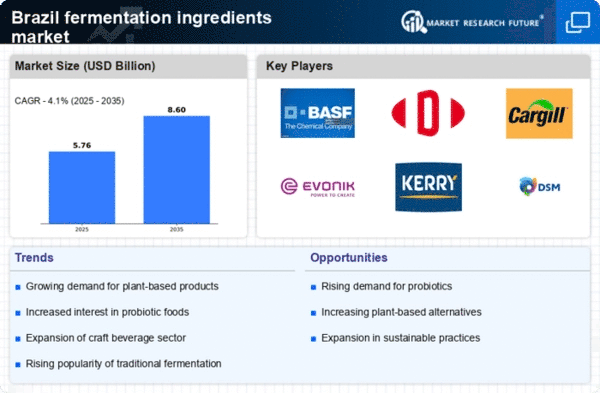
As per Market Research Future analysis, the Brazil fermentation ingredients market size was estimated at 5.53 USD Billion in 2024. The Brazil fermentation ingredients market is projected to grow from 5.76 USD Billion in 2025 to 8.6 USD Billion by 2035, exhibiting a compound annual growth rate (CAGR) of 4% during the forecast period 2025 - 2035

Key Market Trends & Highlights

The Brazil fermentation ingredients market is experiencing robust growth driven by health trends and technological advancements.

  • The market is witnessing a rising demand for natural ingredients, particularly in the food and beverage sector.
  • Technological advancements in fermentation processes are enhancing product quality and efficiency, contributing to market expansion.
  • Health and wellness trends are increasingly influencing consumer preferences, leading to a surge in fermented product consumption.
  • Key market drivers include growing consumer awareness and the expansion of the food and beverage sector, which are propelling the market forward.

Market Size & Forecast

2024 Market Size 5.53 (USD Billion)
2035 Market Size 8.6 (USD Billion)
CAGR (2025 - 2035) 4.1%

Major Players

BASF SE (DE), DuPont de Nemours Inc (US), Cargill Inc (US), Evonik Industries AG (DE), Kerry Group plc (IE), DSM Nutritional Products (CH), Archer Daniels Midland Company (US), Novozymes A/S (DK)

Our Impact
Enabled $4.3B Revenue Impact for Fortune 500 and Leading Multinationals
Partnering with 2000+ Global Organizations Each Year
30K+ Citations by Top-Tier Firms in the Industry

Brazil Fermentation Ingredients Market Trends

the fermentation ingredients market is experiencing notable growth, driven by increasing consumer demand for natural and organic products. This trend is largely influenced by a shift in consumer preferences towards healthier food options, which has led to a rise in the use of fermentation processes in various food and beverage applications. Additionally, the growing awareness of the health benefits associated with fermented products, such as probiotics, is further propelling market expansion. As a result, manufacturers are increasingly investing in research and development to innovate and enhance their product offerings, aiming to meet the evolving needs of consumers. Moreover, the fermentation ingredients market is experiencing advancements in technology that facilitate more efficient production processes. Innovations in fermentation techniques are enabling producers to optimize yields and improve the quality of end products. This technological evolution is complemented by a supportive regulatory environment that encourages the use of fermentation in food production. As the market continues to evolve, it appears poised for sustained growth, with potential opportunities for new entrants and established players alike to capitalize on emerging trends and consumer preferences.

Rising Demand for Natural Ingredients

There is a growing inclination among consumers towards natural and organic ingredients in food products. This trend is influencing the fermentation ingredients market, as manufacturers seek to incorporate more natural fermentation processes to cater to health-conscious consumers.

Technological Advancements in Fermentation

Innovations in fermentation technology are enhancing production efficiency and product quality. These advancements allow for better control over fermentation processes, leading to improved flavors and nutritional profiles in fermented products.

Health and Wellness Trends

The increasing focus on health and wellness is driving the popularity of fermented foods. Consumers are becoming more aware of the health benefits associated with probiotics and other fermented ingredients, which is likely to boost demand in the market.

Brazil Fermentation Ingredients Market Drivers

Growing Consumer Awareness

In Brazil, there is an increasing consumer awareness regarding the benefits of fermentation ingredients. This trend is driven by a shift towards healthier eating habits and a preference for natural products. As consumers become more informed about the nutritional advantages of fermented foods, the demand for fermentation ingredients market is likely to rise. Reports indicate that the market for fermented products in Brazil has seen a growth rate of approximately 8% annually. This heightened awareness is pushing manufacturers to innovate and offer a wider range of fermentation ingredients, catering to the evolving preferences of health-conscious consumers.

Rising Popularity of Plant-Based Diets

The trend towards plant-based diets is gaining momentum in Brazil, influencing the fermentation ingredients market significantly. As more consumers adopt vegetarian and vegan lifestyles, the demand for plant-based fermentation ingredients is likely to increase. This shift is supported by a growing body of research highlighting the health benefits of plant-based diets, including improved digestion and enhanced nutrient absorption. The fermentation ingredients market is expected to adapt to this trend by offering innovative plant-based solutions, potentially capturing a larger share of the market as consumer preferences evolve.

Expansion of the Food and Beverage Sector

The food and beverage sector in Brazil is experiencing robust growth, which is positively impacting the fermentation ingredients market. With the rise of new food trends and the increasing popularity of artisanal and craft products, there is a growing need for diverse fermentation ingredients. The Brazilian food and beverage industry is projected to reach a value of $200 billion by 2026, creating substantial opportunities for fermentation ingredient suppliers. This expansion is likely to drive innovation and investment in fermentation technologies, further enhancing the market's potential.

Regulatory Support for Fermented Products

Brazilian regulatory bodies are increasingly supporting the production and consumption of fermented products. This support is evident in the establishment of guidelines that promote the use of fermentation ingredients in food production. Such regulations not only ensure safety and quality but also encourage manufacturers to explore new fermentation processes. the fermentation ingredients market will benefit from this regulatory environment, as it fosters innovation and enhances consumer trust in fermented products. As a result, the market is expected to grow steadily, with an estimated CAGR of 6% over the next five years.

Technological Innovations in Fermentation Processes

Technological advancements in fermentation processes are transforming the fermentation ingredients market in Brazil. Innovations such as precision fermentation and bioprocessing are enabling manufacturers to produce high-quality fermentation ingredients more efficiently. These technologies not only enhance product consistency but also reduce production costs, making fermentation ingredients more accessible to a broader range of consumers. As the market continues to evolve, it is anticipated that these technological innovations will play a crucial role in driving growth, with the potential to increase market size by 10% over the next few years.


Market Segment Insights

By Application: Food Beverages (Largest) vs. Pharmaceuticals (Fastest-Growing)

In the Brazil fermentation ingredients market, the Food Beverages segment holds the largest market share, driven by increasing consumer demand for fermented food products and beverages. This segment benefits from trends such as health consciousness and the popularity of products like yogurt and kombucha, which appeal to a broad consumer base. On the other hand, the Pharmaceuticals segment is emerging as the fastest-growing area, propelled by advances in biotechnology and a rising focus on bio-based medications. The growth of this segment is further stimulated by regulatory support for biopharmaceutical businesses and the increasing investment in research and development aimed at innovation and sustainability within the sector.

Food Beverages (Dominant) vs. Pharmaceuticals (Emerging)

The Food Beverages segment in the Brazil fermentation ingredients market is characterized by its dominance due to significant consumer preferences for naturally fermented products, which are perceived as healthier alternatives. This segment encompasses a wide range of products including dairy, alcoholic beverages, and plant-based drinks. In contrast, the Pharmaceuticals segment is considered emerging, largely due to the growing interest in using fermentation technologies for drug development and production. This segment includes ingredients harnessed for antibiotic production, probiotic formulations, and other therapeutic applications, reflecting a shift towards integrative health solutions that leverage biological processes.

By Type: Yeast (Largest) vs. Bacterial Cultures (Fastest-Growing)

In the Brazil fermentation ingredients market, Yeast holds the largest market share, driven by its pivotal role in various fermentation processes, ranging from baking to brewing. Bacterial Cultures, while smaller in percentage, are rapidly gaining traction as the market increasingly recognizes their benefits in probiotic products and food preservation, contributing significantly to the overall market dynamics. Growth trends indicate a robust demand for Bacterial Cultures, propelled by rising consumer awareness about health benefits and increasing preference for fermented foods. Innovations in fermentation technology and expanding applications, including plant-based products, are driving the market forward. Additionally, high acceptance rates among consumers are providing a solid foundation for sustained growth, making Bacterial Cultures a key focus area for manufacturers and distributors alike.

Yeast (Dominant) vs. Bacterial Cultures (Emerging)

Yeast is a dominant ingredient in the Brazil fermentation ingredients market, recognized for its versatility and essential role in numerous industries such as food, beverages, and biofuels. Its established applications and widespread usage ensure a constant demand that solidifies its market position. On the other hand, Bacterial Cultures, while an emerging player, showcase significant potential for growth, particularly in the health and wellness sector. As the popularity of probiotics rises, the demand for diverse bacterial strains used in foods is expanding rapidly. This emerging trend emphasizes the innovative application of Bacterial Cultures in functional foods, distinguishing them as a compelling choice for health-conscious consumers. Their rapid adoption indicates a shift in consumer preferences, showing an inclination towards health-oriented fermentation products.

By Source: Natural (Largest) vs. Synthetic (Fastest-Growing)

The Brazil fermentation ingredients market shows a significant distribution of market share between natural and synthetic sources, with natural ingredients holding the largest portion. As consumers increasingly prioritize health and sustainability, natural ingredients are favored for their organic appeal, which resonates well with the growing trend towards clean labeling and transparency in food production. On the other hand, synthetic ingredients, while currently holding a smaller share, are experiencing rapid growth due to their cost-effectiveness and consistent performance in fermentation processes. Growth trends in the Brazil fermentation ingredients market reflect a dynamic shift, with natural sources becoming essential in the products preferred by consumers. This growth is driven by heightened awareness of health benefits and the environmental impact associated with synthetic alternatives. Simultaneously, advancements in fermentation technology are allowing synthetic ingredients to evolve in quality and application, further driving their market penetration. As the market evolves, both segments are expected to expand as they cater to varying consumer preferences and industrial needs.

Source: Natural (Dominant) vs. Synthetic (Emerging)

Natural fermentation ingredients are characterized by their organic nature and minimal processing, making them increasingly popular among health-conscious consumers in the Brazil fermentation ingredients market. They are favored for their authenticity and alignment with the trend towards natural food products. This segment benefits from a strong consumer shift towards sustainability and holistic wellness, positioning natural ingredients as the dominant choice in the market. In contrast, synthetic fermentation ingredients serve as an emerging segment, driven by innovations that enhance their efficacy and reduce production costs. While they may face challenges due to perceptions of artificiality, their ability to deliver consistent results in fermentation processes makes them attractive for manufacturers looking to optimize production efficiency.

By Form: Liquid (Largest) vs. Powder (Fastest-Growing)

In the Brazil fermentation ingredients market, the 'Form' segment is prominently led by the liquid form, which holds the largest share. The liquid fermentation ingredients are favored for their ease of use, scalability, and versatility across various applications in food and beverages. Following closely is the powder form, which is gaining traction among manufacturers looking for convenience and longer shelf life. The granular form, while present, accounts for a smaller share in comparison and is typically used in niche applications. The growth in the liquid segment is attributed to the increasing demand for ready-to-eat and packaged food products, where liquid fermentation ingredients play a crucial role in flavor enhancement and preservation. Meanwhile, the powder form is emerging as the fastest-growing segment, driven by factors such as rising health consciousness and the growing trend toward plant-based ingredients. These trends highlight a shift in consumer preferences that favor convenience, shelf stability, and the incorporation of health benefits in food products.

Liquid (Dominant) vs. Powder (Emerging)

Liquid fermentation ingredients are characterized by their high functionality and adaptability, making them a dominant choice in various sectors such as bakery, dairy, and beverages. They offer advantages such as enhanced flavor profiles and improved preservation qualities. On the other hand, the powder form is emerging due to increasing consumer demand for convenient and health-oriented products. Powdered fermentation ingredients provide longer shelf life and ease of transport, catering to manufacturers who are shifting towards cleaner labeling and plant-based formulations. Together, these forms reflect the dynamic needs of the market, balancing between established products and innovative solutions.

Get more detailed insights about Brazil Fermentation Ingredients Market

Key Players and Competitive Insights

The fermentation ingredients market in Brazil is characterized by a dynamic competitive landscape, driven by increasing consumer demand for natural and sustainable products. Key players are actively engaging in innovation and strategic partnerships to enhance their market presence. Companies such as BASF SE (DE), DuPont de Nemours Inc (US), and Novozymes A/S (DK) are at the forefront, focusing on product development and sustainability initiatives. Their strategies not only reflect a commitment to meeting consumer preferences but also indicate a broader trend towards environmentally friendly practices within the industry.In terms of business tactics, localizing manufacturing and optimizing supply chains appear to be critical for success in this market. The competitive structure is moderately fragmented, with several players vying for market share. However, the influence of major companies is substantial, as they leverage their resources to innovate and streamline operations. This collective effort among key players fosters a competitive environment that encourages continuous improvement and adaptation to market demands.

In October DuPont de Nemours Inc (US) announced the launch of a new line of fermentation-based ingredients aimed at the food and beverage sector. This strategic move is significant as it aligns with the growing trend towards plant-based alternatives, potentially capturing a larger share of the market. By focusing on innovation in fermentation technology, DuPont is likely to enhance its competitive edge and respond effectively to evolving consumer preferences.

In September Novozymes A/S (DK) expanded its partnership with a leading Brazilian beverage manufacturer to develop sustainable fermentation solutions. This collaboration underscores the importance of strategic alliances in driving innovation and sustainability within the market. By working closely with local manufacturers, Novozymes can tailor its offerings to meet specific regional needs, thereby strengthening its market position.

In August BASF SE (DE) unveiled a new fermentation process that significantly reduces production costs while maintaining product quality. This development is crucial as it not only enhances operational efficiency but also positions BASF as a leader in cost-effective fermentation solutions. Such advancements may allow the company to offer competitive pricing, thereby attracting a broader customer base.

As of November current trends in the fermentation ingredients market are heavily influenced by digitalization, sustainability, and the integration of artificial intelligence. These factors are reshaping competitive dynamics, with companies increasingly forming strategic alliances to leverage technological advancements. The shift from price-based competition to a focus on innovation and supply chain reliability is evident, suggesting that future differentiation will hinge on the ability to adapt to these emerging trends.

Key Companies in the Brazil Fermentation Ingredients Market include

Industry Developments

The Brazil Fermentation Ingredients Market has witnessed several significant developments recently. In October 2023, BASF announced an expansion of its production capacity for bio-based fermentation ingredients, aligning with Brazil's growing demand for sustainable products. DuPont is also focusing on Brazil, with investments aimed at enhancing its supply chain for fermentation technologies, which has been bolstered by an increase in local food processing activities. Meanwhile, MGP Ingredients reported a strategic partnership with local Brazilian producers to enhance the availability of their fermentation products in the region.

In terms of market valuation, the Brazil Fermentation Ingredients Market has seen a growth trajectory, largely driven by increased consumer demand for organic and natural products. 

This growth trend is supported by government initiatives promoting fermentation-based solutions for food preservation and biotechnology applications. Additionally, in 2022, Novozymes and DSM collaborated on advancing enzyme technologies specifically tailored for Brazilian agricultural applications, highlighting an ongoing innovation drive. The demand for high-quality fermentation ingredients continues to rise, with expected annual growth rates reinforcing Brazil's role as a significant player in the global fermentation landscape.

Future Outlook

Brazil Fermentation Ingredients Market Future Outlook

The Fermentation Ingredients Market is projected to grow at a 4.1% CAGR from 2025 to 2035, driven by rising demand for natural food additives and sustainable production methods.

New opportunities lie in:

  • Development of bio-based fermentation processes for cost reduction
  • Expansion into plant-based protein fermentation solutions
  • Investment in advanced fermentation technology for enhanced yield

By 2035, the market is expected to achieve robust growth, driven by innovation and sustainability.

Market Segmentation

Brazil Fermentation Ingredients Market Form Outlook

  • Liquid
  • Powder
  • Granular

Brazil Fermentation Ingredients Market Type Outlook

  • Yeast
  • Bacterial Cultures
  • Enzymes
  • Acids

Brazil Fermentation Ingredients Market Source Outlook

  • Natural
  • Synthetic

Brazil Fermentation Ingredients Market Application Outlook

  • Food Beverages
  • Pharmaceuticals
  • Animal Feed
  • Biofuels

Report Scope

MARKET SIZE 2024 5.53(USD Billion)
MARKET SIZE 2025 5.76(USD Billion)
MARKET SIZE 2035 8.6(USD Billion)
COMPOUND ANNUAL GROWTH RATE (CAGR) 4.1% (2025 - 2035)
REPORT COVERAGE Revenue Forecast, Competitive Landscape, Growth Factors, and Trends
BASE YEAR 2024
Market Forecast Period 2025 - 2035
Historical Data 2019 - 2024
Market Forecast Units USD Billion
Key Companies Profiled BASF SE (DE), DuPont de Nemours Inc (US), Cargill Inc (US), Evonik Industries AG (DE), Kerry Group plc (IE), DSM Nutritional Products (CH), Archer Daniels Midland Company (US), Novozymes A/S (DK)
Segments Covered Application, Type, Source, Form
Key Market Opportunities Growing demand for plant-based fermentation ingredients driven by health-conscious consumer preferences.
Key Market Dynamics Rising demand for natural fermentation ingredients driven by consumer preference for clean label products in Brazil.
Countries Covered Brazil
Leave a Comment

FAQs

What is the expected market size of the Brazil Fermentation Ingredients Market in 2024?

The Brazil Fermentation Ingredients Market is expected to be valued at 1.75 USD Billion in 2024.

What is the projected market value for the Brazil Fermentation Ingredients Market by 2035?

By 2035, the market is expected to grow to 2.65 USD Billion.

What is the expected CAGR for the Brazil Fermentation Ingredients Market from 2025 to 2035?

The expected CAGR for the Brazil Fermentation Ingredients Market from 2025 to 2035 is 3.844%.

Which application segment will dominate the Brazil Fermentation Ingredients Market in 2024?

The Food Beverages segment is expected to dominate the Brazil Fermentation Ingredients Market, valued at 0.8 USD Billion in 2024.

How much is the Pharmaceuticals application segment projected to be worth in 2035?

The Pharmaceuticals application segment is projected to reach 0.6 USD Billion by 2035.

What is the expected value of the Animal Feed application segment in 2024?

The Animal Feed application segment is expected to be valued at 0.25 USD Billion in 2024.

What market size is estimated for the Biofuels application in 2035?

The Biofuels application is estimated to reach a market size of 0.45 USD Billion by 2035.

Who are the major players in the Brazil Fermentation Ingredients Market?

Major players in the market include BASF, Dupont, MGP Ingredients, DSM, and Kerry Group.

What growth opportunities exist in the Brazil Fermentation Ingredients Market?

Growth opportunities include an increasing demand for fermentation products in food and beverages, pharmaceuticals, and biofuels.

How are global market trends impacting the Brazil Fermentation Ingredients Market?

Global market trends such as the shift towards sustainable ingredients and increasing health consciousness are positively impacting the Brazil Fermentation Ingredients Market.

Download Free Sample

Kindly complete the form below to receive a free sample of this Report

Compare Licence

×
Features License Type
Single User Multiuser License Enterprise User
Price $4,950 $5,950 $7,250
Maximum User Access Limit 1 User Upto 10 Users Unrestricted Access Throughout the Organization
Free Customization
Direct Access to Analyst
Deliverable Format
Platform Access
Discount on Next Purchase 10% 15% 15%
Printable Versions