×
Request Free Sample ×

Kindly complete the form below to receive a free sample of this Report

* Please use a valid business email

Leading companies partner with us for data-driven Insights

clients tt-cursor
Hero Background

Brazil Breakfast Cereals Market

ID: MRFR/FnB/45009-HCR
200 Pages
Snehal Singh
February 2026

Brazil Breakfast Cereals Market Size, Share, Industry Trend & Analysis Research Report By Source (Wheat, Rice, Corn, Barley, Others), By Packaging (Boxes, Pouches, Others) and By Distribution Channel (Store-based, Non-store based)-Forecast to 2035

Share:
Download PDF ×

We do not share your information with anyone. However, we may send you emails based on your report interest from time to time. You may contact us at any time to opt-out.

Brazil Breakfast Cereals Market Infographic
Purchase Options

Brazil Breakfast Cereals Market Summary

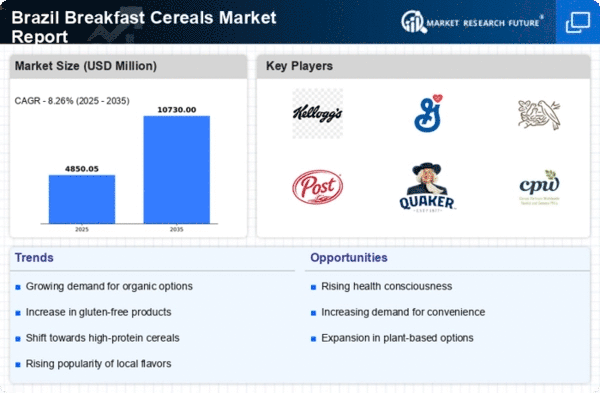
As per Market Research Future analysis, Brazil Breakfast Cereals Market is projected to grow from 4850.05 USD Million in 2025 to 10730.0 USD Million by 2035. Size was estimated at 4480.0 USD Million in 2024. The Brazil breakfast cereals market is projected to grow from 4850.05 USD Million in 2025 to 10730.0 USD Million by 2035, exhibiting a compound annual growth rate (CAGR) of 8.2% during the forecast period 2025 - 2035

Key Market Trends & Highlights

The Brazil breakfast cereals market is experiencing a dynamic shift towards health-oriented and innovative products.

  • The health and wellness focus is driving consumers towards nutritious breakfast cereal options.
  • Product innovation is prevalent, with brands introducing diverse flavors and formats to attract a broader audience.
  • E-commerce growth is reshaping the distribution landscape, making breakfast cereals more accessible to consumers.
  • Rising health consciousness and the demand for convenience are major drivers propelling the market forward.

Market Size & Forecast

2024 Market Size 4480.0 (USD Million)
2035 Market Size 10730.0 (USD Million)
CAGR (2025 - 2035) 8.26%

Major Players

Kellogg's (US), General Mills (US), Nestle (CH), Post Holdings (US), Quaker Oats (US), Cereal Partners Worldwide (CH), Weetabix (GB), PepsiCo (US), Sunrise Foods (IN)

Our Impact
Enabled $4.3B Revenue Impact for Fortune 500 and Leading Multinationals
Partnering with 2000+ Global Organizations Each Year
30K+ Citations by Top-Tier Firms in the Industry

Brazil Breakfast Cereals Market Trends

The Breakfast Cereals Sector in Brazil is currently experiencing a dynamic transformation. in Brazil is currently experiencing a dynamic transformation, driven by evolving consumer preferences and increasing health consciousness. As individuals become more aware of nutrition, there is a noticeable shift towards products that offer health benefits, such as whole grains, high fiber content, and reduced sugar levels. This trend is further supported by a growing demand for organic and natural ingredients, reflecting a broader movement towards clean eating. Additionally, the convenience factor plays a crucial role, as busy lifestyles prompt consumers to seek quick and easy meal options that do not compromise on quality or nutrition. Moreover, the Brazil Breakfast Cereals Market is witnessing innovation in product offerings, with brands introducing diverse flavors and formats to cater to varied tastes. This includes gluten-free options and fortified cereals that appeal to specific dietary needs. The rise of e-commerce platforms has also facilitated access to a wider range of products, allowing consumers to explore and purchase breakfast cereals with ease. As the market continues to evolve, it appears poised for further growth, driven by the intersection of health trends, convenience, and innovation in product development.

Health and Wellness Focus

There is a growing emphasis on health and wellness within the Brazil Breakfast Cereals Market. Consumers increasingly seek products that align with their health goals, such as those rich in whole grains, low in sugar, and high in fiber. This trend reflects a broader societal shift towards healthier eating habits.

Product Innovation

Innovation is a key driver in the Brazil Breakfast Cereals Market, with brands introducing new flavors, textures, and formats. This includes gluten-free options and cereals fortified with vitamins and minerals, catering to diverse consumer preferences and dietary requirements.

E-commerce Growth

The rise of e-commerce is transforming how consumers purchase breakfast cereals. Online platforms provide greater access to a variety of products, enabling consumers to explore and buy cereals conveniently. This trend is likely to continue as digital shopping becomes more prevalent.

Brazil Breakfast Cereals Market Drivers

Rising Health Consciousness

The increasing awareness of health and nutrition among Brazilian consumers appears to be a pivotal driver for the breakfast cereals market. As individuals become more health-conscious, they tend to seek out products that offer nutritional benefits, such as whole grains, fiber, and low sugar content. This trend is reflected in the market, where health-oriented cereals have seen a growth rate of approximately 15% annually. The demand for organic and natural ingredients is also on the rise, with consumers willing to pay a premium for products that align with their health goals. Consequently, manufacturers are reformulating existing products and introducing new lines that cater to this health-centric mindset, thereby influencing the overall dynamics of the Brazil Breakfast Cereals Market.

Growing Middle-Class Population

The expansion of the middle-class demographic in Brazil is likely to have a substantial impact on the breakfast cereals market. As disposable incomes rise, consumers are increasingly willing to invest in higher-quality food products, including premium breakfast cereals. This trend is supported by data showing that the middle-class population has grown by approximately 20% over the past decade, leading to increased spending on food and beverages. The breakfast cereals market is benefiting from this shift, as consumers seek out diverse options that offer both quality and value. Manufacturers are responding by diversifying their product lines to cater to the preferences of this burgeoning consumer segment.

Convenience and On-the-Go Options

The fast-paced lifestyle of Brazilian consumers is driving the demand for convenience in food choices, particularly in the Brazil Breakfast Cereals Market. As more individuals lead busy lives, the need for quick and easy meal solutions has become paramount. Ready-to-eat cereals and single-serve packaging are gaining traction, appealing to consumers who prioritize convenience without compromising on nutrition. Recent data indicates that ready-to-eat cereals account for nearly 60% of the total market share in Brazil. This shift towards on-the-go options is prompting manufacturers to innovate packaging and product formats, ensuring that they meet the evolving needs of consumers who seek efficiency in their breakfast choices.

Influence of Social Media and Marketing

The role of social media in shaping consumer preferences cannot be understated, particularly in the breakfast cereals market. Brazilian consumers are increasingly influenced by online marketing campaigns, health bloggers, and social media influencers who promote various cereal brands and their health benefits. This trend suggests that effective digital marketing strategies can significantly enhance brand visibility and consumer engagement. Recent studies indicate that brands leveraging social media platforms have experienced a sales increase of up to 25%. As a result, companies are investing in targeted advertising and influencer partnerships to capture the attention of health-conscious consumers, thereby driving growth in the Brazil Breakfast Cereals Market.

Sustainability and Eco-Friendly Practices

Sustainability has emerged as a crucial consideration for Brazilian consumers, impacting their purchasing decisions in the breakfast cereals market. There is a growing preference for products that are produced using environmentally friendly practices, such as sustainable sourcing and eco-friendly packaging. This shift is reflected in market data, which shows that products labeled as organic or sustainably sourced have seen a sales increase of approximately 30% in recent years. Manufacturers are responding to this demand by adopting greener practices and transparently communicating their sustainability efforts to consumers. This focus on environmental responsibility is likely to shape the future landscape of the breakfast cereals market, as consumers increasingly prioritize brands that align with their values.


Market Segment Insights

By Type: Ready-to-Eat Cereals (Largest) vs. Hot Cereals (Fastest-Growing)

In the Brazil breakfast cereals market, Ready-to-Eat Cereals dominate the segment, accounting for a significant share of the overall market. Following this, Cooked Cereals and Instant Cereals show a competitive presence, but their market shares are comparatively smaller. Hot Cereals, while currently less established, are gaining traction among health-conscious consumers looking for nutritious breakfast options. Growth trends indicate that the Ready-to-Eat segment continues to thrive due to its convenience and variety, appealing to busy consumers. Additionally, the demand for Hot Cereals is on the rise, driven by increasing health awareness and the trend of homecooked meals. These trends are supported by ongoing product innovations and the introduction of healthier ingredients in cereals.

Ready-to-Eat Cereals (Dominant) vs. Hot Cereals (Emerging)

Ready-to-Eat Cereals represent the dominant segment within the Brazil breakfast cereals market, offering easy and quick meal solutions for consumers. This category includes various options such as flakes, clusters, and puffs that appeal to a broad audience seeking convenience without compromising on taste. In contrast, Hot Cereals, while emerging, are capturing the interest of specific demographics looking for wholesome breakfast choices. These include oatmeal and porridge categories that emphasize natural and organic ingredients. Rising consumer awareness regarding health and wellness propels the demand for Hot Cereals, creating opportunities for brands to innovate and cater to this growing segment.

By Ingredients: Whole Grain (Largest) vs. Gluten-Free (Fastest-Growing)

In the Brazil breakfast cereals market, Whole Grain segments command a significant portion of the market share, reflecting consumer preference for healthier options. Gluten-Free is rapidly gaining traction, appealing to those with dietary restrictions, and is expected to exhibit robust growth as more consumers seek alternatives to traditional cereals. The growth of ingredients in breakfast cereals is driven by increasing health awareness among consumers and a rising demand for functional foods. Organic and High Fiber segments are also experiencing growth, as people prioritize nutrient-rich, natural ingredients in their diets. The trend towards healthier eating habits continues to prop up these segments, with innovation in product formulations further enhancing market opportunities.

Whole Grain: Dominant vs. Gluten-Free: Emerging

Whole Grain remains the dominant segment in the Brazil breakfast cereals market, characterized by its strong positioning as a source of essential nutrients and fiber. This segment appeals to health-conscious consumers seeking wholesome breakfast options. Conversely, the Gluten-Free segment is emerging quickly, catering to a niche market of individuals with gluten intolerances and allergies. This segment's growth is propelled by a broader acceptance of gluten-free diets and increasing product offerings from manufacturers. While Whole Grain maintains a leading role, Gluten-Free is expected to capture a more significant share as health trends evolve, indicating a dynamic shift in consumer preferences.

By End User: Children (Largest) vs. Seniors (Fastest-Growing)

In the Brazil breakfast cereals market, the distribution of market share among different end users reveals a clear dominance of children, who form the largest segment due to their preference for fun and colorful cereal options. This demographic is heavily targeted by manufacturers, leading to innovative flavors and marketing strategies that cater specifically to younger consumers. Adults represent a significant portion of the market as well, focusing on health-conscious options that align with busy lifestyles, while seniors are gradually increasing their presence in the market due to trends towards healthier eating habits. Growth trends in the end user segment indicate that the children segment, while currently the largest, faces challenges from evolving consumer preferences towards healthier choices. The seniors segment is emerging rapidly, driven by an increasing awareness of nutrition and health among older adults, leading them to seek cereals that offer added health benefits. Adults continue to maintain a steady demand, showing a balanced growth rate as they look for nutritious and convenient breakfast options amid changing lifestyles.

Children: Dominant vs. Seniors: Emerging

The children segment of the Brazil breakfast cereals market remains dominant, characterized by colorful packaging, appealing characters, and flavors that resonate with young consumers. Manufacturers invest heavily in marketing campaigns targeting parents, emphasizing the essential nutrients packed into these cereals. On the other hand, the seniors segment is emerging as a significant player, gaining traction as older adults prioritize healthy eating. This demographic prefers cereals that are low in sugar and enriched with fiber or other nutrients beneficial for their health. Manufacturers are beginning to recognize this trend by creating products tailored to the tastes and health needs of seniors, ensuring a growing market presence.

By Distribution Channel: Supermarkets/Hypermarkets (Largest) vs. Online Retail (Fastest-Growing)

In the Brazil breakfast cereals market, Supermarkets and Hypermarkets dominate the distribution channel landscape, capturing significant market share. This channel offers consumers the convenience of one-stop shopping and a wide variety of cereal options, making it a preferred choice among buyers. In contrast, online retail is rapidly gaining traction, particularly among younger consumers and urban populations who seek convenience and variety, contributing to its emerging status in the market. The growth of the online retail segment is driven by increasing internet penetration and changing consumer shopping habits, particularly following the COVID-19 pandemic. The demand for home delivery and the convenience of ordering online have made this channel particularly appealing. As more brands invest in online strategies, this segment is poised for continuous growth, enabling it to become a formidable player in the Brazil breakfast cereals market.

Supermarkets/Hypermarkets (Dominant) vs. Online Retail (Emerging)

Supermarkets and Hypermarkets are dominant players in the breakfast cereals distribution channel, characterized by their extensive product ranges and the ability to cater to mass consumer demands. These retail formats offer promotional discounts and strategic placements, significantly influencing buying behavior. Meanwhile, Online Retail is emerging as a critical channel, driven by technological advancements and a shift in consumer purchasing patterns towards convenience. This segment appeals especially to tech-savvy consumers seeking niche products and limited editions, leading to an impressive growth trajectory. As competition intensifies, brands in the online retail space are adapting quickly to meet consumer expectations, further solidifying their presence in the Brazil breakfast cereals market.

Get more detailed insights about Brazil Breakfast Cereals Market

Key Players and Competitive Insights

The breakfast cereals market in Brazil exhibits a dynamic competitive landscape characterized by a blend of established global players and emerging local brands. Key growth drivers include increasing health consciousness among consumers, a rising demand for convenient breakfast options, and a shift towards organic and natural ingredients. Major companies such as Kellogg's (US), General Mills (US), and Nestle (CH) are strategically positioned to leverage these trends through innovation and product diversification. Their operational focus on health-oriented products and regional adaptations appears to shape the competitive environment, fostering a landscape where consumer preferences increasingly dictate market dynamics.In terms of business tactics, companies are localizing manufacturing to enhance supply chain efficiency and reduce costs. The market structure is moderately fragmented, with a mix of large multinationals and smaller local players. This fragmentation allows for a variety of product offerings, catering to diverse consumer tastes and preferences. The collective influence of key players, however, remains significant, as they set trends and standards that smaller brands often follow.
In October Kellogg's (US) announced a partnership with a local Brazilian health food company to co-develop a new line of organic breakfast cereals. This strategic move is likely aimed at capturing the growing segment of health-conscious consumers in Brazil, reflecting a broader trend towards organic products. By leveraging local expertise, Kellogg's may enhance its market penetration and brand loyalty among Brazilian consumers.
In September General Mills (US) launched a new marketing campaign focused on sustainability, highlighting its commitment to environmentally friendly packaging for its cereal products. This initiative not only aligns with global sustainability trends but also positions General Mills as a responsible brand in the eyes of increasingly eco-conscious consumers. The emphasis on sustainability could potentially enhance customer loyalty and attract new consumers who prioritize environmental considerations in their purchasing decisions.
In August Nestle (CH) expanded its product line by introducing a range of gluten-free cereals tailored specifically for the Brazilian market. This strategic action appears to be a response to the rising demand for gluten-free options, which has been gaining traction among health-conscious consumers. By diversifying its offerings, Nestle may strengthen its competitive position and cater to a broader audience, thereby enhancing its market share.
As of November current competitive trends in the breakfast cereals market are increasingly defined by digitalization, sustainability, and the integration of artificial intelligence in product development and marketing strategies. Strategic alliances among companies are shaping the landscape, allowing for shared resources and expertise. Looking ahead, competitive differentiation is likely to evolve from traditional price-based competition towards innovation, technology, and supply chain reliability, as companies strive to meet the changing demands of consumers.

Key Companies in the Brazil Breakfast Cereals Market include

Industry Developments

The Brazil Breakfast Cereals Market has seen significant activity recently, particularly with General Mills and Nestle expanding their product lines to cater to the growing consumer demand for health-conscious options. In October 2023, General Mills announced plans to introduce a range of gluten-free cereals aimed at Brazilian consumers, reflecting the increasing trend toward healthier eating. Furthermore, the market has felt the impact of rising valuations, with companies like M. Dias Branco and Camil Alimentos experiencing growth driven by innovation in flavor and ingredients.

A noteworthy acquisition took place in March 2023 when Advent International completed its purchase of a stake in Bunge’s breakfast cereals division, enhancing its footprint in the sector. This move has prompted other companies, such as Kellogg and Quaker Oats, to explore strategic partnerships to bolster their market presence. Over the past couple of years, regulatory changes aimed at promoting healthier dietary options have further accelerated competition within the market. Such developments are reshaping the landscape of breakfast cereals in Brazil, with continued investment in Research and Development promising to set new trends for consumer preferences and product offerings.

Future Outlook

Brazil Breakfast Cereals Market Future Outlook

The Breakfast Cereals Market in Brazil is projected to grow at an 8.26% CAGR from 2025 to 2035, driven by health trends, innovation, and increasing consumer demand.

New opportunities lie in:

  • Development of gluten-free and organic cereal lines Expansion of e-commerce platforms for direct-to-consumer sales Partnerships with health-focused brands for co-branded products

By 2035, the market is expected to achieve robust growth, reflecting evolving consumer preferences and innovative product offerings.

Market Segmentation

Brazil Breakfast Cereals Market Type Outlook

  • Ready-to-Eat Cereals
  • Cooked Cereals
  • Instant Cereals
  • Hot Cereals

Brazil Breakfast Cereals Market End User Outlook

  • Children
  • Adults
  • Seniors

Brazil Breakfast Cereals Market Ingredients Outlook

  • Whole Grain
  • Gluten-Free
  • Organic
  • High Fiber

Brazil Breakfast Cereals Market Distribution Channel Outlook

  • Supermarkets/Hypermarkets
  • Online Retail
  • Convenience Stores
  • Specialty Stores

Report Scope

MARKET SIZE 2024 4480.0(USD Million)
MARKET SIZE 2025 4850.05(USD Million)
MARKET SIZE 2035 10730.0(USD Million)
COMPOUND ANNUAL GROWTH RATE (CAGR) 8.26% (2025 - 2035)
REPORT COVERAGE Revenue Forecast, Competitive Landscape, Growth Factors, and Trends
BASE YEAR 2024
Market Forecast Period 2025 - 2035
Historical Data 2019 - 2024
Market Forecast Units USD Million
Key Companies Profiled Kellogg's (US), General Mills (US), Nestle (CH), Post Holdings (US), Quaker Oats (US), Cereal Partners Worldwide (CH), Weetabix (GB), PepsiCo (US), Sunrise Foods (IN)
Segments Covered Type, Ingredients, End User, Distribution Channel
Key Market Opportunities Growing demand for health-oriented breakfast cereals aligns with consumer trends towards nutritious and convenient food options.
Key Market Dynamics Rising health consciousness drives demand for nutritious breakfast cereals, reshaping consumer preferences in Brazil.
Countries Covered Brazil
Leave a Comment

FAQs

What was the projected market size of the Brazil Breakfast Cereals Market in 2024?

The Brazil Breakfast Cereals Market was valued at 5.61 billion USD in 2024.

What will be the market size of the Brazil Breakfast Cereals Market by 2035?

By 2035, the Brazil Breakfast Cereals Market is projected to reach 12.68 billion USD.

What is the expected compound annual growth rate (CAGR) for the Brazil Breakfast Cereals Market from 2025 to 2035?

The Brazil Breakfast Cereals Market expected to grow at a CAGR of 7.695% from 2025 to 2035.

Which segment has the largest market share in the Brazil Breakfast Cereals Market?

The Wheat segment holds the largest market share, valued at 2.18 billion USD in 2024.

What is the projected market value for the Rice segment in 2035?

The Rice segment is expected to be valued at 2.91 billion USD by 2035.

Who are the key players in the Brazil Breakfast Cereals Market?

Major players include General Mills, Nestle, Kellogg, and Quaker Oats among others.

What was the expected market value for the Corn segment in 2024?

The Corn segment of the Brazil Breakfast Cereals Market was valued at 1.12 billion USD in 2024.

How much is the Barley segment expected to grow from 2024 to 2035?

The Barley segment is projected to grow from 0.79 billion USD in 2024 to 1.83 billion USD in 2035.

What opportunities are driving growth in the Brazil Breakfast Cereals Market?

Growing health awareness and increasing demand for convenience foods are key growth drivers.

What challenges are facing the Brazil Breakfast Cereals Market?

Competition and fluctuating raw material prices pose significant challenges to the market.

Download Free Sample

Kindly complete the form below to receive a free sample of this Report

Compare Licence

×
Features License Type
Single User Multiuser License Enterprise User
Price $4,950 $5,950 $7,250
Maximum User Access Limit 1 User Upto 10 Users Unrestricted Access Throughout the Organization
Free Customization
Direct Access to Analyst
Deliverable Format
Platform Access
Discount on Next Purchase 10% 15% 15%
Printable Versions