×
Request Free Sample ×

Kindly complete the form below to receive a free sample of this Report

* Please use a valid business email

Leading companies partner with us for data-driven Insights

clients tt-cursor
Hero Background

Biobank Equipment Market

ID: MRFR/HC/40626-HCR
200 Pages
Garvit Vyas
February 2026

Biobank Equipment Market Research Report By Product Type (Freezers, Incubators, Automated Storage Systems, Sample Processing Systems, Refrigerators), By Application (Clinical Diagnostics, Research and Development, Genetic Research, Pharmaceuticals, Biotechnology), By End Use (Hospitals, Research Institutions, Pharmaceutical Companies, Biotechnology Firms), By Ownership Type (Private, Public, Non-profit) and By Regional (North America, Europe, South America, Asia Pacific, Middle East and Africa) - Growth & Industry Forecast 2025 To 2035

Share:
Download PDF ×

We do not share your information with anyone. However, we may send you emails based on your report interest from time to time. You may contact us at any time to opt-out.

Biobank Equipment Market Infographic
Purchase Options

Biobank Equipment Market Summary

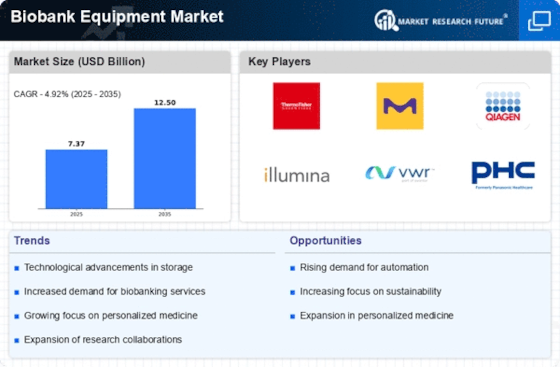
As per Market Research Future analysis, the Biobank Equipment Market Size was estimated at 7.37 USD Billion in 2024. The Biobank Equipment industry is projected to grow from 7.733 USD Billion in 2025 to 12.5 USD Billion by 2035, exhibiting a compound annual growth rate (CAGR) of 4.92% during the forecast period 2025 - 2035

Key Market Trends & Highlights

The Biobank Equipment Market is poised for substantial growth driven by technological advancements and increasing demand for biobanking services.

  • Technological advancements are reshaping the Biobank Equipment Market, enhancing efficiency and reliability.
  • North America remains the largest market, while Asia-Pacific is emerging as the fastest-growing region in biobanking.
  • Freezers dominate the market as the largest segment, whereas automated storage systems are witnessing rapid growth.
  • The increasing demand for biobanking services and advancements in cryopreservation technologies are key drivers propelling market expansion.

Market Size & Forecast

2024 Market Size 7.37 (USD Billion)
2035 Market Size 12.5 (USD Billion)
CAGR (2025 - 2035) 4.92%

Major Players

Thermo Fisher Scientific (US), Merck KGaA (DE), Qiagen N.V. (NL), Illumina, Inc. (US), VWR International (US), Panasonic Healthcare Holdings (JP), Brooks Automation, Inc. (US), Hamilton Company (US), Eppendorf AG (DE)

Our Impact
Enabled $4.3B Revenue Impact for Fortune 500 and Leading Multinationals
Partnering with 2000+ Global Organizations Each Year
30K+ Citations by Top-Tier Firms in the Industry

Biobank Equipment Market Trends

The Biobank Equipment Market is currently experiencing a notable evolution, driven by advancements in technology and increasing demand for biological samples. This market encompasses a wide range of equipment, including freezers, storage systems, and sample processing tools, which are essential for the preservation and management of biological materials. As research institutions and healthcare organizations recognize the value of biobanks in supporting scientific studies and clinical trials, the need for reliable and efficient equipment becomes paramount. Furthermore, the growing emphasis on personalized medicine and genomics is likely to propel the market forward, as biobanks play a crucial role in facilitating research in these areas. In addition to technological advancements, regulatory frameworks and ethical considerations surrounding biobanking are evolving. Stakeholders in the Biobank Equipment Market must navigate these complexities while ensuring compliance with standards and guidelines. The increasing collaboration between public and private sectors is also noteworthy, as it fosters innovation and enhances the capabilities of biobanks. Overall, the Biobank Equipment Market appears poised for growth, with a focus on sustainability and efficiency in equipment design and operation. As the landscape continues to change, stakeholders must remain adaptable to emerging trends and challenges, ensuring that they meet the needs of researchers and healthcare providers effectively.

Technological Advancements

The Biobank Equipment Market is witnessing rapid technological innovations, particularly in storage and processing equipment. Enhanced automation and data management systems are streamlining operations, improving sample tracking and reducing human error. These advancements not only increase efficiency but also ensure the integrity of biological samples, which is critical for research accuracy.

Regulatory Compliance

As the Biobank Equipment Market expands, adherence to regulatory standards becomes increasingly vital. Organizations are focusing on compliance with local and international guidelines to ensure ethical practices in biobanking. This trend emphasizes the importance of transparency and accountability in the handling of biological materials, which is essential for maintaining public trust.

Sustainability Initiatives

There is a growing trend towards sustainability within the Biobank Equipment Market, as stakeholders seek to minimize environmental impact. This includes the development of energy-efficient equipment and sustainable materials for storage solutions. Such initiatives not only align with global sustainability goals but also appeal to environmentally conscious organizations.

Biobank Equipment Market Drivers

Growing Focus on Personalized Medicine

The growing focus on personalized medicine is reshaping the Biobank Equipment Market. As healthcare shifts towards tailored treatment approaches, the demand for biobanks that can provide specific biological samples for research and clinical applications is increasing. This shift necessitates the use of advanced biobank equipment capable of handling diverse sample types and ensuring their integrity. Market analysts predict that the personalized medicine sector will expand at a rate of 9% per year, further driving the need for sophisticated biobanking solutions. Consequently, manufacturers are investing in developing versatile equipment that meets the evolving requirements of personalized medicine, thereby enhancing the Biobank Equipment Market.

Increasing Demand for Biobanking Services

The rising demand for biobanking services is a primary driver of the Biobank Equipment Market. As research institutions and healthcare organizations increasingly recognize the value of biobanks in supporting personalized medicine and genomics, the need for advanced biobank equipment has surged. According to recent estimates, the biobanking sector is projected to grow at a compound annual growth rate of approximately 7.5% over the next five years. This growth is fueled by the need for high-quality biological samples for research and clinical trials, necessitating sophisticated storage and processing equipment. Consequently, manufacturers are focusing on developing innovative solutions that enhance sample integrity and accessibility, thereby propelling the Biobank Equipment Market forward.

Advancements in Cryopreservation Technologies

Advancements in cryopreservation technologies are significantly influencing the Biobank Equipment Market. The ability to preserve biological samples at ultra-low temperatures has become essential for maintaining sample viability over extended periods. Innovations in cryogenic storage systems, such as automated liquid nitrogen freezers and advanced monitoring systems, are enhancing the efficiency and reliability of biobanks. The market for cryopreservation equipment is expected to witness substantial growth, with projections indicating a potential increase of 8% annually. This trend is driven by the growing need for long-term storage solutions in research and clinical applications, thereby reinforcing the importance of cutting-edge cryopreservation technologies within the Biobank Equipment Market.

Rising Investment in Research and Development

Rising investment in research and development activities is a crucial driver for the Biobank Equipment Market. Governments and private entities are increasingly allocating funds to support biobanking initiatives, recognizing their role in advancing medical research and public health. This influx of capital is facilitating the acquisition of state-of-the-art biobank equipment, which is essential for the efficient collection, storage, and analysis of biological samples. Recent reports indicate that R&D spending in the life sciences sector has reached unprecedented levels, with a projected growth rate of 6% annually. This trend underscores the critical role of biobanks in fostering innovation and discovery, thereby propelling the Biobank Equipment Market.

Emphasis on Data Management and Sample Tracking

Emphasis on data management and sample tracking is becoming increasingly vital within the Biobank Equipment Market. As biobanks accumulate vast amounts of biological samples, the need for robust data management systems to ensure sample traceability and integrity is paramount. Advanced software solutions that integrate with biobank equipment are being developed to streamline sample tracking and data analysis processes. The market for biobanking software is projected to grow at a rate of 7% annually, reflecting the increasing importance of data management in biobanking operations. This trend highlights the necessity for biobank equipment that not only preserves samples but also facilitates efficient data handling, thereby driving the Biobank Equipment Market.


Market Segment Insights

By Type: Freezers (Largest) vs. Automated Storage Systems (Fastest-Growing)

In the Biobank Equipment Market, the segment distribution indicates that freezers command a substantial portion of the market share due to their essential role in preserving biological samples. Incubators and refrigerators also hold significant shares, serving crucial functions in sample handling and storage under specific environmental conditions. Automated storage systems and sample processing systems are gaining traction, reflecting the increasing demand for automation and efficient workflows in biobanks, thus reshaping the competitive landscape.

Freezers (Dominant) vs. Automated Storage Systems (Emerging)

Freezers have long been the backbone of the Biobank Equipment Market, characterized by their robust capabilities in sample preservation at ultra-low temperatures. Their reliability and efficiency make them indispensable in biobanks, ensuring the integrity of sensitive biological materials. On the other hand, automated storage systems are rapidly emerging, driven by the need for enhanced speed and accuracy in sample retrieval and management. These systems utilize advanced robotics and software solutions, providing a pivotal shift towards higher operational efficiency while minimizing human error. As biobanks increasingly seek innovative solutions, these segments illustrate the contrasting yet complementary dynamics of traditional and modern technologies.

By Application: Clinical Diagnostics (Largest) vs. Research and Development (Fastest-Growing)

In the Biobank Equipment Market, the application segment is primarily dominated by Clinical Diagnostics, which captures a significant market share compared to other segments. This dominance can be attributed to the increasing demand for precise diagnosis and monitoring of diseases, driving investments in biobanking. In contrast, Research and Development is quickly emerging as a noteworthy segment, benefitting from an upsurge in funding and innovation in medical research, particularly in personalized medicine and rare disease studies.

Clinical Diagnostics: Dominant vs. Research and Development: Emerging

Clinical Diagnostics represents the backbone of the biobank equipment market, reflecting a strong reliance on biobanks to support diagnostic processes that lead to better health outcomes. This segment's stability is attributed to its clear utility in patient care and preventative medicine. On the other hand, the Research and Development segment is rapidly evolving, fueled by advancements in genomics and biotechnology. This emerging segment pushes the boundaries of traditional methods, enabling revolutionary developments in therapeutics and diagnostics, thus appealing to stakeholders who are keen on innovation and groundbreaking research.

By End Use: Hospitals (Largest) vs. Research Institutions (Fastest-Growing)

In the Biobank Equipment Market, hospitals hold a significant share, serving as the primary end-users of biobank equipment due to their extensive patient care and research capabilities. Research institutions follow closely, leveraging biobanks to facilitate innovative studies and correlate clinical findings with laboratory research. This distribution demonstrates the essential role of hospitals in sustaining biobanking efforts while allowing research institutions to grow rapidly as the demand for advanced research intensifies.

Hospitals (Dominant) vs. Research Institutions (Emerging)

Hospitals represent the dominant segment in the Biobank Equipment Market, as they are integral to patient treatment and research facilities. Their continuous need for biological samples drives the demand for sophisticated storage and preservation technologies. In contrast, research institutions are emerging as critical players in this landscape, fueled by the increase in collaborative studies and funding from government and private sectors. They are at the forefront of adopting cutting-edge biobanking technologies, enabling rapid insights into disease mechanisms and therapeutic developments. This dynamic is supported by the growing trend toward personalized medicine, further enhancing the role of these institutions.

By Ownership Type: Private (Largest) vs. Public (Fastest-Growing)

The Biobank Equipment Market exhibits a diverse ownership landscape with three prominent categories: Private, Public, and Non-profit. Among these, Private ownership holds the largest market share, driven by significant investments from biotechnology firms and pharmaceutical companies. Public ownership, although smaller in terms of share, is rapidly gaining traction, fueled by government initiatives and funding aimed at advancing biobanking for public health research. Non-profit organizations play a vital role as well, particularly in ethically guided biobanking initiatives, contributing to a sustainable growth perspective.

Private (Dominant) vs. Public (Emerging)

Private ownership is characterized by substantial financial backing and investment in cutting-edge biobank technologies, resulting in high-quality specimen collection and storage solutions. This segment's dominance comes from a focus on research and development driven by private enterprises. Conversely, the Public segment, while emerging, is seeing a surge in growth due to government-led initiatives and collaborative research projects. Public biobanks often emphasize transparency, ethics, and community engagement, making them increasingly relevant in the biobank ecosystem. The contrast in funding sources and operational focuses presents a unique dynamic in driving innovation and accessibility within the market.

Get more detailed insights about Biobank Equipment Market

Regional Insights

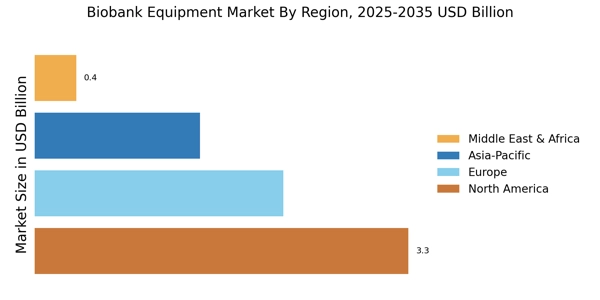
The Biobank Equipment Market exhibits significant variances across its regional divisions, reflective of the varied healthcare infrastructure and research initiatives. In 2024, North America leads with a market value of 3.0 USD Billion, projected to expand to 5.0 USD Billion by 2035, thus maintaining a majority holding due to its robust biopharmaceutical sector and advanced research facilities. Europe follows with a valuation of 2.0 USD Billion in 2024, growing to 3.5 USD Billion, driven by extensive public and private investments in genomics and biobanking.

Meanwhile, the APAC region, with 1.5 USD Billion in 2024 and anticipated to reach 2.5 USD Billion, shows significant growth potential fueled by increasing healthcare needs and government support for biotechnology advancements. South America and MEA, while having smaller market sizes at 0.5 and 0.37 USD Billion, respectively, in 2024, are gradually emerging due to rising awareness of biobanking benefits and improved research capabilities. The Biobank Equipment Market segmentation reveals that North America's dominance is underpinned by its strong industrial base while emerging markets like APAC are poised for robust market growth.

Biobank Equipment Market Regional Image

Key Players and Competitive Insights

The Biobank Equipment Market is characterized by a rapidly expanding landscape driven by the increasing awareness of personalized medicine and the growing need for the efficient collection and preservation of biological samples. As biobanks play a critical role in supporting various research endeavors, the competition among equipment providers intensifies. Companies in this market focus on delivering innovative solutions that enhance the quality and efficiency of sample management. A key trend influencing the competitive environment is the integration of advanced technologies, such as automation and data management systems, into biobanking processes.
In addition, manufacturers are increasingly prioritizing the development of user-friendly and customizable equipment solutions, enabling biobanks to optimize their operations based on specific research needs. Merck KGaA holds a prominent position in the Biobank Equipment Market, leveraging its strong portfolio of products and extensive expertise in bioresearch.
The company’s commitment to sustainability and innovation is reflected in its state-of-the-art sample preservation technologies that enhance sample integrity. Moreover, Merck KGaA’s robust distribution network and presence allow it to cater to a diverse range of clients, from academic institutions to commercial biobanks. The strength of Merck KGaA lies in its ability to provide end-to-end solutions, including high-quality storage systems and comprehensive laboratory support services. Their focus on maintaining user-friendly interfaces and ensuring compliance with regulatory standards further solidifies their competitive advantage in this rapidly evolving market.
Qiagen is another key player in the Biobank Equipment Market, recognized for its broad spectrum of sample and assay technologies that support the biobanking sector.
The company distinguishes itself through its innovative nucleic acid extraction and purification products, which are critical for maintaining the quality of biological samples. Qiagen's commitment to research and development has enabled it to introduce cutting-edge solutions that streamline workflows and enhance the usability of biobanking applications. With a strong emphasis on quality assurance and regulatory compliance, Qiagen ensures that its products meet stringent standards, fostering trust and reliability among its clientele. Its outreach and strategic partnerships with various research entities further enhance Qiagen's presence in the biobanking landscape, allowing it to address diverse needs within the market effectively.

Key Companies in the Biobank Equipment Market include

Industry Developments

  • Q4 2024: India established its first diabetes biobank In December 2024, India opened its first diabetes biobank at the Madras Diabetes Research Foundation in Chennai, aiming to support advanced diabetes research with state-of-the-art biobanking equipment.

Future Outlook

Biobank Equipment Market Future Outlook

The Biobank Equipment Market is projected to grow at 4.92% CAGR from 2025 to 2035, driven by advancements in biobanking technologies and increasing demand for personalized medicine.

New opportunities lie in:

  • Development of automated sample processing systems
  • Expansion of biorepository services for clinical trials
  • Integration of AI-driven data management solutions

By 2035, the market is expected to be robust, reflecting substantial growth and innovation.

Market Segmentation

Biobank Equipment Market Type Outlook

  • Freezers
  • Incubators
  • Automated Storage Systems
  • Sample Processing Systems
  • Refrigerators

Biobank Equipment Market End Use Outlook

  • Hospitals
  • Research Institutions
  • Pharmaceutical Companies
  • Biotechnology Firms

Biobank Equipment Market Application Outlook

  • Clinical Diagnostics
  • Research and Development
  • Genetic Research
  • Pharmaceuticals
  • Biotechnology

Biobank Equipment Market Ownership Type Outlook

  • Private
  • Public
  • Non-profit

Report Scope

MARKET SIZE 2024 7.37(USD Billion)
MARKET SIZE 2025 7.733(USD Billion)
MARKET SIZE 2035 12.5(USD Billion)
COMPOUND ANNUAL GROWTH RATE (CAGR) 4.92% (2025 - 2035)
REPORT COVERAGE Revenue Forecast, Competitive Landscape, Growth Factors, and Trends
BASE YEAR 2024
Market Forecast Period 2025 - 2035
Historical Data 2019 - 2024
Market Forecast Units USD Billion
Key Companies Profiled Thermo Fisher Scientific (US), Merck KGaA (DE), Qiagen N.V. (NL), Illumina, Inc. (US), VWR International (US), Panasonic Healthcare Holdings (JP), Brooks Automation, Inc. (US), Hamilton Company (US), Eppendorf AG (DE)
Segments Covered Product Type, Application, End Use, Ownership Type, Regional
Key Market Opportunities Integration of advanced automation technologies enhances efficiency in the Biobank Equipment Market.
Key Market Dynamics Technological advancements and regulatory changes drive innovation and competition in the Biobank Equipment Market.

Countries Covered North America, Europe, APAC, South America, MEA
Leave a Comment

FAQs

What is the projected market valuation of the Biobank Equipment Market by 2035?

The Biobank Equipment Market is projected to reach a valuation of 12.5 USD Billion by 2035.

What was the market valuation of the Biobank Equipment Market in 2024?

In 2024, the Biobank Equipment Market was valued at 7.37 USD Billion.

What is the expected CAGR for the Biobank Equipment Market during the forecast period 2025 - 2035?

The expected CAGR for the Biobank Equipment Market during the forecast period 2025 - 2035 is 4.92%.

Which segment is projected to have the highest valuation in the Biobank Equipment Market by 2035?

The Refrigerators segment is projected to reach a valuation of 3.2 USD Billion by 2035.

What are the key applications driving the Biobank Equipment Market?

Key applications include Clinical Diagnostics, Research and Development, and Pharmaceuticals, with projected valuations of 3.1, 3.5, and 2.0 USD Billion respectively by 2035.

Who are the leading players in the Biobank Equipment Market?

Leading players in the Biobank Equipment Market include Thermo Fisher Scientific, Merck KGaA, and Illumina, Inc.

What is the projected valuation for the Automated Storage Systems segment by 2035?

The Automated Storage Systems segment is projected to reach a valuation of 2.5 USD Billion by 2035.

How does the ownership type affect the Biobank Equipment Market?

The Private ownership type is expected to grow to 4.2 USD Billion by 2035, indicating a strong trend in private sector investment.

What is the expected growth for Research Institutions in the Biobank Equipment Market?

Research Institutions are projected to see a valuation increase to 3.7 USD Billion by 2035.

What is the significance of the Biotechnology segment in the Biobank Equipment Market?

The Biotechnology segment is expected to grow to 2.1 USD Billion by 2035, highlighting its critical role in the market.

Download Free Sample

Kindly complete the form below to receive a free sample of this Report

Compare Licence

×
Features License Type
Single User Multiuser License Enterprise User
Price $4,950 $5,950 $7,250
Maximum User Access Limit 1 User Upto 10 Users Unrestricted Access Throughout the Organization
Free Customization
Direct Access to Analyst
Deliverable Format
Platform Access
Discount on Next Purchase 10% 15% 15%
Printable Versions