×
Request Free Sample ×

Kindly complete the form below to receive a free sample of this Report

* Please use a valid business email

Leading companies partner with us for data-driven Insights

clients tt-cursor
Hero Background

Argentina Mobile Virtual Network Operator Market

ID: MRFR/ICT/56045-HCR
200 Pages
Aarti Dhapte
February 2026

Argentina Mobile Virtual Network Operator Market Size, Share and Research Report: By Business Model (Discount MVNO, Functional MVNO, Brand MVNO, Niche MVNO), By Service Type (Prepaid Services, Postpaid Services, Data-Only Services, Voice-Only Services), By Customer Segment (Individual Consumers, Small and Medium Enterprises, Large Enterprises, Government) and By Network Infrastructure (Full MVNO, Light MVNO, Thin MVNO)- Industry Forecast to 2035

Share:
Download PDF ×

We do not share your information with anyone. However, we may send you emails based on your report interest from time to time. You may contact us at any time to opt-out.

Argentina Mobile Virtual Network Operator Market Infographic
Purchase Options

Argentina Mobile Virtual Network Operator Market Summary

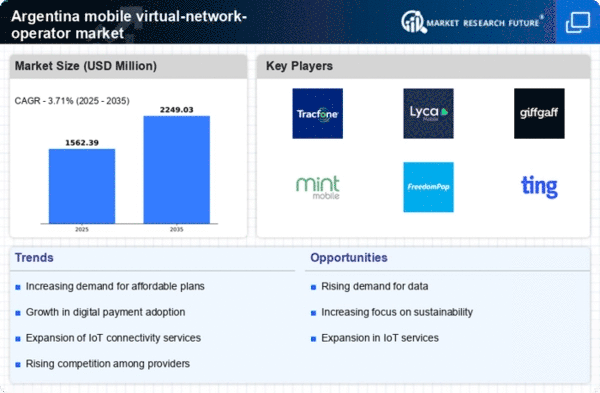
As per Market Research Future analysis, the Argentina Mobile Virtual Network Operator Market size was estimated at 1506.5 USD Million in 2024. The Mobile Virtual-network-operator market is projected to grow from 1562.39 USD Million in 2025 to 2249.03 USD Million by 2035, exhibiting a compound annual growth rate (CAGR) of 3.7% during the forecast period 2025 - 2035

Key Market Trends & Highlights

The Argentina mobile virtual-network-operator market is experiencing dynamic growth driven by consumer preferences and technological advancements.

  • The largest segment in the Argentina mobile virtual-network-operator market is prepaid services, while the fastest-growing segment is postpaid services.
  • Technological advancements are fostering innovation, leading to enhanced service offerings and customer experiences.
  • Regulatory support is facilitating market growth, encouraging new entrants and competition among existing providers.
  • Rising mobile data consumption and cost-effective service offerings are key drivers propelling the market forward.

Market Size & Forecast

2024 Market Size 1506.5 (USD Million)
2035 Market Size 2249.03 (USD Million)
CAGR (2025 - 2035) 3.71%

Major Players

TracFone Wireless (US), Lycamobile (GB), Giffgaff (GB), Mint Mobile (US), FreedomPop (US), Ting (US), Republic Wireless (US), Lebara (GB), PosteMobile (IT)

Our Impact
Enabled $4.3B Revenue Impact for Fortune 500 and Leading Multinationals
Partnering with 2000+ Global Organizations Each Year
30K+ Citations by Top-Tier Firms in the Industry

Argentina Mobile Virtual Network Operator Market Trends

The Argentina Mobile Virtual Network Operator Market in Argentina is currently experiencing a dynamic evolution, characterized by a growing demand for flexible and cost-effective telecommunications solutions. This market segment has gained traction as consumers increasingly seek alternatives to traditional mobile network operators. The rise of digital services and the proliferation of smartphones have further fueled this trend, enabling virtual operators to offer tailored packages that cater to diverse consumer needs. As competition intensifies, these operators are likely to innovate continuously, enhancing service offerings and customer experiences. Moreover, regulatory frameworks in Argentina appear to support the growth of the mobile virtual-network-operator market. The government has implemented policies aimed at fostering competition and ensuring fair access to network infrastructure. This regulatory environment may encourage new entrants to the market, potentially leading to a wider array of services and pricing options for consumers. As the landscape evolves, it is essential for stakeholders to remain vigilant and responsive to emerging trends and consumer preferences, which could shape the future of telecommunications in the country.

Increased Consumer Demand for Flexibility

There is a noticeable shift in consumer preferences towards flexible mobile plans that allow for customization. This trend indicates that users are seeking more control over their telecommunications expenses, favoring options that align with their specific usage patterns.

Technological Advancements Driving Innovation

The mobile virtual-network-operator market is witnessing rapid technological advancements, particularly in areas such as mobile applications and data management. These innovations are enabling operators to enhance service delivery and improve customer engagement.

Regulatory Support for Market Growth

The regulatory landscape in Argentina appears to be conducive to the expansion of the mobile virtual-network-operator market. Government initiatives aimed at promoting competition may lead to increased market participation and a broader range of service offerings.

Argentina Mobile Virtual Network Operator Market Drivers

Rising Mobile Data Consumption

The mobile virtual-network-operator market in Argentina experiences a notable surge in mobile data consumption. As smartphone penetration increases, users demand more data services, leading to a shift in consumer behavior. Reports indicate that mobile data traffic in Argentina is projected to grow by approximately 30% annually. This trend compels mobile virtual-network-operators to enhance their data offerings, ensuring competitive pricing and attractive packages. The growing reliance on mobile applications for communication, entertainment, and business further fuels this demand. Consequently, operators must adapt their strategies to cater to the evolving needs of consumers, positioning themselves effectively within the mobile virtual-network-operator market.

Cost-Effective Service Offerings

In Argentina, the mobile virtual-network-operator market thrives on the provision of cost-effective service offerings. With economic fluctuations, consumers increasingly seek affordable mobile plans that provide value without compromising quality. Mobile virtual-network-operators can leverage this demand by offering tailored packages that cater to specific demographics, such as students or low-income households. The competitive landscape encourages operators to innovate pricing strategies, potentially leading to a 15% reduction in average monthly costs for consumers. This focus on affordability not only attracts new customers but also fosters loyalty among existing users, thereby enhancing the overall market dynamics.

Increased Competition Among Providers

The mobile virtual-network-operator market in Argentina is characterized by heightened competition among providers. As new entrants emerge, existing operators are compelled to differentiate their services to maintain market share. This competitive environment stimulates innovation, prompting operators to enhance their service quality and customer experience. Market data suggests that the number of mobile virtual-network-operators in Argentina has increased by 20% over the past two years. This influx of competition may lead to improved service offerings, better pricing, and increased consumer choice, ultimately benefiting the mobile virtual-network-operator market as a whole.

Growing Demand for Customized Solutions

In Argentina, the mobile virtual-network-operator market witnesses a growing demand for customized solutions tailored to individual consumer needs. As users become more discerning, they seek personalized mobile plans that align with their usage patterns. This trend encourages operators to develop flexible offerings, such as pay-as-you-go plans or family bundles. Market analysis indicates that approximately 40% of consumers express interest in personalized services. By addressing this demand, mobile virtual-network-operators can enhance customer satisfaction and retention, thereby solidifying their position within the competitive landscape of the mobile virtual-network-operator market.

Technological Integration and Innovation

The mobile virtual-network-operator market in Argentina is significantly influenced by technological integration and innovation. Advancements in mobile technology, such as 5G deployment, create opportunities for operators to enhance their service capabilities. The introduction of 5G is expected to revolutionize the mobile experience, offering faster speeds and lower latency. As a result, mobile virtual-network-operators must invest in infrastructure and technology to remain competitive. Reports indicate that investments in network upgrades could reach $500 million over the next five years. This focus on technological advancement not only improves service quality but also positions operators favorably within the evolving mobile virtual-network-operator market.


Market Segment Insights

By Business Model: Discount MVNO (Largest) vs. Functional MVNO (Fastest-Growing)

In the Argentina mobile virtual-network-operator market, the distribution of market share among business models reveals that Discount MVNOs hold the largest share due to their competitive pricing strategies that attract a cost-conscious consumer base. Functional MVNOs, while currently smaller, are making notable strides in the market, carving out a niche with unique offerings that cater to specific needs.

Brand MVNO (Dominant) vs. Niche MVNO (Emerging)

Brand MVNOs dominate the Argentina mobile virtual-network-operator market with strong brand loyalty and a focus on customer experience. They leverage existing brand equity to provide customized mobile services. In contrast, Niche MVNOs, though emerging, target specific segments such as gamers or streaming enthusiasts, offering tailored services that enhance user experience and build community. The differentiation in service offerings creates unique value propositions, driving both segments' growth.

By Service Type: Prepaid Services (Largest) vs. Data-Only Services (Fastest-Growing)

In the Argentina mobile virtual-network-operator market, prepaid services currently dominate the service type segment, accounting for a significant share of user subscriptions. This dominance is largely attributed to consumer preferences for flexible pricing and the ability to control spending, especially among younger demographics. In contrast, data-only services are gaining traction, appealing to users who prioritize internet connectivity over traditional voice services, which indicates a shift in consumer behavior towards data-centric usage. The growth trends in this segment show a notable increase in demand for data-only services, driven by the rising penetration of smartphones and the proliferation of digital content. As more consumers rely on mobile devices for streaming and online activities, operators are responding by enhancing their data offerings. This trend is complemented by the increasing adoption of mobile apps requiring robust data plans, indicating that data services will continue to expand rapidly in the coming years.

Prepaid Services (Dominant) vs. Voice-Only Services (Emerging)

Prepaid services are characterized by their flexibility and widespread appeal in the Argentina mobile virtual-network-operator market, making them the dominant choice among consumers. These services allow users to pay upfront without long-term commitments, resulting in a substantial user base. On the other hand, voice-only services, while still relevant, are seen as an emerging segment as they cater to a niche market that values traditional voice communication over data services. Despite the growth in data-centric usage, voice-only services hold a steady position, especially among older users or those with limited access to data networks. This dichotomy reflects the changing landscape of mobile user preferences, with prepaid services leading the charge while voice services adapt to a transforming market.

By Customer Segment: Individual Consumers (Largest) vs. Small and Medium Enterprises (Fastest-Growing)

In the Argentina mobile virtual-network-operator market, the customer segment distribution reveals that Individual Consumers hold the largest share, driven by the widespread use of mobile devices and affordable service packages. Small and Medium Enterprises (SMEs) are emerging as a competitive force, capitalizing on tailored mobile solutions that enhance connectivity and service efficiency. The growing trend towards digitalization among SMEs further bolsters their market presence. Growth trends indicate that Individual Consumers are increasingly seeking value-added services and flexible plans, reflecting a shift in consumer behavior towards personalized offerings. In contrast, SMEs are showing rapid expansion due to their adaptation to mobile innovations and business models that streamline operations. The governmental push for improved digital infrastructure is also contributing to the uptick in both segments.

Individual Consumers (Dominant) vs. Large Enterprises (Emerging)

The Individual Consumers segment is characterized by its vast reach and the demand for various mobile services catering to everyday needs, including social media, gaming, and streaming. This segment enjoys significant loyalty due to competitive pricing and service diversity. On the other hand, Large Enterprises, while currently an emerging segment, are increasingly recognizing the potential of mobile virtual-network-operators to enhance their operational efficiency. They are exploring customized mobile solutions that align with their complex communication needs, indicating a promising trend towards increased adoption as these entities seek to leverage mobile technology for growth and innovation.

By Network Infrastructure: Full MVNO (Largest) vs. Thin MVNO (Fastest-Growing)

In the Argentina mobile virtual-network-operator market, Full MVNOs command a substantial share of the market, benefiting from their ability to offer a wide range of services due to ownership of core network elements. Light MVNOs follow with a moderate market presence, focusing on cost-effective services, while Thin MVNOs, although smaller in market share, are quickly capturing user interest with innovative, niche solutions. The growth trends in this segment are indicative of a shifting consumer preference towards flexibility and tailored offerings. Full MVNOs are leveraging their established infrastructure to adapt to new market demands, while Thin MVNOs are expanding rapidly by catering to specific demographics with unique products, including data-heavy plans targeting young adults and digital natives. This combination of stability from Full MVNOs and dynamism from Thin MVNOs fuels a robust competitive landscape.

Full MVNO (Dominant) vs. Thin MVNO (Emerging)

Full MVNOs dominate the landscape due to their comprehensive service capabilities, offering end-to-end mobile services while owning critical network components. This enables them to provide high-quality user experiences and extensive customer support. Their established presence allows them to capitalize on brand loyalty and market familiarity. On the other hand, Thin MVNOs are emerging as agile competitors with their lean operational models and targeted marketing strategies. They excel at serving niche markets, often appealing to younger, tech-savvy consumers by offering innovative plans and services. Together, these two segments represent the spectrum of service offerings in the Argentina mobile virtual-network-operator market, balancing stability with innovation.

Get more detailed insights about Argentina Mobile Virtual Network Operator Market

Key Players and Competitive Insights

The mobile virtual-network-operator market in Argentina exhibits a dynamic competitive landscape characterized by rapid technological advancements and evolving consumer preferences. Key players such as TracFone Wireless (US), Lycamobile (GB), and Mint Mobile (US) are actively shaping the market through strategic initiatives. TracFone Wireless (US) focuses on expanding its service offerings by enhancing customer engagement through digital platforms, while Lycamobile (GB) emphasizes competitive pricing and international calling services to attract a diverse customer base. Mint Mobile (US) leverages its unique subscription model to foster customer loyalty, indicating a trend towards innovative pricing strategies that cater to consumer needs. Collectively, these strategies contribute to a moderately fragmented market structure, where competition is driven by service differentiation and customer-centric approaches.
In terms of business tactics, companies are increasingly localizing their operations to better serve the Argentine market. This includes optimizing supply chains and enhancing customer service capabilities. The competitive structure remains moderately fragmented, with several players vying for market share. The collective influence of these key players fosters a competitive environment where agility and responsiveness to market demands are paramount.
In October 2025, TracFone Wireless (US) announced a partnership with a local telecommunications provider to enhance its network coverage across Argentina. This strategic move is likely to improve service reliability and customer satisfaction, positioning TracFone as a more formidable competitor in the region. By aligning with local expertise, the company appears to be addressing the critical need for robust infrastructure in a market that demands high-quality connectivity.
In September 2025, Lycamobile (GB) launched a new promotional campaign targeting the growing immigrant population in Argentina, offering tailored plans that include affordable international calling rates. This initiative not only strengthens Lycamobile's market presence but also highlights the importance of understanding demographic trends in shaping service offerings. Such targeted marketing strategies may enhance customer acquisition and retention, thereby solidifying Lycamobile's competitive edge.
In August 2025, Mint Mobile (US) introduced a new tiered pricing structure that allows customers to choose plans based on their data usage patterns. This innovative approach reflects a growing trend towards personalization in service offerings, catering to the diverse needs of consumers. By providing flexible options, Mint Mobile is likely to attract a broader audience, further intensifying competition in the market.
As of November 2025, the competitive trends in the mobile virtual-network-operator market are increasingly defined by digitalization, sustainability, and the integration of AI technologies. Strategic alliances are becoming more prevalent, as companies seek to enhance their service capabilities and operational efficiencies. Looking ahead, competitive differentiation is expected to evolve, shifting from traditional price-based competition to a focus on innovation, technological advancements, and supply chain reliability. This transition may redefine the competitive landscape, compelling operators to invest in cutting-edge solutions that meet the demands of a rapidly changing market.

Key Companies in the Argentina Mobile Virtual Network Operator Market include

Industry Developments

In recent months, the Argentina Mobile Virtual Network Operator Market has seen significant developments with several companies making strides in market expansion and service offerings. Digi has been incrementally enhancing its customer service infrastructure and diversifying its data plans to capture a larger subscriber base. Gigas has also been focusing on innovative pricing models to remain competitive. Vox recently launched new packages geared towards younger demographics, emphasizing flexibility and data-rich options. Notably, in January 2023, Tuenti announced a partnership with local tech firms aimed at improving its network efficiency. 

Meanwhile, Movistar has been making headlines with iterative enhancements to its mobile coverage and service quality. In terms of mergers, Super Paga and Flash Mobile undertook discussions in March 2023 towards potential collaboration for integrated services but no formal acquisition has been disclosed yet. The overall market valuation of companies such as Personal and Claro continues to experience growth, significantly impacting service competition and pricing strategies across the sector. Furthermore, regulatory updates from the Argentinian government in 2022 have provided a more conducive environment for MVNO operations, fostering greater participation in the market.


Future Outlook

Argentina Mobile Virtual Network Operator Market Future Outlook

The mobile virtual-network-operator market in Argentina is projected to grow at a 3.71% CAGR from 2025 to 2035, driven by technological advancements and increasing consumer demand.

New opportunities lie in:

  • Partnerships with local businesses for bundled service offerings.
  • Expansion into underserved rural areas with tailored plans.
  • Development of IoT solutions for smart agriculture applications.

By 2035, the market is expected to achieve robust growth and enhanced competitive positioning.

Market Segmentation

Argentina Mobile Virtual Network Operator Market Service Type Outlook

  • Prepaid Services
  • Postpaid Services
  • Data-Only Services
  • Voice-Only Services

Argentina Mobile Virtual Network Operator Market Business Model Outlook

  • Discount MVNO
  • Functional MVNO
  • Brand MVNO
  • Niche MVNO

Argentina Mobile Virtual Network Operator Market Customer Segment Outlook

  • Individual Consumers
  • Small and Medium Enterprises
  • Large Enterprises
  • Government

Argentina Mobile Virtual Network Operator Market Network Infrastructure Outlook

  • Full MVNO
  • Light MVNO
  • Thin MVNO

Report Scope

MARKET SIZE 2024 1506.5(USD Million)
MARKET SIZE 2025 1562.39(USD Million)
MARKET SIZE 2035 2249.03(USD Million)
COMPOUND ANNUAL GROWTH RATE (CAGR) 3.71% (2025 - 2035)
REPORT COVERAGE Revenue Forecast, Competitive Landscape, Growth Factors, and Trends
BASE YEAR 2024
Market Forecast Period 2025 - 2035
Historical Data 2019 - 2024
Market Forecast Units USD Million
Key Companies Profiled TracFone Wireless (US), Lycamobile (GB), Giffgaff (GB), Mint Mobile (US), FreedomPop (US), Ting (US), Republic Wireless (US), Lebara (GB), PosteMobile (IT)
Segments Covered Business Model, Service Type, Customer Segment, Network Infrastructure
Key Market Opportunities Expansion of mobile virtual-network-operator services leveraging 5G technology and evolving consumer preferences.
Key Market Dynamics Intensifying competition among mobile virtual-network-operators drives innovation and consumer-centric service offerings in Argentina.
Countries Covered Argentina
Leave a Comment

FAQs

What is the expected market size of the Argentina Mobile Virtual Network Operator Market in 2024?

The Argentina Mobile Virtual Network Operator Market is expected to be valued at 723.12 USD Million in the year 2024.

What will be the projected value of the market by 2035?

By 2035, the market is anticipated to reach a value of 1075.0 USD Million.

What is the expected CAGR for the Argentina Mobile Virtual Network Operator Market from 2025 to 2035?

The expected CAGR for this market from 2025 to 2035 is 3.67 percent.

Which business model is forecasted to have the highest valuation in 2035?

The Functional MVNO business model is forecasted to have the highest valuation at 300.0 USD Million in 2035.

What is the expected market value of Discount MVNO in 2035?

The Discount MVNO segment is expected to reach 270.0 USD Million in 2035.

Who are the major players in the Argentina Mobile Virtual Network Operator Market?

Key players in the market include Digi, Gigas, Vox, Tuenti, and Movistar.

What is the market value of the Niche MVNO segment in 2024?

The Niche MVNO segment is valued at 193.12 USD Million in the year 2024.

What trends are emerging in the Argentina Mobile Virtual Network Operator Market?

Emerging trends in the market include the growth of Brand MVNOs and increased consumer demand for personalized services.

How much is the Brand MVNO market expected to grow by 2035?

The Brand MVNO market is projected to grow to 225.0 USD Million by 2035.

What challenges are faced by the Argentina Mobile Virtual Network Operator Market?

Challenges include intense competition and regulatory hurdles impacting market entry and growth.

Download Free Sample

Kindly complete the form below to receive a free sample of this Report

Compare Licence

×
Features License Type
Single User Multiuser License Enterprise User
Price $4,950 $5,950 $7,250
Maximum User Access Limit 1 User Upto 10 Users Unrestricted Access Throughout the Organization
Free Customization
Direct Access to Analyst
Deliverable Format
Platform Access
Discount on Next Purchase 10% 15% 15%
Printable Versions