×
Request Free Sample ×

Kindly complete the form below to receive a free sample of this Report

* Please use a valid business email

Leading companies partner with us for data-driven Insights

clients tt-cursor
Hero Background

Argentina Electric Truck Market

ID: MRFR/AT/52460-HCR
200 Pages
Sejal Akre
February 2026

Argentina Electric Truck Market Research Report By Propulsion Type (BEV, PHEV, FCEV), By Type (Light Duty Trucks, Medium Duty Trucks, Heavy Duty Trucks), By End User (Last-Mile Delivery, Long Haul Transportation, Refuse Services, Field Services, Distribution Services), By Range (Up to 200 Miles, Above 200 Miles) and By Battery Capacity (Less Than 50kwh, 50-250 Kwh, Above 250 Kwh) - Growth & Industry Forecast 2025 To 2035

Share:
Download PDF ×

We do not share your information with anyone. However, we may send you emails based on your report interest from time to time. You may contact us at any time to opt-out.

Argentina Electric Truck Market Infographic
Purchase Options

Argentina Electric Truck Market Summary

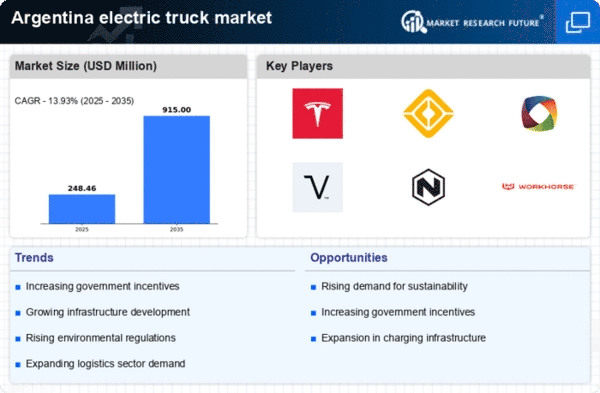
As per Market Research Future analysis, the Argentina electric truck market size was estimated at 218.08 USD Million in 2024. The Argentina electric truck market is projected to grow from 248.46 USD Million in 2025 to 915.0 USD Million by 2035, exhibiting a compound annual growth rate (CAGR) of 13.9% during the forecast period 2025 - 2035

Key Market Trends & Highlights

The Argentina electric truck market is poised for substantial growth driven by technological advancements and supportive government policies.

  • Government incentives and policies are increasingly shaping the electric truck market landscape in Argentina.
  • Technological advancements in battery technology are enhancing the performance and efficiency of electric trucks.
  • The largest segment in the market is the logistics sector, while the fastest-growing segment is expected to be the construction industry.
  • Infrastructure development for electric vehicles and rising fuel costs are key drivers propelling the adoption of electric trucks.

Market Size & Forecast

2024 Market Size 218.08 (USD Million)
2035 Market Size 915.0 (USD Million)
CAGR (2025 - 2035) 13.93%

Major Players

Tesla (US), Rivian (US), BYD (CN), Volta Trucks (SE), Nikola (US), Workhorse Group (US), Lordstown Motors (US), Canoo (US)

Our Impact
Enabled $4.3B Revenue Impact for Fortune 500 and Leading Multinationals
Partnering with 2000+ Global Organizations Each Year
30K+ Citations by Top-Tier Firms in the Industry

Argentina Electric Truck Market Trends

The electric truck market is currently experiencing a notable transformation, driven by a combination of environmental policies and technological advancements. In Argentina, the government has been actively promoting the adoption of electric vehicles, including trucks, as part of its commitment to reducing greenhouse gas emissions. This initiative aligns with international climate agreements and reflects a growing awareness of sustainability among businesses and consumers alike. The infrastructure for electric vehicles is gradually improving, with charging stations being established in key locations, facilitating the transition to electric trucks. Furthermore, local manufacturers are beginning to invest in electric truck production, indicating a shift in the automotive industry towards greener alternatives. In addition to government support, the electric truck market is influenced by the rising costs of fossil fuels and the increasing demand for efficient logistics solutions. Companies are recognizing the long-term cost benefits associated with electric trucks, such as lower fuel and maintenance expenses. As logistics and transportation sectors evolve, the integration of electric trucks is likely to enhance operational efficiency and reduce overall carbon footprints. The market appears poised for growth, with potential collaborations between public and private sectors to further develop the necessary infrastructure and technology. Overall, the electric truck market is on a promising trajectory, reflecting a broader trend towards sustainable transportation solutions in Argentina.

Government Incentives and Policies

The government is implementing various incentives to encourage the adoption of electric trucks. These include tax breaks, subsidies, and grants aimed at both manufacturers and consumers. Such policies are designed to lower the initial costs associated with electric truck purchases, making them more accessible to businesses.

Technological Advancements in Battery Technology

Recent developments in battery technology are enhancing the performance and range of electric trucks. Innovations in energy density and charging speed are making electric trucks more viable for long-haul transportation. This trend is likely to attract more companies to consider electric options.

Growing Environmental Awareness

There is an increasing recognition of the environmental impact of traditional diesel trucks. Businesses are becoming more conscious of their carbon footprints and are seeking sustainable alternatives. This shift in mindset is driving demand for electric trucks as companies aim to align with eco-friendly practices.

Argentina Electric Truck Market Drivers

Government Regulations on Emissions

The Argentine government is implementing stricter regulations on vehicle emissions, which is significantly impacting the electric truck market. These regulations aim to reduce air pollution and promote cleaner transportation options. As a result, companies are incentivized to transition to electric trucks to comply with these new standards. Data indicates that emissions from heavy-duty vehicles account for a substantial portion of urban pollution, prompting regulatory bodies to act. The electric truck market is poised for growth as businesses seek to align with government mandates, thereby fostering a more sustainable transportation ecosystem.

Corporate Sustainability Initiatives

Many companies in Argentina are adopting sustainability initiatives, which significantly influence the electric truck market. As businesses strive to reduce their carbon footprints, the transition to electric trucks becomes a strategic priority. Recent surveys indicate that over 50% of logistics companies are planning to incorporate electric trucks into their fleets by 2026. This trend reflects a broader commitment to environmental responsibility and aligns with consumer preferences for sustainable practices. The electric truck market stands to gain from this corporate shift, as companies seek to enhance their brand image while contributing to environmental goals.

Rising Fuel Costs and Economic Factors

The fluctuation of fuel prices in Argentina has a direct impact on the electric truck market. With traditional fuel costs rising, companies are increasingly looking for cost-effective alternatives. Electric trucks, which typically have lower operational costs, present a compelling solution. Data suggests that electric trucks can reduce fuel expenses by up to 60%, making them an attractive option for fleet operators. This economic shift encourages businesses to transition to electric vehicles, thereby driving growth in the electric truck market. As fuel prices continue to rise, the financial incentives for adopting electric trucks are likely to become even more pronounced.

Infrastructure Development for Electric Vehicles

The expansion of charging infrastructure in Argentina plays a crucial role in the electric truck market. As the government invests in charging stations, the accessibility of electric trucks increases, encouraging adoption among logistics companies. Recent data indicates that the number of charging stations has grown by 30% in the last year, facilitating longer routes for electric trucks. This infrastructure development not only supports the operational efficiency of electric trucks but also enhances the overall market appeal. The electric truck market is likely to benefit from this trend, as improved infrastructure reduces range anxiety among potential users, making electric trucks a more viable option for transportation and logistics.

Technological Innovations in Electric Truck Design

Innovations in electric truck design are reshaping the electric truck market in Argentina. Advances in aerodynamics, lightweight materials, and energy-efficient technologies are enhancing the performance and range of electric trucks. For instance, new models are achieving ranges of over 400 km on a single charge, making them more competitive with traditional trucks. This technological progress not only improves the operational capabilities of electric trucks but also attracts interest from various sectors, including logistics and distribution. The electric truck market is likely to see increased investment in research and development as manufacturers strive to meet evolving consumer demands and regulatory standards.


Market Segment Insights

By Vehicle Type: Light Duty Trucks (Largest) vs. Heavy Duty Trucks (Fastest-Growing)

The distribution of market share among the vehicle types in the Argentina electric truck market shows that Light Duty Trucks currently hold the largest portion of the market. They are favored for their versatility and lower entry costs, making them a preferred choice for urban logistics and transport. In contrast, Heavy Duty Trucks are gaining traction as the demand for larger load capacities increases among various industries, contributing to their rapid growth.

Light Duty Trucks (Dominant) vs. Heavy Duty Trucks (Emerging)

Light Duty Trucks are characterized by their efficiency and adaptability in urban environments, making them the dominant segment in the Argentina electric truck market. Their compact size allows for easier maneuverability, which is particularly advantageous in crowded city settings. On the other hand, Heavy Duty Trucks are emerging as key players, driven by the need for sustainable solutions in freight transport. They offer substantial capacity and power, appealing to businesses seeking to transition to cleaner energy options while maintaining productivity in logistics operations.

By Power Source: Battery Electric Trucks (Largest) vs. Hydrogen Fuel Cell Trucks (Fastest-Growing)

In the Argentina electric truck market, the distribution of market share among the various power source segments reveals that battery electric trucks dominate the landscape due to their established infrastructure and lower operating costs. They are favored by consumers looking for an efficient and sustainable mode of transport. In contrast, hydrogen fuel cell trucks are capturing attention as they align with the future interests of reducing emissions and enhancing fleet operations, though they currently hold a smaller market share than their battery counterparts. Looking ahead, hybrid electric trucks are also gaining traction for their versatility in applications, making them an attractive choice for fleet operators. The growth in this segment can be attributed to stringent environmental regulations and the rising demand for clean transportation solutions. As government incentives for green technologies and infrastructure development escalate, both hydrogen fuel cell and hybrid electric trucks are poised to grow significantly in the coming years.

Battery Electric Trucks (Dominant) vs. Hydrogen Fuel Cell Trucks (Emerging)

Battery electric trucks are currently the dominant power source in the market, recognized for their efficiency, lower operational costs, and the maturity of supporting infrastructure. They appeal to buyers who prioritize long-term cost savings and sustainability within urban logistics. On the other hand, hydrogen fuel cell trucks represent an emerging segment. They offer unique benefits, including extended range and quick refueling times, making them suitable for heavier applications and long-haul routes. While still in the nascent stages of adoption, investments in hydrogen infrastructure and technological advancements are expected to bolster their market position, providing an alternative to battery electric solutions.

By Application: Freight Transportation (Largest) vs. Urban Delivery (Fastest-Growing)

In the Argentina electric truck market, Freight Transportation leads in market share, significantly outpacing other segments such as Construction, Waste Management, and Urban Delivery. Freight Transportation accounts for a substantial portion of the overall demand, driven by the increasing need for sustainable logistics solutions. On the other hand, Urban Delivery is recognized as the fastest-growing segment, propelled by the rise of e-commerce and the urgency for eco-friendly last-mile delivery solutions. As urban areas continue to expand and demand for instant delivery increases, this segment is witnessing rapid growth fueled by innovations in electric vehicle technology and supportive government policies.

Freight Transportation: Dominant vs. Urban Delivery: Emerging

Freight Transportation remains the dominant segment in the Argentina electric truck market due to its established infrastructure and high demand for efficient cargo movement. Companies prioritizing logistics and cost savings gravitate towards electric trucks to enhance their operational efficiency while reducing carbon footprints. In contrast, Urban Delivery is emerging rapidly, appealing to businesses focused on agility and sustainability in urban settings. This segment is characterized by smaller, lighter electric trucks designed for quick stops and shorter routes, helping to meet the increasing consumer expectations for fast delivery times. As cities implement stricter emission regulations, the urban delivery segment is likely to continue its upward trajectory, driven by innovative solutions like electric vans and streamlined distribution strategies.

By Weight Class: 3.5 to 7.5 Tons (Largest) vs. Above 7.5 Tons (Fastest-Growing)

The market share distribution in the Argentina electric truck market reveals an interesting dynamic among the various weight classes. The 3.5 to 7.5 Tons segment holds the largest portion of the market, primarily due to its versatility and suitability for logistics and delivery services. Conversely, the Above 7.5 Tons category is gaining traction, reflecting the increasing demand for heavy-duty electric trucks in industries like construction and freight. Growth trends within the weight class segment are driven by several factors, including stringent environmental regulations and a shift towards sustainable transport solutions. The 3.5 to 7.5 Tons segment benefits from these regulations, encouraging businesses to transition to electric alternatives. In contrast, the Above 7.5 Tons segment is rapidly expanding as companies seek to enhance their operational efficiencies while reducing carbon footprints, marking it as the fastest-growing category in this market.

3.5 to 7.5 Tons (Dominant) vs. Above 7.5 Tons (Emerging)

The 3.5 to 7.5 Tons segment is characterized by its dominant position in the Argentina electric truck market, appealing to a wide range of consumers with its practical payload capacity and flexibility for various applications. Companies often prefer this weight class for near urban deliveries and regional transport, which enhances its attractiveness. On the other hand, the Above 7.5 Tons segment is emerging rapidly, fueled by the growing industrial and commercial demand for electric trucks capable of handling heavier loads. This category presents robust opportunities for manufacturers focusing on innovative designs and improved performance to cater to major sectors like construction and longer-haul logistics.

Get more detailed insights about Argentina Electric Truck Market

Key Players and Competitive Insights

The electric truck market in Argentina is currently characterized by a dynamic competitive landscape, driven by increasing demand for sustainable transportation solutions and government incentives aimed at reducing carbon emissions. Key players such as Tesla (US), BYD (CN), and Rivian (US) are actively shaping the market through innovative technologies and strategic partnerships. Tesla (US) continues to leverage its strong brand recognition and advanced battery technology, focusing on expanding its production capabilities in the region. Meanwhile, BYD (CN) emphasizes its commitment to local manufacturing, which not only reduces costs but also aligns with Argentina's push for economic development through job creation. The market structure appears moderately fragmented, with several players vying for market share. Companies are increasingly localizing their manufacturing processes and optimizing supply chains to enhance efficiency and reduce operational costs. This trend is indicative of a broader strategy among key players to establish a more resilient and responsive market presence. The collective influence of these companies is likely to foster a competitive environment that encourages innovation and collaboration, ultimately benefiting consumers and businesses alike. In October 2025, Rivian (US) announced a partnership with a local logistics company to develop a fleet of electric delivery trucks tailored for the Argentine market. This strategic move is significant as it not only enhances Rivian's operational footprint but also demonstrates its commitment to addressing local market needs. By collaborating with established logistics providers, Rivian (US) is likely to gain valuable insights into regional supply chain dynamics, thereby optimizing its offerings. In September 2025, BYD (CN) unveiled plans to invest $50 million in a new manufacturing facility in Argentina, aimed at producing electric trucks and buses. This investment underscores BYD's long-term commitment to the region and its strategy to capitalize on the growing demand for electric vehicles. The establishment of local production capabilities may also enable BYD (CN) to reduce lead times and improve service delivery, positioning the company favorably against competitors. In November 2025, Tesla (US) launched a new initiative to provide charging infrastructure across major urban centers in Argentina, enhancing the viability of electric trucks for commercial use. This initiative is crucial as it addresses one of the primary barriers to electric vehicle adoption—charging accessibility. By investing in infrastructure, Tesla (US) not only strengthens its market position but also contributes to the overall growth of the electric truck ecosystem in Argentina. As of November 2025, current trends in the electric truck market are increasingly defined by digitalization, sustainability, and the integration of artificial intelligence. Strategic alliances among key players are shaping the competitive landscape, fostering innovation and collaboration. The shift from price-based competition to a focus on technological advancement and supply chain reliability is evident. Companies that prioritize innovation and sustainability are likely to differentiate themselves in this evolving market, paving the way for a more sustainable and efficient transportation future.

Key Companies in the Argentina Electric Truck Market include

Industry Developments

Recent developments in the Argentina Electric Truck Market reflect a growing commitment to sustainability and innovation in transportation. 

Notably, in June 2023, Mercedes-Benz announced the expansion of its electric truck lineup, enhancing production capabilities in Argentina indicating a strategic pivot towards electric vehicles. In the current landscape, companies like Volvo and BYD are vying for share in this nascent but promising market, bolstered by government initiatives aimed at reducing carbon emissions, which have significantly increased interest in electric mobility solutions. Furthermore, the announcement of a collaboration in July 2023 between Hino Motors and Eastern companies to develop electric trucks tailored for the Latin American market has garnered attention. 

Although there have been no publicly known mergers or acquisitions involving key players such as Freightliner and Nikola Corporation in Argentina recently, the market continues to experience a surge in investment and growth, with projections suggesting a valuation boost as manufacturers ramp up production. Over the last two years, Argentina has demonstrated significant advancements in regulatory frameworks supportive of electric vehicle adoption, encouraging major automotive players like Scania and Volkswagen to invest in local production and expand their electric vehicle offerings.


Future Outlook

Argentina Electric Truck Market Future Outlook

The Electric Truck Market in Argentina is projected to grow at a 13.93% CAGR from 2025 to 2035, driven by technological advancements, regulatory support, and increasing demand for sustainable transport solutions.

New opportunities lie in:

  • Development of charging infrastructure partnerships with local governments. Integration of telematics for fleet optimization and maintenance. Launch of electric truck leasing programs targeting small businesses.

By 2035, the electric truck market in Argentina is expected to achieve substantial growth and innovation.

Market Segmentation

Argentina Electric Truck Market Application Outlook

  • Freight Transportation
  • Construction
  • Waste Management
  • Urban Delivery

Argentina Electric Truck Market Power Source Outlook

  • Battery Electric Trucks
  • Hydrogen Fuel Cell Trucks
  • Hybrid Electric Trucks

Argentina Electric Truck Market Vehicle Type Outlook

  • Light Duty Trucks
  • Medium Duty Trucks
  • Heavy Duty Trucks

Argentina Electric Truck Market Weight Class Outlook

  • Below 3.5 Tons
  • 3.5 to 7.5 Tons
  • Above 7.5 Tons

Report Scope

MARKET SIZE 2024 218.08(USD Million)
MARKET SIZE 2025 248.46(USD Million)
MARKET SIZE 2035 915.0(USD Million)
COMPOUND ANNUAL GROWTH RATE (CAGR) 13.93% (2025 - 2035)
REPORT COVERAGE Revenue Forecast, Competitive Landscape, Growth Factors, and Trends
BASE YEAR 2024
Market Forecast Period 2025 - 2035
Historical Data 2019 - 2024
Market Forecast Units USD Million
Key Companies Profiled Tesla (US), Rivian (US), BYD (CN), Volta Trucks (SE), Nikola (US), Workhorse Group (US), Lordstown Motors (US), Canoo (US)
Segments Covered Vehicle Type, Power Source, Application, Weight Class
Key Market Opportunities Growing demand for sustainable logistics solutions drives innovation in the electric truck market.
Key Market Dynamics Regulatory incentives and technological advancements drive growth in Argentina's electric truck market.
Countries Covered Argentina
Leave a Comment

FAQs

What is the projected market size of the Argentina Electric Truck Market in 2024?

The Argentina Electric Truck Market is expected to be valued at 81.78 USD Million in 2024.

What is the estimated market size of the Argentina Electric Truck Market by 2035?

By 2035, the market is expected to reach a valuation of 346.78 USD Million.

What is the expected compound annual growth rate (CAGR) for the Argentina Electric Truck Market from 2025 to 2035?

The expected CAGR for the market during this period is 14.035 %.

Which propulsion types are most prominent in the Argentina Electric Truck Market?

The market is segmented into Battery Electric Vehicles (BEV), Plug-in Hybrid Electric Vehicles (PHEV), and Fuel Cell Electric Vehicles (FCEV).

What is the projected value of the BEV segment in 2024 and 2035?

The BEV segment is valued at 30.0 USD Million in 2024 and expected to increase to 130.0 USD Million by 2035.

How about the PHEV segment's value in 2024 and 2035?

In 2024, the PHEV segment is valued at 25.0 USD Million, with projections of reaching 100.0 USD Million by 2035.

What is the forecast for FCEV segment value in 2024 and 2035?

The FCEV segment is expected to hold a value of 26.78 USD Million in 2024, growing to 116.78 USD Million by 2035.

Who are the key players in the Argentina Electric Truck Market?

Some major players include Volvo, Peterbilt, Hino Motors, and Tesla among others.

What are the main growth drivers for the Argentina Electric Truck Market?

Key growth drivers include increasing environmental regulations and the growing demand for sustainable transportation solutions.

Is there any impact of current global events on the Argentina Electric Truck Market?

Current global events may influence supply chain dynamics and manufacturing costs in the Argentina Electric Truck Market.

Download Free Sample

Kindly complete the form below to receive a free sample of this Report

Compare Licence

×
Features License Type
Single User Multiuser License Enterprise User
Price $4,950 $5,950 $7,250
Maximum User Access Limit 1 User Upto 10 Users Unrestricted Access Throughout the Organization
Free Customization
Direct Access to Analyst
Deliverable Format
Platform Access
Discount on Next Purchase 10% 15% 15%
Printable Versions